Watches
What Makes a Watch Rare? How to Test the Claim
A watch is not rare merely because it is expensive, discontinued or difficult to buy today. Test the claim in layers: production, configuration, survival, originality and provenance. Then ask whether documentary and physical evidence agree. “Rare” is a conclusion with a scope — rare reference, dial, material, retailer signature or surviving condition — not a decorative adjective.
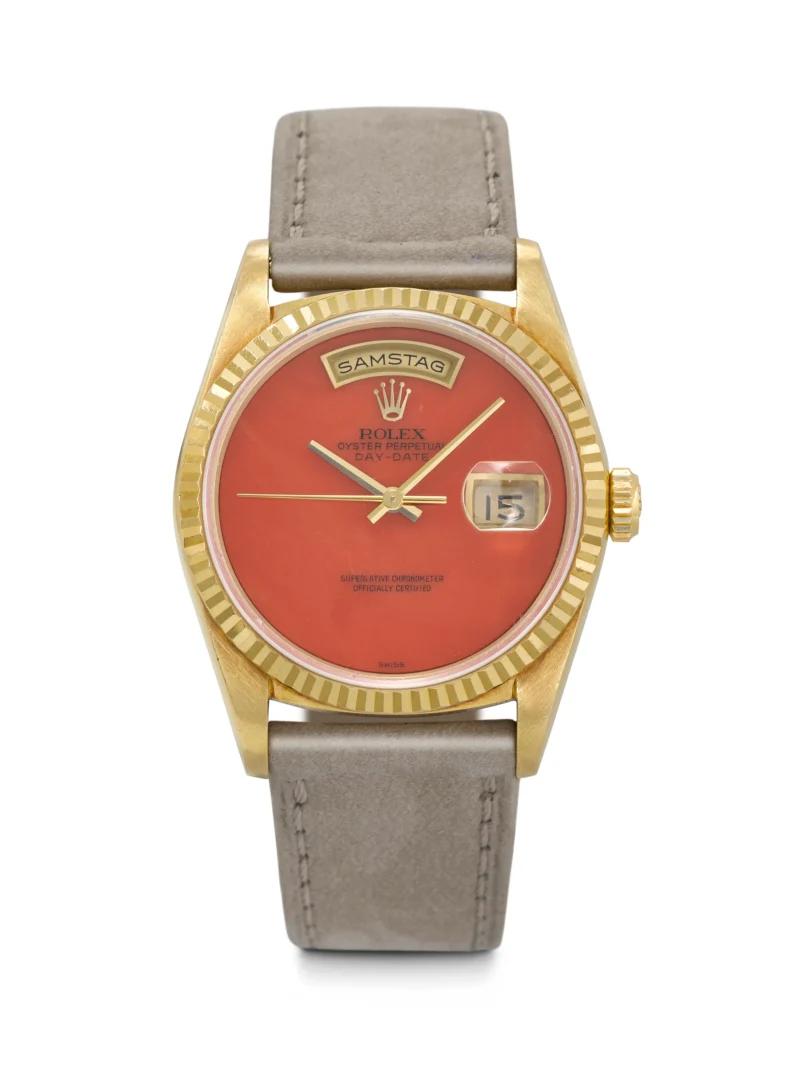
Configuration under examination: coral-dial Rolex Day-Date reference 18238, lot 12. CHRISTIE’S IMAGES LTD. 2025.
Answer first
A watch is not rare merely because it is expensive, discontinued or difficult to buy today. Test the claim in layers: production, configuration, survival, originality and provenance. Then ask whether documentary and physical evidence agree. “Rare” is a conclusion with a scope — rare reference, dial, material, retailer signature or surviving condition — not a decorative adjective.
Key takeaways
- Define exactly what is said to be rare before looking for a number.
- Separate factory production from the smaller population that may survive in original form.
- Confirm that dial, case, movement and bracelet belong together for the stated period.
- Treat boxes, papers and archive extracts as evidence with defined limits, not automatic proof of value.
- Use auction catalogues as dated observations and look for repeated, independently documented examples.
Begin by finishing the sentence
“This watch is rare” is incomplete. Rare in which respect? The reference may have been widely produced while one dial configuration was short-lived. A precious-metal version may be scarce within a model family. A retailer signature may distinguish a small subset. An ordinary reference may become difficult to find with its original case geometry and components intact.
Write the claim in testable form: “reference X in material Y with dial Z was produced during period A” or “few examples retain this documented configuration”. If the seller cannot define the scope, the adjective is doing more work than the evidence.
Sotheby’s official collecting essay on valuable Rolex watches makes a similar distinction between temporary difficulty of purchase and historical scarcity. It identifies reference, dial originality, case integrity, component coherence, production context and provenance as separate factors. The framework is useful beyond Rolex because it prevents fame from standing in for analysis.
A closer look
Details worth keeping.
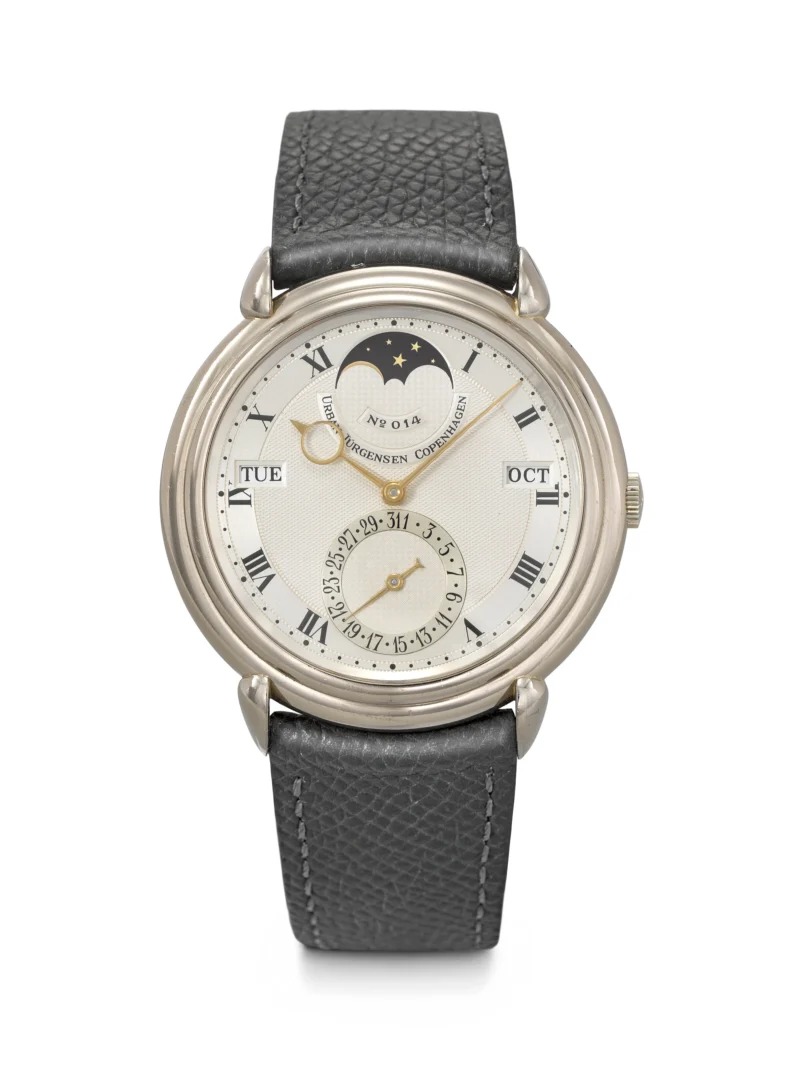
Production and configuration example: Urban Jürgensen reference 2, lot 13. CHRISTIE’S IMAGES LTD. 2025.
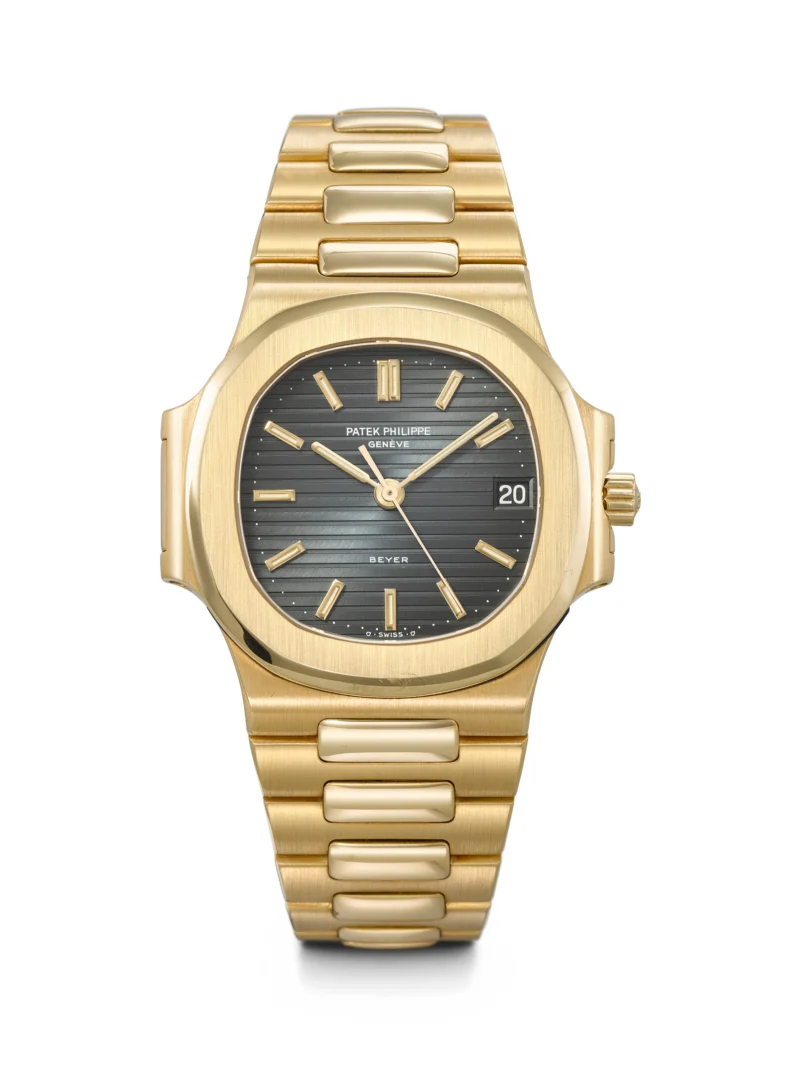
Retailer-signature example: Beyer-signed Patek Philippe Nautilus reference 3800/1, lot 15. CHRISTIE’S IMAGES LTD. 2025.
Production: ask what was made
Production evidence may come from a manufacture, a serial study, period catalogues, specialist scholarship or a well-documented sequence of public examples. Exact totals are uncommon. A statement such as “approximately 172 pieces” needs a source and still may describe an entire reference rather than the metal or dial in front of you.
Christie’s May 2026 Geneva catalogue described an Urban Jürgensen reference 2 perpetual calendar as one of approximately 172 pieces, with white-gold examples made by special order. That is more precise than simply calling the watch rare: it identifies the reference population and explains why this configuration may form a narrower group. The next question is where that figure comes from and whether other catalogues or manufacture records repeat it consistently.
Do not convert “limited edition” into rarity automatically. An edition of 500 may be less scarce than an undocumented vintage configuration known in dozens. Conversely, a serially produced watch can become rare in a particular intact state.
Configuration: ask what left the maker
Reference number is the starting point, not the verdict. Check whether the case material, dial printing, hands, bezel, crown, movement calibre, bracelet and clasp make sense together for the approximate production period. A later genuine service part may make a watch reliable to wear while changing its status as an original example.
TheTimeo’s condition and originality guide explains why cosmetic freshness and historical integrity are different qualities. A polished case can look clean while having lost metal and geometry. A flawless dial may be refinished. Matching ageing can support coherence, but colour alone is not proof.
Use macro photographs, movement images and serial information where legitimately available. Compare several documented examples, not only the nearest attractive result. Small differences can be meaningful, but they can also reflect service, photography or normal production variation.
Survival: ask what remains intact
Production rarity and survival rarity are different. Watches are serviced, damaged, recased, redialled and separated from their bracelets or papers. A common model may be genuinely difficult to find in a narrow, well-preserved specification. That does not make every worn example equally scarce.
Christie’s catalogue described a 1991 Rolex Day-Date reference 18238 with a coral dial, guarantee and related accessories. The dial material and the coherent package are the points to investigate. The catalogue adjective is an invitation to inspect the evidence: confirm that the dial is correct for the reference, study its surface and setting, examine the case and compare the documentation with the watch.
Survival claims are often the hardest to quantify because private watches are invisible and public records repeat the same example. Count unique serials or clearly distinct objects where possible. “Only three seen at auction” means only that three have been found in the dataset, not that three exist.
Provenance and documents: ask what each paper proves
Provenance is a chain of ownership or custody. Documentation can support it, but a box or undated story cannot substitute for a chain. Receipts, correspondence, service papers, photographs and family records become stronger when names, dates and the physical watch align.
Patek Philippe explains that its Extract from the Archives is a partial transcript of information recorded for a particular timepiece; it can be requested only when the first sale was more than ten years earlier and requires photographs for visual-compliance checks. The manufacture distinguishes this from the original Certificate of Origin, which records identifying numbers and cannot be replaced. That distinction is essential: an extract is valuable evidence, but it is not a duplicate birth certificate and does not by itself certify every component’s present originality.
TheTimeo’s documentation and provenance guide sets out a practical hierarchy of records. Treat each document according to what it actually states.
Market evidence: ask what is comparable
Auction results help when the comparison is disciplined. Match reference, material, dial, production period, condition, accessories, provenance, date, currency and whether the published number is hammer or price realised. A retailer-signed watch shows why one extra line of text can change the relevant comparison set.
Christie’s Geneva catalogue included a 1983 Patek Philippe Nautilus reference 3800/1 retailed by Beyer. The retailer signature narrows the claim: the comparison is not every yellow-gold 3800/1, but documented examples sharing that feature and an adequately similar state. The number of search results is less important than the quality of the match.
Demand must remain separate from rarity. A genuinely scarce watch may have a small audience; a widely produced watch may be fiercely sought after. Price forms where supply, demand, condition and confidence meet. None of those variables is fixed.
A practical rarity test
Before accepting the claim, require a short evidence table:
- Claim: the exact rare attribute and its scope.
- Production: source for dates, quantity or configuration.
- Physical match: reference, serial context, dial, case, movement and bracelet.
- Interventions: known service parts, restoration, polishing or repairs.
- Documents: what each record proves and what it does not.
- Comparables: several dated, genuinely similar examples.
- Unknowns: missing images, inaccessible numbers or disputed scholarship.
The final category matters most. A sound conclusion may be “uncommon and coherent, but the production total is unverified”. That is not weakness; it is accurate collecting language. Confidence should rise only when independent forms of evidence agree.
Rarity without theatre
Real rarity becomes clearer under pressure. It survives a precise definition, physical examination, documentary checks and comparison with other known examples. The claim may narrow as the work proceeds: from rare model to rare dial, or from rare production to rare survival condition.
That narrower conclusion is usually more valuable than a grander one. It tells the collector what is known, what remains uncertain and why this particular watch deserves attention. The objective is not to remove romance from collecting. It is to ensure that romance begins with the object rather than replacing it.
Sources & further reading
The rarity framework was checked on 9 September 2026 against Sotheby’s official anatomy of valuable Rolex watches, particularly its treatment of reference, dial, case, component coherence, provenance and historical scarcity. Archive-document limits were checked against Patek Philippe’s official Extract from the Archives FAQ. Concrete examples and images were checked against Christie’s official pages for lot 12, the coral-dial Rolex Day-Date, lot 13, the Urban Jürgensen reference 2 and lot 15, the Beyer-signed Patek Philippe Nautilus. No universal production total, future-value claim or investment recommendation is inferred from an auction description.
Last verified: 9 September 2026.