
Maison Dossier / Continuity Test
Watches
When Is a Revived Watch Brand Still the Same Brand? Testing the New Gallet Against the Archive
The archive is real and the manufacturing system is new. We test Flying Officer, Multichron and the Classics against what can actually be documented.
TheTimeo view
A name can return in a day. Continuity has to be proved field by field.
Gallet's history contains verifiable objects and functions. Its current watches are manufactured through Breitling with Sellita-based core calibres or Breitling B09. The question is which layer continued.
The name is continuous. The archive is real. The manufacturing system is new.
TheTimeo
The visual edit
The object, frame by frame.
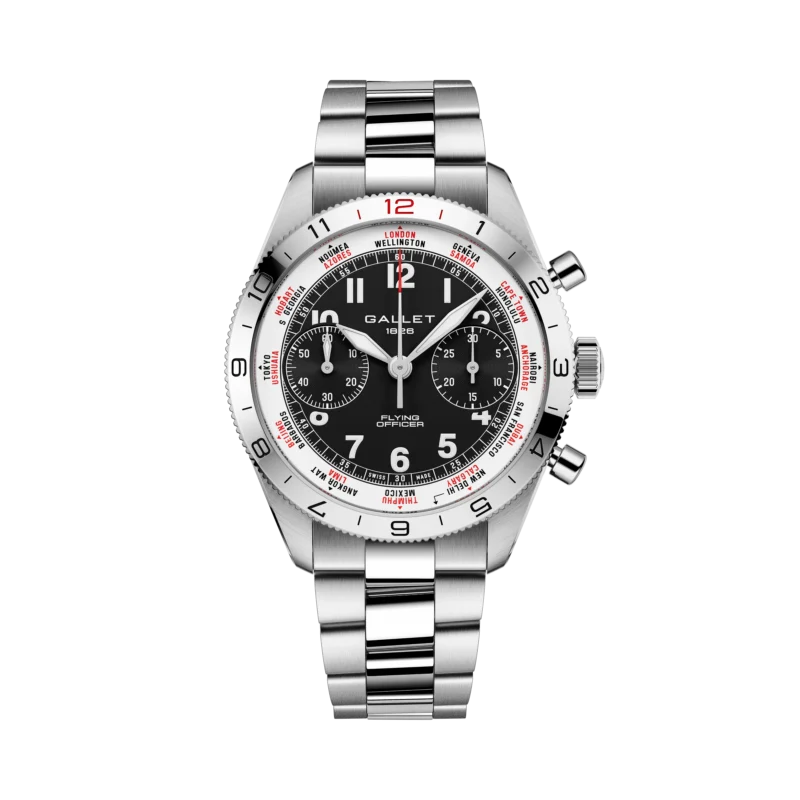
Gallet identifies Gallet 23 as based on the Sellita SW510. Courtesy of Gallet.
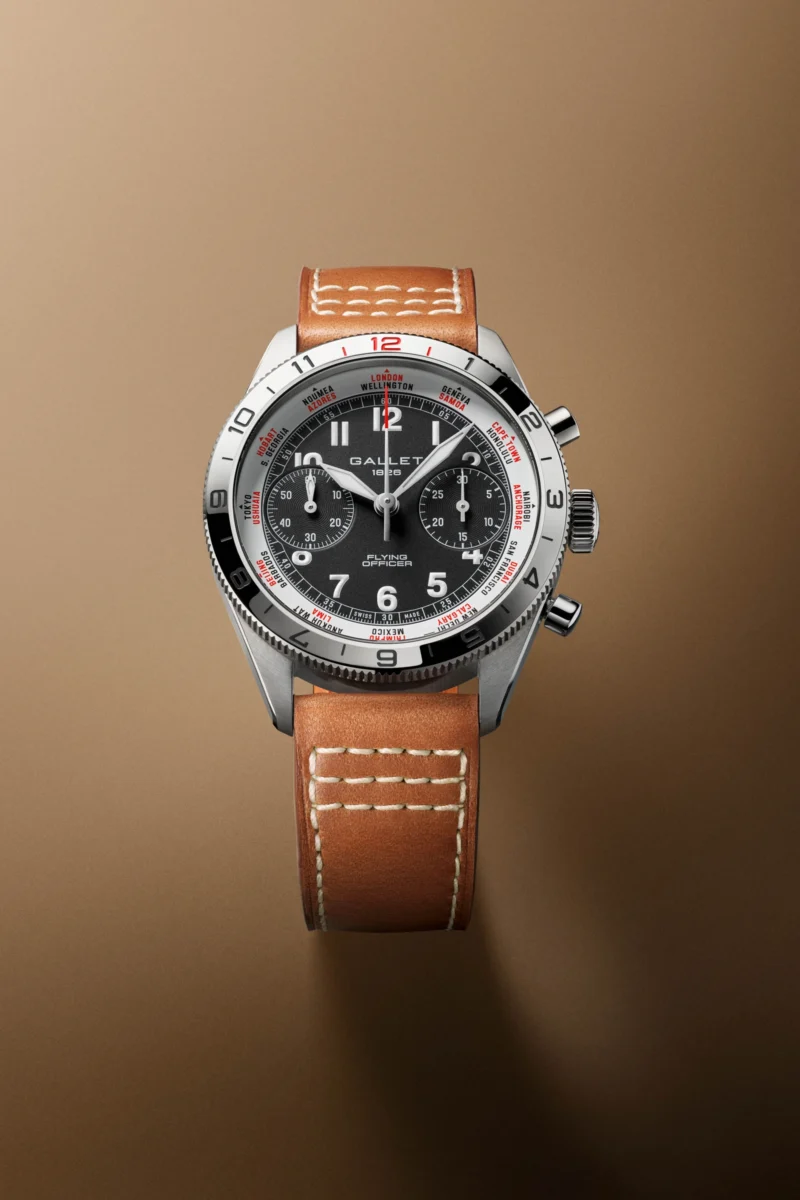
The rotating city ring carries the Flying Officer’s historical travel function into a new Breitling-manufactured watch. Courtesy of Gallet.
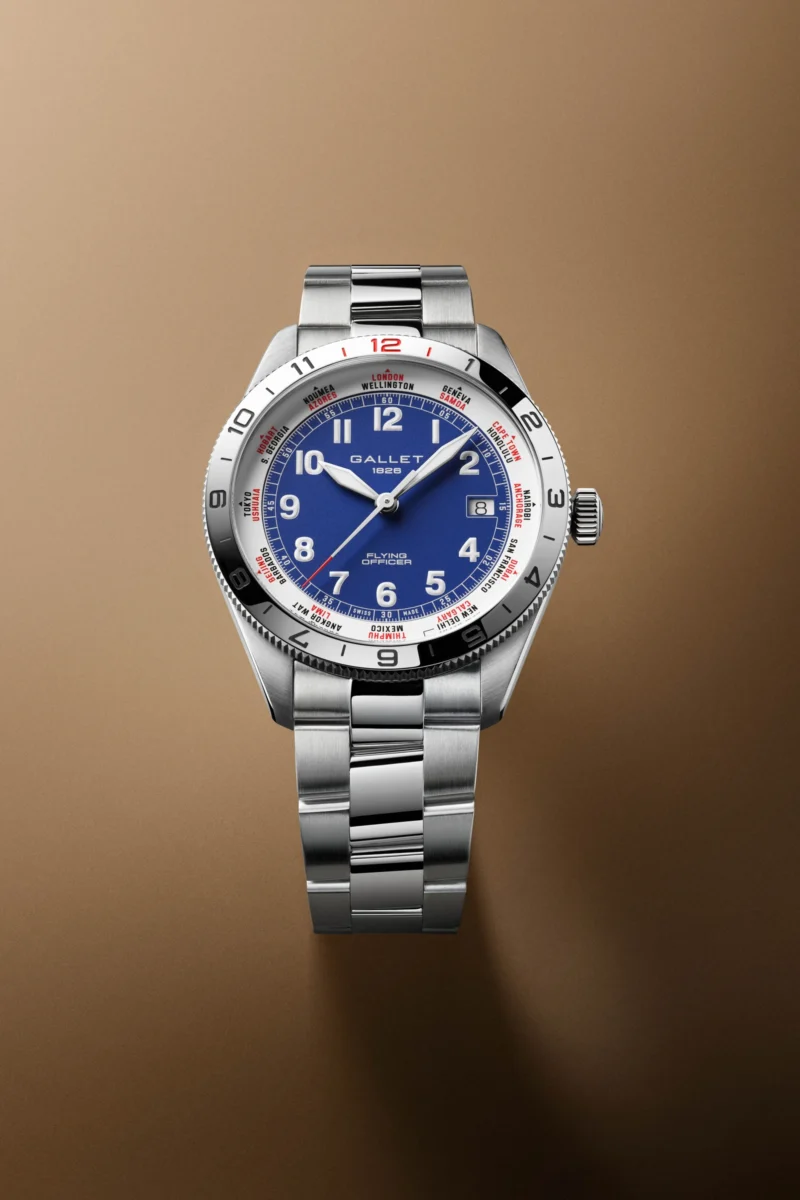
The three-hand Flying Officer extends the historical city-ring language beyond the original chronograph identity. Courtesy of Gallet.
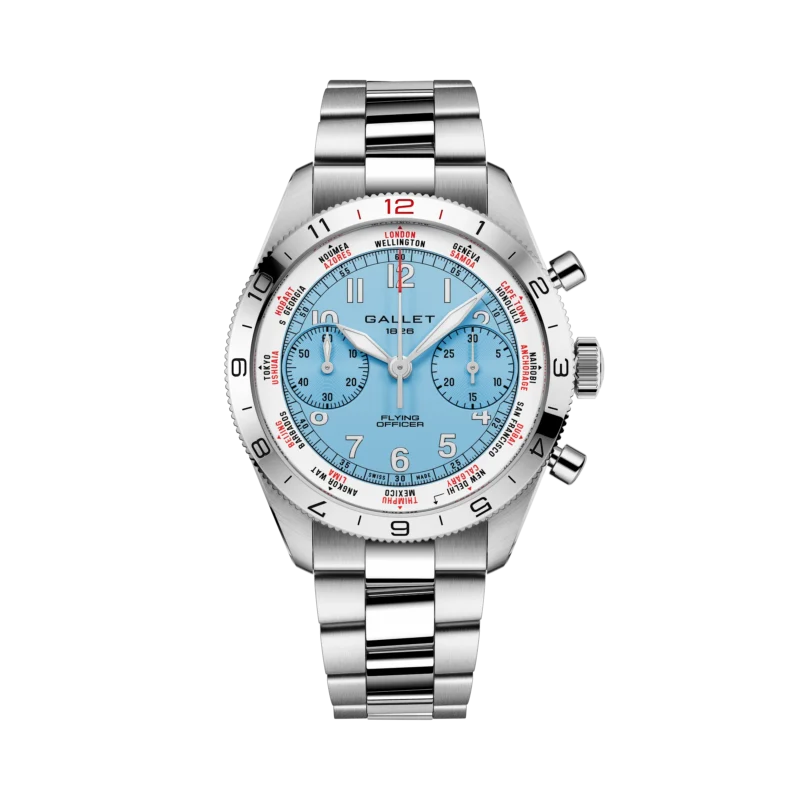
The same contemporary 40 mm architecture with a 24-destination rotating bezel. Courtesy of Gallet.
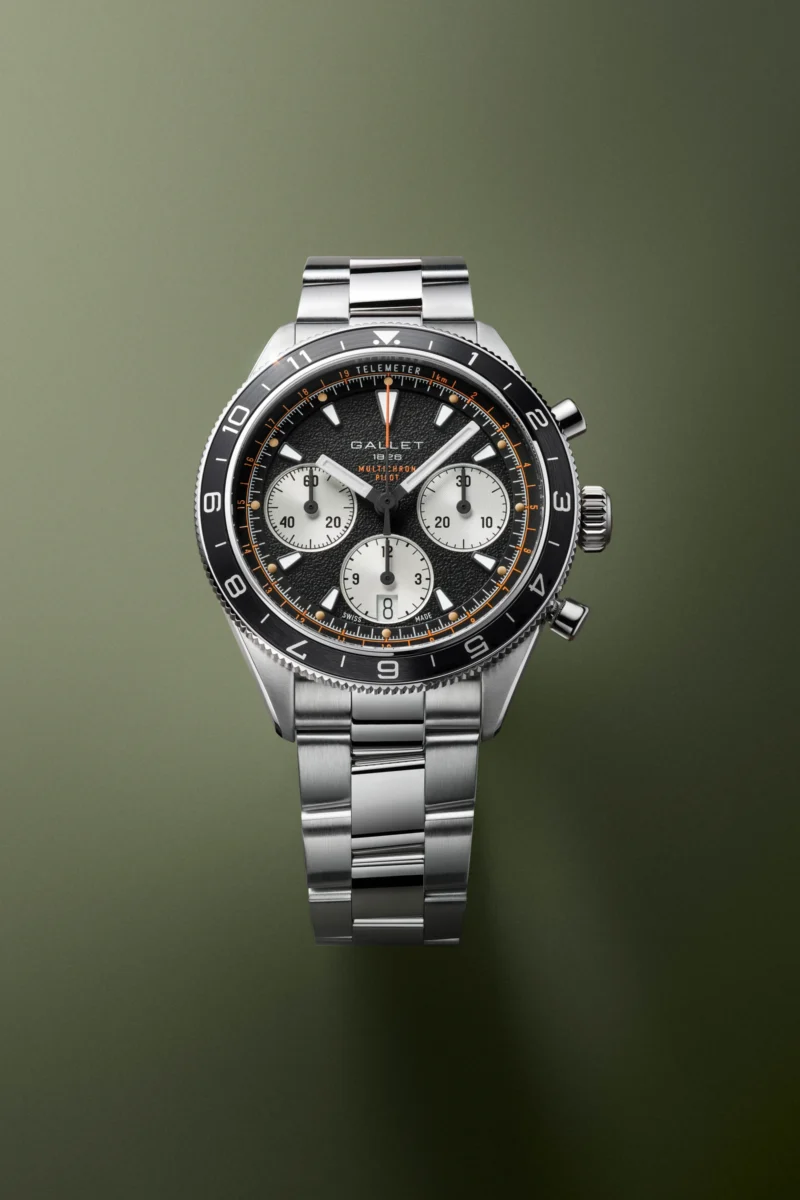
Its twelve-hour bezel can be set for a second time zone; it is not an independent GMT display. Courtesy of Gallet.
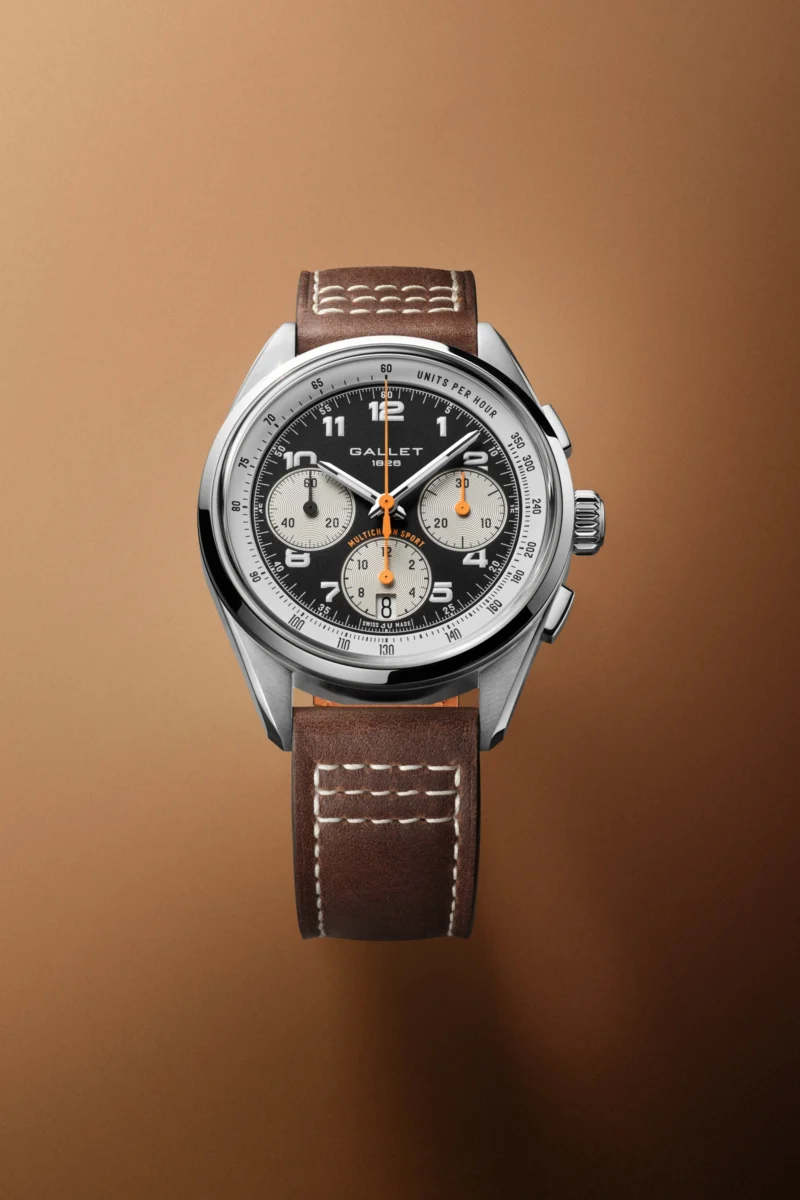
The tachymeter translates a broader Multichron motorsport identity. Courtesy of Gallet.
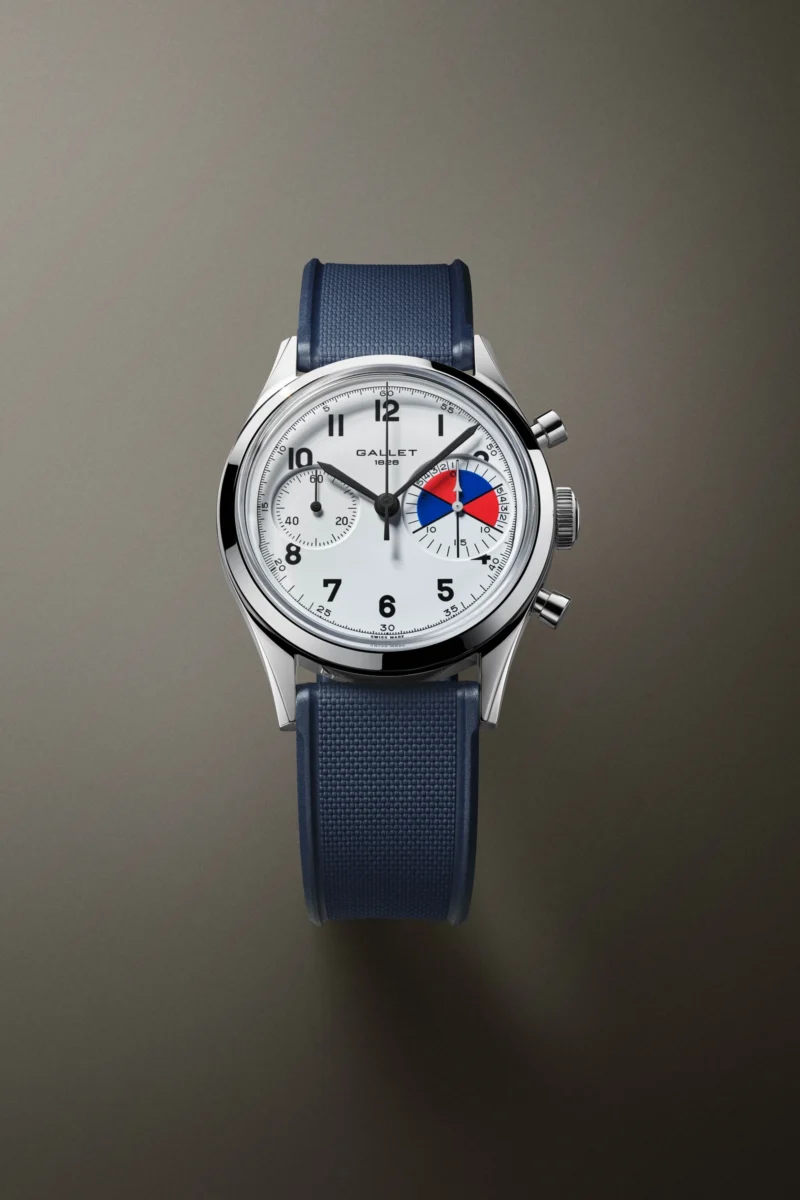
The blue-and-red regatta register is the anniversary trio’s clearest graphic quotation. Courtesy of Gallet.
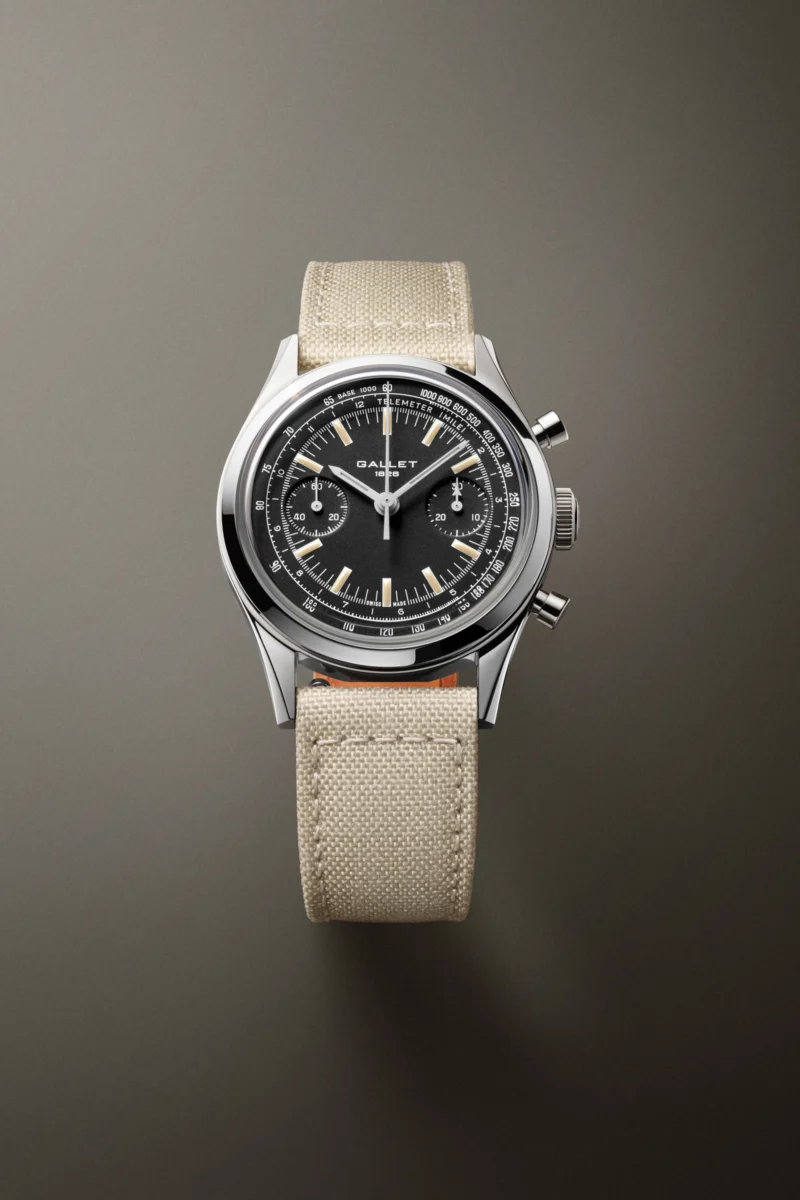
A 38 mm hand-wound tribute returns closer to archival proportion and display logic. Courtesy of Gallet.
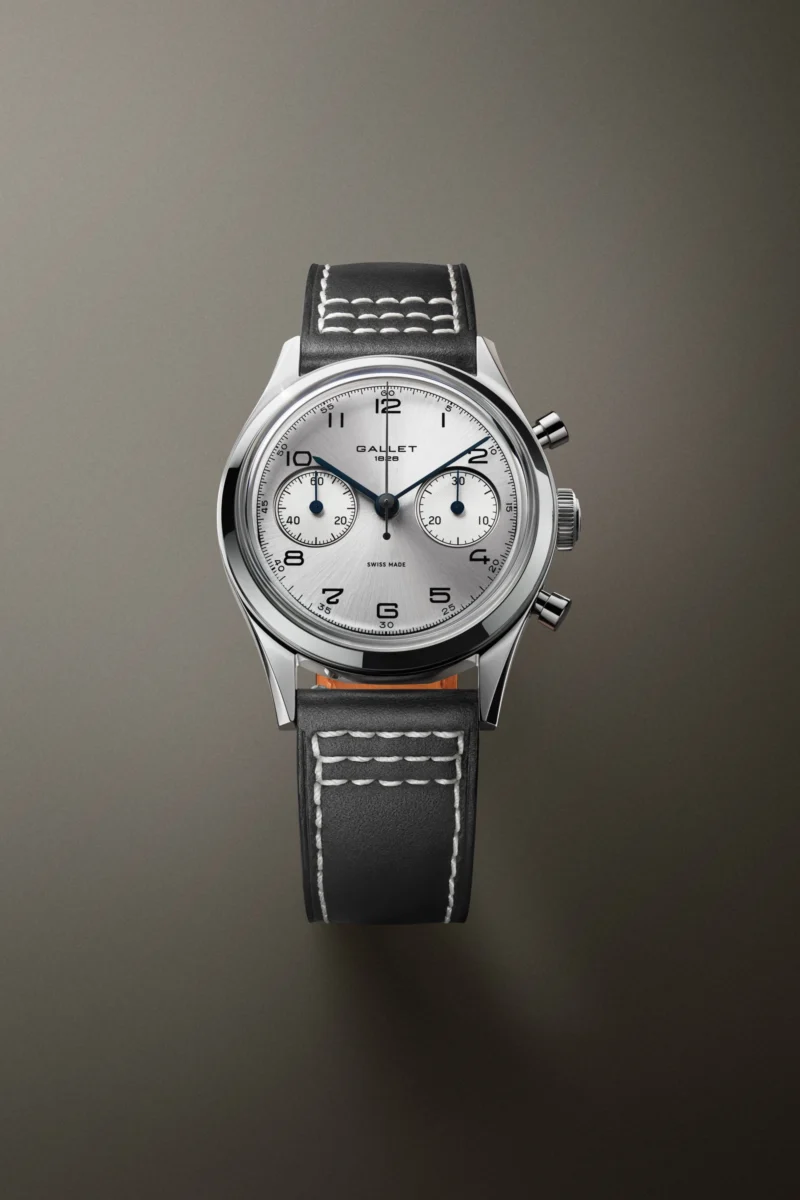
The dial refers to the historic Multichron Navigator while the movement is Breitling B09. Courtesy of Gallet.

The relaunch’s most explicitly archival group: Yachting Big Eye, Multichron 45 and Silverlight. Courtesy of Gallet.
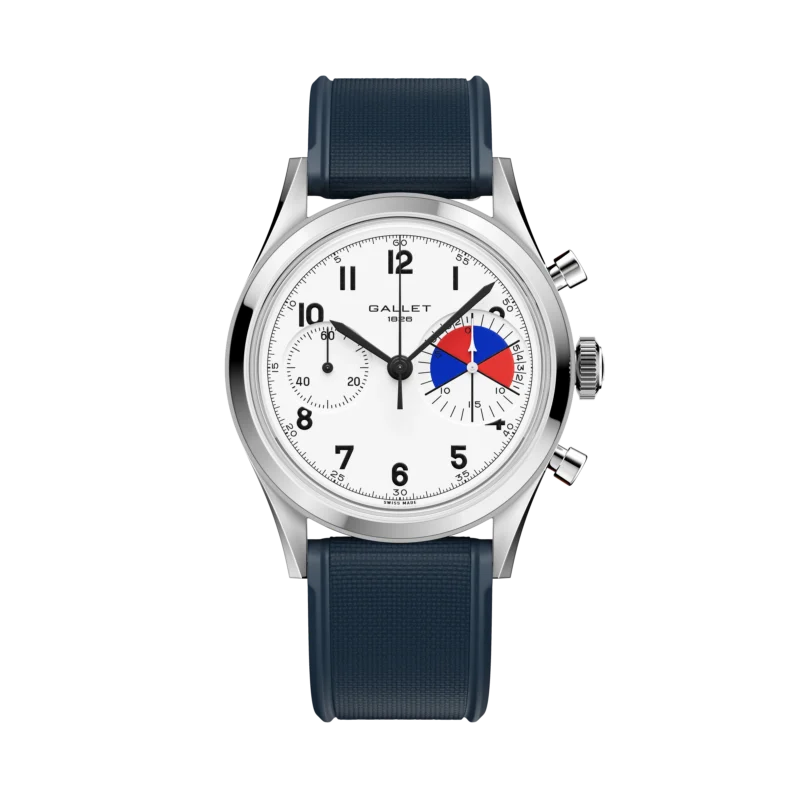
A modern 100-metre case around the hand-wound Breitling B09. Courtesy of Gallet.
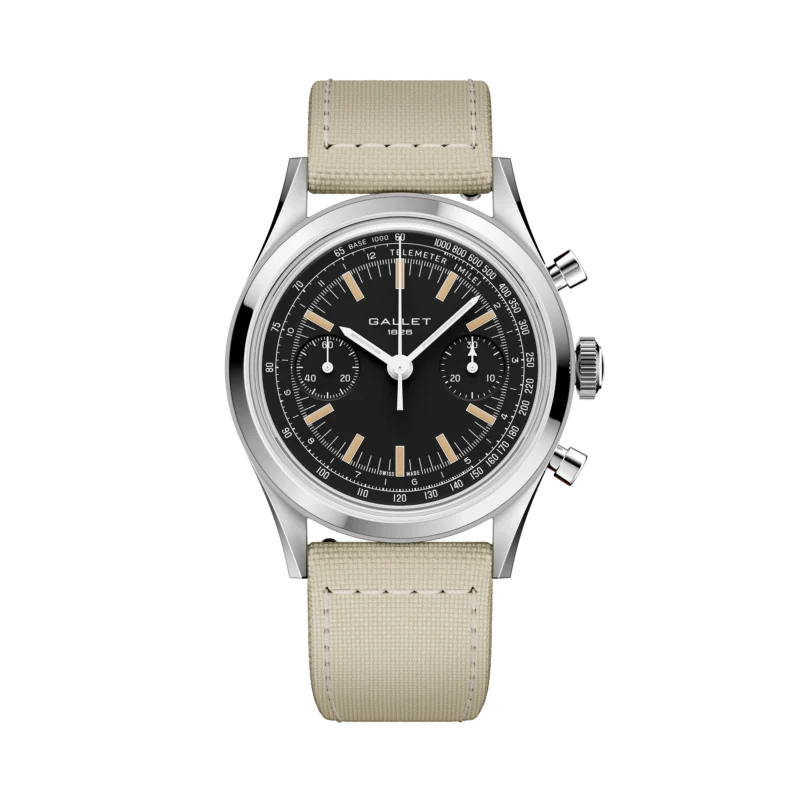
A direct tribute, not a claim of uninterrupted manufacture. Courtesy of Gallet.
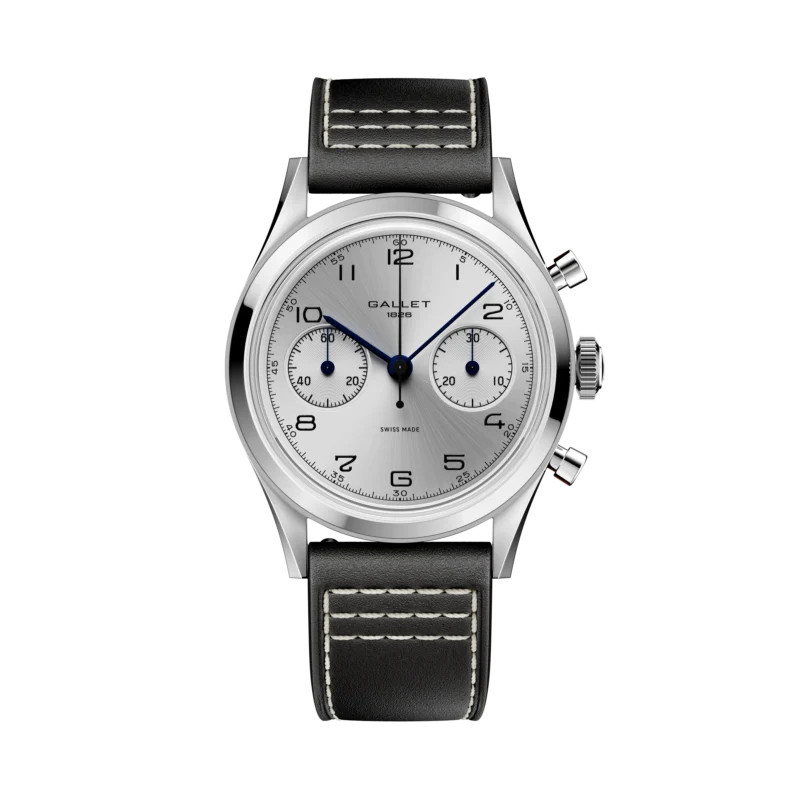
Modern sapphire, water resistance and B09 mechanics sit beneath archival dial vocabulary. Courtesy of Gallet.
Continuity test / Four fields
What survives. What restarts.
A revived name becomes legible only when archival, functional, design and industrial continuity are judged separately.
Archive
DocumentedThe objects survive
A Gallet stopwatch used for the Wright brothers' 1903 flights is independently catalogued by the Smithsonian. The Flying Officer also has an archival record that predates the modern company.
Function
TranslatedThe tasks survive
The city ring, twelve-hour bezel, chronograph and tachymeter return as recognisable operating ideas, rebuilt around contemporary destinations, dimensions and materials.
Design
VariableThe fidelity changes
Flying Officer preserves a function. Multichron Sport interprets a family. The 38 mm Classics quote individual historical dials more directly.
Manufacture
RestartedThe system is new
Breitling owns and manufactures the relaunch. Gallet 17 and 23 are Sellita-based; the anniversary Classics use Breitling B09.
Key facts
- Breitling announced its acquisition of Gallet in March 2025 and relaunched the brand on 3 September 2026, exactly two centuries after the modern company history begins in La Chaux-de-Fonds in 1826.
- Every new Gallet is explicitly described as manufactured by Breitling. The core chronographs use Gallet 23, based on the Sellita SW510; the Flying Officer Automatic uses Gallet 17, based on the Sellita SW200; the three Gallet Classics use Breitling’s hand-wound manufacture B09.
- The 2026 range is organised into Flying Officer, Multichron Pilot, Multichron Sport and Gallet Classics. The first three are modern core collections; the Classics are more explicit archival tributes.
- One of Gallet’s strongest historical claims is independently verifiable: the Smithsonian National Air and Space Museum identifies Gallet as the manufacturer of the stopwatch used by Wilbur and Orville Wright to time their 17 December 1903 flights.
- The current sources are not perfectly clean. Gallet dates the Flying Officer’s introduction to 1939, while archival specialist research identifies a 1938 design drawing. The Swiss patent associated with Philippe Weiss was filed only in 1940. Gallet also publishes conflicting reserve figures for the Gallet 17, about 41 hours in the launch release and about 38 hours on the current product page.
A dormant watch name can be relaunched in a weekend. A watchmaking identity cannot.
That is the useful problem presented by Gallet in 2026. The name has returned. The logo is on new dials. Flying Officer and Multichron are back in the catalogue. The company presents the launch as the continuation of a story that begins in 1826. Yet the watches are now manufactured within Breitling’s infrastructure, the principal modern movements come from Sellita-based calibres or a Breitling manufacture calibre, and the distribution, after-sales network and commercial positioning belong to a new corporate structure.
So what, exactly, has continued?
The answer cannot be reduced to whether the watches look vintage enough. A revival has several kinds of continuity, and they do not have to move together. There is legal continuity in ownership of the name and archive. There is historical continuity in documented objects and functions. There is design continuity in proportions, layouts and model names. There is industrial continuity in factories, suppliers, movements and technical teams. A brand can preserve some of these and break others.
Gallet is a particularly useful case because the 2026 relaunch does not hide the break. The press material repeatedly says the watches are “manufactured by Breitling”. At the same time, several of the historical stories used to justify the new collection can be checked outside Gallet’s own marketing.
That gives us something better than nostalgia. It gives us a test.
Start with the archive, not the logo
The easiest heritage claim to verify is also the oldest one used in the 2026 relaunch.
Gallet says a timing instrument of its manufacture was used for the Wright brothers’ first powered flight. The Smithsonian National Air and Space Museum independently records a hand-held stopwatch dated around 1903, marked “The Sun”, with Gallet listed as manufacturer. The museum states that Wilbur and Orville Wright used it to time the flights at Kitty Hawk on 17 December 1903. The first flight covered 120 feet in 12 seconds; the longest of the four covered 852 feet in 59 seconds.
That is unusually strong heritage evidence because the object exists in an institutional collection and its use is documented independently of the modern company.
It also exposes the difference between a brand archive and a brand slogan. “Gallet timed the Wright brothers” is a broad phrase. The Smithsonian record lets us be more exact: a specific Gallet-manufactured stopwatch was used by the brothers to time those flights. It was not a wristwatch and it was not a modern chronograph. The evidence is still valuable, but only when stated at the correct level.
The same discipline is useful with Harry S. Truman’s Flying Officer. Gallet’s current history presents the model as a 1939 travel chronograph and repeats Truman’s description of his Christmas gift as the most elaborate wristwatch he had seen. Specialist archival research by Fratello traces that wording to a letter Truman wrote to his wife Bess on 13 December 1939 and shows the surviving watch in the Harry S. Truman Presidential Library & Museum.
Those are the kinds of details that give a revival substance. They are not proof that every new product is historically faithful. They establish that the archive being referenced is real.
The relaunch’s most explicitly archival group: Yachting Big Eye, Multichron 45 and Silverlight. Courtesy of Gallet.
The Flying Officer is the strongest continuity test
If one watch had to carry the revived Gallet on its own, it would be the Flying Officer.
The original concept joined a chronograph to a rotating hour bezel and a ring of cities representing time zones. The user could align the bezel with a chosen city and read corresponding times without resetting the central hands. It was an early attempt to make expanding long-distance air travel legible on the wrist.
Gallet officially dates the model’s introduction to 1939. That date should be retained in the public article because it is the current manufacturer position, but the archive is slightly messier. Specialist research has identified a 1938 drawing associated with the design, while the Swiss patent CH215450, filed by Philippe Weiss, has a filing date of 29 April 1940 and publication date of 30 June 1941. The patent describes a rotating hour ring working against dial indications corresponding to time zones.
This sequence matters. The patent is not evidence that the idea first appeared in 1940. Surviving watches and the 1938 drawing predate the filing. Nor does the drawing by itself prove commercial launch in 1938. The safest reconstruction is that the design was already being developed in 1938, Gallet currently identifies the watch as introduced in 1939, and the related patent was filed afterwards.
The 2026 Flying Officer preserves the functional idea more convincingly than a simple dial reissue would. Its rotating bezel has been rebuilt around 24 contemporary destinations. The city names are different because the world of commercial travel is different. The core task remains recognisable: use a fixed set of global locations and a rotatable hour scale to place local time in relation to somewhere else.
But the object itself is modern in almost every industrial sense. The chronograph now measures 40 mm, uses sapphire, offers 100 metres of water resistance and is powered by the automatic Gallet 23, which Gallet identifies as based on the Sellita SW510. The current US product page lists roughly 65 hours of reserve, 28,800 vibrations per hour and a 30-minute chronograph.
There is also a three-hand Flying Officer Automatic, something that shifts the model name away from its historical identity as a chronograph. It retains the city-ring concept but uses Gallet 17, based on the Sellita SW200. That is a design and functional extension, not a restoration of an old reference.
This is where the relaunch begins to define itself. Gallet is not trying to resume production where it stopped. It is treating the archive as a vocabulary.
“Manufactured by Breitling” is not a footnote
The most important sentence in Gallet’s 2026 press material may be the least romantic one: every watch is manufactured within Breitling’s infrastructure.
That means the revived brand does not claim unbroken industrial continuity. Breitling provides manufacturing expertise, distribution, after-sales service and the physical commercial network. Selected Breitling boutiques even contain dedicated Gallet spaces.
The movements make the separation clearer. The core Flying Officer chronograph, Multichron Pilot and Multichron Sport use the Gallet 23, which the company openly identifies as based on the Sellita SW510. The Flying Officer Automatic uses Gallet 17, based on the SW200. Only the anniversary Gallet Classics move deeper into the parent company’s own movement architecture with the hand-wound Breitling B09.
This is not a criticism. It is simply the industrial truth of the revival.
A revived manufacture can choose to pretend that a new supply chain is invisible, or it can acknowledge it and make the quality of the new system part of the proposition. Gallet chooses the second route. The phrase “Manufactured by Breitling” appears throughout the site and on current product specifications.
That honesty is useful because it lets collectors judge continuity on the things that are genuinely continuous: names, functions, design cues and documented history. Nobody needs to imagine that a 2026 Gallet chronograph descends through an uninterrupted workshop line from a 1940s Multichron.
The new watches live inside a different industrial machine.
Function / design / industrial base
Historical purpose above. New manufacture underneath.
The three-hand Flying Officer extends the historical city-ring language beyond the original chronograph identity. Courtesy of Gallet.
The same contemporary 40 mm architecture with a 24-destination rotating bezel. Courtesy of Gallet.
Its twelve-hour bezel can be set for a second time zone; it is not an independent GMT display. Courtesy of Gallet.
Mechanical context
The architecture, in two acts.
Core collection
Historical names and functions enter a newly built industrial system.
- Range
- 40 / 41 / 42 mm
- Display
- City ring / 12 h bezel / tachymeter
- Control
- Gallet 17 or Gallet 23
- Isolation
- 100 m
- Flyback
- 38 h listed / 41 h launch conflict; 65 h chronograph
Gallet Classics
Three 38 mm hand-wound tributes quote archival dials more closely.
- Range
- 38 mm
- Display
- Three archival tributes
- Control
- Breitling B09 · hand-wound
- Isolation
- 100 m
- Flyback
- Approx. 70 hours
The Multichron Pilot preserves purpose more than construction
The Multichron Pilot makes the same distinction in a different way.
Gallet dates the original to 1969 and describes it as a chronograph for long-duration timing and tracking a second time zone. The revived version keeps a bidirectional twelve-hour bezel, a chronograph display, strong luminous markers and a telemeter scale. At 42 mm and 15.25 mm thick in the current product specification, it is substantially a modern sports chronograph rather than a period-correct reissue.
Its engine is again Gallet 23, based on the SW510, with about 65 hours of reserve. The historical connection therefore lies above the movement: use case, bezel logic, three-register chronograph layout and the model’s role as a piece of travel equipment.
That is a defensible form of continuity, but it should be named correctly. The new Multichron Pilot is not mechanically descended from the 1969 watch in the way a continuously developed calibre family might be. It is a new Breitling-manufactured product built around the historical model’s functional identity.
There is another reason to be precise. A twelve-hour bezel can display a second time zone only after the wearer sets it relative to the main hands. It is not a GMT movement with an independently driven second-hour hand. The difference is important because “tracks a second timezone” can sound more mechanically elaborate than the actual interface.
This is one of the strengths of the new Gallet when stripped of advertising language. The watch does not need to be a complicated travel watch to preserve the historical idea. The bezel itself is the tool.
Multichron Sport is the looser archival translation
The Multichron Sport is less directly tied to a single old reference.
Gallet connects it to the 1960s Multichron 12 Scientific and to the broader history of motorsport timing. The new watch uses a 41 mm steel case, tachymeter scale, orange chronograph hands and the same Gallet 23 architecture found elsewhere in the core collection.
That makes it a family-level interpretation rather than a forensic remake.
The distinction is useful because heritage relaunches often compress several decades of archive material into one modern object and then describe the result as though it were a direct descendant. Gallet’s own launch language is actually more careful than that. It says the Multichron family developed a technical, performance-driven approach and became associated with motorsport. The 2026 Sport draws from that identity.
The strongest continuity here is therefore the category of instrument: a legible chronograph with a tachymeter for calculating average speed over a known distance.
The case, movement, materials, date architecture and modern strap system belong to 2026.
The Gallet Classics show what a stricter tribute looks like
The anniversary Gallet Classics are where the relaunch moves closest to deliberate archival quotation.
There are three: Tribute to Multichron Yachting Big Eye, Tribute to Multichron 45 and Tribute to Silverlight. All measure 38 mm, all are hand-wound, all use the Breitling B09 and all are offered on straps rather than as part of the broader bracelet-led core collection.
The Yachting Big Eye preserves the asymmetry that made the historical regatta timer memorable: one enlarged countdown register dominates the dial in blue and red. The Multichron 45 tribute uses a compact black dial and two registers with the visual economy associated with interval timing. The Silverlight borrows its irregular numeral language and navigational theme from the historic Multichron Navigator.
These are still not replicas. The movement is Breitling’s B09, running at 28,800 vibrations per hour with around 70 hours of reserve. The current watches are water resistant to 100 metres and have sapphire crystals and modern quick-release straps. The current US product pages list them at $6,700 excluding sales tax as checked on 16 September 2026.
But the Classics tell us something about the hierarchy of the relaunch. When Gallet wants to speak most directly to collectors who already know the archive, it makes the watches smaller, manually wound and more graphically faithful. When it wants to build the everyday modern brand, it moves to 40, 41 and 42 mm steel watches, automatic Sellita-based movements and interchangeable straps or bracelets.
That split feels deliberate.
The archive is not being used as one universal design template. It is being divided into two jobs: direct tribute and modern product language.
The relaunch also changes what “Gallet” costs
Brand continuity is not only technical. Positioning changes what kind of object a name becomes.
Breitling announced from the beginning that Gallet would sit as its more accessible luxury sibling. The current prices make that visible. In the United States, the Flying Officer Automatic begins around $2,900 on the current product pages. Core chronographs sit around $4,400 on straps, with some bracelet configurations at $4,600. The three Classics are $6,700.
Those numbers put the revived Gallet into a very different competitive environment from Breitling itself and far below the future positioning of Universal Genève inside the same House of Brands.
That matters to the identity question because the archive once served professionals who bought instruments for aviation, timing and sport. A modern mechanical watch at several thousand dollars is no longer professional equipment in that historical economic sense. It is a luxury product using professional-instrument design language.
The distinction does not invalidate the design. It stops us from pretending the commercial role is unchanged.
Two source conflicts say more than a polished timeline would
The new Gallet is unusually easy to research because the company has published a large amount of material at once. That does not mean every page agrees.
The clearest current conflict concerns the Flying Officer Automatic’s power reserve. The 3 September launch release says Gallet 17, based on the Sellita SW200, offers approximately 41 hours. Current product pages list approximately 38 hours. Both are first-party sources. No correction note explains the difference.
For publication, the correct treatment is not to choose the more flattering number. The reserve should be marked as not fully reconciled until Gallet corrects or clarifies the specification. If the article needs a number, the current product page is the stronger reference for the current sold object, but the conflict belongs in the dossier.
The second issue is historical. Gallet’s current public chronology says the Flying Officer was introduced in 1939. The specialist archival record includes a 1938 design drawing and later patent paperwork filed in 1940. Those dates are not necessarily contradictory, but they warn against turning one neat launch year into the whole origin story.
There is a third, smaller problem on some current product copy: pages for the Multichron Sport contain text referring to the Multichron Pilot. That appears to be a CMS or template carry-over rather than a product fact. It is exactly the sort of error that becomes dangerous when an article treats every manufacturer sentence as equally authoritative.
The archive is strongest when it survives scrutiny, not when its rough edges are removed.
So is the revived Gallet still Gallet?
A useful answer needs to be more specific than yes or no.
The 2026 company is not an uninterrupted continuation of the old industrial system. Breitling acquired the brand, manufactures the watches, supplies the infrastructure and provides either Sellita-based movements under Gallet calibre names or its own B09 for the Classics. The modern commercial organisation is new.
The historical foundation, however, is not synthetic. The Wright stopwatch exists in the Smithsonian. Truman’s Flying Officer is documented. The rotating city-ring concept has a surviving patent trail and archival examples. Multichron is a real historical family rather than a newly invented vintage-sounding name.
The products occupy the middle ground. Flying Officer preserves an identifiable function but rewrites the cities, dimensions and movements. Multichron Pilot preserves the bezel-and-chronograph logic but uses an entirely modern industrial base. Multichron Sport translates a broader family identity rather than one exact reference. The Classics quote the archive more closely while still being powered by a Breitling calibre.
That is probably the most credible way to revive a dormant watch brand: not by pretending the interruption never happened, but by making the interruption visible and deciding which parts of the old identity deserve to survive it.
For Gallet, the name is continuous. The archive is real. The manufacturing system is new. The watches are reinterpretations with different degrees of fidelity.
The question for collectors is therefore not whether the new Gallet is “authentic” in the abstract. It is whether each new watch can show exactly which part of Gallet it is carrying forward.
The Flying Officer can. The Classics can. The Multichron family can, although sometimes at a greater distance from a single historical object.
That is enough to make the relaunch more than a trademark exercise. It is not enough to make two hundred years of industrial continuity reappear by declaration. The distinction is where the new Gallet becomes worth taking seriously.
The Edit
Stories selected by TheTimeo

Rolex GMT-Master II: a closer look
Beyond the bezel colour: understanding GMT-Master generations, original components, service history and the documents
Patek Philippe: what references and archives reveal
A reference identifies the design; an archive extract adds part of its history. How

Blancpain Lady B: What Does 19 Millimetres Require?
Blancpain’s 19 mm Lady B is best understood as an exercise in mechanical volume: