
TheTimeo / Watches
A horse in crystal.
Time in view.
On the Arceau Samarcande W408546WW00, Hermès cuts a horse into a Saint-Louis crystal dial so the H1927 minute repeater becomes part of the image.
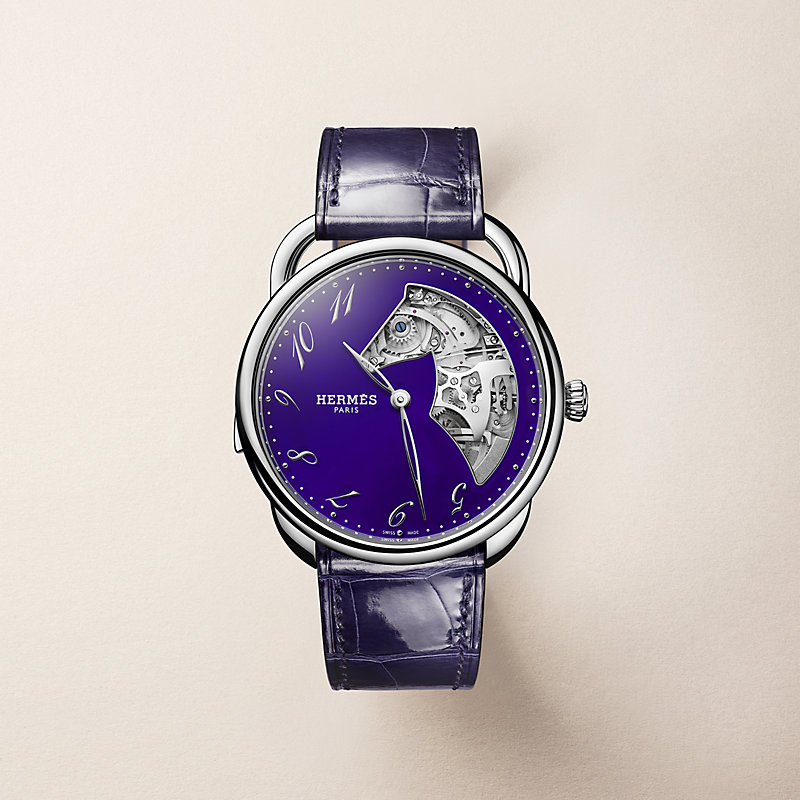
Hermès Arceau Samarcande W408546WW00 in white gold, with its Saint-Louis crystal dial and ink-blue strap.
Explore the story
Two faces of Samarcande
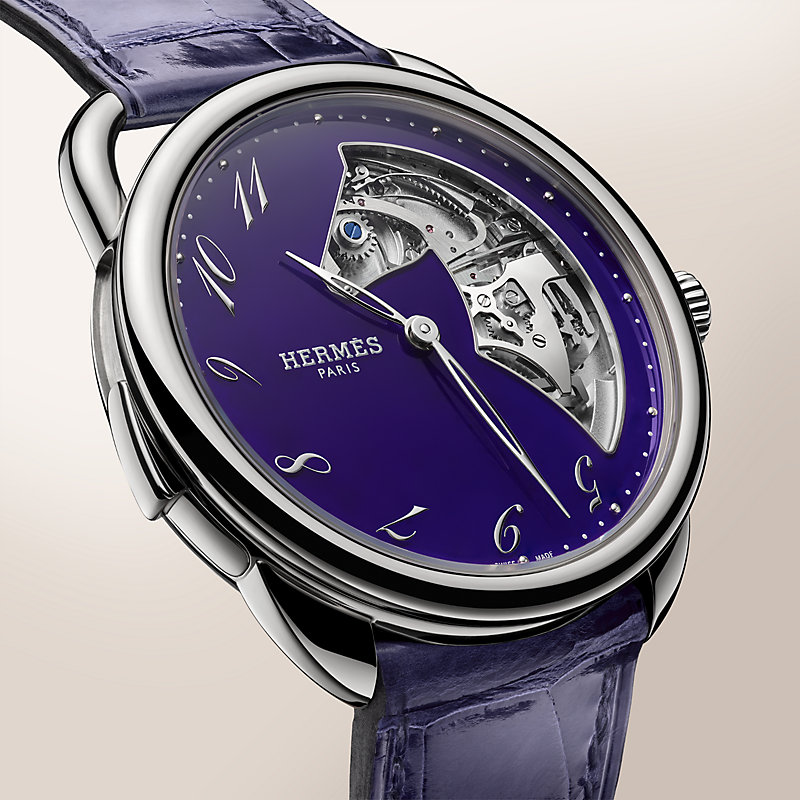
An oblique view of the horse-shaped opening and the slanted Arceau numerals on W408546WW00.
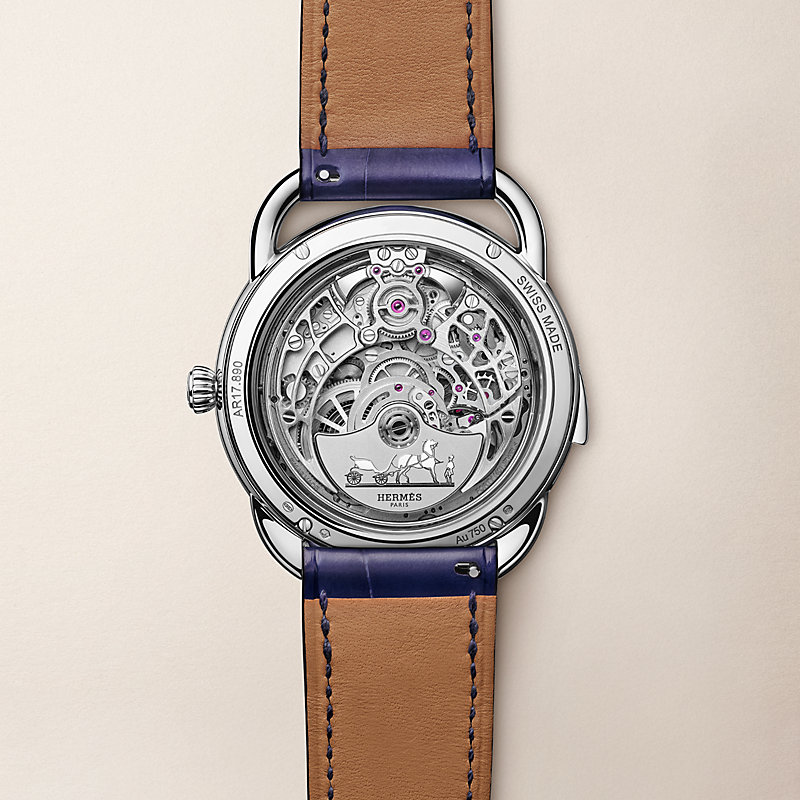
Through the sapphire caseback of W408546WW00: the H1927 and its decorated micro-rotor.
The horse-shaped opening and the sapphire caseback offer two views into the same H1927.
The horse is an aperture
An oblique view of the horse-shaped opening and the slanted Arceau numerals on W408546WW00.
Look at the watch straight on and the most important detail is the boundary between blue crystal and exposed mechanism. The horse is not simply printed on top of a finished dial. Hermès describes the Saint-Louis crystal dial as openworked to form a horse’s head, and the opening reveals the skeletonised H1927 beneath it.
That distinction changes the way the watch reads. The animal is simultaneously image and absence. Its outline is legible because the dial stops, then the movement begins. Bridges, wheels and screws do not sit in a separate technical zone. They occupy the horse-shaped opening and become part of its anatomy.
This is where the Samarcande feels particularly Hermès. The equestrian reference is obvious, but it does not need a literal stable scene or a decorative horse applied to the surface. The motif determines the composition itself. The eye moves from blue crystal to the sharply defined opening, then into the greys and metallic reflections of the calibre.
The effect also gives the dial an unusual balance. Much of the blue field remains calm and readable, while the exposed mechanics are concentrated inside a single, recognisable silhouette. The skeletonisation is selective: the mechanism becomes active in the picture without dissolving the whole dial into visual noise.
Arceau gives the picture motion
The horse-shaped opening would feel very different in a neutral round case. The Arceau already has its own sense of movement.
Henri d’Origny created the line in 1978. Hermès identifies its signatures as a round case and asymmetrical lugs inspired by stirrups. On W408546WW00, the case is 38 mm in white gold and is paired with a smooth ink-blue alligator strap and white-gold pin buckle.
Those lugs matter because they prevent the circle from feeling static. They extend differently above and below the case, framing the dial with an off-balance elegance that is deliberate rather than irregular. The slanted Arceau numerals continue that feeling around the perimeter. Even before the movement is considered, the watch already looks as if its geometry is leaning forward.
The 38 mm diameter is also important to the visual argument. Hermès has put a grand complication, a carved crystal dial and an openworked movement into a case that does not need exaggerated diameter to announce complexity. Its compact diameter keeps the dial, case and lugs in close visual balance.
The ink-blue strap then extends the dial colour beyond the case. Instead of isolating the crystal as a decorative centre, the strap makes the whole watch read as one vertical composition: blue, white gold, blue again.
Crystal is doing more than adding colour
Saint-Louis crystal could easily have been treated as a luxurious material note. Here it has a more structural role.
Hermès says the dial is made in Saint-Louis crystal and that the horse motif is in sapphire crystal. In its Watches and Wonders presentation, the maison describes the dial as being made by Saint-Louis crystalmakers and openworked into the horse’s head. The useful thing to notice is not simply that two types of crystal are present. It is that transparency, colour and cut-out space are organised to control what the viewer can see of the movement.
The blue surface gives the watch visual mass. The opening removes part of that mass. The exposed H1927 then fills the void with mechanical depth. In a single glance, the dial moves through three registers: colour, silhouette and mechanism.
That sequence is more interesting than treating the watch as a list of métiers. The crystal is not a decorative layer placed over the complication, and the complication is not hidden behind a conventional dial. Each depends on the other. Without the blue field, the horse would lose its graphic force. Without the cut-out, the movement would lose its role in the image.
The official front view makes this especially clear around the upper-right section of the dial, where the horse-shaped opening exposes a dense cluster of components while the rest of the face remains comparatively quiet. It creates a tension between precision and emptiness that a fully openworked dial would not have.
Then the watch begins to sound
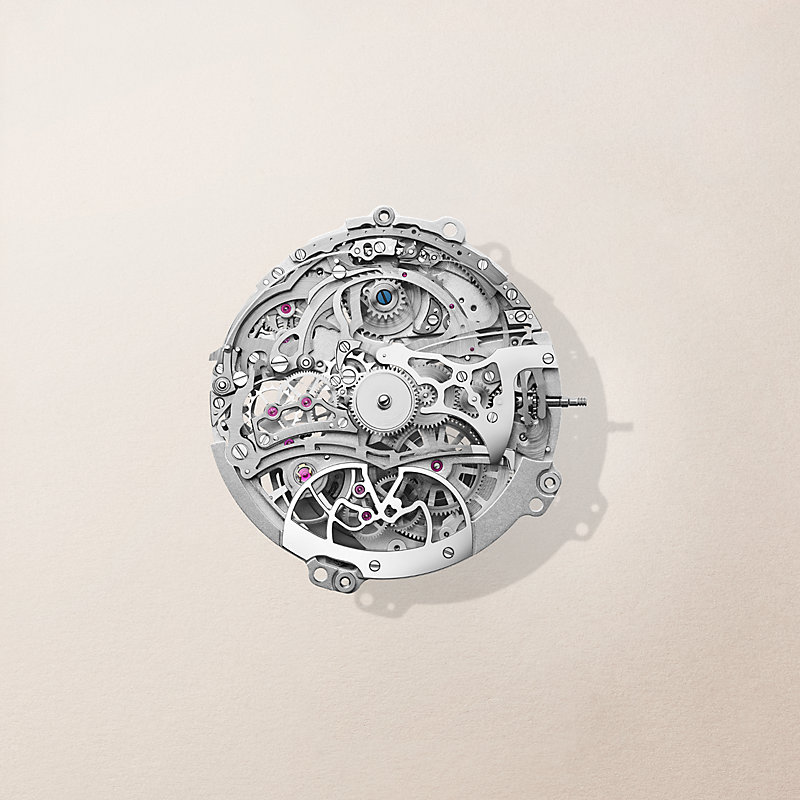
The Hermès H1927 calibre, seen uncased from the dial side.
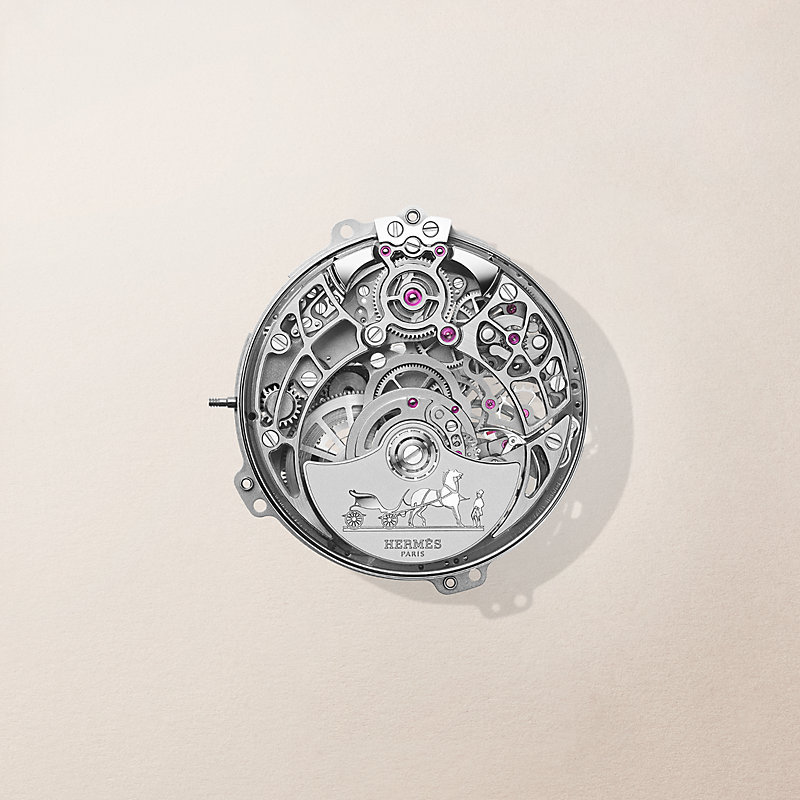
The reverse of the H1927, with the Duc attelé motif on its micro-rotor.
The H1927 adds an acoustic dimension to the dial’s play of openings and depth.
A minute repeater is a striking mechanism that gives the time acoustically on demand. In the traditional form described by the Fondation Haute Horlogerie, it communicates the hours, quarter-hours and remaining minutes through a sequence of strikes. Hermès confirms that the H1927 is a minute-repeater movement and that the Samarcande provides the hours and minutes as its displayed functions.
For this watch, the significance is not a promised acoustic superlative. Timbre, volume and musical character belong to an actual listening experience, not to a photograph. What the construction does reveal is the relationship between an acoustic mechanism and a dial designed around visibility.
Hermès calls the H1927 a new skeletonised mechanical self-winding movement, built around a custom calibre designed and produced exclusively for the maison. The product page gives a 48-hour power reserve. The Watches and Wonders material adds a crucial visual detail: through the sapphire caseback, the minute-repeater hammers and the micro-rotor can be seen, with the latter decorated with the Duc attelé motif.
That means the back is not merely a technical appendix. It completes the logic established on the front. The dial reveals the movement through the horse; the caseback reveals the parts associated with winding and striking. Front and back offer two different kinds of access to the same calibre.
The complication is framed, not advertised
There is a temptation with a minute repeater to make sound the entire story. Samarcande offers another route.
From the front, the first recognition is Hermès rather than repeater. The Arceau lugs, the horse, the slanted numerals, the blue crystal and the strap establish an identity before the mechanism asks for attention. The complication then deepens that identity rather than replacing it.
This is a useful way to think about high complications more generally. Technical difficulty alone does not determine visual character. A watch can be mechanically ambitious and still feel generic if the complication has no relationship with the case, dial or material language around it. Here the opening in the crystal gives the H1927 a precise place to appear.
It also gives the eye somewhere to stop. A fully skeletonised watch can ask the viewer to process every bridge and wheel at once. Samarcande edits that information. The horse-shaped aperture concentrates the most active area of the dial, while the blue crystal preserves larger fields of colour. The mechanics are visible, but they are not allowed to dissolve the image.
That restraint is one of the watch’s most persuasive qualities in photographs. It lets the reader understand the complication visually before understanding it mechanically.
The other face of H1927
Through the sapphire caseback of W408546WW00: the H1927 and its decorated micro-rotor.
The sapphire caseback changes the view from silhouette to architecture. The horse-shaped opening on the dial gives selected parts of the movement a place in the picture; the reverse lets the calibre occupy the entire circle.
Hermès identifies the repeater hammers and the micro-rotor among the details visible through the back. The hammers belong to the mechanism that strikes the time, while the micro-rotor provides automatic winding without a large central rotor sweeping across the view.
The Duc attelé decoration gives that winding component its own equestrian signature. On the dial, a horse determines the opening. On the reverse, horse and carriage appear on a moving part. The motif changes both scale and purpose as the watch is turned over.
Seen beside the uncased H1927, the caseback photograph also makes the movement's relationship with the white-gold Arceau frame easier to read. Skeletonisation is not confined to the dial side: bridges, openings and the decorated rotor remain part of the rear composition.
Arceau Samarcande — the details
Explore the comparison
| Element | Specification | The visual relationship |
|---|---|---|
| Case | White gold, 38 mm | Asymmetrical stirrup-inspired Arceau lugs frame the crystal dial. |
| Dial | Saint-Louis crystal; sapphire-crystal horse motif | The horse-shaped opening reveals the H1927. |
| Movement | H1927, mechanical self-winding | Skeletonisation and a decorated micro-rotor shape the movement’s architecture. |
| Complication | Minute repeater; hours and minutes displayed | The sapphire back reveals the repeater hammers. |
| Reserve | 48 hours | Automatic winding is provided by the micro-rotor. |
| Strap | Smooth ink-blue alligator; white-gold pin buckle | The strap continues the dial colour beyond the case. |
A complicated watch with a clear first impression
Arceau Samarcande is easy to over-explain because it brings together a recognisable Hermès case, an equestrian motif, Saint-Louis crystal and a minute repeater. Its strength is that these elements do not arrive as separate chapters when the watch is seen.
The blue crystal establishes a field. The horse removes part of it. The H1927 fills that opening. The asymmetric Arceau lugs keep the round case in motion. Turn the watch over and the mechanism becomes more explicit, with the hammers and micro-rotor visible through sapphire.
That sequence is what makes reference W408546WW00 interesting. The repeater is not hidden, but neither is it asked to carry the whole identity of the watch. Hermès gives the complication a visual role before giving it a technical one.
Return to the complete watch after considering the crystal, the opening and the movement separately, and the front view reads differently. The horse is no longer simply a motif on a blue dial. It is the exact place where decoration stops and watchmaking begins.
Sources & further reading
The Edit
Watches stories
Selected stories from the same editorial universe.
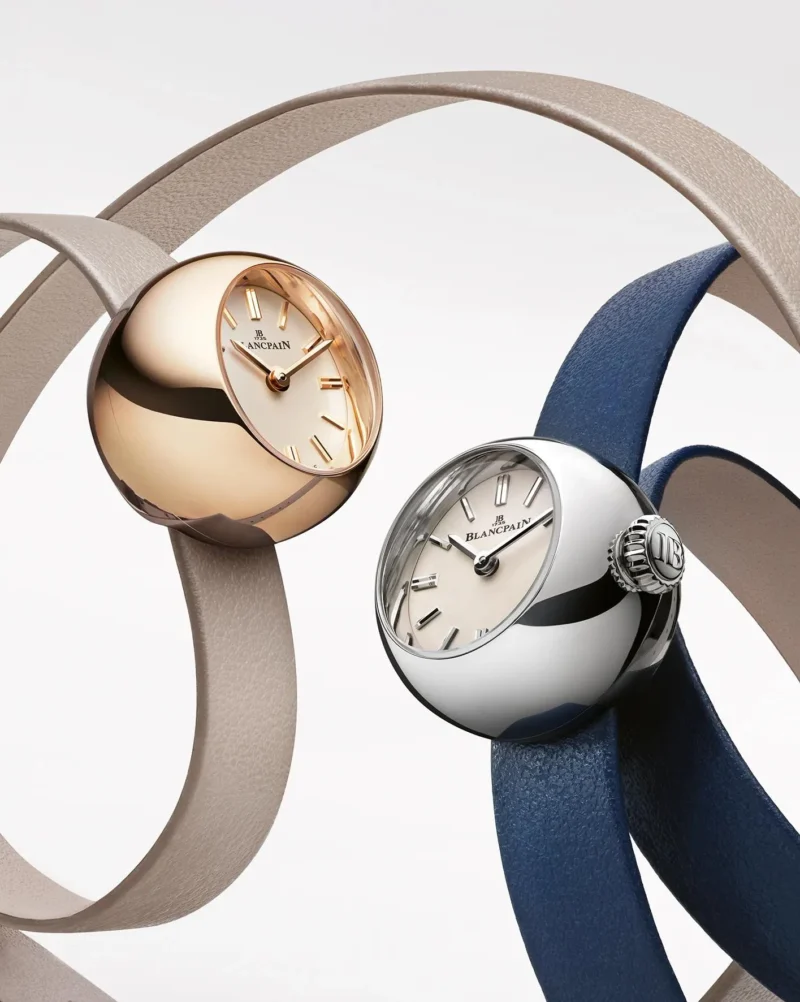
Blancpain Lady B: What Does 19 Millimetres Require?
Blancpain’s 19 mm Lady B is best understood as an exercise in mechanical volume:

When Is a Revived Watch Brand Still the Same Brand? Testing the New Gallet Against the Archive
The archive is real and the manufacturing system is new. We test Flying Officer,
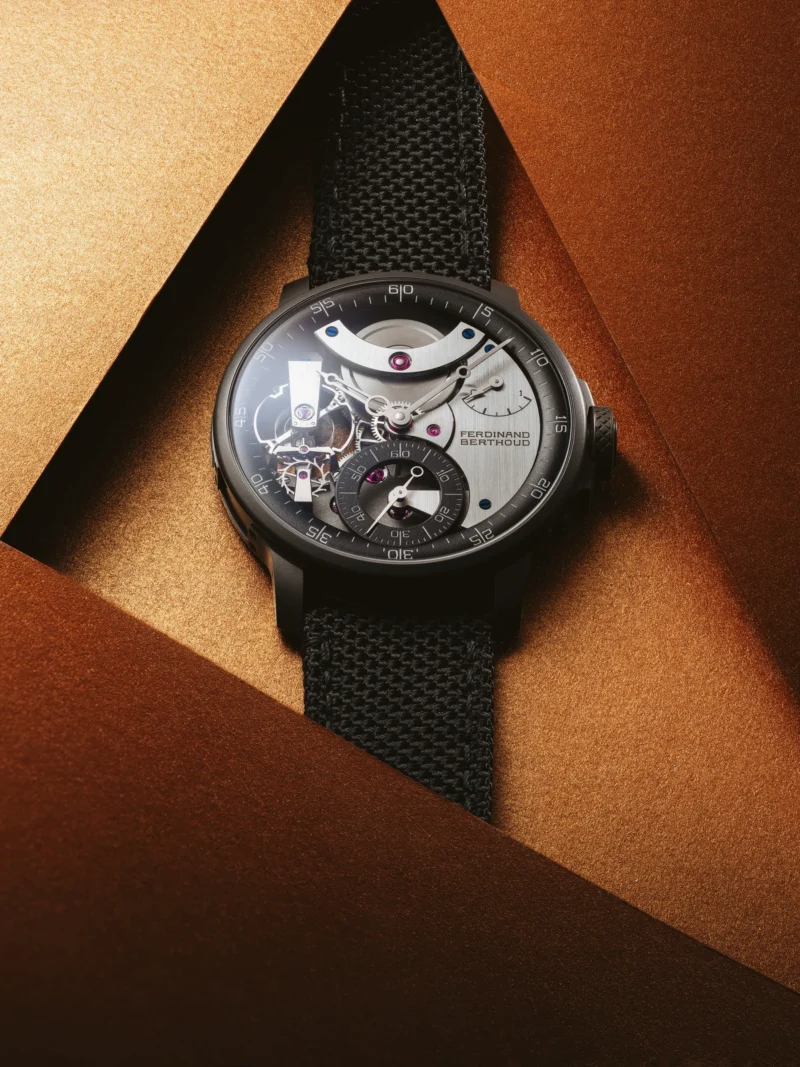
Ferdinand Berthoud FB 3SPC.4-1: Why Bend a Balance Spring into a Cylinder?
The black titanium case is new. The harder achievement is regulating a cylindrical spring
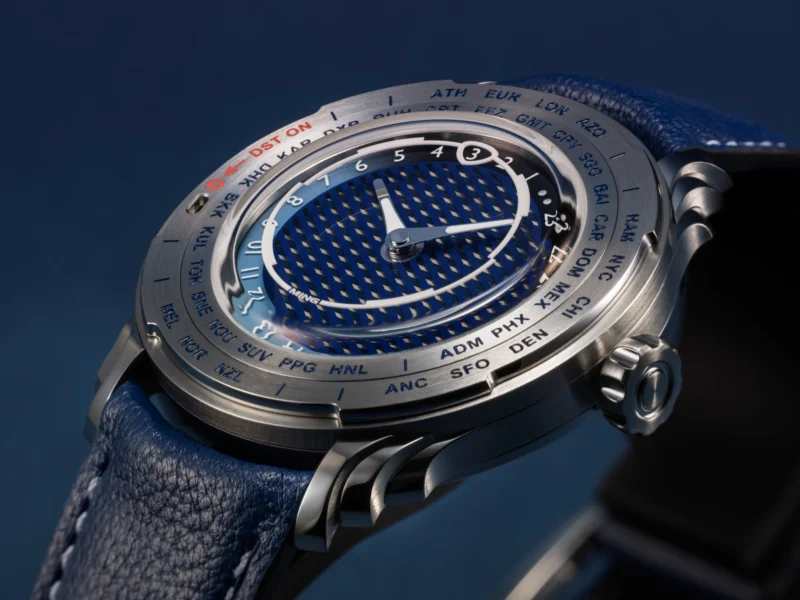
MING 57.05 Comet: The One-Click DST Fix and the Time-Zone Problem It Cannot Fully Solve
One click moves DST-observing cities by an hour. The harder problem is that civil-time
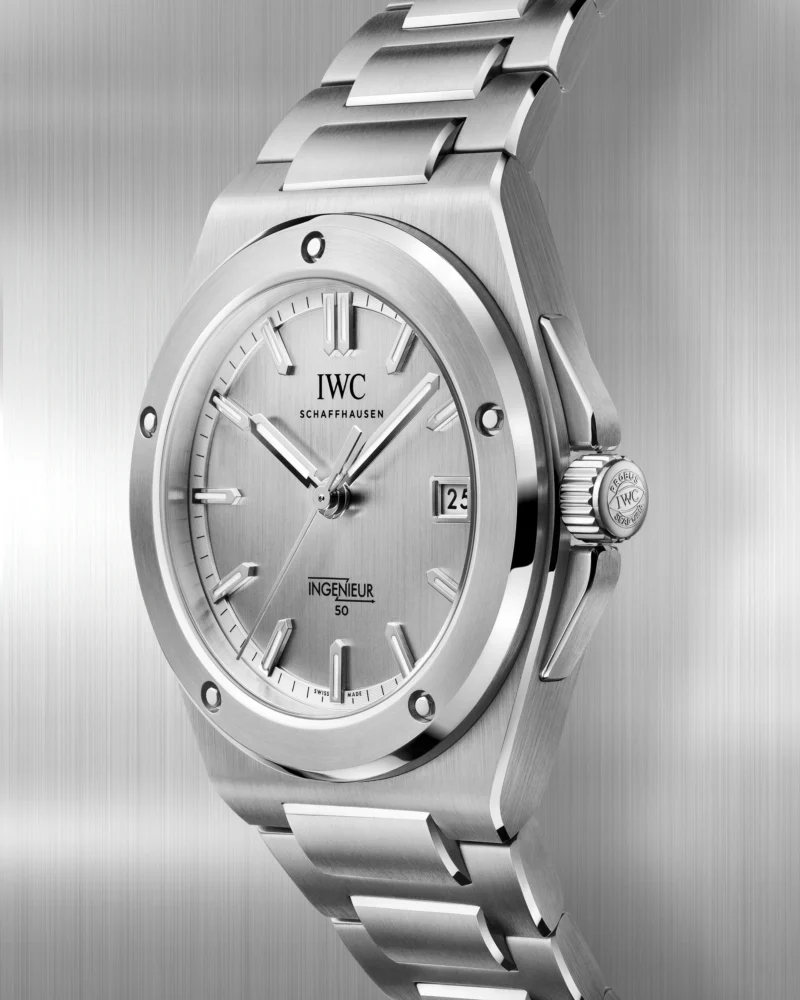
What Did IWC Actually Bring Back from Gérald Genta’s Ingenieur SL?
The 40 and 35 mm anniversary Ingenieurs share a rare silver-dial reference, but only
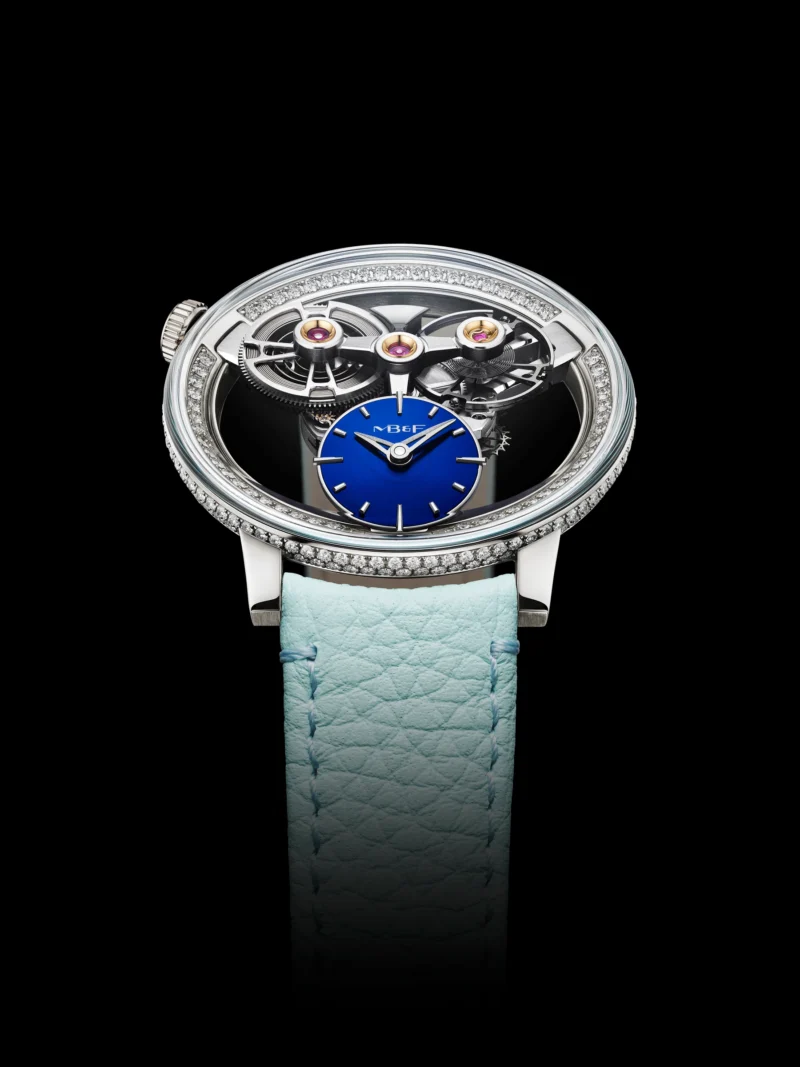
MB&F SP One Pavée: Where Do You Put 255 Diamonds on a Watch That Has No Bezel?
The bezel-free SP One leaves its three mechanical circles untouched and distributes 255 diamonds