
TheTimeo / Watches
EL PRIMERO,
without the chronograph
Zenith removes the pushers and counters from Chronomaster but keeps El Primero at 5 Hz, creating a sharper test of what the famous movement name now means.
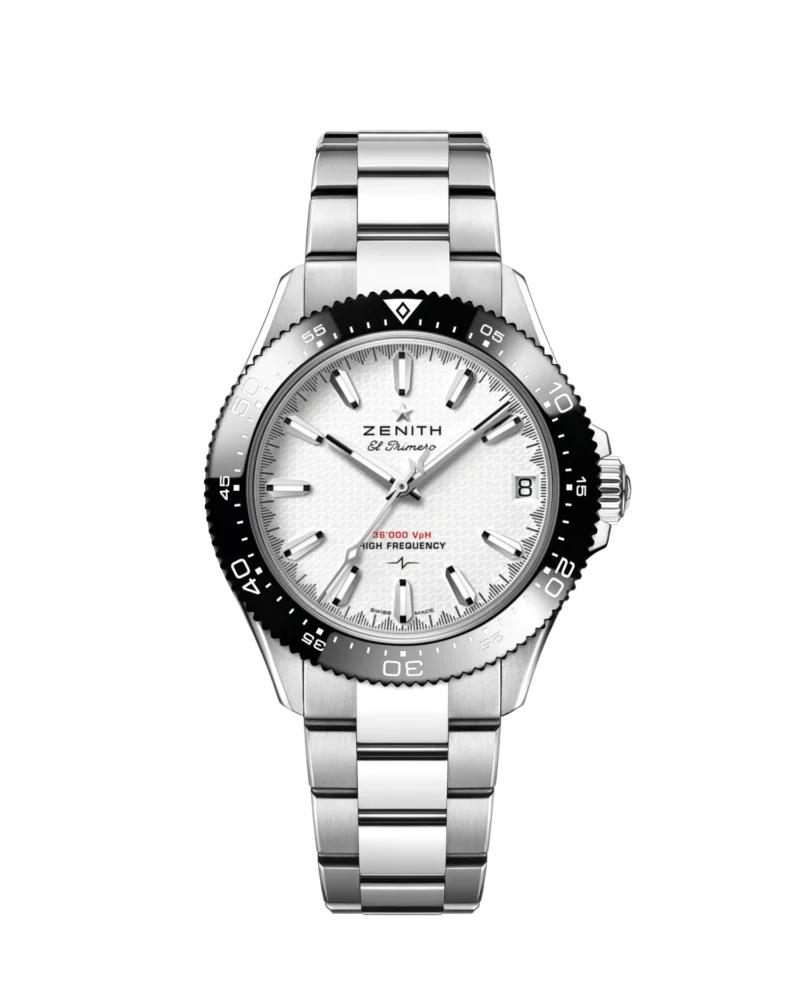
The white-date reference introduces the Chronomaster Solo Sport as a three-hand, 5 Hz sports watch. Courtesy of Zenith.
Explore the story
Zenith has created a slightly awkward question for itself. If El Primero is one of watchmaking’s best-known chronograph movements, what happens when the chronograph disappears?
That question sits at the centre of the new Chronomaster Solo Sport. There are no pushers. There are no overlapping grey, blue and anthracite registers. There is no central chronograph hand making a ten-second lap of the dial. What remains is hours, minutes, central seconds, and, on three of the four references, a date window at three o’clock.
The obvious answer is that Zenith has made a simpler sports watch. The more useful answer is that Zenith has separated two things that collectors often treat as if they were inseparable: El Primero’s chronograph function and El Primero’s high-frequency regulating architecture.
That distinction is why the Solo Sport deserves more than launch coverage.
Key facts
- Introduced on 2 September 2026 at Geneva Watch Days.
- The first three-hand watch in the Chronomaster collection.
- Four references at launch: white dial with date, black dial with date, brown dial with date, and black dial without date.
- 40 mm stainless-steel case with screw-down crown and 20 ATM water resistance.
- Unidirectional rotating ceramic bezel.
- El Primero 3620 automatic manufacture movement, derived from the El Primero 3600 chronograph architecture.
- 5 Hz frequency, equivalent to 36,000 vibrations per hour.
- Silicon escapement, stop-seconds, bidirectional automatic winding and approximately 60 hours of power reserve.
- Three-link steel bracelet with the ZENCLASP micro-adjustment system.
- Swiss launch prices: CHF 9,900 with date and CHF 8,900 for the black no-date version.
El Primero began as a chronograph, and Chronomaster was built around that fact
Zenith unveiled El Primero on 10 January 1969. The manufacture’s own historical record describes it as the world’s first automatic, integrated high-frequency chronograph calibre. Its balance ran at 36,000 vibrations per hour, or 5 Hz, which allowed the chronograph to divide a second into ten readable parts.
The relationship between frequency and display was unusually clear. A conventional mechanical chronograph could measure short intervals, but El Primero’s faster oscillator made the tenth of a second part of the calibre’s technical identity. In modern Chronomaster models powered by the El Primero 3600, Zenith makes that relationship visible again: the central chronograph hand completes one revolution in ten seconds rather than sixty.
This history matters because Chronomaster has never been a neutral collection name. The line has been the house in which Zenith interprets its chronograph heritage, from close descendants of the 1969 A386 to contemporary 1/10-second executions.
The Solo Sport therefore changes the collection at a conceptual level. Zenith is not simply adding a new case shape or colour. It is asking whether Chronomaster can still be Chronomaster when the complication that gave the family its identity is absent.
The important detail: this is the first three-hand Chronomaster, not Zenith’s first three-hand 5 Hz watch
That distinction needs to be made carefully.
Zenith describes the Solo Sport as the first three-hand watch in the Chronomaster collection. It is not the manufacture’s first modern three-hand watch powered by a 5 Hz El Primero-derived calibre.
The Defy Skyline, introduced in 2022, already used the El Primero 3620. That watch turned the movement’s high frequency into a visible feature by driving a 1/10-second indicator directly from the escapement. The small hand made one complete revolution every ten seconds. Zenith later used the same idea in the Defy Skyline Skeleton.
The Solo Sport makes a different choice. It retains the 5 Hz oscillator, but removes the dedicated fractional-seconds display. High frequency is still present mechanically, yet it is no longer staged as a complication on the dial.
That makes this watch less spectacular technically and more interesting editorially. It asks the buyer to value the 5 Hz architecture even when the watch is not constantly demonstrating it.
What 5 Hz means when there is nothing to time
A frequency of 5 Hz means that the balance completes five oscillations per second, producing ten vibrations or beats in that second. Over an hour, the regulating organ reaches the familiar El Primero figure of 36,000 vibrations.
In a chronograph such as the Chronomaster Original or Sport, Zenith uses that frequency to support a display readable to one tenth of a second. The chronograph function gives the frequency an obvious task.
The Solo Sport removes that task. Its central seconds hand is a normal running-seconds display, and Zenith does not present it as a 1/10-second timing instrument. This is an important boundary. A movement beating at 5 Hz and a watch displaying measured intervals to one tenth of a second are related ideas, but they are not the same claim.
So what is left?
First, the regulating organ still works at the cadence that has defined El Primero since 1969. Second, Zenith retains an architecture developed from the El Primero 3600 rather than replacing the movement with a lower-frequency three-hand calibre and keeping the famous name on the dial. Third, the watch turns the oscillator itself into the point of continuity.
That may sound abstract, but it changes how the model should be judged. The Solo Sport is not interesting because it has fewer functions. It is interesting because Zenith has chosen frequency, rather than the chronograph, as the minimum technical condition for calling this a contemporary Chronomaster.
Calibre 3620 is the bridge between two Zenith families
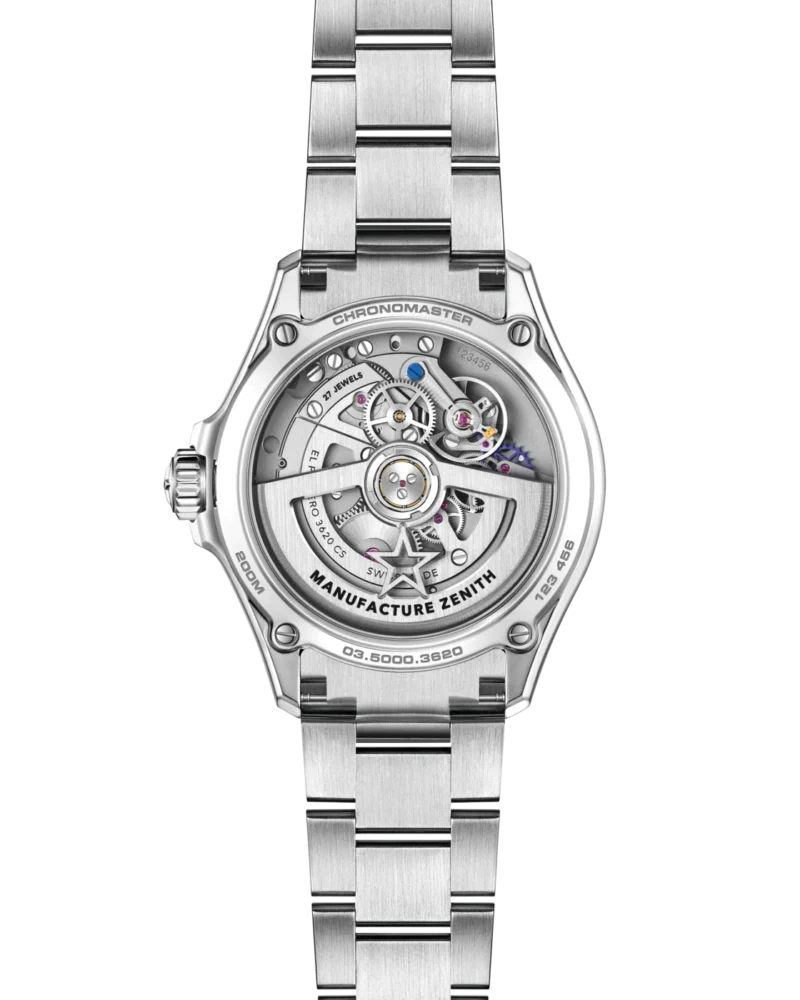
Calibre 3620 retains the El Primero family’s 5 Hz regulating architecture. Courtesy of Zenith.
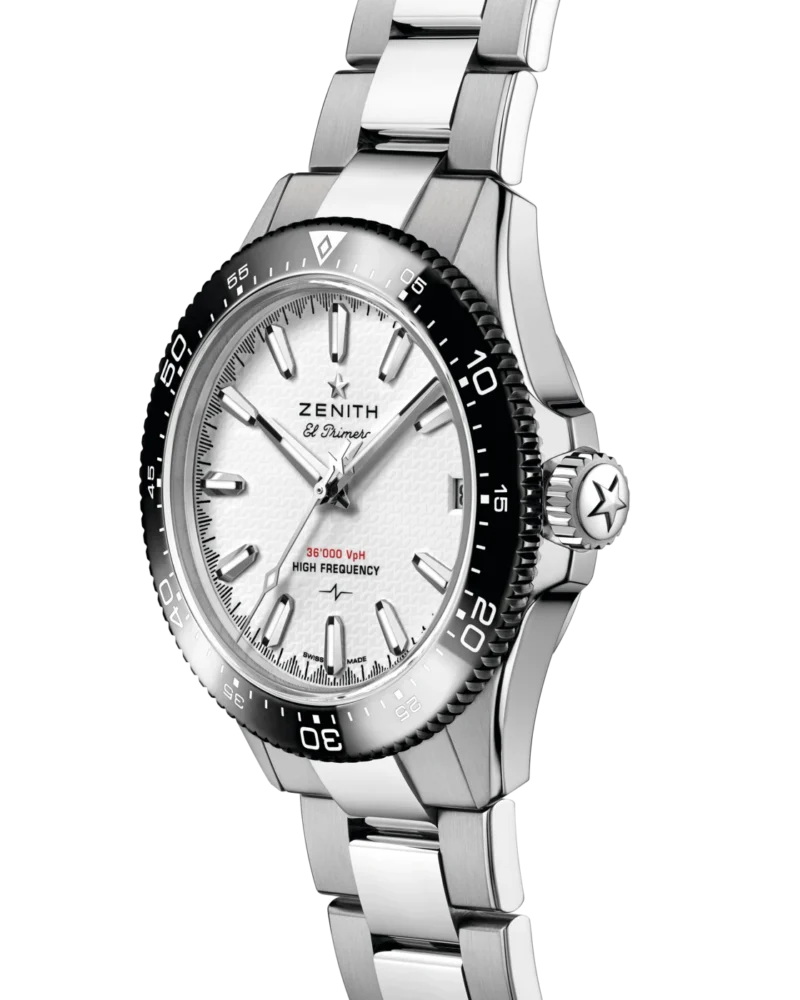
The three-quarter view makes the screw-down crown, guards, bezel and integrated bracelet easier to read. Courtesy of Zenith.
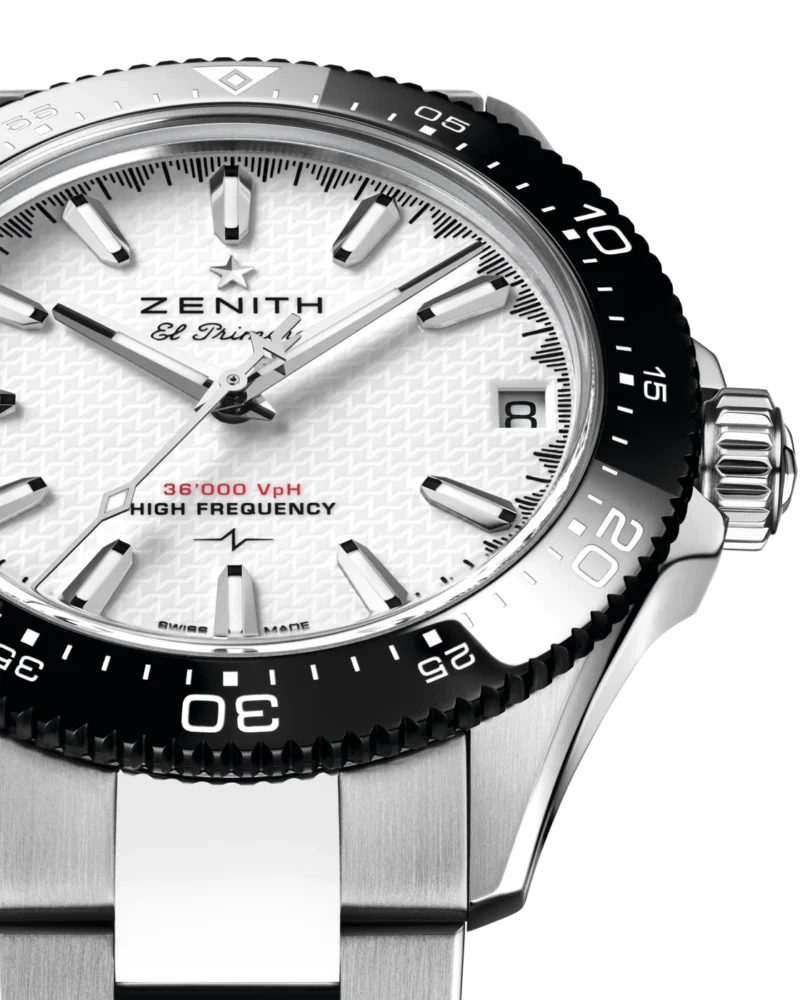
The bezel supplies a direct way to mark elapsed minutes without recreating a chronograph. Courtesy of Zenith.
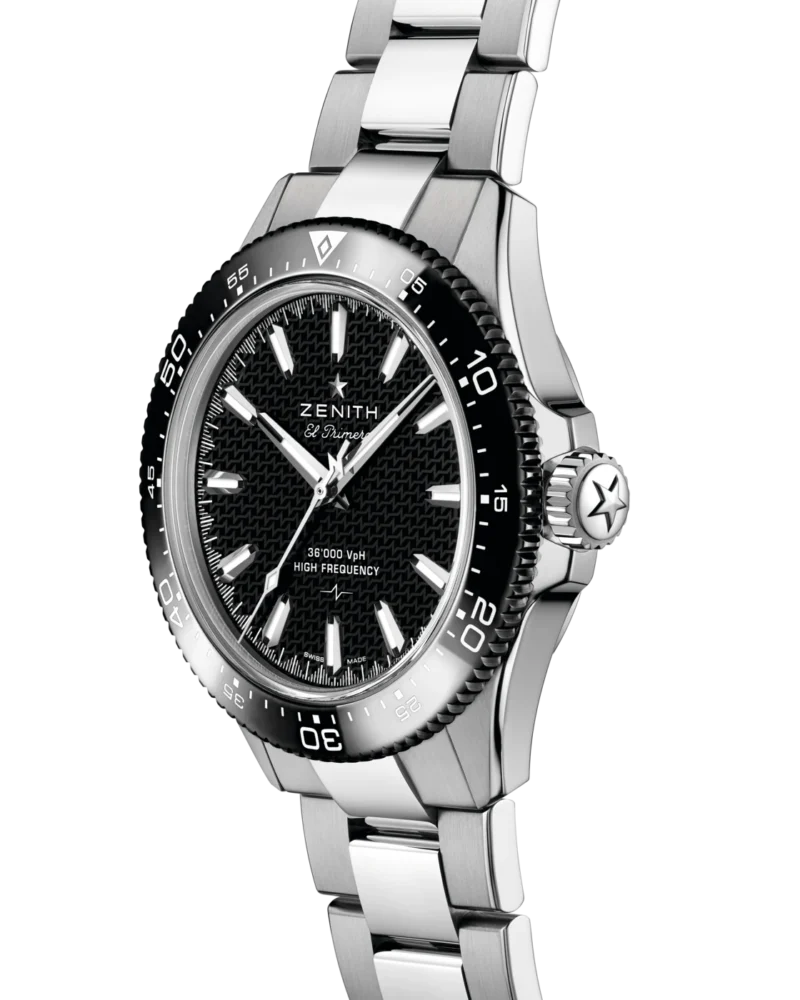
Crown guards and bracelet articulation give the three-hand watch its own case identity. Courtesy of Zenith.
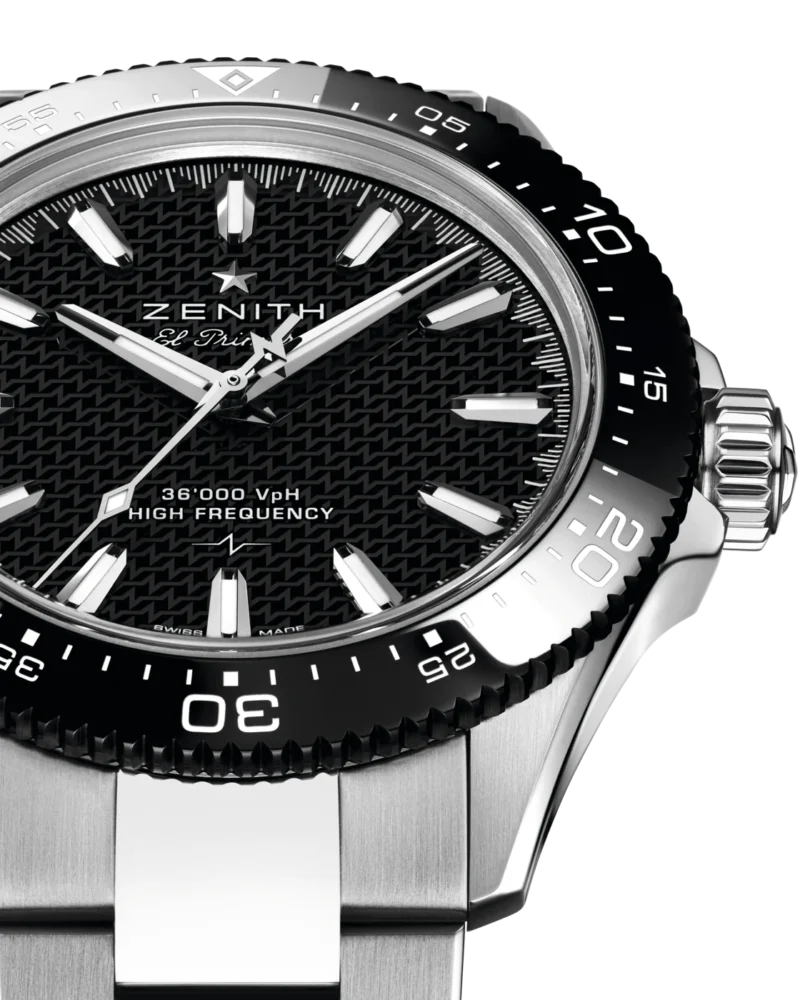
The repeated Z motif is intended to make an otherwise invisible high frequency visually present. Courtesy of Zenith.
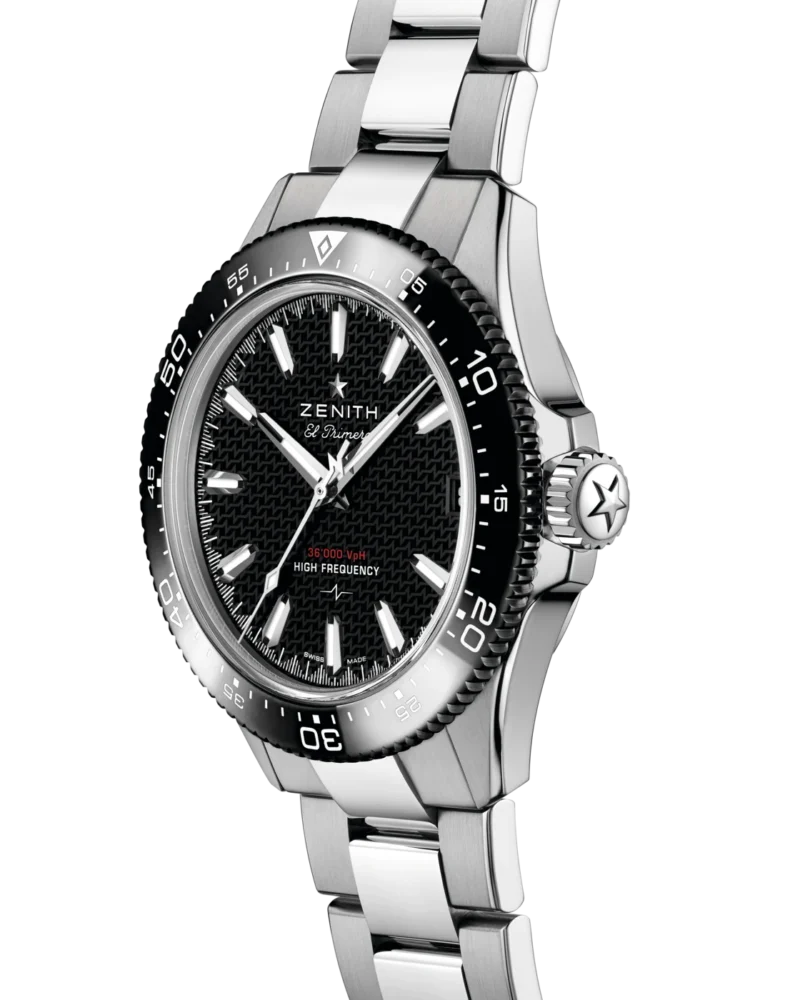
The polished ceramic surfaces change character as light moves across the case. Courtesy of Zenith.
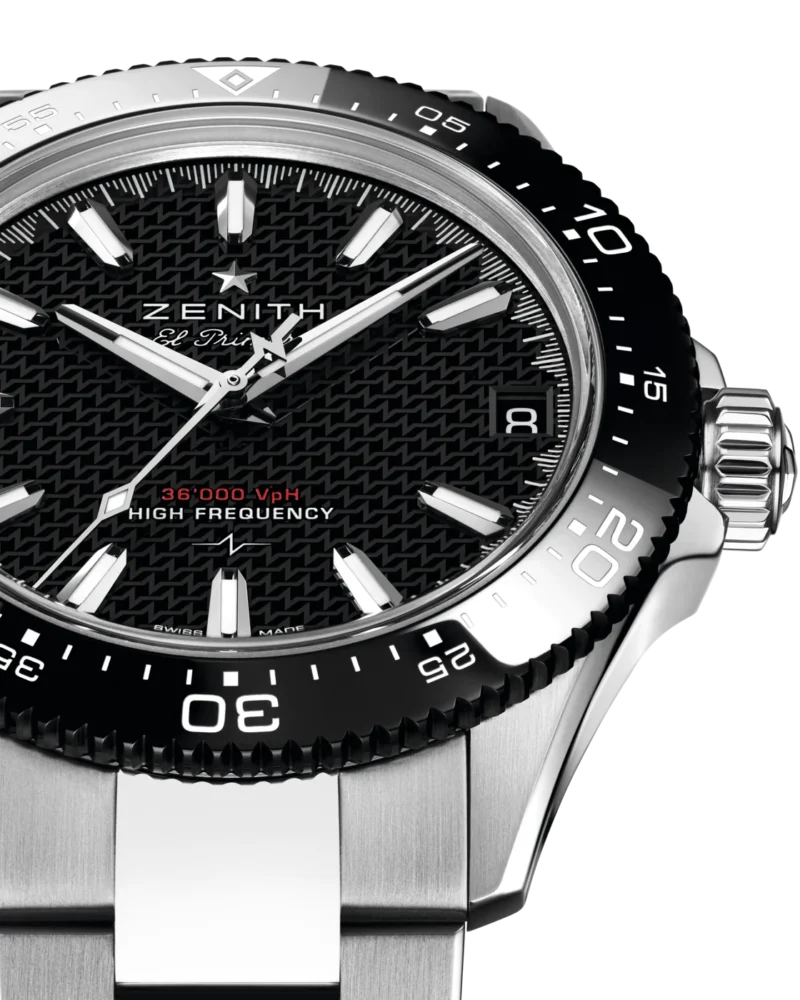
A close view separates the ceramic dial pattern from the sixty-minute bezel scale. Courtesy of Zenith.
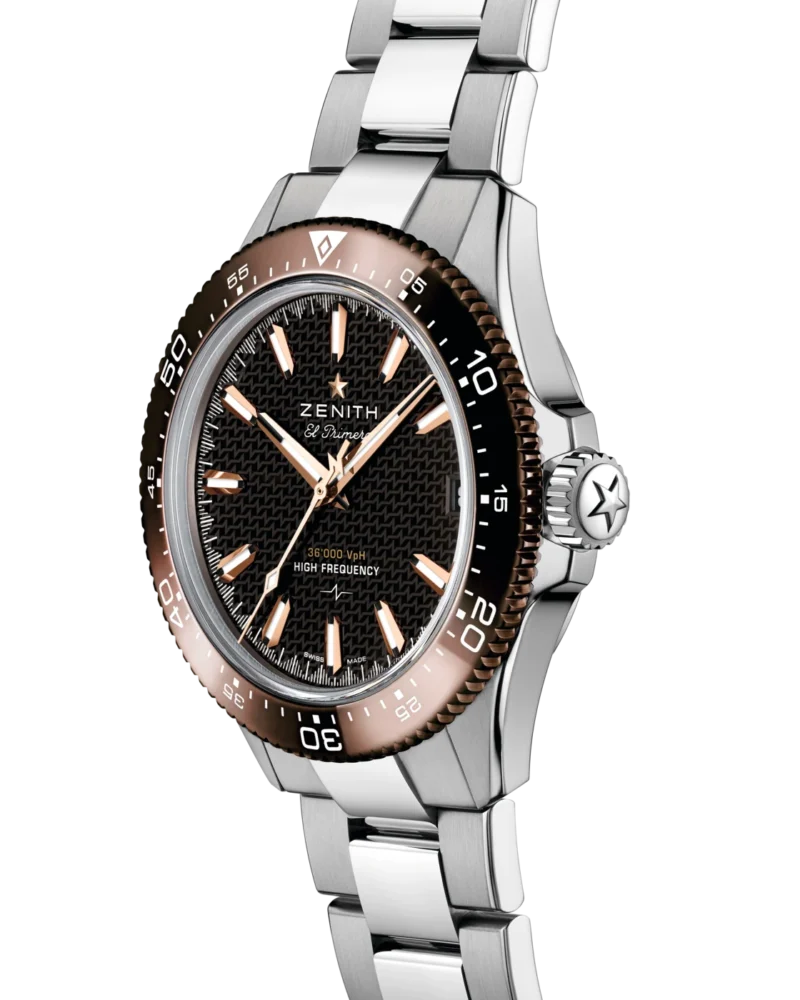
The warmer reference preserves the collection’s structural relationship between bezel, crown and bracelet. Courtesy of Zenith.
The automatic El Primero 3620 inside the Solo Sport is derived from the El Primero 3600 chronograph movement. Zenith specifies a silicon escapement, a stop-seconds mechanism, bidirectional winding, a star-shaped openworked rotor and approximately 60 hours of power reserve.
The movement is not new in 2026. That is useful rather than disappointing, because its previous life gives the Solo Sport context.
In the Defy Skyline, calibre 3620 was used to turn high frequency into an animated 1/10-second display. In the Chronomaster Solo Sport, the same family of architecture is asked to behave more quietly. The watch has ordinary central seconds and, depending on the reference, a date. The oscillator remains at 5 Hz, but the display is conventional.
There is a good design logic in that restraint. Had Zenith given the Solo Sport another continuously rotating 1/10-second subdial, it would have imported the Defy Skyline’s most distinctive mechanical gesture into Chronomaster. Instead, the movement links the families internally while the dial keeps them visually separate.
The stop-seconds mechanism also matters more here than it may sound. Once the chronograph has disappeared, the watch is fundamentally about civil timekeeping. Being able to halt the seconds hand while setting the watch is a practical feature, particularly on a model whose communication is built around precision.
The rotating bezel changes the kind of watch Chronomaster can be
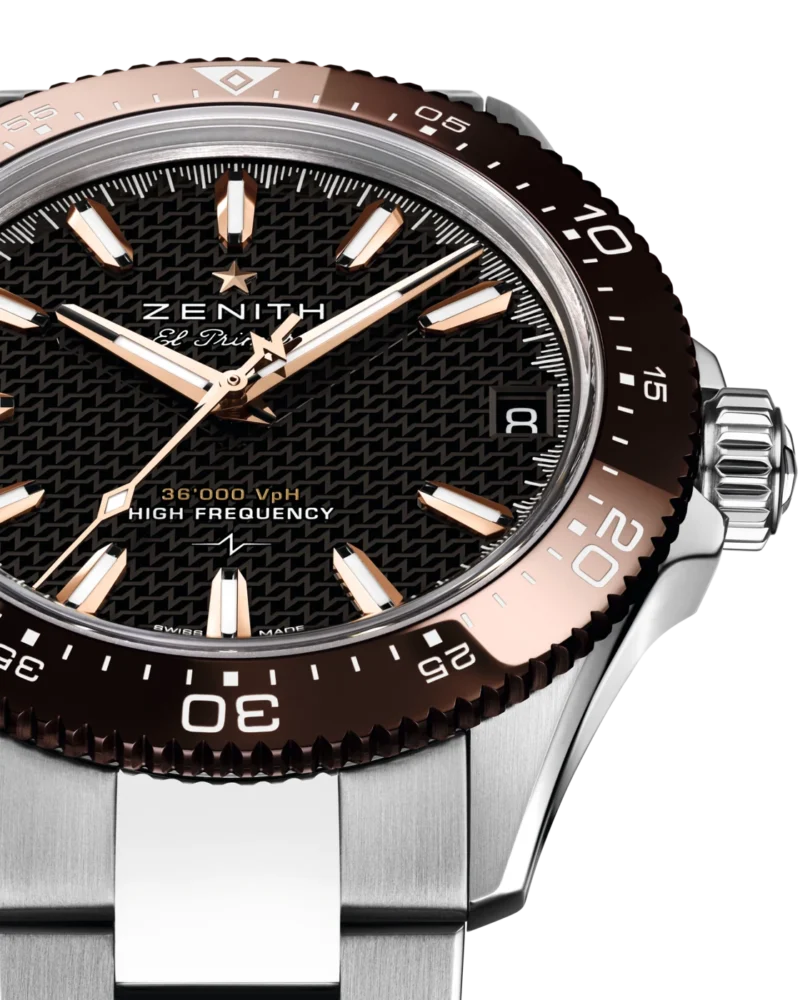
The macro view shows how colour, polish and repeated geometry share the visual work. Courtesy of Zenith.
Removing the chronograph creates another problem. A Chronomaster Sport without pushers and counters could easily look like a chronograph that has lost its machinery.
Zenith avoids that by giving the Solo Sport a unidirectional rotating ceramic bezel and a more robust case architecture. The crown screws down, crown guards flank it, and water resistance rises to 20 ATM. The result is not presented by Zenith as a professional dive watch, and it should not be described as one without a separate certification or use specification. But the hardware moves the watch decisively away from a stripped-down dress chronograph.
The bezel is marked as a sixty-minute timing scale. It gives the wearer a simple mechanical reference for elapsed time without recreating a chronograph. That is a clever substitution. Chronomaster loses the start-stop-reset ritual of a column-wheel chronograph, yet the watch still retains a physical way to mark passing minutes.
This is also where the word “Sport” becomes more credible than it might have been on a purely cosmetic variation. A screw-down crown, 20 ATM rating, rotating ceramic bezel and bracelet with on-wrist adjustment are functional changes to the way the watch can be used.
Four references, but one of them explains the collection best
Explore the comparison
| Reference | Dial | Date |
|---|---|---|
| 03.5000.3620/69.M5000 | White ceramic | Yes |
| 03.5000.3620/22.M5000 | Black ceramic | Yes |
| 03.5001.3620/72.M5000 | Brown ceramic | Yes |
| 03.5000.3620/21.M5000 | Black ceramic | No |
Zenith launches the Solo Sport in four versions.
Reference 03.5000.3620/69.M5000 has a white ceramic dial with a sunray finish and black ceramic bezel. Reference 03.5000.3620/22.M5000 uses black ceramic for both dial and bezel. Reference 03.5001.3620/72.M5000 moves into brown ceramic, giving the watch a warmer appearance while keeping the same date display at three o’clock. All three were announced at CHF 9,900.
The fourth, 03.5000.3620/21.M5000, uses the black dial and bezel but removes the date. Its Swiss launch price is CHF 8,900.
The no-date model is the most revealing of the four because it exposes Zenith’s thesis with the least distraction. There are only three central hands, a rotating bezel and the high-frequency movement underneath. Nothing on the dial can be mistaken for a chronograph function.
That does not automatically make it the best version. A date is useful on a daily watch, and Zenith clearly intends the Solo Sport to be worn that way. But the no-date reference is the cleanest answer to the editorial question. It shows exactly how far the manufacture is prepared to reduce Chronomaster while still insisting on El Primero as the mechanical foundation.
The dial tries to make an invisible frequency visible
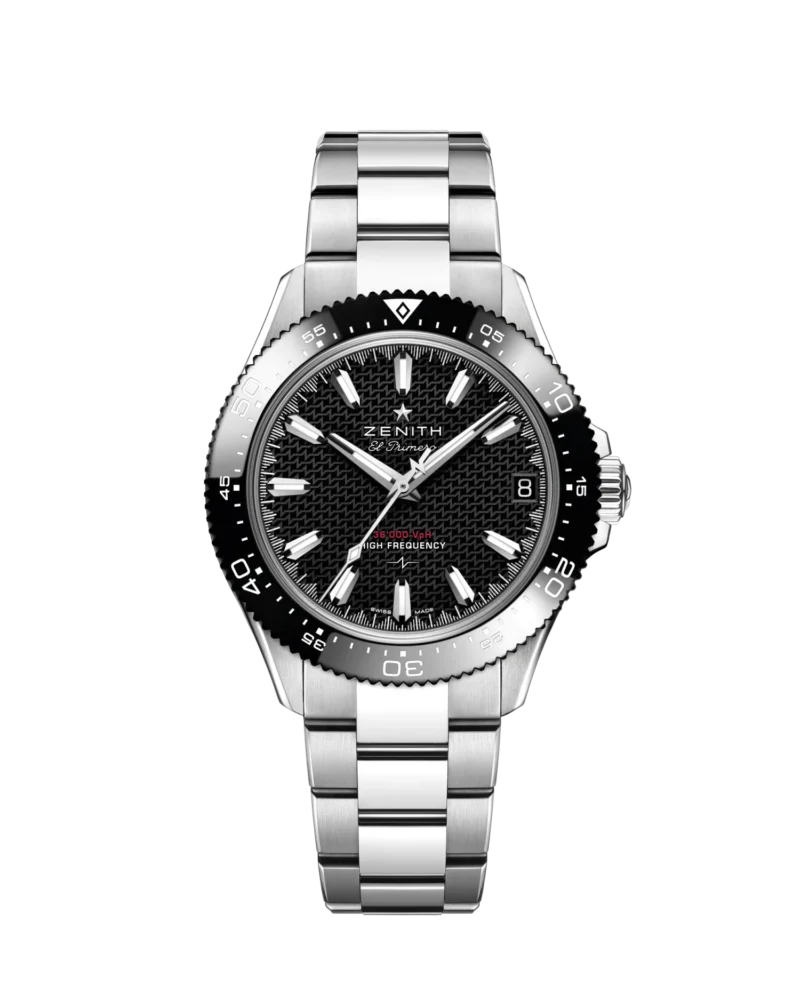
The black-date reference concentrates the new ceramic dial and bezel language into one dark field. Courtesy of Zenith.
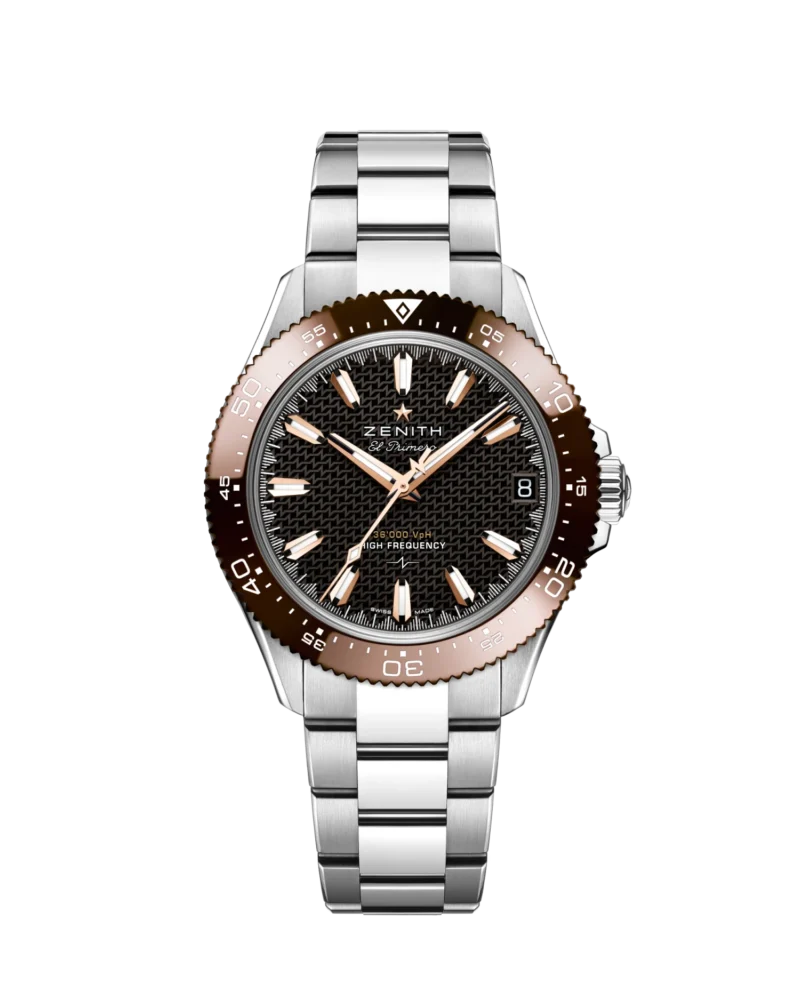
The brown-date reference proves that the architecture survives beyond a black-and-white sports-watch palette. Courtesy of Zenith.
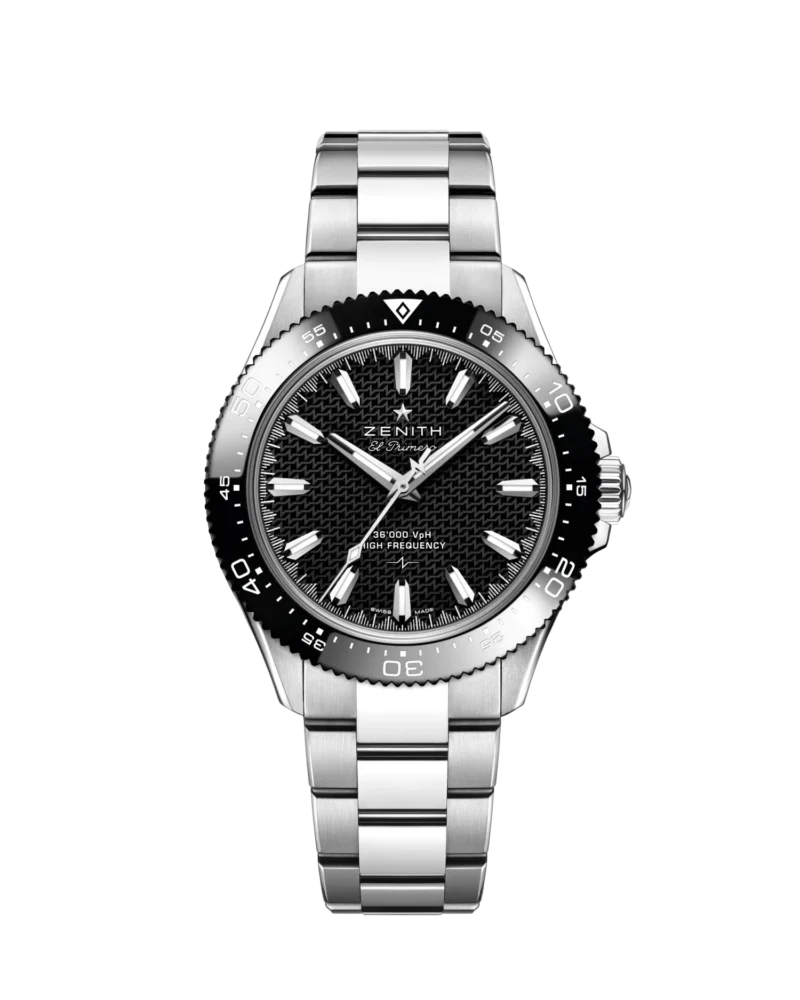
The no-date reference is the collection’s clearest reduction: three hands, rotating bezel and 5 Hz calibre. Courtesy of Zenith.
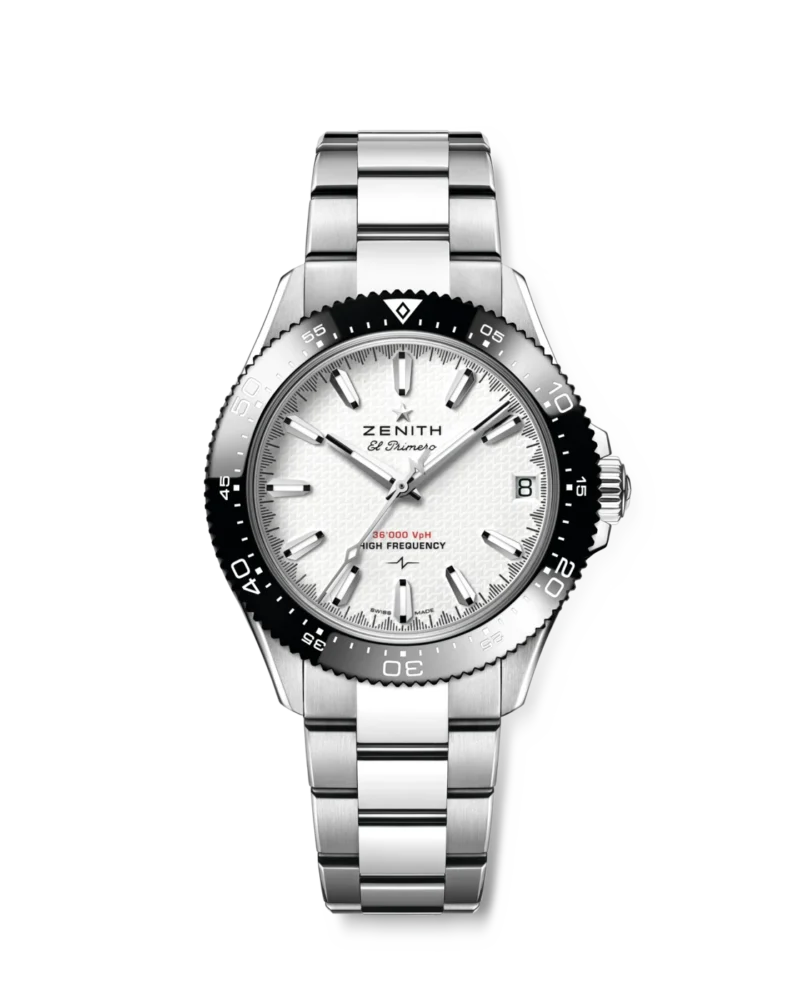
The patterned white ceramic dial uses surface and minute-track geometry in place of chronograph counters. Courtesy of Zenith.
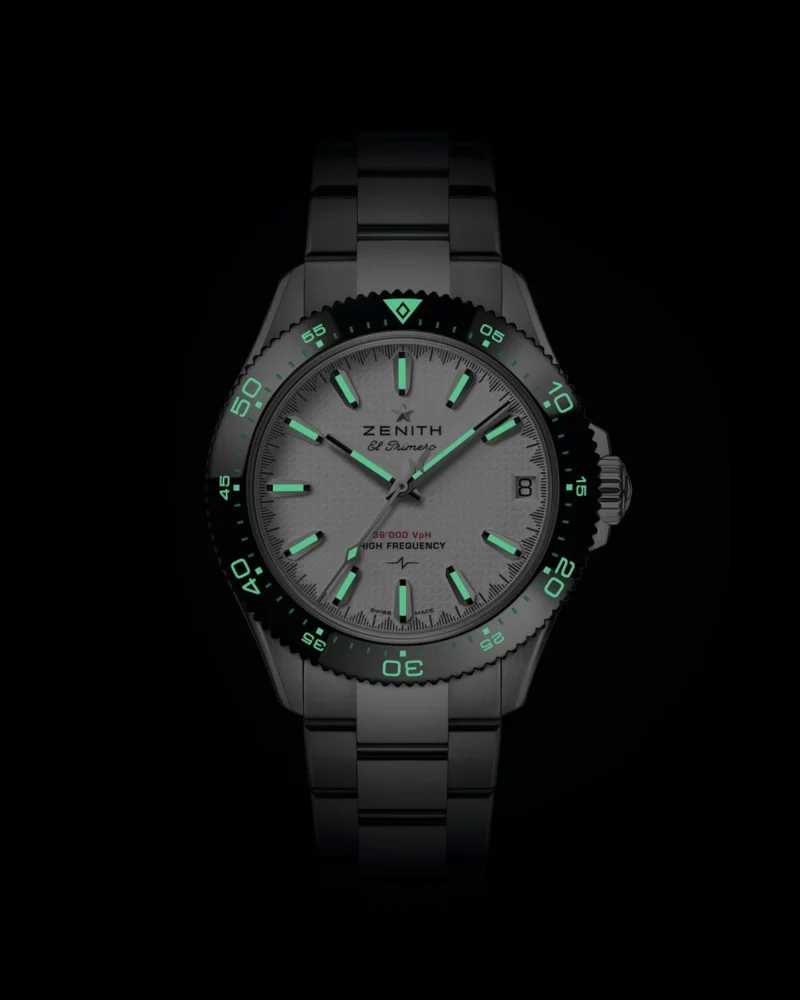
Luminous hands and markers preserve the time display while the dial pattern recedes. Courtesy of Zenith.
There is a problem with high frequency in a three-hand watch: most of it is hidden.
A collector can read “36’000 VpH” on the dial, and the movement can be viewed through the caseback, but 5 Hz is not a material, colour or complication that announces itself across a room. Zenith therefore created a new surface pattern for the Solo Sport.
The ceramic dials carry a repeated Z motif set at 45 degrees. Zenith says the pattern is intended to evoke the rhythm and vibration of the movement. The same language appears in the counterweight of the seconds hand. Around the perimeter, a sharply segmented “shark tooth” minute track refers to historical Zenith designs.
The idea is understandable even if the marketing language can be pushed too far. A pattern cannot literally show the oscillator frequency. What it can do is give the collection a graphic identity that does not depend on the familiar three coloured chronograph counters.
This is a significant design problem for Zenith. Those counters are among the easiest ways to make a modern Chronomaster recognisable. Once they disappear, the brand has to invent new visual cues rather than shrink the old ones into a three-hand layout.
The Solo Sport’s solution is more contemporary and less archival. That is probably the right decision. An A386-derived dial without chronograph registers would have looked like an absence. The new ceramic surface lets the watch admit that it is something different.
Ceramic is doing more work than colour
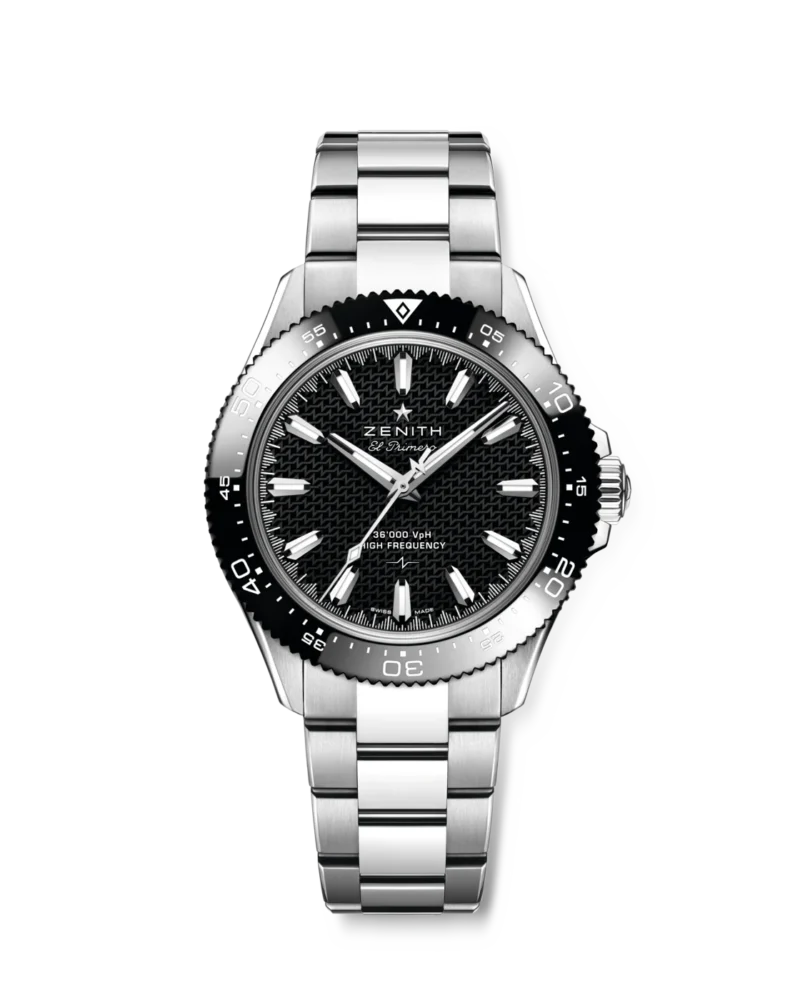
Without a date or chronograph display, the black reference isolates Zenith’s new Chronomaster proposition. Courtesy of Zenith.
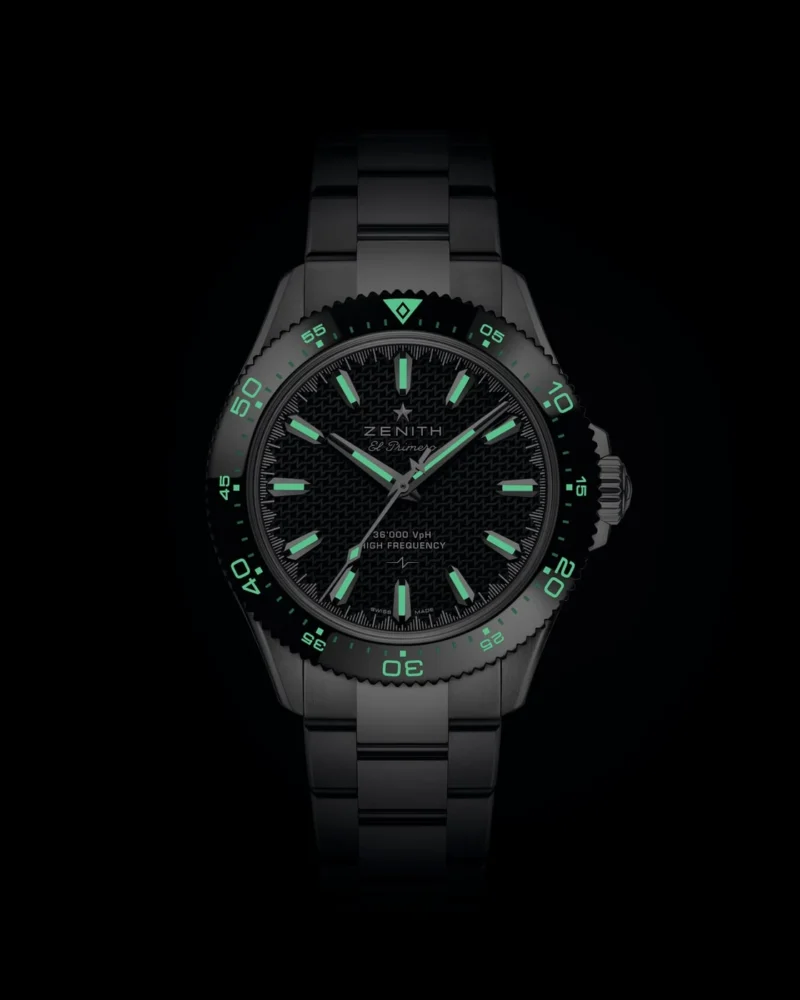
The no-date dial keeps a symmetrical luminous reading in low light. Courtesy of Zenith.
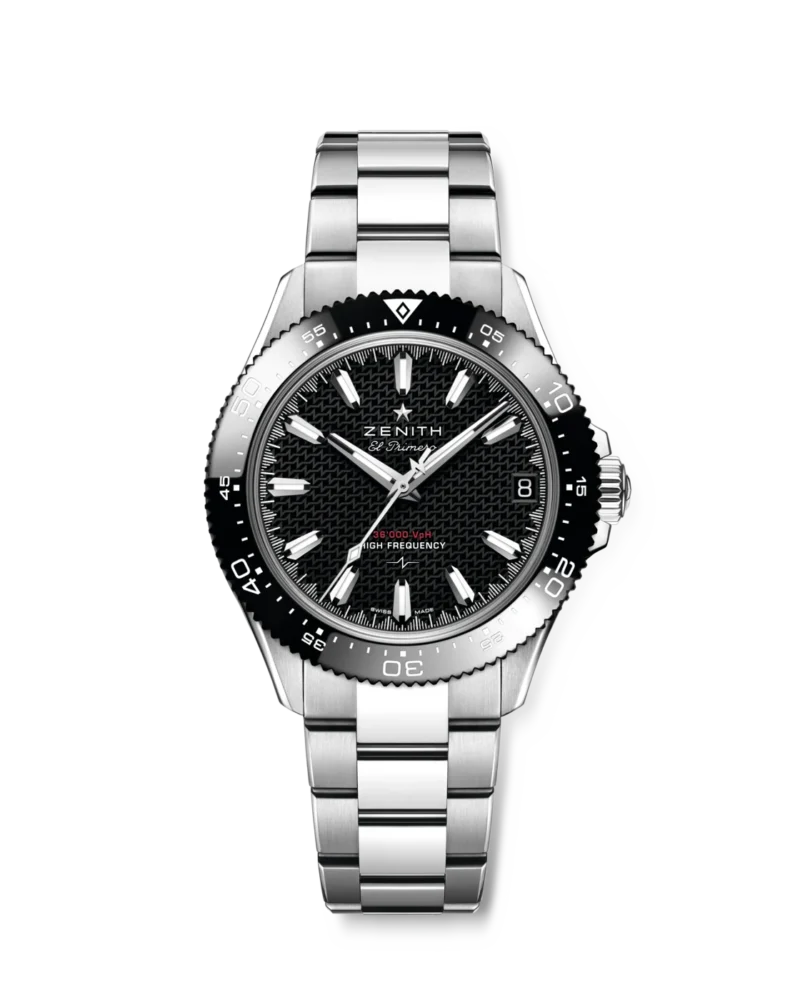
The date version adds daily utility without changing the 40 mm steel architecture. Courtesy of Zenith.
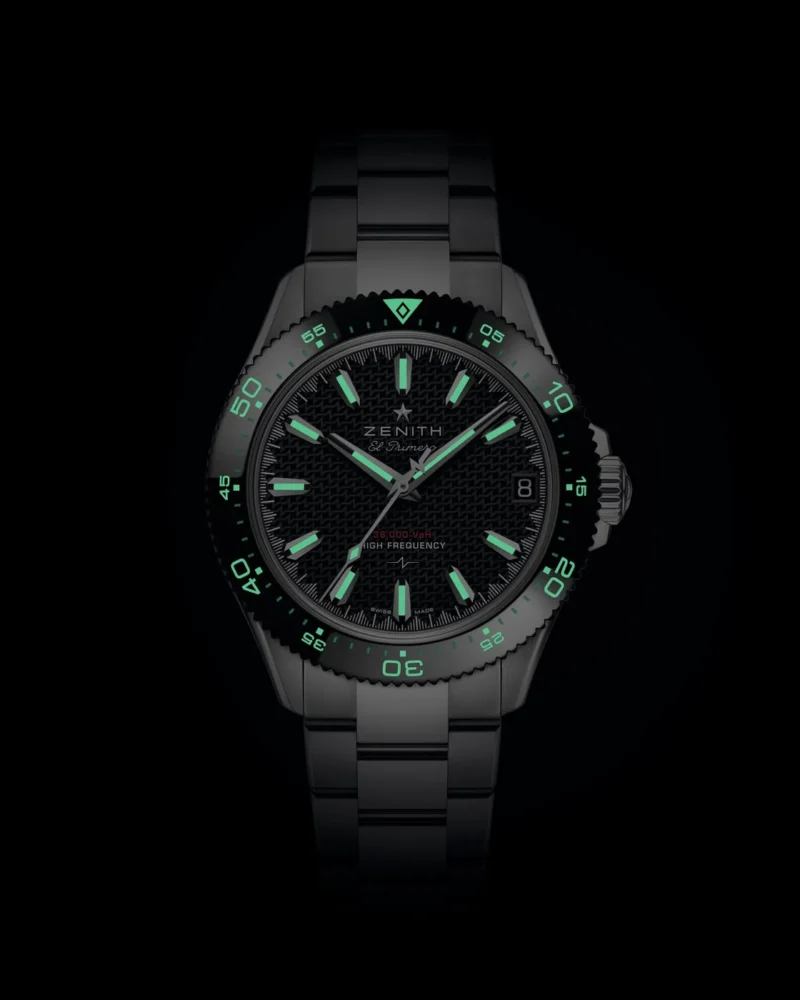
The date model maintains the same luminous hierarchy as the no-date watch. Courtesy of Zenith.
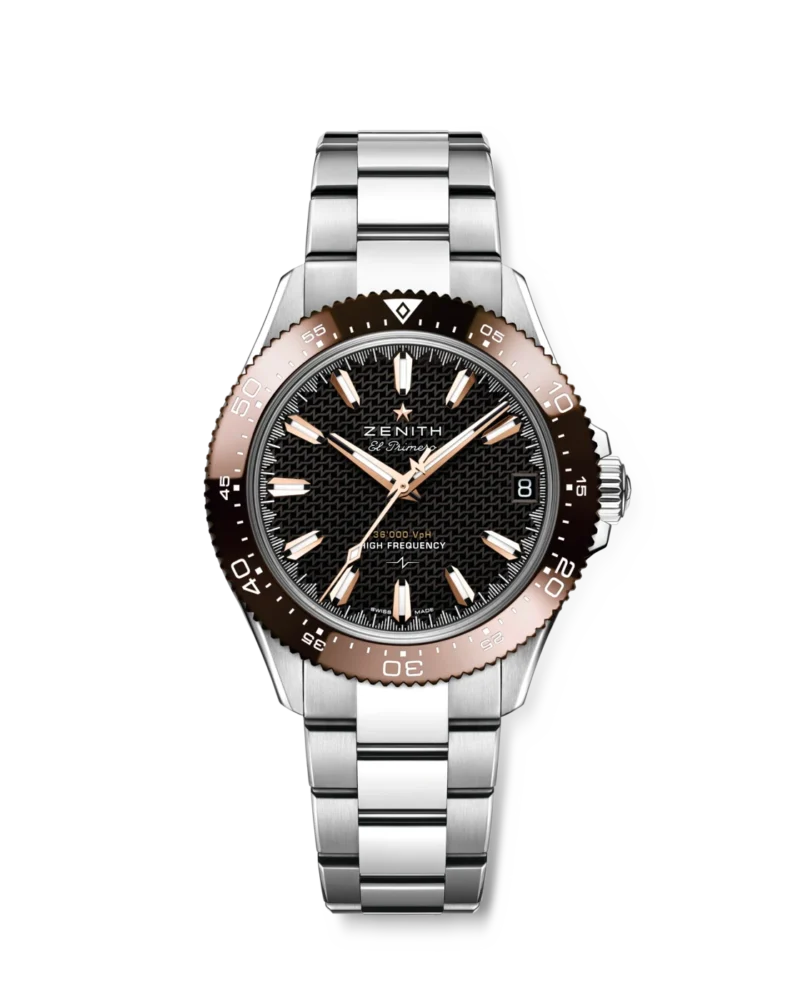
Brown ceramic brings a warmer reading to the same steel case and bracelet. Courtesy of Zenith.
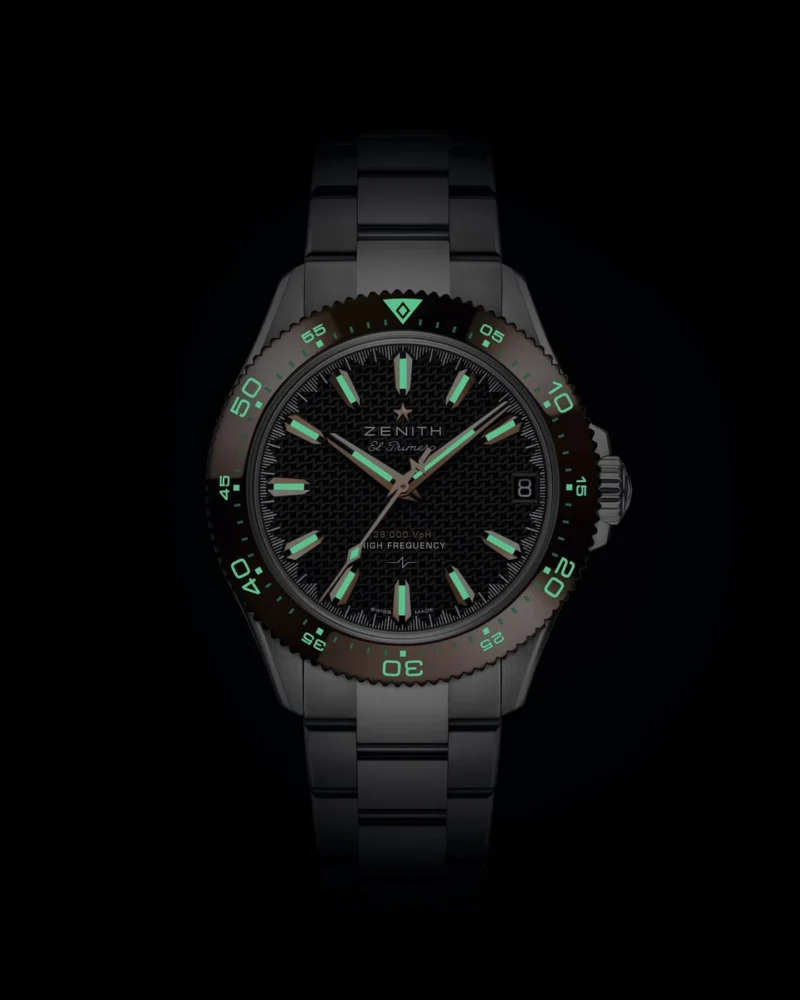
The brown dial disappears into shadow while the functional display remains legible. Courtesy of Zenith.
The black, white and brown options could be dismissed as a simple launch palette, but the use of ceramic on the dial as well as the bezel is important to the visual result.
On the white reference, Zenith applies a sunray finish before the repeated motif becomes part of the surface. The black and brown versions are polished, producing a harder reflective field. The pattern therefore behaves differently with light depending on the colour and finishing treatment.
This matters because the dial is carrying the burden that the chronograph registers used to carry. It needs depth without subdials, and it needs a reason to look recognisably Zenith without leaning entirely on the star logo.
The brown reference is especially useful in this respect. It proves that the design is not dependent on the obvious black-and-white sports-watch vocabulary. The architecture survives a warmer colour, which suggests the pattern is intended as a long-term collection code rather than a one-season graphic.
ZENCLASP is not the headline, but it may be the feature owners notice every day
Zenith introduced its ZENCLASP folding clasp at Watches and Wonders earlier in 2026, and the Solo Sport uses it across all four references.
The mechanism allows tool-free adjustment in 2.5 mm increments over a total range of 10 mm. Zenith says the clasp contains 41 components and required three years, or about 1,800 hours, of development and optimisation. The manufacture also reports durability testing representing more than 600,000 cumulative opening and closing cycles.
Those numbers are unusually detailed for a clasp, which is useful because it prevents the feature from becoming vague ergonomic copy. The practical point is simple: wrist size changes during the day, particularly with heat and activity, and a sports-oriented bracelet benefits from fine adjustment without removing the watch.
There is also a broader lesson here. The Solo Sport’s identity is built less around one spectacular mechanism than around several everyday engineering choices: crown, water resistance, bezel, bracelet adjustment, stop-seconds and power reserve. That distribution of attention is different from the usual Chronomaster proposition.
The Solo Sport does not prove that high frequency is automatically more accurate
This is one place where language needs discipline.
Zenith describes the watch in terms of high-frequency precision, and the 5 Hz regulating organ is central to El Primero history. But frequency alone does not establish the real-world daily rate of an individual watch, nor does the public launch material provide a specific chronometer tolerance for the Solo Sport.
A higher beat rate changes the behaviour of the regulating system, but it is not a standalone certificate of accuracy. Regulation, position, amplitude, shock response, temperature and the condition of the movement still matter.
The correct claim is narrower and stronger: Zenith has preserved a 5 Hz architecture in a time-only Chronomaster, and it has done so using an El Primero-derived manufacture calibre rather than treating the name as styling.
That is enough. There is no need to promise more.
What the Solo Sport changes about Chronomaster
For years, the simplest way to explain Chronomaster was through the chronograph. The collection could move between revival pieces, open dials and modern ceramic-bezel sports watches, but elapsed-time measurement remained its centre of gravity.
The Solo Sport moves that centre.
Chronomaster can now mean a watch defined by El Primero frequency even when there is no chronograph. The historical connection is therefore more abstract than before. Instead of preserving a function, Zenith preserves a regulating principle and then builds a new case, bezel, dial and bracelet around it.
There is risk in that move. If too many future Chronomaster models abandon the chronograph, the collection could lose the sharp identity that made the name useful in the first place. The Solo Sport works precisely because it feels like an exception with a clear mechanical argument.
But it also opens a credible path. Zenith now has a three-hand platform with serious water resistance, a robust bracelet system and a movement that belongs to the same technical family as its modern chronographs. That could give Chronomaster a broader role without forcing every daily-wear Zenith into the Defy architecture.
The answer is frequency, but only if Zenith keeps earning it
So what is El Primero without a chronograph?
In the Solo Sport, Zenith’s answer is 5 Hz.
That answer is convincing because the manufacture has done more than remove components from an existing Chronomaster Sport dial. It uses calibre 3620, itself derived from the 3600 architecture, retains the silicon escapement and high-frequency regulator, adds a case designed for 20 ATM water resistance, gives elapsed-time duty to a rotating bezel, and develops a new dial language that does not pretend to be an A386.
The result is less obviously “El Primero” than a tri-colour chronograph. It is also a useful test of how strong that name really is.
If El Primero is only the chronograph function, the Solo Sport is a contradiction. If El Primero also means a specific high-frequency approach to mechanical timekeeping, the watch makes sense.
Zenith has chosen the second definition. The Chronomaster Solo Sport is the evidence.
Sources & further reading
- Zenith official pressroom and current product pages, checked against the Maison’s launch specifications on 8 September 2026. Duplicate caseback renditions supplied under different reference routes were deliberately excluded.
- TheTimeo distinguishes official specifications from editorial interpretation and does not claim hands-on inspection.
The Edit
Watches stories
Selected stories from the same editorial universe.
Audemars Piguet Neo Frame Jumping Hour: Why the New Calibre Matters More Than the Vintage Shape
Audemars Piguet returns to a two-window jumping-hour format from the late 1920s, reversing its
Bulgari Octo Finissimo Dual Time x Vianney Halter
Bulgari and Vianney Halter give the Octo Finissimo four separate displays, a new calibre
F.P. Journe Résonance: understanding the generations
Two balances, a distinctive dial and several important revisions. How to recognise the main
Omega Seamaster Diver 300M Chronograph “007 First Light”: The Bond Watch That Launched Inside a Video Game First
A TheTimeo collector reading of ref. 210.32.44.51.01.002 — the first chronograph in James Bond’s
Breitling Navitimer Cosmonaute Artemis II: The Watch That Went Back to the Moon
A TheTimeo collector reading of the Breitling Navitimer Cosmonaute Artemis II, ref. AB02307A1C1P1: meteorite
Bulgari Octo Finissimo 37mm: When Minimalism Becomes a World Record, Twice
A TheTimeo collector reading of the Bulgari Octo Finissimo 37mm: the new BVF 100