

Miniaturisation / Volume Study
Watches
Blancpain Lady B: What Does 19 Millimetres Require?
Blancpain’s 19 mm Lady B is best understood as an exercise in mechanical volume: calibre, rotor, strap and setting compressed into one small boundary.
TheTimeo view
A 19 mm case is not one small dimension. It is a stack of competing clearances.
Lady B looks simple because its complexity has been compressed out of sight. Calibre 615 fills most of the nominal diameter, while the strap passes through the case and the automatic rotor defines the back's internal geometry.
The simplicity is the result, not the method.
TheTimeo
The visual edit
Fifteen millimetres of movement. Nineteen of watch.
The two Lady B references share the same nineteen-millimetre architecture. Courtesy of Blancpain.
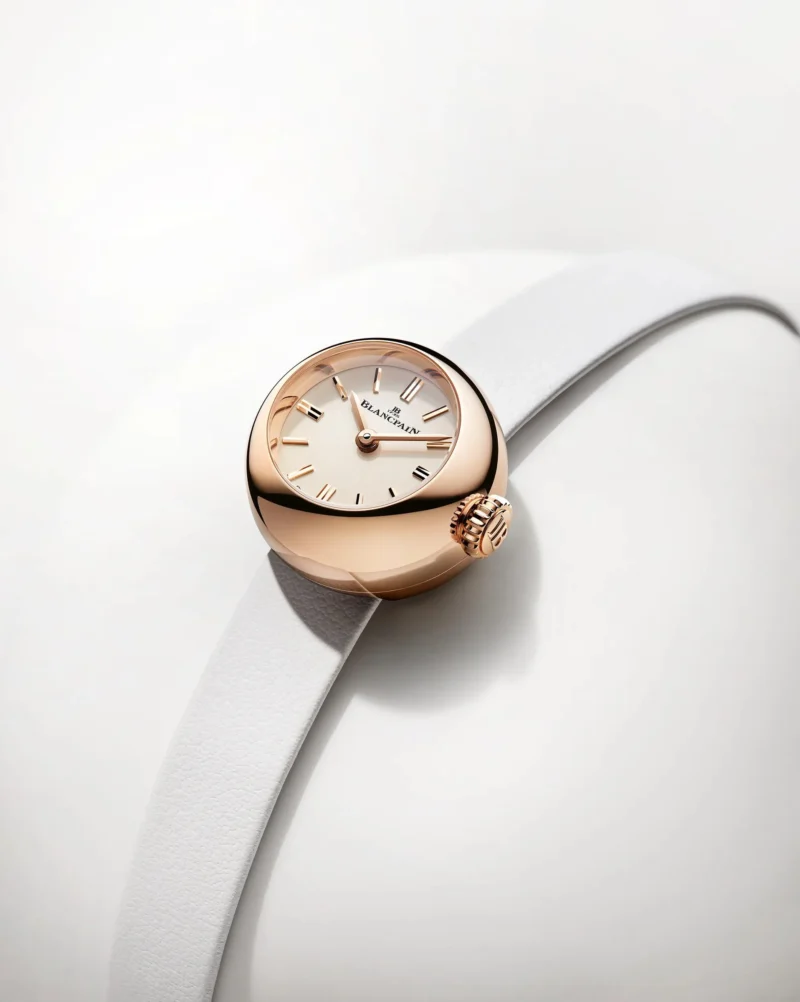
The rounded case and concealed strap passage turn the watch into a compact volume rather than a conventional case with projecting lugs. Courtesy of Blancpain.
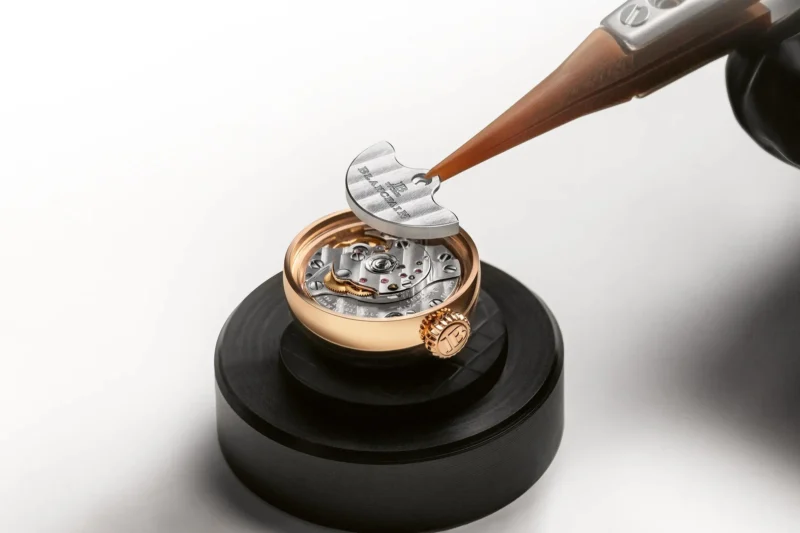
Miniaturisation is built through tolerances, surfaces and interfaces before the finished object appears simple. Courtesy of Blancpain.
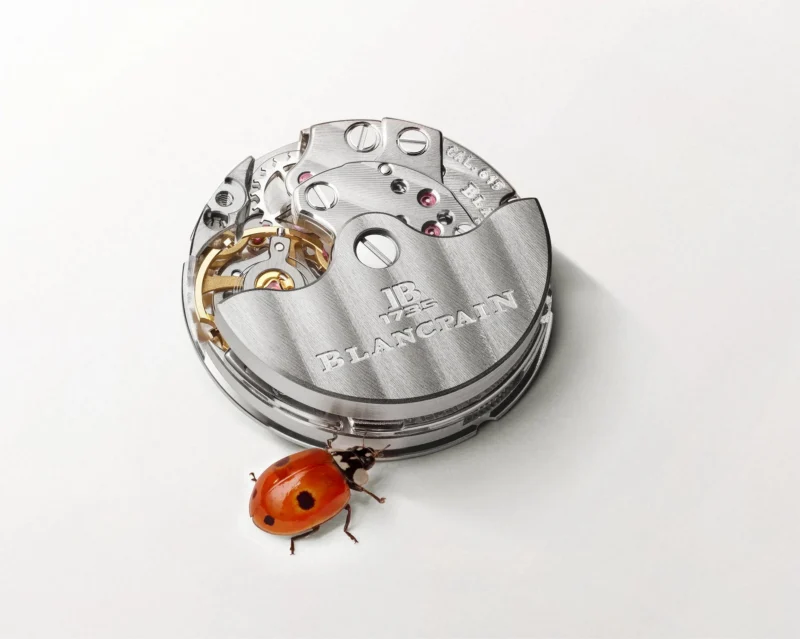
The automatic rotor requires its own moving clearance inside the compact caseback. Courtesy of Blancpain.
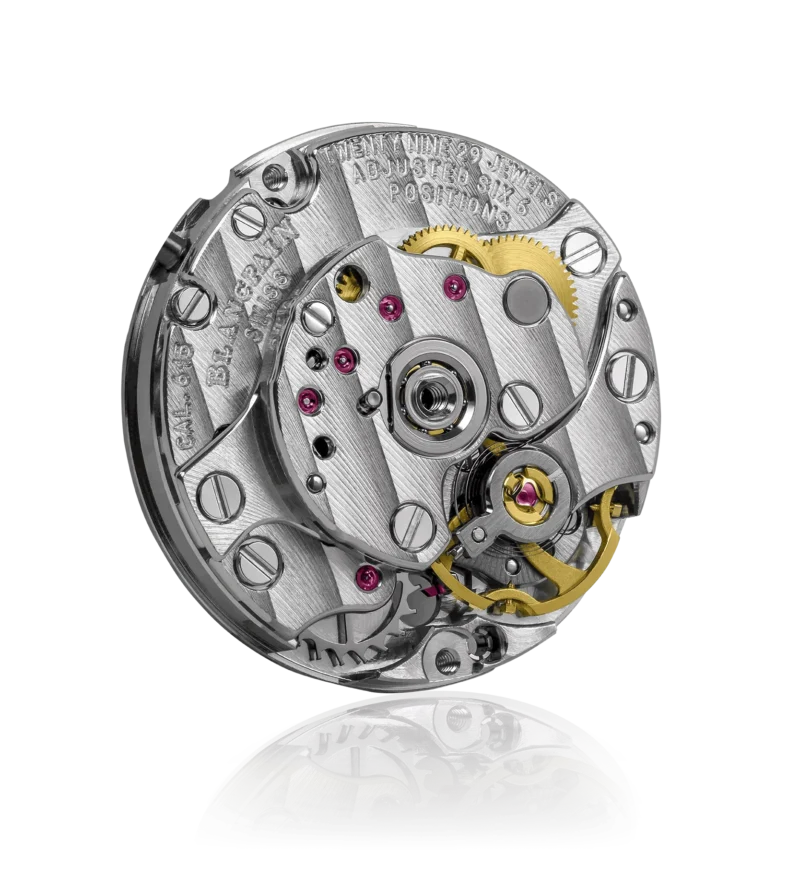
Calibre 615 measures 15.70 by 3.90 millimetres and stores 38 hours of energy. Courtesy of Blancpain.
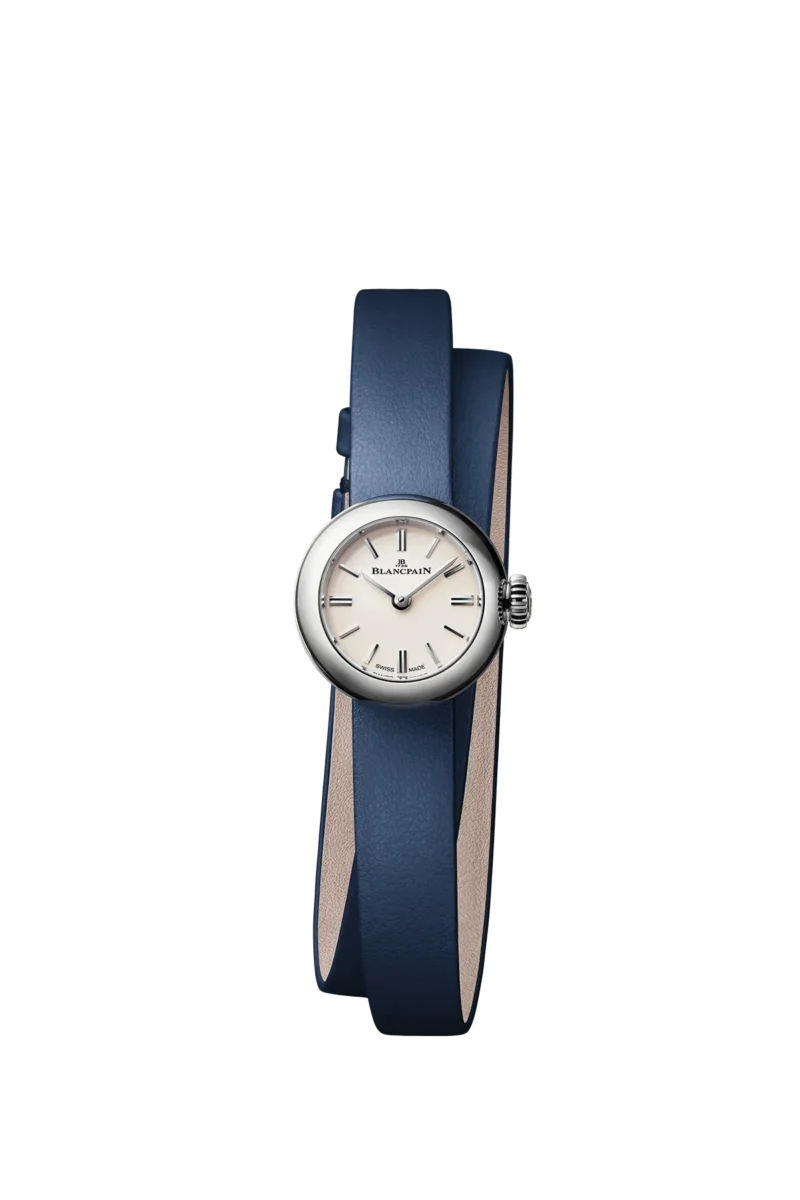
The steel reference uses an opaline dial, applied gold batons and a diamond-set case. Courtesy of Blancpain.
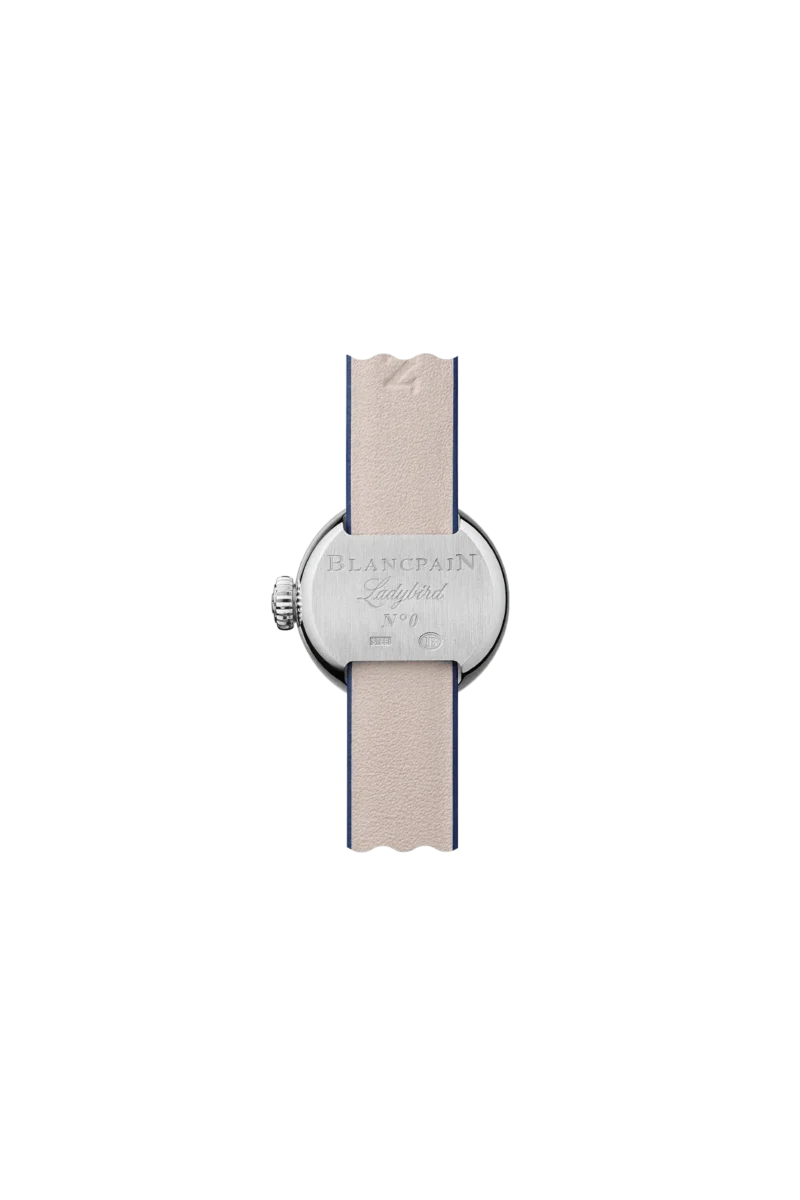
The shaped rear volume closes around the automatic movement. Courtesy of Blancpain.
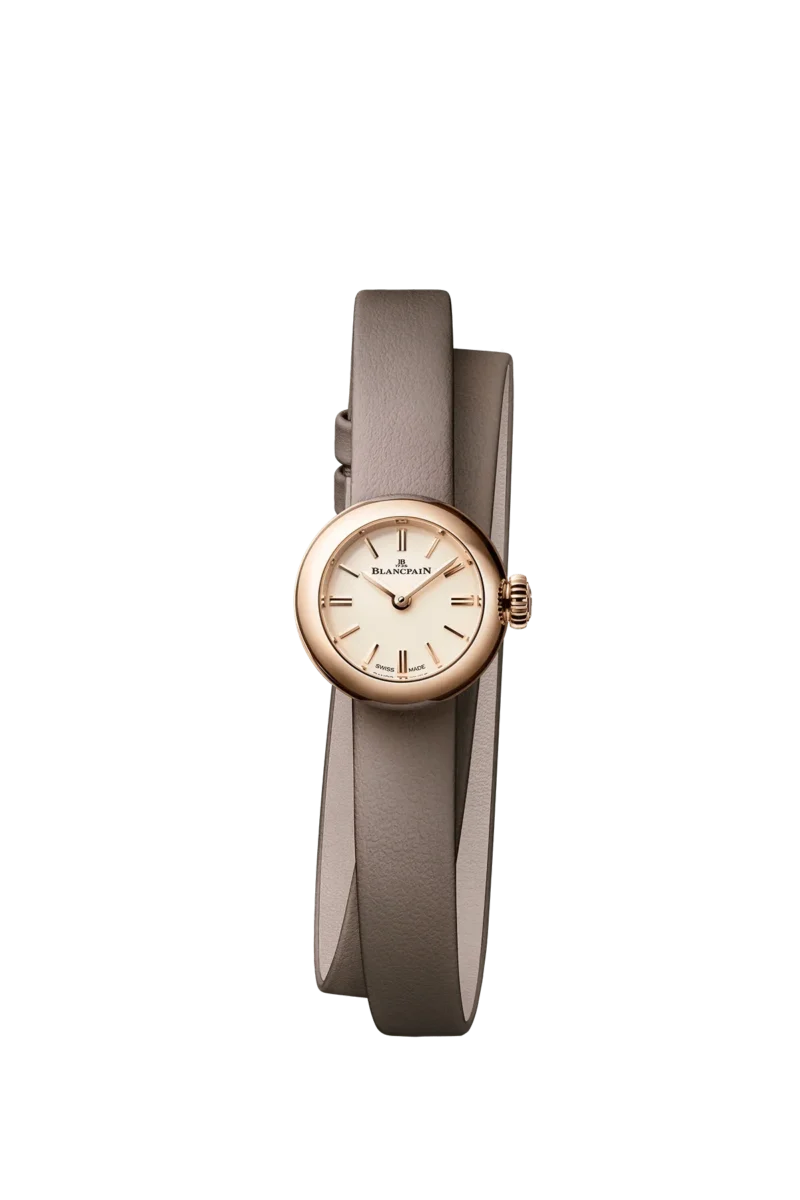
The red-gold version places the same calibre and display inside a warmer material architecture. Courtesy of Blancpain.
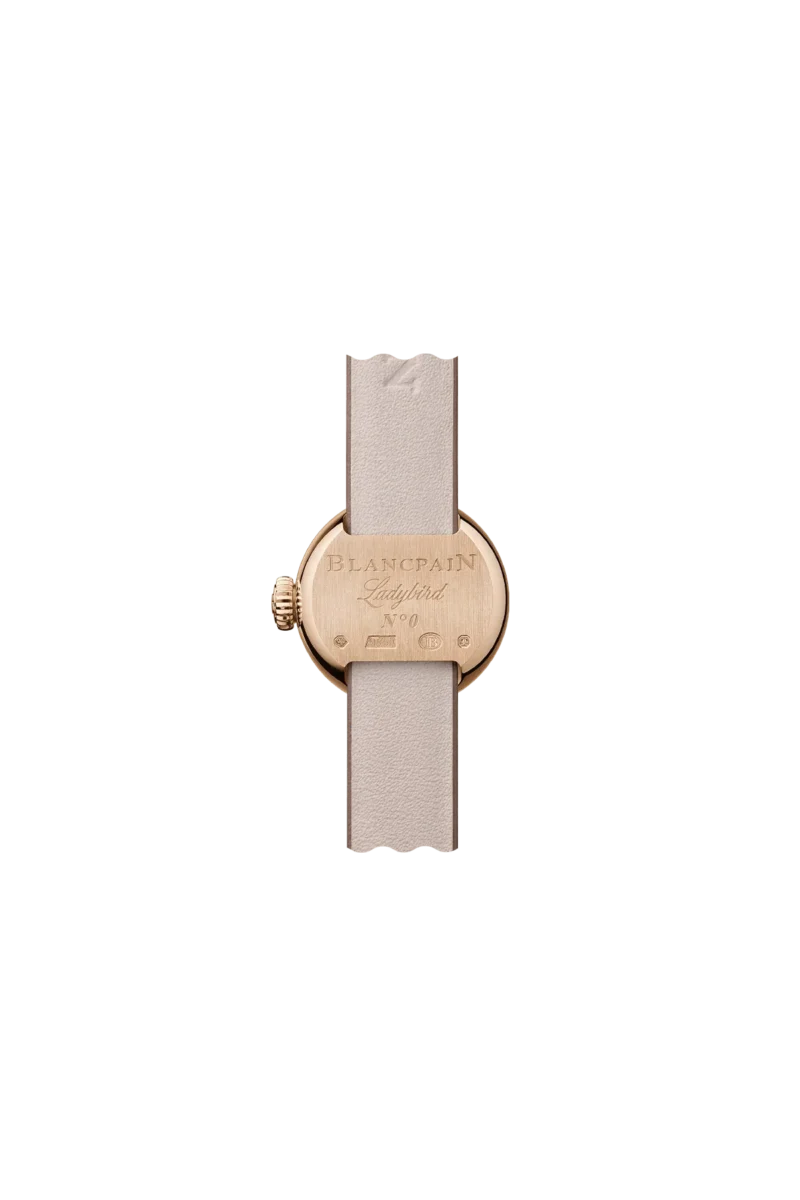
The caseback reveals how much of the nineteen-millimetre plan belongs to the movement. Courtesy of Blancpain.
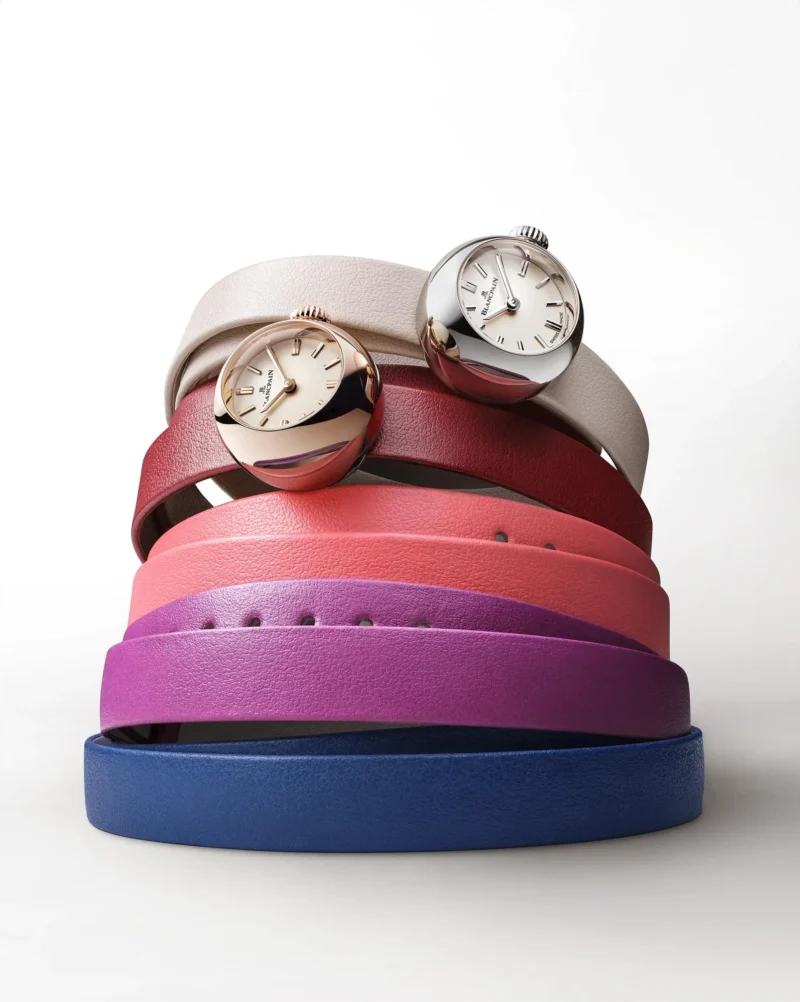
Material changes the presence of the object without changing its compact technical proposition. Courtesy of Blancpain.
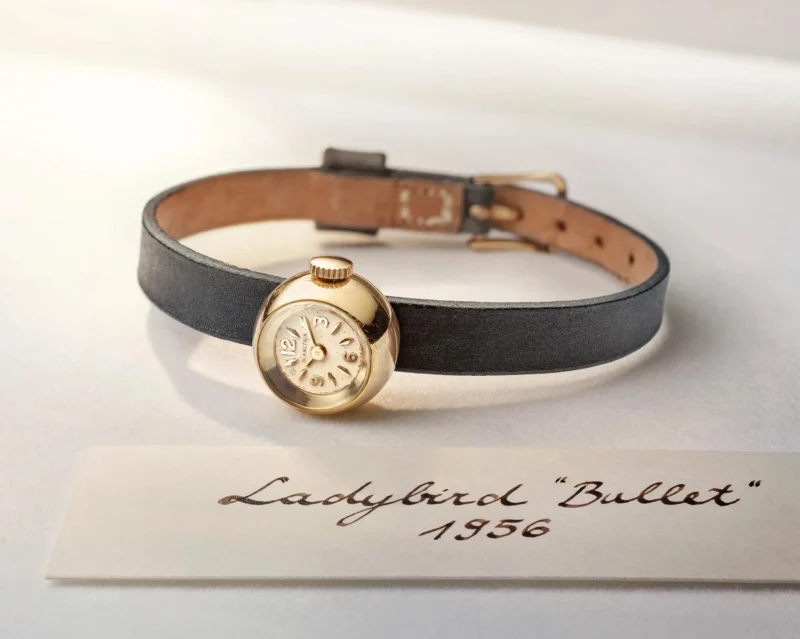
The 1956 Ladybird Bullet supplies the historical proposition, not a template for literal reproduction. Courtesy of Blancpain.
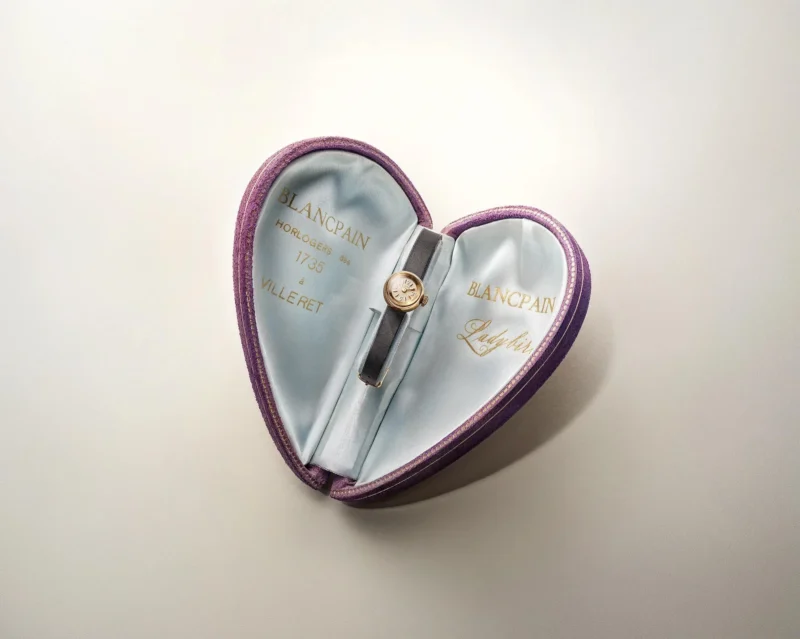
The surviving historic object anchors Lady B in a documented Ladybird lineage. Courtesy of Blancpain.

The double-tour strap changes the apparent scale of the nineteen-millimetre watch on the wrist. Courtesy of Blancpain.
Volume ledger / Four clearances
Diameter is only the first limit.
A nineteen-millimetre watch is not a flat measurement. It is a stack of mechanical, structural and wearable clearances.
Movement footprint
15.70 mm
82.6% of the nominal case diameterCalibre 615 leaves 3.30 mm across the published diameters before walls, tolerances and shock protection are considered.
Moving clearance
Automatic
Rotor beneath a shaped casebackThe winding mass needs a free trajectory inside the rear volume. Miniaturisation is therefore three-dimensional, not a dial-side exercise.
Strap passage
10 x 1.6 mm
Attachment absorbed into the lower caseThe strap crosses the watch through a concealed passage rather than conventional projecting lugs, preserving the nineteen-millimetre outline.
Sealed object
3 bar
Setting, walls and seals inside one boundaryThirty-four diamonds, the crystal, the crown and the water-resistant envelope all compete for the same finite volume.
Key facts
- Lady B was presented on 17 September 2026 for the Ladybird’s 70th anniversary.
- The case is 19 mm across, available in steel or 18K red gold, and rated to 3 bar.
- Blancpain currently publishes two thickness figures: 13.2 mm on the Lady B editorial page and 14.9 mm on the reference pages. The difference remains unresolved.
- Automatic Calibre 615 measures 15.70 by 3.90 mm, contains 180 components and 29 jewels, runs at 3 Hz and stores 38 hours of energy.
- The double-tour calf strap passes through a 10 by 1.6 mm channel in the lower case.
- Lady B is a contemporary interpretation of the 1956 Ladybird Bullet, not a literal reissue.
A watch 19 millimetres across leaves little room for euphemism. The movement either fits or it does not. The rotor must turn, the stem must reach the calibre, the case must close, the strap must attach and the whole object must remain sealed.
That is why Blancpain’s Lady B is more interesting as a packaging problem than as a return to petite proportions. Its automatic Calibre 615 already occupies 15.70 mm of the nominal diameter. Only 3.3 mm remain across the full width before the real work of walls, clearances, seals and interfaces begins.
The finished watch looks almost disarmingly simple. Its case is a polished sphere with an opaline dial and no conventional lugs. The simplicity is the result, not the method.
The movement takes most of the plan
Calibre 615 is not a 2026 invention. Blancpain introduced it in 1995 and continues to use it in compact watches. It is automatic, 3.90 mm thick, built from 180 components and 29 jewels, and uses a silicon balance spring. Its stated reserve is 38 hours.
Placing a 15.70 mm calibre inside a 19 mm case means the movement spans about 82.6 per cent of the watch’s nominal diameter. That percentage is not a construction drawing, but it reveals the brief. Lady B could not be designed as a conventional round watch and then reduced evenly.
Automatic winding sharpens the constraint. A rotor is not just another component. It needs an unobstructed path while the watch moves. Blancpain says the geometry of the back was developed around the specific trajectory of the oscillating mass. The closure of the case therefore becomes part of the movement’s operating space.
The movement is hidden in normal use. This is a quiet decision. Many contemporary mechanical watches prove value through a transparent back; Lady B lets the calibre dictate the exterior and then suppresses it beneath a closed shell.
The automatic rotor requires its own moving clearance inside the compact caseback. Courtesy of Blancpain.
Thickness is part of the idea, and the published record conflicts
Blancpain describes Lady B as a watch conceived in volume and assigns it a volume of 2.9 cubic centimetres. The Maison’s editorial page says the case is 13.2 mm thick. Its steel and red-gold reference pages list 14.9 mm.
Both figures are current official statements. Blancpain does not explain whether they use different measurement conventions, and TheTimeo has not found a technical drawing that reconciles them. The honest reading is therefore not to choose the more attractive number. It is to keep the 19 mm diameter, the 2.9 cubic centimetre claim and the two published thickness figures separate until the Maison corrects or clarifies the specification.
Either figure describes an unusually tall proportion for the diameter. Blancpain turns that height into a continuous spherical form rather than presenting a stacked bezel, middle and back. From above, the lower section retreats beneath the upper volume. Thickness is not disguised as thinness; it is shaped into the object’s character.
The strap removes the lugs, not the engineering
A lugless case still needs a secure route to the wrist. Lady B sends its double-tour calf strap directly through a channel in the lower case. Blancpain gives the opening as 10 by 1.6 mm and says its interior is micro-blasted so the leather can pass through it.
That slot is easy to dismiss as styling. It is actually one of the moves that allows the case to remain spherical. Conventional lugs would add width, drilled interfaces and another visual axis. Here the attachment is absorbed into the object.
The double-tour format changes scale in a different way. The mechanical head remains minute while the strap draws a broader line around the wrist. Blancpain now lists seven colours: white, beige, mocha, burgundy, blue, coral and purple. The launch package supplied earlier listed six, but the direct official page governs the current count.
The historical Ladybird Bullet used a related pass-through idea. The contemporary watch does not copy its case line for line, but it preserves the useful logic of treating the strap as part of the package rather than an appendage.
Calibre / setting / concealed attachment
Smallness is the result of several architectures agreeing.
Miniaturisation is built through tolerances, surfaces and interfaces before the finished object appears simple. Courtesy of Blancpain.
The automatic rotor requires its own moving clearance inside the compact caseback. Courtesy of Blancpain.
Calibre 615 measures 15.70 by 3.90 millimetres and stores 38 hours of energy. Courtesy of Blancpain.
Mechanical context
The architecture, in two acts.
Lady B / steel
The cooler expression of the same miniaturised architecture.
- Range
- 19 mm
- Display
- 14.90 mm on product page; 13.2 mm editorial
- Control
- Calibre 615 · automatic
- Isolation
- 3 bar
- Flyback
- 38 hours
Lady B / red gold
Warm material changes presence, not the mechanical volume problem.
- Range
- 19 mm
- Display
- 14.90 mm on product page; 13.2 mm editorial
- Control
- Calibre 615 · automatic
- Isolation
- 3 bar
- Flyback
- 38 hours
A tiny dial benefits from restraint
Lady B shows hours and minutes. There is no date, seconds hand, moon phase or exposed movement. Applied gold baton indices sit on a warm opaline field within a mirror-polished rehaut.
At this scale, another indication would consume a large part of the available reading surface. The absence of extra display is not evidence of a simple mechanism. Calibre 615 still contains 180 components. It is a hierarchy decision: the dial must remain legible while the case carries most of the visual argument.
The crown remains visible at the side. That separates Lady B from the historic R550, which moved winding to the back. Blancpain is not reproducing every old solution. It is returning to the problem and accepting a different answer.
The 1956 Ladybird solved another problem
The original Ladybird movement measured 11.85 mm across. Blancpain’s historical research distinguishes side-wound R55 and back-wound R550 versions, both running at 3 Hz, after earlier 2.5 Hz R52 and R520 calibres.
The 1956 achievement was not simply a record diameter. Blancpain added a fifth wheel to the train to control the force reaching the escapement and adapted shock protection for the miniature balance. Its house history describes a balance poised with 22 gold screws and a pivot above the escape wheel measuring 0.07 mm.
Those details matter because miniaturisation without robustness would have solved only half the problem. Betty Fiechter and Jean-Jacques Fiechter wanted a movement small enough to free the exterior design while remaining usable as a wristwatch.
Lady B does not attempt to beat that 11.85 mm record. Calibre 615 is larger and automatic. The modern project begins with a proven calibre and asks how little exterior volume can surround it while retaining rotor clearance, 3 bar sealing, a practical crown and an interchangeable strap route.
The continuity is conceptual rather than genealogical. Blancpain’s own documentation does not establish an uninterrupted movement family from R55 or R550 to Calibre 615.
Finishing becomes less forgiving as the object shrinks
Blancpain says the two-part case is finished by hand across polished, satin-finished and micro-blasted areas. Each surface is worked on an assembled watch while adjacent zones are protected. Engravings are cut mechanically rather than left entirely to laser processing.
On a broad case, a softened junction consumes a small proportion of the surface. On a 19 mm object, the same imprecision occupies much more of what the eye sees. Miniaturisation changes the tolerance of appearance as well as the tolerance of mechanics.
The official manufacturing image makes that point better than a complication count. It shows the case held as a small object under a tool, with the movement exposed nearby. The work is concentrated in transitions, access and clearance rather than in another indication on the dial.
What the specification does not prove
Blancpain does not publish a daily rate tolerance for Lady B. The silicon balance spring is a documented material feature, not permission to invent a numerical accuracy claim. A frequency of 3 Hz is likewise one variable inside an oscillator system, not a verdict on performance.
The 3 bar rating is the stated sealing specification. It should not be converted into advice about swimming, particularly with a calf-leather strap, without Blancpain’s use guidance.
Nor is it necessary to declare Calibre 615 the smallest automatic movement currently in production. Blancpain calls it one of the smallest contemporary round automatic mechanical movements. A universal ranking would require a wider audit and a definition of production.
These limits leave the important achievement intact. Lady B puts a moving automatic system inside a diameter only 3.3 mm wider than the calibre, then finds room for case walls, setting, sealing and the passage that carries the strap.
TheTimeo view
Lady B works because it does not pretend that one number explains smallness. Diameter, calibre footprint, rotor path, thickness, volume and attachment are different constraints.
The 1956 Ladybird pursued a movement record and made that miniature architecture robust. The 2026 watch starts with a known automatic calibre and compresses the object around it. Its most persuasive features are the ones that disappear when the design succeeds: the caseback shaped for a moving mass, the channel hidden beneath the sphere, the interfaces contained inside a polished 19 mm boundary.
This is mechanical miniaturisation as spatial editing. What remains visible is the calm surface left after every necessary part has found somewhere to go.
The Edit
Stories selected by TheTimeo

Rolex Perpetual Padellone: How an Annual Calendar Makes Three Displays Jump at Midnight
At midnight, Rolex’s new annual calendar has to identify a short month, skip a
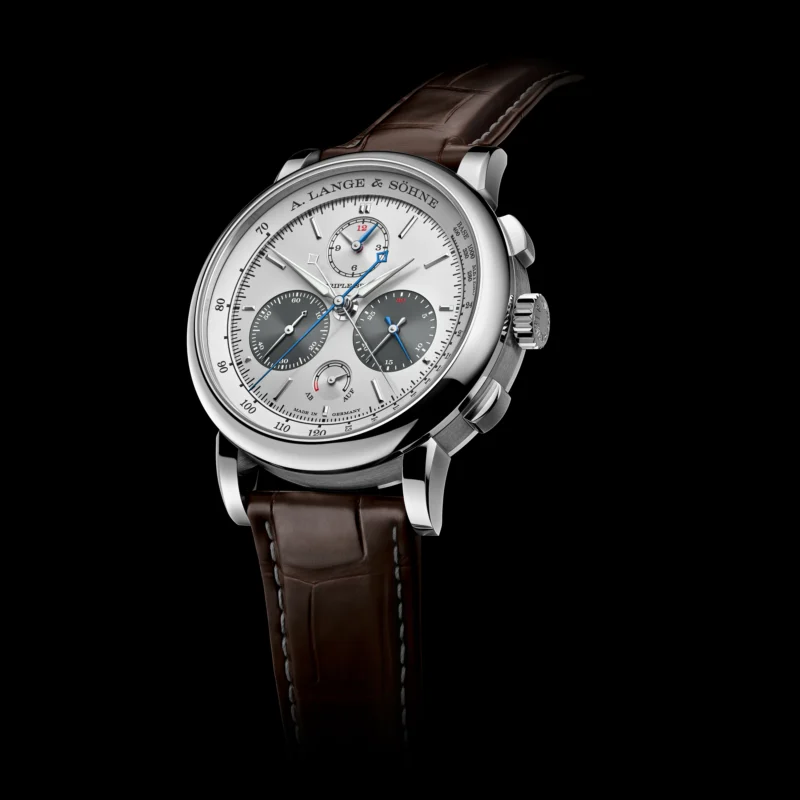
A. Lange & Söhne Triple Split: Why Twelve Hours Changes a Rattrapante
Seconds sweep, minutes jump and hours advance continuously. Calibre L132.1 must hold all three
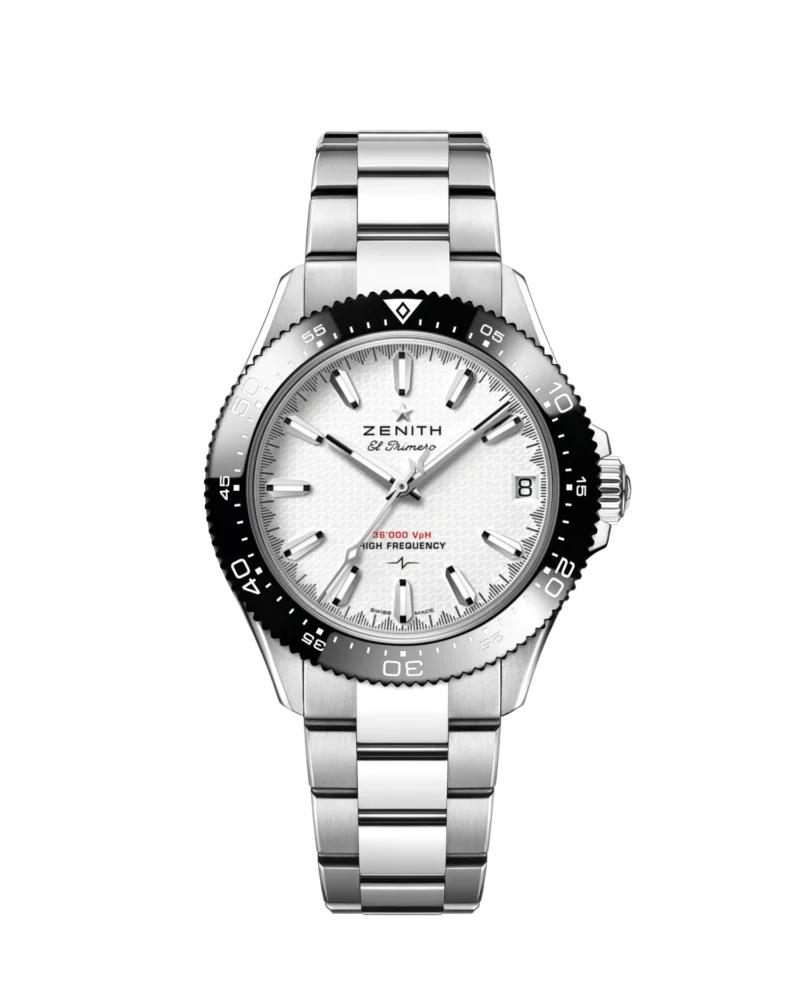
Zenith Chronomaster Solo Sport: What Is El Primero Without a Chronograph?
Zenith removes the pushers and counters from Chronomaster but keeps El Primero at 5