
Watchmaking Intelligence / Flagship
Watches
A. Lange & Söhne Triple Split: Why Twelve Hours Changes a Rattrapante
Seconds sweep, minutes jump and hours advance continuously. Calibre L132.1 must hold all three comparative times, reunite them and fly them back as one.
TheTimeo view
A mechanical memory in three scales
The platinum case is the visible update. The deeper story is a mechanism that asks seconds, jumping minutes and continuous hours to preserve one comparative time without losing another.
The stopped hand's position is the memory.
TheTimeo technical reading
The signature mechanism
One command.
Three registers.
Move through the sequence to see how one split-second command changes character across seconds, minutes and hours.
A split-seconds chronograph begins with an elegant illusion. Two central hands travel as one until a press of the rattrapante pusher leaves one behind, holding an intermediate time, while the other continues. Press again and the stopped hand catches its partner. The disagreement was temporary; the measurement never stopped.
The A. Lange & Söhne Triple Split stages that manoeuvre three times at once. Its paired seconds hands share the central axis. Paired elapsed-minute hands occupy the register at four o’clock. Paired elapsed-hour hands sit at twelve. One command arrests the three blued split hands while the corresponding rhodiumed chronograph hands continue. Another releases them. A third can fly every active timing hand back to zero and immediately begin again.
That is the spectacle visible on the dial. Underneath it, seconds, minutes and hours refuse to behave like copies of one another. The minute display jumps; the hour display creeps. The faster indications need protection from the drag created when a split hand is clamped; the hour counter has different torque conditions. Twelve hours, in other words, are not thirty minutes multiplied by twenty-four. They force the rattrapante to become a different machine.
The platinum watch introduced in September 2026 does not bring a new calibre. L132.1 has powered the Triple Split since 2018. The new reference is better understood as a change of light and material around an existing piece of engineering — and as a reason to look again at what that engineering actually achieves.
A mechanical memory, held in place
A chronograph records elapsed time. A rattrapante preserves a second reading without interrupting the first. There is no separate memory bank. The stopped hand’s position is the memory, held physically at the instant chosen by the wearer.
In Lange’s construction, the chronograph centre hand sits on a tubular arbor and the split-seconds hand on an inner arbor. While connected, their wheels travel together and the hands appear to be one. When the split is taken, a clamp arrests the rattrapante wheel while the chronograph wheel beneath it keeps turning. Release the clamp and a lever working against a heart-shaped cam returns the split wheel to the running reference by the shortest route.
That simple description hides a delicate exchange. The watch must hold one indication firmly enough to read it, allow the other to run with as little disturbance as possible, then recouple them without losing the elapsed time already gathered. A rattrapante adds a moving indication, a new control state and a potential source of friction to a mechanism that is already starting, stopping and resetting on demand.
The familiar version of the complication is also brief. A central split-seconds hand can preserve a difference within one rotation, but after a minute the comparison loses its cumulative context. The minute totaliser continues to report the underlying chronograph; the stopped seconds hand alone cannot tell you which minute it belongs to.
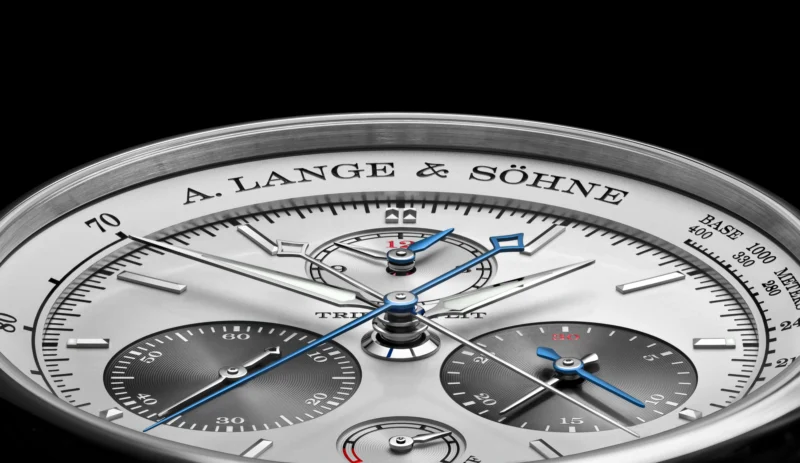
The central seconds, jumping-minute register at four and continuous-hour register at twelve form three comparative scales. Courtesy of A. Lange & Söhne.
Thirty minutes: the Double Split’s decisive step
The Double Split of 2004 broke that limit by adding a second pair of hands to the elapsed-minute counter. A comparative reading could now retain its seconds and its minutes for events lasting up to thirty minutes.
It also made friction impossible to ignore. Once a split hand is stopped, the wheel below it continues to turn. If the lever that normally aligns the split wheel with its heart cam remains in contact with that rotating surface, it rubs continuously. Energy taken there is energy no longer available to the oscillator.
Lange’s response was a disengagement system, described by the manufacture as patented in 2005. When the rattrapante is arrested, isolating wheels lift the relevant heart levers away from the turning cams. The stopped indication is held without maintaining the friction-intensive contact that would otherwise persist throughout the split.
This matters because a split is meant to be read, not merely flashed for a fraction of a second. The mechanism has to tolerate the pause without allowing the act of comparison to become a tax on the watch’s rate stability. The Double Split applied that protection to seconds and minutes. The Triple Split retains it, then adds another, slower layer.
For a broader view of the manufacture’s contemporary language, TheTimeo’s A. Lange & Söhne 2026 survey sets the Triple Split beside the maison’s recent work with luminous displays and the Saxonia family.
Three scales, three different behaviours
The first Triple Split arrived in 2018, fourteen years after the Double Split, extending the comparative range from thirty minutes to twelve hours. The arithmetic is tidy. The mechanics are not.
Seconds are arrested by a clamp. The elapsed-minute counter advances precisely once for every completed minute rather than drifting between its marks. Its split wheel has thirty arresting positions, allowing the stopped hand to remain exactly on one of those discrete indices. The elapsed-hour counter, by contrast, advances continuously. When its split is taken, the hand is held wherever it has reached between the hour markers.
One idea is therefore expressed through three kinds of motion: the sweep of the seconds, the jump of the minutes and the slow progression of the hours. The command has to freeze each according to its own behaviour, then release all three so they can recover their moving partners.
Their frictional needs differ too. Lange uses the isolating system at the seconds and minute-counter levels, where contact with the rotating heart cams would matter most. The manufacture says the hour counter turns slowly and has sufficiently high torque that the additional isolator is unnecessary. That asymmetry reveals the calibre’s logic. Triple Split does not mean three identical mechanisms stacked vertically. It means one principle adjusted to three time scales.
Calibre L132.1
The command becomes architecture.
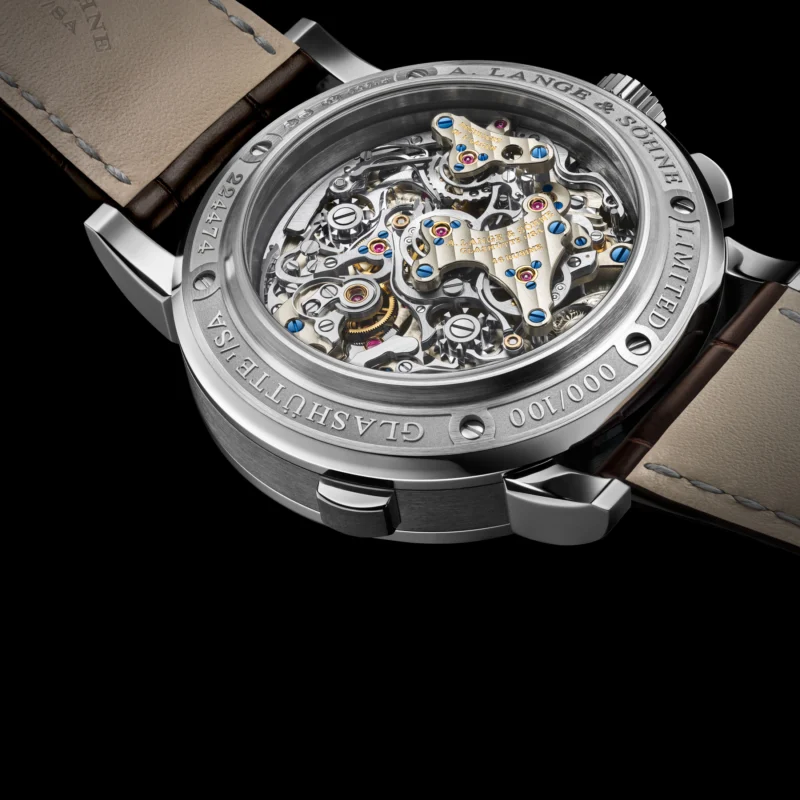
Calibre L132.1 is visible through the sapphire-crystal caseback, exposing much of its switching architecture. Courtesy of A. Lange & Söhne.
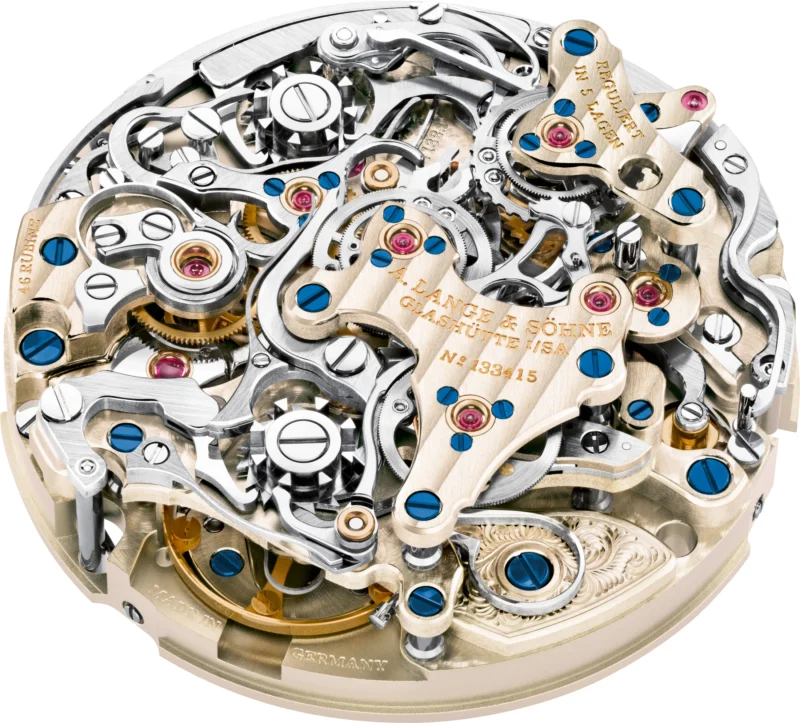
The manually wound L132.1 comprises 567 parts and has a stated power reserve of 55 hours. Courtesy of A. Lange & Söhne.
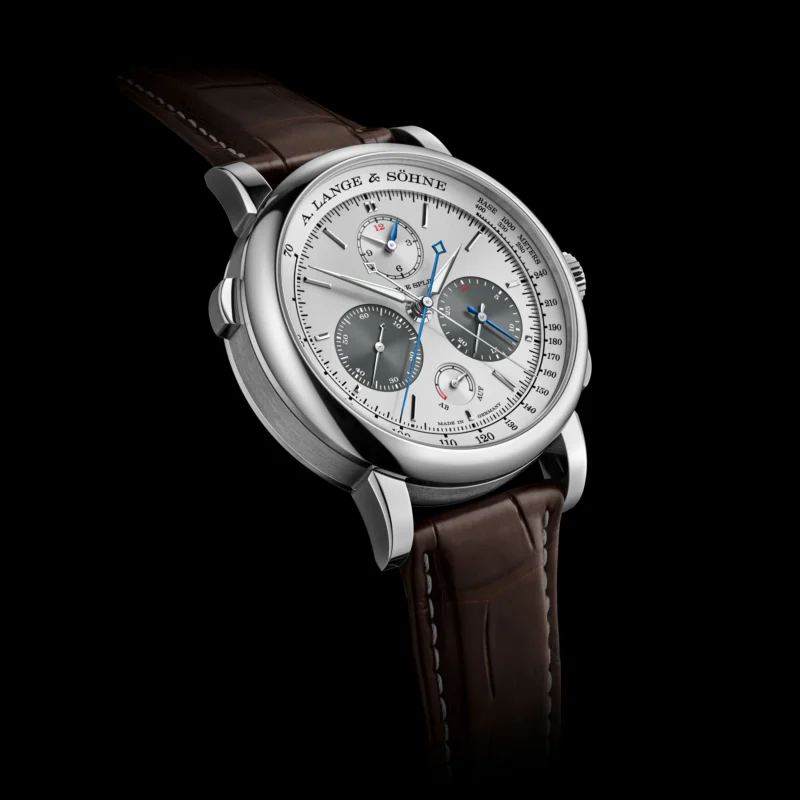
Three pushers govern chronograph, rattrapante and reset or flyback commands. Courtesy of A. Lange & Söhne.
Mechanical context
The architecture, in two acts.
Double Split · 2004
The first decisive extension preserved seconds and minutes, turning a one-revolution comparison into a thirty-minute one.
- Range
- 30 minutes
- Display
- Seconds + jumping minutes
- Control
- Rattrapante
- Isolation
- Seconds and minutes
- Flyback
- No
Triple Split · 2018–2026
A third pair of hands extends comparative timing to twelve hours while flyback must resolve every active split state.
- Range
- 12 hours
- Display
- Seconds + minutes + hours
- Control
- Rattrapante + flyback
- Isolation
- Seconds and minutes
- Flyback
- All six timing hands
Six hands, one choreography
The pusher at two o’clock starts and stops the chronograph. The pusher at ten controls the rattrapante. The pusher at four resets the display and operates the flyback. The wearer encounters three controls; calibre L132.1 must translate them into a far larger sequence of actions.
At the start, all six elapsed-time hands move in synchrony. Take a split and the three blue hands stop together as their rhodiumed partners continue. Release it and three stopped indications have to find three moving references. A rattrapante switching lever advances a column wheel, closing the split-seconds clamp while actuating the arresting elements for the minute and hour indications. A single pressure is distributed through several mechanical paths.
This is where the often-quoted count of 567 parts becomes useful — not as a score, but as evidence of visible functional states. The number includes the layers required for three pairs of timing hands, their switching and arresting systems, the isolators, the jumping minute mechanism, reset and flyback, as well as the ordinary going train. Complexity only persuades when its parts answer a coherent problem. Here, most of what the wearer sees has a corresponding mechanical consequence.
Turn the watch over and much of that consequence remains legible. Untreated German-silver bridges carry Glashütte ribbing. Five jewels sit in screwed gold chatons. Steel levers, springs and rockers are straight-grained and bevelled; acute internal corners retain the sharp geometry associated with hand finishing. Decoration does not make the rattrapante work, but it keeps the switching architecture in view instead of hiding it under a broad bridge.
Flyback: clearing a disagreement
A conventional chronograph usually asks for three actions before a fresh measurement: stop, reset, start. Flyback compresses them. Press the lower pusher while the chronograph is running and the elapsed-time hands return to zero; release it and the next measurement begins.
The Triple Split has an extra state to resolve. Its split hands might already be travelling with the chronograph hands, or they might be frozen on an intermediate reading. In the latter case, the watch contains an intentional disagreement across seconds, minutes and hours at the moment the flyback command arrives.
The control sequence first releases the arrested rattrapante wheels when necessary, allowing them to recouple through their heart systems. Only then can reset return the seconds, minute and hour indications coherently to zero, with the split hands following. Releasing the pusher re-engages the chronograph drive.
This is the complication inside the complication. A split says: remember this instant while time continues. A flyback says: discard the preceding measurement and begin again. L132.1 has to reconcile both instructions across all three scales before the next event can start.
What platinum changes — and what it leaves alone
The 2026 reference 424.025F is the third Triple Split edition documented by Lange and the first in 950 platinum. The 2018 debut used a white-gold case and grey dial; a second series of 100 pieces followed in 2021 in pink gold with a blue dial. The new edition is again limited to 100 examples.
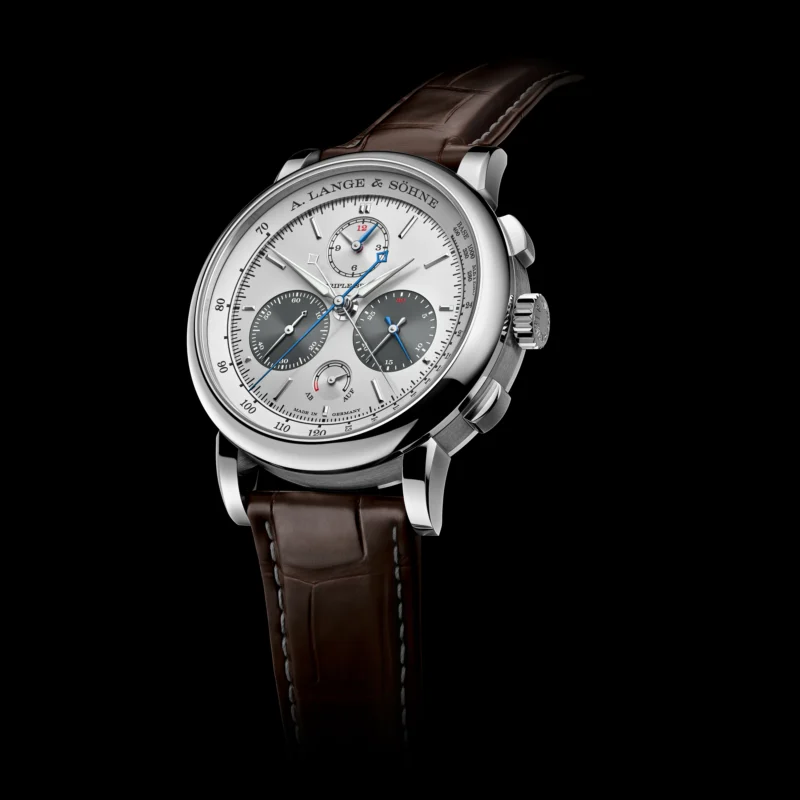
The case remains 43.2 millimetres in diameter and 15.6 millimetres high. Its dial is solid 925 silver, finished in a rhodié colour with darker grey subsidiary dials. The chronograph hands are rhodiumed and the rattrapante hands blued. Small red accents cut through the minute and hour scales and the Up/Down power-reserve display. A dark-brown alligator strap ends in a platinum deployant buckle.
Calibre L132.1 is still manually wound, runs at 21,600 semi-oscillations per hour, or 3 Hz, and offers a stated 55-hour power reserve. Lange lists 46 jewels, including five in screwed gold chatons. The movement measures 30.6 by 9.4 millimetres. The current product specification gives water resistance as 3 bar; that primary figure takes precedence over inconsistent early secondary reporting.
Platinum changes the weight, colour and scarcity of the object, not the answer beneath its dial. Lange continues to describe the Triple Split as the only mechanical split-seconds chronograph able to compare times for as long as twelve hours. That is a current manufacturer claim, not an independently audited census of every mechanical chronograph in production.
The dial is the mechanism’s map
The Triple Split appears dense because it has to communicate normal time, subsidiary seconds, power reserve, chronograph seconds, split seconds, elapsed minutes, split minutes, elapsed hours, split hours and a tachymeter scale. Read by function, the hierarchy is calmer.
Seconds occupy the central axis and the widest visual field. They are the fastest elapsed-time indication and the easiest to compare directly. The four o’clock register carries the precisely jumping minute pair. The smaller register at twelve holds the continuous hour pair. Subsidiary seconds sit at eight; the Up/Down reserve indication occupies the lower segment.
These are not equal circles arranged for symmetry. Each comparison receives a scale suited to the precision with which it must be read. The blue split hands provide another layer of information. While superposed they almost disappear. Take a split and blue remains behind as rhodium moves on. Colour identifies the set of hands carrying the stored time.
The 2026 grey-on-rhodié treatment makes that information feel more architectural. Platinum, silver, blue steel and the sparing red accents give the eye a route through the complication. The design does not make the calibre simpler; it makes its states readable.
What twelve hours really proves
The Triple Split is not compelling because it can replace a digital stopwatch. The electronic device will be cheaper, more precise and easier to read. Nor is 567 a magic number. A more complicated movement is not automatically a better one.
Its achievement is coherence. Press the rattrapante and the watch must hold three memories while one chronograph keeps running. Release it and three stopped indications must recover three moving references. Trigger the flyback and any disagreement has to be cleared before the next measurement begins. Throughout, the oscillator must keep receiving enough energy for the isolators’ work to matter.
The new case is a platinum frame around a decision made over two decades. In 2004, Lange decided a mechanical split should survive beyond sixty seconds. In 2018, it asked the same idea to survive beyond thirty minutes. The 2026 watch gives that architecture another hundred cases and a cooler, quieter face. Its question remains wonderfully excessive: how long can a mechanical watch preserve a comparative time before the rattrapante itself has to become another kind of machine?
For more on contemporary chronograph design, explore TheTimeo’s Watches archive or its close reading of a modern flyback chronograph.
Methodology and sources
TheTimeo checked specifications and mechanism descriptions against A. Lange & Söhne’s 2026 press release, current product page, rattrapante mechanism overview, history of short-time measurement, 2018 Triple Split archive and Double Split reference page. Product specifications and availability can change; the article was last verified on 15 September 2026.
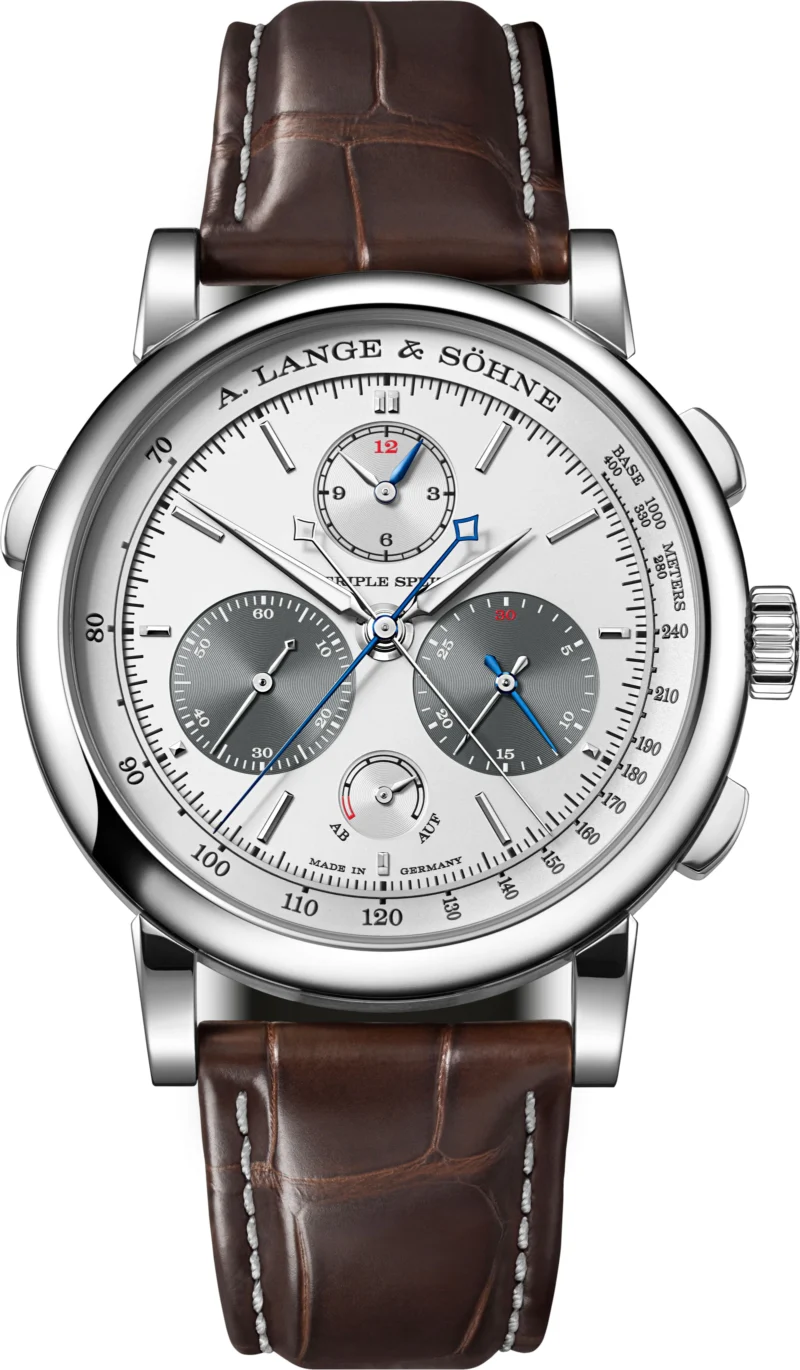
Reference 424.025F measures 43.2 mm across and 15.6 mm high. Courtesy of A. Lange & Söhne.
The Edit
Stories selected by TheTimeo
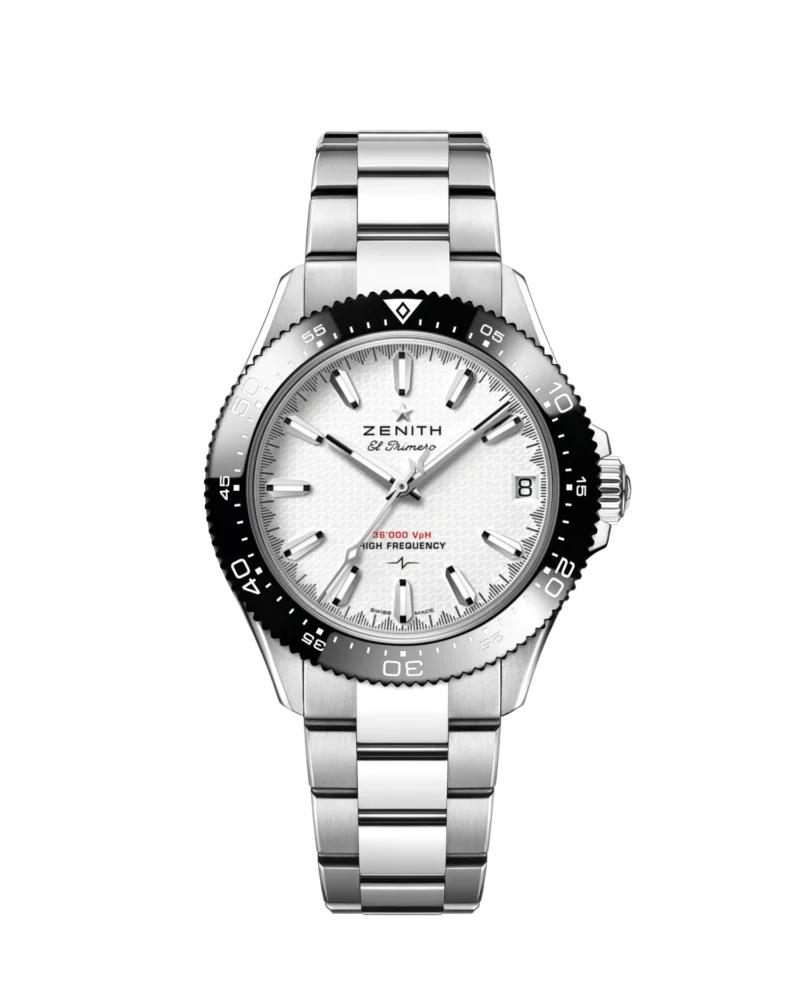
Zenith Chronomaster Solo Sport: What Is El Primero Without a Chronograph?
Zenith removes the pushers and counters from Chronomaster but keeps El Primero at 5
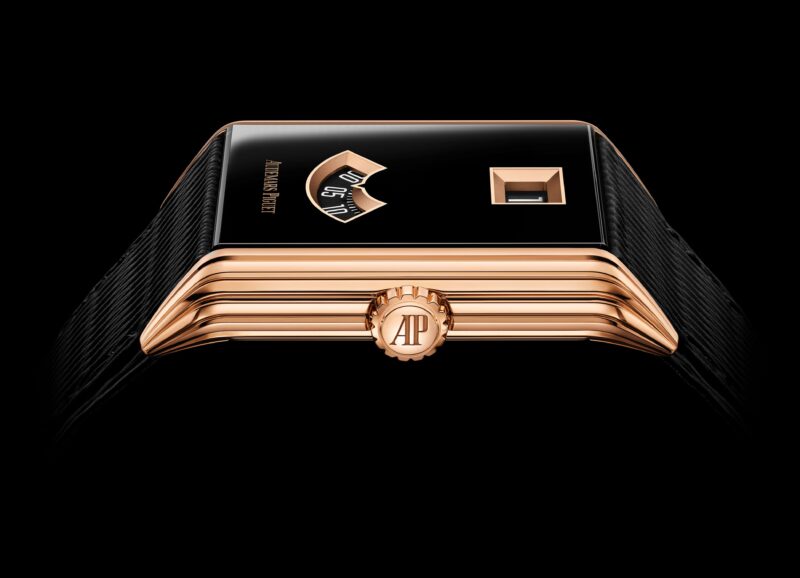
Audemars Piguet Neo Frame Jumping Hour: Why the New Calibre Matters More Than the Vintage Shape
Audemars Piguet returns to a two-window jumping-hour format from the late 1920s, reversing its

Bulgari Octo Finissimo Dual Time x Vianney Halter
Bulgari and Vianney Halter give the Octo Finissimo four separate displays, a new calibre