
TheTimeo / Watches
Octo FinissimoThrough Halter’s eyes
Bulgari and Vianney Halter give the Octo Finissimo four separate displays, a new calibre and two distinct characters in titanium and rose gold.

The Dual Time in titanium and rose gold, with an integrated bracelet and a brown alligator strap respectively. Source: Bulgari / Vianney Halter.
Explore the story
Four white displays, blue hands and a red arrow: Vianney Halter has given the Octo Finissimo a new way of telling the time. Its familiar angular case now frames a small collection of instruments, each with a task of its own.
The change reaches beneath the dial. Bulgari and Halter developed additional mechanisms around the manufacture’s slender micro-rotor movement, then built a case to accommodate the raised displays. The resulting Dual Time is recognisably an Octo, with a distinctly different character.
Reading the four displays

The Octo Finissimo Dual Time pictured with drawings and components from the collaboration. Source: Bulgari / Vianney Halter.
The attraction begins with the separation of information. On a conventional GMT watch, another hand and a second scale often share the main dial. Here, a second time zone occupies a dial of its own. The eye moves between small instruments rather than following several scales around one face.
- Hours and minutesThe largest circular dial carries the main time display. Its blue hands and opaline surface establish the visual language used across the watch.
- A second time zoneThe lower dial carries the GMT indication. The red arrow provides the small-seconds display, adding a sharply contrasting moving detail.
- The dateA separate display follows the upper-left curve of the composition. Its shape makes use of the space between the circular dials and the Octo case.
- Day and nightThe smallest circular indicator completes the group. Together, the four displays give the face depth as well as a clear division of functions.
Making a new face
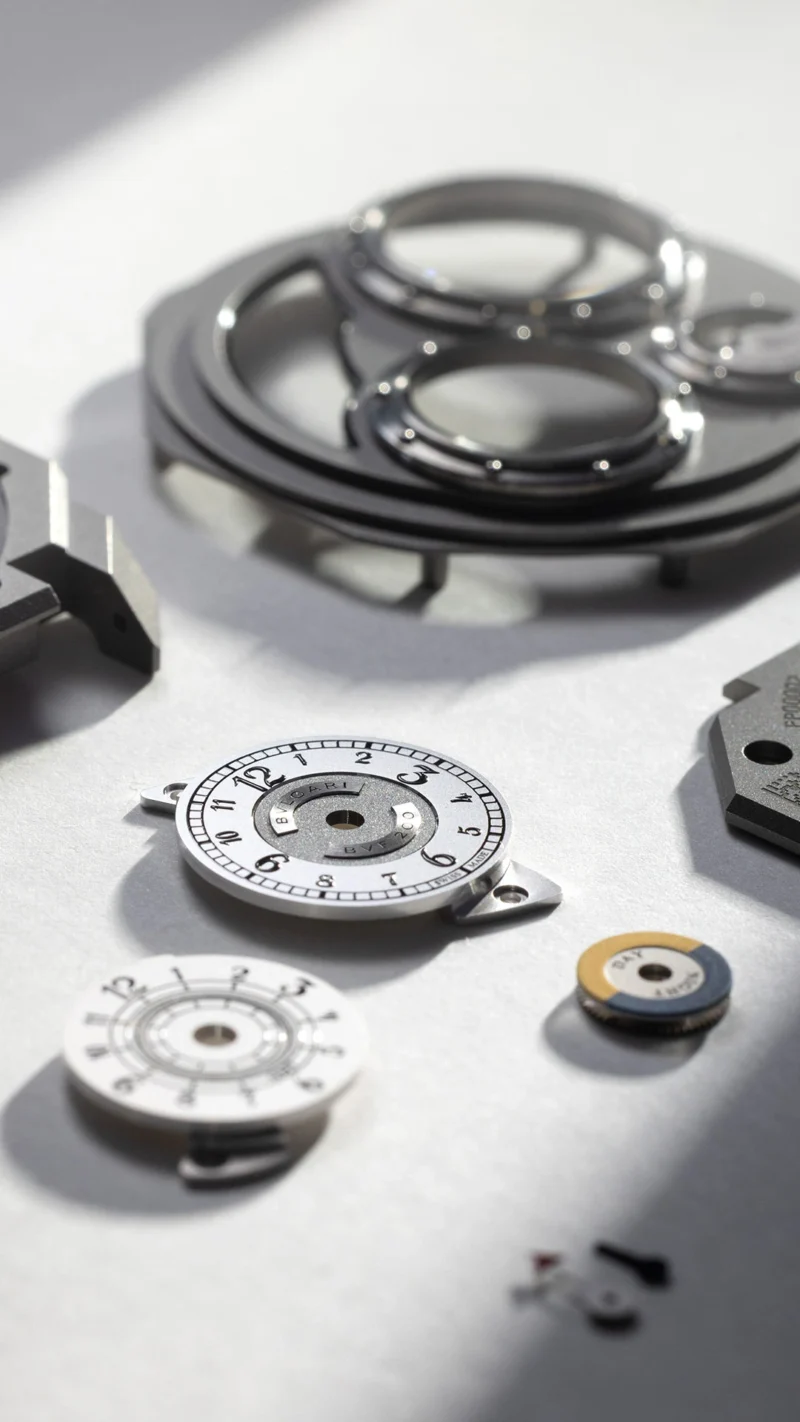
Separate dial and case components before assembly. Source: Bulgari / Vianney Halter.

Assembly beneath the dial, with the date scale visible. Source: Bulgari / Vianney Halter.
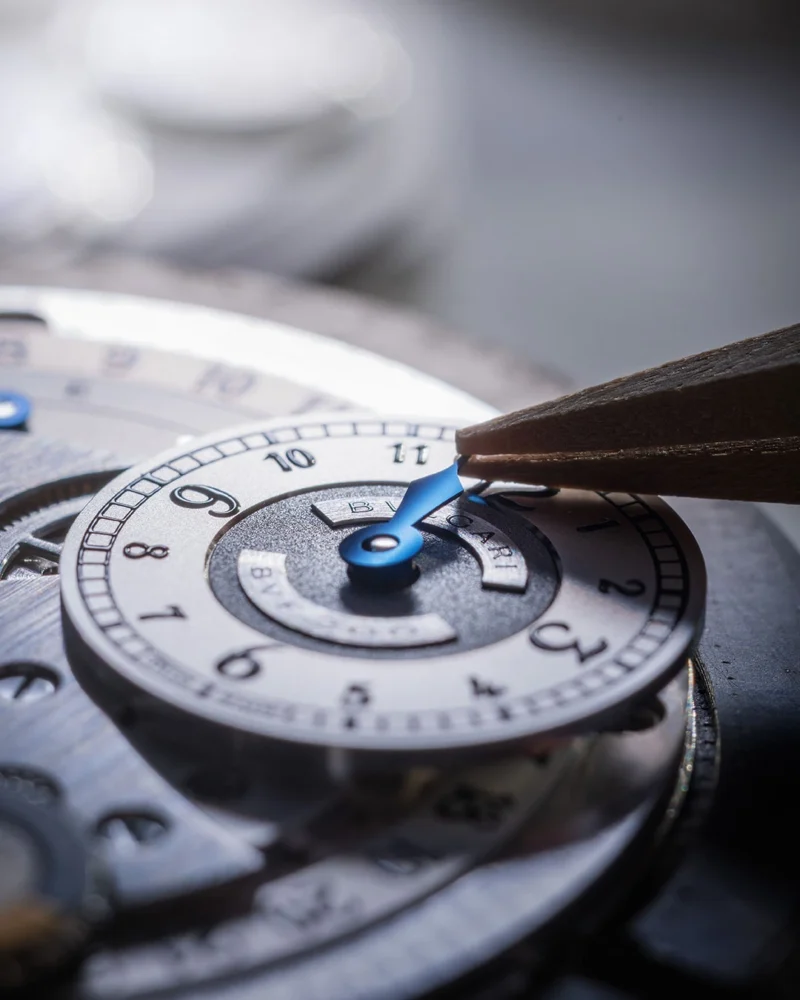
Positioning a blue hand over the opaline dial. Source: Bulgari / Vianney Halter.
The workshop photographs explain why the collaboration required more than a different dial. Separate components must become one coherent display: the opaline finish, blue hands and raised bezels need to agree across differently sized surfaces.
- Separate elementsBefore assembly, the individual dials and case elements reveal how the information is divided. Each display occupies its own physical space.
- Mechanisms beneath the dialThe movement-side assembly shows the date scale and the components that sit below the finished face. The additional indications have to be driven as well as displayed.
- The final detailA blue hand is positioned over its dial. At this scale, alignment and finish become part of the clarity of the whole watch.
The Octo underneath
The regular titanium Octo Finissimo Automatic, reference 102713, makes a useful starting point. Its broad, largely uninterrupted dial sits inside a case just 5.15 mm thick. The integrated bracelet continues the geometry of the case, while the sandblasted surfaces keep reflections subdued.
Halter introduces another rhythm. Circular bezels rise above the angular base; pale dials interrupt the grey surface. The effect is more architectural, with shadows between the displays taking the place of the original watch’s visual continuity.
That extra depth is measurable. The Dual Time is 9.70 mm thick overall. Bulgari also gives a measurement of 7.70 mm from the caseback to the largest bezel; the full height includes the raised display architecture. These are two measurements of the same construction, rather than competing specifications.
The octagonal outline and, on the titanium version, the integrated bracelet keep the family resemblance clear. This is where the collaboration finds its balance: Halter changes the organisation of the face while Bulgari supplies the structure through which that idea takes shape.
What the collaboration changes
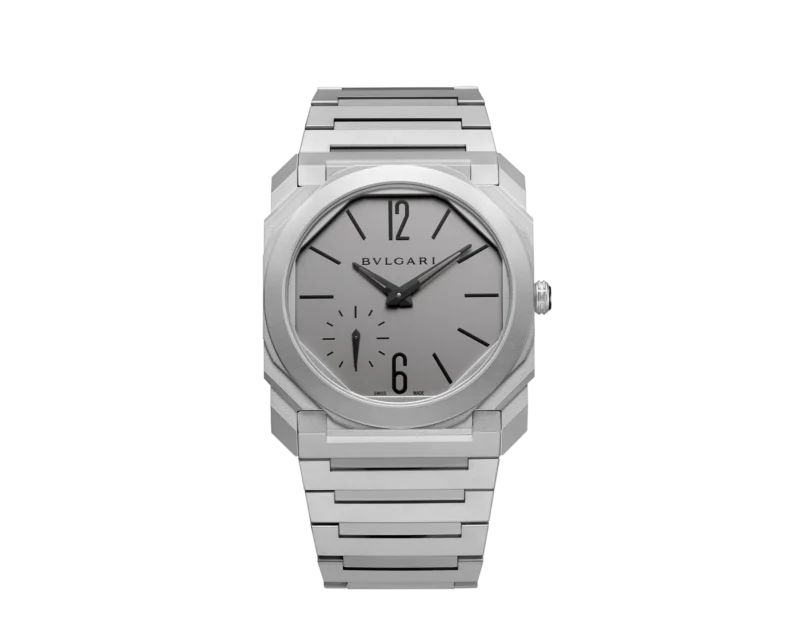
The regular titanium Octo Finissimo Automatic, reference 102713. Source: Bulgari / Vianney Halter.

The completed titanium Dual Time examined at the bench. Source: Bulgari / Vianney Halter.
The finished watch shown alongside the regular Octo makes the added volume and display architecture visible. These photographs illustrate the designs; they are not a calibrated comparison of physical size.
Explore the comparison
| Detail | Octo Finissimo Automatic 102713 | Dual Time 104356 |
|---|---|---|
| Diameter | 40 mm | 40.5 mm |
| Overall thickness | 5.15 mm | 9.70 mm |
| Movement | BVL 138, 2.23 mm thick | BVF 200, 5.49 mm thick |
| Display | Hours, minutes and small seconds | Hours, minutes, small seconds, GMT, date and day/night |
| Power reserve | 60 hours | 60 hours |
| Water resistance | 30 metres | 30 metres |
Both use automatic winding with a micro-rotor: a small winding weight integrated into the movement’s architecture. In the Dual Time, the familiar BVL 138 provides the foundation for dedicated modules. The completed calibre is designated BVF 200.
Small parts, substantial changes
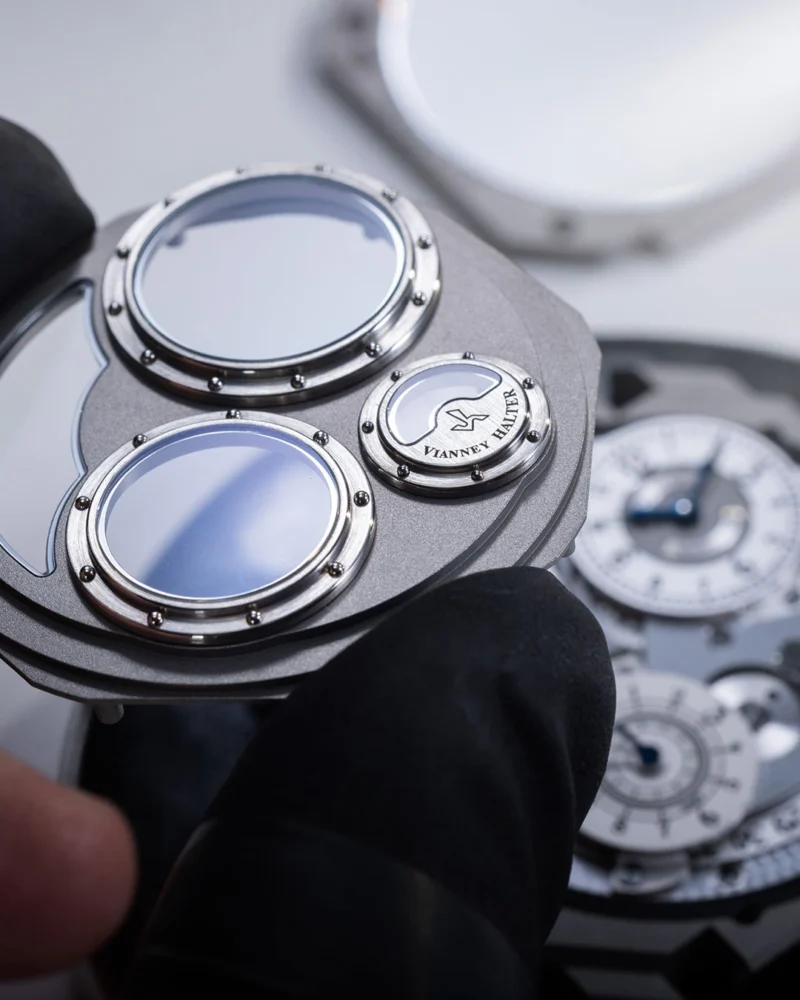
Raised porthole bezels on the titanium case during assembly. Source: Bulgari / Vianney Halter.
The 40.5 mm case comprises more than 50 components. Bulgari’s press documentation describes dedicated tooling for miniaturised parts and the challenge of achieving a consistent opaline appearance across four separate displays.
Look at the case during assembly and those demands become easier to understand. Four raised bezels meet an angular base; each opening needs a precise relationship with the display beneath it. The contrasts between sandblasted metal and brighter bezel edges give the finished watch much of its definition.
The BVF 200 runs at 3 Hz and offers a 60-hour power reserve. Its platinum micro-rotor bears Halter’s signature, a discreet counterpart to the much more conspicuous signature of his hands and dial architecture.
Two materials, two characters
Reference 104356 combines sandblasted titanium with satin-polished porthole bezels and an integrated titanium bracelet. Limited to 30 pieces, it keeps the cool, instrument-like character of the displays close to the Octo’s familiar visual language.
Reference 104355 brings rose gold and a brown alligator strap. Its sandblasted base, vertically brushed upper section and satin-polished bezels catch light differently; the warmer case makes the blue hands more conspicuous. Bulgari specifies an edition of 15 pieces.
The strap also changes the composition. Where the titanium bracelet extends the case into a continuous object, the brown leather gives the rose-gold head a more distinct frame. The movement’s platinum micro-rotor is rose-gold coloured in this version.
These are useful distinctions to see before choosing a favourite. They concern the appearance and construction shown in the official material; comfort and the feel of the controls require time with the watch.
Two signatures, still visible
The most convincing collaborations allow us to recognise both contributors. Here, the Octo’s geometry remains legible around Halter’s separate instruments. Neither needs to disappear for the other to work.
That makes the Dual Time an unusually revealing addition to the collection. Bulgari’s pursuit of thinness has created a platform with room for a different watchmaker’s ideas about depth, information and mechanical expression. The pleasure is in looking closely enough to see where the two meet.
Sources & further reading
Independent analysis of the supplied launch material; no hands-on access is claimed. Specifications checked on 6 September 2026. Photographs: Bulgari and Vianney Halter, from their official collection and press material.
The Edit
Watches stories
Selected stories from the same editorial universe.

Blancpain Lady B: What Does 19 Millimetres Require?
Blancpain’s 19 mm Lady B is best understood as an exercise in mechanical volume:

Rolex Perpetual Padellone: How an Annual Calendar Makes Three Displays Jump at Midnight
At midnight, Rolex’s new annual calendar has to identify a short month, skip a

A. Lange & Söhne Triple Split: Why Twelve Hours Changes a Rattrapante
Seconds sweep, minutes jump and hours advance continuously. Calibre L132.1 must hold all three
Zenith Chronomaster Solo Sport: What Is El Primero Without a Chronograph?
Zenith removes the pushers and counters from Chronomaster but keeps El Primero at 5
Audemars Piguet Neo Frame Jumping Hour: Why the New Calibre Matters More Than the Vintage Shape
Audemars Piguet returns to a two-window jumping-hour format from the late 1920s, reversing its
F.P. Journe Résonance: understanding the generations
Two balances, a distinctive dial and several important revisions. How to recognise the main