
TheTimeo / Watches
NEO FRAME:
the calibre behind the form
Audemars Piguet returns to a two-window jumping-hour format from the late 1920s, reversing its material logic and building the new automatic Calibre 7122 around it.
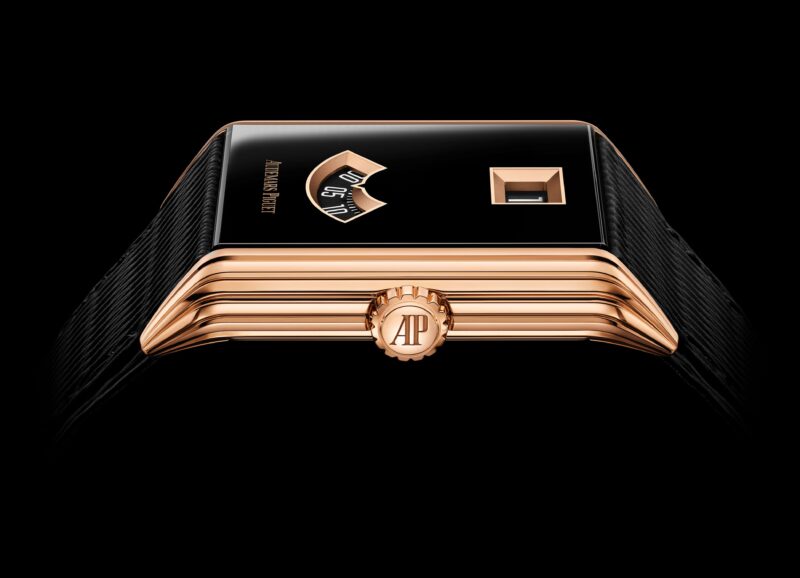
The pink-gold gadroons run into the pointed lugs and frame the black sapphire plane. Courtesy of Audemars Piguet.
Explore the story
A jumping-hour watch can look simpler than a conventional one. Two windows. No hour hand. No minute hand sweeping across a dial. The Audemars Piguet Neo Frame makes that reduction especially severe: black sapphire occupies most of the front, while pink-gold apertures isolate the hour and the passing minutes.
The simple appearance is deceptive.
This watch asks three separate questions. How closely does it follow the Audemars Piguet jumping-hour watches of the late 1920s? What had to change when a fragile period glass became a modern sapphire surface? And why did Audemars Piguet build a new automatic calibre rather than put a contemporary module behind an archival-looking case?
Those questions make the Neo Frame more useful to study than to describe.
Audemars Piguet introduced the watch in February 2026 and now lists Neo Frame as a collection in its own right. The reference is shown on the current product page as 15245OR.OO.A206VE.01. The case is 18-carat pink gold, the dial is black PVD-treated sapphire, and the movement is the new selfwinding Calibre 7122. Audemars Piguet describes it as the Manufacture’s first selfwinding jumping-hour movement.
The watch clearly borrows from the past. It is not, however, a period watch rebuilt with modern tolerances. The strongest connection to the archive is the layout. The strongest departure is the way the front of the watch is constructed.
Start with the 1929 watch, not with the current jumping-hour trend
The Neo Frame is easy to place inside the recent return of digital mechanical displays. That is useful context, but it does not explain the watch.
Audemars Piguet points instead to pre-model 1271 from 1929. The company highlights its restrained layout, vertical gadroons and streamlined lines. AP’s historical material also documents a closely related Art Deco jumping-hour wristwatch sold in 1930: white gold, two apertures for hours and minutes, a satin-brushed case with vertical gadroons, Calibre 10GHSM and movement 40546 made in 1929.
That archive matters because it changes the reading of the new watch. The two windows are not a borrowed visual trick added to a rectangular case. Aperture displays, shaped cases and covered dial surfaces were already part of Audemars Piguet’s inter-war output.
AP Chronicles shows how broad that period was. The Manufacture worked with rectangles, squares, cushion forms and unusual lug constructions while wristwatches were still establishing their own design language. The company’s 1930 jumping-hour watch sits inside that experimentation, rather than looking like an isolated ancestor discovered because the format became fashionable again.
Specialist research drawing on AP’s archives puts the scale into perspective. Between 1924 and 1951, Audemars Piguet sold 347 timepieces with a jumping-hour display, including 135 with two apertures. Those figures are small compared with ordinary watch production, but large enough to show sustained work rather than a one-off exercise.
For TheTimeo, the important distinction is straightforward: the Neo Frame has historical legitimacy, but legitimacy alone is not the story. A faithful remake would have been the less interesting option.
The old metal protected the glass. The new watch exposes the sapphire
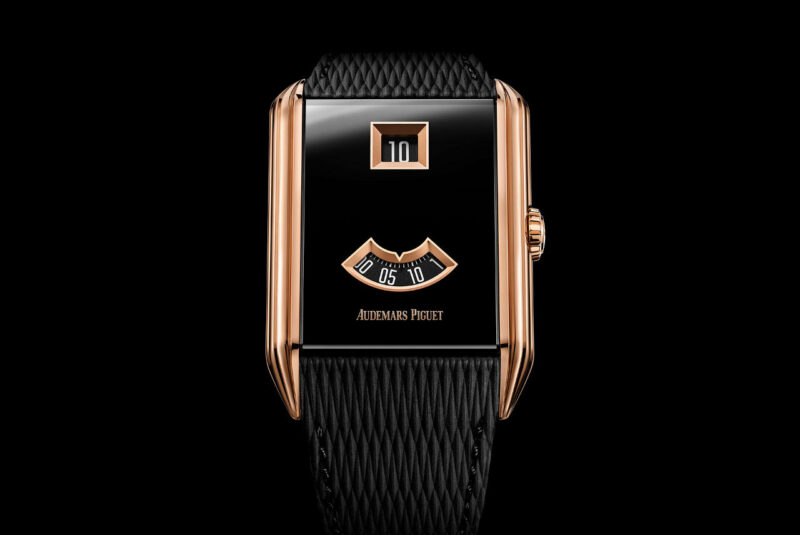
The sapphire front takes the place once occupied by a protective metal cover. Courtesy of Audemars Piguet.
The most useful design comparison is also the least decorative.
Audemars Piguet’s heritage team explains that the covered fronts of early jumping-hour watches had a practical role. Glass was fragile. Reducing the exposed area to small apertures gave the dial surface physical protection.
The 2026 watch turns that relationship around.
Its black front is sapphire crystal treated with black PVD. Instead of hiding the glass behind a broad metal cover, Audemars Piguet makes the sapphire the dominant visible plane. Pink-gold frames mark the hour window and the fan-shaped minute display, but the black surface is allowed to run almost uninterrupted to the top and bottom of the case.
That change created a construction problem.
In the AP Japan launch material, the Manufacture explains that a conventional crystal is normally secured at its perimeter by the case or bezel. Here, the sapphire remains visually exposed at 12 and 6 o’clock. To achieve the stated 20 metres of water resistance, the dial plate is bonded to the sapphire and the assembly is then screwed into the case.
This is the point where the Neo Frame stops being a nostalgic exercise.
The 1920s solution used metal because the glass needed protection. The 2026 solution uses modern sapphire confidently enough that the glass becomes part of the architecture. The visual idea survives, but the engineering reason behind the surface has been inverted.
That is a more convincing connection between old and new than matching typefaces or reproducing patina.
A rectangular impression built from several measurements
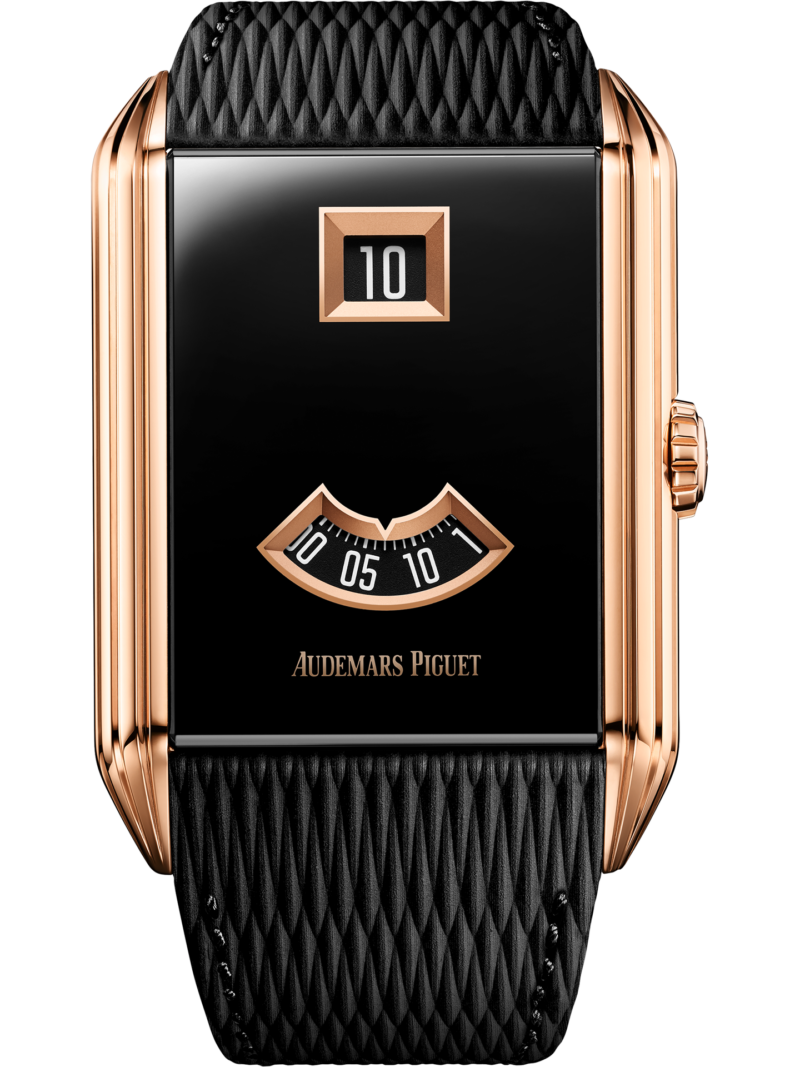
The display separates an instantaneous hour from continuously advancing minutes. Courtesy of Audemars Piguet.
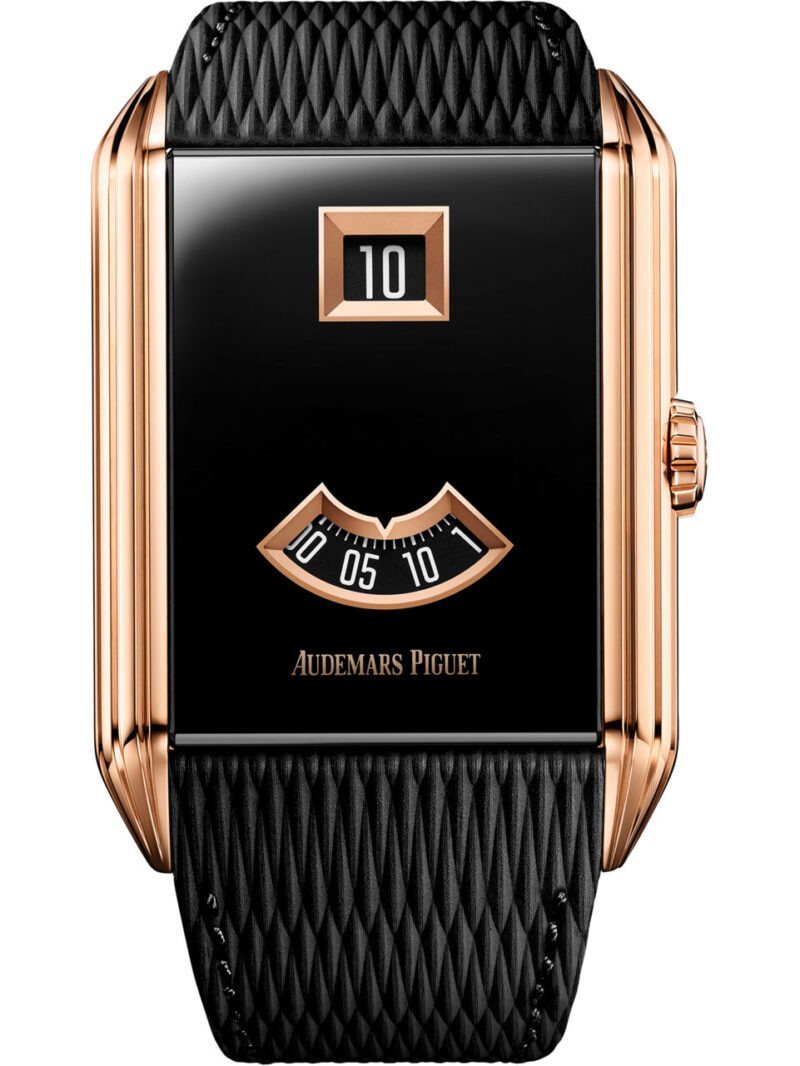
The shaped case cannot be understood from a single diameter figure. Courtesy of Audemars Piguet.
Rectangular watches are unusually easy to misdescribe because one number rarely explains how they occupy the wrist.
Audemars Piguet’s current collection listing calls the Neo Frame a 34 mm watch. The AP Japan release gives the main body as 34.6 x 34 mm without the lugs, while one of its official technical image captions gives the overall dimension as 47.1 x 34 mm. Specialist coverage later clarified the same measurement convention: roughly 34.6 mm across the upper-to-lower crystal/body measurement, 34 mm across the case between the gadroons and about 47.1 mm from lug to lug. Thickness is 8.8 mm.
These are not three different watches. They are different ways of measuring a shaped case.
The 47.1 mm figure matters because the pointed lugs are visually active. They extend the vertical line of the case far beyond the black sapphire rectangle. The watch can therefore look much longer than a simple “34 mm” specification suggests.
This is also why photographs from the side are essential. Straight-on images make the black centre appear almost architectural, bordered by parallel pink-gold ribs. A profile view shows that the gadroons are doing another job: they carry the case into the lugs and produce a continuous set of lines around the crown.
Audemars Piguet says those gadroons are CNC-machined and repeated on the caseback, crown and rotor. The decision is easy to dismiss as styling until the watch is viewed from several angles. Then it becomes clear that the fluting is the device that ties together case, control surface and movement view.
The dial is not really a dial in the usual sense
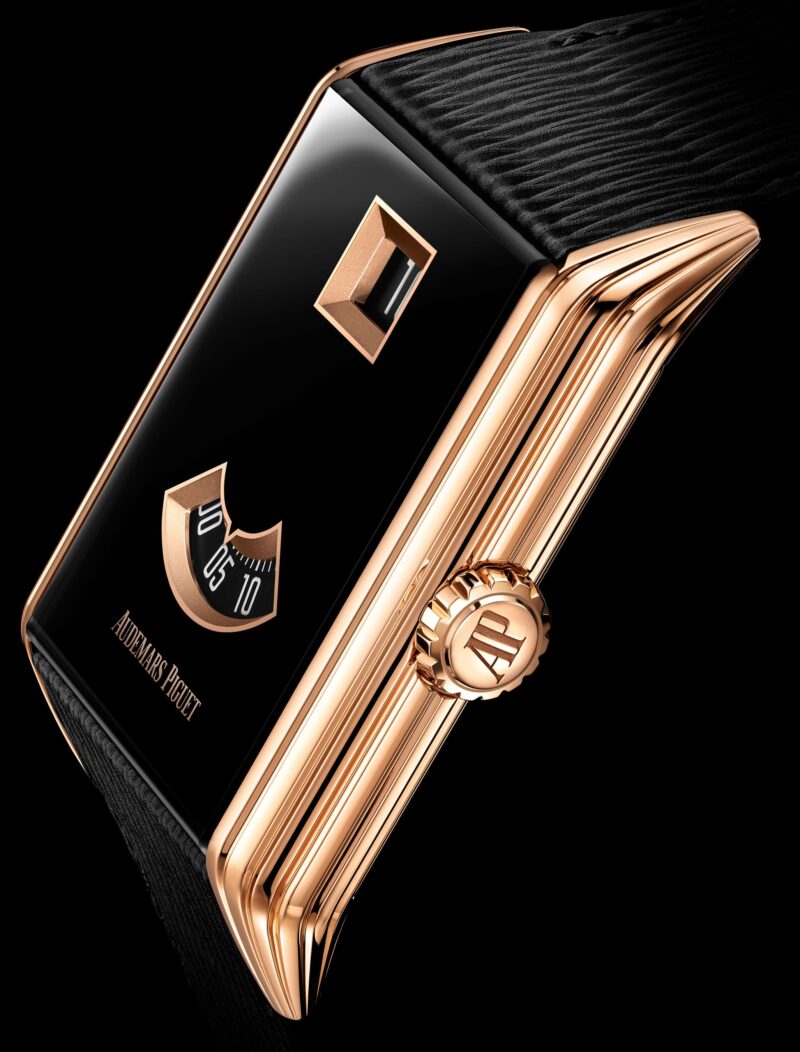
The fluting continues across the redesigned crown beside the black PVD-treated sapphire. Courtesy of Audemars Piguet.
The black sapphire is visually quiet, but the display is doing several things at once.
The upper aperture presents the hour as a numeral that changes instantaneously. The lower fan shows the minutes moving continuously. The two indications therefore behave differently: one waits and jumps; the other keeps advancing.
That difference is the point of the complication.
A digital-looking watch can suggest electronics because the display appears to replace analogue hands with numbers. Mechanically, however, the Neo Frame is still organising stored energy, gear ratios and release events. At the top of the hour, the system has to advance the hour indication decisively without allowing that event to disturb the underlying timekeeping.
Audemars Piguet describes Calibre 7122 as combining accuracy, shock resistance and a 52-hour power reserve. Specialist technical documentation supplied around the launch gives the movement as 29.6 mm in diameter, 4 mm thick, 293 components, 43 jewels and 4 Hz / 28,800 vibrations per hour.
That makes the caseback image more useful than a glamour shot. It shows a round automatic movement sitting inside a shaped watch, with a dedicated pink-gold rotor whose geometry repeats the fluting outside.
The architecture is not rectangular because the case is rectangular. The movement and case are separate problems brought together by the display.
Calibre 7122 is where this becomes a modern Audemars Piguet
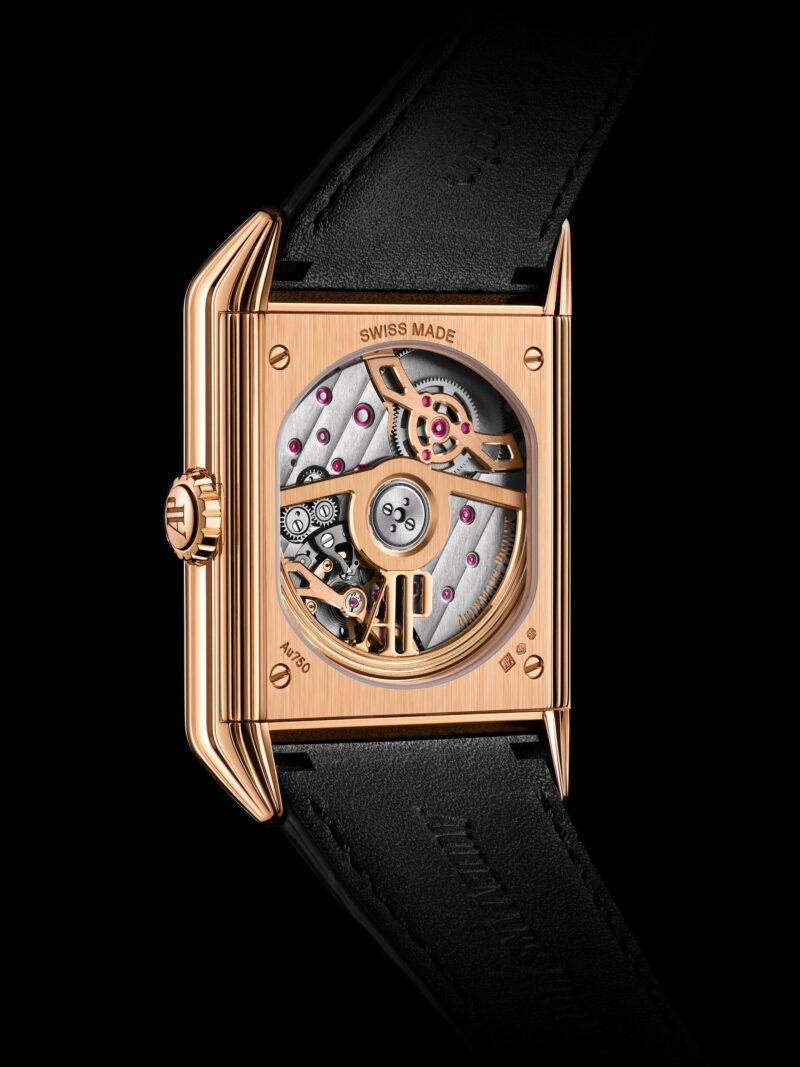
The round selfwinding Calibre 7122 sits inside the shaped pink-gold case. Courtesy of Audemars Piguet.
The cleanest fact about the movement is also the most important: this is Audemars Piguet’s first selfwinding jumping-hour calibre.
The Manufacture’s current Neo Frame page states that directly.
Specialist sources including Hodinkee report that Calibre 7122 is based on the architecture of Calibre 7121, the automatic movement introduced in 2022 for the Royal Oak “Jumbo” Extra-Thin. AP’s own documentation for the 7121 gives a diameter of 29.6 mm and explains that it was developed over five years as a more robust and efficient successor to Calibre 2121.
The shared 29.6 mm diameter is easy to see as continuity. The important change is functional.
Calibre 7121 is an hours-minutes-date movement designed around the thin Royal Oak case. Calibre 7122 has to manage a jumping-hour event and a separate rolling minute display inside a case that is visually unlike the Royal Oak. Its 4 mm thickness is greater than the 3.2 mm figure AP gives for Calibre 7121, but the Neo Frame still stays below 9 mm overall.
That is a more meaningful technical link to current Audemars Piguet than calling the watch “retro”.
There is one detail we are deliberately not treating as established. Specialist reports disagree on the material of the minute disc, with some describing aluminium and others a copper alloy. Several sources agree that the hour disc is lightweight and that shock resistance was an explicit development concern, but without the current AP technical sheet in hand, TheTimeo is not using the disputed minute-disc material as a fact.
This is a small point. It is also the kind of small point that separates a reference article from a rewritten launch note.
Shock resistance matters because a jumping display can be wrong while the movement is right
A jumping-hour mechanism has a specific failure mode that an ordinary hand display does not share.
The movement can continue to keep time while a display disc is displaced by shock. If that happens, the watch can tell the wrong hour even though the underlying gear train is still running.
Audemars Piguet’s public Neo Frame page explicitly calls out shock resistance. Specialist technical accounts of the 7122 describe a patented system intended to keep the hour display locked between jumps and release it only when the mechanism commands the change.
The practical consequence is more interesting than the patent language.
A jumping-hour watch needs to control two forms of energy: the ordinary flow that keeps the movement running and the short event that changes the display. Making the hour jump look effortless is therefore partly a problem of preventing it from moving when it should not.
That also explains why the Neo Frame should not be judged only by how quickly the numeral changes at the hour. The quality of the system includes what happens during the other 59 minutes.
The crown, strap and caseback are part of the redesign
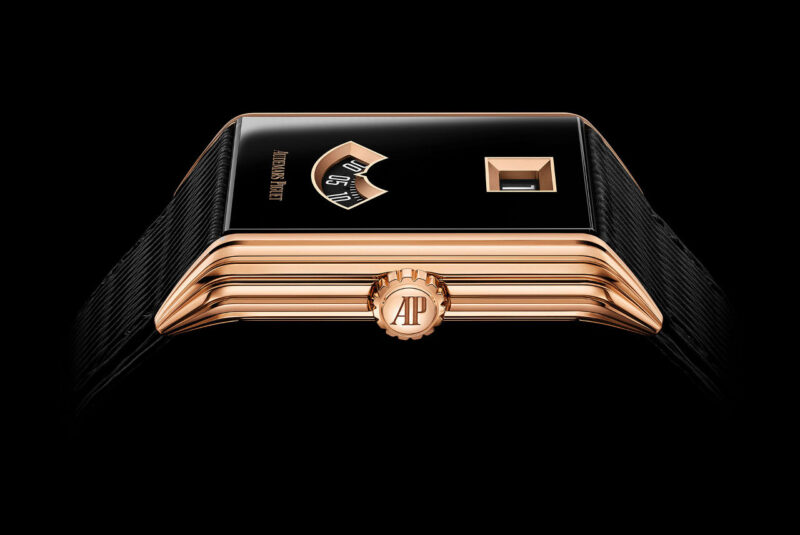
The side view reveals how the gadroons bind case, lugs and crown. Courtesy of Audemars Piguet.
Historical reissues often concentrate attention on the dial because it is the easiest place to recognise the source object.
Audemars Piguet has made several quieter changes elsewhere.
The Manufacture says the crown was redesigned to improve operation while keeping the profile controlled. That matters on a thin shaped watch because an oversized crown would interrupt the case’s long side line. The fluted crown instead sits inside the rhythm created by the gadroons.
The black calfskin strap is also new. AP describes a textile-like motif developed by its design team, with the strap meeting the sapphire between the lugs to make the transition appear continuous.
Neither detail needs to be romanticised. They solve visible problems.
The crown must be usable without looking detached from the case. The strap must enter an unusually shaped lug architecture without leaving a dead visual gap. The caseback must expose a round movement without making the rear of the watch feel unrelated to the front.
The repeated fluting is what makes those separate components read as one object.
Why the 20-metre rating should be read literally
Twenty metres of water resistance is a modest figure by contemporary standards. It should not be inflated into a claim about versatility.
The interesting part is not the number itself. It is the reason Audemars Piguet gives for the construction behind it.
The sapphire front could have been visually simplified by surrounding it with more metal. Instead, AP preserved the exposed top and bottom edges and developed the bonded-and-screwed assembly described in the launch material.
The result is a watch whose water-resistance rating remains limited but whose construction is clearly shaped by the requirement to achieve it.
For owners, the correct reading is conservative. This is a precious shaped watch rated to 20 metres, not a sports watch whose sapphire dial happens to look robust.
For collectors, the construction is more revealing than the rating. It shows where the design team was unwilling to compromise the front geometry, and where engineering had to work around that decision.
Neo Frame is more important as a collection than as a one-off revival
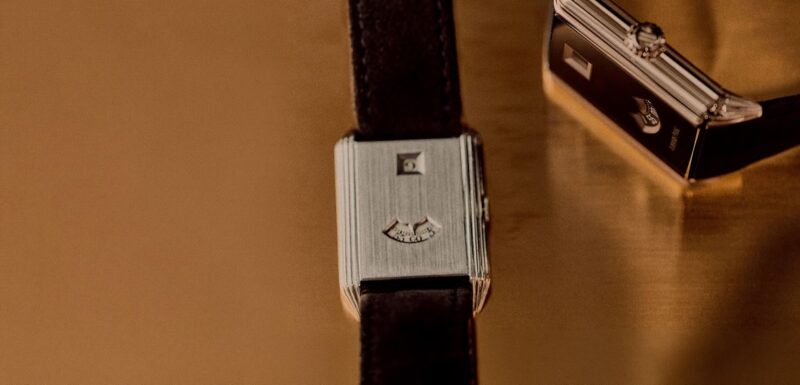
A wider campaign image places Neo Frame within Audemars Piguet’s 2026 collection language. Courtesy of Audemars Piguet.
Audemars Piguet now presents Neo Frame as a distinct collection on its website. That matters because the first watch establishes a vocabulary that can support future objects: shaped cases, aperture-based displays, archival reference without literal reproduction.
The current model should therefore be read as a first proposition, not as the complete definition of Neo Frame.
That is also why comparing it too narrowly with pre-model 1271 misses part of the point. The historical watch explains where the first object came from. It does not tell us what the collection must become.
Audemars Piguet has already used the archive in different ways. The [RE]Master projects brought specific historical watches back into view. AP Chronicles has turned the Manufacture’s archives into a public research resource. Neo Frame takes another route: it starts from a historical design problem and gives the resulting watch a new collection name.
The distinction is subtle but useful.
A reissue asks how faithfully the present can recover the past. Neo Frame asks which parts of the past remain productive when the materials, movement and manufacturing methods change.
What the archive proves, and what it does not
The historical evidence establishes several things well.
Audemars Piguet produced jumping-hour wristwatches in the inter-war period. It used double apertures. It worked with shaped cases and vertical gadroons. Its archive documents a 1930 white-gold example with the basic visual grammar that the Neo Frame revives. The company identifies pre-model 1271 from 1929 as the direct source for the 2026 watch.
The archive does not establish that every contemporary detail came from that one object.
The black sapphire front is modern. The bonded construction is modern. The automatic movement is modern. The strap integration is modern. The current dimensions and ergonomics are modern.
That separation matters because it prevents “heritage” from becoming a blanket explanation.
The Neo Frame works best when the old watch is treated as evidence, not as permission.
The most convincing change is the one you cannot see from the front
From a photograph, the obvious story is 1929 revisited in 2026.
From the caseback, a different story appears.
Audemars Piguet has taken a display associated with a period of shaped manual-wind watches and attached it to a current automatic movement architecture. It has kept the abrupt hour change, retained the trailing minutes, and made the movement visible through sapphire. The case is still thin enough to preserve the visual restraint of the front.
That does not make Calibre 7122 automatically important in the wider history of jumping hours. Longevity, reliability and future use across the Neo Frame collection will matter more than launch-day novelty.
It does, however, make the watch internally coherent.
The archival connection is visible. The mechanical work is current. The sapphire front changes the old relationship between protection and display. The movement turns a historic layout into a functioning new platform rather than a costume around an existing calibre.
That is why the Neo Frame deserves attention.
The shape gets you to the watch. The construction explains it.
Key facts
- Reference: 15245OR.OO.A206VE.01 on the current Audemars Piguet product page.
- Collection: Neo Frame.
- Case: 18-carat pink gold with sapphire front and sapphire caseback.
- Dimensions: AP’s 2026 launch material supports approximately 34.6 x 34 mm for the main case/body, 47.1 mm overall lug-to-lug and 8.8 mm thickness.
- Water resistance: 20 m / 2 bar.
- Dial/front: black PVD-treated sapphire with pink-gold-toned microblasted apertures.
- Movement: selfwinding Calibre 7122, Audemars Piguet’s first selfwinding jumping-hour movement.
- Movement data: 29.6 mm diameter, 4 mm thickness, 293 parts, 43 jewels, 4 Hz and 52-hour power reserve according to specialist technical documentation supplied around the launch.
- Display: instantaneous jumping hours with continuously advancing minutes.
- Historical reference: pre-model 1271 from 1929; AP Chronicles also documents a closely related two-aperture Art Deco jumping-hour wristwatch sold in 1930.
- Unresolved technical point: specialist sources disagree on the material of the minute disc. TheTimeo does not treat that material as established pending an AP technical sheet.
Sources & further reading
The article prioritises Audemars Piguet’s current product and collection pages, Audemars Piguet Japan’s official February 2026 release, and AP Chronicles for archive evidence. Hodinkee and other specialist publications are used where detailed movement dimensions were distributed at launch but are not exposed in the current public AP product page. Conflicting specifications are recorded rather than silently normalised.
Last verified: 5 September 2026.
The Edit
Watches stories
Selected stories from the same editorial universe.
Blancpain Lady B: What Does 19 Millimetres Require?
Blancpain’s 19 mm Lady B is best understood as an exercise in mechanical volume:
Rolex Perpetual Padellone: How an Annual Calendar Makes Three Displays Jump at Midnight
At midnight, Rolex’s new annual calendar has to identify a short month, skip a
A. Lange & Söhne Triple Split: Why Twelve Hours Changes a Rattrapante
Seconds sweep, minutes jump and hours advance continuously. Calibre L132.1 must hold all three
Zenith Chronomaster Solo Sport: What Is El Primero Without a Chronograph?
Zenith removes the pushers and counters from Chronomaster but keeps El Primero at 5
Omega Speedmaster 38 (2026): What Changed, What Stayed, and Why the Black No-Date Matters
Seven new references give the Speedmaster 38 a cleaner face and a stronger visual

Bulgari Octo Finissimo Dual Time x Vianney Halter
Bulgari and Vianney Halter give the Octo Finissimo four separate displays, a new calibre