
Art Watch Intelligence / Maze Study
Watches
Ressence TYPE 9 Jules Wittock: How Do You Draw a Solvable Maze on a Dial That Never Stops Moving?
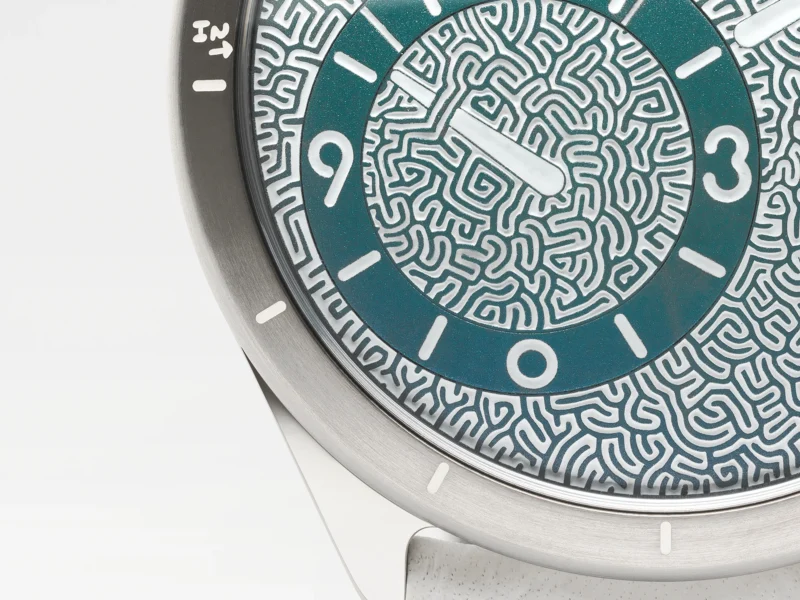
A hand-drawn labyrinth is divided across Ressence’s moving ROCS display. Only at noon and midnight do its paths return to alignment.
TheTimeo view
The drawing is correct only when time allows it.
A conventional art dial asks an image to survive time. This one makes time a rule of the artwork: the main dial and hour satellite keep moving, so the complete maze exists only at noon and midnight.
A Ressence adds a fourth dimension to the canvas: time.
Benoît Mintiens, Ressence
The visual edit
One path. Twelve moving hours.
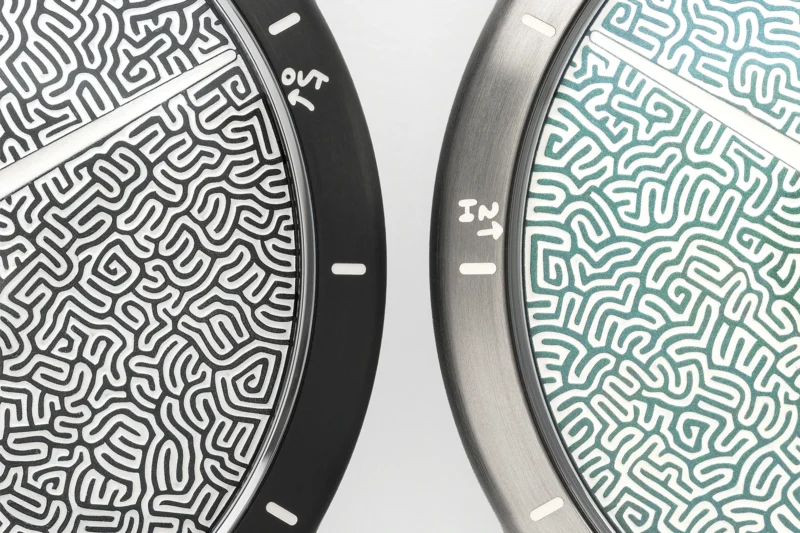
Black and emerald versions share one labyrinth logic while light changes the character of each surface. © Ressence.
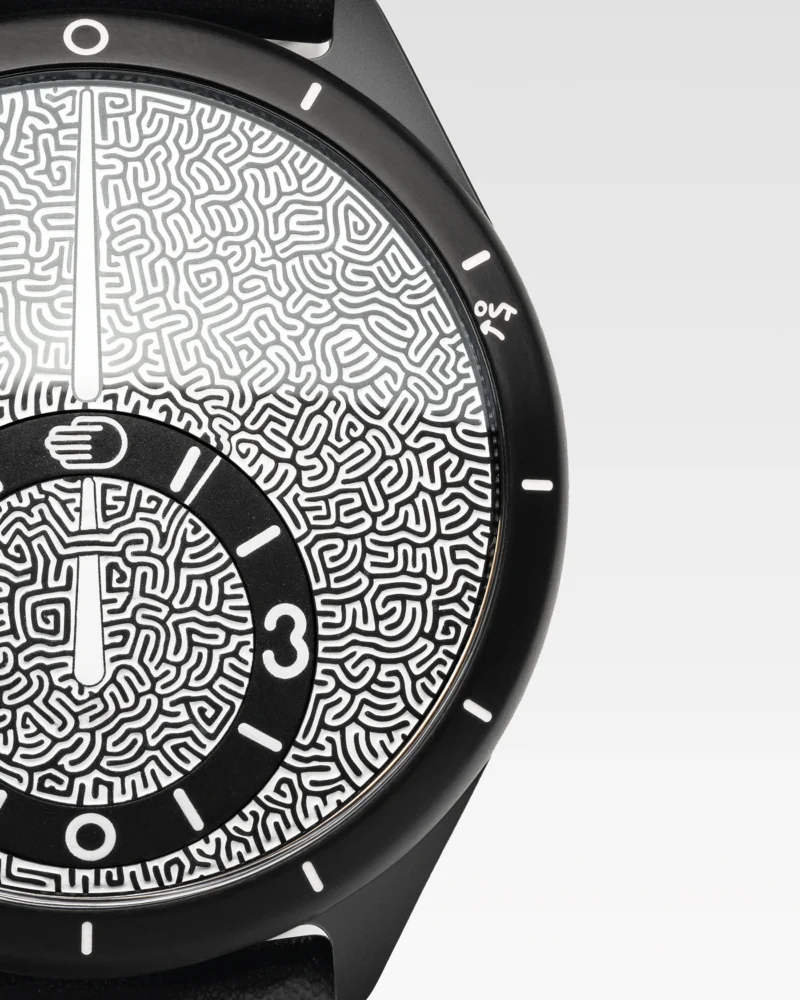
On the JWB, the white route is cut against a black PVD-coated titanium dial. © Ressence.
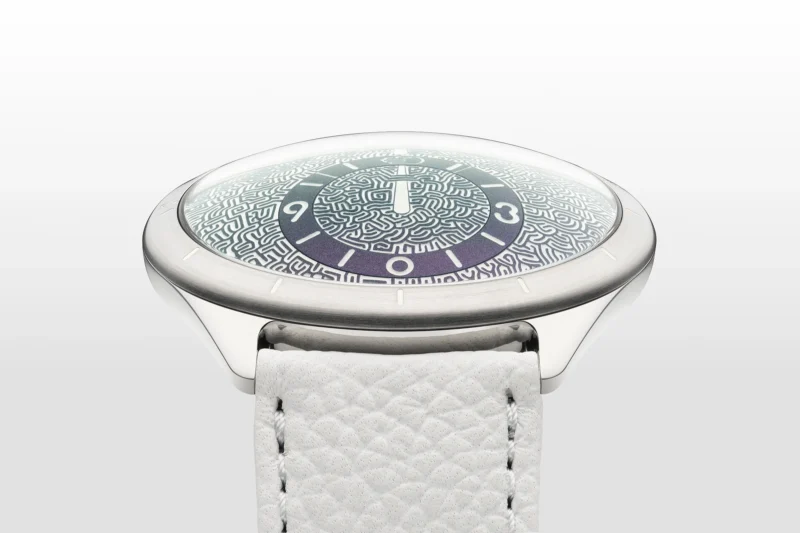
The domed crystal, fluid lugs and 11 mm case height keep the 39 mm TYPE 9 visually compact. © Ressence.
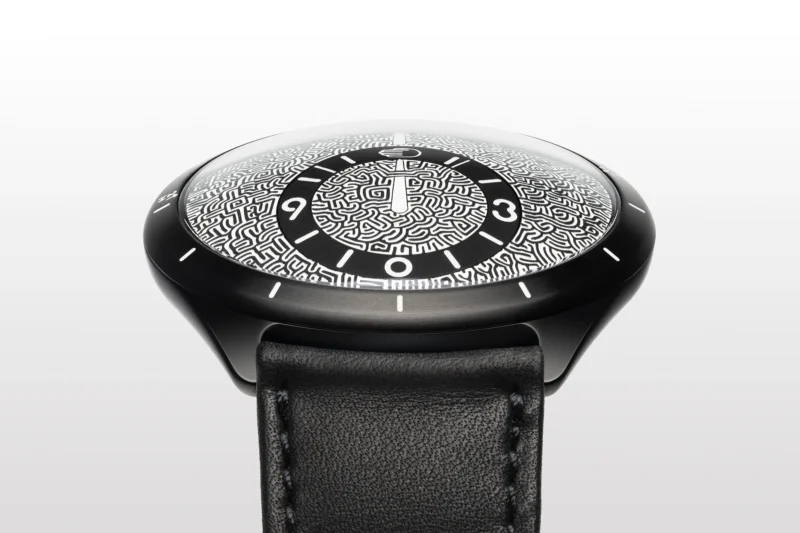
The black case turns the maze into the brightest element at the edge of the watch. © Ressence.
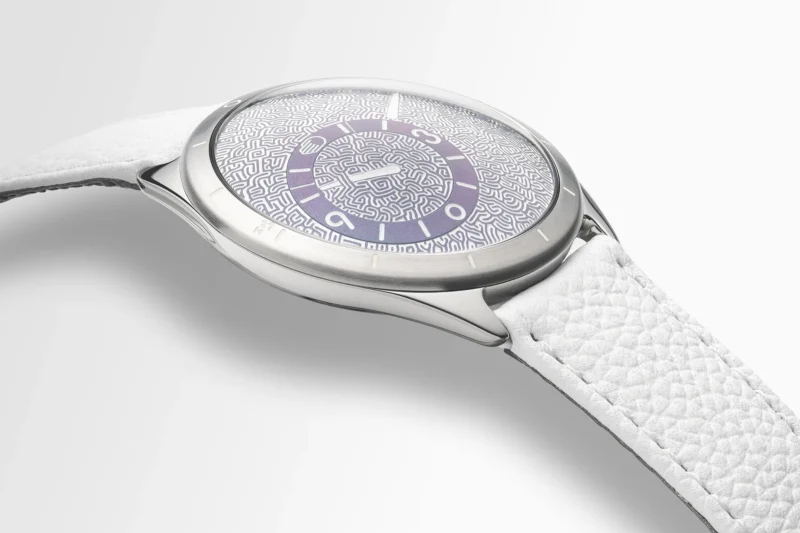
The emerald ALD coating can shift toward violet as the viewing angle changes. © Ressence.
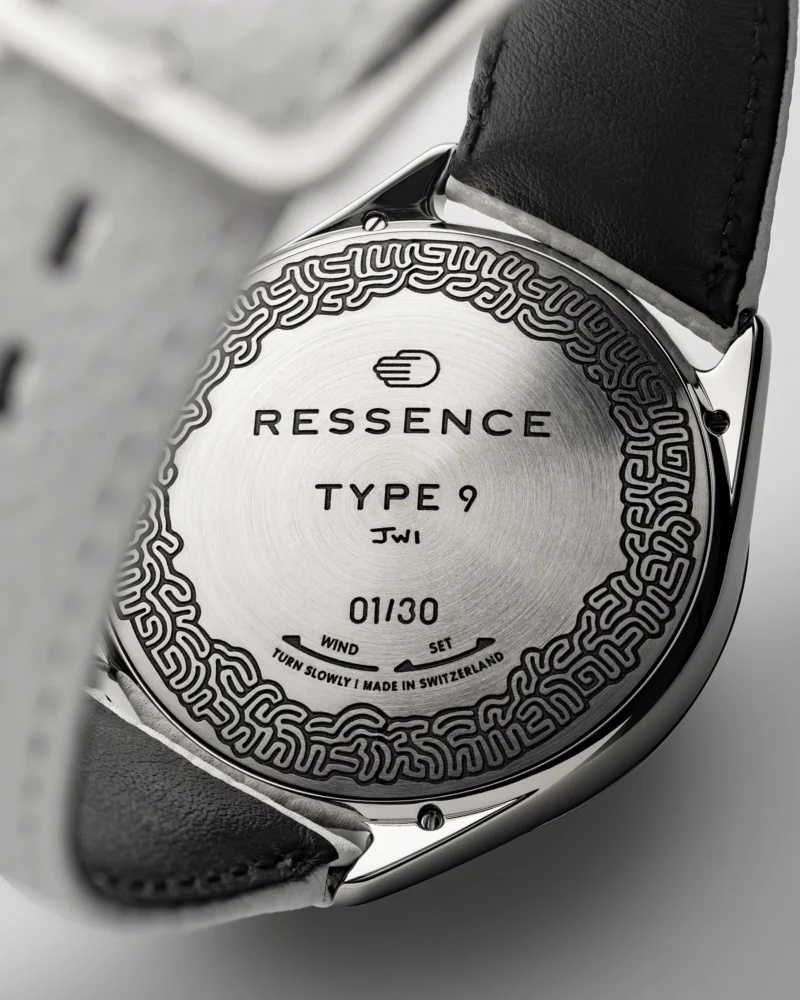
Winding and setting happen through the caseback; the limited-edition marking records one of thirty emerald pieces. © Ressence.
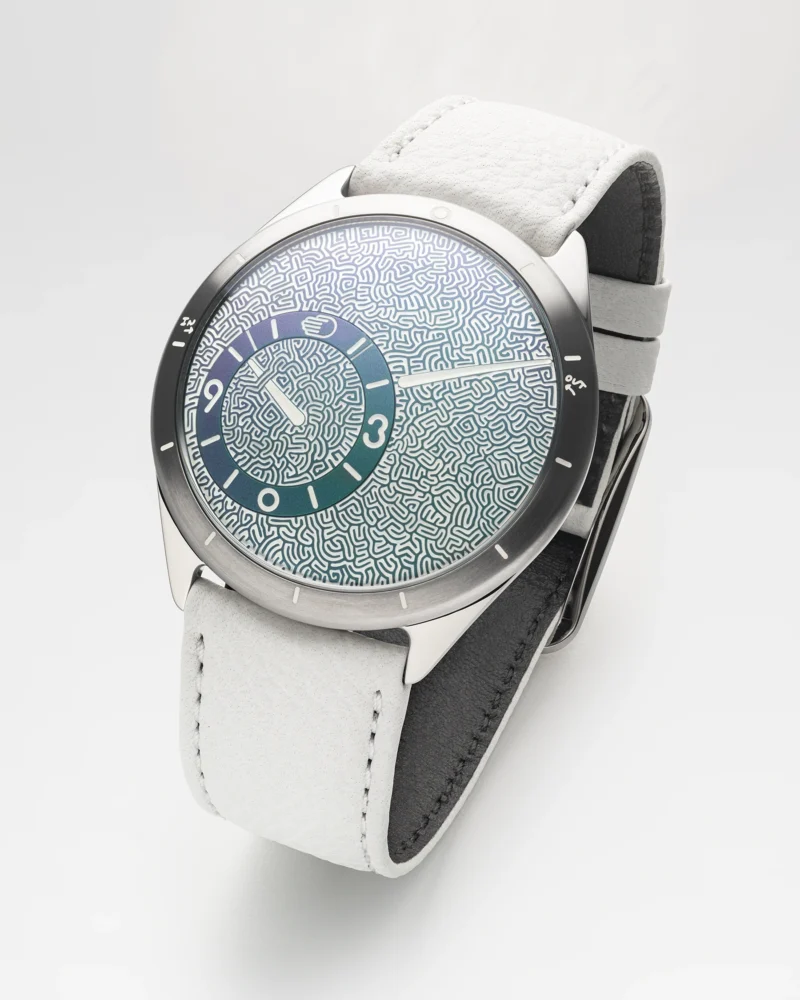
A three-quarter view makes the crownless titanium case and convex dial read as one continuous object. © Ressence.
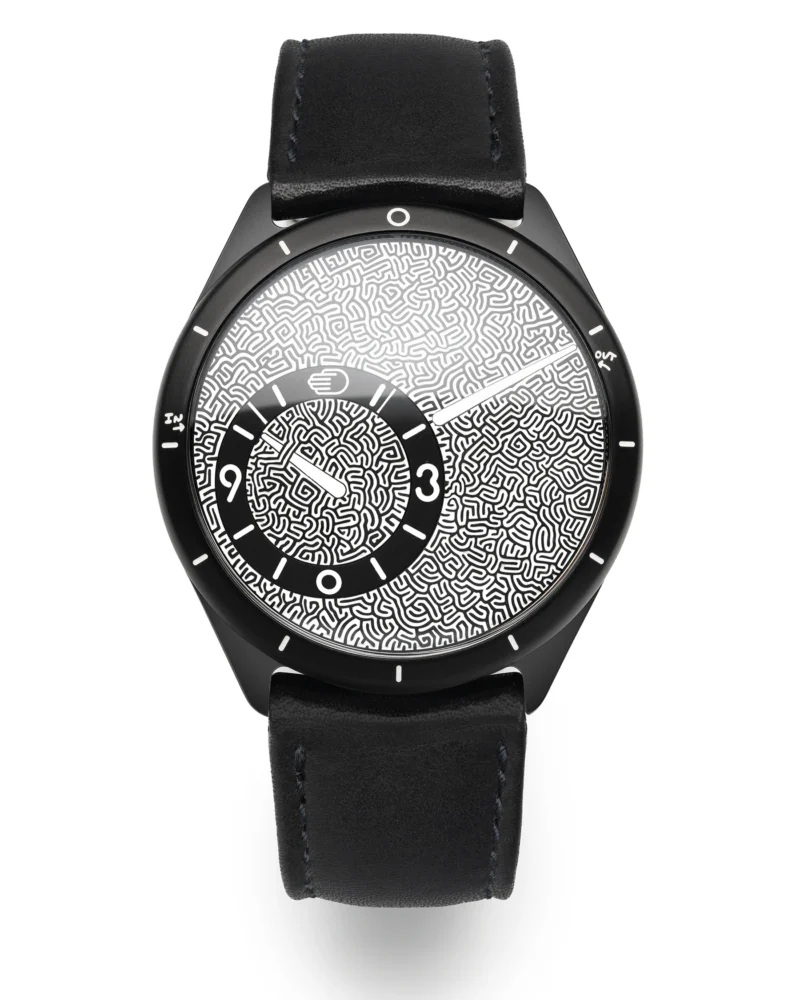
The JWB concentrates hours and minutes inside a graphic black-and-white architecture. © Ressence.
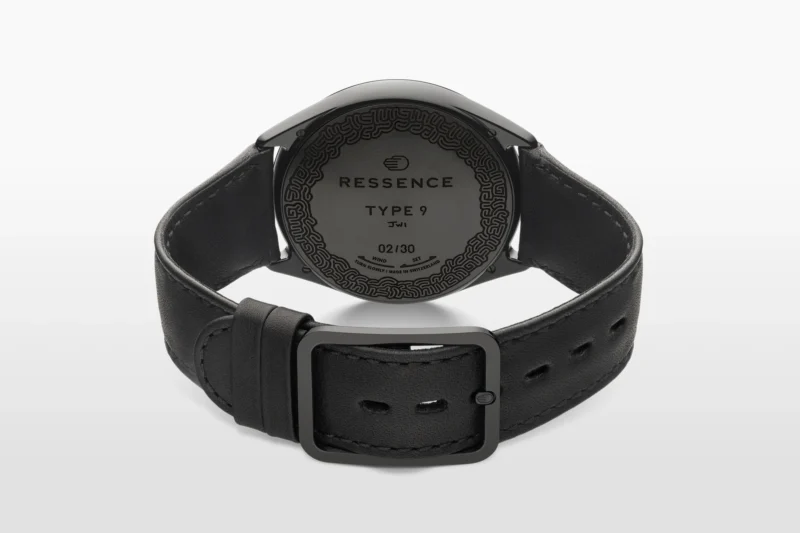
The black edition extends its monochrome treatment across case, buckle and leather strap. © Ressence.
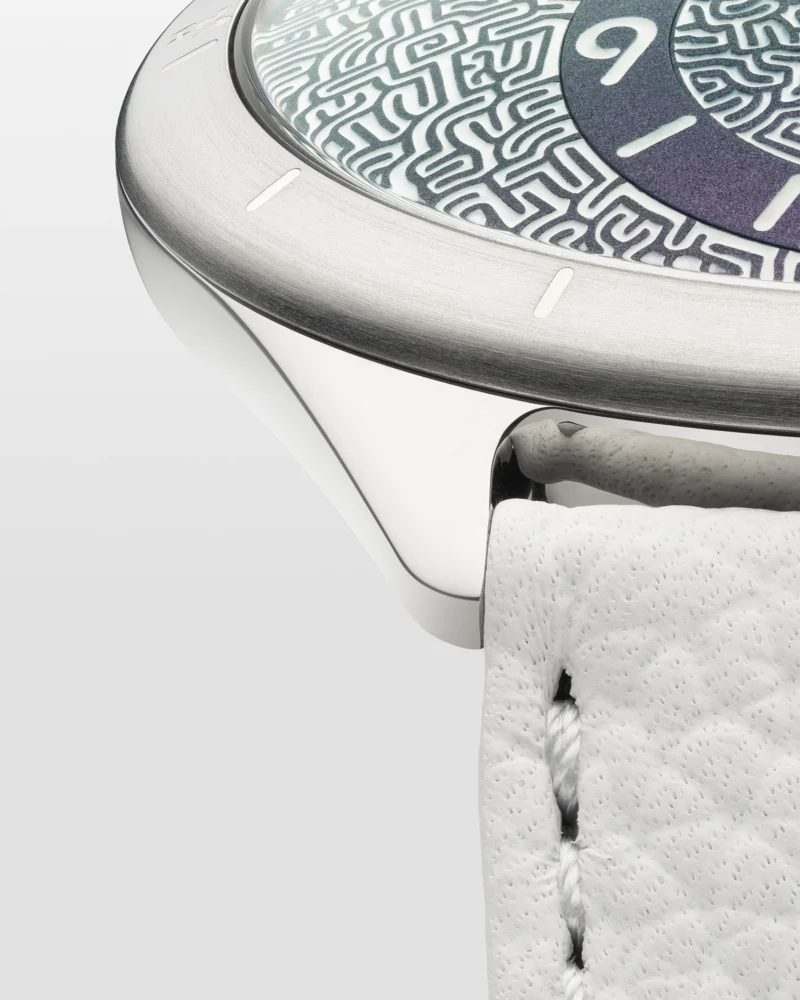
Polished titanium frames the engraved line without adding conventional hands or a crown. © Ressence.
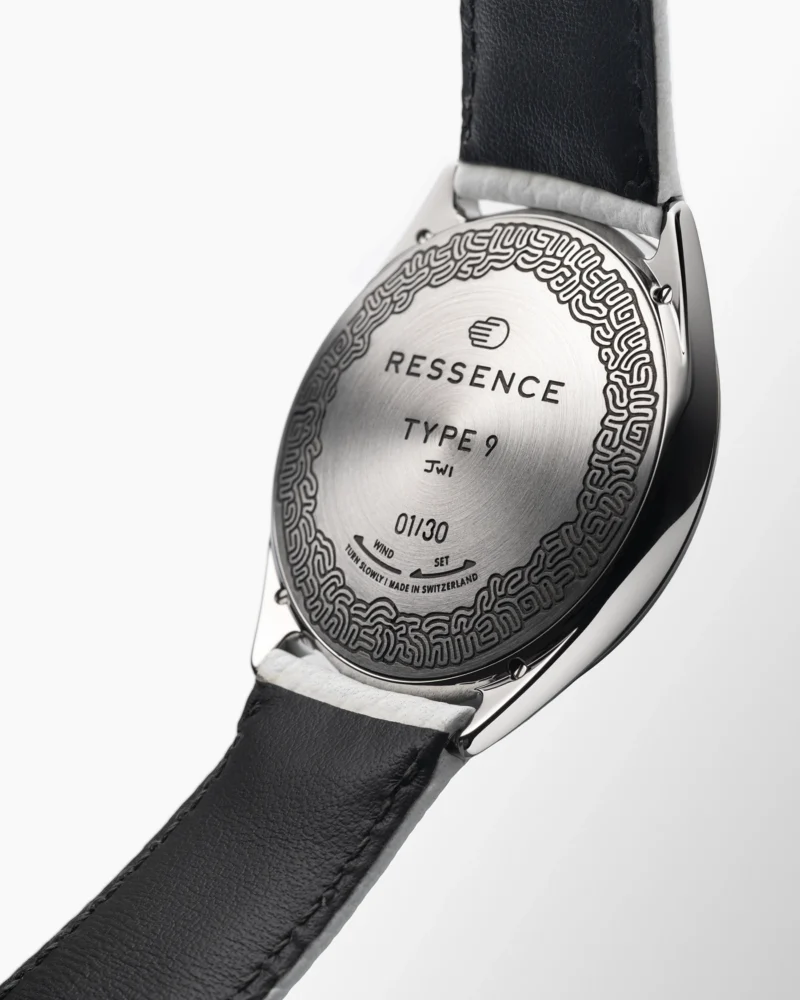
The rear view shows the caseback interface and the white 20/18 mm calf-leather strap. © Ressence.
ROCS 9 / Display architecture
A mechanical reading of the dial.
Three technical views explain how the TYPE 9 carries the artwork: the construction of its indications, the train that moves them and the period at which they return to alignment.
Orbital indication
Convex dial / eccentric satellite
The minutes are read against the fixed external bezel while the hour indication travels on an inclined satellite. Both indications belong to the same continuously moving display.
ROCS 9
20 gears / 31 jewels / 4 bearings
Driven from the minute axle of a customised automatic base calibre, the display module replaces conventional hands with a system of rotating discs and geared satellites.
Twelve-hour return
Noon / midnight
The main dial and hour satellite return to their designed relationship twice in every twenty-four hours. At those two moments, the engraved maze becomes a continuous path.
Key facts
- Release: 17 September 2026
- References: TYPE 9 JWE, emerald green; TYPE 9 JWB, black
- Case: Grade 5 titanium, 39 mm diameter, 11 mm thick
- Display: hours and minutes through the patented ROCS 9 orbital system
- Base calibre: customised and reinforced ETA 2892/2
- Frequency: 4 Hz / 28,800 vph
- Power reserve: 36 hours
- ROCS specification: 20 gears, 31 jewels, four ball bearings
- Dial: convex Grade 5 titanium, 75 mm radius
- Hour satellite inclination: 9.75 degrees
- Maze: reported 0.2 mm-wide milled paths, hand-filled with white lacquer and Grade A Super-LumiNova
- Edition: reported 30 pieces in each colour
- Launch price: CHF 20,000 excluding tax in contemporary launch coverage
A maze normally assumes the page will stay where the artist left it.
The Ressence TYPE 9 Jules Wittock begins by removing that assumption. The drawing is divided across a main rotating dial and an eccentric hours satellite. Those surfaces do not remain in a fixed relationship as the watch runs. Their positions change continuously because that movement is how the TYPE 9 tells time.
For most of the day, then, Wittock’s labyrinth is incomplete by design.
The unusual part is not that an artist has decorated a mechanical watch. It is that the artwork depends on the movement architecture to become temporarily correct. Contemporary launch material describes a single entrance, a single exit and a hidden word in the solution. The word is withheld. What can be studied now is the mechanical condition required for the drawing to make sense.
That turns a collaboration into a geometry problem.
The artwork could not simply be printed on top
Jules Wittock’s normal works already contain a rule.
His own site describes each painting as a maze with an entrance and an exit. Every labyrinth has a solution, and the route through it forms a word. The word remains secret, while the title can act as a clue. His work has moved between acrylic and oil on linen, and more recently into bronze and aluminium.
A static watch dial could have reproduced that language fairly easily. Reduce a painting, engrave or print it, add hands, and the essential maze would still exist.
Ressence made that option impossible by choosing the TYPE 9 as the support.
The TYPE 9 has no conventional central hour hand turning above a stationary dial. Its Ressence Orbital Convex System, ROCS 9, uses a large convex titanium dial that rotates, while the hours are carried on an eccentric satellite that travels with the system and turns in its own relationship to the main surface.
The maze therefore had to be designed across moving parts.
This matters because a line that begins on the main dial cannot be treated as if the neighbouring line on the hour satellite will remain beside it. The joint is dynamic. A path that crosses from one surface to the other will be broken as soon as those elements move out of their reference orientation.
The collaboration succeeds or fails at those boundaries.
The artist is no longer drawing only on a circular surface. He is drawing through a mechanism.
Black and emerald versions share one labyrinth logic while light changes the character of each surface. © Ressence.
Why the maze comes back twice a day
The most useful way to understand the watch is to forget the hidden word for a moment and look at the periods of the display.
Ressence’s standard TYPE 9 documentation states that ROCS 9 is driven from the minute axle of a customised and reinforced 2892/2 base calibre. The fixed minute scale has been moved to the external bezel. Secondary technical descriptions of the display explain that the large dial completes one revolution per hour, while the hours satellite completes its own twelve-hour cycle.
That creates two relevant clocks.
The first repeats every 60 minutes. The second repeats every 12 hours.
For the entire maze to return to a given relationship, both moving systems have to return to the same relative geometry at the same time. A twelve-hour analogue display does exactly that twice in a civil day.
This is why contemporary launch reports place the full alignment at noon and midnight. Hypebeast and Fratello both describe the maze as resolving twice daily. Monochrome mentions midnight when discussing the reveal, but its own mechanical description gives the hours disc a twelve-hour cycle. The twice-daily interpretation is therefore consistent with the display geometry.
That point is more important than the surprise word.
The mechanism does not animate a complete picture. It spends eleven hours and fifty-nine minutes of each half-day pulling that picture away from its solved state, then returns it to a known relationship.
Time is acting on the artwork as a structural variable.
The Type 9 was already an unusual canvas
The special edition does not introduce the TYPE 9 architecture.
Ressence launched the model in 2024 as its compact expression of the ROCS idea. The standard watch measures 39 mm across and 11 mm thick. Its case is Grade 5 titanium, and its dial is a convex Grade 5 titanium surface with a stated radius of 75 mm.
The standard technical sheet is unusually useful for understanding what sits under the artwork. Ressence lists 20 gears, 31 jewels and four ball bearings for ROCS 9. The hours satellite runs on jewel ball bearings and is inclined by 9.75 degrees.
Those numbers are not decoration for a specification table.
A flat printed dial can assume that every mark remains in one plane. The TYPE 9 cannot. The main dial is curved, the hour display is eccentric, and the satellite is tilted. A continuous-looking drawing has to account for surfaces that meet optically while behaving mechanically as separate bodies.
The fixed external bezel is also important. On the normal TYPE 9, Ressence moved the minute indications outside the revolving dial. That cleared much of the mobile surface.
For Wittock, that decision creates usable territory.
The minute track no longer cuts a dense ring of functional graphics through the maze. The watch still has to show time, but most of the active visual field can carry the labyrinth.
This is the kind of design choice that looks obvious only after someone has made it.
ROCS 9 / 20 gears / 4 ball bearings
The movement becomes part of the artwork's rules.
On the JWB, the white route is cut against a black PVD-coated titanium dial. © Ressence.
The domed crystal, fluid lugs and 11 mm case height keep the 39 mm TYPE 9 visually compact. © Ressence.
The black case turns the maze into the brightest element at the edge of the watch. © Ressence.
Colour / coating / orbital display
One drawing. Two atmospheres.
TYPE 9 JWE
Emerald green ALD-coated titanium shifts toward violet with the viewing angle, giving the white-filled maze a changing chromatic field.
- Case
- Polished Grade 5 titanium · 39 × 11 mm
- Display
- Hours / minutes · fixed outer minute scale
- Calibre
- ROCS 9 · customised automatic 2892/2
- Water resistance
- 1 ATM splash resistance
- Reserve
- 36 hours · 28,800 vph
TYPE 9 JWB
Black PVD-coated titanium turns the same maze into a high-contrast drawing across dial and black-coated case.
- Case
- Black-coated Grade 5 titanium · 39 × 11 mm
- Display
- Hours / minutes · fixed outer minute scale
- Calibre
- ROCS 9 · customised automatic 2892/2
- Water resistance
- 1 ATM splash resistance
- Reserve
- 36 hours · 28,800 vph
A 0.2 mm line becomes a manufacturing problem
Launch coverage reports that the maze paths are approximately 0.2 mm wide.
That figure has not yet appeared in the indexed Ressence product specification, so it should be treated as a reported launch detail rather than silently converted into a primary-source measurement. It is nevertheless repeated clearly in Hypebeast’s release material and fits the visible scale of the work.
If correct, 0.2 mm changes the nature of the dial work.
The labyrinth is milled into Grade 5 titanium rather than simply printed onto it. The engraved paths are then filled by hand with white lacquer and Grade A Super-LumiNova. The luminous material means the maze remains part of the display after dark instead of disappearing while the hour and minute indications continue to work.
There are two different tolerances here.
One is local. Individual lines have to be machined and filled cleanly enough that neighbouring routes remain distinguishable.
The other is global. Sections of the maze that cross separate moving components have to meet convincingly when the mechanism reaches the intended alignment.
A small error in a decorative line can be visually harmless when the line exists by itself. The same error becomes obvious if two segments are meant to form one path at a specific time.
That is why the moving dial changes the manufacturing question. Precision is no longer required only inside each component. It is required between components.
The hidden word has a mechanical deadline
Wittock’s paintings usually give the viewer as long as necessary to solve them.
The watch does not.
According to the launch material, the path through the TYPE 9 maze forms a secret word, consistent with the artist’s wider practice. The bezel marks the entrance and exit with small “in” and “out” cues. The word itself has deliberately not been published.
The display creates a peculiar condition. At the solved alignment, the owner can attempt to read the maze as a coherent object. Once the discs continue moving, the relationships begin changing again.
There is no need to exaggerate this into a race against seconds. A maze can be remembered, photographed or revisited twelve hours later. The important point is conceptual: the watch does not preserve the artwork in its resolved form.
It grants access to that form periodically.
That turns the hidden word into something closer to a complication of visibility. No extra wheel is added to display the word. The existing time display creates the reveal by reaching a particular geometric state.
The artwork borrows the clock’s periodicity.
The movement is conventional below, unconventional above
The TYPE 9 remains based on a customised and reinforced ETA 2892/2 automatic calibre.
Ressence does not hide this. The official specification states that ROCS 9 is driven from the minute axle of that base movement. Frequency is 28,800 vibrations per hour, or 4 Hz, with a stated power reserve of 36 hours.
The interesting engineering sits in the display module above it.
A conventional 2892 family movement is normally asked to turn familiar hands. Here it has to drive a system of discs, gears, bearings and satellites. SJX notes that the energy demand of the ROCS architecture helps explain why the TYPE 9’s reserve is 36 hours despite newer versions of the underlying ETA architecture often being associated with longer reserves in conventional applications.
That comparison needs restraint because base-calibre variants and modifications differ. The useful conclusion is simply that moving the display carries an energy cost.
Ressence has addressed that problem differently in the 2026 TYPE 11, where the new RW-01 was purpose-designed to power ROCS and uses two barrels for a longer reserve. That makes the TYPE 9 a useful snapshot of Ressence’s earlier architecture: a familiar automatic base driving an unusual mechanical interface.
The Wittock edition does not alter that movement strategy.
Its innovation is how the artwork uses it.
The caseback is part tool, part second maze
Ressence watches famously avoid a conventional crown.
The TYPE 9 is wound and set by rotating the caseback. The official product page specifies manual winding over a 12-degree movement and two-way rotation for setup.
On the Jules Wittock edition, the back receives its own maze treatment.
SJX reports that the engraving around the caseback also improves grip for the winding and setting action, replacing the usual visual language of simple serrations with part of the artist’s pattern. Fratello additionally notes Wittock’s signature on the back.
This is a small but useful detail because it shows the collaboration extending into an interface rather than stopping at the front surface.
The maze on the dial is disrupted by timekeeping. The maze on the back is touched by the user in order to change timekeeping.
Both surfaces are therefore active.
There is no need to call that a complication. It is better described as integration between graphic design and the physical controls of the watch.
Green and black are not technically documented with equal clarity
There are two versions: TYPE 9 JWE in emerald green and TYPE 9 JWB in black.
The green version is described consistently in contemporary coverage as using an ALD-coated titanium dial whose colour can move toward purple as the viewing angle changes. That adds another variable to a surface already being transformed by orbital motion.
The black version is less cleanly documented.
Ressence’s currently indexed product text contains coating language that is internally awkward. It lists Grade 5 titanium with DLC coating, then separately describes a black ALD-coated titanium dial. Secondary reports variously call the black treatment PVD or DLC. The case description on the indexed Ressence product page also appears templated and does not resolve every difference between the two references.
There is no editorial advantage in choosing one coating label by guesswork.
The article can safely describe the JWB as the black-coated version and record the coating conflict in the production dossier until Ressence’s dedicated press release or technical sheet provides a cleaner hierarchy.
The green treatment, by contrast, can be identified as ALD with much higher confidence because the sources converge.
This is exactly the kind of small specification conflict that gets erased in ordinary launch coverage and becomes troublesome later.
Thirty plus thirty, but the primary page is incomplete
Contemporary launch reporting from SJX, Fratello, Monochrome and Hypebeast converges on 30 examples in emerald green and 30 in black.
The indexed Ressence product pages available during this research identify the JWE and JWB references and their technical specifications, but they do not currently state the edition count in the retrieved text.
That means the 30-plus-30 figure is strongly cross-checked but remains secondary-source evidence in this dossier.
The same care applies to price.
Launch coverage gives CHF 20,000 excluding tax. The German Ressence shop page displays €26,200 including VAT. Those numbers are not contradictory. They are different currencies, tax treatments and sales contexts.
Treating them as if one disproved the other would create a problem that does not exist.
What the evidence establishes
Several parts of the watch are clear enough to state without qualification.
The TYPE 9 uses the patented ROCS 9 display driven from the minute axle of a customised and reinforced 2892/2 base calibre. It runs at 4 Hz with a 36-hour reserve. The case is 39 mm by 11 mm in Grade 5 titanium. The convex titanium dial has a 75 mm radius. The hour satellite is inclined by 9.75 degrees. Winding and setting are performed through the caseback rather than a crown.
The Jules Wittock editions engrave the maze into the titanium dial and fill the markings by hand with white lacquer and Grade A Super-LumiNova. The artist’s established method is to create a single solvable path whose route forms a hidden word.
Contemporary launch evidence also supports the two-colour release, the 30-piece allocation per colour and the twice-daily alignment.
Other details remain less secure.
The exact secret word is intentionally undisclosed. The black coating terminology is not fully reconciled. The 0.2 mm path width is well reported but has not yet been located in an indexed primary Ressence technical sheet. No claim can be made about the ease of solving the maze on the wrist because there has been no direct test.
Those limits do not make the story smaller.
They make the real achievement easier to see.
The maze only exists completely when the watch allows it
The most revealing thing about the TYPE 9 Jules Wittock is that the artwork is not permanently available.
For most art watches, movement is a threat to the image. Hands cross a painting. Openings interrupt an enamel scene. A subdial forces the artist to work around a circle that does not belong to the composition.
Here, the movement is the reason the work has a second state.
The ROCS display fragments the maze because it must keep time. Then, twice a day, the same mechanism gives the artist back the relationship he designed.
That is a more rigorous use of collaboration than placing a recognisable motif on a familiar watch.
Wittock had to draw for a surface that changes topology from the viewer’s perspective. Ressence had to manufacture lines that remain credible both as isolated fragments and as a solved path. The owner receives an artwork that cannot stay solved because the watch would have to stop doing its job.
The question, then, is not whether a maze belongs on a watch.
It is whether a watch can become part of the maze’s rules.
In this one, it does.
Sources & credits
Sources & methodology
- Ressence, TYPE 9 Jules Wittock press release, for the collaboration, maze construction, alignment, edition, materials and technical specification.
- Ressence TYPE 9, for the platform, dimensions, display, caseback setting and ROCS context.
- Ressence TYPE 9 JWE and TYPE 9 JWB, for current reference-level specifications.
- Jules Wittock, for the artist’s established maze practice.
- This is an independent editorial analysis, not a hands-on review. The hidden word is intentionally undisclosed. No unpublished tolerances, manufacturing steps or solving experience are inferred.
The Edit
Stories selected by TheTimeo

Blancpain Lady B: What Does 19 Millimetres Require?
Blancpain’s 19 mm Lady B is best understood as an exercise in mechanical volume:
When Is a Revived Watch Brand Still the Same Brand? Testing the New Gallet Against the Archive
The archive is real and the manufacturing system is new. We test Flying Officer,
Ferdinand Berthoud FB 3SPC.4-1: Why Bend a Balance Spring into a Cylinder?
The black titanium case is new. The harder achievement is regulating a cylindrical spring
MING 57.05 Comet: The One-Click DST Fix and the Time-Zone Problem It Cannot Fully Solve
One click moves DST-observing cities by an hour. The harder problem is that civil-time
What Did IWC Actually Bring Back from Gérald Genta’s Ingenieur SL?
The 40 and 35 mm anniversary Ingenieurs share a rare silver-dial reference, but only
MB&F SP One Pavée: Where Do You Put 255 Diamonds on a Watch That Has No Bezel?
The bezel-free SP One leaves its three mechanical circles untouched and distributes 255 diamonds