

Worldtime Intelligence / Civil Time Study
Watches
MING 57.05 Comet: The One-Click DST Fix and the Time-Zone Problem It Cannot Fully Solve
One click moves DST-observing cities by an hour. The harder problem is that civil-time calendars never move together.
TheTimeo view
The click is exact. The calendar is not.
The 57.05 separates locations that stay on standard time from those that move seasonally. Its outer bezel corrects the second group with one tactile click, while leaving the wearer responsible for knowing which civil-time calendar matters now.
The Comet is not a database of daylight-saving law. It is a legible mechanical interface for managing one recurring offset.
TheTimeo
The visual edit
One blue instrument. Several versions of now.
The Comet separates fixed standard-time locations from a movable DST-observing group. Courtesy of MING.

One 15-degree click advances the outer group by one hour; the red aperture confirms the selected DST state. Courtesy of MING.

The inner ring remains fixed while the outer city ring carries locations that observe seasonal clock changes. Courtesy of MING.

The external DST interface sits above the automatic Sellita for MING calibre 330.M2. Courtesy of MING.

The 40 mm steel case can be paired with MING’s curved titanium Polymesh. Courtesy of MING.

White, blue, orange and red lume separate local time, day, night and the selected DST state. Courtesy of MING.

The outer city ring remains readable on the wrist without hiding the layered blue dial. Courtesy of MING.

The red DST ON marker is a state indicator, not an automatic civil-time calendar. Courtesy of MING.

Nine separate components create the triple-stepped lug construction and distinct finishing planes. Courtesy of MING.

The sapphire back reveals skeletonised anthracite bridges over the calibre 330.M2 baseplate. Courtesy of MING.

The 24-hour ring and two city groups turn civil-time legislation into a visible interface. Courtesy of MING.
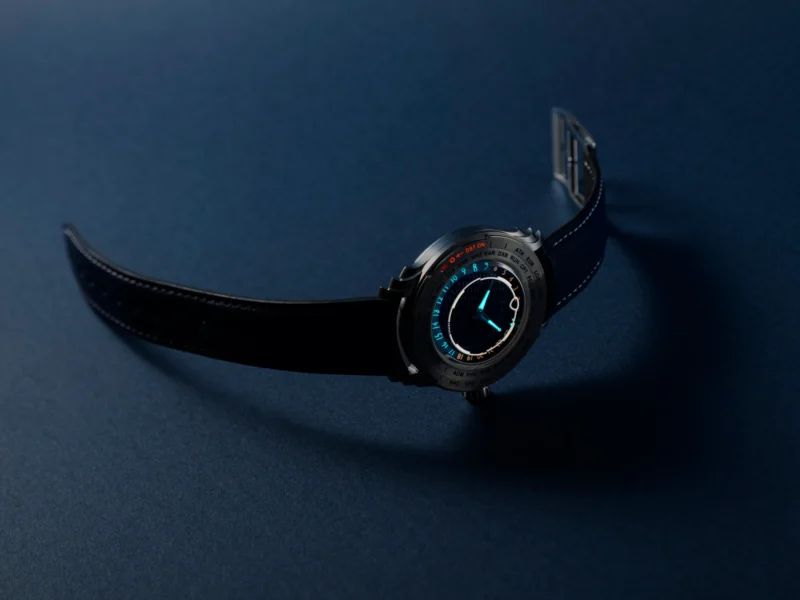
Blue hands and the day scale, orange night hours and the red DST state remain visually distinct. Courtesy of MING.

The watch measures 40 mm across, 10.33 mm thick and 47.8 mm lug to lug. Courtesy of MING.
Civil time / 2026 transition map
One click. Three calendars that refuse to move together.
The bezel has two exact positions. The jurisdictions engraved on it occupy several overlapping seasonal states.
North America advances before Europe and returns after it.
The European interval begins three weeks later and ends one week earlier.
The Southern Hemisphere season crosses the year boundary.
Key facts
- The MING 57.05 Comet is a 200-piece worldtime watch introduced on 26 August 2026 for the brand’s ninth anniversary.
- Its patent-pending DST system separates locations that stay on standard time from those that observe daylight saving time.
- Rotating the outer bezel one click through 15 degrees advances only the DST group by one hour against the 24-hour scale.
- A spring-loaded ball and recesses lock the bezel in either position, while a small aperture shows silver for standard time and red for DST.
- The 40 mm stainless-steel case is 10.33 mm thick, measures 47.8 mm lug to lug and is water-resistant to 100 metres.
- Sellita for MING calibre 330.M2 is automatic, runs at 4 Hz, has 25 jewels and approximately 50 hours of power reserve.
A worldtimer is elegant because it turns geography into a fixed relationship. Place London, New York, Tokyo and the rest of the selected locations around a 24-hour ring, align the ring once, and the owner can read multiple time zones at a glance.
That elegance depends on a quiet assumption: each city remains at the UTC offset engraved beside it.
Civil time does not cooperate.
New York is UTC−5 in standard time and UTC−4 during daylight saving time. London moves from UTC±0 to UTC+1. Melbourne moves from UTC+10 to UTC+11. Phoenix stays at UTC−7. Tokyo stays at UTC+9. A conventional fixed city ring can therefore be perfectly correct in January and one hour wrong for part of the dial a few months later.
The MING 57.05 Comet is an attempt to make that problem visible and mechanically adjustable. It is also a useful demonstration of why the problem is harder than simply adding the words “DST ON” to a bezel.
Why a conventional worldtimer becomes wrong
The modern worldtime idea descends from the system associated with Louis Cottier in the early 1930s. A rotating 24-hour indication is read against a ring of cities representing the world’s principal time zones. Vacheron Constantin’s own heritage documentation dates its collaboration with Cottier to 1932 and describes the principle as a rotating disc for 24 time zones with an outer ring of city names.
The basic geometry is still compelling. Twenty-four hours correspond to 360 degrees, so one hour occupies 15 degrees around a full circle. If the city ring is fixed and the 24-hour ring makes one revolution per day, each location remains aligned with the hour implied by its nominal UTC offset.
Daylight saving time changes the offset without changing the engraving.
That is not a fault in the movement. It is a mismatch between mechanical permanence and legislation. The watch does not know that a government has ordered clocks forward. A conventional worldtimer simply continues to show the standard-time relationship it was designed around, leaving the owner to add or subtract an hour mentally.
MING had already used the classic logic in the 19.02 Worldtimer of 2019. The company deliberately kept the cities static and rotated the 24-hour disc, arguing that numbers are faster to recognise than airport codes. The 29.01 Worldtimer later took a more elaborate visual route, but the city-to-offset problem remained conceptually the same.
The 57.05 does not replace that architecture with an electronic calendar or a mechanically programmed schedule. Instead, it makes one part of the city ring movable.
The inner ring remains fixed while the outer city ring carries locations that observe seasonal clock changes. Courtesy of MING.
What the 15-degree click actually does
MING divides the reference locations into two groups.
Cities and regions that do not observe daylight saving time remain on the inner bezel. These include Tokyo, Dubai, Cape Town, Phoenix, Honolulu and a surprisingly useful list of less obvious references such as Adamstown in the Pitcairn Islands. Locations that do observe DST sit on the separate outer bezel. London, Central Europe, Athens, Melbourne, New Zealand, New York, Chicago and others belong to this movable group.
Turn the outer bezel one click and it rotates exactly 15 degrees.
That number is not arbitrary. Fifteen degrees is one twenty-fourth of a circle, so the rotation moves every location on the outer bezel by the equivalent of one hour against the 24-hour ring. The inner bezel does not move. Tokyo remains where it was. Phoenix remains where it was. New York advances by one hour. London advances by one hour.
The mechanism is deliberately simple from the user’s side. MING states that a spring-loaded ball locates in corresponding recesses beneath the bezel, creating positive standard-time and DST positions. The edge has distinct grip points. Between eight and nine o’clock, a small aperture changes from silver to red and displays “DST ON” when the daylight-saving position is selected.
This is the most persuasive part of the design. The correction is not hidden in a crown sequence or buried in a pusher instruction. The user can see the problem, make one tactile adjustment and verify the state without consulting the movement.
MING describes the mechanism as patent-pending. No patent application number was established in the public material reviewed by TheTimeo, so the article does not convert that status into an independently verified patent grant or priority claim.
The part the bezel cannot know
The phrase “DST adjustment” can sound more comprehensive than the mechanism actually is.
The Comet has two states: standard time and DST. Civil time has many more states because jurisdictions do not switch together.
In 2026, New York moved to daylight saving time on 8 March and is scheduled to return to standard time on 1 November. London changed on 29 March and is scheduled to return on 25 October. Melbourne, in the Southern Hemisphere, ended daylight saving time on 5 April and starts it again on 4 October.
Those dates expose the real limit of a single movable ring.
If the Comet’s outer bezel is set to DST in July, London and New York are shown in their summer offsets, but Melbourne is on standard time and the same one-hour advance makes Melbourne wrong. If the bezel is left in standard position in January, London and New York are correct but Melbourne is in daylight saving time and therefore wrong by an hour.
There are short periods in 2026 when those three examples are all simultaneously on daylight saving time, such as the overlap from late March to early April and again during part of October. Outside those overlaps, no single position can make the whole outer ring globally correct at once.
Even within the Northern Hemisphere, changeover dates are not synchronised. The United States and Europe switch on different Sundays. Hodinkee noted this explicitly in its launch coverage, and SJX made the same point: the solution is highly useful, but not perfect because national schedules differ.
This is not a criticism that invalidates the watch. It defines what the watch actually does.
The 57.05 is best understood as a user-selectable seasonal offset for the DST-observing group, not as a mechanical database of global daylight-saving law. It turns a recurring arithmetic task into a physical control. The owner still has to know which region matters at that moment and whether the selected bezel state is appropriate for it.
That distinction is precisely the kind of thing a sophisticated worldtimer should make its owner think about.
City bezel / detent / state aperture
A global problem reduced to one visible mechanical choice.
The inner ring remains fixed while the outer city ring carries locations that observe seasonal clock changes. Courtesy of MING.
The external DST interface sits above the automatic Sellita for MING calibre 330.M2. Courtesy of MING.
The 40 mm steel case can be paired with MING’s curved titanium Polymesh. Courtesy of MING.
Mechanical context
The architecture, in two acts.
The mechanical answer
A spring-loaded ball locates the city bezel in standard or DST position; a silver/red aperture makes the selected state visible.
- Range
- 40 mm · 10.33 mm
- Display
- 15° · one-hour correction
- Control
- 330.M2 · 4 Hz
- Isolation
- 100 m
- Flyback
- ≈50 hours
The legislative limit
Jurisdictions change on different dates and some use fractional offsets. The wearer still chooses which regional truth the bezel should prioritise.
- Range
- Two bezel states
- Display
- Multiple civil calendars
- Control
- Full-hour map
- Isolation
- 200 pieces
- Flyback
- Patent-pending, manufacturer-stated
Why the city list becomes stranger, and better
Splitting the world into “moves seasonally” and “does not move seasonally” creates an unexpected design consequence: MING needs more than the usual familiar city names.
A conventional worldtimer can choose one representative city for each full-hour offset. The Comet needs, where possible, one useful reference that stays on standard time and another that observes DST.
That is why Phoenix matters more here than Los Angeles for UTC−7. Phoenix does not generally observe daylight saving time, so it can remain fixed on the inner bezel while Denver, which does observe DST, belongs to the movable outer ring. Brisbane plays a similar role at UTC+10 against Melbourne. Adamstown becomes useful at UTC−8 because it stays on standard time while San Francisco moves.
MING’s official decoder is unusually candid about the compromises. It notes blank divisions where it could not identify a suitable year-round standard-time location. It also explains that not every abbreviation is a city: EUR represents Central Europe, NZL New Zealand, AZO the Azores, and other labels refer to regions or territories.
This gives the Comet a more interesting geography than the usual London-Paris-New York-Tokyo circuit. It also makes clear that the display is an edited model of the world rather than a complete civil-time database.
There are further limits. The 24-hour architecture is built around full-hour offsets. India’s UTC+5:30, Nepal’s UTC+5:45 and other fractional offsets are not represented as independent positions. Again, that is not unusual for a classical 24-city worldtimer, but it matters when evaluating a watch presented as a response to real-world timekeeping.
The result is more honest when treated as a specialised analogue map than as a universal time computer.
The 24-hour ring still does the conventional work
The DST bezel gets the attention, but the core worldtime display remains familiar.
A rotating 24-hour ring surrounds the central dial. Once aligned, it provides the hour corresponding to the locations around the city rings. MING uses different luminous colours to separate day and night: blue emission for daytime hours and orange for nighttime hours.
The distinction is useful because a worldtimer is not only about the number. Calling someone at 15:00 and calling them at 03:00 are technically the same arithmetic problem and socially very different decisions. A day-night cue turns the 24-hour scale from pure calculation into information about human availability.
The primary 12-hour indices are not printed on a conventional chapter ring. MING laser-engraves the floating box-style sapphire crystal and fills the engraving with its Polar White luminous material. The hands use blue-emission Super-LumiNova X1. The red DST indicator adds a third luminous colour.
This could easily have become visual noise. The reason it mostly avoids that is hierarchy. White marks local hours. Blue identifies the hands and daytime portion of the worldtime scale. Orange separates night. Red is reserved for the exceptional state the owner has actively selected.
The luminous scheme therefore mirrors the information architecture rather than merely decorating it.
The Comet Tail dial is optical, not mechanical
At the centre is what MING calls the Comet Tail dial, built from overlapping raster structures.
A raster is a repeating grid. Place two repeating grids over one another and small changes in alignment can create much larger interference patterns. The familiar visual term is a moiré effect. MING describes the result as an animated pattern whose appearance shifts as the relationship between the layers changes.
The effect is deliberately restless. That makes sense on a watch already concerned with relative time, moving reference rings and changing civil offsets. The dial does not add another timekeeping function, and it should not be described as a complication. It is an optical construction.
That distinction matters because MING has a history of using transparency, layered crystals and optical interference as part of the design language. Here the technique gives the centre of the watch movement without competing mechanically with the worldtime display around it.
The name “Comet” therefore operates on two levels. MING links the watch to the de Havilland Comet, the aircraft that entered BOAC service in 1952 as the first commercial jet airliner. The RAF Museum confirms both the 2 May 1952 service date and the aircraft’s status as the first commercial jet airliner. The central dial’s streaking visual effect supplies the second association.
The aviation reference is useful when it remains historical. It does not need to become generic travel romance.
Nine pieces just to make the lugs
The 57.05 uses MING’s fifth-generation case language. The case is 40 mm in diameter, 10.33 mm thick and 47.8 mm lug to lug, made from 316L stainless steel and rated to 100 metres.
The most unusual construction detail is at the lugs. MING states that the triple-stepped lug architecture requires nine individual components. The point is not component count for its own sake. Separate parts allow neighbouring surfaces to receive sharply distinct brushed and polished finishes that would be difficult to execute with the same definition on a simpler monobloc form.
That is an expensive way to solve a visual problem, but it is consistent with the rest of the watch. The DST bezel separates moving and fixed civil-time references. The crystal separates local indices from the dial. The lugs separate finishing planes physically instead of asking polishing alone to create the boundary.
The watch is available on a cobalt-blue goat-leather strap made by Jean Rousseau Paris or on MING’s curved titanium Polymesh. Launch pricing was reported consistently at CHF 6,950 on strap and CHF 7,950 on Polymesh, excluding taxes. The current MING page is internally inconsistent about availability, simultaneously carrying archive-style sold-out language, waitlist messaging and an 8-to-12-week delivery field. For that reason, TheTimeo treats the launch pricing as date-stamped and does not claim a definitive current delivery status.
Calibre 330.M2 is not the reason to buy the watch
Behind the sapphire caseback is the Sellita for MING 330.M2.
The published specifications are straightforward: automatic winding, 25 jewels, 28,800 vibrations per hour, approximately 50 hours of reserve, 26.2 mm diameter and 4.10 mm thickness. The bridges are skeletonised, brushed and anthracite-coated over a matching anthracite baseplate.
This is not an article in which movement exclusivity should be inflated. The technical interest of the Comet lies primarily in the external worldtime control and the way the case, bezel and display manage civil-time information. The movement provides the automatic base and rotating 24-hour indication required for the watch to function.
That division of labour is sensible. A proprietary calibre is not automatically superior, and a sourced base is not automatically a weakness. The relevant question is whether the watch adds meaningful engineering and design above the movement. Here it does.
MING also reserves the right to make minor product improvements before final delivery. That clause matters because the watch was launched as a 200-piece edition and the public product page remains active in a transitional state. Any late production change should therefore be checked against delivered watches before TheTimeo treats prototype photography as definitive production evidence.
What the Comet solves, and what it leaves to the owner
The MING 57.05 Comet does not solve daylight saving time in the mathematical sense.
It cannot know when a parliament changes the law. It cannot make North American, European and Australasian changeover dates coincide. It cannot simultaneously represent all DST-observing cities correctly through every week of the year with a single two-position ring. It does not model half-hour and quarter-hour offsets.
What it solves is narrower and, in a mechanical watch, arguably more useful.
It separates cities according to a real behavioural difference. It gives the owner a physical one-hour correction that moves only the seasonal group. It makes that state visible. It leaves the year-round standard-time group untouched. And it does all of this without adding a calendar programme, electronic database or complicated setting sequence.
That is why the watch is better described as an intelligent interface than as an autonomous solution.
The conventional worldtimer asks the owner to remember which cities have moved. The Comet lets the owner move those cities as a class. The remaining inaccuracies come from the fact that the class itself is not synchronised by law.
That is not an edge case. It is the central truth of civil time.
A century after worldtime watches began mapping a standardised planet onto the wrist, governments still change the map underneath them. MING’s contribution in 2026 is not to pretend that problem has disappeared. It is to give the wearer one very satisfying click with which to manage it.
The Edit
Stories selected by TheTimeo

Blancpain Lady B: What Does 19 Millimetres Require?
Blancpain’s 19 mm Lady B is best understood as an exercise in mechanical volume:

When Is a Revived Watch Brand Still the Same Brand? Testing the New Gallet Against the Archive
The archive is real and the manufacturing system is new. We test Flying Officer,

Ferdinand Berthoud FB 3SPC.4-1: Why Bend a Balance Spring into a Cylinder?
The black titanium case is new. The harder achievement is regulating a cylindrical spring