
Chronometry / Orientation Study
Watches
Ferdinand Berthoud FB 3SPC.4-1: Why Bend a Balance Spring into a Cylinder?
The black titanium case is new. The harder achievement is regulating a cylindrical spring when gravity changes direction.
TheTimeo view
The geometry is attractive. Gravity is the test.
The FB 3SPC.4-1 looks new because black ceramised titanium reframes the movement. Its authority comes from an older problem: making a three-dimensional spring behave consistently when its axis no longer points the same way.
The visible cylinder is the outcome of the work, not the whole mechanism.
TheTimeo
The visual edit
One oscillator. Thirteen views of the problem.
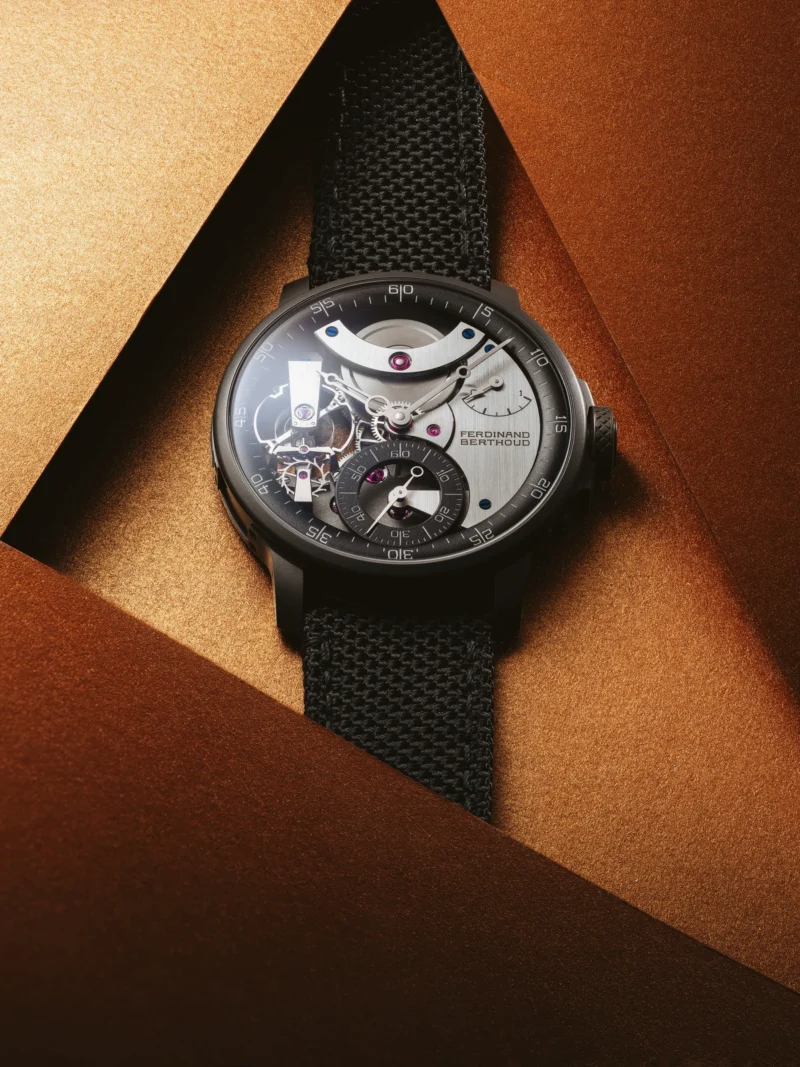
The 2026 execution changes the case and finishing language; the FB-SPC regulator dates to 2022. Courtesy of Chronométrie Ferdinand Berthoud.
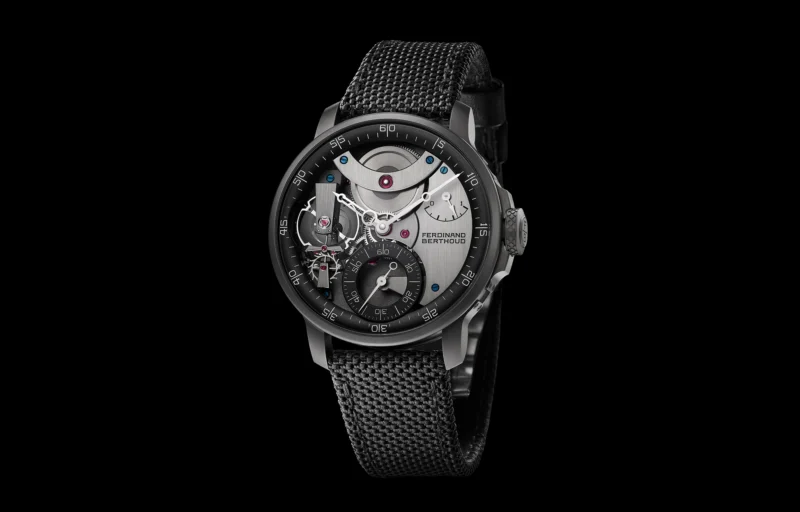
The regulating organ is isolated at nine o’clock, with small seconds at six and power reserve near two. Courtesy of Chronométrie Ferdinand Berthoud.
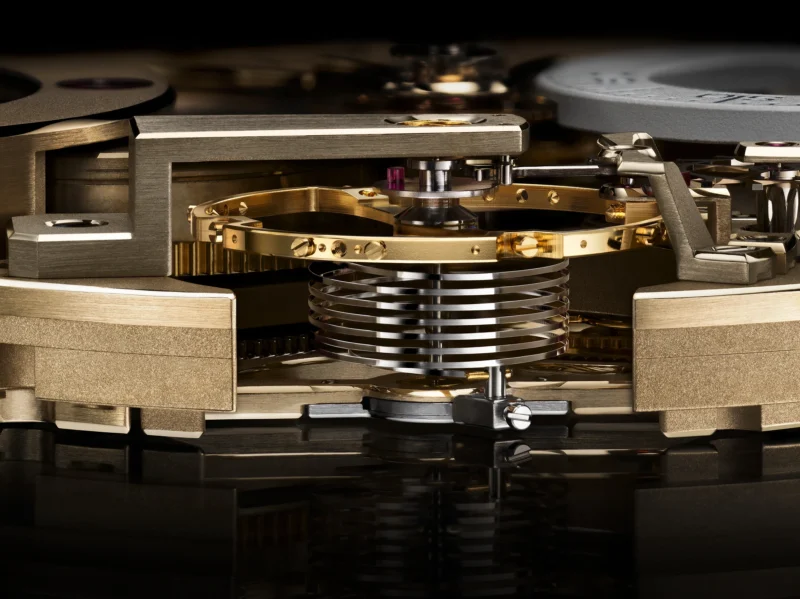
Stacked coils offer the potential for concentric breathing while their mass creates a harder problem in vertical positions. Courtesy of Chronométrie Ferdinand Berthoud.
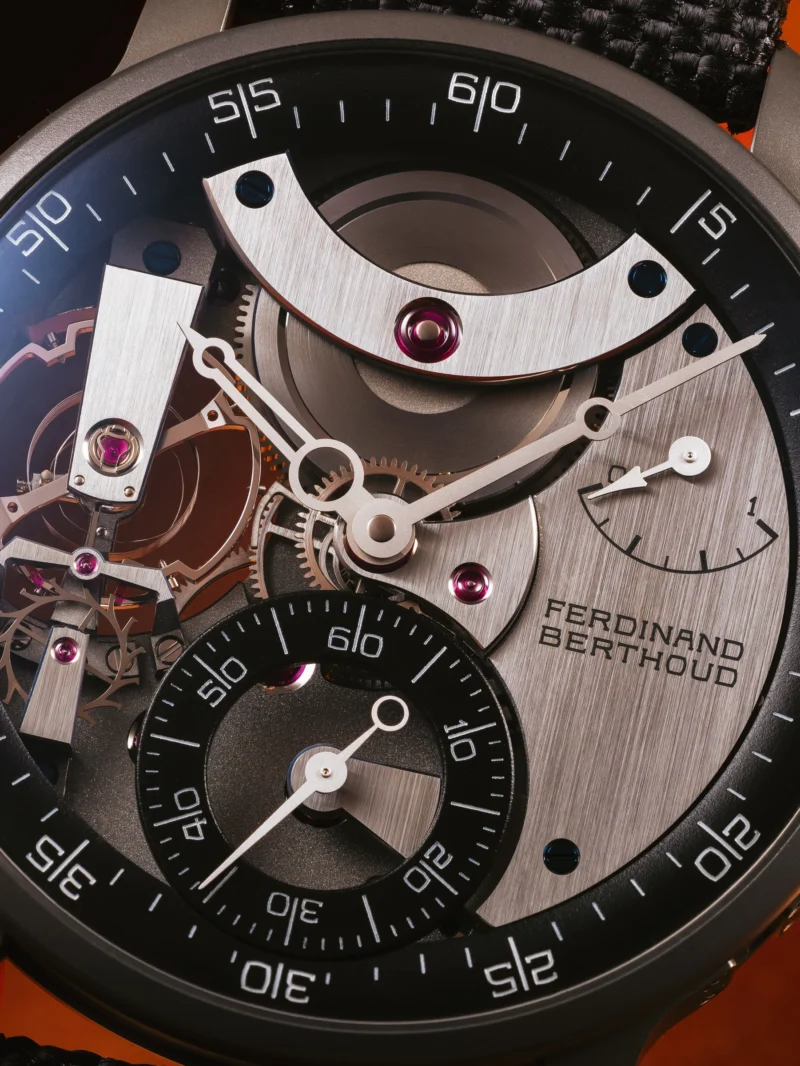
Six dial-side bridges receive aligned vertical satin finishing after their bevels have been completed. Courtesy of Chronométrie Ferdinand Berthoud.
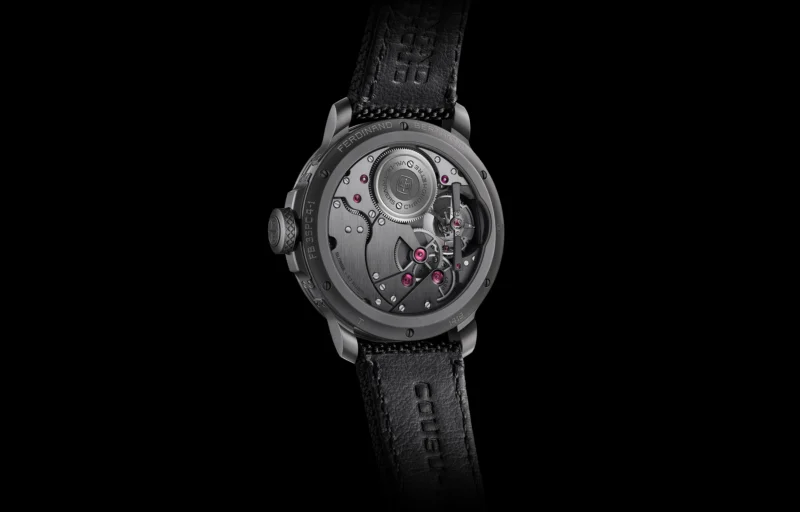
The hand-wound FB-SPC contains 230 components, 47 jewels and a 72-hour power reserve. Courtesy of Chronométrie Ferdinand Berthoud.
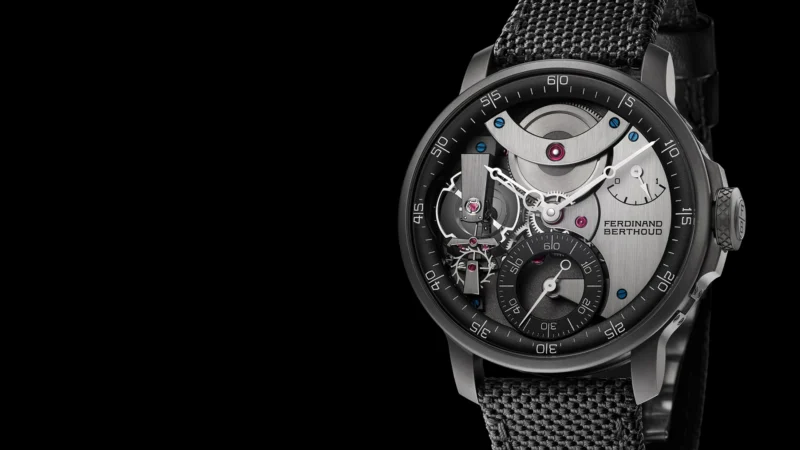
The black fabric strap and crown guard are both new within the FB 3SPC collection. Courtesy of Chronométrie Ferdinand Berthoud.
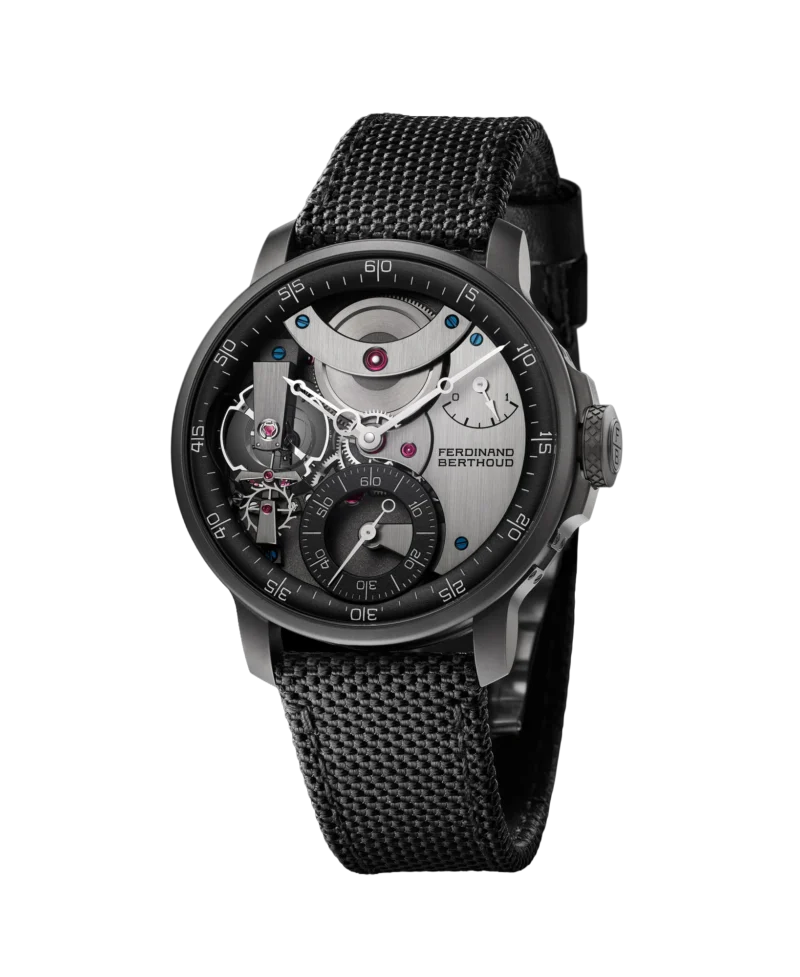
The 42.30 mm ceramised-titanium case is 9.43 mm thick and water-resistant to 30 metres. Courtesy of Chronométrie Ferdinand Berthoud.
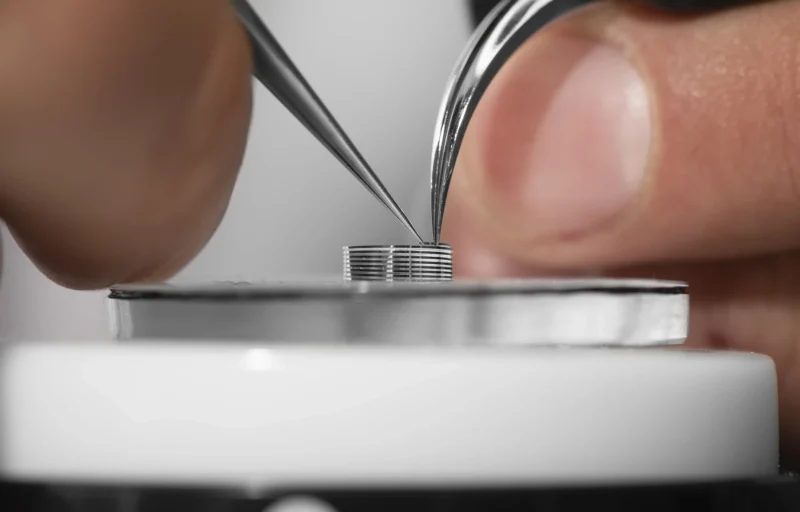
Each terminal curve contains three bends formed with manual tools; this process image documents the official method, not a specific delivered watch. Courtesy of Chronométrie Ferdinand Berthoud.
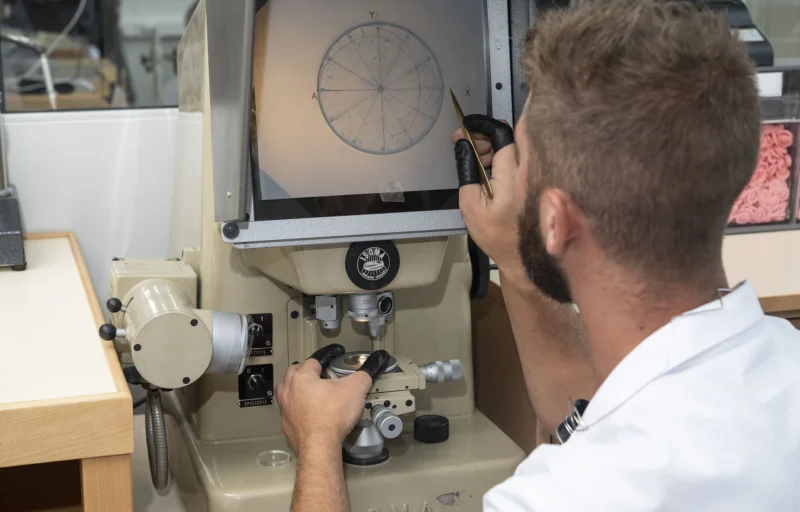
Ferdinand Berthoud states that the terminal geometry is checked under 20× projection. Courtesy of Chronométrie Ferdinand Berthoud.
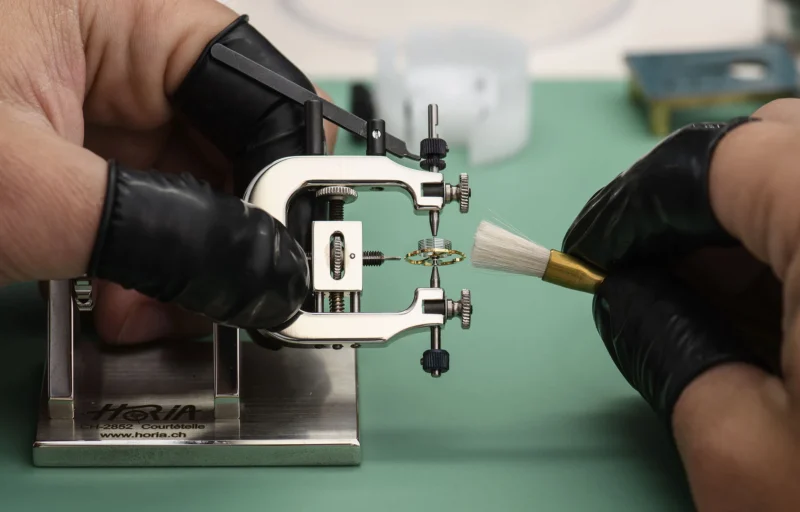
The cylindrical spring, special collet and variable-inertia balance were developed as one coupled system. Courtesy of Chronométrie Ferdinand Berthoud.
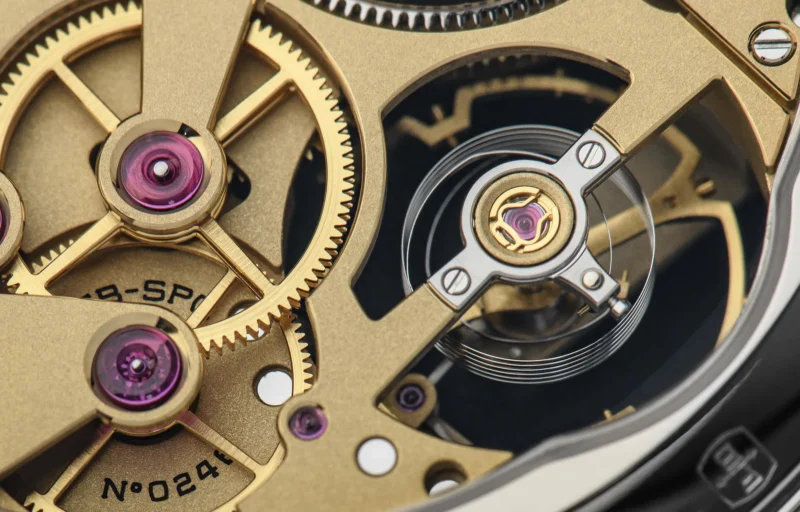
Earlier FB-SPC imagery clarifies the regulator’s architecture; the 2026 watch changes its exterior treatment, not the underlying calibre. Courtesy of Chronométrie Ferdinand Berthoud.

The direct archival reference is Louis Berthoud’s No. 26, not a generic Ferdinand Berthoud marine chronometer. Courtesy of Chronométrie Ferdinand Berthoud.
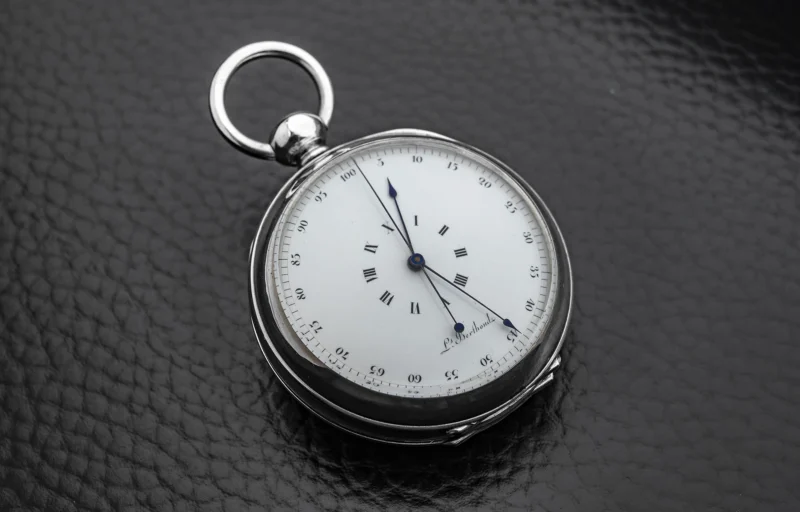
The modern FB 3SPC revisits No. 26’s regulating question rather than reproducing its case, dial or movement. Courtesy of Chronométrie Ferdinand Berthoud.
FB-SPC / cylindrical regulatorOrientation / mass / correction
The cylinder changes character when gravity changes direction.
Concentric breathing is only the opening proposition. A wristwatch has to remain regulatable when its oscillator leaves the horizontal plane.
Axis / horizontal
Concentric potential
Equal-diameter coilsWith gravity acting along the spring's axis, the cylindrical form can expand around a more stable centre.
Axis / vertical
Mass becomes error
Greater moving massTurn the watch through ninety degrees and the same three-dimensional spring can multiply positional disturbance.
System / adjusted
Geometry becomes rate
Collet + curves + balanceA lighter special collet, two terminal curves and a variable-inertia balance are regulated as one coupled system.
Key facts
- The Chronomètre FB 3SPC.4-1 uses the existing hand-wound FB-SPC calibre, not a new 2026 movement.
- Its case is black ceramised titanium, 42.30 mm across and 9.43 mm thick, with a sapphire porthole at 9 o’clock and 30 metres of water resistance.
- Calibre FB-SPC measures 34 mm by 6.84 mm, contains 230 components and 47 jewels, runs at 3 Hz and provides 72 hours of power reserve.
- The regulator combines a variable-inertia balance with a cylindrical hairspring whose two terminal curves are shaped by hand.
- Ferdinand Berthoud states that each terminal curve contains three bends made with manual tools and checked under 20x projection.
- The movement is individually chronometer-certified by COSC. The collection won the GPHG Chronometry Prize in 2023.
A flat hairspring lies in one plane. A cylindrical hairspring rises above the balance in stacked coils, more like a compressed helix than the familiar spiral used in most wristwatches. That difference is easy to see. The difficult part is understanding why anyone would accept the extra height, mass and adjustment work.
The answer is not nostalgia.
A hairspring is useful only if it returns energy to the balance in a controlled and repeatable way. Its geometry affects where its centre of gravity moves as the spring expands and contracts. If that centre wanders, the balance pivots see changing forces. Those forces can alter rate, especially when amplitude falls near the end of the power reserve or when the watch changes position.
Ferdinand Berthoud chose the cylindrical form because, in principle, coils of equal diameter can expand and contract more concentrically than a flat spiral. The problem is that a wristwatch does not live flat on a desk. It turns vertical, tilts, moves and changes orientation continuously. The same mass that makes a cylindrical spring geometrically attractive can become a liability under gravity.
That is the real subject of the Chronomètre FB 3SPC. The 2026 black case is new. The chronometric problem is not.
Why concentric breathing matters
The term “breathing” is useful because a hairspring does not simply open and close. It changes radius with every oscillation of the balance. Ideally, it does so around a stable centre.
Ferdinand Berthoud’s technical documentation makes the problem unusually explicit. The Manufacture explains that a spring whose coils develop concentrically is mechanically more stable because its centre of gravity remains more consistent during oscillation. When the spacing develops irregularly, that centre shifts. The resulting imbalance can increase friction at the balance pivots and disturb rate.
This is one reason a flat hairspring is difficult to perfect even though its overall shape looks simple. The inner and outer attachment points matter. The terminal geometry matters. Collet mass matters. The spring’s behaviour changes with amplitude. Small geometric errors that would be visually insignificant can become chronometrically important.
The cylindrical form offers a different starting point. Its coils are stacked with matching diameters, so the spring has greater potential to expand and contract concentrically. Marine chronometers and precision portable timekeepers historically exploited that property because they spent much of their working life in controlled orientations.
A wristwatch removes that comfort.
Ferdinand Berthoud states that the cylindrical spring’s larger mass can increase positional error when the watch is vertical. In other words, the geometry that helps the spring breathe evenly in one orientation does not automatically produce a better wristwatch. A cylinder is not a shortcut to accuracy. It is a different set of problems.
That distinction matters because the modern watch industry often treats unusual oscillator architecture as self-validating. A tourbillon, silicon component or exotic spring geometry can sound like an improvement simply because it is unusual. The FB 3SPC offers a more useful lesson: architecture only matters if the finished regulating organ can be adjusted to deliver repeatable performance across the test conditions that matter.
Six dial-side bridges receive aligned vertical satin finishing after their bevels have been completed. Courtesy of Chronométrie Ferdinand Berthoud.
The hard part is at the ends of the spring
The FB-SPC regulator took more than three years of research and development. The most revealing part of that work was not the visible stack of coils. It was the geometry at the attachment points.
Ferdinand Berthoud says the regulator combines a variable-inertia balance, a specially developed collet and a cylindrical hairspring with two specific terminal curves. Each terminal curve sits at one end of the spring and contains three bends. Those bends are shaped by hand with manual tools and checked using a profile projector at 20x magnification.
This is where the historical-looking component becomes a modern engineering exercise.
During development, the Manufacture found that a spring that behaved correctly in isolation changed once it was pinned to the collet. The additional mass at the inner attachment disturbed concentric breathing. Reducing the collet mass then changed the geometry required at the terminal curves. Altering the curves changed the attachment relationship again.
The variables were coupled.
A lighter collet alone was not the solution. A new terminal curve alone was not the solution. The collet profile, the angular relationship between the inner and outer attachments and the spring geometry had to be treated as a system.
That is why “why bend a balance spring into a cylinder?” is only half the question. The other half is “how do you stop that cylinder from becoming worse when gravity changes direction?”
Ferdinand Berthoud’s answer was iterative geometry rather than a single headline component. The spring, collet and variable-inertia balance were developed together. The balance itself uses fine-adjustment and loading screws, while the spring geometry was repeatedly modelled and tested until the Manufacture could regulate the completed movement to chronometer criteria.
The visible cylinder is therefore the outcome of the work, not the whole mechanism.
COSC proves a test result, not permanent wrist accuracy
The strongest independent fact attached to the FB 3SPC is not an adjective. It is certification.
Calibre FB-SPC is individually certified as a chronometer by the Contrôle Officiel Suisse des Chronomètres. Ferdinand Berthoud describes it as the first and only wristwatch movement of its type, combining a variable-inertia balance and cylindrical hairspring, to achieve COSC certification. That exclusivity remains a Manufacture statement unless the entire current market is independently audited, but the certification itself is external.
The distinction is important.
COSC certification does not mean an owner will see the same daily deviation in every wearing pattern. It means the movement passed a defined laboratory programme. Ferdinand Berthoud states that its movements are tested over sixteen consecutive days, in five positions and at three temperatures.
The Manufacture has also published more detailed historical data for FB 3SPC movements tested by 2023. It reported an average daily rate result of 2.08 seconds per day across those movements and said 80 per cent showed daily variation between minus one and plus three seconds per day under the COSC programme. Those figures are valuable because they describe an actual tested population, but they should not be converted into a guaranteed 2026 wrist-performance promise for every FB 3SPC.4-1.
The 2023 data show that the cylindrical architecture can be regulated successfully under formal chronometry testing. They do not abolish positional effects, ageing, shock, magnetism, lubrication changes or the realities of individual ownership.
That is the right way to read the GPHG Chronometry Prize the collection received in 2023 as well. The award confirms that the industry’s jury recognised the watch’s chronometric proposition. It does not replace the measurement work. COSC is the more useful evidence when discussing rate.
Terminal curves / collet / variable inertia
The visible cylinder is only one variable in the equation.
Stacked coils offer the potential for concentric breathing while their mass creates a harder problem in vertical positions. Courtesy of Chronométrie Ferdinand Berthoud.
Six dial-side bridges receive aligned vertical satin finishing after their bevels have been completed. Courtesy of Chronométrie Ferdinand Berthoud.
The hand-wound FB-SPC contains 230 components, 47 jewels and a 72-hour power reserve. Courtesy of Chronométrie Ferdinand Berthoud.
Spring / geometry / certification
One movement. Two layers of achievement.
The regulator
Two terminal curves, each with three hand-formed bends, control the spring's inner and outer attachment geometry.
- Range
- 34 mm · 6.84 mm
- Display
- 3 Hz · 21,600 vph
- Control
- 230 components
- Isolation
- 47 jewels
- Flyback
- 72 hours
The 2026 frame
Ceramised titanium, a crown guard, black fabric and black-rhodium nickel silver alter the object around an unchanged 2022 calibre.
- Range
- 42.30 mm · 9.43 mm
- Display
- 30 m
- Control
- Manual winding
- Isolation
- COSC chronometer
- Flyback
- 102 external · 15 internal angles
The historical reference is Louis Berthoud’s No. 26
The watch’s historical anchor is precise enough to avoid generic heritage storytelling.
Ferdinand Berthoud traces the FB 3SPC to the decimal watch No. 26 made by Louis Berthoud in 1793. Louis was Ferdinand Berthoud’s nephew and successor, and the Manufacture says he favoured cylindrical hairsprings in some of the precision watches he regarded most highly. No. 26 is now part of the Chronométrie Ferdinand Berthoud heritage collection in Fleurier.
That distinction is worth preserving. The modern house carries Ferdinand Berthoud’s name, but the direct object cited for the FB 3SPC is a Louis Berthoud watch.
The 2026 FB 3SPC.4-1 does not reproduce the No. 26 dial, case construction or movement architecture. Its connection is narrower and more credible: the use of a cylindrical balance spring as a chronometric problem, together with a round case shape that the Manufacture relates to early nineteenth-century pocket watches.
This is not an archival replica. It is a modern wristwatch that chooses to revisit one historical regulating idea under contemporary testing.
That makes the historical claim stronger, not weaker. It avoids pretending that a black ceramised titanium wristwatch with exposed mechanics is a continuation of a 1793 object in every respect. The continuity lies in the question being asked of the oscillator.
What Calibre FB-SPC is actually doing
The movement architecture makes the regulating organ unusually easy to study.
At 9 o’clock, the balance, pallet lever and escape wheel are separated visually from the rest of the calibre. The balance spring rises in its cylindrical stack, while the caseband includes a sapphire porthole so the oscillator can also be seen from the side.
This is more than display theatre. A cylindrical hairspring is three-dimensional, so a conventional top view hides part of what makes it different. The lateral window gives the architecture a reason to exist visually as well as mechanically.
The calibre is hand-wound and measures 34 mm across by 6.84 mm thick. It contains 230 components and 47 jewels, runs at 21,600 vibrations per hour, or 3 Hz, and stores 72 hours of energy. Hours and minutes are central, small seconds sit at six, and the power-reserve indication appears around two o’clock.
The mainplate occupies the centre of the movement, with components assembled on both sides. Earlier FB 3SPC documentation describes six bridges on the dial side and ten on the back. That organisation produces a calibre that is visible from both faces rather than a conventional movement hidden behind a complete dial.
This matters because the 2026 watch is often described visually before it is described mechanically. The blackened surfaces make the open architecture look more technical, but the layout itself belongs to the FB 3SPC conceived in 2022. The case colour does not create the movement.
What is actually new in 2026
The FB 3SPC.4-1 should not be published as though Ferdinand Berthoud invented the cylindrical-hairspring wristwatch in 2026. The movement and regulator date to 2022.
The new work is concentrated in the exterior and finishing language.
The case is made from black ceramised titanium. Ferdinand Berthoud describes the material as lightweight and more scratch-resistant than untreated titanium, with a black colour intended to remain stable over time. The case is sandblasted to produce a muted surface. At 42.30 mm by 9.43 mm, the dimensions remain those of the FB 3SPC family.
This is also not the first titanium FB 3SPC. In 2024, the Manufacture made five FB 3SPC.4 watches in sandblasted titanium for the fifth anniversary of Art in Time Monaco. The 2026 reference is different: it brings ceramised black titanium into the current collection rather than merely repeating the earlier sandblasted metal.
The current product page also contains a small inherited-copy inconsistency that is worth recording rather than silently correcting. One descriptive paragraph says the round case is available in 18-carat rose gold, language that belongs to another FB 3SPC execution. The same page’s title, launch copy and formal specification table all identify the FB 3SPC.4-1 as ceramised titanium. Those specific and repeated fields govern. The mismatch is best treated as a CMS or template artefact, not evidence of a second rose-gold version of reference .4-1.
Two exterior changes are explicitly new within the FB 3SPC line. The .4-1 introduces a crown guard, and Ferdinand Berthoud calls the black fabric strap a first for the collection. The crown, guard, case and caseback are all ceramised titanium. A titanium pin buckle is standard, while a folding clasp with safety fastening and adjustable blade is available on request.
The dial-side movement is nickel silver treated with black rhodium. Against it, six visible bridges receive vertical satin finishing. Hours, minutes, seconds and power-reserve hands are white gold and sandblasted, while the peripheral hour-minute ring and small-seconds ring are black-varnished brass with matt grey numerals.
Calling this arrangement a dial can be misleading. Much of what the wearer reads is the movement itself: bridges, train, oscillator and mainplate occupy the visual field, while conventional dial furniture is reduced to the peripheral chapter ring and the small-seconds scale. The 2026 black rhodium therefore changes more than colour. It alters the contrast between the calibre as mechanism and the calibre as display, without altering the gear train or regulating architecture beneath it.
The visual result is quieter than the gold-toned 2022 model, but the underlying mechanism is unchanged. That is the useful editorial distinction: 2026 changes how the movement is framed, not why the cylindrical spring exists.
The finishing is structural, not a generic luxury claim
Ferdinand Berthoud publishes an unusually specific finishing inventory for the new reference.
The nickel-silver movement uses eight categories of decoration: bevelling, black polishing, circular finishing, open polishing around jewel and screw sinks, sandblasting, satin finishing, softening and stretching. The Manufacture also states that it does not apply preliminary machine bevelling before the hand work.
Its description of anglage is concrete. Each 45-degree bevel is raised by hand with a knife, then filed, softened and polished through progressively finer abrasives. The final polish uses gentian wood sourced from pastures near the Manufacture.
The numbers make that process easier to interrogate: the movement contains 102 external angles and 15 internal angles according to Ferdinand Berthoud’s September 2026 documentation.
That matters because internal angles are not automatically produced by a rotating polishing wheel. Sharp inward corners require controlled manual work if they are to remain geometrically crisp. The component count or number of angles still does not prove quality on its own, but here the Manufacture explains what the craft operation actually is.
The vertical satin finish on the six dial-side bridges creates a second difficulty. It is applied after anglage. That means the artisan has to maintain straight, aligned surface lines without touching the polished bevels already completed around the bridges. The brand says pressure must remain consistent across all six bridges for the lines to appear continuous.
This is the kind of finishing claim that can be evaluated visually. It is more useful than saying the movement is “hand-finished” and leaving the phrase undefined.
Why the cylinder still matters in a black titanium watch
The danger with the FB 3SPC.4-1 is that the new exterior can make the watch look like a material update. It is one, but that is not where its authority comes from.
Ceramised titanium changes weight, surface hardness, colour and the relationship between the case and movement. A crown guard and fabric strap change the watch’s posture. Black rhodium changes the way the six bridges and regulating organ are read.
None of those changes explains why the watch exists.
The reason is still the oscillator.
A cylindrical hairspring offers the possibility of more concentric breathing, then immediately creates another problem because a wristwatch is constantly changing position. Ferdinand Berthoud had to redesign the collet, terminal curves and regulating system around that contradiction. Each terminal curve is hand-shaped. Each movement then has to be individually adjusted well enough to pass an independent chronometer test.
That is a much stronger story than “heritage meets modernity”. The old idea was not borrowed because it looked historical. It was borrowed because it created a problem difficult enough to be worth solving again.
The FB 3SPC.4-1 does not prove that cylindrical hairsprings are universally better than flat ones. It proves something narrower: a cylindrical spring can be engineered, adjusted and certified in a wristwatch despite the positional weaknesses that once made the geometry impractical for the wrist.
The black case is the 2026 chapter. The cylinder is the reason there is a book at all.
The Edit
Stories selected by TheTimeo

Blancpain Lady B: What Does 19 Millimetres Require?
Blancpain’s 19 mm Lady B is best understood as an exercise in mechanical volume:
When Is a Revived Watch Brand Still the Same Brand? Testing the New Gallet Against the Archive
The archive is real and the manufacturing system is new. We test Flying Officer,
MING 57.05 Comet: The One-Click DST Fix and the Time-Zone Problem It Cannot Fully Solve
One click moves DST-observing cities by an hour. The harder problem is that civil-time