
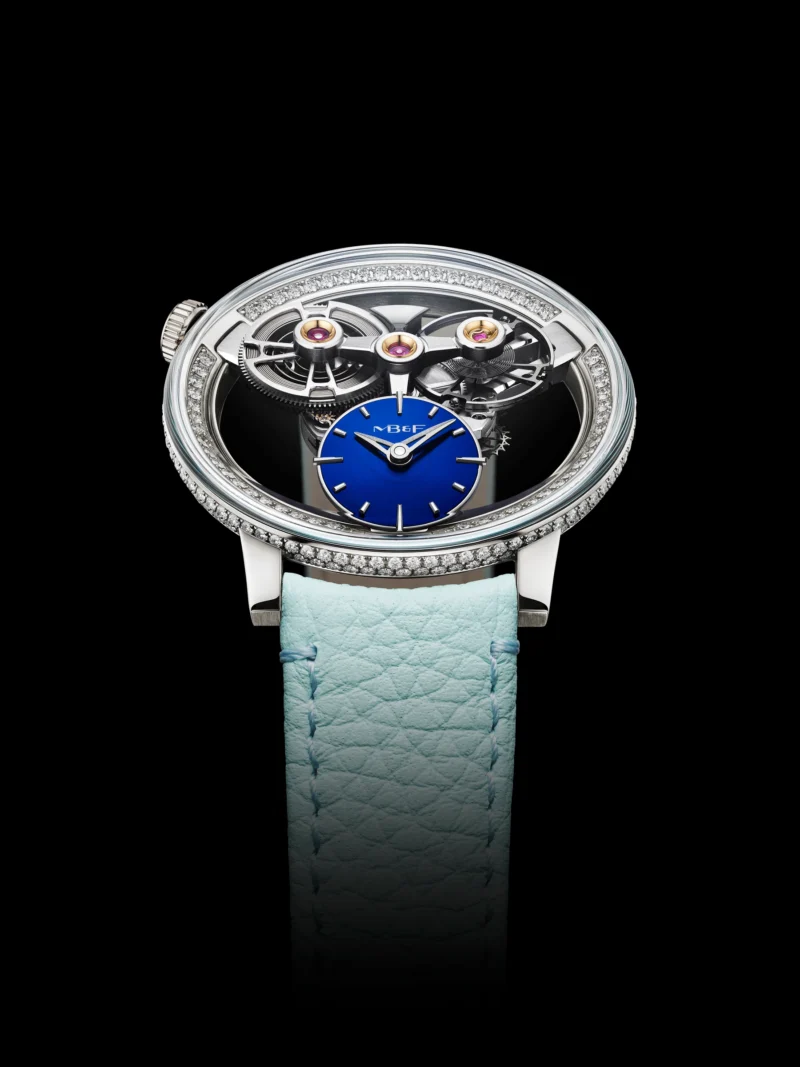
High Jewellery Watch / Spatial Study
Watches
MB&F SP One Pavée: Where Do You Put 255 Diamonds on a Watch That Has No Bezel?
The bezel-free SP One leaves its three mechanical circles untouched and distributes 255 diamonds across the case, internal flange, crown and buckle.
TheTimeo view
The perimeter preserves the void.
The SP One was designed around absence. Its Pavée edition succeeds only if 255 stones can add light without filling the open field that makes barrel, balance and dial appear to float.
The achievement is not putting 255 diamonds onto a 38 mm watch. It is knowing where not to put the 256th.
TheTimeo
The visual edit
Light at the edge. Mechanics in the void.
The SP One Pavée places 255 diamonds around a movement built from three floating circles. © MB&F.
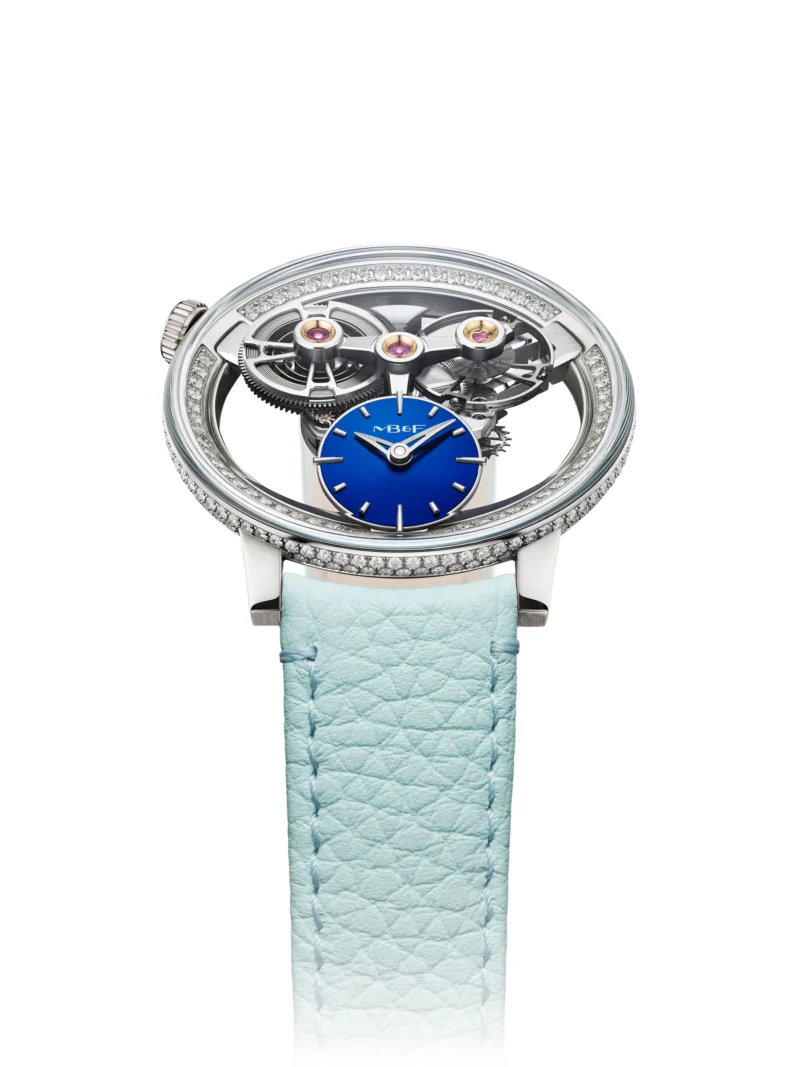
The dark-blue inclined dial remains a single opaque field inside the open mechanical architecture. © MB&F.
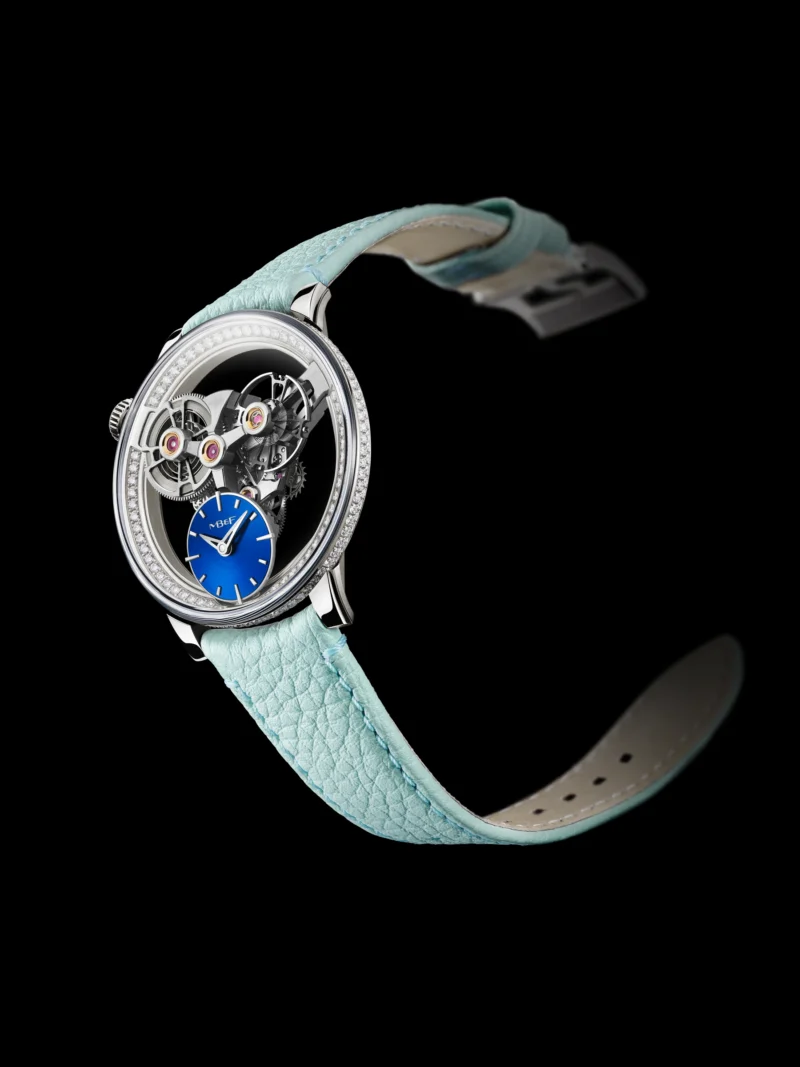
The three-quarter view shows the bezel-free sapphire volume and diamond-set white-gold perimeter. © MB&F.
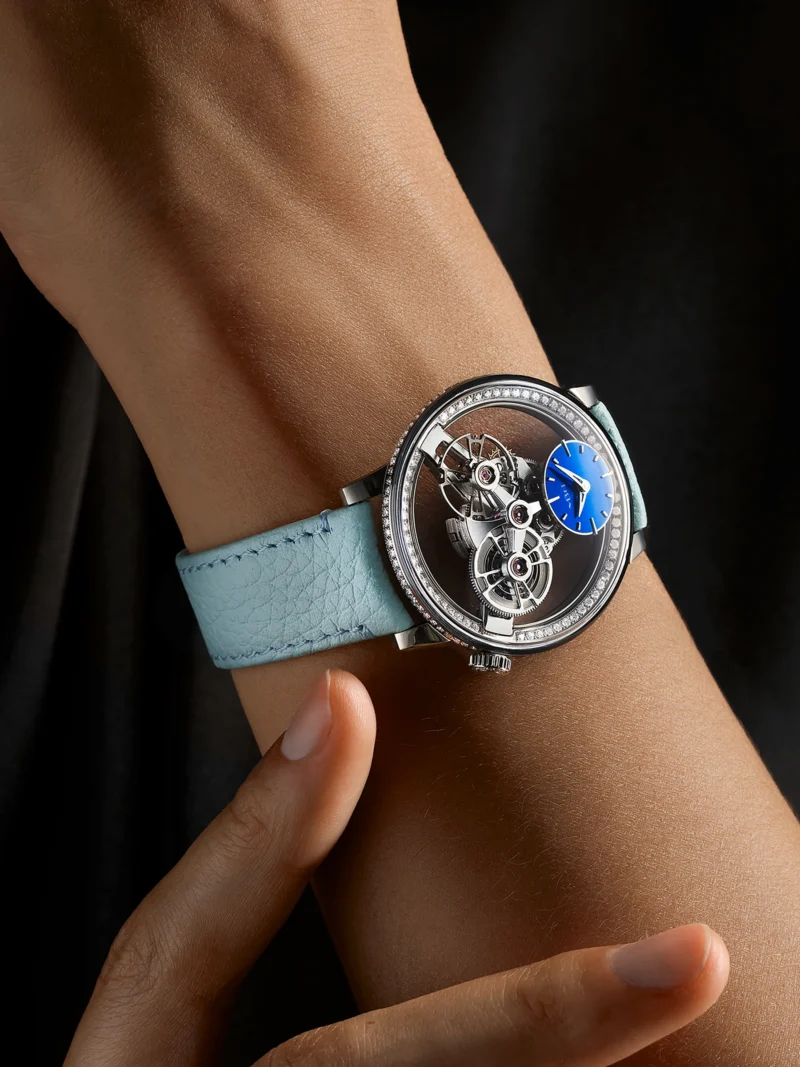
At 38 mm, the SP One Pavée keeps the compact scale of the original Special Project One. © MB&F.
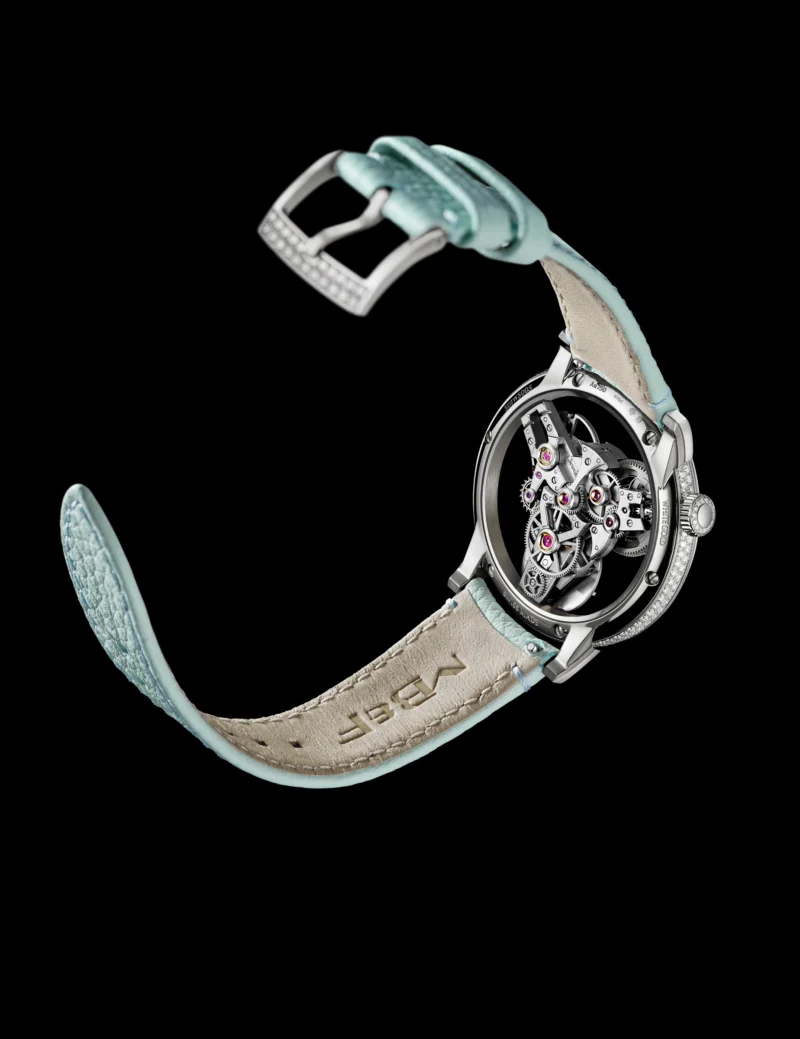
Manual winding leaves the rear sapphire free of a rotor, exposing the supporting movement architecture. © MB&F.
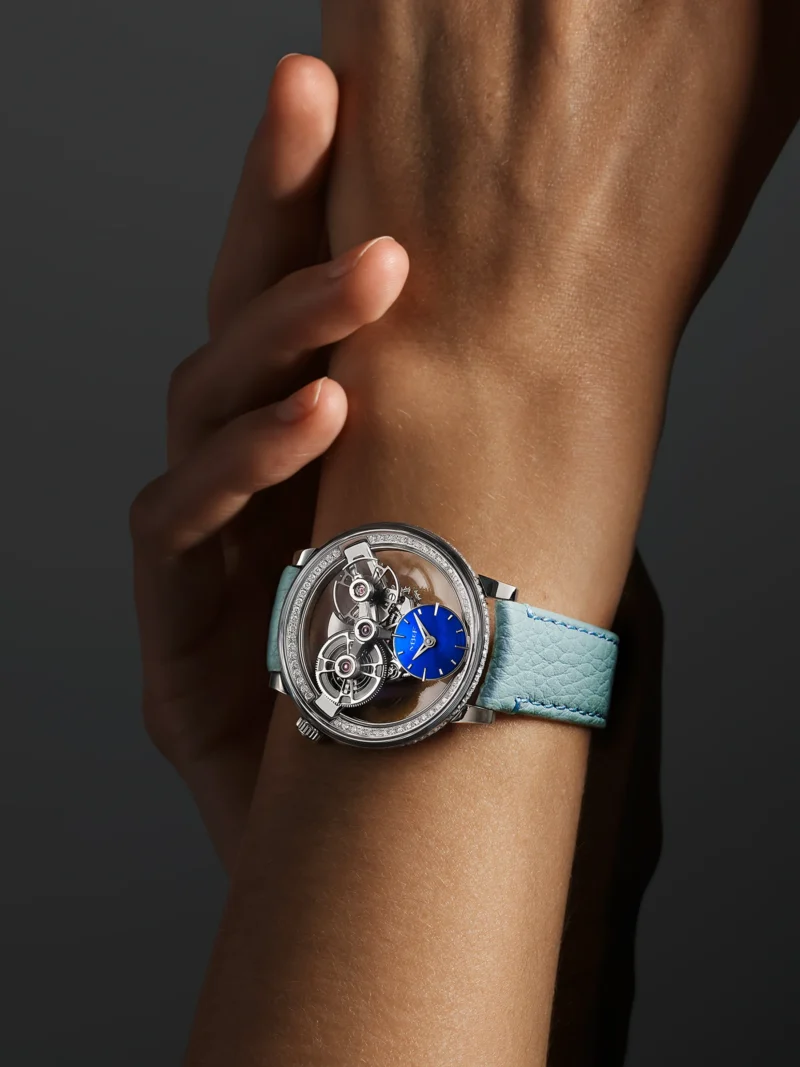
White gold, rhodium, diamonds and pale-blue calfskin establish the Pavée’s cool material field. © MB&F.

Detached lugs preserve a visual gap between the pebble case and its strap. © MB&F.
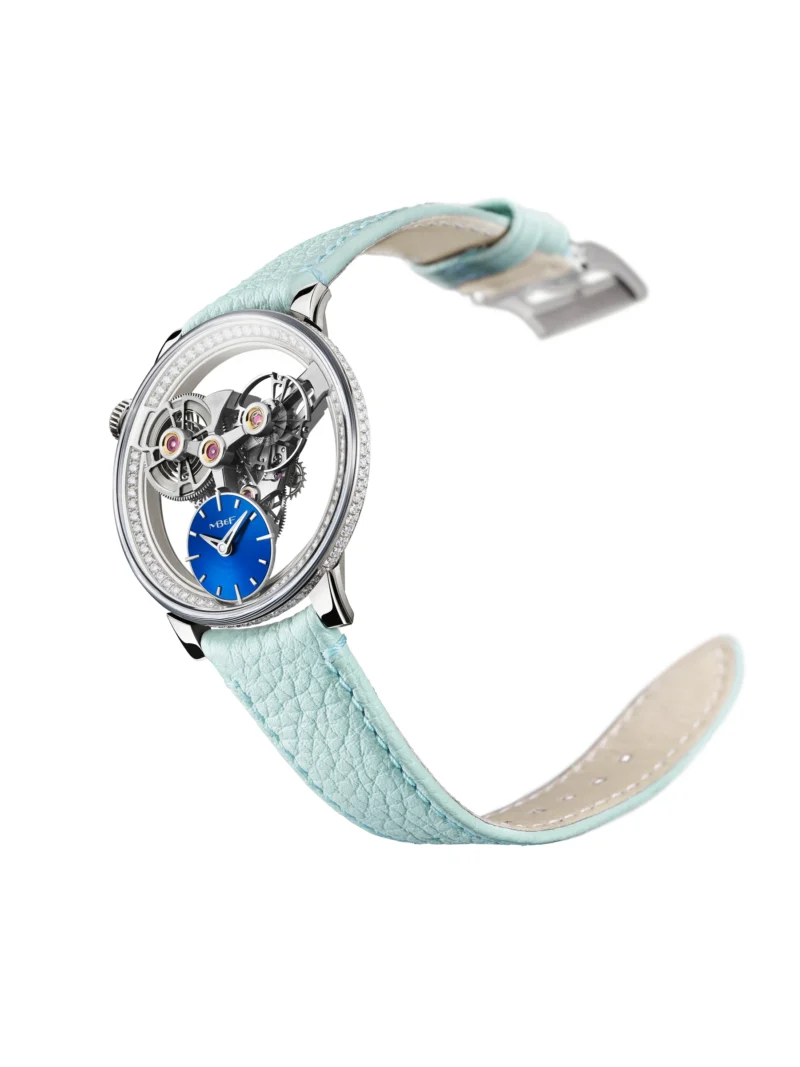
The set case follows the object’s curvature instead of creating a conventional flat bezel. © MB&F.
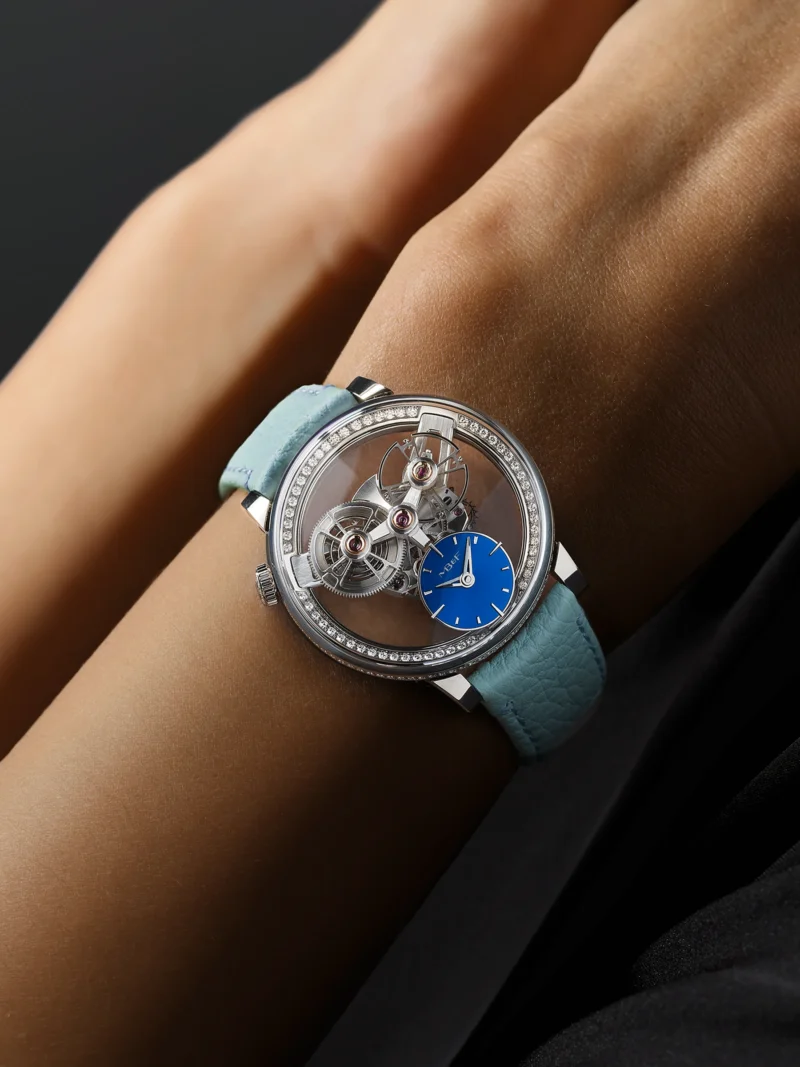
An oblique view reveals how the internal flange brings diamonds closer to the movement. © MB&F.
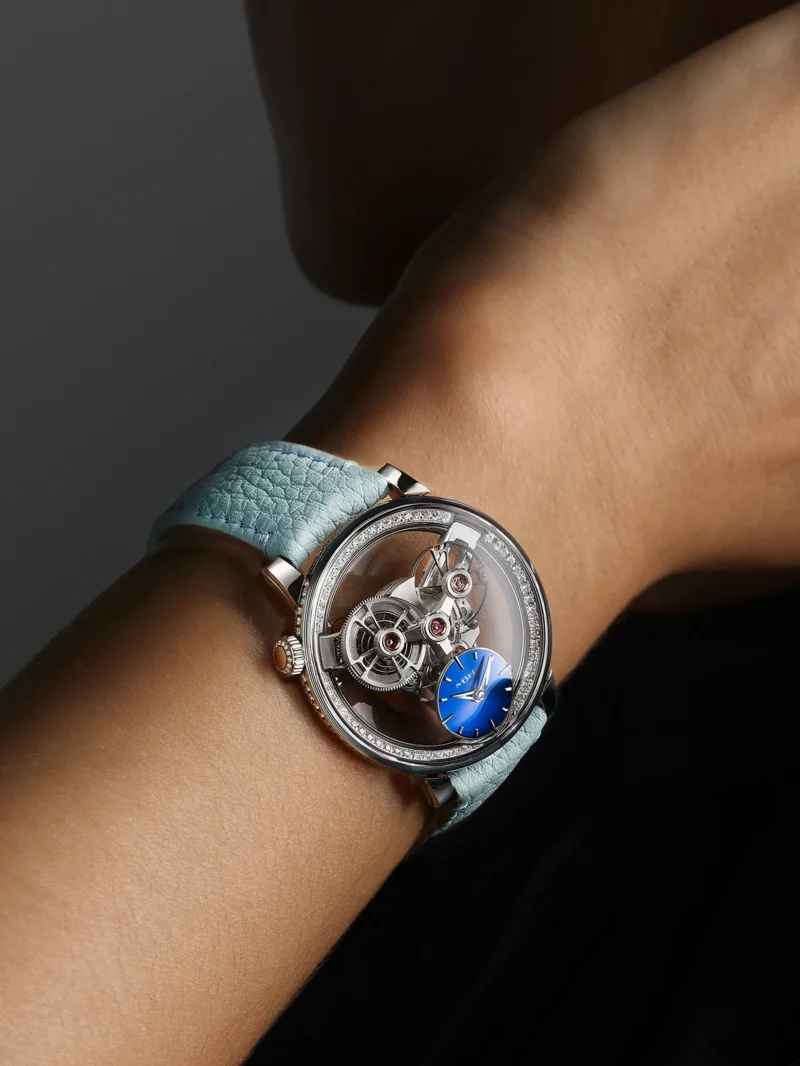
Fourteen diamonds carry the setting onto the crown, one of the watch’s principal interfaces. © MB&F.

The founding diagram was three circles inside a fourth: barrel, balance and dial within the case. © MB&F.
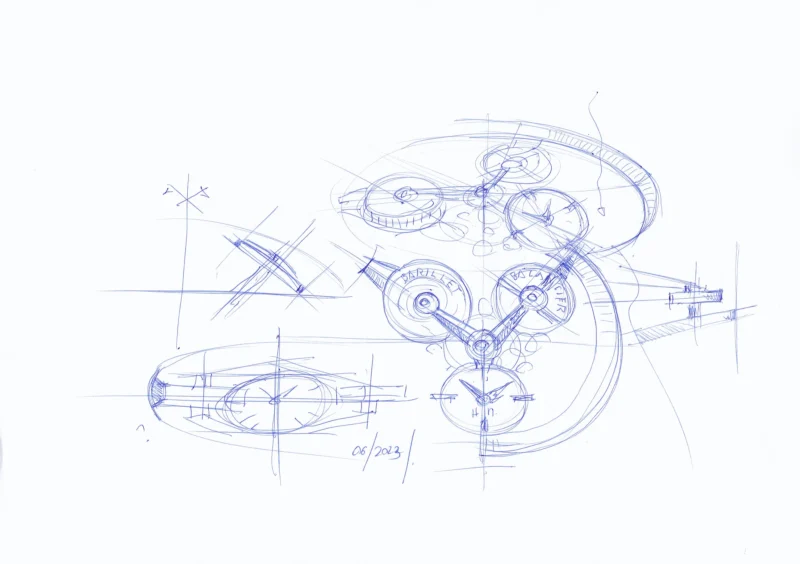
Eric Giroud’s development drawing translates the three-circle idea into a supported mechanical volume. © MB&F.
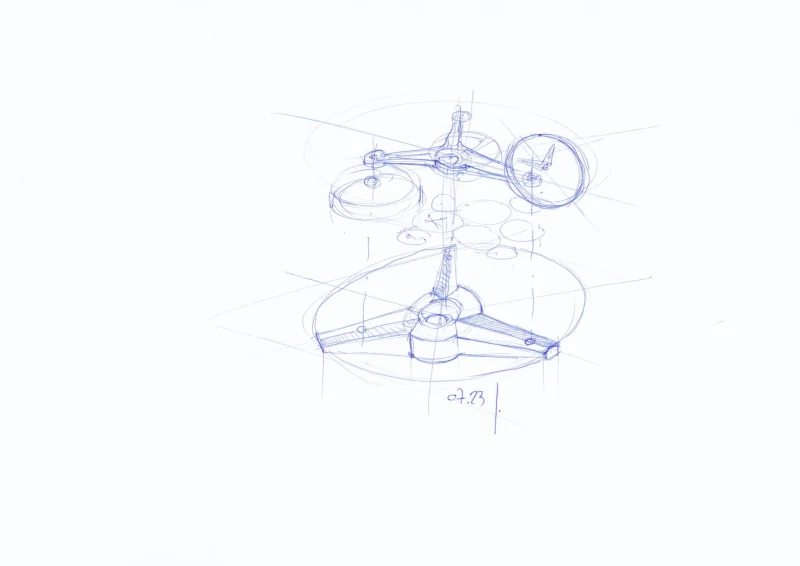
The side study resolves sapphire, detached lugs and movement support around the desired emptiness. © MB&F.
Diamond distribution / 255 stones
The brightest material stays at the edge.
The barrel, balance and dark-blue dial remain untouched. Every published stone belongs to the architecture around them.
Case
16564.7%Two rows follow the pebble-shaped white-gold perimeter.
Internal flange
5521.6%The amphitheatre is set from inside the sapphire volume.
Buckle
218.2%The line of light continues onto the white-gold pin buckle.
Crown
145.5%The principal interface completes the perimeter treatment.
SP One Pavée / perimeter studyKey facts
- Model: MB&F SP One Pavée
- Release: September 2026
- Collection: Special Projects
- Case: 18K white gold, 38 mm diameter, 12 mm height, 41.9 mm lug-to-lug
- Case construction: 19 components, sapphire front and display back, 30 m water resistance
- Diamonds: 255 stones, 1.608 ct total
- Distribution: 165 on case, 55 on flange, 14 on crown, 21 on buckle
- Movement: MB&F SP One, developed in-house, manual winding
- Frequency: 2.5 Hz / 18,000 vph
- Power reserve: 72 hours
- Components / jewels: 189 / 31
- Display: hours and minutes on inclined dark-blue PVD dial at 6 o’clock
- Movement finish: rhodium-finished bridges on the Pavée
- Price: CHF 78,000 excluding VAT on MB&F’s current commercial listing and contemporary launch coverage
Most diamond-set watches begin with an obvious place to work.
There is usually a bezel. It provides a continuous ring of metal around the dial, structurally separate from the movement and visually expected to carry stones. If more surface is needed, a setter can move onto the lugs, case, bracelet or dial.
The SP One removes the obvious ring.
Its upper surface is dominated by an ultra-domed sapphire crystal. Beneath it sit the three circles that gave the project its original name: a skeletonised mainspring barrel, a large balance wheel and an inclined time dial. MB&F deliberately hides much of the supporting mechanics so these three elements appear suspended inside the case.
That architecture makes conventional pavé logic dangerous. Fill the centre and the illusion disappears. Build a heavy diamond bezel and the bezel-free pebble becomes a different watch.
MB&F’s solution is not to search for more space.
It is to set the space that already frames the emptiness.
The numbers show where the diamonds are allowed to exist
MB&F publishes the distribution precisely.
The case receives 165 diamonds. The internal flange receives 55. The crown carries 14. The white-gold pin buckle carries 21. Together they make 255 stones weighing 1.608 carats.
The count is more useful than the total carat weight because it maps the design decision.
Almost two thirds of the stones by number sit on the case. A little over one fifth sit on the flange. The crown and buckle account for the remaining 35.
Those percentages do not describe carat weight distribution because MB&F does not publish the weight of each group and the stones need not all be identical in size. But the count still reveals the hierarchy: the main mechanical field is left alone.
No diamonds are listed on the barrel.
None are listed on the balance.
None are listed on the movement bridges.
None are listed on the blue time dial.
The brightest material is pushed to the perimeter.
This is the opposite of using diamonds to make the movement disappear beneath decoration. The stones define where the movement ends.
The dark-blue inclined dial remains a single opaque field inside the open mechanical architecture. © MB&F.
The missing bezel becomes an internal flange
The most important 55 stones are arguably not the largest group.
They sit on the rhodium-plated bevelled flange inside the sapphire perimeter.
Monochrome describes that area as the solution to the missing conventional bezel: the flange becomes the place where a normal watch might have offered an outer setting surface. MB&F itself calls the surrounding architecture an amphitheatre, a useful term because the mechanics sit in the centre while the flange rises around them.
This placement changes how the diamonds behave visually.
A traditional gem-set bezel normally marks the exterior boundary of the dial. On the SP One, the diamond line sits inside the crystal volume and closer to the movement. It therefore frames the mechanics from within the case rather than simply outlining the watch from outside.
The result is not a bezel in disguise.
The flange is part of the interior architecture. Its 55 stones occupy a transition between case and mechanism, which is why they are so important to the Pavée’s identity. Remove the case-side diamonds and the watch would still have an unmistakably gem-set interior frame. Remove the flange diamonds and much of the connection between stones and floating mechanics would disappear.
That is the real answer to the bezel problem.
MB&F does not add one. It uses the amphitheatre.
The 165 case stones have to follow a pebble, not a cylinder
The SP One case was never designed as a conventional vertical-sided dress-watch case.
MB&F describes it as pebble-like. Eric Giroud, who refined Max Büsser’s initial concept, explained the underlying approach more precisely in a 2025 WorldTempus interview: he was designing from emptiness, asking what could be removed while keeping the watch thin, transparent and reliable.
The case contributes to that idea through its rounded profile and detached lugs. Giroud notes that the lugs are attached from the back and separated from the main case by a small gap. This makes the central body appear less anchored to the strap.
The Pavée does not close those gaps with stones.
Instead, the 165 case diamonds follow the curved case flanks. Monochrome describes them as a double row running around the side, preserving the rotundity rather than creating a flat upper platform.
This matters because pavé setting is often visually planar even when the underlying object is not. Rows of stones can straighten a curved surface by creating a strong geometric band.
Here the setting has to acknowledge the pebble.
The stones are an expensive material applied under a stricter rule: their path is constrained by a case whose identity depends on continuous curvature.
The watch still needs to look rounded before it looks set.
Barrel / balance / inclined dial
Three circles remain mechanically legible.
The three-quarter view shows the bezel-free sapphire volume and diamond-set white-gold perimeter. © MB&F.
At 38 mm, the SP One Pavée keeps the compact scale of the original Special Project One. © MB&F.
Manual winding leaves the rear sapphire free of a rotor, exposing the supporting movement architecture. © MB&F.
Object / architecture / setting
One object. Two fields of attention.
Mechanical centre
Barrel, balance and inclined dial remain visually distinct beneath the sapphire volume.
- Case
- 18K white gold · 38 × 12 mm
- Setting
- Three circles · zero diamonds
- Movement
- Manual SP One · 189 components
- Water resistance
- 30 m / 3 ATM
- Reserve
- 72 hours · 2.5 Hz
Diamond perimeter
The setting follows the case, internal flange, crown and buckle without entering the movement field.
- Case
- 255 diamonds · 1.608 ct
- Setting
- 165 / 55 / 14 / 21
- Movement
- Rhodium bridges · blue PVD dial
- Water resistance
- 30 m / 3 ATM
- Reserve
- 72 hours · 31 jewels
White gold changes what can disappear
The first SP One arrived in platinum with a sky-blue flange and rose gold with an anthracite flange.
For the Pavée, MB&F chooses 18K white gold.
The change is logical before it is decorative.
White metal allows prongs, metal between stones and polished case surfaces to recede into the overall field of diamonds, sapphire and rhodium. It also lets the unset detached lugs remain visually connected to the set case without introducing a new colour.
MB&F does not publish a statement saying white gold was selected specifically for gem-setting performance, so that causal claim should not be invented. The material can, however, be read descriptively: the Pavée uses white gold where the original options used platinum or rose gold, and the movement bridges change from the earlier ruthenium treatment to rhodium.
The palette becomes deliberately cold.
White gold surrounds the case.
Rhodium cools the movement bridges and flange.
Diamonds produce white reflections.
The strap moves to pale blue.
Then one saturated surface breaks the field.
The blue dial is not a minor colour change
The inclined dial of the original SP One was black DLC.
The Pavée uses dark blue PVD.
That change matters because the dial is one of the three circles on which the architecture depends. The other two, barrel and balance, are mechanically open and visually complex. A fully gem-set dial would collapse the distinction between time display and surrounding jewellery work.
Blue does the opposite.
It creates a dense, continuous disc at six o’clock.
Against the open barrel, exposed balance, rhodium bridges and diamond flange, it becomes the most stable patch of colour in the entire watch. The hands and indexes can be read on a surface that does not compete with the adjacent mechanical texture.
The colour also prevents the Pavée from becoming monochrome.
A completely white-metal and diamond execution would risk merging case, flange and movement into a single reflective field. The blue dial restores depth by giving the eye a visual stop.
This is a small intervention with a large effect because the SP One has so few opaque surfaces.
Why the three circles cannot be touched
The 2018 sketch that started the SP One is almost comically simple.
Max Büsser drew three circles inside a larger circle. They resemble a face. Those circles later became the barrel, balance and dial.
The simplicity is deceptive because the finished watch required the engineers to support three large visual elements while hiding much of what normally supports a mechanical movement.
Eric Giroud described the mechanics as being held on three arms. The technical team had to add what was necessary for the watch to function, after which the structure was reduced again to recover transparency. Reliability and emptiness were being negotiated against each other.
That history explains why diamond-setting the central elements would be more than a stylistic change.
The balance wheel is not simply exposed because MB&F likes visible oscillators. It occupies one of the three founding circles.
The barrel is not simply skeletonised for decoration. Its form is the second circle.
The inclined dial is not simply off-centre. It is the third.
All three share the same visual circumference in the original concept, a relationship repeatedly documented in contemporary technical coverage and visible in MB&F’s own sketches.
Setting stones into those components would alter the geometry that created the watch.
So MB&F does not.
The Pavée adds preciousness without rewriting the three-circle diagram.
Manual winding protects the rear view
Nothing mechanically fundamental changes in the movement.
The SP One remains manually wound, with 189 components, 31 jewels, a 2.5 Hz balance and 72 hours of reserve. The functions remain hours and minutes.
This matters visually because there is no automatic rotor crossing the back.
The rear sapphire exposes the Y-shaped supporting architecture, gear train and hand-finished components. MB&F specifies hand-angled wheels, polished bevels, hand-made engravings and a combination of satin, polished and micro-blasted surfaces. For the Pavée, the bridges are rhodium finished.
It would be easy to turn manual winding into a claim of technical superiority. That would be wrong.
Automatic winding solves a practical problem that the SP One simply chooses not to solve. A micro-rotor could preserve more of the view, but it would require a different movement architecture. A full rotor would interrupt it more directly.
The actual point is narrower: manual winding is compatible with the visual brief.
A single barrel provides the stated 72 hours, so the owner is not forced to wind the watch every morning. More importantly for the design, the back remains another transparent face of the object.
The Pavée does not sacrifice that face to make room for the jewellery treatment.
The crown and buckle finish the path
Fourteen diamonds on the crown and 21 on the buckle might look like leftovers after the case and flange have been addressed.
They are not.
The crown sits at approximately ten o’clock, close to the barrel. It is one of the few conventional watch components protruding from the pebble shell. Leaving it completely plain would create a metal interruption in the diamond line around the case.
Setting it extends the jewellery treatment onto the principal user interface.
The buckle performs a similar job farther away from the watch head. MB&F uses an 18K white-gold pin buckle with 21 diamonds on a light-blue calfskin strap.
There is a practical limit to what can be concluded from that choice. The published material does not provide an engineering discussion of stone security under buckle wear, nor does it give individual stone dimensions or setting tolerances. Those details should not be reverse-engineered from photographs.
What can be established is simpler: the gem-setting does not end where the case ends.
It follows the interaction points.
Case, flange, crown, buckle.
The mechanical centre remains untouched.
The Pavée is not mechanically new
The easiest mistake with this watch is to treat the diamond execution as a new calibre story.
It is not.
MB&F’s current specifications keep the same core movement architecture introduced in 2025. Frequency remains 18,000 vibrations per hour. Reserve remains 72 hours. Component count remains 189. Jewel count remains 31. The display remains hours and minutes on an inclined dial.
The mechanical differences described by MB&F are finishing and colour treatment: rhodium-finished bridges for the Pavée and a dark-blue PVD dial in place of black DLC.
Even the case dimensions remain 38 mm by 12 mm with 41.9 mm lug-to-lug.
The new watch therefore offers a useful controlled comparison.
If the architecture stays essentially fixed, we can see what gem-setting alone does to the perception of that architecture.
It makes the perimeter brighter.
It pushes reflected light inward.
It gives the amphitheatre a literal ring of stones.
But it does not change the three mechanical circles into jewellery components.
That separation is the whole project.
What the sources do not establish
The published material is unusually detailed about stone count and placement, but it does not answer every gemmological question.
MB&F states 255 diamonds totalling 1.608 carats. The technical material reviewed for this article does not publish colour grades, clarity grades, individual stone sizes or a breakdown of carat weight by case, flange, crown and buckle.
Those should therefore remain unstated.
The documents also do not name the individual gem-setter in the indexed material reviewed here. It would be inappropriate to attribute the work to a specific workshop without evidence.
Nor does the carat total tell us the average visible size of the stones in a useful way. Dividing total carat weight by 255 would produce a mathematical average, but the groups can use different stone sizes and the result would imply a uniformity the documentation does not establish.
The edition status also needs care.
Hodinkee reports the Pavée as not limited, while some launch summaries describe production as limited. MB&F’s public machine page lists it as a current third edition but does not state a numbered limitation in the technical section. The safest treatment is to avoid assigning a fixed production number unless MB&F publishes one.
This is why source discipline matters even for a watch whose most obvious facts seem visual.
Where 255 diamonds go
The SP One Pavée works because its answer is spatially strict.
The stones do not migrate toward the most mechanically interesting parts of the watch.
They stay around them.
A total of 165 follows the case. Fifty-five occupy the internal flange. Fourteen mark the crown. Twenty-one continue the treatment onto the buckle. The barrel, balance and blue dial remain distinct objects inside that frame.
That choice preserves the original SP One’s central contradiction.
It is a watch designed to make structure disappear so the mechanism appears to float.
Pavé setting normally adds visual material. Here it has to respect an architecture built from absence.
The important achievement is therefore not putting 255 diamonds onto a 38 mm watch.
It is knowing where not to put the 256th.
Sources & credits
Sources & methodology
- MB&F SP One, for the official architecture, case, movement and Pavée specification.
- MB&F media center, for the official Pavée imagery, sketches, components and workshop material.
- WorldTempus interview with Eric Giroud, for attributed design-development context.
- This is independent editorial analysis, not a hands-on review. Diamond grades, individual sizes, per-zone carat weights, setter identity, tolerances and a numbered edition are not inferred.
The Edit
Stories selected by TheTimeo
Chopard Happy Diamonds at 50: The Stone Is Fixed. The Setting Moves.
The diamond is secured. Its gold carrier is free to travel between sapphire surfaces.
When Is a Revived Watch Brand Still the Same Brand? Testing the New Gallet Against the Archive
The archive is real and the manufacturing system is new. We test Flying Officer,
Ferdinand Berthoud FB 3SPC.4-1: Why Bend a Balance Spring into a Cylinder?
The black titanium case is new. The harder achievement is regulating a cylindrical spring