
Design Lineage / Enclosure Study
Watches
What Did IWC Actually Bring Back from Gérald Genta’s Ingenieur SL?
The 40 and 35 mm anniversary Ingenieurs share a rare silver-dial reference, but only one restores the soft-iron technical architecture.
TheTimeo view
The system survives. The enclosure does not.
The silver dial proves that the Ingenieur remains legible without its famous grid. The decisive split sits behind it: a closed, shielded 40 mm construction versus a smaller display-back watch that keeps the sculpture but changes the technical inheritance.
The anniversary brings back a system, not a costume. Its two sizes reveal exactly where design lineage and technical lineage separate.
TheTimeo
The visual edit
One silver surface. Two kinds of inheritance.
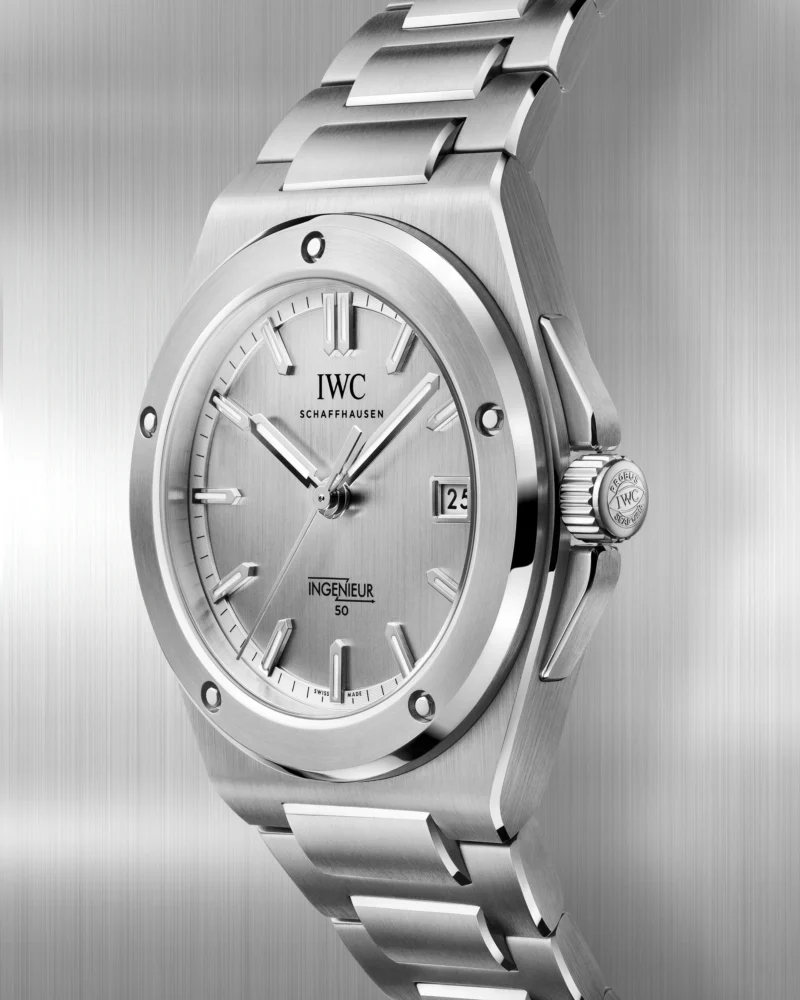
The anniversary dial removes the familiar grid and lets brushed steel, five functional screws and the integrated bracelet carry the identity. © IWC Schaffhausen.
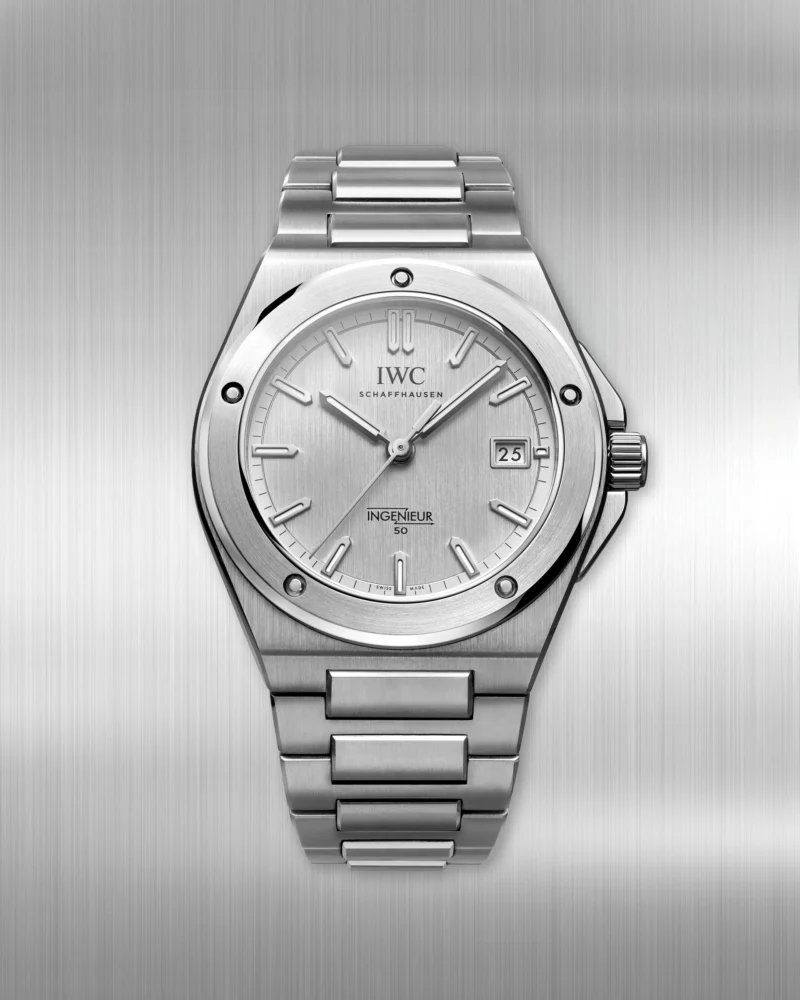
The 40 mm reference keeps the solid case back required by its soft-iron movement enclosure. © IWC Schaffhausen.
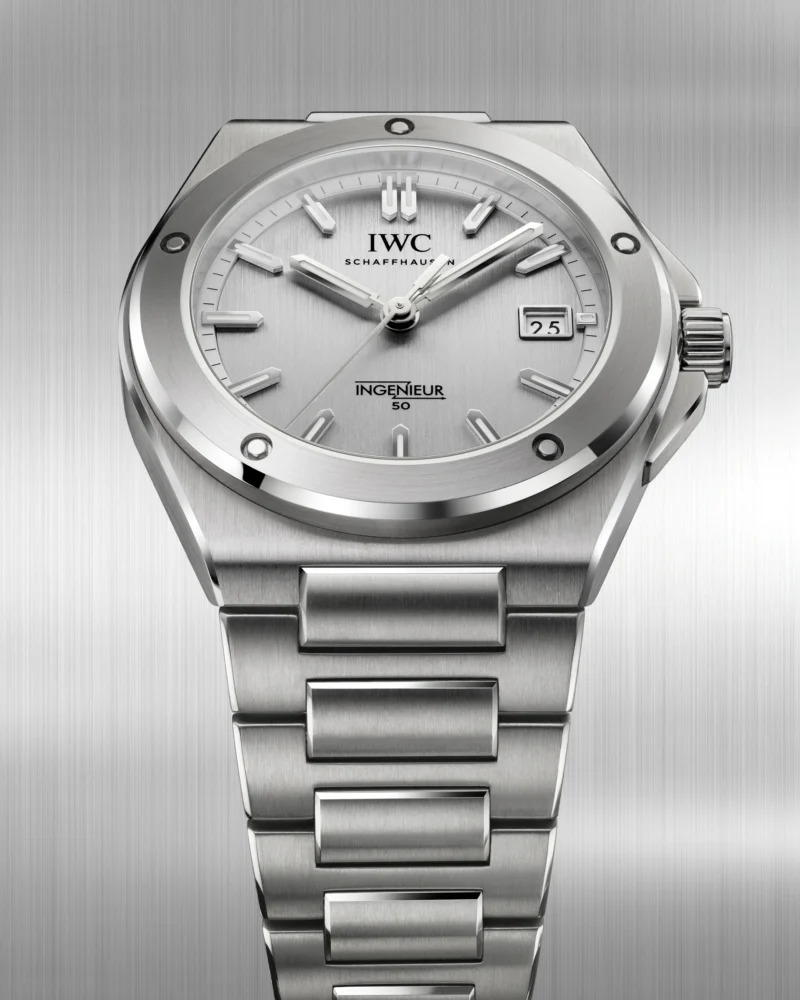
A small ‘50’ replaces the lightning-bolt element beneath the Ingenieur signature. © IWC Schaffhausen.
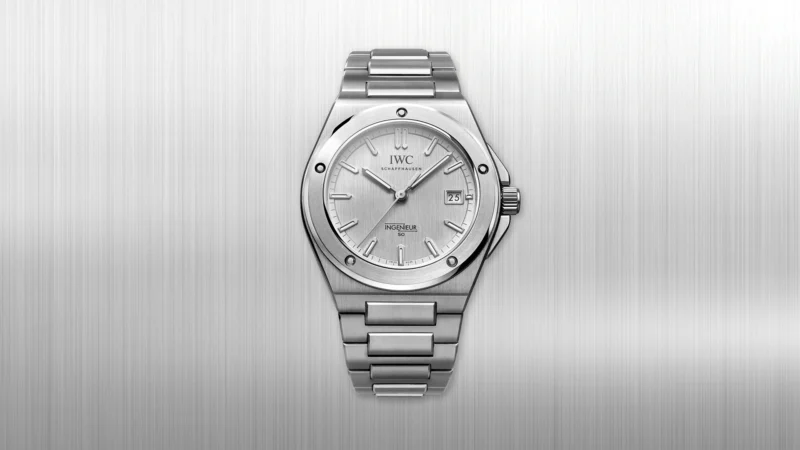
The silver dial shifts attention from surface pattern to the continuous case-and-bracelet architecture. © IWC Schaffhausen.
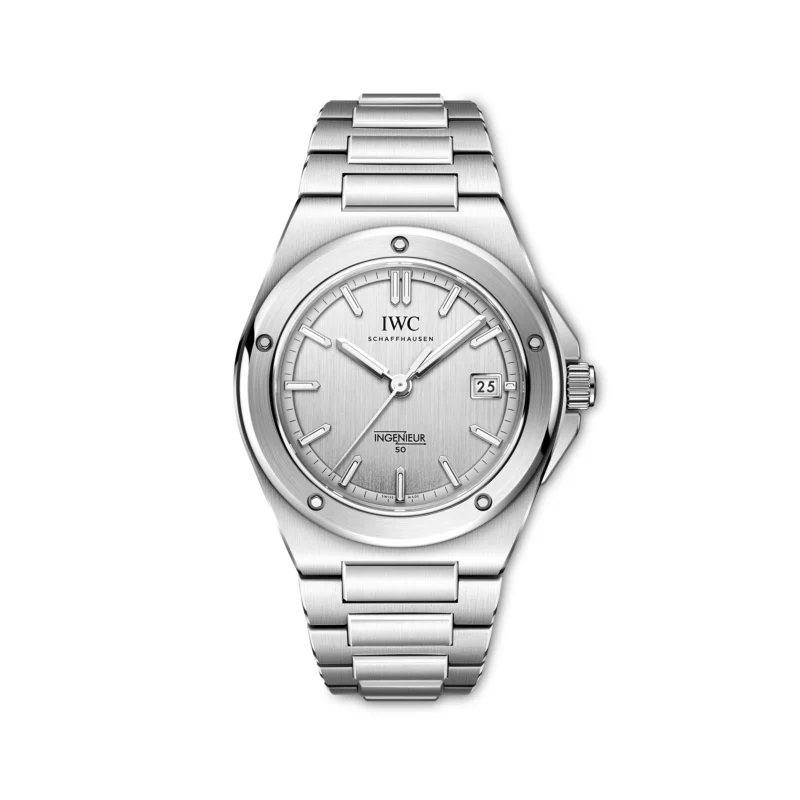
Reference IW328910 measures 40 mm and pairs calibre 32111 with a 120-hour power reserve. © IWC Schaffhausen.
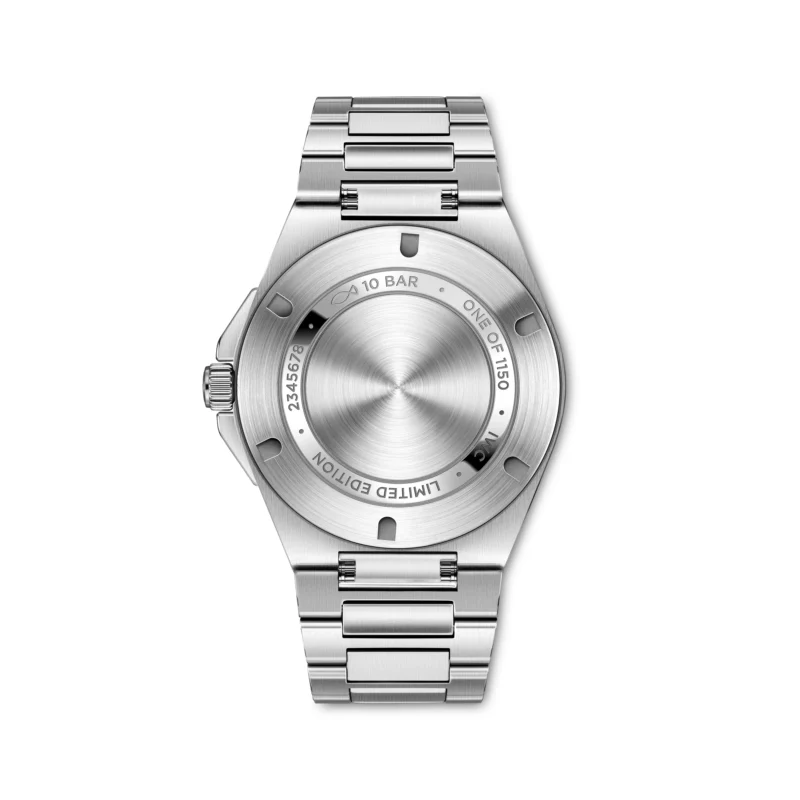
The closed rear belongs to the 40 mm watch’s soft-iron shielding architecture; IWC does not publish a modern resistance threshold. © IWC Schaffhausen.
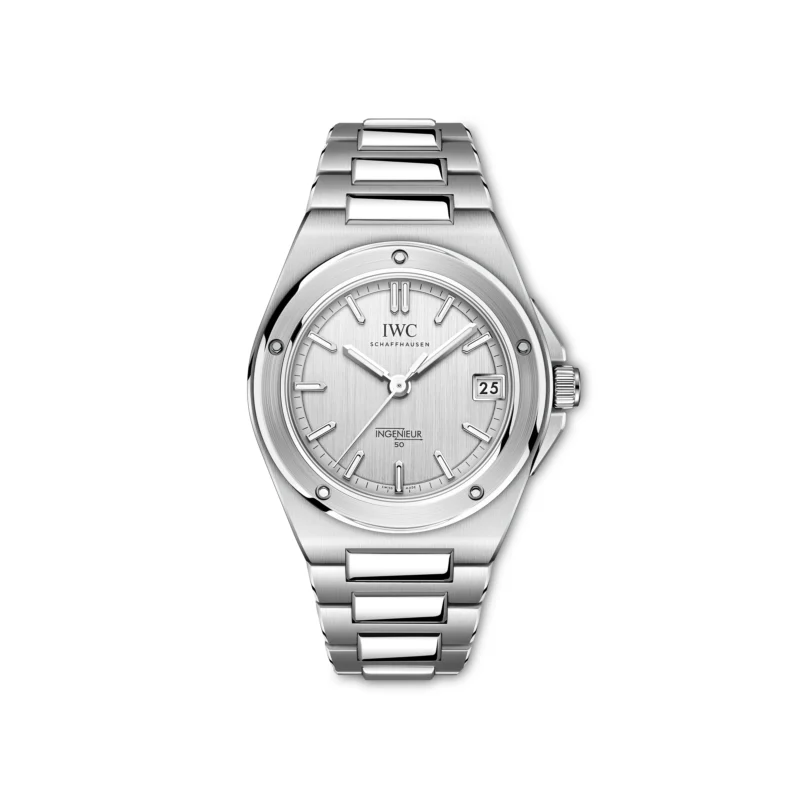
Reference IW324909 preserves the integrated Genta-derived form at 35.1 mm. © IWC Schaffhausen.
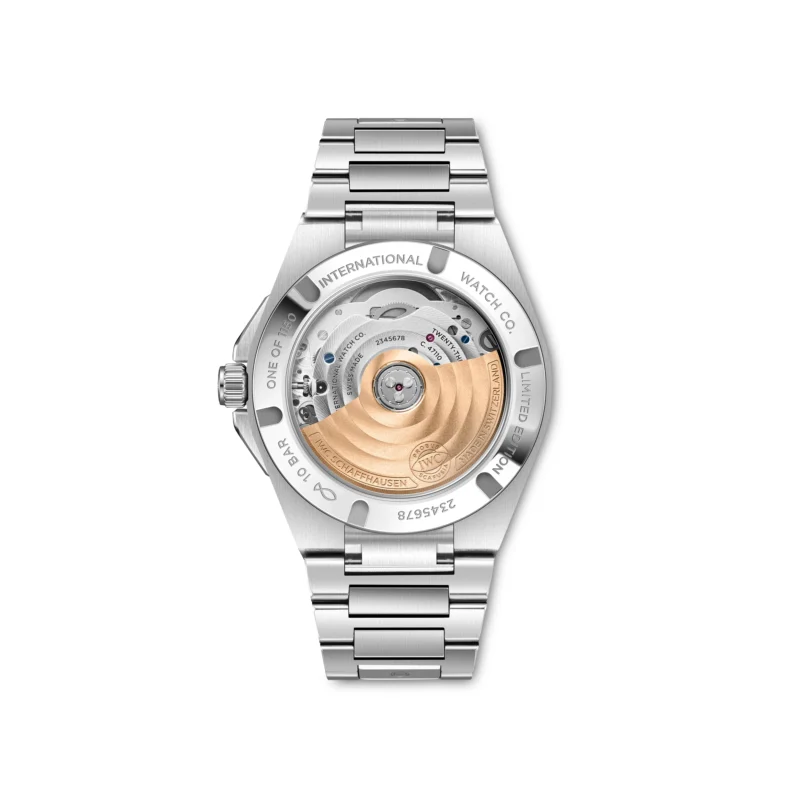
The 35 mm watch opens the rear to calibre 47110 instead of listing the soft-iron inner case used by the 40 mm reference. © IWC Schaffhausen.
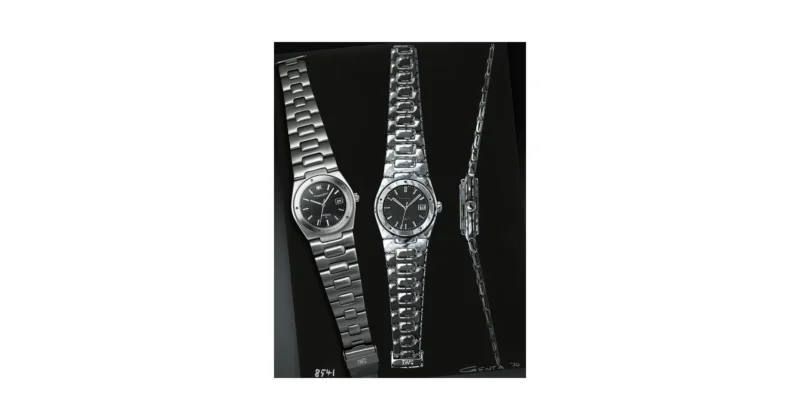
IWC archive material places the Ingenieur SL’s case, bracelet and profile in one continuous design study. © IWC Schaffhausen.
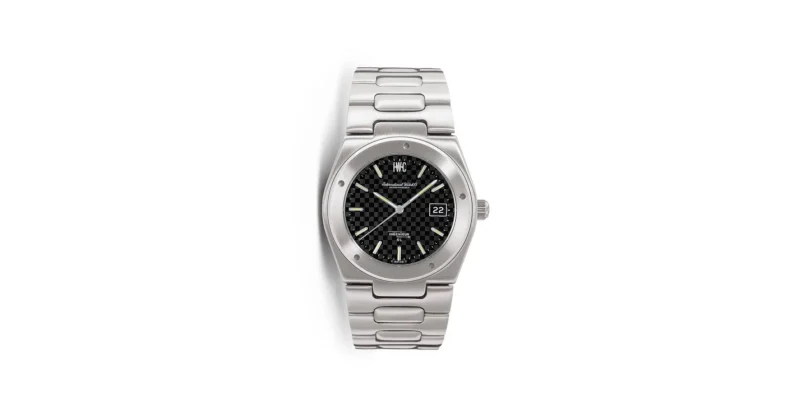
The familiar black structured dial is only one branch of Ref. 1832 history; the anniversary follows a rarer brushed-silver variant. © IWC Schaffhausen.
Technical inheritance / Two architectures
The silhouette agrees. The enclosure does not.
Two anniversary watches share the same visible argument. Their case backs reveal where design continuity and technical continuity separate.
Closed shield
Solid back / soft-iron inner case
The larger anniversary watch encloses calibre 32111 in the architecture that has defined Ingenieur magnetic protection since before Genta redesigned its exterior.
Open movement
Sapphire back / calibre 47110
The smaller reference retains the integrated silhouette and silver dial, then opens the rear to the movement instead of listing the 40 mm model’s soft-iron enclosure.
Key facts
- Launch: 15 September 2026, marking 50 years since the Ingenieur SL Ref. 1832 entered the IWC catalogue in 1976.
- References: Ingenieur Automatic 40 50th Anniversary Ref. IW328910 and Ingenieur Automatic 35 50th Anniversary Ref. IW324909.
- Production: 1,150 pieces of each reference.
- Shared design: stainless-steel case and integrated bracelet, brushed silver-plated dial inspired by a rare 1970s Ref. 1832 variant, rhodium-plated hands and markers with Super-LumiNova, and a “50” replacing the lightning-bolt element in the Ingenieur dial signature.
- 40 mm: 40 mm diameter, 10.7 mm thick according to IWC’s current product page, calibre 32111, 4 Hz, 120-hour power reserve, soft-iron inner case and solid case back.
- 35 mm: 35.1 mm diameter, 9.4 mm thick, calibre 47110, 4 Hz, 42-hour power reserve and sapphire display back.
- Historical Ref. 1832: 40 mm steel case, integrated H-link bracelet, screw-on bezel with five recesses, automatic calibre 8541 with Pellaton winding, rubber shock buffers and a soft-iron inner case rated by IWC to 80,000 A/m.
- Important distinction: the 40 mm anniversary edition restores the Ingenieur’s magnetic-shielding architecture. IWC does not state the same for the 35 mm model, whose transparent back exposes the movement instead.
There is an easy way to make an anniversary watch. Reproduce the colour everyone remembers, put a date on the case back and let nostalgia do the rest.
IWC did not do that.
The Ingenieur SL Ref. 1832 most collectors picture is the black-dialled “Jumbo” with a geometric surface, five recesses around the bezel and an integrated steel bracelet that turns case and strap into one continuous object. Yet the 2026 50th-anniversary editions arrive with brushed silver-plated dials and no grid at all. IWC says the finish comes from a rare silver-dial version of the original watch.
That choice changes the question. This is not a straightforward exercise in making the new Ingenieur look more like the most recognisable Ref. 1832. It asks which parts of Genta’s design mattered enough to survive when one of its best-known visual cues was deliberately removed.
The answer becomes clearer when the 40 mm and 35 mm watches are compared separately. Both inherit the silhouette, the integrated bracelet, the five-point bezel idea and the anniversary dial. Only one also carries a soft-iron inner case, the feature that connects the 1976 sports-watch design back to the Ingenieur’s original technical purpose.
The two anniversary models therefore tell two different versions of the same history.
Before Genta, the Ingenieur was a problem-solving watch
The Ingenieur did not begin as an exercise in industrial styling.
IWC introduced the first Ingenieur in 1955 for people whose work exposed mechanical watches to magnetic fields. Engineers, technicians, physicists, chemists and doctors were among the users IWC had in mind. A soft-iron inner case surrounded the movement, giving magnetic flux a path around rather than through the regulating components.
The principle was already familiar to IWC from the Mark 11 pilot’s watch. The civilian Ingenieur adapted that protection to a more conventional wristwatch format and paired it with Albert Pellaton’s automatic winding system.
By the end of the 1960s, however, the problem was no longer only technical. IWC wanted a tougher steel Ingenieur whose exterior communicated the engineering identity that had previously been hidden inside an understated round case. The company turned to Gérald Genta. IWC’s own historical account says Genta delivered his design in 1974; the watch entered the catalogue in 1976 as the Ingenieur SL Ref. 1832.
The change was substantial. The soft-iron cage remained, but the exterior stopped pretending to be conservative.
A broad steel case met an integrated H-link bracelet. A round bezel was screwed onto the case ring and pierced by five recesses. The dial gained a strong repeating structure. The watch measured about 40 mm across, large enough in its period to acquire the collector nickname “Jumbo”.
Inside was the automatic calibre 8541 with Pellaton winding. IWC says the movement was mounted on rubber buffers to protect it against shocks and that the soft-iron inner case shielded it against magnetic fields up to 80,000 A/m.
This is the useful starting point for the anniversary. Genta did not erase the Ingenieur’s technical identity. He made it visible.
The silver dial shifts attention from surface pattern to the continuous case-and-bracelet architecture. © IWC Schaffhausen.
The 1832 was not built from one signature detail
It is tempting to reduce the Ref. 1832 to its bezel, just as the Royal Oak is often reduced to its octagon or the Nautilus to its porthole shape. The Ingenieur is harder to separate into independent motifs.
The bezel is round, but it sits inside a broad, almost cushion-like case that flows directly into the bracelet. The bracelet is not an accessory attached between conventional lugs. It is part of the silhouette. Even the five recesses are visually useful because their irregular position from watch to watch makes the bezel look mechanically installed rather than decoratively stamped.
The Genta family’s account, published by IWC for the 50th anniversary, gives that continuity a more explicit reading. Evelyne and Alexia Genta describe Gérald as thinking of the watch as one sculptural object, with case, bracelet and clasp conceived as a continuous form.
That helps explain why the 2026 silver dial is not as historically perverse as it first appears.
The familiar structured dial contributes strongly to the Ref. 1832, but the watch does not collapse when that texture disappears. IWC’s archive material documents a silver-plated variant with a brushed finish. The anniversary references choose that less familiar historical branch while leaving the overall object recognisably Ingenieur.
The exercise is therefore less about reproducing the standard collector image of an 1832 and more about testing how much of the design survives without it.
Quite a lot does.
What the modern Ingenieur had already changed in 2023
The 2026 anniversary editions are not a fresh reconstruction of a 1976 watch. They sit on the modern Ingenieur platform IWC introduced in 2023.
That distinction matters because several details that now feel inseparable from the current watch are modern engineering decisions rather than literal historical carry-overs.
The clearest example is the bezel.
On the Ref. 1832, the bezel itself was screwed onto the case ring. Its five recesses were tooling features, and their final positions could vary because the bezel stopped wherever the thread reached its seated position. On the 2023 Ingenieur Automatic 40, IWC replaced that arrangement with five individual polygonal screws. The screws now physically secure the bezel to the case, so IWC can place them consistently.
The effect looks faithful from a distance, but mechanically it is different.
The bracelet attachment also changed. IWC’s 2023 documentation notes that the original watch used pronounced nose-shaped horns. The modern case instead connects through a newly engineered middle link, reducing the effective span across the wrist. The 40 mm case has a published lug-to-lug measurement of 45.7 mm in IWC’s launch documentation and a curved case ring designed to improve fit.
A crown guard was added. Water resistance became 10 bar. The calibre changed completely. The modern dial’s standard “Grid” pattern is stamped into a soft-iron blank before galvanic treatment.
The 2023 watch was already a reinterpretation, not a replica.
The anniversary editions inherit that reinterpretation and then make another deliberate historical choice on top of it.
Dial / bracelet / enclosure
The visible design leads to an invisible technical choice.
A small ‘50’ replaces the lightning-bolt element beneath the Ingenieur signature. © IWC Schaffhausen.
The silver dial shifts attention from surface pattern to the continuous case-and-bracelet architecture. © IWC Schaffhausen.
Reference IW328910 measures 40 mm and pairs calibre 32111 with a 120-hour power reserve. © IWC Schaffhausen.
Case / enclosure / movement
One anniversary. Two technical positions.
Closed shield
The 40 mm anniversary reference joins the Genta-derived exterior to the Ingenieur’s older technical purpose.
- Range
- 40 mm · 10.7 mm
- Display
- Solid back · soft-iron inner case
- Control
- 32111 · 4 Hz
- Isolation
- 10 bar
- Flyback
- 120 hours
Open movement
The 35 mm reference preserves the integrated form while allowing calibre 47110 to remain visible through sapphire.
- Range
- 35.1 mm · 9.4 mm
- Display
- Sapphire display back
- Control
- 47110 · 4 Hz
- Isolation
- 10 bar
- Flyback
- 42 hours
The silver dial is the most interesting anniversary decision
IWC could have used the black structured dial and produced a watch that announced “1976” from across a room.
Instead, both 2026 references use vertically brushed, silver-plated dials based on a rare historic variant. The hour markers and hands are rhodium plated and filled with Super-LumiNova. At the lower half of the dial, the familiar lightning-bolt detail in the Ingenieur signature is replaced by a small “50”.
The result is quieter than the standard modern grid dial, but it places more emphasis on the metal architecture around it.
On the 40 mm version, that is especially effective because the integrated bracelet is entirely satin finished. The bezel is satin finished on its upper surface with polished edges. The case introduces polished facets against broader brushed planes. With less visual activity on the dial, those changes in surface treatment become easier to read.
This is where “heritage” needs a precise definition. The brushed silver surface is historically rooted, but it is not the dial most people associate with the 1832. The modern bezel uses screws rather than the original threaded-bezel recesses. The present bracelet attachment is redesigned for ergonomics. Super-LumiNova, modern sapphire crystal, current tolerances and a contemporary movement belong to another era.
What IWC brings back is therefore not a frozen 1976 specification. It brings back one documented visual variant inside a modern case architecture that was already revised in 2023.
That is a more defensible use of history than pretending the new object is the old one again.
The 40 mm watch carries the deeper technical lineage
Ref. IW328910 measures 40 mm in diameter and 10.7 mm thick on IWC’s current Italian product page. It is water-resistant to 10 bar and uses a screw-in crown. The case and bracelet are stainless steel, and the bracelet is entirely satin finished.
Inside is calibre 32111, an automatic IWC-manufactured movement running at 28,800 vibrations per hour, or 4 Hz. IWC lists 163 components and 21 jewels. A double-pawl winding system builds a power reserve of 120 hours in the mainspring.
Those figures are modern. The important historical carry-over sits around the movement rather than inside it.
The 40 mm anniversary watch has a soft-iron inner case.
IWC explicitly links that construction to the original Ingenieur SL. The shield closes the technical loop between the Genta watch and the Ingenieur family that existed before Genta ever drew it. This is more than a heritage prop because it changes the physical construction of the watch. A soft-iron enclosure occupies volume, influences how the movement is housed and prevents the use of a conventional transparent display back.
IWC does not publish a magnetic-resistance figure for the 2026 watch in the material reviewed for this article. That limit matters. The Ref. 1832 was rated by IWC to 80,000 A/m. The anniversary watch should not inherit that number simply because it uses the same shielding principle.
The correct claim is narrower: the 40 mm model restores the Ingenieur’s soft-iron magnetic-protection architecture. Its present resistance threshold is not established in IWC’s current public specification.
That distinction keeps a technical feature from turning into marketing arithmetic.
The 35 mm anniversary watch tells another story
The smaller Ref. IW324909 is not simply the 40 mm watch reduced to 35 mm.
IWC lists the case at 35.1 mm in diameter and 9.4 mm thick. It retains 10 bar water resistance and the same silver-plated anniversary dial concept. The integrated bracelet continues the H-link language, although the centre links are polished rather than kept entirely satin finished.
The more consequential difference is behind the dial.
The 35 mm uses calibre 47110. IWC specifies 28,800 vibrations per hour, 23 jewels, 151 components and a 42-hour power reserve. The movement is visible through a sapphire case back, with Côtes de Genève, perlage and a gold-plated oscillating weight.
That display back is visually appealing, but it changes what the watch can claim as Ingenieur inheritance.
IWC does not list a soft-iron inner case for the 35 mm anniversary reference. The transparent back itself is a strong clue as to why. A conventional magnetic shield works by surrounding the movement with ferromagnetic material, so opening the rear of that enclosure for a sapphire window compromises the very geometry that makes the shielding concept useful.
The 35 mm therefore preserves the sculptural and graphic lineage while stepping away from one of the family’s defining technical devices.
That does not make it a lesser object. It makes it a different interpretation.
The 40 mm asks how a modern Ingenieur can still behave like an Ingenieur under the dial. The 35 mm asks how much of Genta’s integrated design can be preserved in a smaller, thinner watch with an exposed movement.
Those are not identical briefs.
Antimagnetism is where the anniversary becomes measurable
The soft-iron cage is easy to overlook because it is invisible in normal use, yet it is one of the few features that links every important stage of the Ingenieur story.
The 1955 watch used magnetic protection because the target users actually encountered magnetic fields at work. The Ref. 1832 retained the shield even as the case became far more expressive. IWC states that the original SL protected calibre 8541 up to 80,000 A/m.
The 2026 40 mm reference brings the inner case back into an anniversary watch that could easily have relied on external styling alone.
What it does not do is revive IWC’s old 80,000 A/m figure publicly. Nor should the presence of a soft-iron cage be described as equivalent to the resistance achieved by modern movements built around non-ferrous escapement and oscillator components. Different antimagnetic strategies solve the problem differently.
The soft-iron approach is architectural. It protects the movement by diverting magnetic flux through a surrounding enclosure. Its effectiveness depends on the material, thickness, geometry and continuity of the shield. A modern non-magnetic or amagnetic movement strategy attacks susceptibility at component level instead.
IWC’s decision is therefore historically coherent rather than technologically inevitable.
For the 40 mm anniversary model, that coherence is the point.
The production-number problem inside IWC’s own archive
The Ref. 1832 has another detail worth treating carefully: how many were actually made.
IWC’s current 2026 anniversary press release gives a precise figure. It states that 598 pieces were made between 1976 and 1983. The dedicated 50th-anniversary history page repeats 598, and IWC’s 2025 short-film material uses the same number.
However, an older official IWC heritage page and the company’s 2023 Ingenieur launch material state that a little more than 1,000 pieces were produced.
Both claims come from IWC.
The discrepancy should not be solved by choosing whichever number makes the better story. The current anniversary material is more recent and more specific to Ref. 1832, so 598 is the figure that should govern a 2026 article. The older “little more than 1,000” statement remains an unresolved archival inconsistency unless IWC publishes a reconciliation explaining whether it used a broader model family, a different production basis or older archive data.
TheTimeo therefore treats 598 as IWC’s current position and records the earlier figure rather than deleting it from the research trail.
That may sound pedantic, but production numbers become collector facts very quickly. Once repeated enough, they are difficult to unwind.
Limited to 1,150 each, but scarcity is not the thesis
Both anniversary references are limited to 1,150 pieces.
The number is notable because it is larger than IWC’s present 598-piece production claim for the original Ref. 1832. That does not make the modern watches common, and it does not tell us anything useful about future collectability.
A limited edition number establishes supply at launch. It does not establish demand, secondary-market performance or long-term rarity in use. The relevant editorial point is that IWC chose to commemorate a watch now remembered partly for its initial commercial failure with two separate editions, each nearly twice the size of the currently stated original production run.
The context has inverted.
In 1976, IWC tried to sell an unusually bold steel watch to engineers and found that the market did not follow. In 2026, the same design language arrives with an established collector audience, a mature luxury-sports category and a Genta name that carries its own historical weight.
The object did not need to change for the market to change around it.
So what did IWC actually bring back?
Not the original movement.
Not the original bezel mechanism.
Not the original bracelet attachment.
Not even the best-known original dial.
What survives is the harder part to copy: the relationship between components.
The case still expands into an integrated bracelet rather than ending at conventional lugs. The round bezel still interrupts a broader geometric body. Five mechanical points still organise the bezel visually. The brushed silver dial proves that the watch remains recognisable even when the famous grid is removed. On the 40 mm model, the soft-iron inner case restores the invisible engineering continuity that justified the Ingenieur name before Genta transformed its appearance.
The 35 mm edition is more selective. It preserves the sculptural form and gives up the enclosed magnetic shield in favour of a smaller case and visible calibre. That makes it useful precisely because it exposes where design lineage and technical lineage separate.
This is why the 50th-anniversary pair works better as a study than as a simple tribute.
Ref. IW328910 is the closer descendant of the 1976 concept because it preserves both the integrated Genta architecture and the Ingenieur’s protected movement enclosure. Ref. IW324909 preserves the visual language while adapting it to a different mechanical and ergonomic brief.
Neither is a re-edition.
The anniversary is more interesting for that.
Genta’s Ref. 1832 does not survive because every line has been frozen. It survives because the watch can lose its familiar grid, change its bezel construction, re-engineer its bracelet attachment and accept a modern movement while still being read immediately as an Ingenieur.
The part IWC actually brought back is the system, not the costume.
Sources & credits
Sources & further reading
The 2026 references, dimensions, movements, production limits, dial treatment, bracelet finishing and magnetic-shielding statements were checked against IWC Schaffhausen’s official 15 September 2026 press release and current product pages for Ref. IW328910 and Ref. IW324909.
Historical construction, the 1974 design date, 1976 launch, calibre 8541, rubber shock buffers, 80,000 A/m magnetic protection, bezel construction and the evolution of the 2023 Ingenieur were checked against IWC’s official history pages and 2023 launch documentation. The current 598-piece production claim was compared with older IWC material stating a little more than 1,000 examples; that conflict is retained in the production dossier rather than silently normalised.
Current specifications were cross-checked against Fratello’s 15 September 2026 physical-access report. TheTimeo did not handle either anniversary watch for this article.
The Edit
Stories selected by TheTimeo
Panerai Luminor Firenze 8 Giorni: What Was the Grooved Crown Guard Actually For?
A rare Ref. 6152/1 detail returns on PAM01734: grooves inside the crown bridge designed
Patek Philippe Ref. 6105G: What a Sunrise-and-Sunset Celestial Actually Displays
The Ref. 6105G is not one astronomical display but several kinds of time negotiated
Blancpain Lady B: What Does 19 Millimetres Require?
Blancpain’s 19 mm Lady B is best understood as an exercise in mechanical volume: