
TheTimeo / Watches
THE SKY,
translated into time
The Ref. 6105G is not one astronomical display but several kinds of time negotiated across a single dial: solar, sidereal, lunar and civil.
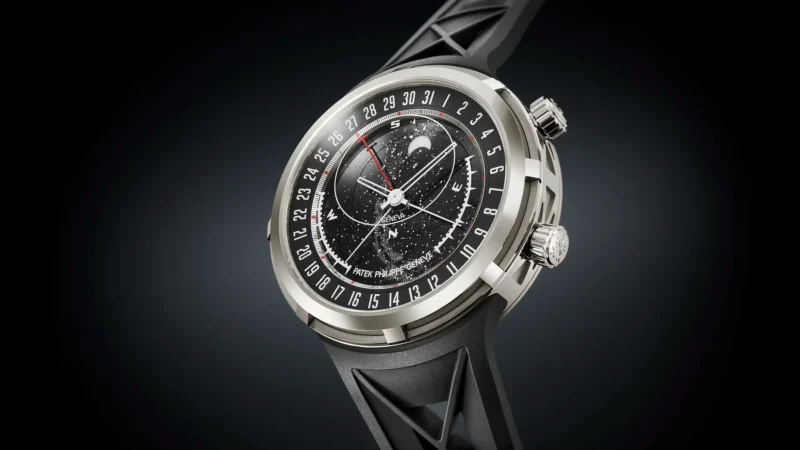
Patek Philippe Ref. 6105G-001: a Geneva sky chart surrounded by civil, solar and calendar indications. Courtesy of Patek Philippe.
Explore the story
A first look at the Patek Philippe Ref. 6105G-001 can be misleading. The eye goes straight to the stars, the Moon and the white ellipse cutting through the dial. It is tempting to read the watch as a single astronomical display, a mechanical picture of the sky. It is more complicated than that.
The dial is carrying several different clocks at once.
The central hands show hours and minutes of mean solar time. A rotating celestial display follows sidereal time, which is measured against the fixed stars rather than the Sun. A lunar system tracks the Moon’s angular motion and phase. Two additional hands show the changing times of sunrise and sunset through the year. The date sits on the outer ring. Then, because civil time can jump by an hour when daylight saving begins or ends, Patek Philippe adds a correction system that has to keep the ordinary time display and the solar indications coherent.
That distinction is the key to understanding the 6105G. It is not impressive because there are many things on the dial. It is impressive because those things do not all run to the same astronomical rhythm.
Key takeaways
- Ref. 6105G-001 is Patek Philippe’s first wristwatch to display sunrise and sunset times, according to the Manufacture’s own user guide.
- The sky chart is calibrated to the northern sky as seen from Geneva and other locations at the same latitude; the visible portion is framed by an ellipse on the sapphire crystal.
- Patek’s instructions describe a three-disc celestial assembly, with each disc only 0.2 mm thick, used to represent the star field, lunar position and lunar phase.
- The sunrise and sunset indications follow the seasonal change in day length and are corrected together with civil time when summer or winter time is selected.
- The new self-winding calibre 240 C LU CL LCSO has 426 parts. Patek says 121 components were added for the sunrise/sunset indications and the daylight-saving correction architecture.
- The watch is large by Patek standards at 47 mm, yet the movement is 7.93 mm thick and the complete case is 12.39 mm thick.
- The date is not perpetual. Patek’s instructions require manual date correction five times a year, at the end of months with fewer than 31 days.
Fact rail
Explore the comparison
| Item | Ref. 6105G-001 |
|---|---|
| Collection | Grand Complications |
| Case | 18K white gold |
| Diameter | 47 mm |
| Thickness | 12.39 mm |
| Water resistance | 30 m |
| Movement | Self-winding calibre 240 C LU CL LCSO |
| Movement dimensions | 38 mm × 7.93 mm |
| Components | 426 |
| Jewels | 51 |
| Frequency | 21,600 semi-oscillations/hour (3 Hz) |
| Power reserve | 38 to 48 hours |
| Rotor | Off-centre 22K gold minirotor |
| Main displays | Mean solar time, sky chart, Moon position and phase, date, sunrise, sunset |
| Seasonal correction | Summer time / winter time |
| Development | More than five years, six patent filings stated by Patek Philippe |
Start with the question the dial is answering
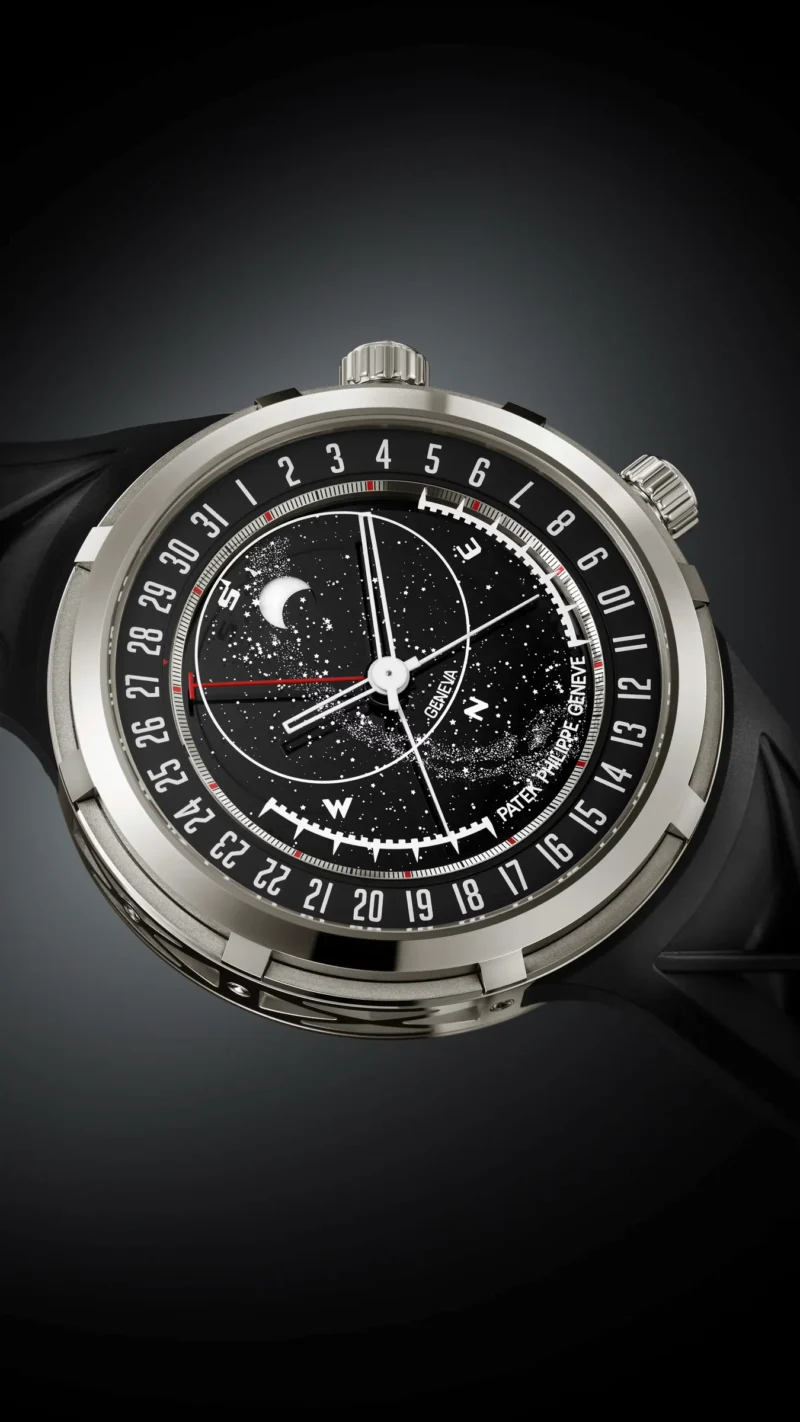
The 47 mm white-gold case gives each astronomical layer room to remain readable. Courtesy of Patek Philippe.
The 6105G does not show “the universe” in any useful technical sense. It shows a specific view of the northern sky and a specific set of astronomical relationships.
Patek Philippe describes the sapphire-crystal dial as showing the configuration of the sky over Geneva. The ellipse on the crystal defines the portion visible from Geneva and other places at the same geographical latitude. The four cardinal directions provide orientation. The star field moves beneath the ellipse, while the Moon changes position and phase.
This is a planisphere adapted to a wristwatch. The ellipse acts as a horizon window: stars inside it are presented as visible above that horizon, while stars outside it are below the visible portion of the sky. The effect looks poetic, but the architecture is mathematical.
There is an important practical consequence. The astronomical display is geographically anchored. This is not a world-time sky map that can be moved from Geneva to Singapore or New York with a city pusher. Patek’s public documentation is explicit about the Geneva latitude for the celestial view.
The online setting tool does ask the owner to choose a city when preparing the annual sunrise/sunset index, moon and sky settings. That should not be confused with a claim that the watch is a freely programmable universal ephemeris. The public product documentation still defines the visible-sky display around Geneva and cities sharing its latitude.
Three thin discs, three different rates
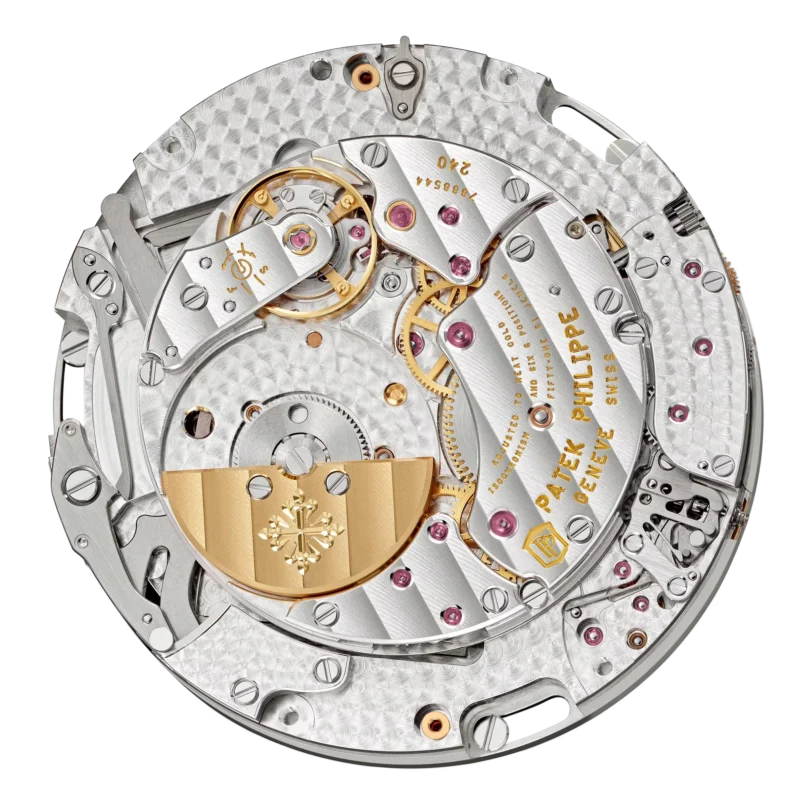
Calibre 240 C LU CL LCSO: 426 parts organised around an off-centre 22K gold minirotor. Courtesy of Patek Philippe.
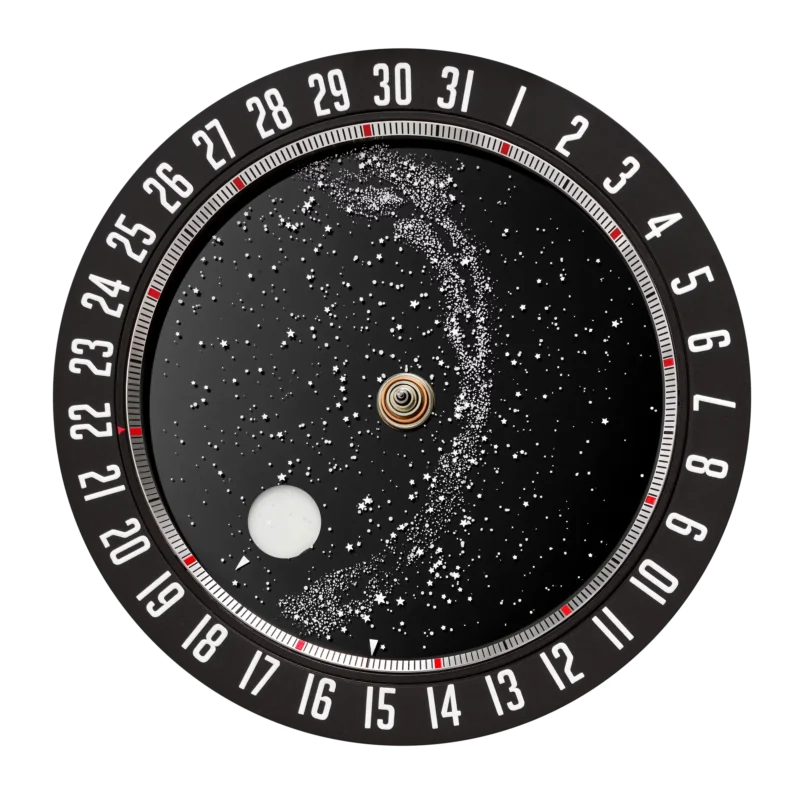
The superposed celestial display separates star-field, lunar position and lunar phase rates. Courtesy of Patek Philippe.
Patek’s user guide is unusually useful here because it explains what sits beneath the sapphire crystal.
The celestial mechanism uses superposed discs rotating at different speeds. A mineral disc formed as a 279-tooth wheel tracks the orbital position of the Moon. Through a planetary gear system it also drives a smaller disc for the lunar phases. Above it, a 356-tooth wheel rotates a transparent disc carrying the sky chart on one side and a representation of the Milky Way on the other.
Patek states that the three discs are each only two tenths of a millimetre thick.
That slimness matters because the movement is already being asked to carry several independent astronomical rates. Mean solar time, a sidereal day and a lunar day are close enough to look similar on a watch, but mechanically they are different problems.
A mean solar day is averaged to 24 hours. A sidereal day, measured from one meridian passage of a fixed star to the next, averages 23 hours, 56 minutes and 4.09892 seconds in Patek’s instructions. A lunar day, measured between consecutive meridian passages of the Moon, averages 24 hours, 50 minutes and 28.328 seconds.
If a gear train treated those periods as the same, the display would drift. The solution is a set of carefully chosen transmission ratios that lets the star chart, lunar position and moon phase advance at their own rates.
Patek says more than 25 billion transmission-ratio combinations were calculated before the final set was chosen. The resulting published deviations are small: 0.05 seconds per day for the lunar day, 0.088 seconds per day for the sidereal day, and 4.203 seconds per lunation for the moon-phase indication.
Those figures are more revealing than the usual phrase “astronomical precision”. They tell us what is being approximated, and by how much.
Sunrise and sunset are a different kind of complication
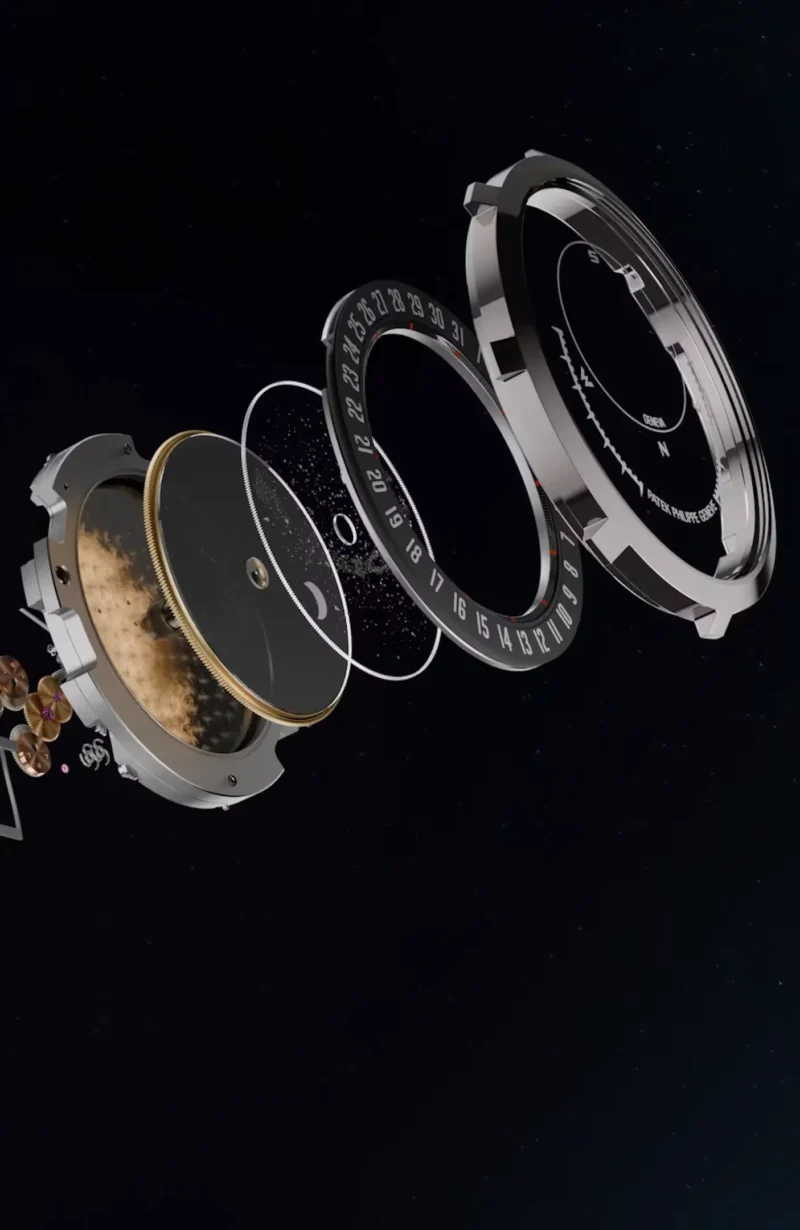
The display stack translates different astronomical periods into one view of the sky. Courtesy of Patek Philippe.
The star chart deals with the Earth’s rotation relative to the fixed stars. Sunrise and sunset depend on a different seasonal geometry.
As the year progresses, the apparent path of the Sun changes. Around Geneva’s latitude, summer days are longer and winter days shorter. Sunrise moves earlier and later. Sunset does the same in the opposite direction. Near the solstices the daily change can be less than a minute; around the equinoxes it can move by two or three minutes a day, according to Patek’s instructions.
The 6105G translates that annual curve into two hands placed low on the dial. One points to the sunrise time, the other to sunset. Instead of giving them a separate 24-hour chapter ring, Patek makes them read against the peripheral scale that also carries the date.
This is one of the cleverest choices in the watch because it avoids adding another ring of numbers to an already dense display. It also creates the next technical problem: the date scale is now doing two jobs.
Public patent records help explain why Patek says the development generated six patent filings. Several Patek Philippe applications from the development period deal directly with sunrise/sunset indication architecture, including mechanisms for displaying astronomical information, for guiding the two sunrise/sunset elements symmetrically, for coordinating the calendar with sunrise/sunset displays, and for reconciling legal time with sunrise/sunset indications.
The patents are worth reading because they strip away the romance. Sunrise and sunset become a problem of cams, feelers, racks, elastic guidance, display indices and correction logic.
The compliant mechanism is the quiet technical story
The detailed public product page does not name every component of the sunrise/sunset mechanism, but patent documentation and specialist technical analysis provide a clearer view.
A pair of annual cams encodes the seasonal variation of sunrise and sunset. The profile of each cam changes gradually around its circumference, effectively storing a mechanical curve for the year. A feeler reads that profile and converts it into the position of a display hand.
What is unusual in the Patek architecture is the way the two readings are guided. European patent EP3629100 describes a symmetrical guidance system using elastic members and a monolithic structure. The patent’s later figures explicitly show the system associated with a sunrise-and-sunset display. Instead of relying only on conventional pivots, separate springs and sliding guides, the elastic geometry itself contributes guidance and restoring force.
Revolution and SJX, both of which published technical analyses of the 6105G, describe the production watch as using a compliant double-feeler arrangement. Their explanation is consistent with the patent record: the feelers are constrained to move in a controlled, near-linear manner against the annual cams, reducing play and friction that would otherwise become part of the indication error.
The important point for a reader is not the novelty of the word “compliant”. It is what the architecture is trying to achieve. A mechanical sunrise display is only useful if a small movement of the cam produces a correspondingly controlled movement of the hand throughout the year. Any unnecessary play or geometric distortion becomes a display problem.
Why daylight saving time creates a second problem
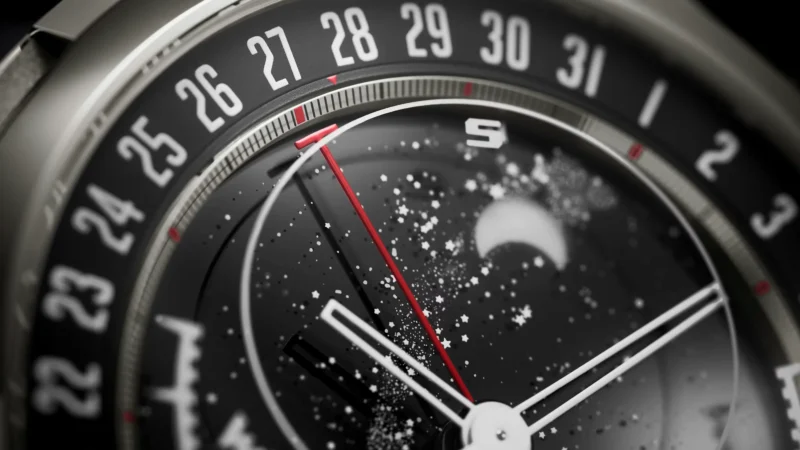
Sunrise, sunset and date share the periphery without adding another scale. Courtesy of Patek Philippe.
Mechanical astronomy follows nature. Civil time does not always do that.
When a jurisdiction moves the clocks forward by one hour for summer time, sunrise has not suddenly occurred one hour later in the sky. The legal time assigned to that event has changed. A conventional sunrise/sunset mechanism can therefore remain astronomically correct while becoming wrong as a reading of civil time.
Patek’s Ref. 6105G addresses this directly. Two correctors sit at 9 and 10 o’clock. One advances the watch by an hour for summer time; the other subtracts an hour for winter time. Patek’s user guide states that the correction applies not only to the current time but also to the sunrise and sunset indications.
That coordination is easy to describe and much harder to implement. Patent EP3731028 is specifically concerned with displaying legal time together with sunrise and/or sunset. Patent EP3731027 addresses the calendar alongside sunrise and/or sunset. In the production watch, the moving peripheral disc is part of the solution: the scale against which the sunrise and sunset hands are read can be repositioned when the civil-time regime changes, while the date indication remains coherent.
This is the kind of complication that makes more sense once you imagine actually owning the watch. A sunrise display that requires the wearer to remember a mental one-hour offset for half the year would be mechanically interesting and practically awkward. Patek chose to solve the awkwardness.
The date is simpler than the astronomy
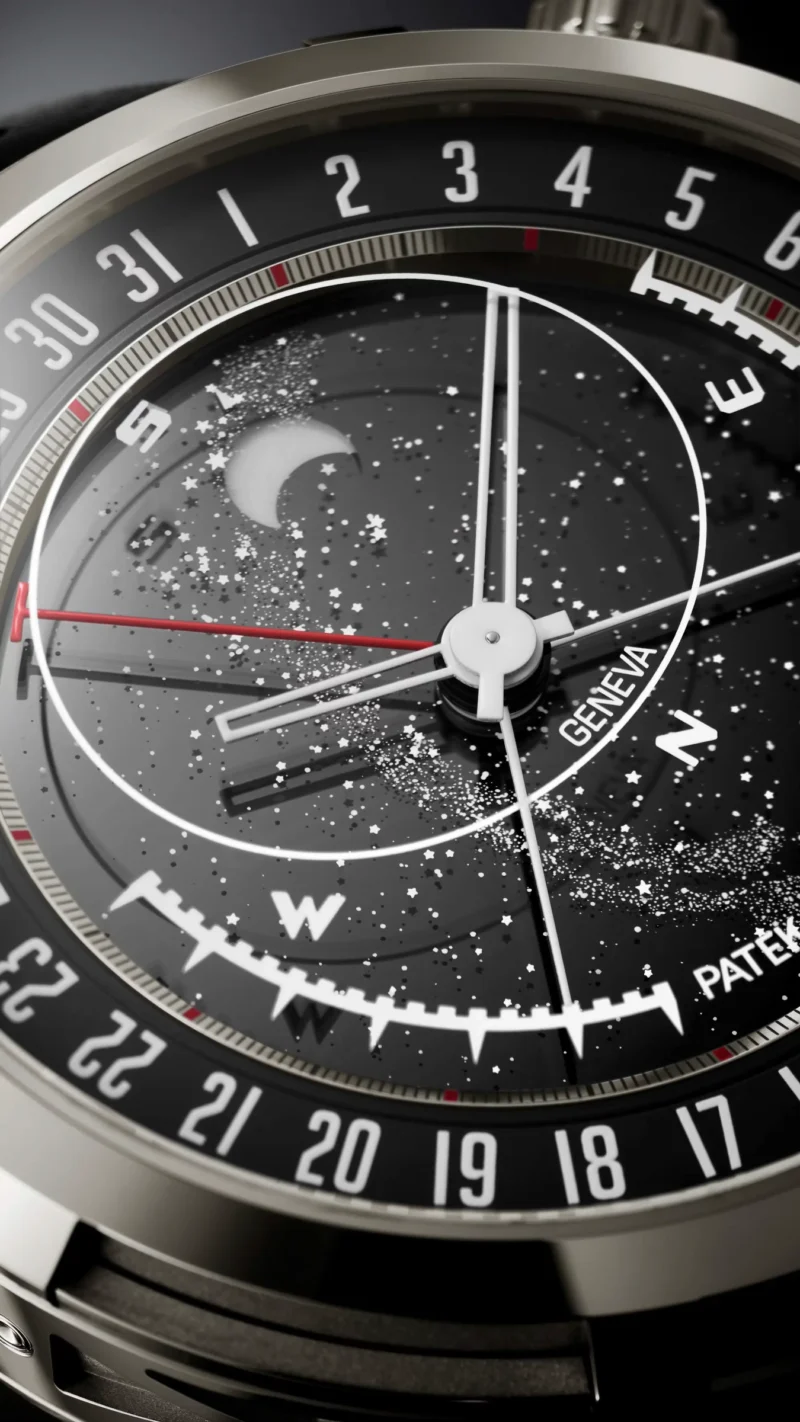
The red hand reads the date; the calendar still requires five corrections each year. Courtesy of Patek Philippe.
There is an amusing imbalance in the 6105G.
The watch calculates a moving night sky, lunar position, lunar phase, sunrise and sunset, yet the calendar is a straightforward date indication. The red-varnished hand points to the date on the peripheral disc. Patek’s instructions require the owner to correct it five times a year, after every month containing fewer than 31 days.
That is useful to state plainly because the words “Grand Complications” can encourage assumptions. The 6105G does not contain a perpetual calendar. It does not contain an annual calendar. The date mechanism has a different job here: it gives the wearer the date and also provides part of the visual architecture used by the sunrise and sunset scale.
In a watch this complex, the humble date disc becomes unusually important.
Setting it is part of understanding it
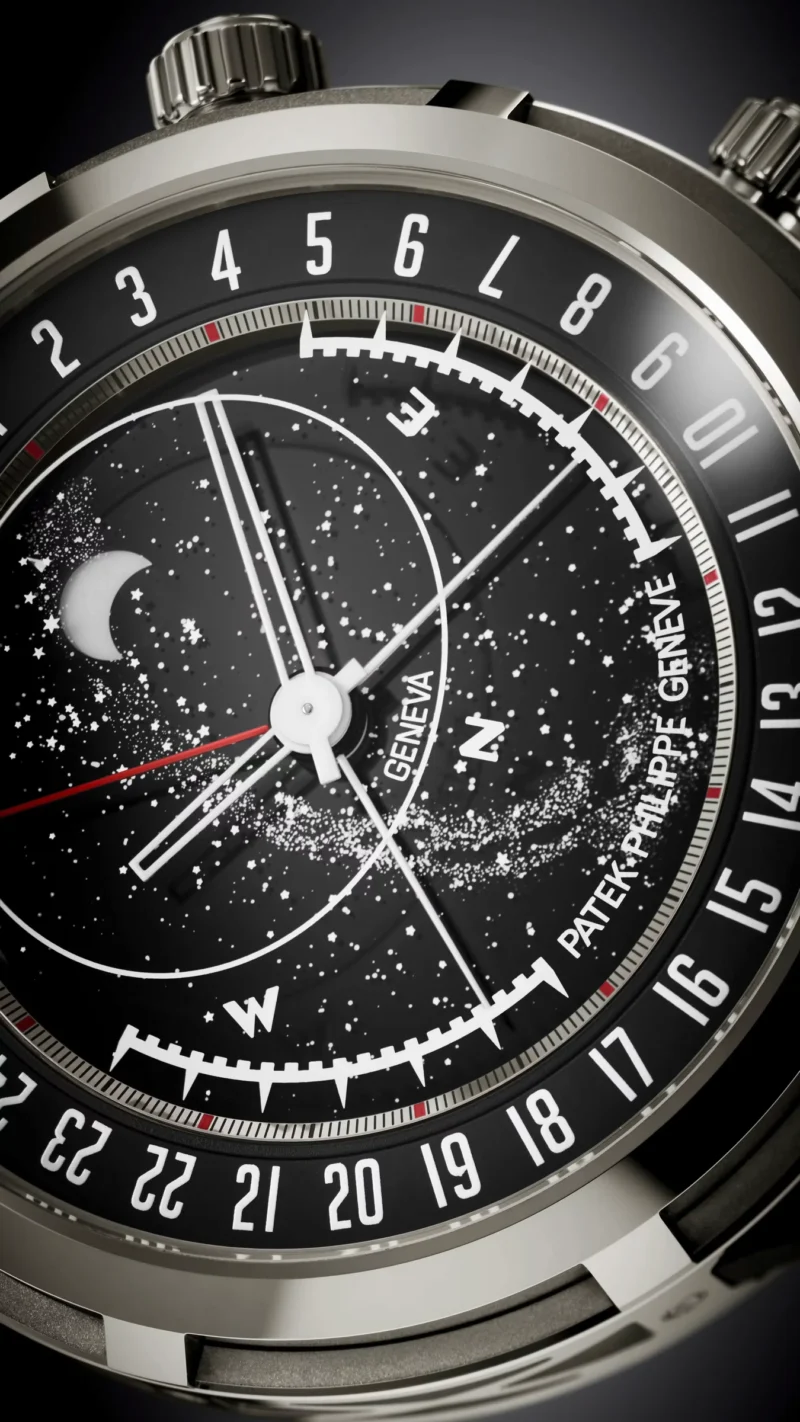
Separate hands and fixed references turn the dense dial into a sequence of readable questions. Courtesy of Patek Philippe.
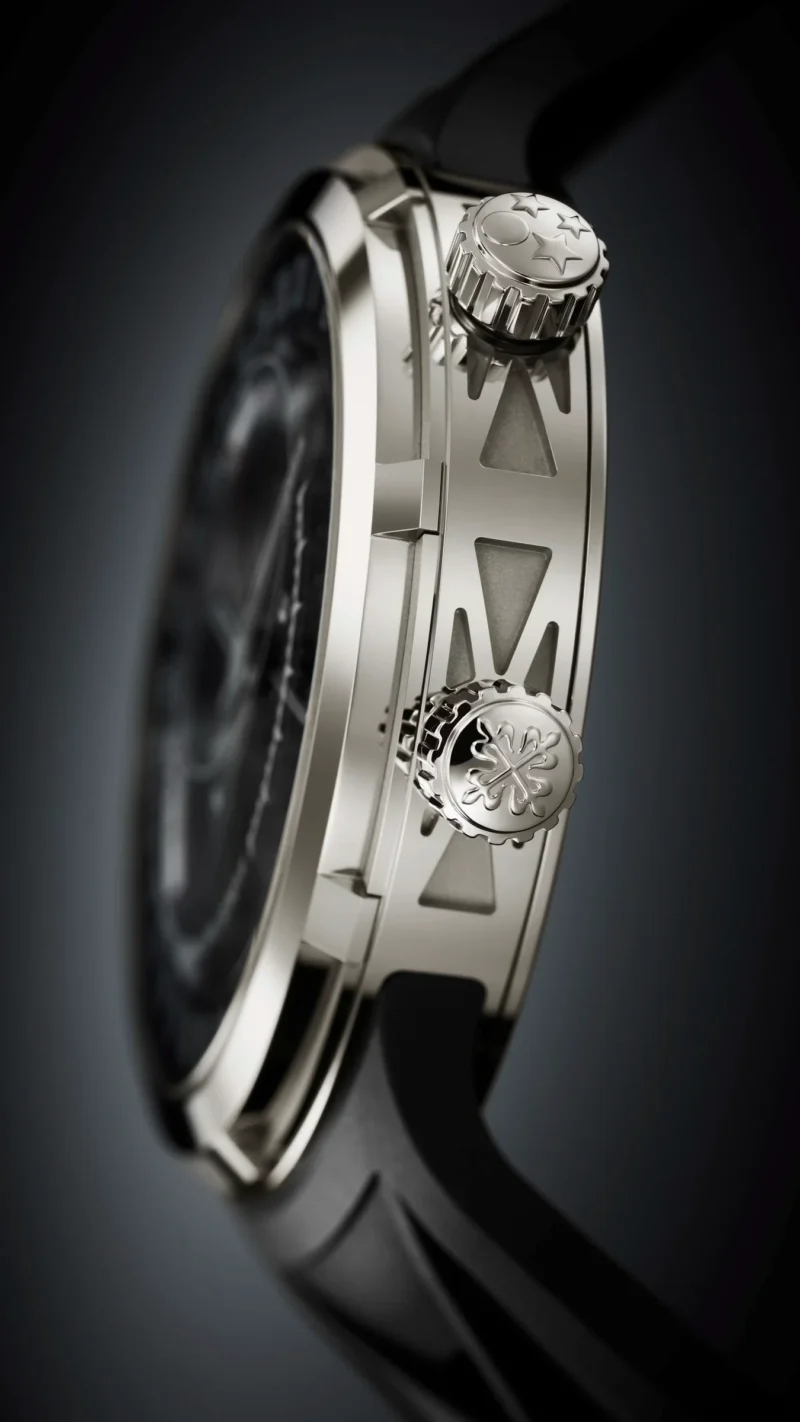
The two-o’clock disengageable crown controls the annual index, Moon and sky-chart settings. Courtesy of Patek Philippe.
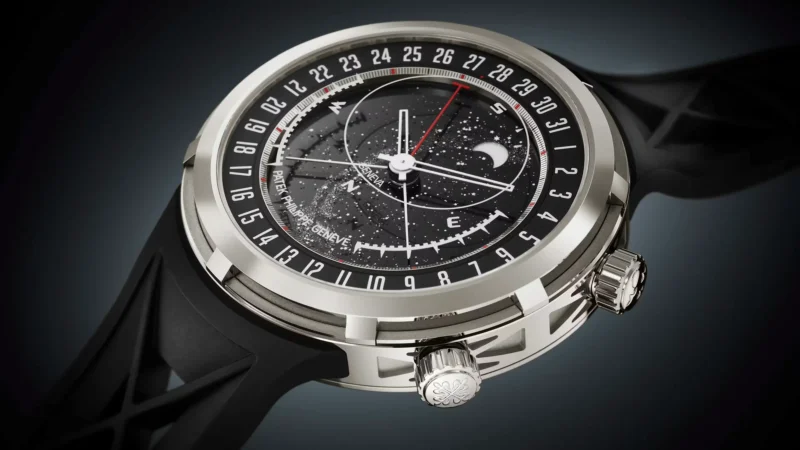
The ordinary time, astronomical display and correction architecture occupy distinct layers. Courtesy of Patek Philippe.
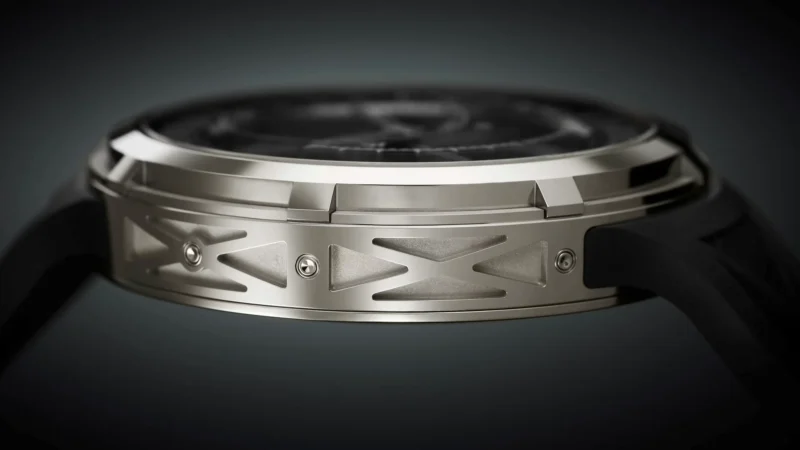
The X-shaped case architecture continues the space-module theme around the case. Courtesy of Patek Philippe.
A collector can learn a lot about a complicated watch from the instructions required to set it. The 6105G is a good example.
The crown at 4 o’clock winds the movement and sets the ordinary time. The crown at 2 o’clock handles the annual index for sunrise/sunset and is also used to adjust the Moon and sky chart. Patek calls it a disengageable or bayonet-release crown: the user presses and rotates it to engage the setting functions, reducing the chance of accidental correction.
A separate corrector at 7 o’clock advances the date. The 9 and 10 o’clock correctors switch between summer and winter time.
The astronomical setup is not something to improvise. Patek directs the owner to an online calculator. The user enters date, time and city, and the tool returns the number of large and small divisions required for the annual index, Moon and sky adjustments.
The Moon adjustment can require up to 28 revolutions of the dial. That detail is worth more than a paragraph of prestige language. It makes the mechanism tangible. The watch is not simply set to a date and left to “know” the sky. The owner is mechanically placing several astronomical systems into the correct relationship, after which the movement keeps them moving at their own rates.
Calibre 240, expanded without losing its logic
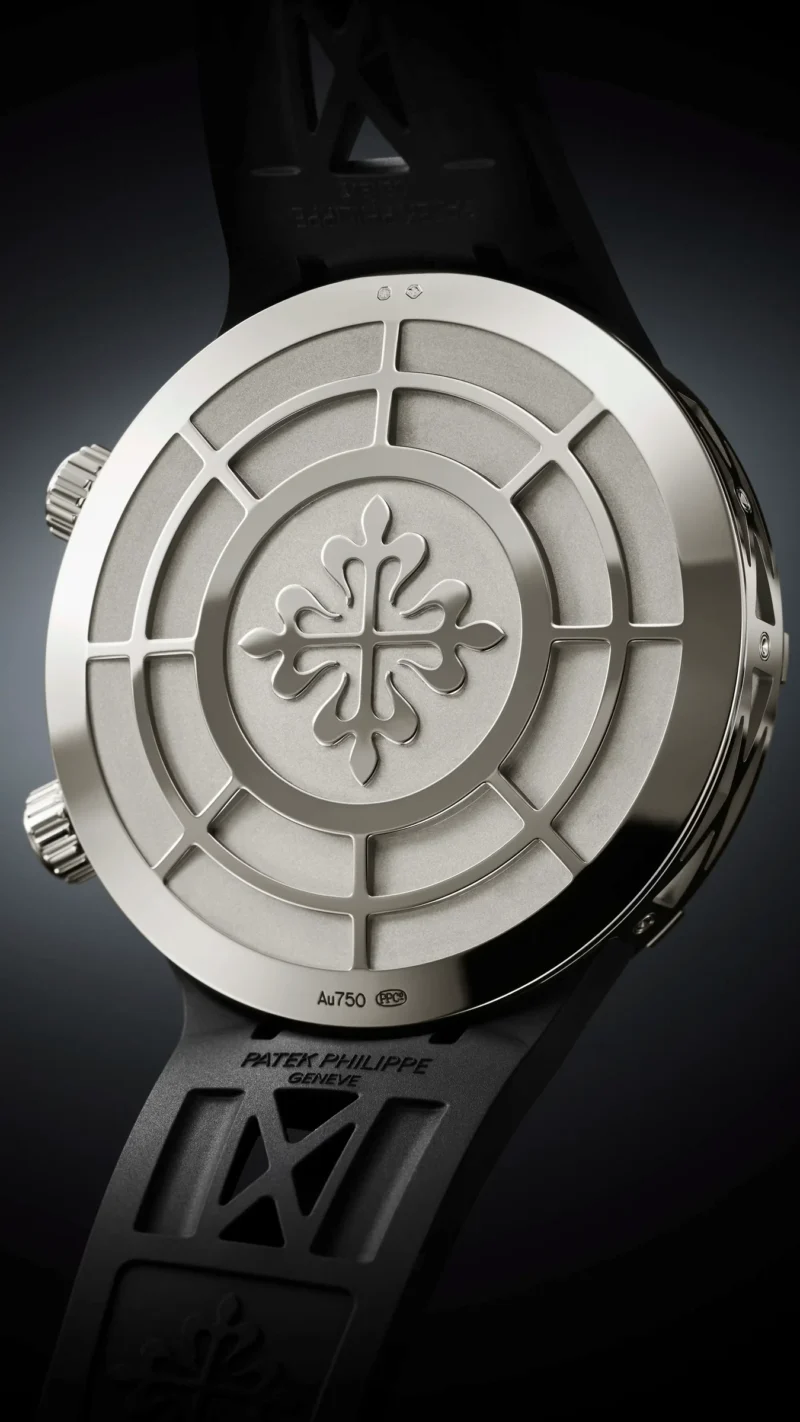
The solid white-gold back keeps the mechanical theatre on the dial side. Courtesy of Patek Philippe.
The movement is named 240 C LU CL LCSO, and the 240 part matters.
Patek Philippe has used the ultra-thin calibre 240 family for decades, with an off-centre minirotor allowing automatic winding without stacking a full rotor above the movement. In the 6105G, that basic architecture gives the manufacture vertical space for the astronomical mechanisms.
The finished calibre is 38 mm in diameter and 7.93 mm thick, with 426 components and 51 jewels. It runs at 21,600 semi-oscillations per hour and offers a power reserve between 38 and 48 hours. The minirotor is 22K gold.
Patek says the sunrise/sunset indications and their correction system add 121 components. That number becomes more meaningful when compared with the current calibre 240 LU CL C used in the Celestial Ref. 6104: 305 parts and 6.81 mm thickness. The new calibre grows to 426 parts and 7.93 mm, an increase of 1.12 mm in movement thickness while adding exactly those 121 components.
This is a better way to understand the engineering than counting complications. The design problem was not simply to make the movement do more. It was to add an annual solar display and a correction architecture without turning an ultra-thin minirotor movement into a tall stack of modules.
Why the case looks the way it does
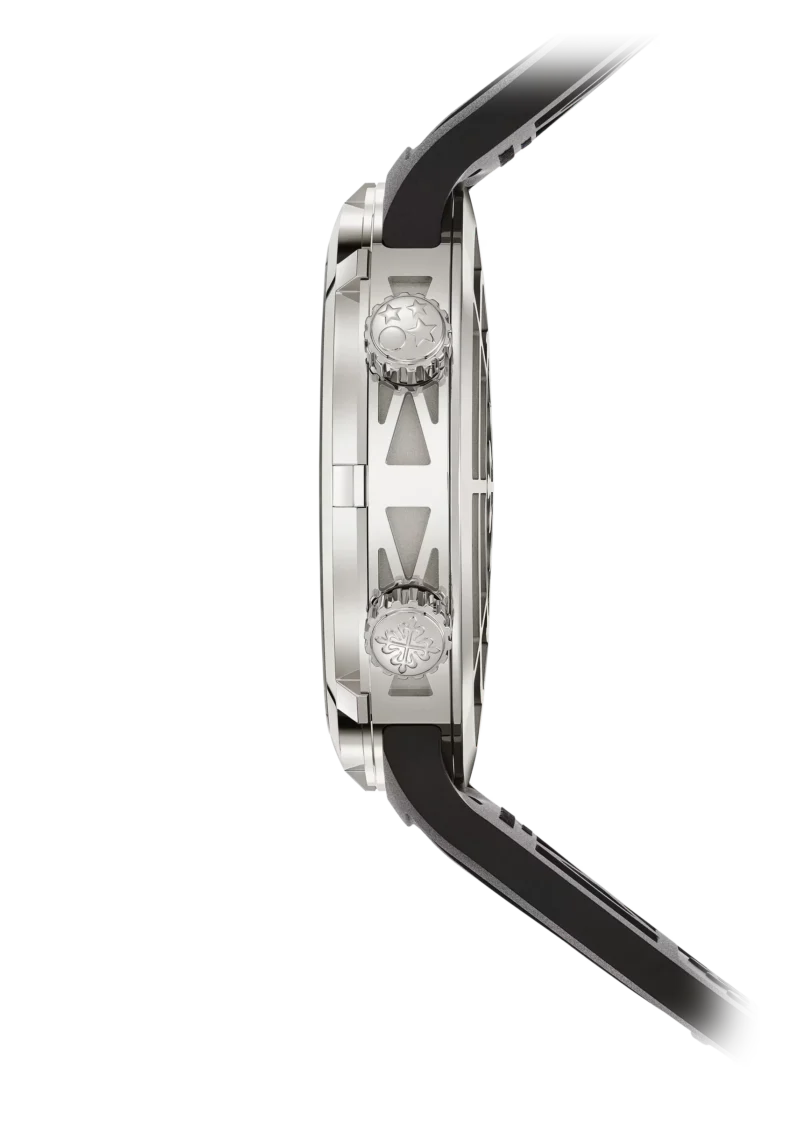
Three-o’clock profile of the 12.39 mm white-gold case. Courtesy of Patek Philippe.
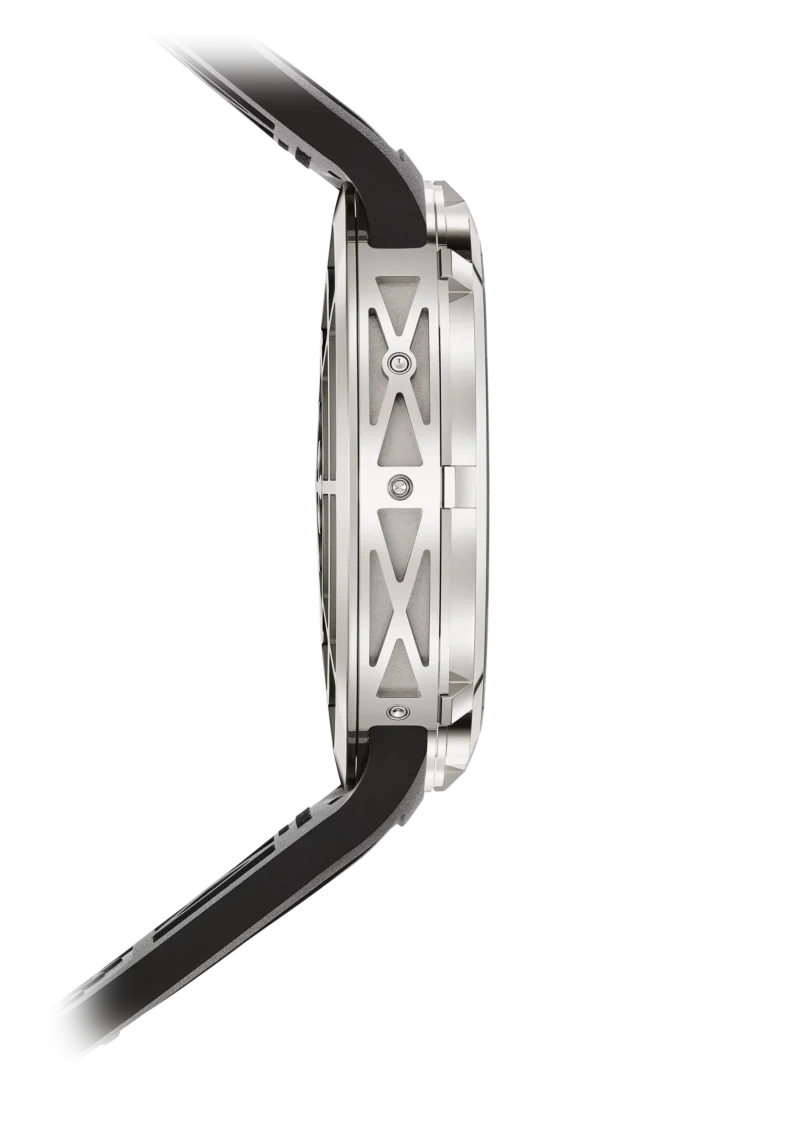
Nine-o’clock profile showing the dedicated correction controls. Courtesy of Patek Philippe.
The case is where the 6105G breaks most visibly from the usual Celestial vocabulary.
It is 47 mm in white gold, 12.39 mm thick and water-resistant to 30 metres. The lugs are absorbed into the overall circular form, and the black composite strap integrates directly into the case. Patek repeats an X-shaped pattern on the case flanks, strap and solid caseback, describing the motif as inspired by the tubular structures of space modules.
The size is substantial, but there is a functional reason for a broad dial. The watch has to leave room for a moving sky, the ellipse, central time hands, lunar indications, a peripheral date, and two solar-time hands without making the individual readings microscopic.
The solid caseback is a more surprising choice. Patek could easily have shown the 426-part calibre through sapphire. Instead, the back continues the X-shaped case language and keeps the mechanical theatre on the dial side.
That decision makes the watch feel more like an astronomical instrument than a movement showcase. Whether a collector prefers that approach is personal, but it is coherent with the object.
How to read the dial without getting lost
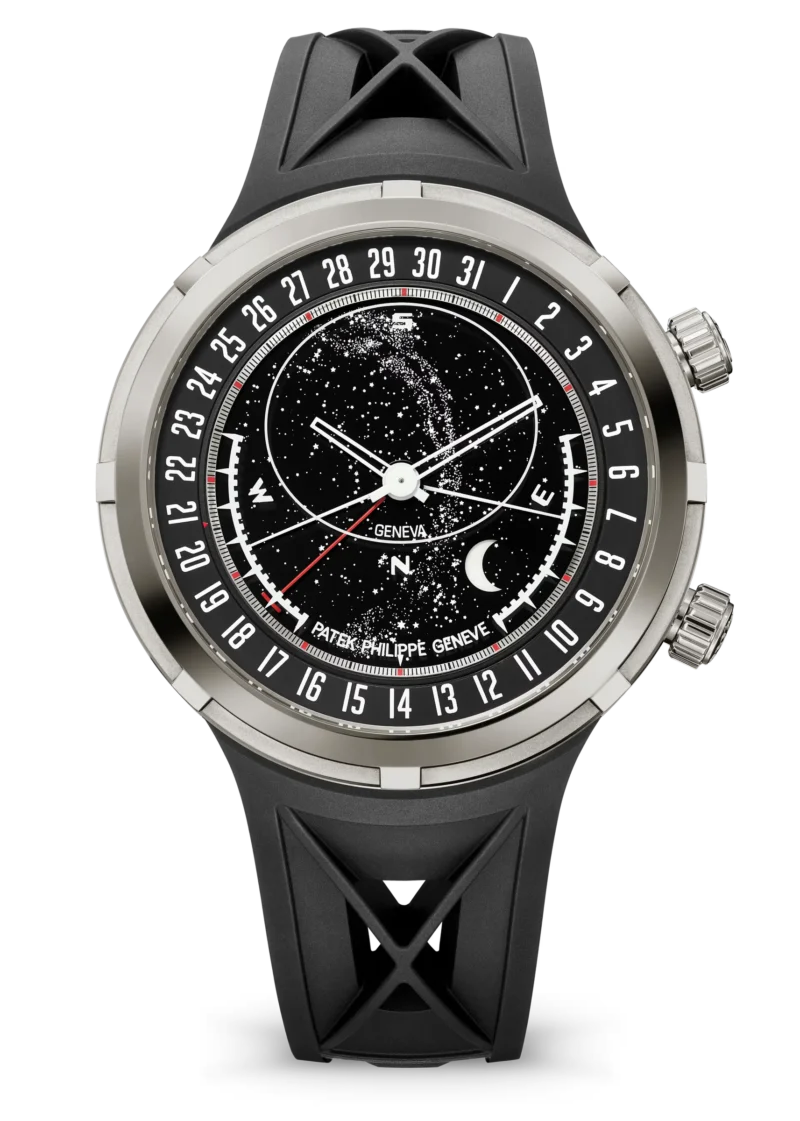
Front view: date at the perimeter, solar indications below and the Geneva sky inside the ellipse. Courtesy of Patek Philippe.
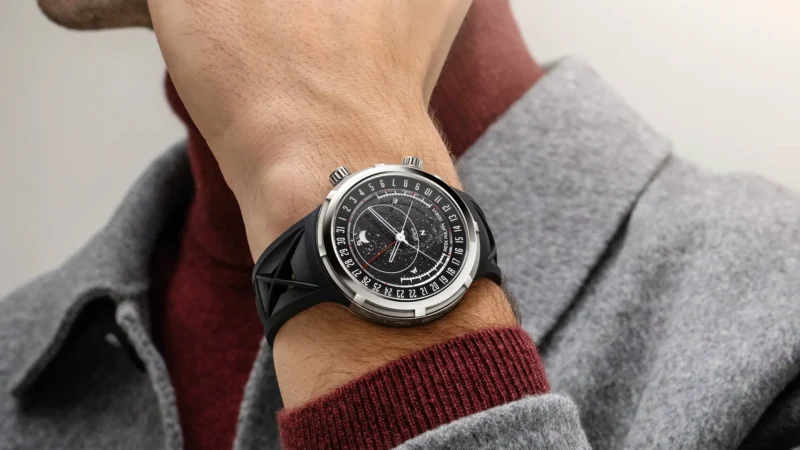
The broad dial remains the primary instrument when the watch is worn. Courtesy of Patek Philippe.
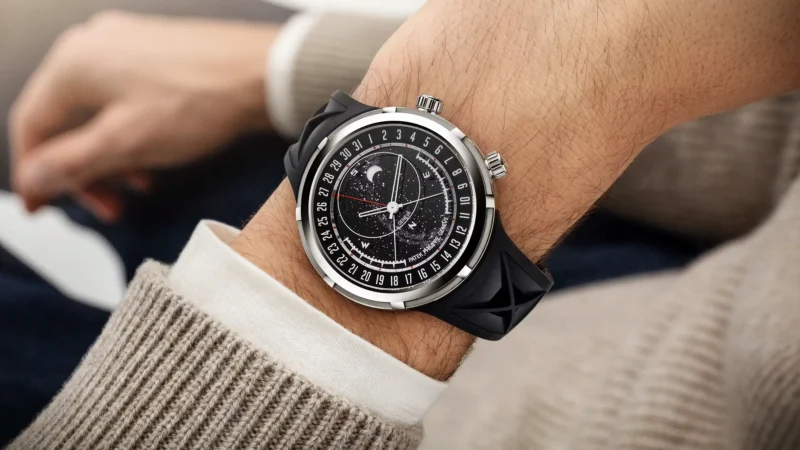
On the wrist, the celestial display reads first as a dark, graphic field. Courtesy of Patek Philippe.
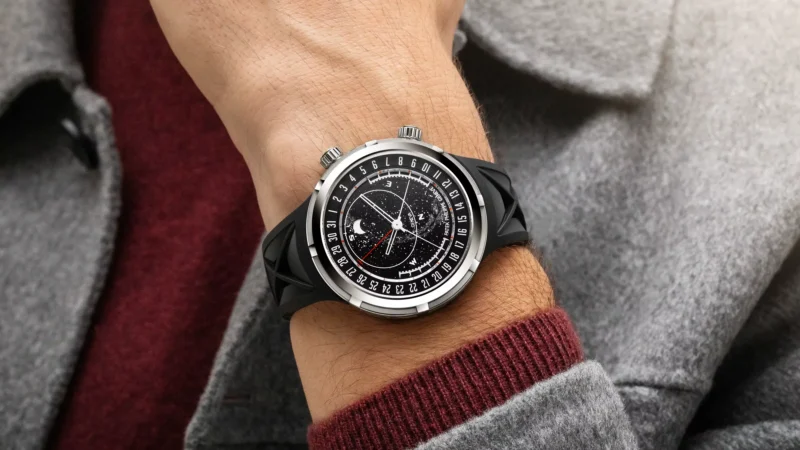
A wrist view establishes the scale of the 47 mm case. Courtesy of Patek Philippe.
A useful way to approach the 6105G is to read it from the outside inward, then return to the sky.
Date: the red hand points to the numbered peripheral disc.
Sunrise and sunset: two white hands at the lower left and lower right point to the solar-event time scales integrated into the dial perimeter.
Mean solar time: the central skeletonised white-gold hour and minute hands show conventional local time.
Visible sky: the ellipse on the sapphire crystal defines the portion of the celestial chart visible above the horizon for Geneva’s latitude.
Meridian: the fixed meridian line provides the reference for the passage of celestial objects.
Stars: the sky-chart disc advances according to the sidereal day, not the 24-hour solar day.
Moon: the lunar display indicates angular position and phase and allows the time of the Moon’s meridian passage to be read in relation to the fixed references.
Once those layers are separated, the dial becomes much less intimidating. The complexity is real, but the display is organised around distinct questions rather than arbitrary decoration.
What the Ref. 6105G does not tell you
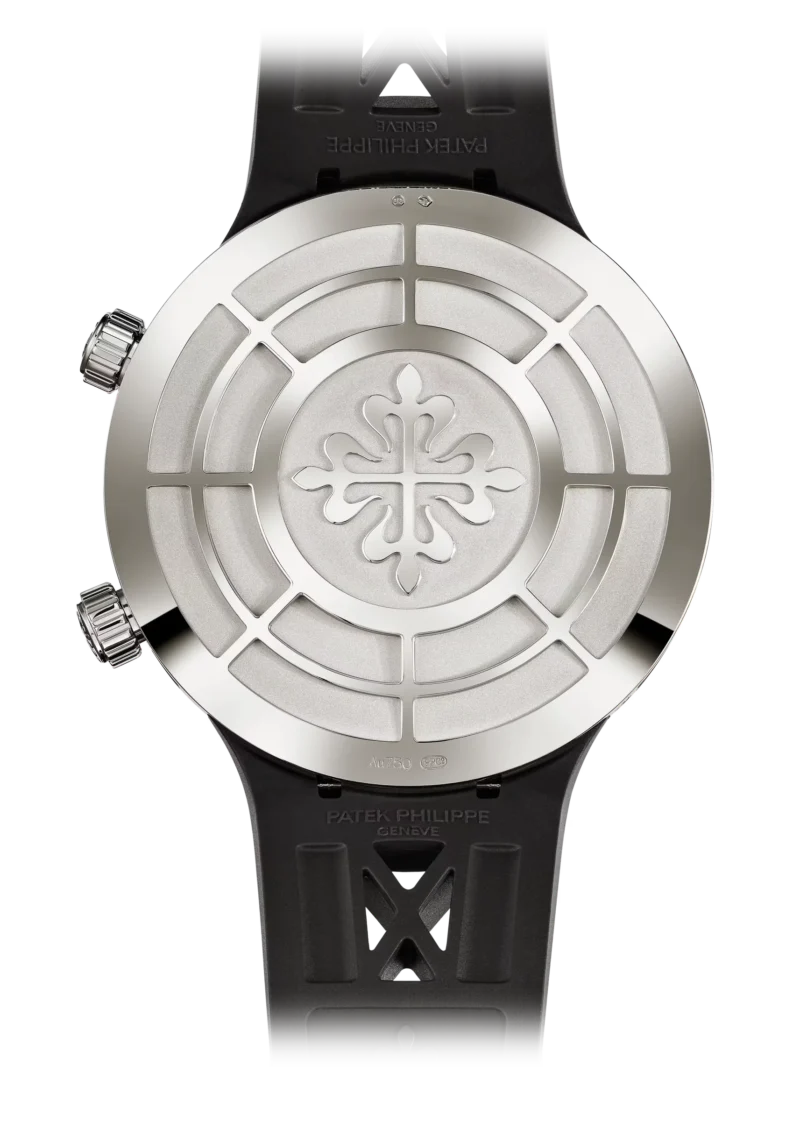
The solid back repeats the case’s concentric and X-shaped design language. Courtesy of Patek Philippe.
Clarity also means saying what the watch does not establish.
It is not a universal sunrise/sunset calculator that the wearer can freely reprogram for any latitude from the wrist. Its celestial view is explicitly anchored to Geneva and places at the same latitude, and the public documentation should be read conservatively on location changes.
It is not a perpetual calendar. The date needs correction five times a year.
It does not show apparent solar time in the sense of an equation-of-time display. Patek specifies hours and minutes of mean solar time for the central time display.
And the six patent filings should not be treated as six vague badges of innovation. Public patent records show concrete work around the sunrise/sunset display, calendar coordination, legal-time correction and elastic guidance mechanisms. Where a direct mapping between every patent family and the production watch has not been explicitly published by Patek, it is better to stop short of inventing one.
TheTimeo view
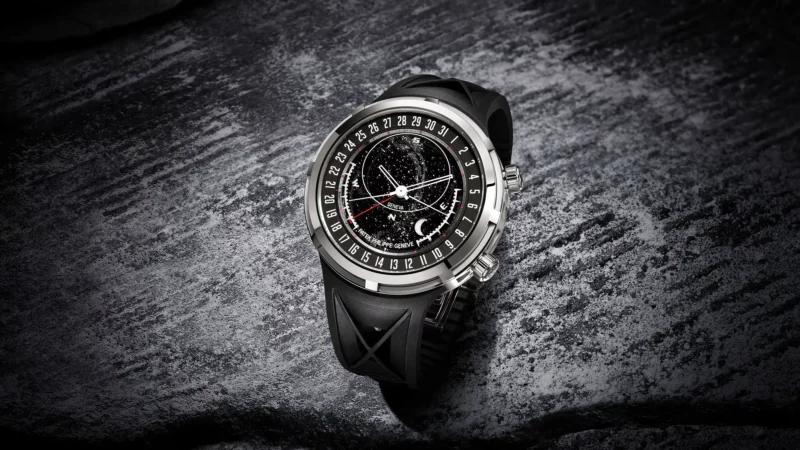
The Ref. 6105G becomes clearest when its sky, solar cycle and civil-time corrections are read separately. Courtesy of Patek Philippe.
The Ref. 6105G becomes more interesting as soon as the word “celestial” is unpacked.
It carries ordinary time, sidereal time, lunar time and an annual solar cycle on the same dial. Those systems agree only because the movement is full of ratios, cams, correction logic and carefully controlled mechanical motion. The summer/winter-time system adds one more layer: a reminder that the sky and the clock on the wall are not governed by the same authority.
That is the real achievement of the watch. The stars are the first thing you see, but the most revealing part is the negotiation underneath them.
A date disc becomes a solar-time scale. A pair of annual curves becomes sunrise and sunset. Three discs only 0.2 mm thick turn different astronomical periods into a view of the sky. The owner still has to correct the date after April.
That last detail is almost perfect. It keeps the 6105G grounded. This is an object capable of following the heavens with extraordinary patience, built around mechanisms that still expect a human hand to participate.
Sources & further reading
Primary source base:
- Patek Philippe, Ref. 6105G-001 product page and technical specifications.
- Patek Philippe, official Ref. 6105 instruction manual for calibre 240 C LU CL LCSO.
- Patek Philippe, Celestial Sunrise and Sunset online setting tool.
- Patek Philippe, calibre 240 movement family page.
- Patek Philippe, Ref. 6104 current Celestial specifications for movement comparison.
- European patent records assigned to Patek Philippe SA Genève, including EP3740821B1, EP3629100B1, EP3731027B1 and EP3731028B1.
Secondary technical cross-checks:
- Revolution, technical analysis of the Ref. 6105G sunrise/sunset and daylight-saving mechanism.
- SJX Watches, technical analysis of the compliant mechanism used for the sunrise/sunset indications.
No hands-on experience, manufacture visit or private access is claimed in this article.
The Edit
Watches stories
Selected stories from the same editorial universe.

What Did IWC Actually Bring Back from Gérald Genta’s Ingenieur SL?
The 40 and 35 mm anniversary Ingenieurs share a rare silver-dial reference, but only

Panerai Luminor Firenze 8 Giorni: What Was the Grooved Crown Guard Actually For?
A rare Ref. 6152/1 detail returns on PAM01734: grooves inside the crown bridge designed

Rolex Perpetual Padellone: How an Annual Calendar Makes Three Displays Jump at Midnight
At midnight, Rolex’s new annual calendar has to identify a short month, skip a
Patek Philippe: what references and archives reveal
A reference identifies the design; an archive extract adds part of its history. How
A Horse in Crystal: Hermès Arceau Samarcande
On the Arceau Samarcande W408546WW00, Hermès cuts a horse into a Saint-Louis crystal dial

Blancpain Lady B: What Does 19 Millimetres Require?
Blancpain’s 19 mm Lady B is best understood as an exercise in mechanical volume: