
Crown Interface / Technical Study
Watches
Panerai Luminor Firenze 8 Giorni: What Was the Grooved Crown Guard Actually For?
A rare Ref. 6152/1 detail returns on PAM01734: grooves inside the crown bridge designed to improve access when gloves and pressure made winding harder.
TheTimeo view
The smallest cut carries the strongest evidence.
Begin inside the crown guard. One modest intervention connects the 1956 sealing patent, a rare 1960s prototype and a modern eight-day movement into a single operational story.
A feature that looks almost pointless until you put your attention where a diver's fingers would have been.
TheTimeo
The visual edit
The object, frame by frame.
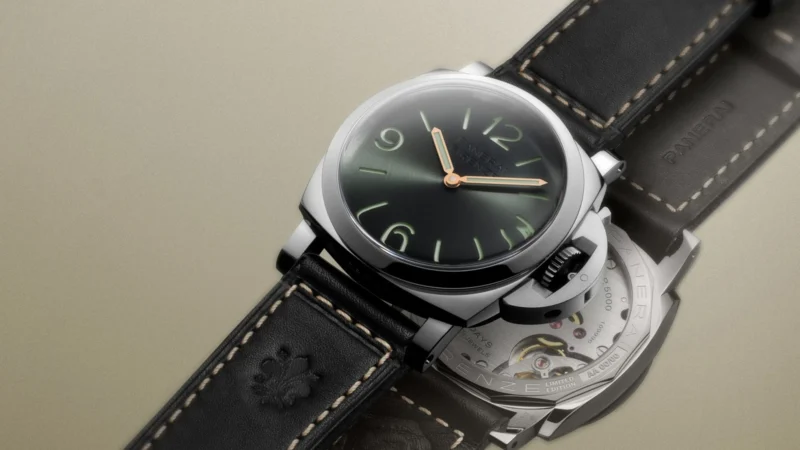
PAM01734 pairs a 44 mm Platinumtech case with a green sandwich dial and the hand-wound P.5000. © Panerai.
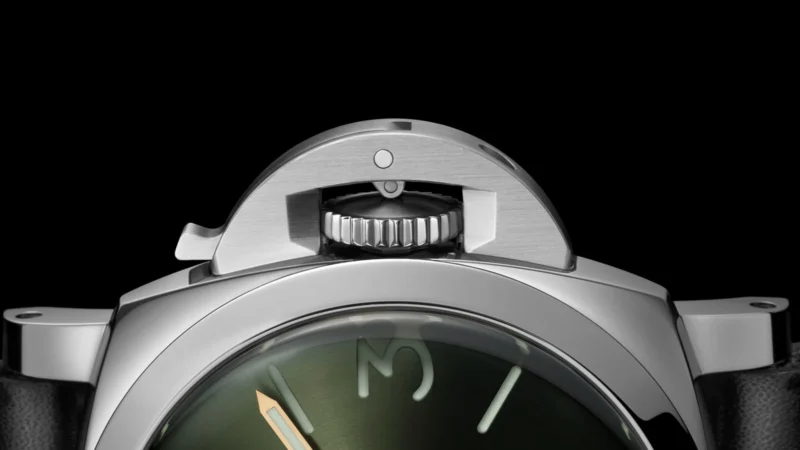
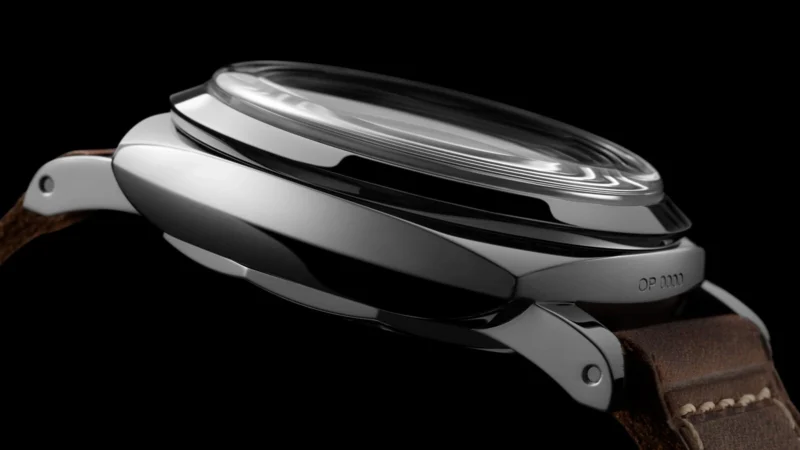
Parallel grooves appear on the inner faces of the PAM01734 crown-protecting bridge, where fingers reach the crown. © Panerai.
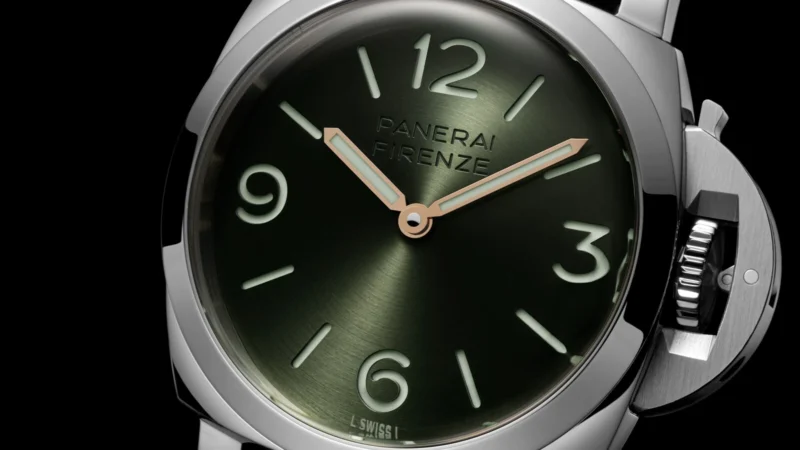
The green sandwich dial carries gold-effect pencil hands and the Panerai Firenze signature. © Panerai.
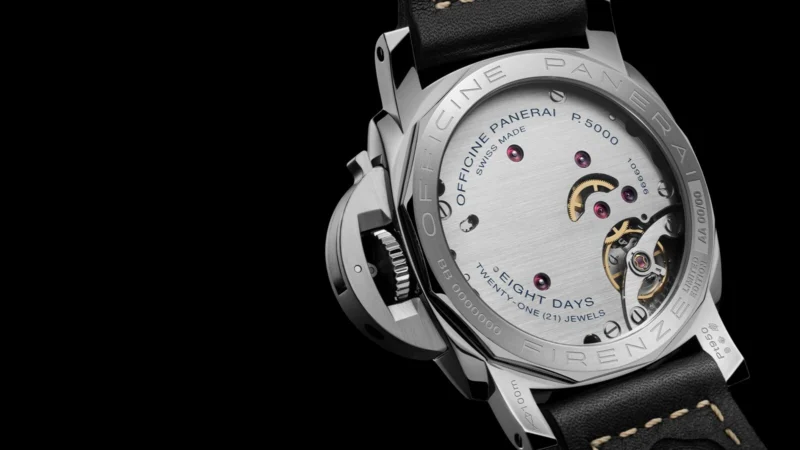
The sapphire back exposes the broad P.5000 architecture and its two-barrel, eight-day reserve. © Panerai.
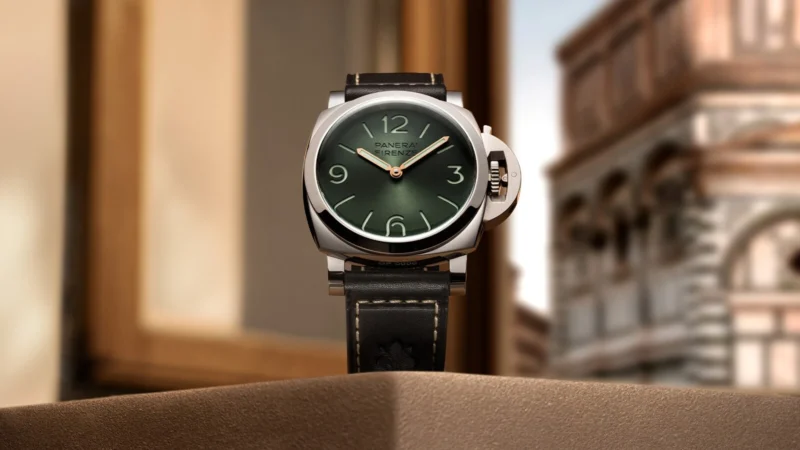
The Firenze edition marks a century at Panerai’s Piazza San Giovanni address. © Panerai.
PAM01794 translates the anniversary brief into polished steel and an anthracite sandwich dial. © Panerai.
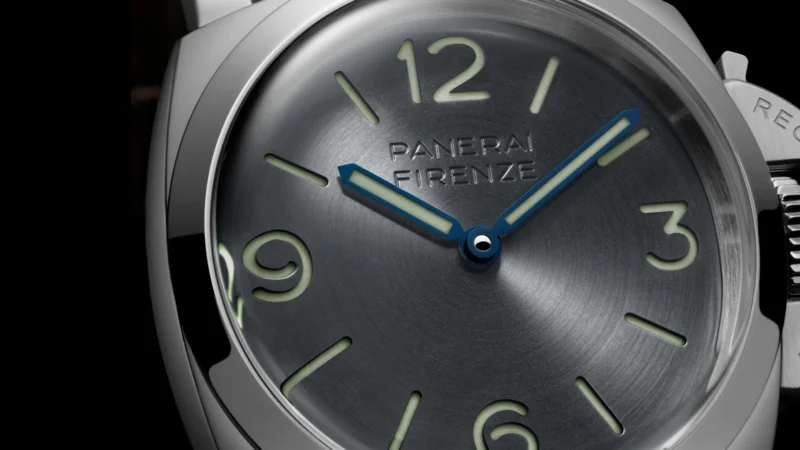
The steel reference uses heat-blued pencil hands against a restrained anthracite surface. © Panerai.
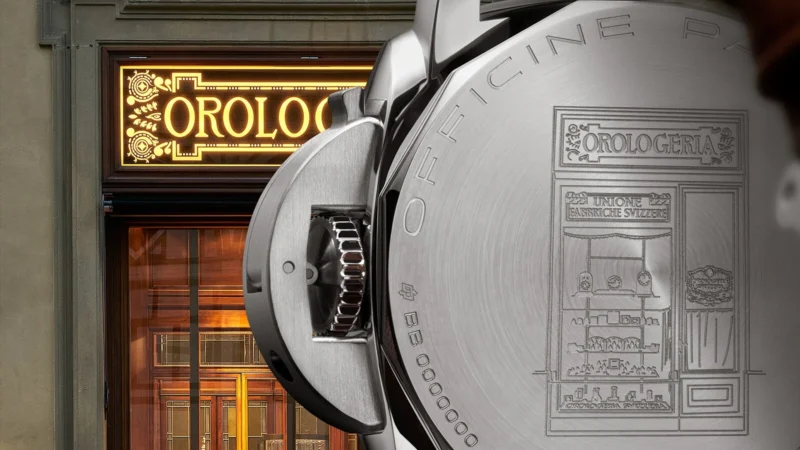
Its solid back records the historic Florence boutique façade rather than exposing the calibre. © Panerai.
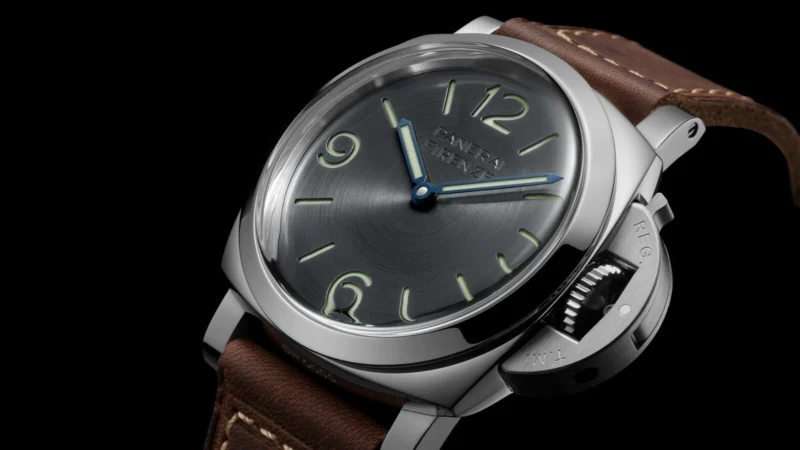
The steel PAM01794 retains the defining lever-and-bridge architecture and is rated to 30 bar. © Panerai.
Interface study / PAM01734Crown interface / Technical reading
Protection changes the way a crown is reached.
Protect
Lever / bridge / seal
The lever closes the crown against the case. The patented bridge begins as a sealing solution, not as an ornamental signature.
Reach
Internal grooves / PAM01734
Parallel cuts on the bridge's inner faces give gloved fingers more purchase around the crown. Panerai documents this detail specifically on the Platinumtech reference.
Wind less
P.5000 / two barrels / eight days
A long manual reserve reduces how often the protected interface must be opened. The crown, bridge and movement form one operational sequence.
Key facts
- Panerai marks 100 years at its Piazza San Giovanni boutique with two 44 mm Luminor Firenze 8 Giorni references: PAM01734 in Platinumtech, limited to 100 pieces, and PAM01794 in steel, limited to 1,000.
- Panerai documents the unusual parallel grooves specifically on the inner faces of the PAM01734 crown-protecting bridge. The stated purpose was to improve grip and access to the crown when winding with gloves, under pressure or in poor visibility.
- The crown-protecting bridge itself is older than that prototype detail. Panerai traces the patented bridge to the GPF 2/56 of 1956 and its later adaptation to Ref. 6152/1 in the 1960s.
- Both 2026 watches use the hand-wound P.5000 with two barrels and an eight-day reserve. The current specification lists 4.5 mm thickness, 21 jewels, 21,600 vibrations per hour and 146 components.
- The steel PAM01794 is rated to 30 bar, about 300 metres. The Platinumtech PAM01734 is rated to 10 bar, about 100 metres. Panerai does not state that the different casebacks or materials are the cause of that difference.
There is a strange little feature inside the crown guard of the new Panerai Luminor Firenze 8 Giorni PAM01734. It is easy to miss because the watch around it is doing several louder things at once. The case is made from Platinumtech. The dial is green. The words “Panerai Firenze” sit at twelve. The watch celebrates the centenary of the Florence boutique. Only 100 examples are planned.
But look between the bridge and the winding crown and there are parallel grooves cut into the metal.
They are not a modern texture treatment. Panerai says the feature comes from a rare Ref. 6152/1 prototype from the 1960s, now held in a private collection. More importantly, the Maison gives the grooves a functional explanation: they were developed and tested to give divers better grip and easier access to the crown when winding the watch with gloves, under pressure or in low visibility.
That is a much better place to begin than the anniversary.
The grooves turn a familiar Panerai silhouette back into a piece of equipment. They also force several useful distinctions. The crown-protecting bridge itself was not born on the Ref. 6152/1. Panerai dates its patented form to the GPF 2/56 of 1956, then describes the bridge as being inserted and adapted to the 6152/1 during the following decade. The grooved inner faces belong to a rarer experimental branch of that story. And in the current 2026 pair, Panerai documents the grooves explicitly on the Platinumtech PAM01734, not on the steel PAM01794.
Once those layers are separated, the Luminor Firenze 8 Giorni becomes more than another heritage edition. It becomes a useful case study in how an operational solution can survive into a modern luxury watch without pretending that every historical detail had the same origin.
The bridge was designed to solve a sealing problem first
The object now recognised as a Panerai signature began as a piece of functional engineering.
Panerai’s current historical material states that Guido Panerai & Figlio obtained an international patent for the crown-protecting bridge in 1956. The system was installed on the GPF 2/56, later nicknamed the “Egiziano”, built for the Egyptian Navy with Italian Navy approval. Panerai describes the bridge as locking the crown in order to improve water resistance during underwater missions.
That sequence matters because modern visual memory tends to merge the bridge and the Luminor case into a single timeless object. The archive is less tidy. Early Ref. 6152/1 watches existed without the bridge. Panerai’s current exhibition material even labels a 6152/1 Marina Militare without the device, powered by a Cortébert 618. The bridge appears later in the evolution of the reference.
The 1956 patent itself reinforces the technical origin. The surviving French patent record is titled as an improvement to sealing devices for instrument controls, particularly the winding and setting crown of watches. Its priority date is listed as 30 November 1955, with a French filing dated 30 November 1956. That does not tell us everything about the production chronology, but it does make one thing clear: the bridge should not be read merely as styling.
At its simplest, the lever-and-bridge assembly presses the crown into its sealing position. Close the lever and the crown is held against the case. Open it and the wearer can wind or set the watch. The mechanism turns a vulnerable control interface into something visibly protected and mechanically constrained.
The grooves found on the rare 6152/1 prototype are a refinement of that interface, not the origin of the bridge itself.
Parallel grooves appear on the inner faces of the PAM01734 crown-protecting bridge, where fingers reach the crown. © Panerai.
So what were the grooves actually doing?
Panerai’s 2026 product documentation is unusually direct. On the PAM01734, parallel grooves are cut into the inner sides of the crown-protecting bridge, facing the crown. The Maison says the solution was developed and tested to provide a firmer grip and easier access when winding with gloves, under pressure or in low visibility.
The wording is important because the grooves are not on the outer face where a decorative motif would be most visible. They are inside the bridge, precisely where fingers trying to reach the crown have to work around a narrow metal structure.
A modern wearer can reproduce the basic ergonomic problem without pretending to recreate a military dive. The crown sits partially enclosed by the bridge. With bare dry fingers, that is manageable. Add thick gloves and the space available for fingertip contact shrinks. Put texture on the internal surfaces and those surfaces offer more purchase than polished or uniformly brushed metal.
Panerai goes further, connecting the detail to operation under pressure and low visibility. Those are manufacturer statements rooted in its prototype narrative. TheTimeo has not independently tested a 1960s prototype underwater, and the public documentation reviewed does not provide the original test report, diver names, trial dates or military acceptance record for this specific grooved bridge. Those details are therefore not established.
What is established is the physical geometry and the Maison’s explanation of its purpose.
That distinction is useful. There is no need to inflate the grooves into a lost military secret. They are interesting precisely because they are modest: a small modification intended to make a control easier to reach when the surrounding equipment made fine finger movement harder.
The rare prototype is not the whole history of Ref. 6152/1
The PAM01734 and PAM01794 both draw from the Ref. 6152/1, but the historical reference was not one fixed configuration.
Panerai’s timeline describes the 6152/1 evolving through the 1960s. The crown-protecting bridge was inserted and adapted to the case. The luminous material changed as the brand moved away from radium. In around 80 examples, according to Panerai’s current historical account, the Swiss-made Angelus SF 240 with an eight-day reserve replaced earlier movement arrangements. Some watches also used a transparent acrylic centre in the back so the movement could be seen.
That is a surprisingly flexible object for something often treated today as an immutable design code.
The 2026 pair selects from that history rather than reproducing one archival watch component by component. Both new watches are reduced to 44 mm from the 47 mm architecture Panerai associates with the 6152/1. They use sapphire rather than vintage acrylic over the dial. They use a contemporary manufacture movement rather than an Angelus or Cortébert calibre. Their luminosity is Super-LumiNova rather than historical radium or tritium compounds.
The PAM01734 goes furthest in reviving the prototype-specific language because it reproduces the inner bridge grooves and uses an open sapphire caseback, visually recalling the historical experiments with a transparent back. The PAM01794 takes a different route. It keeps the steel case, anthracite sandwich dial, heat-blued pencil hands and a solid back engraved with the historic boutique façade.
Calling either watch a replica would therefore be inaccurate. They are selective translations.
Calibre L132.1
The command becomes architecture.
The green sandwich dial carries gold-effect pencil hands and the Panerai Firenze signature. © Panerai.
The sapphire back exposes the broad P.5000 architecture and its two-barrel, eight-day reserve. © Panerai.
The Firenze edition marks a century at Panerai’s Piazza San Giovanni address. © Panerai.
Mechanical context
The architecture, in two acts.
PAM01734
The prototype-specific reading: Platinumtech, green sandwich dial, inner bridge grooves and an open sapphire back.
- Range
- Platinumtech · 44 mm
- Display
- Green sandwich dial · gold-effect hands
- Control
- P.5000 · hand-wound
- Isolation
- 10 bar water resistance
- Flyback
- Eight days · two barrels · 3 Hz
PAM01794
The steel interpretation: anthracite sandwich dial, heat-blued hands and a solid back engraved with the Florence boutique.
- Range
- Polished steel · 44 mm
- Display
- Anthracite sandwich dial · blued hands
- Control
- P.5000 · hand-wound
- Isolation
- 30 bar water resistance
- Flyback
- Eight days · two barrels · 3 Hz
Eight days mattered because winding is a mechanical intervention
The title “8 Giorni” could easily become another heritage cue unless the reason for the long reserve is examined.
Panerai’s history states that approximately 80 Ref. 6152/1 examples adopted the Angelus SF 240 with an eight-day power reserve in the 1960s, and that extended reserve became a fundamental element of the brand’s technical identity. The modern 2026 watches use the P.5000 instead, but they preserve the idea of infrequent manual winding.
The practical logic is simple. Every winding operation requires the crown interface to be used. On a watch whose water resistance depends in part on a protected crown system, reducing the frequency of that intervention has an obvious operational appeal. A user who winds once a week opens the crown-protecting lever far less often than one winding every day.
Panerai itself makes that connection on the new steel PAM01794, stating that the long autonomy reduces the need to operate the crown for winding and that the solution originates in its professional instruments. A contemporary secondary source goes one step further and argues that fewer winding operations reduce stress on the crown assembly. That is mechanically plausible, but because Panerai’s own 2026 material does not quantify wear reduction, the article does not turn it into a measured durability claim.
The current P.5000 provides its reserve through two barrels. Panerai lists the movement at 15½ lignes, 4.5 mm thick, with 21 jewels, a Glucydur balance, Incabloc Parechoc shock protection and a frequency of 21,600 alternations per hour, or 3 Hz. The 2026 Platinumtech product page lists 146 components.
Its architecture is deliberately broad and covered. Panerai says much of the mechanism sits beneath two plates, leaving the balance bridge and intermediate wheel visible. A variable-inertia balance is regulated through small gold timing screws around its circumference, while the traversing bridge adds rigidity around the oscillator.
None of this makes P.5000 a recreation of the Angelus SF 240. It is the modern machine chosen to preserve the same ownership rhythm: wind it, close the bridge and leave it alone for much of the week.
PAM01734 and PAM01794 are not the same watch in different metals
The two centenary references share case size, basic Luminor architecture, P.5000 and eight-day autonomy. Their differences are more substantial than a change of alloy.
PAM01734 is made in Platinumtech, which Panerai describes as a 95 per cent pure platinum alloy developed for greater hardness and scratch resistance. It carries the green circular-brushed sandwich dial, gold-effect pencil hands and the “Panerai Firenze” inscription. The back is transparent sapphire, exposing P.5000. Production is limited to 100 pieces.
Most importantly for this article, this is the reference on which Panerai explicitly documents the parallel grooves inside the bridge.
PAM01794 uses polished steel, an anthracite circular-brushed sandwich dial and heat-blued pencil hands. Its solid screw-down back carries “Officine Panerai Firenze” and an engraving of the historic boutique façade. It is limited to 1,000 pieces.
The water-resistance figures diverge sharply. Panerai rates PAM01794 to 30 bar, about 300 metres, and states that each watch is pressure tested underwater at 25 per cent above its guaranteed rating. PAM01734 is rated to 10 bar, about 100 metres, with the same statement that cases are tested 25 per cent above the guaranteed figure.
The temptation is to explain that difference by pointing to the transparent caseback on the Platinumtech model or to the case material. The public documentation reviewed does not establish either as the cause. We can observe the different construction and the different ratings. We cannot honestly claim the engineering reason without Panerai saying so.
That is also why the Platinumtech model should not be described as the “more professional” watch simply because it is rarer and more expensive. The steel version has three times the published water-resistance rating.
The dial is closer to an instrument than an anniversary plaque
Both watches carry the inscription “Panerai Firenze”, but Panerai avoids adding a date, centenary logo or decorative crest to the front.
The PAM01794 is particularly restrained. The anthracite surface is circular brushed, with a sandwich construction, luminous Arabic numerals and markers, no date and no small seconds. The heat-blued pencil hands provide the only strong colour accent. Panerai says the bluing recalls a treatment found on historical references.
PAM01734 uses a green brass dial with hand-finished concentric micro-circles. The Maison says those operations create slight individual variations as the surface catches light. The luminous material remains green, while the hands use a gold-effect treatment.
There is a useful reason to keep both dials simple. A watch with eight days of power reserve does not need a power-reserve indicator to prove its autonomy, and these two references deliberately avoid adding one. The owner has to know the winding rhythm rather than read it from a gauge.
That is not automatically better. It is a design choice that keeps the face closer to the stripped-back instrument vocabulary of the historical watches.
The Florence centenary is more than a city name on the dial
Panerai’s Florence story begins before the current boutique. The Maison dates its origins to Giovanni Panerai’s watch shop, workshop and watchmaking school on Ponte alle Grazie in 1860. After several moves, the business settled in its present Piazza San Giovanni location in 1926, inside the Archbishop’s Palace opposite Florence Cathedral, under the name Orologeria Svizzera.
The current boutique page stresses that the address also functioned as a working watchmaking space, where watches were assembled and repaired and where the Panerai family developed relationships with major Swiss houses.
That context makes the centenary more specific. The 2026 anniversary is not the 100th anniversary of Panerai as a company, nor the 100th anniversary of the Luminor, nor the 100th anniversary of its relationship with naval diving. It is the centenary of one address becoming a long-term centre of the Maison’s identity.
The packaging references that fact directly. The steel watch’s solid back depicts the boutique façade. Both references use Tuscan calf straps hot-stamped with the Florentine lily and arrive in mahogany presentation boxes carrying a metal plaque of the entrance. Panerai also opened its Immersion exhibition at Florence’s Museo Marino Marini from 10 to 19 September 2026 as part of the centenary programme.
Those details are secondary to the watch, but they prevent the word “Firenze” from becoming vague lifestyle branding.
The historical claim that still needs evidence
The most interesting unresolved point is the grooved 6152/1 prototype itself.
Panerai says it is rare, dates it to the 1960s, identifies it as a Ref. 6152/1 prototype and states that it is held in a private collection. The 2026 PAM01734 is described as reviving its unusual crown-bridge detail.
What the public sources reviewed do not provide is a complete archival dossier for that object: no case number, military issue record, prototype test sheet, production order, named recipient or documented chronology of the groove trials. None of those absences disproves the prototype. They simply define the boundary of what can be independently reconstructed from the material currently public.
For TheTimeo, that boundary belongs in the article rather than in a hidden note.
The crown-protecting bridge itself has a much stronger documentary chain: Panerai’s history, its exhibition material and the surviving 1950s patent record all point to a sealing function developed around the GPF 2/56. The later adaptation to Ref. 6152/1 is also part of Panerai’s published history. The grooves are narrower evidence, tied by the Maison to one unusual private prototype.
That makes them more interesting, not less. They are a reminder that the objects we now call “design icons” were once work in progress.
What the 2026 Firenze pair actually preserves
If the Luminor Firenze 8 Giorni is reduced to shape, green or black dial, and military nostalgia, the strongest part of the release disappears.
What survives from the historical logic is a sequence of relationships.
The crown is important because water can enter through controls. The bridge exists because that control needed to be secured. The grooves exist because securing the crown can also make the crown harder to reach. Eight days of reserve matter because the most protected crown is the crown you do not have to operate every morning. A large luminous dial matters because a tool used in difficult conditions has to be read quickly.
Those are connected decisions.
The 2026 watches are contemporary luxury products, not military equipment. Platinumtech, collector limitations, presentation boxes and boutique-centenary context make that obvious. Nor should a modern owner mistake a historical rationale for proof that every surviving 1960s watch was used exactly as current brand literature describes.
But the PAM01734 contains one unusually honest piece of heritage design: a feature that looks almost pointless until you put your attention where a diver’s fingers would have been.
That is what the grooves were for. Not to make the bridge recognisable from across a room, but to make the crown easier to reach when the bridge was doing its job.
Sources & credits
Sources & methodology
- Panerai PAM01734, for the Platinumtech reference, bridge grooves, edition and specification.
- Panerai PAM01794, for the steel reference, edition, water resistance and specification.
- Panerai history, for the 1956 crown-bridge patent, GPF 2/56 and Ref. 6152/1 chronology.
- Patent FR1170180A, for the contemporary sealing-device record.
- This is independent editorial analysis, not a hands-on review. The private prototype provenance and the engineering cause of the references’ different water-resistance ratings are not inferred.
The Edit
Stories selected by TheTimeo
What Did IWC Actually Bring Back from Gérald Genta’s Ingenieur SL?
The 40 and 35 mm anniversary Ingenieurs share a rare silver-dial reference, but only

Patek Philippe Ref. 6105G: What a Sunrise-and-Sunset Celestial Actually Displays
The Ref. 6105G is not one astronomical display but several kinds of time negotiated

Blancpain Lady B: What Does 19 Millimetres Require?
Blancpain’s 19 mm Lady B is best understood as an exercise in mechanical volume: