
TheTimeo / Watches
SPEEDMASTER 38:
the identity shift
Seven new references give the Speedmaster 38 a cleaner face and a stronger visual link to the Moonwatch. The important change is not size, but the way the 38 mm line now explains itself.
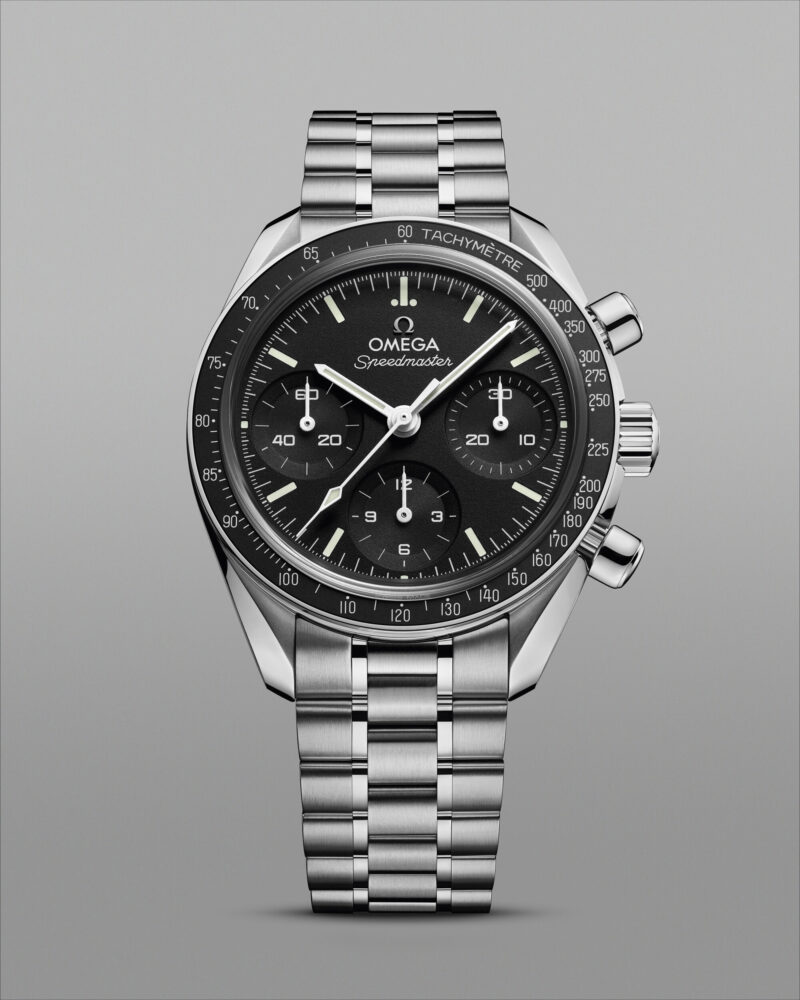
The black no-date reference gives the redesigned Speedmaster 38 its clearest Moonwatch connection. Courtesy of OMEGA.
Explore the story
The easiest way to understand the new Speedmaster 38 is to ignore six of the seven watches for a minute.
Start with the black one.
It has three round subdials, a black aluminium tachymeter bezel with the dot over 90, white hands, less text on the dial and no date window. The bracelet is built in the five-link style now associated with the Moonwatch. At a glance, this is the closest the Speedmaster 38 has come to stating its family connection without qualification.
That matters because the outgoing 38 mm collection had spent years doing something else. Omega’s own material described the 2017 generation through oval subdials, an oval date window and a more decorative mix of colour, gold and diamond-set bezels. Those watches were not failed attempts at a smaller Moonwatch. They had their own design language.
The 2026 update changes that language.
It does not, however, replace the underlying idea of the watch. The diameter remains 38 mm. The case is still 14.75 mm thick. Water resistance remains 100 metres. Six references continue with the automatic Co-Axial Calibre 3330 and a date at six. Only the black steel model moves to the no-date Calibre 3332.
So the story here is not miniaturisation, nor a new technical platform. It is a careful visual realignment: Omega has moved the Speedmaster 38 closer to the Moonwatch while keeping the compact automatic chronograph that already existed underneath.
Key facts
Explore the comparison
| Launch date | 25 August 2026 |
| New references | 7 |
| Case diameter | 38 mm |
| Thickness | 14.75 mm |
| Lug-to-lug | 44.96 mm on most official product pages; white-dial ref. 324.30.38.50.04.001 is listed at 45.00 mm |
| Water resistance | 100 m / 10 bar |
| Movements | Omega Co-Axial Calibre 3332, no date; Calibre 3330, date |
| Power reserve | 52 hours |
| Certification | Officially certified chronometer |
| Bracelet | Five-link, Moonwatch-style, with comfort-release adjustment |
| Main visual changes | Round subdials, reduced dial text, wider/classic bezel treatment, dot over 90, revised bracelet |
| Collection status | Permanent collection |
The black no-date tells the story most clearly
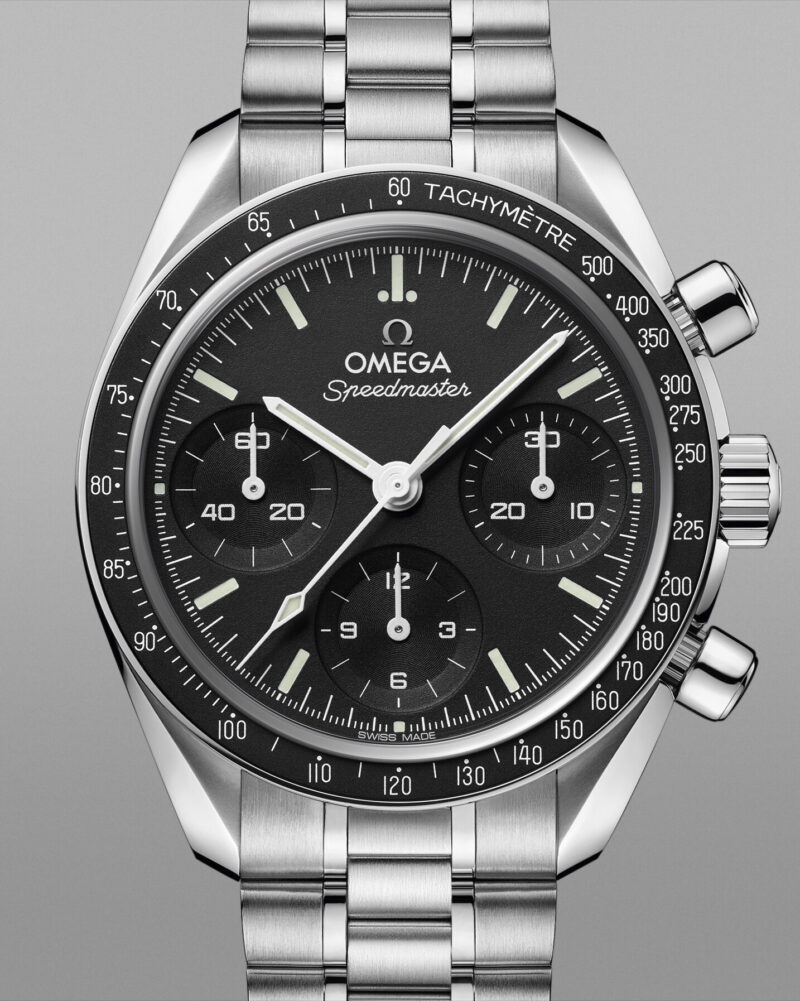
Round counters, reduced dial text and no date restore a quieter three-register symmetry. Courtesy of OMEGA.
Omega presents seven watches, but they do not all carry the update with the same force.
Reference 324.30.38.50.01.002 is the useful place to begin because it strips away most of the distractions. The steel case is paired with a matt black dial and black aluminium bezel. There is no date aperture at six. The hands are white. The three subdials are round. The dial text has been reduced to the Omega name and Speedmaster signature rather than carrying the fuller technical wording seen on earlier versions.
None of those decisions is dramatic on its own. Together, they change the watch’s centre of gravity.
The previous Speedmaster 38 could be recognised by its oval counters before the eye reached the logo. The new black model does the opposite: its visual cues immediately recall the broader Speedmaster family. Omega says exactly this in its launch material, describing the new collection as moving closer to the aesthetic codes of the Moonwatch.
The black no-date takes that idea furthest because removing the date restores the symmetry of the three-register layout. That is more consequential than the loss of one complication might suggest. On a 38 mm chronograph, every opening competes for limited dial area. Take the date away and the face becomes quieter without needing a larger case or a new arrangement of the counters.
The result is not a Moonwatch Professional reduced to 38 mm. The movement is automatic rather than hand-wound, the case proportions are different, the dial is not the same construction and the watch has 100 metres of water resistance. But the visual relationship is now immediate rather than implied.
The 2017 design has not been erased by accident
There is a temptation with any redesign to treat the outgoing version as a problem that the new one has finally solved. That is too simple here.
Omega’s own historical collection material explains that the 2017 Speedmaster 38 used horizontal oval subdials and a vertical oval date window inspired by oval displays found on earlier De Ville watches. The collection also made room for the brown-and-Sedna-gold “Cappuccino”, bicolour cases and diamond-set bezels. It was a deliberate attempt to make a compact Speedmaster less literal.
The 2026 watches reverse several of those choices.
The subdials return to circles. The bezel becomes visually broader and, on the steel black model, more conventional in Speedmaster terms. The dot over 90 is brought into the tachymeter layout. Dial wording is reduced. The bracelet is replaced by a five-link design that Omega itself calls Moonwatch-style.
This is why the update reads as a change of editorial direction inside the collection rather than a cosmetic refresh. Omega has decided that the Speedmaster 38 should now explain its identity through the strongest shared Speedmaster codes first, and use colour and precious materials second.
The old collection started with difference. The new one starts with family resemblance.
The case did not become smaller in the way some readers may expect
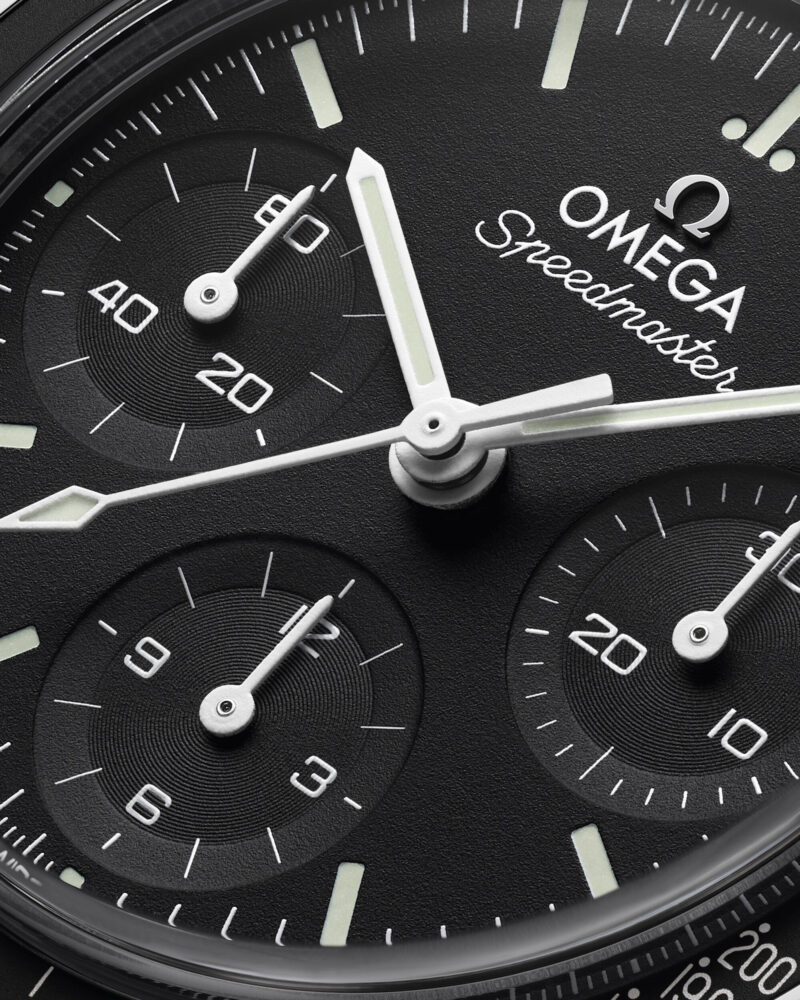
The black dial brings the new circular subdials and simplified wording into close view. Courtesy of OMEGA.
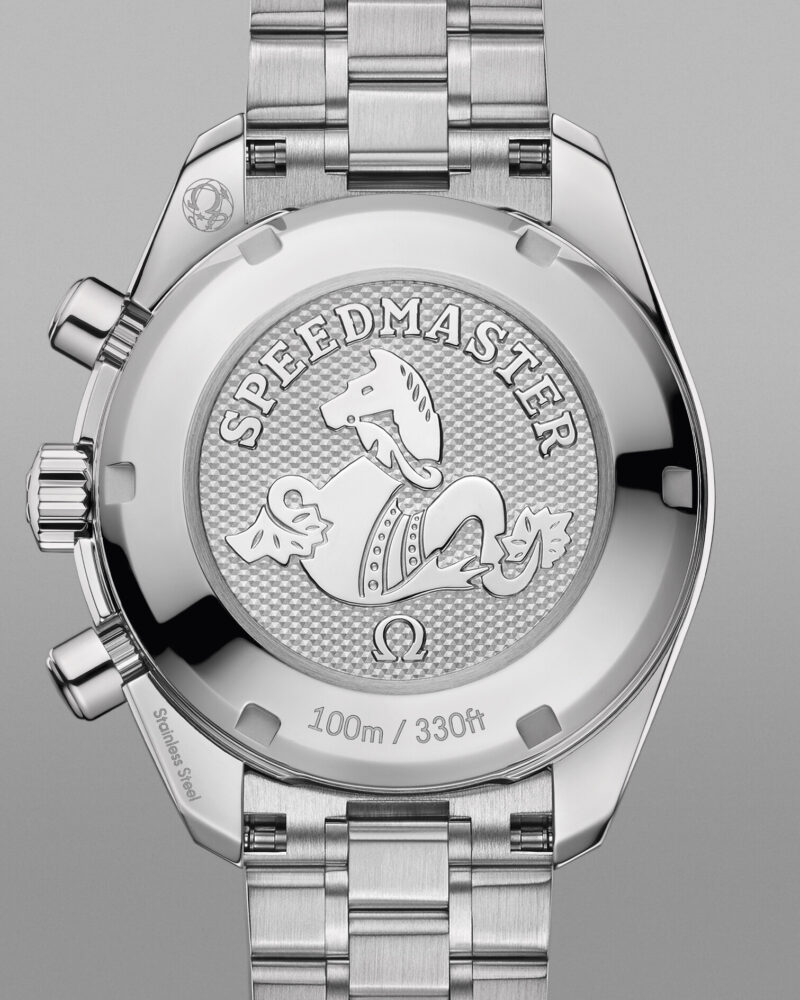
The closed caseback belongs to the automatic Calibre 3332 no-date reference. Courtesy of OMEGA.
The number on the dial of the press release is 38 mm, but diameter alone is not enough to understand the proportions.
Omega’s current product pages list a thickness of 14.75 mm and a lug-to-lug measurement of 44.96 mm for the black, silver and most other references. The white-dial steel model is listed at 45.00 mm lug-to-lug, a difference small enough to treat as a product-page specification rather than a meaningful change in case architecture unless Omega later clarifies otherwise.
The compact lug-to-lug is important because it tells us that the watch occupies relatively little length across the wrist. The 14.75 mm thickness is equally important because it tells us what Omega did not redesign.
The new Speedmaster 38 is not a thin chronograph created around a new movement. The movement family carries over, and so does the vertical dimension of the case.
That creates a proportion that photographs from the front can hide. A 38 mm diameter and a case approaching 15 mm in height are two different kinds of compactness. The watch is short across the wrist, but it is not shallow.
Without handling the new watches, TheTimeo will not claim how that balance feels. Caseback shape, end links, bracelet articulation and the way the mid-case sits against the wrist all affect perceived thickness. Those are hands-on questions. What the dimensions establish is simply that the redesign concentrated on the face, bezel and bracelet rather than reducing the watch’s height.
This is one of the most useful facts in the release because it prevents the black model from being mistaken for something Omega has not actually made: a newly engineered, slim, automatic 38 mm Moonwatch.
Two calibres, and one deliberate omission
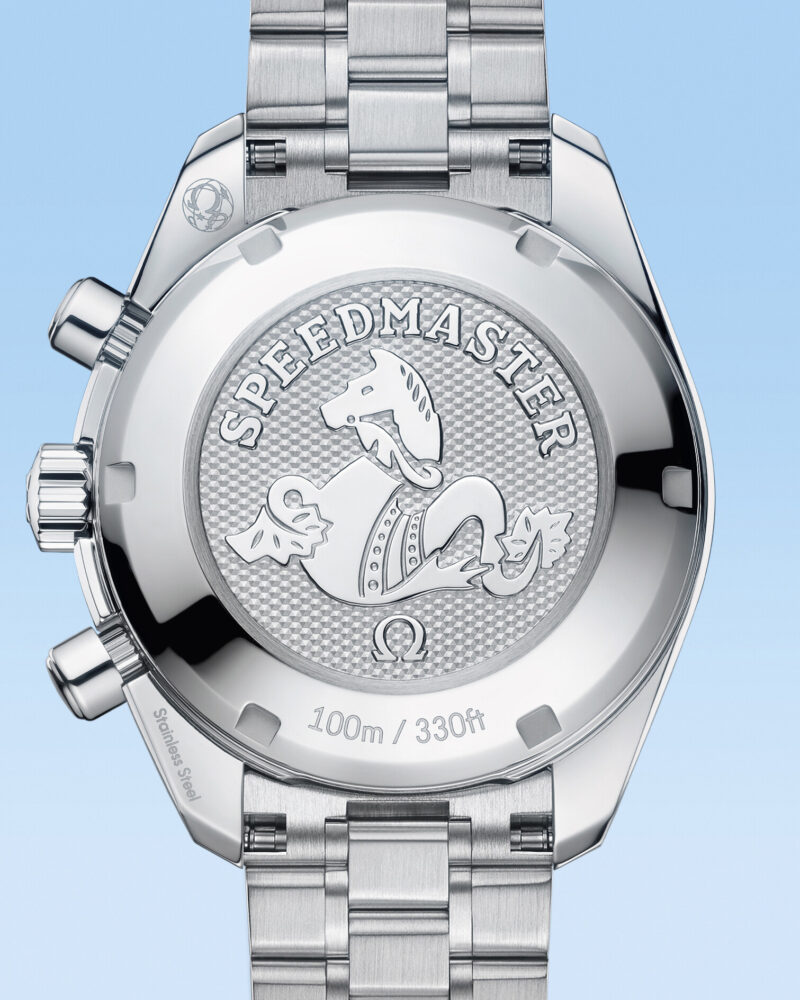
The date-equipped references retain the Calibre 3330 architecture. Courtesy of OMEGA.
Six of the seven references use the Omega Co-Axial Calibre 3330. The black no-date uses Calibre 3332.
Omega’s official product pages describe both as self-winding chronographs with column-wheel mechanism and Co-Axial escapement, a free-sprung balance with Si14 silicon balance spring, 4 Hz frequency and 52 hours of power reserve. Both are officially certified chronometers.
The important functional difference in this collection is simple. Calibre 3330 provides the date. Calibre 3332 does not.
That makes the black model technically quieter as well as visually quieter. The missing date is not hidden with a colour-matched disc or pushed to another position. It has been removed from the watch’s information architecture.
Specialist coverage has noted that these calibres are not Master Chronometer-certified. Omega’s current product pages call them chronometers and describe their Co-Axial and silicon-spring construction; they do not present the new Speedmaster 38 as a Master Chronometer line. That distinction should be preserved rather than blurred by the broader strength of Omega’s METAS programme elsewhere in the catalogue.
The movement choice also explains why the update is evolutionary. Omega did not need a new calibre to create the new visual identity. It used the existing automatic chronograph platform and made one targeted functional change for the black reference.
That is a sensible way to read the watch: design first, architecture second.
The bracelet does more work than a new bracelet usually does
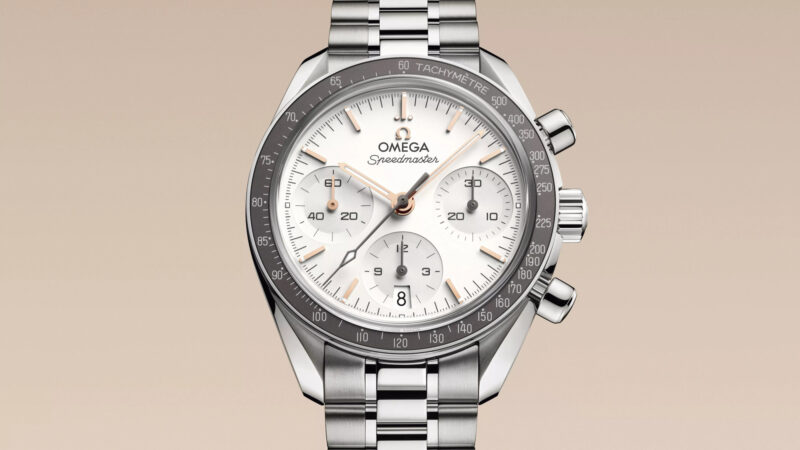
A wide launch detail shows the broader bezel and five-link bracelet language. Courtesy of OMEGA.
Bracelet changes are easy to dismiss as finishing detail. Here the bracelet helps complete the repositioning.
Omega states that every new reference is delivered on a five-link Moonwatch-style bracelet. The small central links can be polished or brushed depending on the model, and the product pages specify a folding clasp with the brand’s comfort setting. Hodinkee and Monochrome report a two-position micro-adjust providing 2.3 mm of adjustment.
The visual effect is more important than the number of adjustment positions.
On the black no-date, the bracelet removes another point of distance from the current Moonwatch design language. Shorter-looking links and alternating surface treatment continue the same message established by the dial and bezel: this is a member of the Speedmaster family before it is a decorative variation of it.
On the bicolour models, the same structure has a different job. Small central links in 18K Moonshine Gold or Sedna Gold let the precious-metal accents run through the bracelet without turning the whole watch into a solid-gold object. The architecture stays consistent while the materials change.
That consistency matters across a seven-watch release. It is one of the reasons the collection now feels like one family with several levels of decoration rather than several styling ideas sharing a 38 mm case.
Seven references, but three distinct directions
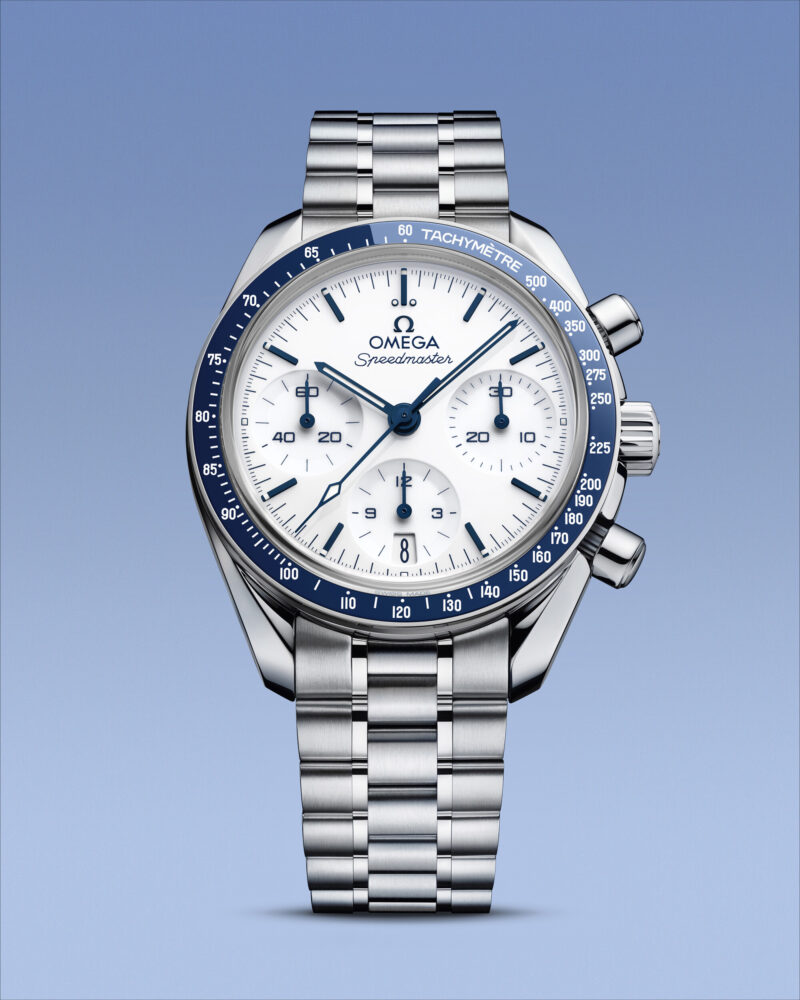
The white lacquered dial is paired with a blue ceramic bezel. Courtesy of OMEGA.
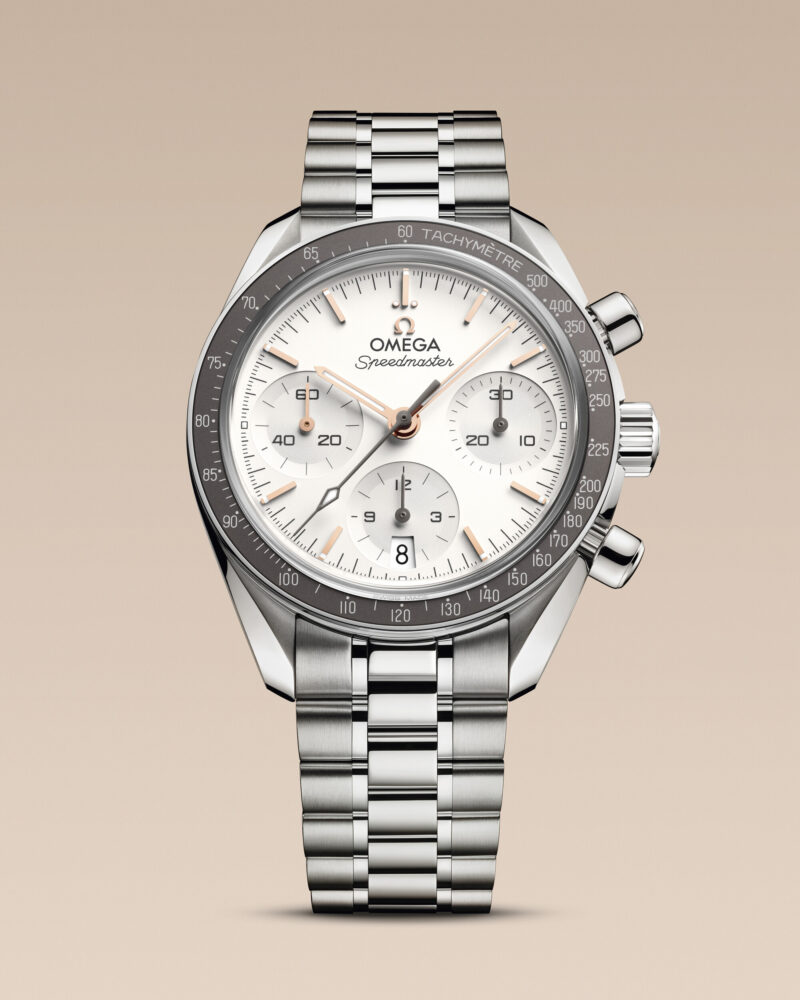
Warm grey and Sedna-toned details soften the steel reference. Courtesy of OMEGA.
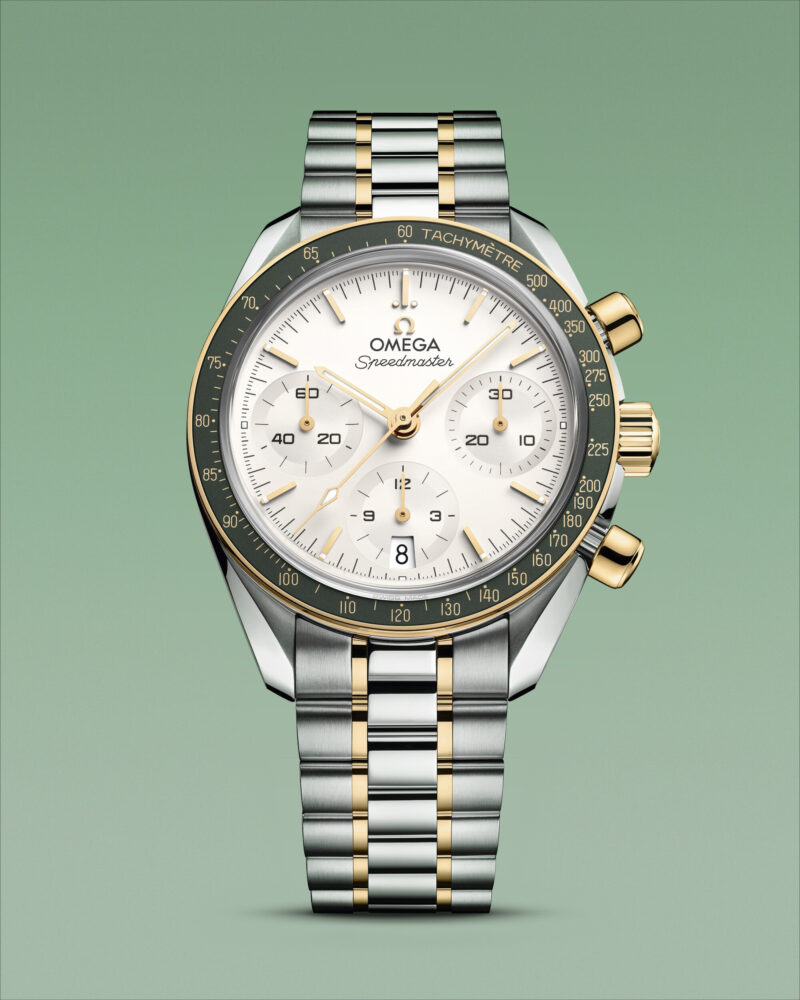
Moonshine Gold and a green bezel define one of the two bicolour directions. Courtesy of OMEGA.
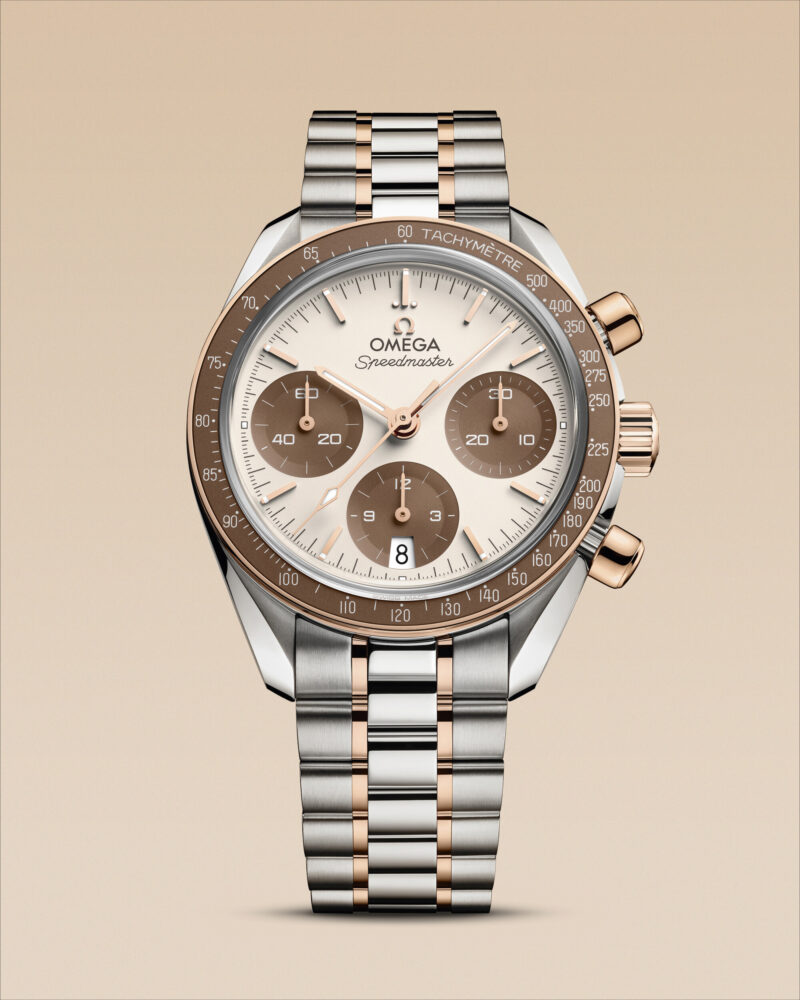
The ivory and brown ‘Cappuccino’ palette continues inside the redesigned family. Courtesy of OMEGA.
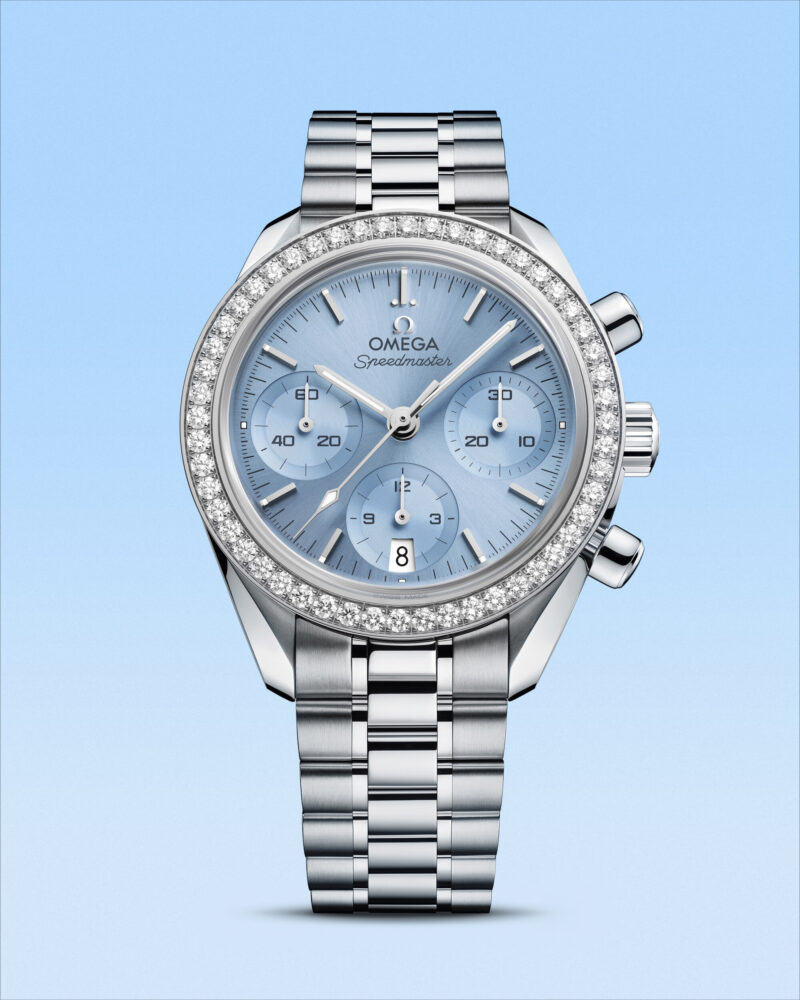
An ice-blue dial and diamond-set bezel occupy the jewellery-led end of the range. Courtesy of OMEGA.
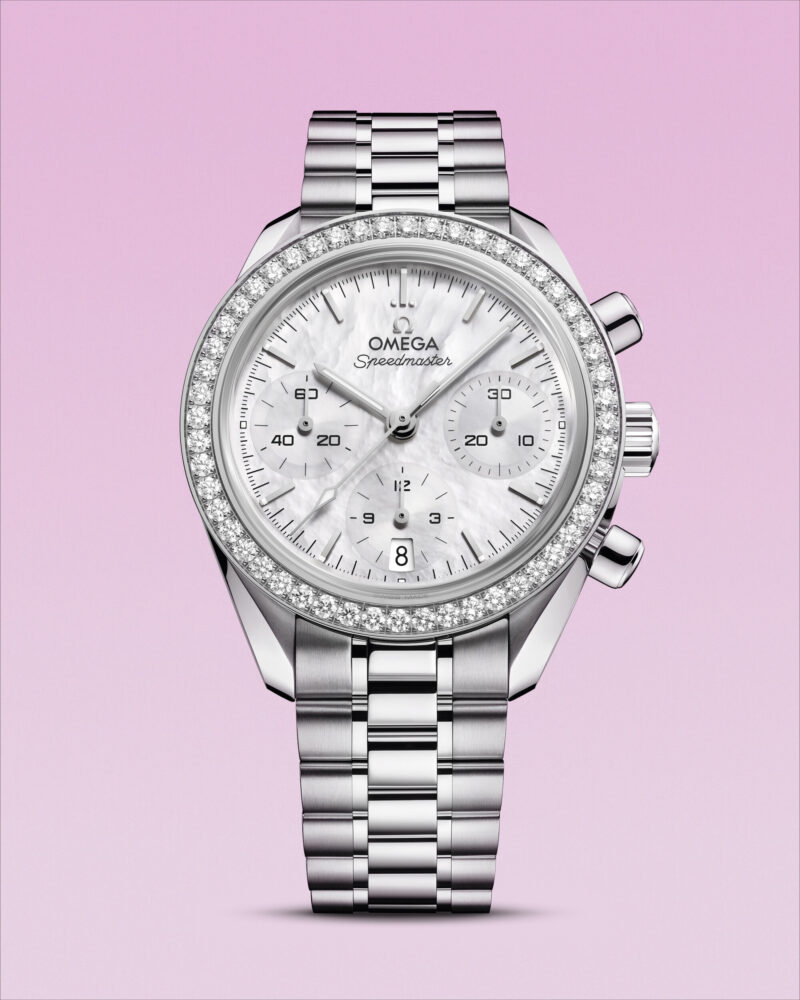
White mother-of-pearl gives the second diamond-set reference a different surface response. Courtesy of OMEGA.
The full launch makes more sense when the seven watches are grouped by what they are trying to do.
1. The steel watches
The black no-date is the most direct link to the Moonwatch.
The white-dial reference 324.30.38.50.04.001 uses a blue ceramic bezel with white enamel tachymeter scale, a lacquered white dial and blue CVD-coated hands and indexes. It keeps the date and Calibre 3330. The contrast is crisp, but the round registers and simplified layout keep it inside the new design language.
Reference 324.30.38.50.02.003 takes a softer route: opaline silvery dial, warm-grey aluminium bezel and Sedna Gold-coloured PVD details. It shows that “closer to the Moonwatch” does not mean every watch has to become monochrome.
2. The bicolour watches
The Moonshine Gold version, reference 324.20.38.50.02.001, pairs a green aluminium bezel with a silvery dial and yellow-gold-coloured details. The Sedna Gold reference 324.20.38.50.02.002 returns to the brown-and-ivory “Cappuccino” palette that has been part of the Speedmaster 38 story for years.
That second watch is important because it demonstrates continuity. Omega has not rejected the decorative identity of the previous collection. It has rebuilt it inside a more conventional Speedmaster layout.
3. The diamond-set watches
References 324.15.38.50.03.001 and 324.15.38.50.05.001 use bezels set with 52 diamonds totalling 1.53 carats, paired respectively with an ice-blue PVD dial and a white mother-of-pearl dial.
These are not side notes to the release. They are evidence that Omega still expects the 38 mm platform to span sports-chronograph language and jewellery-led presentation.
That breadth is part of the collection’s identity. The black no-date may attract the loudest attention from enthusiasts, but it does not redefine the entire 38 mm range as a tool-watch exercise.
The more interesting change is hierarchy
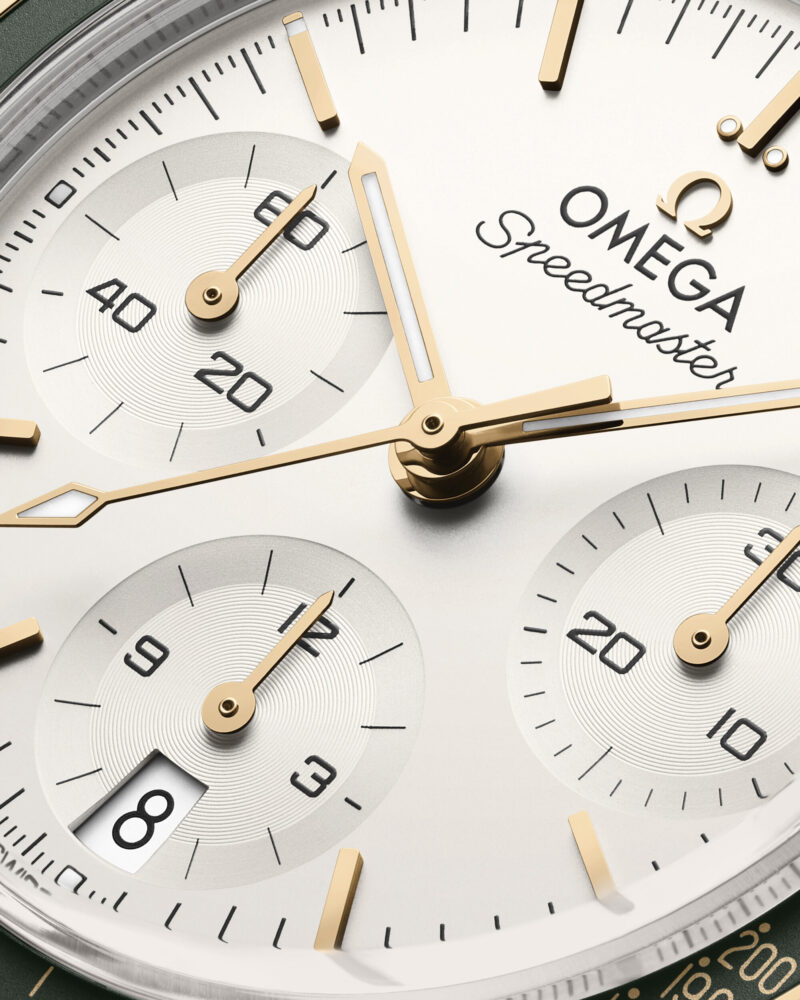
The circular counters remain consistent while materials change the visual temperature. Courtesy of OMEGA.
A redesign can add features, introduce a material or change a movement. This one mostly changes what the eye notices first.
On the outgoing generation, oval counters, decorative bezels and varied colour schemes gave the Speedmaster 38 its own vocabulary. On the new watches, the shared family markers are stronger: round counters, cleaner text, the broader tachymeter treatment, dot over 90 and the Moonwatch-style bracelet.
Colour still matters. Gold still matters. Diamonds still matter. They simply sit one level lower in the hierarchy.
That is why the update feels more coherent even though it remains very broad. A black no-date steel chronograph and a mother-of-pearl watch with 1.53 carats of diamonds can now look like two ends of the same line rather than distant relatives.
The change is especially clear when the old “Cappuccino” concept is compared with the new Sedna Gold version. The brown-and-ivory idea survives, but the oval counters do not. Omega kept the colour memory and changed the grammar around it.
For a collection with a long-running identity problem between “smaller Speedmaster” and “separate lifestyle chronograph”, that is more consequential than another dial colour.
What the release does not answer
Official photography can tell us a great deal about colour, layout and finishing. It cannot answer the most practical questions about a compact but relatively thick chronograph.
TheTimeo has not handled the seven new references. We therefore cannot state whether the new bracelet makes the case feel thinner, whether the black dial feels more legible in changing light, whether the pushers are satisfying to operate, or whether the 14.75 mm height is noticeable in normal wear.
We also cannot infer that the black no-date is “better” because it looks more familiar. Some owners may prefer the date. Others may prefer the outgoing ovals precisely because they gave the 38 mm line an identity independent of the Moonwatch.
Nor does launch pricing tell us anything reliable about future resale performance. Hodinkee reported US pricing from $6,500 for the black steel model to $13,100 for the mother-of-pearl diamond-set version. Monochrome reported European pricing from €6,400 to €12,900. Those are regional launch references, not evidence of value retention.
If the watch is being considered as an object rather than a press image, three checks matter more than the release-day excitement:
- compare the 14.75 mm thickness with watches already comfortable on your wrist;
- decide whether the date is useful enough to justify choosing Calibre 3330 over the cleaner no-date layout;
- compare the black model not only with the outgoing Speedmaster 38, but with the Moonwatch Professional whose design language it now borrows more openly.
None of those questions can be settled by a specification sheet alone.
TheTimeo view
The 2026 Speedmaster 38 is a redesign by subtraction and reordering.
Omega removed the oval counters. It removed the date from one reference. It removed some dial text. It brought back a more familiar bezel language and gave the whole collection a bracelet that makes the family connection harder to miss.
What it did not do is equally important. The 38 mm diameter did not become a thinner new case. The automatic chronograph platform did not become a new-generation Master Chronometer movement. The collection did not abandon colour, gold or diamonds.
The black no-date therefore deserves attention, but not because it is a miniature Moonwatch. It is more interesting than that. It shows Omega deciding that the Speedmaster 38 no longer needs to distance itself from the Moonwatch in order to justify its existence.
The line now starts from a familiar Speedmaster grammar and moves outward from there.
That makes the seven watches easier to understand. Whether it also makes them better in daily wear will have to wait for the watches themselves.
Sources & further reading
The launch facts, seven-reference structure, dial/bezel changes, bracelet description and calibre split were checked against Omega’s official press release dated 25 August 2026 and current regional Omega product pages for the new references. The outgoing 2017 design language was checked against Omega’s own Speedmaster 38 collection/history material, which documents the oval subdials and De Ville-derived inspiration.
Dimensions, water resistance, power reserve and calibre details were checked against current Omega product pages. Regional launch pricing and the reported 2.3 mm clasp adjustment were cross-checked against Hodinkee and Monochrome because these details were not all present in the global press release reviewed for this article.
This is a New Release Analysis, not a hands-on review. No claims about comfort, pusher feel, real-world legibility or perceived thickness are based on physical access.
The Edit
Watches stories
Selected stories from the same editorial universe.
Audemars Piguet Neo Frame Jumping Hour: Why the New Calibre Matters More Than the Vintage Shape
Audemars Piguet returns to a two-window jumping-hour format from the late 1920s, reversing its

Omega Speedmaster: originality, service and the watch you wear
A replacement dial or bracelet can change a vintage Speedmaster’s appeal. How to understand
A Horse in Crystal: Hermès Arceau Samarcande
On the Arceau Samarcande W408546WW00, Hermès cuts a horse into a Saint-Louis crystal dial

Blancpain Lady B: What Does 19 Millimetres Require?
Blancpain’s 19 mm Lady B is best understood as an exercise in mechanical volume:
When Is a Revived Watch Brand Still the Same Brand? Testing the New Gallet Against the Archive
The archive is real and the manufacturing system is new. We test Flying Officer,
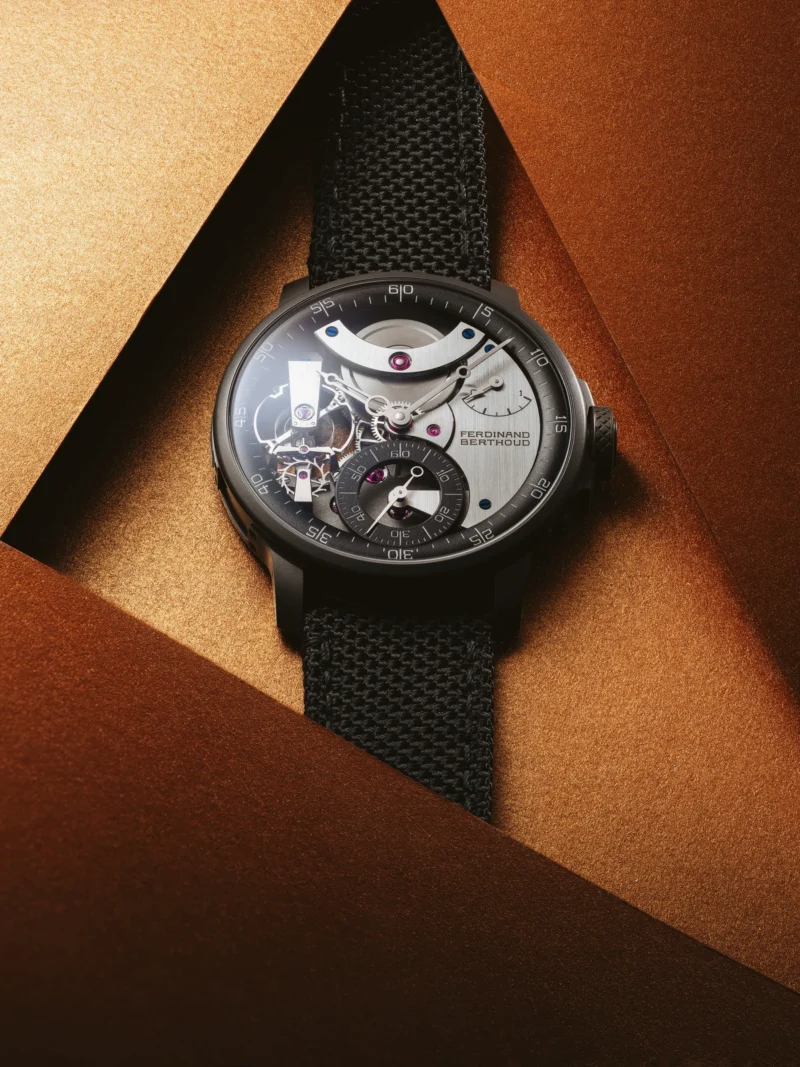
Ferdinand Berthoud FB 3SPC.4-1: Why Bend a Balance Spring into a Cylinder?
The black titanium case is new. The harder achievement is regulating a cylindrical spring