
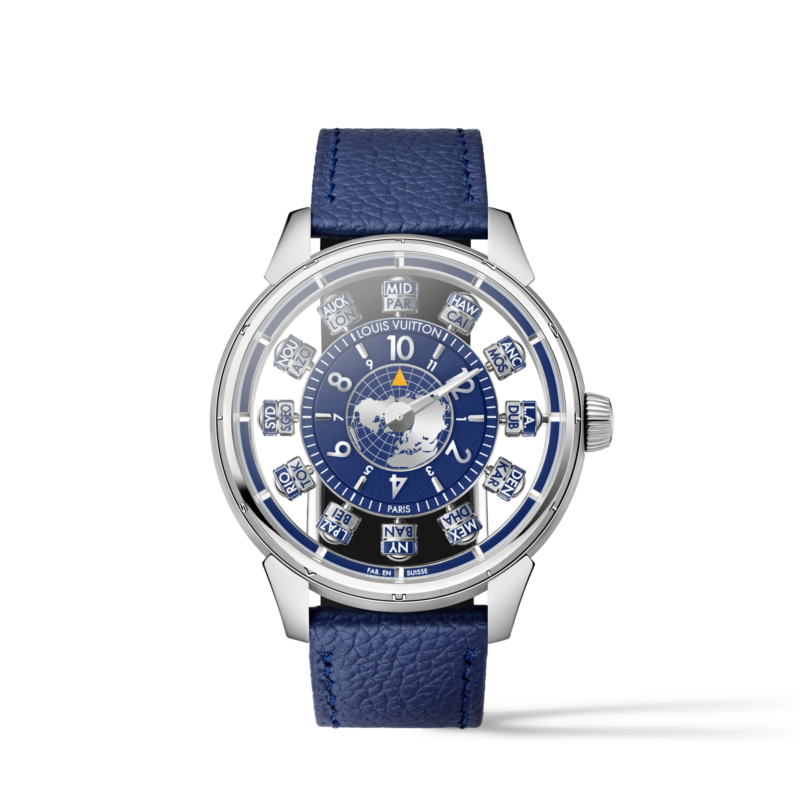
Watchmaking Intelligence / Flagship
Watches
Louis Vuitton Spin Time: How Twelve Cubes Carry Twenty-Four Time Zones
The Tambour Spin Time Air Antipode compresses twenty-four time-zone references into twelve rotating cubes. Its elegance—and its daylight-saving limit—reveal how the system really works.
TheTimeo view
The world, compressed without pretending to contain it
The Antipode is most revealing when read as information architecture: position supplies the hour, the cube supplies the pair, and colour restores the half of the day.
The movement can organise offsets. It cannot predict the next law that changes civil time.
TheTimeo technical reading
The visual edit
One language. Four different jobs.
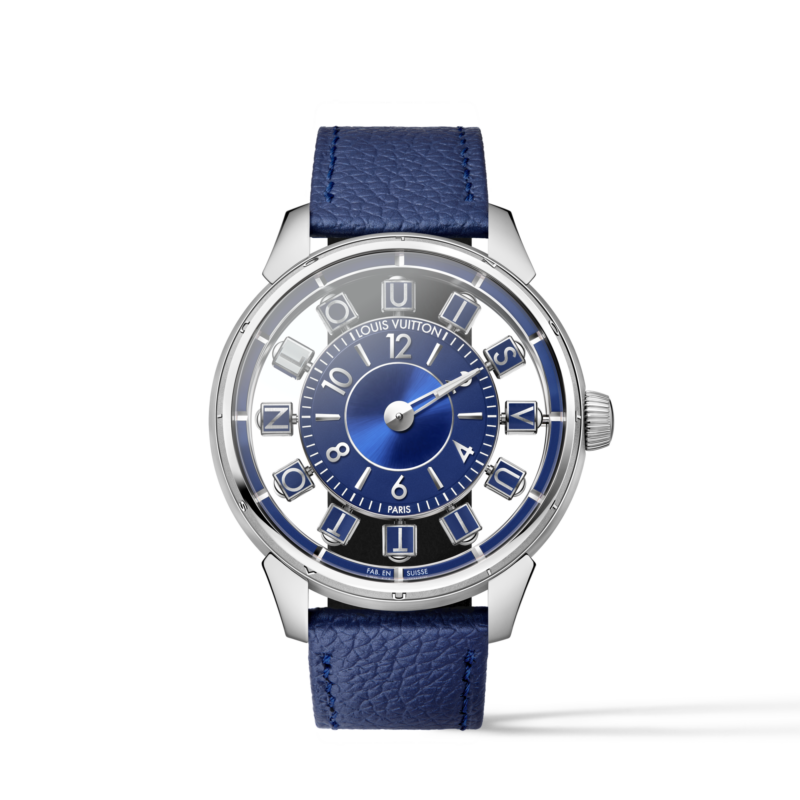
On Spin Time Air Blue, position identifies the hour while the cube faces spell LOUIS VUITTON. Courtesy of Louis Vuitton.
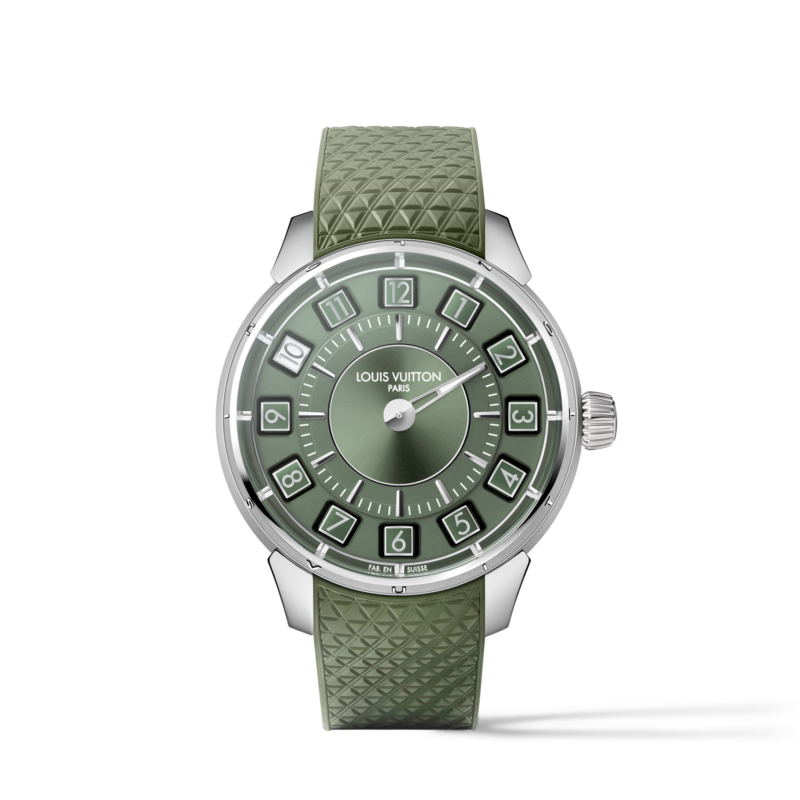
Spin Time Green is the clearest baseline: one lighter numbered cube identifies the active hour. Courtesy of Louis Vuitton.
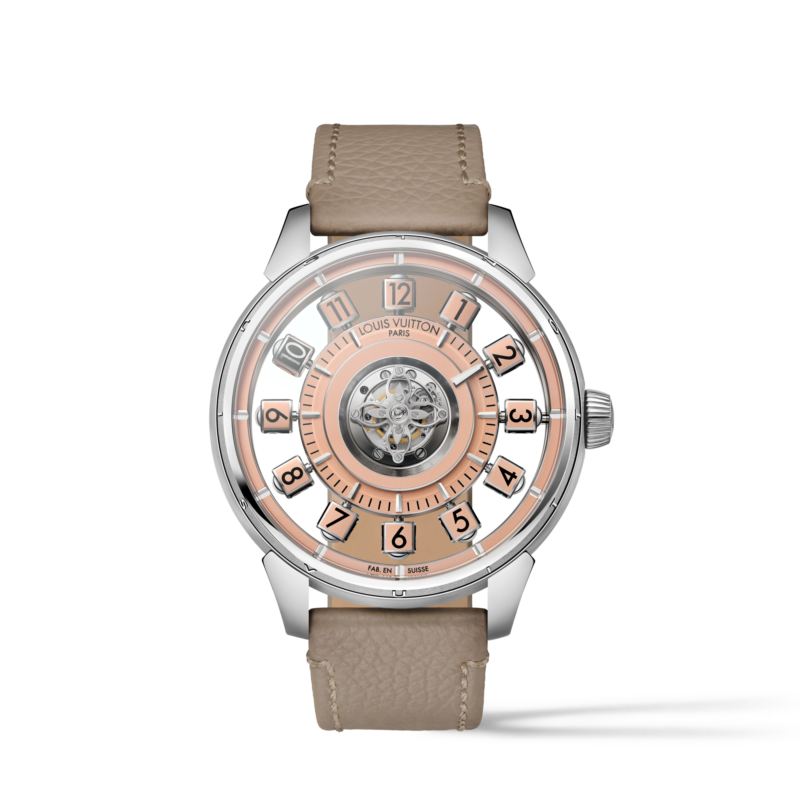
The Flying Tourbillon retains the peripheral cube language and gives the dial centre a second kinetic system. Courtesy of Louis Vuitton.
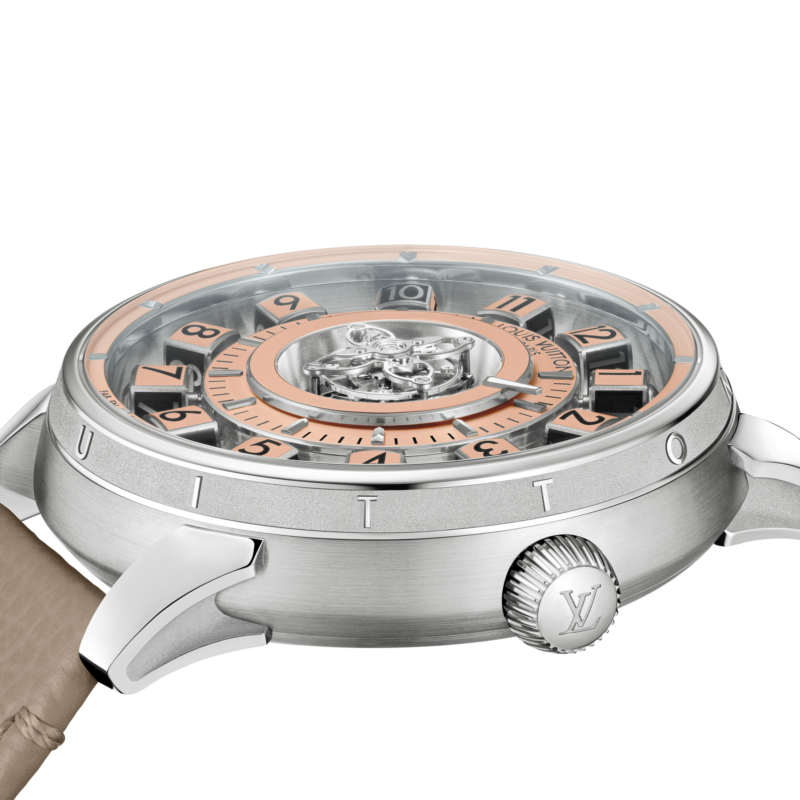
A low-angle view of the Flying Tourbillon reveals the height and separation of its central and peripheral displays. Courtesy of Louis Vuitton.
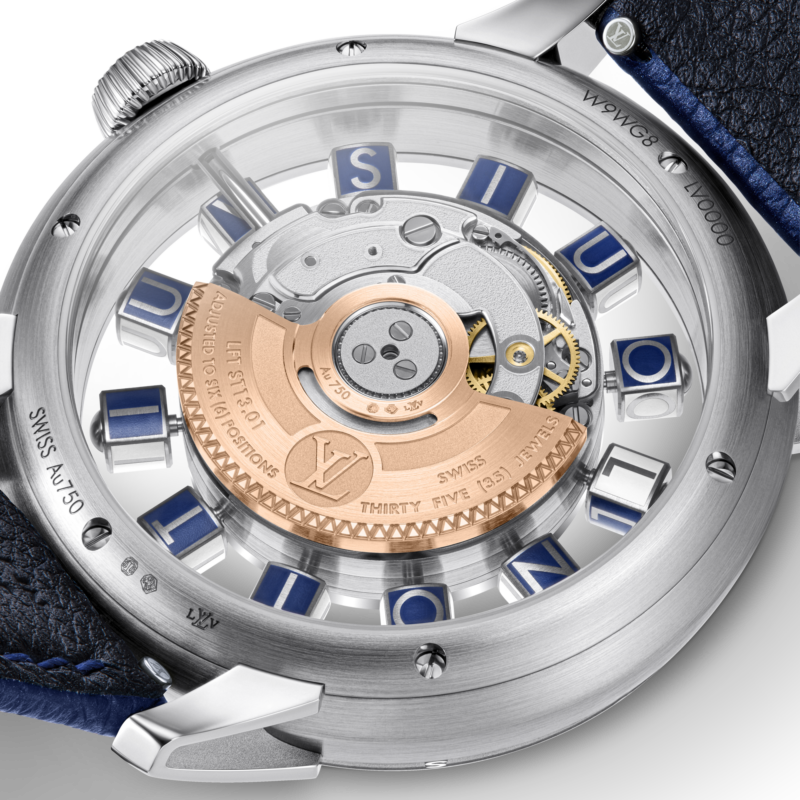
The Air Blue caseback shows calibre ST13.01 and the rear architecture supporting its twelve cubes. Courtesy of Louis Vuitton.
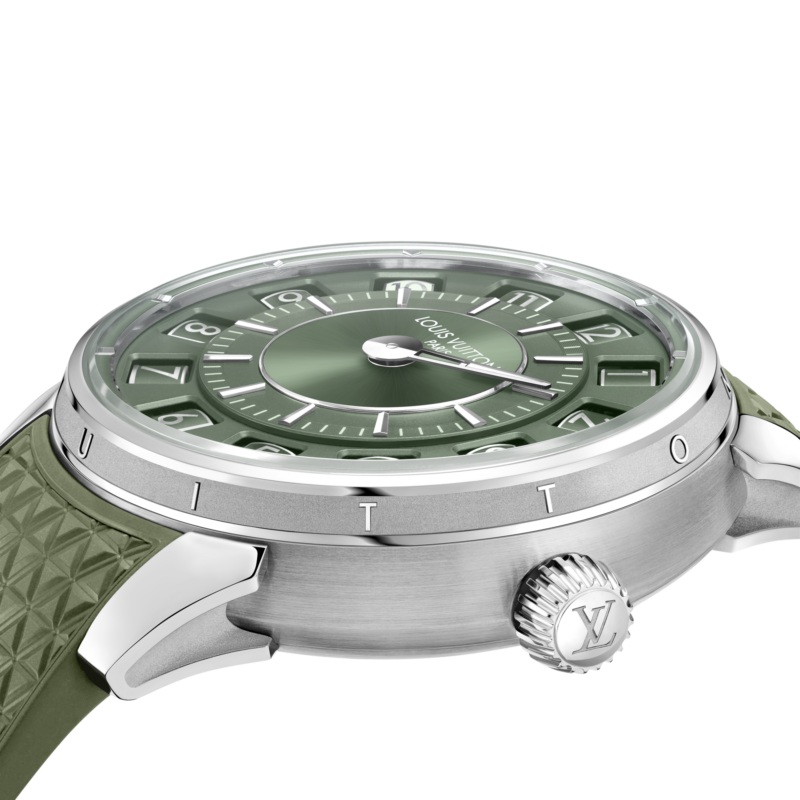
The green execution shows how the jumping-hour grammar survives a closed dial and conventional numerals. Courtesy of Louis Vuitton.
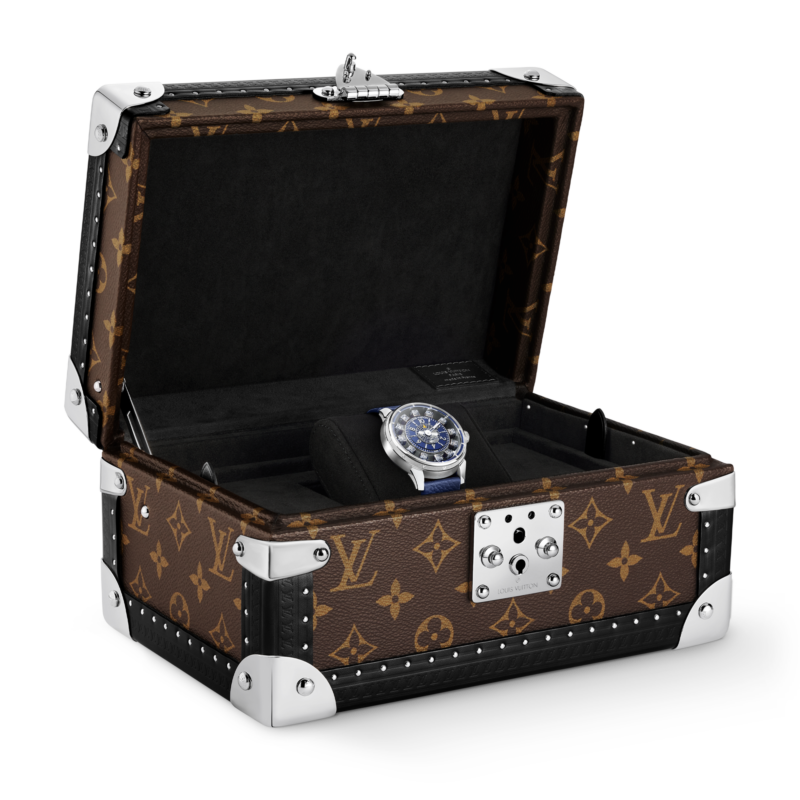
The Antipode in its Louis Vuitton presentation trunk: travel context made literal without changing the mechanism’s limits. Courtesy of Louis Vuitton.
The signature mechanism
Twelve carry
twenty-four.
Move through the code: position supplies the hour, a paired cube carries two cities, and colour restores day or night.
Key facts
- Louis Vuitton introduced the Spin Time display in 2009. Twelve rotating cubes replace a conventional hour hand, and at each hour two cubes move: the old hour returns to neutral while the new hour reveals its active face.
- The major mechanical reset happened with the 2025 Tambour Taiko Spin Time family, which introduced three new in-house movement variants and new 39.5 mm and 42.5 mm cases.
- The 2026 Tambour Spin Time Air Antipode, reference W9WG91, uses calibre ST12.01 to display 24 time zones through 12 cubes, with two cities assigned to each cube and separated by 12 hours.
- The Antipode is 42.5 mm by 12.45 mm in 18K white gold, water resistant to 50 metres, with a 45-hour reserve, 36 jewels and a 4 Hz frequency.
- The current 2026 range also includes the 39.5 mm Spin Time Green, the gem-set Australian Opal execution, the 42.5 mm Spin Time Air Blue and the platinum Spin Time Air Flying Tourbillon.
Twelve cubes should not be enough to display twenty-four time zones. That apparent mismatch is exactly where the Louis Vuitton Tambour Spin Time Air Antipode becomes interesting.
The solution does not depend on making each cube more complicated than it looks. It depends on recognising a simple property of a twelve-hour dial. If two cities are exactly twelve hours apart, they share the same numerical hour on a 1-to-12 scale. When it is 3 in one city, it is also 3 in the other, only on the opposite half of the day. The number can therefore be shared. What must change is the day-night information.
Louis Vuitton uses that compression deliberately. Each of the Antipode’s twelve rotating cubes represents two cities separated by twelve hours. Background colours distinguish day from night and change every twelve hours. A yellow arrow gives the local hour, while a conventional central hand reads the minutes. The result is a world-time display in which twelve physical modules can carry twenty-four principal time-zone references without multiplying the number of cubes around the dial.
That is the elegant part. The harder part is understanding what the watch does not know. Civil time is political. Daylight-saving rules change by country and season, and sometimes by legislation. A mechanical pairing that is exactly twelve hours apart under one set of offsets can become eleven or thirteen hours apart when one location changes clocks and the other does not. The Antipode can organise the world mechanically, but it cannot contain every future decision made by governments.
The watch is therefore more useful when read as an information architecture problem than as a claim to have mechanised the planet. Louis Vuitton has built a compact way to show twenty-four zones through twelve moving objects. It has not built a database of civil-time law. That distinction is where the real engineering becomes visible.
The 2026 collection is not where the mechanism was reinvented
The current Spin Time watches arrived in September 2026, but calling them an entirely new mechanism would erase the more important work completed a year earlier.
Louis Vuitton’s own 2025 Tambour Taiko Spin Time documentation describes six limited-edition watches built around three newly introduced movements. It also identifies that launch as a milestone for La Fabrique du Temps Louis Vuitton. The case architecture was revised into 39.5 mm and 42.5 mm formats, the Air versions gained display backs around their floating cube system, and the movements received a common finishing vocabulary of sandblasted bridges, circular-grained plates, colourless jewels and an 18K pink-gold oscillating weight. All three movement families were specified with a 45-hour power reserve.
Specialist reporting on that 2025 launch goes further, describing it as the point when the complete Spin Time object, including cases, dials and movements, was brought in-house at La Fabrique du Temps. That matters because the 2026 range is best understood as the permanent deployment of that platform rather than its technical birth.
The difference is visible in the references. The 2025 dolphin-grey watches remain documented by Louis Vuitton as limited editions. The current 2026 Green, Air Blue, Air Antipode Blue and platinum Flying Tourbillon product pages do not carry that limited-edition designation. Hodinkee and WatchTime both describe the five-watch 2026 set as entering the permanent collection.
The editorial consequence is simple. Colour is not the story. Neither is permanence by itself. The question is what the new regular collection allows us to examine more clearly about Spin Time as a system.
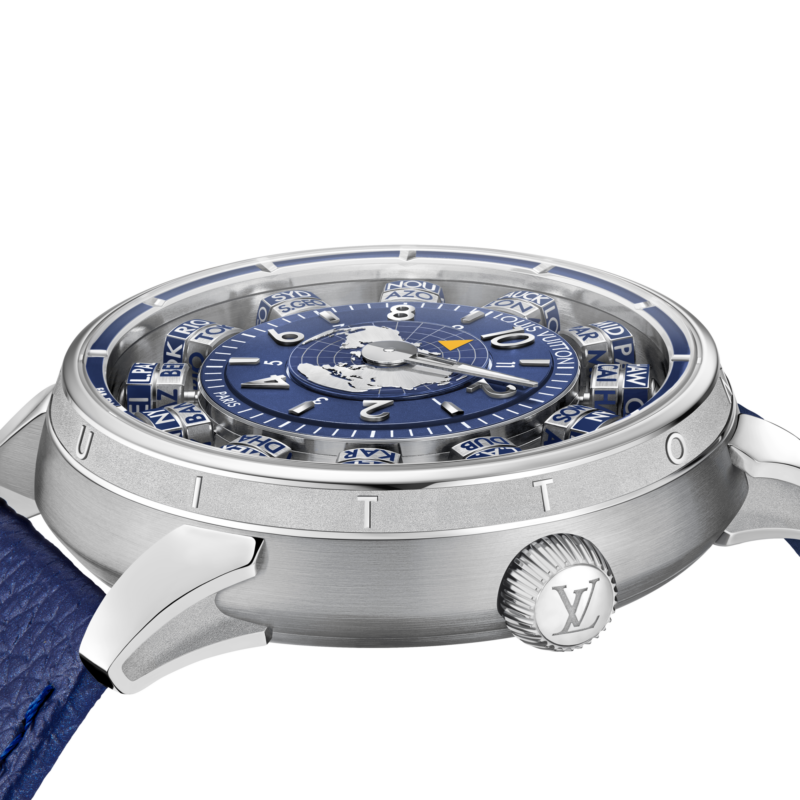
The low-angle view makes each city cube legible as a physical rotating module rather than a printed index. Courtesy of Louis Vuitton.
First, the basic Spin Time only needs to identify one hour
The original Spin Time logic is easier to understand before adding world time.
Louis Vuitton says the display was first introduced in 2009 and was inspired by the mechanical flap boards once common in airports. Instead of using a central hour hand, twelve cubes sit around the dial. One cube is visually active. Every sixty minutes, two actions happen almost together: the cube representing the completed hour returns to its neutral state, while the cube for the new hour rotates to reveal its active face.
Only two cubes need to move because the watch is not animating all twelve positions. It is transferring emphasis from one fixed hour location to the next.
That distinction is important. A jumping-hour watch usually concentrates the jump inside a window or on a disc. Spin Time distributes the jump around the perimeter. The complication therefore has to solve two problems at once. Mechanically, it has to trigger an instantaneous change on schedule. Visually, it has to make the active cube unmistakable among eleven nearly identical objects.
The 2026 Spin Time Green, reference W9WGA2, is the clearest baseline. Its 39.5 mm white-gold case is 12.15 mm thick and rated to 100 metres. Calibre ST13.01 runs at 4 Hz, uses 35 jewels and stores 45 hours of power. Louis Vuitton describes the active hour through a lighter cube while the remaining cubes stay in their neutral positions. A central white-gold hand handles the minutes in the familiar way.
This separation of roles is what makes the system readable. Minutes remain continuous. Hours become events.
Spin Time Air changes the architecture of the display, not its grammar
The Air version makes the same hour logic more exposed.
On the 2026 Spin Time Air Blue, reference W9WG81, the case grows to 42.5 mm and the water-resistance rating falls to 50 metres. The cubes appear to float around the centre rather than sit against a closed dial. Instead of twelve conventional hour numerals, the cubes spell the twelve letters of LOUIS VUITTON. The lighter cube still identifies the active hour.
That could have become a branding exercise at the expense of reading the time. It works because the underlying grammar does not change. Position still corresponds to the hour. Contrast still identifies the active cube. The minute hand still carries the continuous part of the reading.
The Air version therefore demonstrates something useful about the complication. The cubes do not have to carry Arabic numerals to function as an hour display. Their positions can carry the numerical meaning while their surfaces carry something else.
This is the conceptual bridge to the Antipode. Once position and cube face have been separated, the faces can hold city information instead of hour numerals. The same twelve rotating objects can become a world-time interface.
Louis Vuitton’s current Air product page contains one small documentation error worth recording: the case diameter appears once as “42.5.5mm”. The product title, the 2025 family documentation and the other current sources consistently identify the Air case as 42.5 mm. The article therefore uses 42.5 mm and records the extra “.5” as an apparent CMS typo rather than treating it as a conflicting specification.
Calibre ST12.01
The interface becomes architecture.
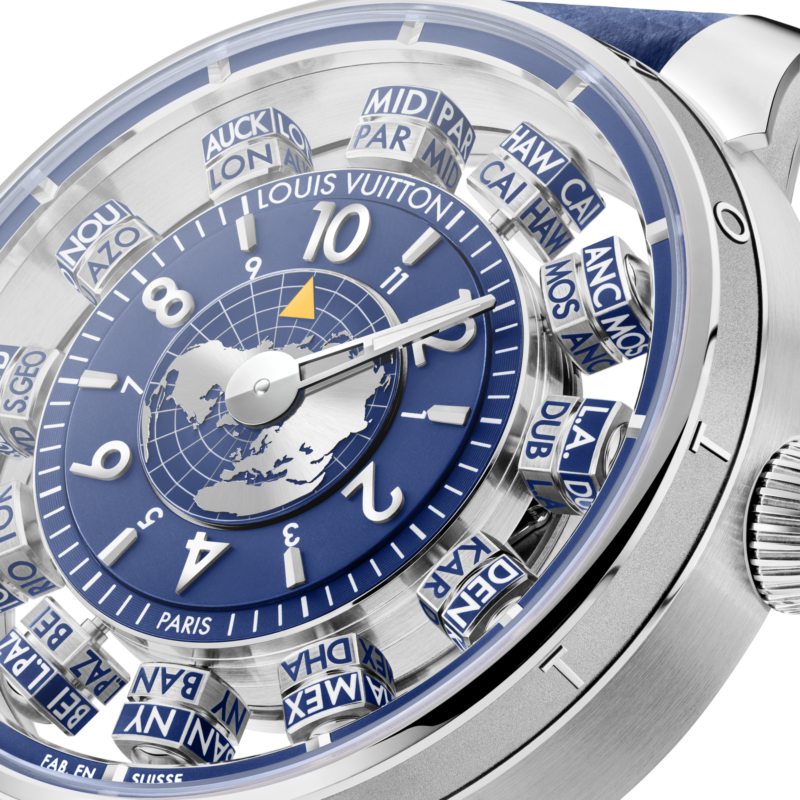
The yellow arrow reads local hours; paired city cubes carry the world-time reference around the perimeter. Courtesy of Louis Vuitton.
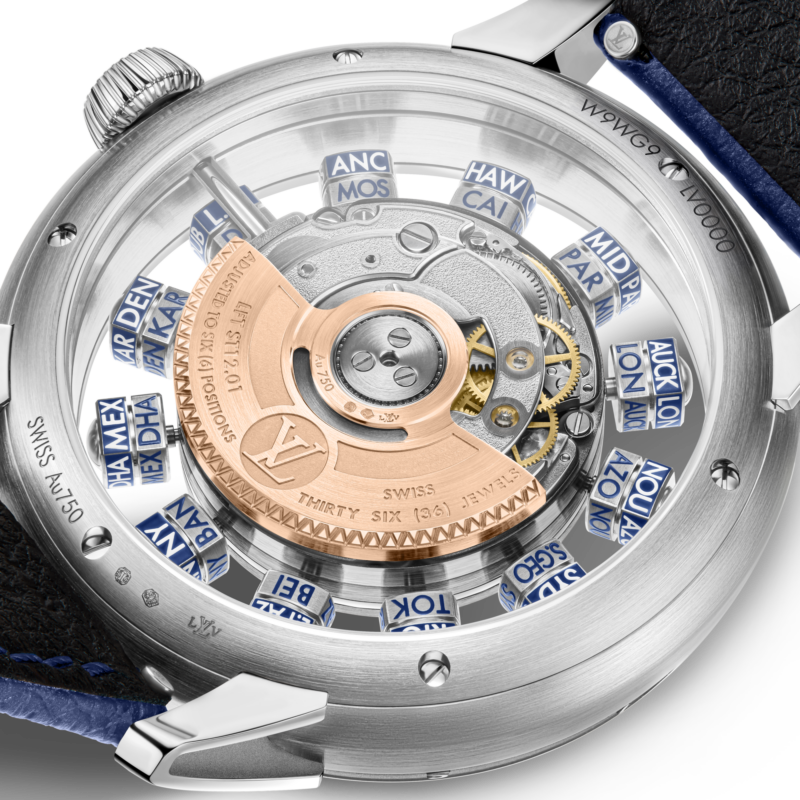
Calibre ST12.01 is visible through the open caseback, framed by the rear of the floating cube system. Courtesy of Louis Vuitton.
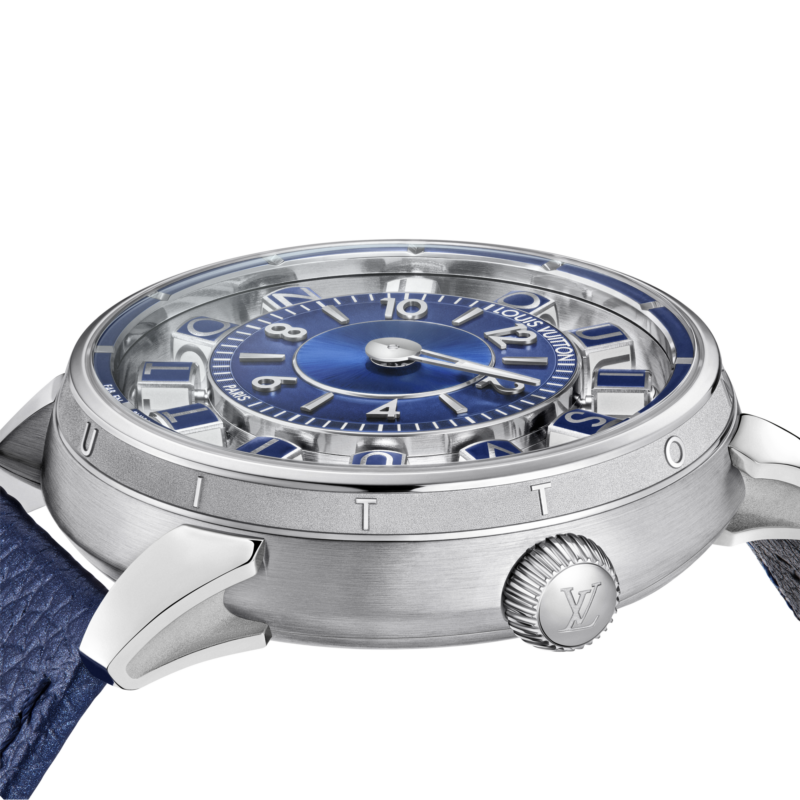
Spin Time Air separates the cubes from the central dial, allowing position and surface information to do different jobs. Courtesy of Louis Vuitton.
Mechanical context
The platform, in two architectures.
Air Antipode
The world-time expression separates local time at the centre from paired city references around the perimeter.
- Case
- 42.5 × 12.45 mm
- Display
- 24 zones / 12 cubes
- Calibre
- ST12.01
- Water resistance
- 50 metres
- Reserve
- 45 hours
Spin Time platform
The permanent family shows how the same cube grammar can carry numerals, letters, city pairs or coexist with a flying tourbillon.
- Case
- 39.5 or 42.5 mm
- Display
- Jumping hour / Air / world time
- Calibre
- ST13.01 / ST12.01 / LFT ST05.01
- Water resistance
- 50 or 100 metres
- Reserve
- 45 hours
The Antipode halves the number of modules by pairing time opposites
The Antipode’s core idea is arithmetic rather than decorative.
A conventional world timer normally associates one city with each of the twenty-four standard hour offsets around a ring. The Spin Time Air Antipode has only twelve cubes. Louis Vuitton resolves that mismatch by assigning two cities to every cube, with the pair separated by twelve hours.
WatchTime gives examples such as Los Angeles and Dubai, New York and Bangkok, and Paris and the Midway Islands. These are best understood as time-zone antipodes, not necessarily geographic antipodes. The term describes their relationship on the clock, not a requirement that the cities sit on opposite points of the globe.
Why does that pairing work? Consider a twelve-hour display. If City A is showing 4 a.m., a city exactly twelve hours away is showing 4 p.m. Both can use the numeral 4. The only missing information is which half of the day applies. Louis Vuitton supplies that second layer through colour. Its official product page states that the cube backgrounds indicate day or night and change every twelve hours.
This creates a two-part code:
- the position around the dial provides the hour value;
- the cube’s city pairing and background state tell the reader which member of the pair is on which side of the day.
The arrangement is efficient because it compresses two zones into one spatial position without pretending they are the same place.
The centre remains dedicated to local time. Louis Vuitton describes a yellow arrow for the local hour and a white-gold minute hand. Beneath them sits a world map made by galvanic growth. The outer cubes then become reference points for the other zones.
The watch is not asking the wearer to read twenty-four miniature clocks. It provides one local clock and twelve paired comparisons.
How to read twenty-four zones without twenty-four hour hands
The easiest way to understand the Antipode is to separate local time from reference time.
Local minutes are conventional. The central minute hand makes one full rotation every hour. The local hour is identified by the yellow arrow against the inner hour scale. That preserves a normal clock at the centre of the watch.
The world-time information lives outside it. Each peripheral cube names two cities. Because those cities are separated by twelve hours, the same numerical hour applies to both on a twelve-hour scale. The cube’s colour state provides the day-night distinction that the shared number cannot.
This is mechanically economical but visually demanding. The system has to maintain the cube choreography while the wearer also reads a central map, an hour scale, a minute track and twelve city pairs. The open Air architecture helps because the cubes are physically separated from the central dial rather than compressed onto one printed surface.
Louis Vuitton also keeps setting centralised. Specialist sources describing the 2026 watch state that the adjustments are handled through the crown. That matters more than it sounds. A world-time watch with multiple independent correctors can become difficult to operate after travel. Here the external interface remains close to that of a conventional watch even though the display around it is anything but conventional.
The result is not minimal. It is, however, logically layered. Local time occupies the centre. World time occupies the perimeter. Twelve-hour equivalence reduces the hardware count. Colour restores the information lost by that reduction.
Day and night solve one ambiguity, but not daylight saving
The cube backgrounds answer a fixed twelve-hour question: which city in this pair is on the opposite half of the day?
They do not answer a changing civil-time question: has one jurisdiction moved its clocks this month?
This is the limitation that a serious account of the Antipode has to keep visible.
Daylight-saving time is not a universal astronomical event. Different jurisdictions start and stop it on different dates. Some never use it. Governments can change the rules. A pair that is twelve hours apart in standard time may temporarily become eleven or thirteen hours apart when only one member changes clocks.
Hodinkee’s 2026 coverage explicitly identifies daylight saving as a weakness of the Antipode concept. That is not a trivial footnote. It defines the boundary between what the mechanism calculates and what the owner still has to know.
This does not make the world-time system false. It makes it mechanical. The watch encodes a fixed relationship between selected zones. Civil-time exceptions have to be corrected or mentally accounted for when local rules diverge from that fixed relationship.
The same distinction applies more broadly to world timers. A mechanical watch can model a map of offsets. It cannot predict future legislation. The Antipode makes that boundary particularly visible because its elegance depends on exact twelve-hour pairing.
This is why the day-night colour system should not be described as an automatic DST solution. It is a twelve-hour state indicator. Those are different things.
ST12.01 carries more than the base Spin Time display
The Antipode has its own calibre designation, ST12.01, and the published specifications differ from the base Spin Time movement.
Louis Vuitton gives ST12.01 a diameter of 34.8 mm and a thickness of 8 mm, compared with 7.7 mm for the ST13.01 used in the Air Blue. It has 36 jewels rather than 35. Both run at 28,800 vibrations per hour and both are rated to 45 hours of power reserve. Both use an 18K pink-gold oscillating weight.
WatchTime reports 271 components for ST12.01 and 246 for ST13.01. Those counts are useful because they show that the Antipode adds genuine mechanical content, but they remain secondary-source figures in the material reviewed for this article. Louis Vuitton’s current product pages publish jewels, dimensions, frequency and reserve, but not the component totals.
The official description is careful in another useful way. It calls the function “World time with Spin Time Air display” rather than implying twenty-four independent movements. That is exactly right. One calibre governs a local clock and a coordinated peripheral reference system.
The movement can be seen through an open caseback. Louis Vuitton’s 2025 collection documentation identifies sandblasted bridges, circular-grained plates, colourless jewels and a pink-gold rotor as the common finishing language of the three movement families. The 2026 Antipode keeps that technical platform while changing the dial and cube treatment to blue.
The other four 2026 watches show how elastic the cube system has become
The permanent collection matters because the same basic device now has to support several very different jobs.
The Green is the clean reference point. Twelve numbered cubes show the jumping hour around a 39.5 mm closed-style dial, with 100 metres of water resistance and calibre ST13.01.
The Air Blue removes the conventional numerical cube faces and lets position plus contrast carry the hour while the cubes spell LOUIS VUITTON. The case grows to 42.5 mm and water resistance becomes 50 metres.
The Australian Opal execution pushes the 39.5 mm architecture toward high jewellery. Specialist reporting identifies a rose-gold case, Australian opal and baguette-set sapphires and diamonds. Because a current official product page for reference W9PG42 was not surfaced in the reviewed Louis Vuitton pages, exact stone weights and setting totals remain secondary-source data and are not used here as primary facts.
The Air Antipode assigns the cubes an entirely different role. They stop being the local hour display and become world-time modules, while the local time moves to the centre.
The platinum Flying Tourbillon, reference W9PT21, then adds a central flying tourbillon shaped as a Monogram flower. Louis Vuitton states that it completes one revolution every sixty seconds. Calibre LFT ST05.01 measures 34.8 mm by 9.42 mm, uses 40 jewels, runs at 4 Hz and retains the same 45-hour reserve. The case remains 42.5 mm by 12.45 mm and is rated to 50 metres.
These watches are visually very different, but the interesting continuity is the display architecture. The cubes are no longer a single complication with a single visual treatment. They have become a language that can carry numerals, letters, city pairs or share the dial with a tourbillon without losing the original hourly jump.
What actually changed in 2026
The most important 2026 change is not that Louis Vuitton discovered a new way to rotate a cube. The mechanism’s lineage goes back to 2009, and the current in-house movement architecture was introduced in 2025.
What changed is the status and range of the system.
The 2025 Tambour Taiko Spin Time family was a limited-edition statement in one tightly controlled dolphin-grey palette. The 2026 set turns the architecture into an ongoing collection and makes its internal hierarchy easier to read. Green explains the base complication. Air Blue explains the floating construction. Antipode shows how the cubes can become a world-time data structure. The opal model tests the same case against hardstone and gem setting. The flying tourbillon adds a second kinetic system at the centre.
That is more consequential than a seasonal colour update because it reveals what La Fabrique du Temps believes is durable about the design.
The durable element is not the blue, green or salmon dial. It is the rule that twelve peripheral objects can change meaning while their mechanical choreography remains recognisable.
The Antipode is the clearest proof. Twelve cubes become twenty-four zones because the watch pairs cities twelve hours apart and uses day-night state to restore the information lost by sharing one hour number. It is an efficient piece of mechanical encoding.
It is also incomplete in exactly the way a mechanical world timer should be expected to be incomplete. Daylight-saving legislation can break the fixed offset. The owner still has to understand the world outside the case.
That boundary does not diminish the complication. It explains it. Louis Vuitton has not put twenty-four clocks around the dial. It has found a way to make twelve cubes carry twenty-four references, then left the political part of time where it belongs: outside the movement.
Sources & credits
Sources & methodology
- Louis Vuitton, Tambour Spin Time Air Antipode W9WG91, checked 21 September 2026.
- Louis Vuitton, High Watchmaking: Spin Time, used for the 2009 origin and 2025 platform context.
- Louis Vuitton, La Fabrique du Temps, used for manufacture context.
- TheTimeo distinguishes official specifications from editorial interpretation and does not claim hands-on inspection.
The Edit
Stories selected by TheTimeo
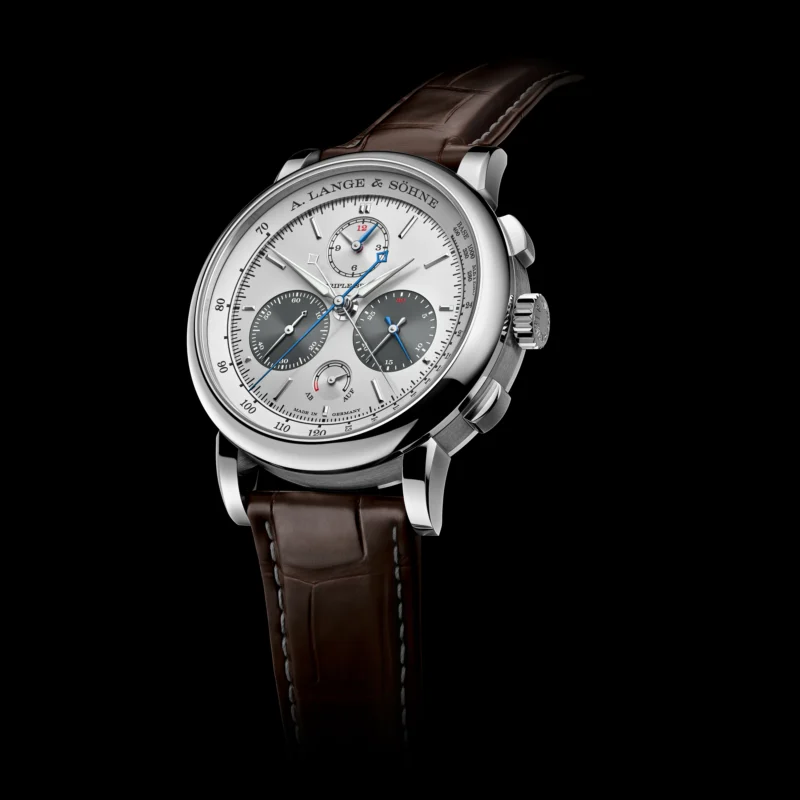
A. Lange & Söhne Triple Split: Why Twelve Hours Changes a Rattrapante
Seconds sweep, minutes jump and hours advance continuously. Calibre L132.1 must hold all three
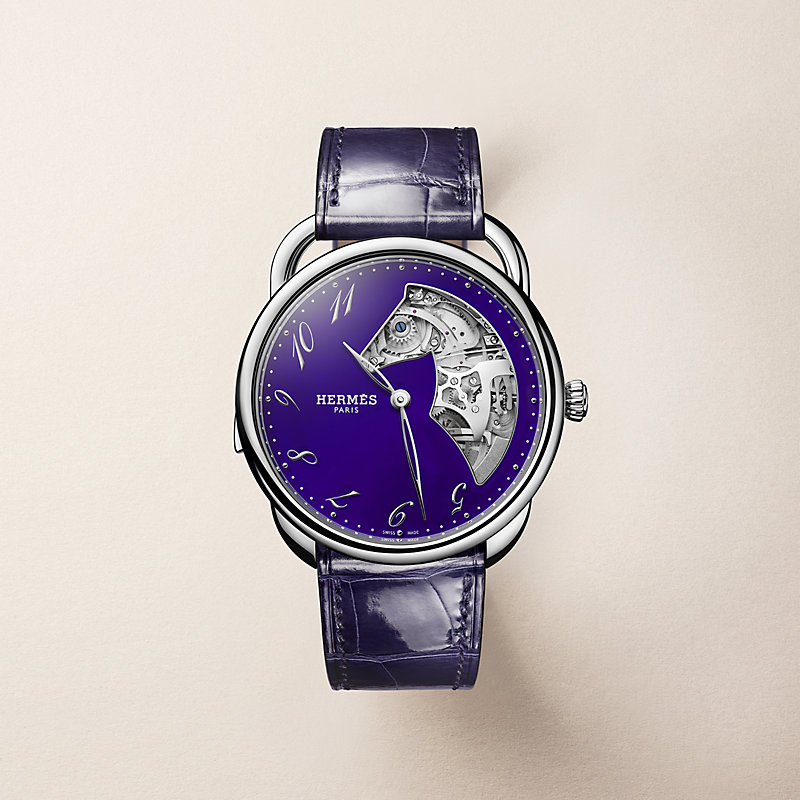
A Horse in Crystal: Hermès Arceau Samarcande
On the Arceau Samarcande W408546WW00, Hermès cuts a horse into a Saint-Louis crystal dial
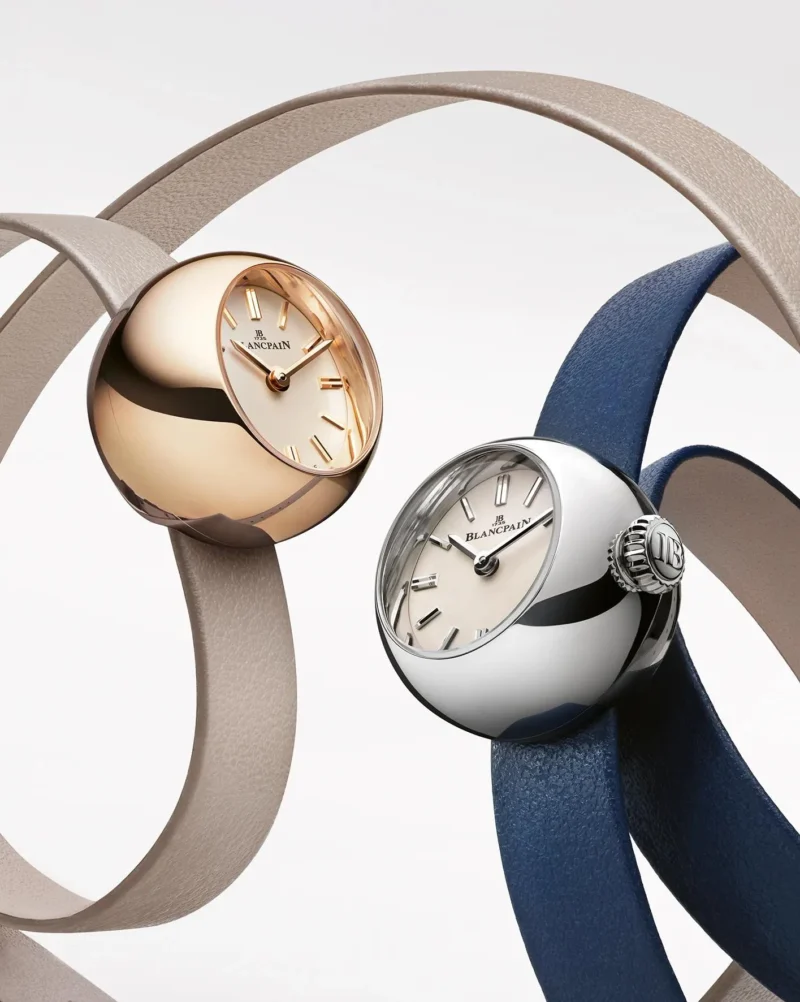
Blancpain Lady B: What Does 19 Millimetres Require?
Blancpain’s 19 mm Lady B is best understood as an exercise in mechanical volume:
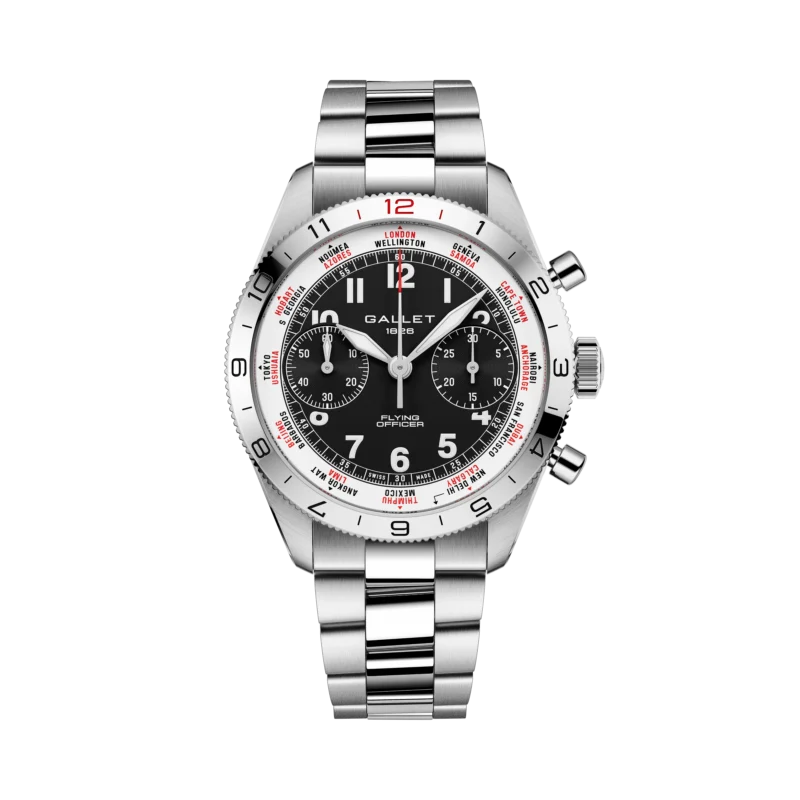
When Is a Revived Watch Brand Still the Same Brand? Testing the New Gallet Against the Archive
The archive is real and the manufacturing system is new. We test Flying Officer,
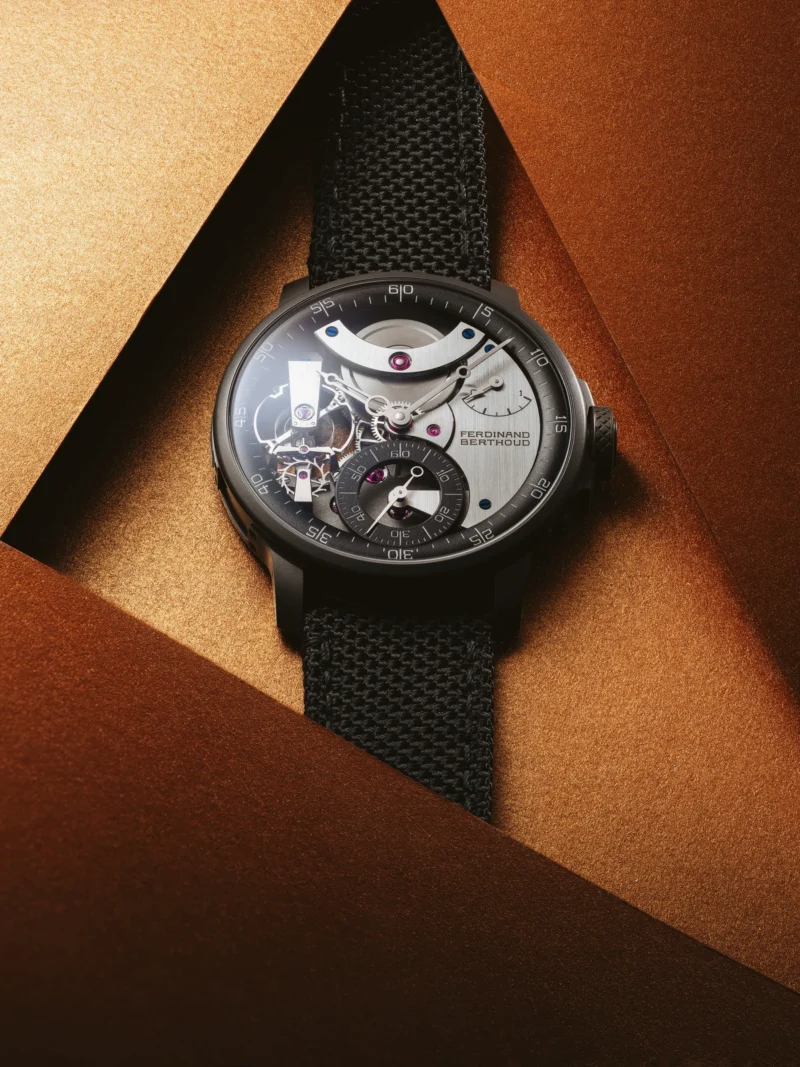
Ferdinand Berthoud FB 3SPC.4-1: Why Bend a Balance Spring into a Cylinder?
The black titanium case is new. The harder achievement is regulating a cylindrical spring
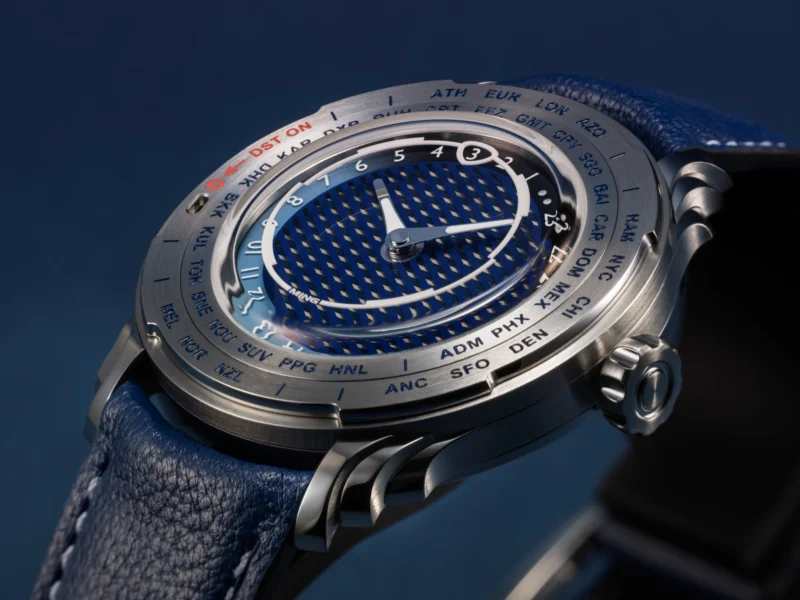
MING 57.05 Comet: The One-Click DST Fix and the Time-Zone Problem It Cannot Fully Solve
One click moves DST-observing cities by an hour. The harder problem is that civil-time