
TheTimeo / Watches
Reverso Pegasus:
A world,
inside the case.
Carved gold, blue lacquer and an open movement give the Reverso Pegasus three ways to draw the eye. The closer view begins where the case turns and the surfaces change.
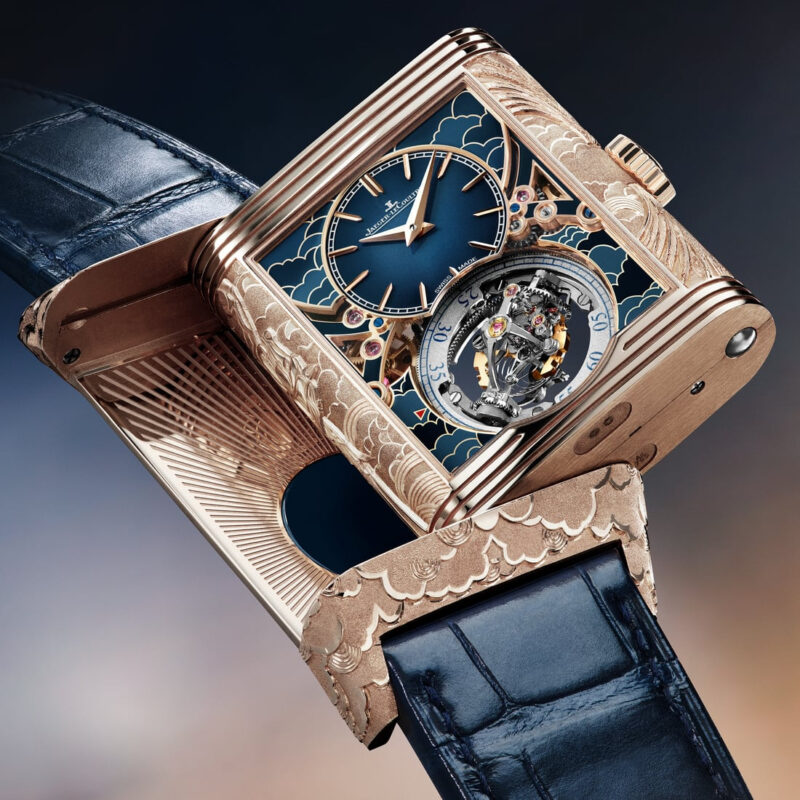
Reverso Pegasus Q39424E5 with the case open, in the house’s design sequence. Courtesy of Jaeger-LeCoultre.
Explore the story
Blue lacquer makes the first impression, but the gold around it holds another picture. On Jaeger-LeCoultre’s Reverso Hybris Artistica Calibre 179 Pegasus, engraved clouds move around the case while an opening reveals the Gyrotourbillon. The closer view begins with the meeting of those two worlds: a surface to look at and a mechanism to look into.
Two faces around one opening
01 / 02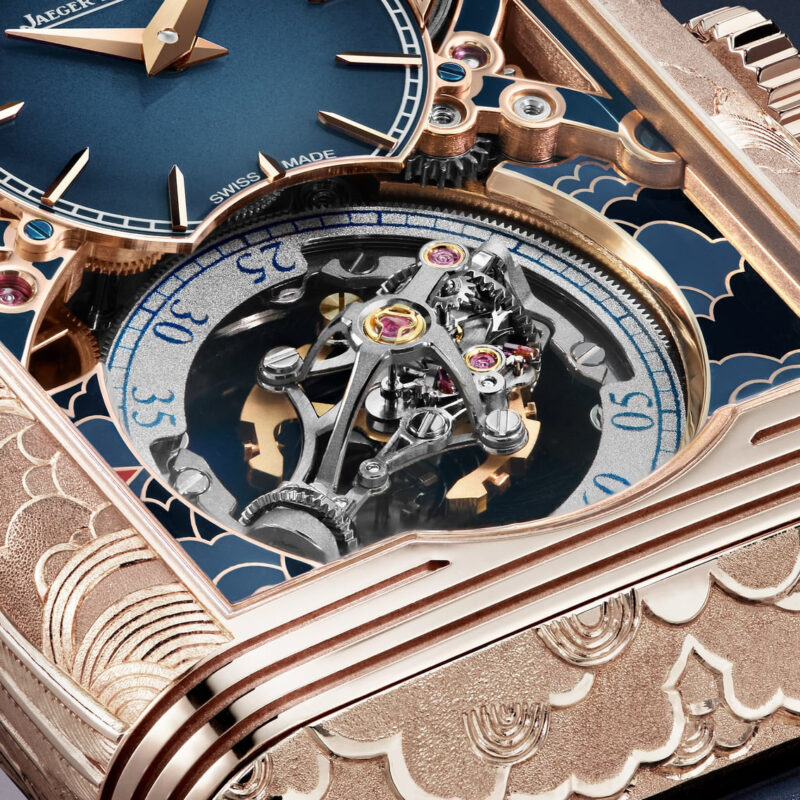
Blue lacquer, cloud outlines and the Gyrotourbillon opening on the front. Source detail frame. Courtesy of Jaeger-LeCoultre.
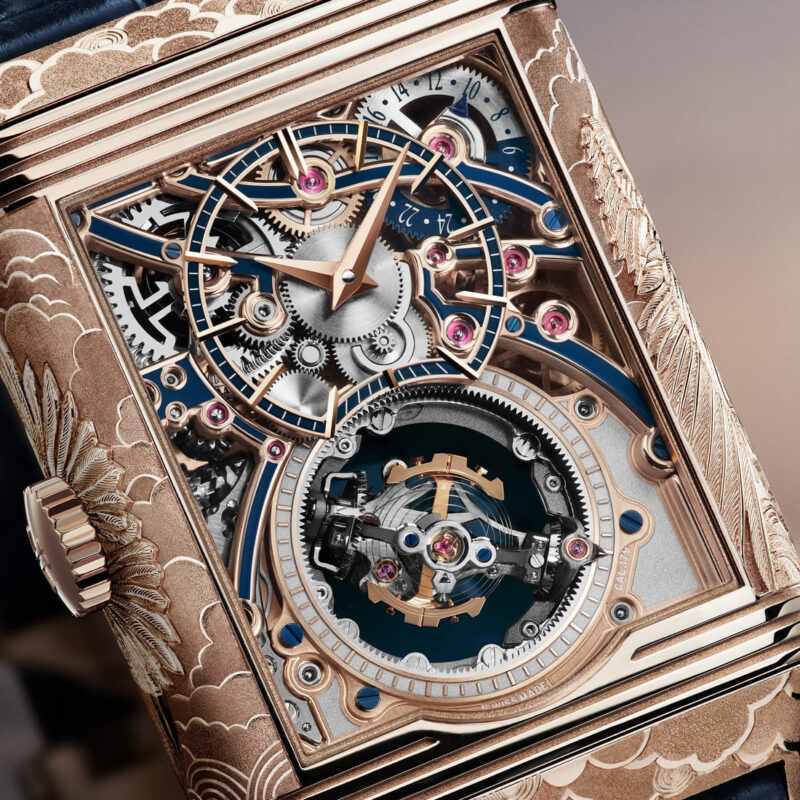
The skeletonised reverse, in the official design sequence. Source detail frame. Courtesy of Jaeger-LeCoultre.
The front has a particularly rich contrast between blue and gold. Fine golden outlines divide the lacquer into cloud-like shapes, while a clearer circular area carries the time display. Lower down, the Gyrotourbillon occupies a large opening. Its visible structure introduces a different kind of detail within a dial that already has plenty to hold the eye.
The reverse changes the balance. Much of the surface has been opened, making the movement and the spaces between its parts more prominent. The time display sits within that structure rather than covering it with a conventional full dial. Warm metal, blue accents and small bright edges become connected parts of the same view.
It is worth looking at the two faces before trying to follow every component. On the front, the lacquer gives the picture a more continuous field of colour. On the reverse, the spaces within the construction interrupt that field. One face gathers the details into a decorated surface; the other lets the eye travel more deeply through the movement.
The lower opening gives both views a point of connection. Jaeger-LeCoultre’s Gyrotourbillon turns on two axes, and its structure can be seen from either side. The still images cannot reproduce that motion, but they show how much of the visual composition is organised around the space it occupies.
The exact reference is Q39424E5, with a manually wound Calibre 179. Its Duoface arrangement displays a different time zone on each side, with a 24-hour indication on the reverse. That function gives the two faces a practical distinction alongside their contrasting appearance. Turning the case changes both what the owner sees and the time display available to read.
Two surfaces, two kinds of work
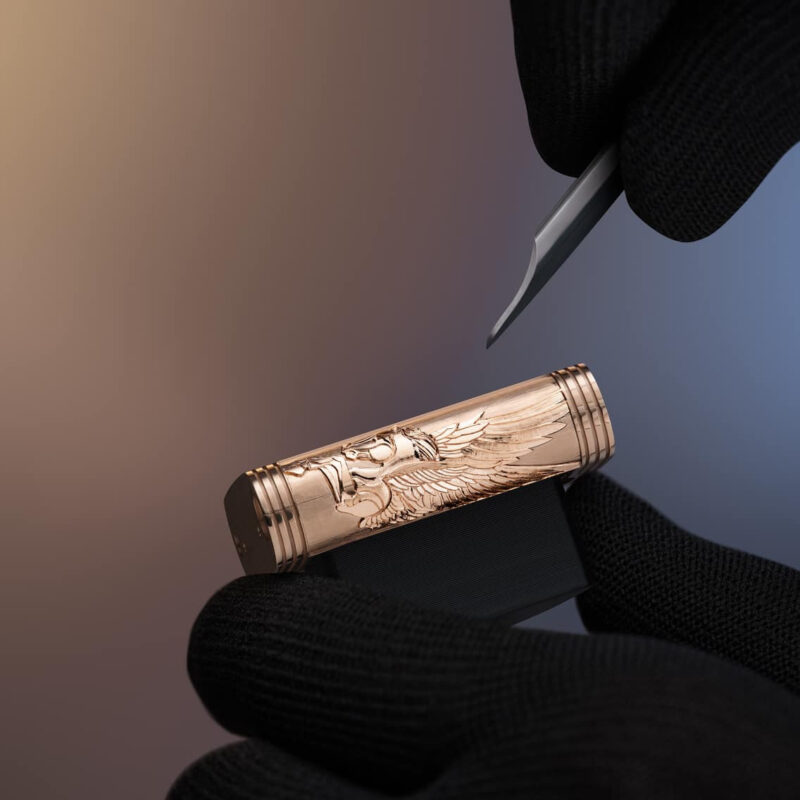
Engraving the case-side motif, in the house’s Pegasus craftsmanship images. Courtesy of Jaeger-LeCoultre.
The engraving photograph brings the case side close enough to become a small sculptural surface. A gloved hand supports the gold beneath a fine tool; the relief catches light along raised edges while deeper areas remain darker. Jaeger-LeCoultre describes Pegasus against a background of clouds, extending around the curved case. The house assigns 180 hours to the engraving of each watch. The photograph makes a more immediate point: decoration has to remain convincing as the surface curves away, with the image carried through a narrow area of metal rather than placed on a flat panel.
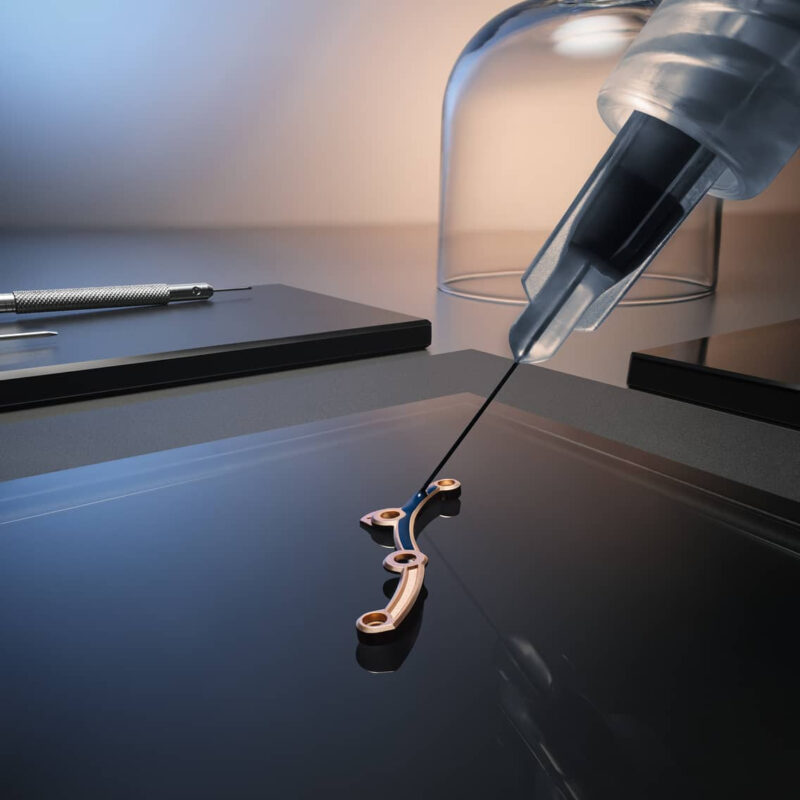
A bridge in the lacquering sequence shown on the exact Pegasus product page. Courtesy of Jaeger-LeCoultre.
In the lacquering image, attention moves to a much smaller open-worked component on the work surface. A fine applicator is positioned above it, and the contrast between the tool and the narrow gold form makes the scale of the work apparent. The official account describes blue lacquer filling more than 50 recesses in the dial plates, with the cloud outlines left visible. This is one stage in the house’s illustrated account, rather than a photograph of the entire dial being completed. Seen beside the engraving, it shows two different relationships with the surface: shaping metal into relief and introducing colour within a prepared structure.
The distinction matters in the finished watch. The engraved case changes through shadow and reflection; the lacquer introduces a denser field of blue. Neither effect is simply applied as a decorative border around the mechanism. Both help determine how the case, dial and exposed movement can be read together.
The space inside the rectangle
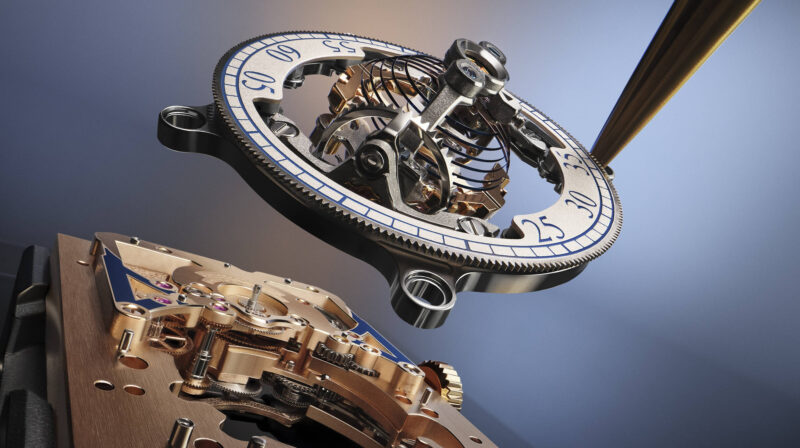
The house’s close construction visual for Calibre 179. An explanatory construction image, not a record of a TheTimeo workshop visit. Courtesy of Jaeger-LeCoultre.
The house’s close construction view gives the mechanism a different scale. Components that sit close together in the watch are separated in the visual, making the relationship between the open display, the tourbillon structure and the surrounding gold easier to follow. It is an explanatory image, rather than a record of a watch being taken apart in front of TheTimeo.
That distinction allows the visual to do its proper work. The complete watch establishes the outline; the separated construction reveals why the apparent opening is such a busy place. A large number of small parts must occupy a defined volume, with enough space for the mechanism to function and remain visible from two sides.
The rectangular Reverso case gives this complexity a strong outer boundary. Its straight lines and repeated horizontal gadroons provide a relatively calm frame around the curved shapes, engraving and exposed components. The contrast is especially clear in the image of the case swung open above the strap: a precise outer architecture holding a much less regular inner picture.
This version uses 18-carat pink gold and blue alligator leather. The colour relationship continues from case to movement details, then into the darker strap. It helps the many surfaces remain part of a coherent object, even when the case is turned and a different arrangement comes into view.
Jaeger-LeCoultre introduced Pegasus as an edition of five pieces in 2026. The number describes the edition, rather than current availability. For an understanding of the design, the more useful sequence is visual: the complete case, the two faces, the work on the surfaces and finally the space that the mechanism requires inside them.
Two kinds of attention
Reading the time
The time displays remain recognisable within the detail. Hands and hour markers establish a smaller, ordered picture inside each face, and the Duoface function gives the reverse a different time zone. The official power reserve is 40 hours. These are practical characteristics of the hand-wound watch; they sit alongside the visual spectacle without providing evidence of a personal wearing or timing test.
Looking through the case
The other pleasure asks for more time. Follow the cloud outlines, then the engraved relief, then the fine edges within the open movement. Each changes the scale of the view. The watch does not depend on one single decorative image, even though Pegasus gives it a name. Its character comes from the way several different kinds of work can remain legible inside the same strongly drawn rectangle.
Sources & further reading
The Edit
Watches stories
Selected stories from the same editorial universe.
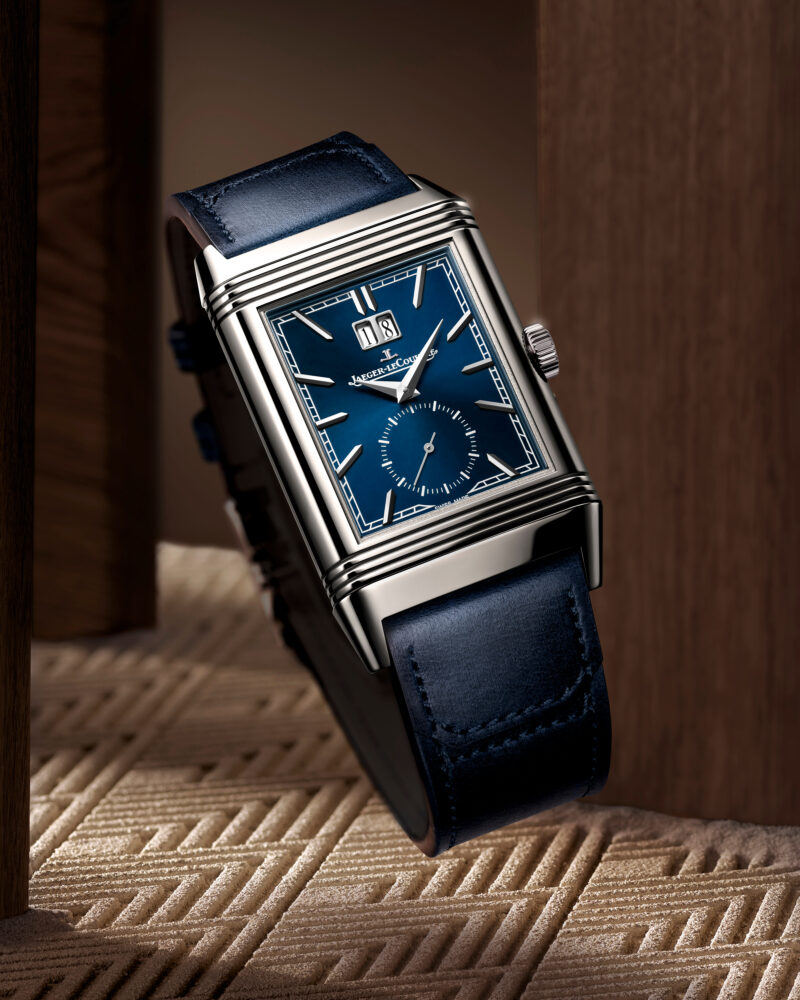
Reverso Tribute Geographic: A World Behind the Dial
A blue dial keeps the first impression quiet. Turn the Reverso Tribute Geographic and
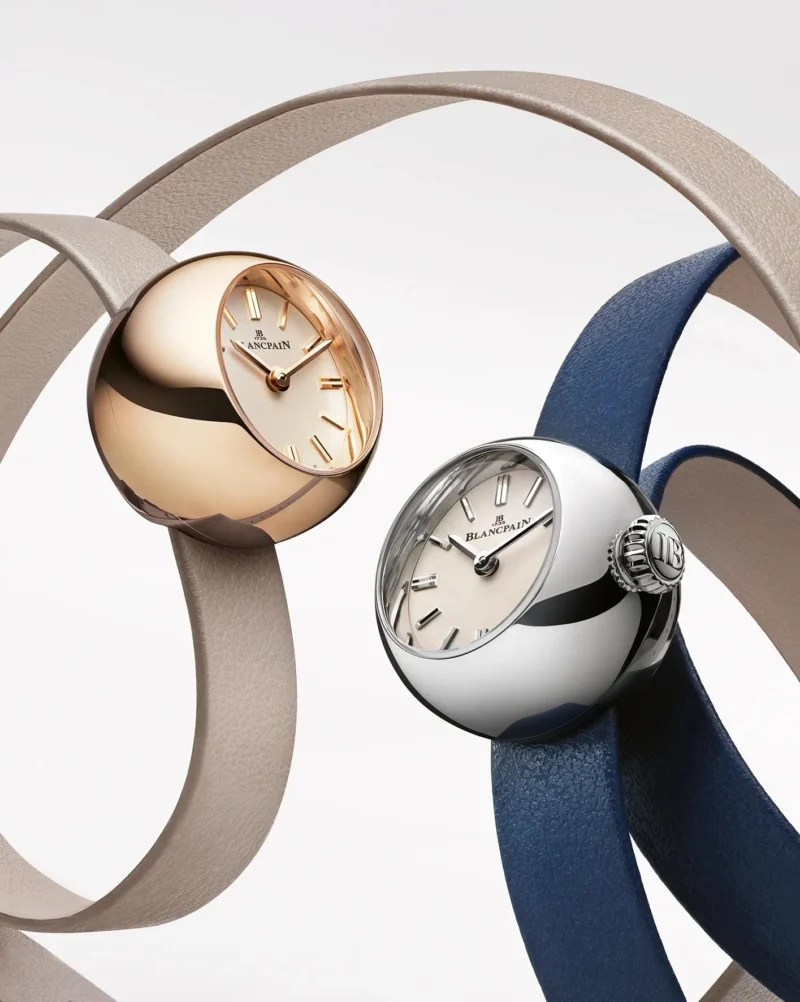
Blancpain Lady B: What Does 19 Millimetres Require?
Blancpain’s 19 mm Lady B is best understood as an exercise in mechanical volume:
Rolex Perpetual Padellone: How an Annual Calendar Makes Three Displays Jump at Midnight
At midnight, Rolex’s new annual calendar has to identify a short month, skip a
A. Lange & Söhne Triple Split: Why Twelve Hours Changes a Rattrapante
Seconds sweep, minutes jump and hours advance continuously. Calibre L132.1 must hold all three
Zenith Chronomaster Solo Sport: What Is El Primero Without a Chronograph?
Zenith removes the pushers and counters from Chronomaster but keeps El Primero at 5
Audemars Piguet Neo Frame Jumping Hour: Why the New Calibre Matters More Than the Vintage Shape
Audemars Piguet returns to a two-window jumping-hour format from the late 1920s, reversing its