
TheTimeo / Watches
A world
within
a turn.
A blue dial keeps the first impression quiet. Turn the Reverso Tribute Geographic and a miniature map opens a different scale of time: cities, oceans and the hours that connect them.
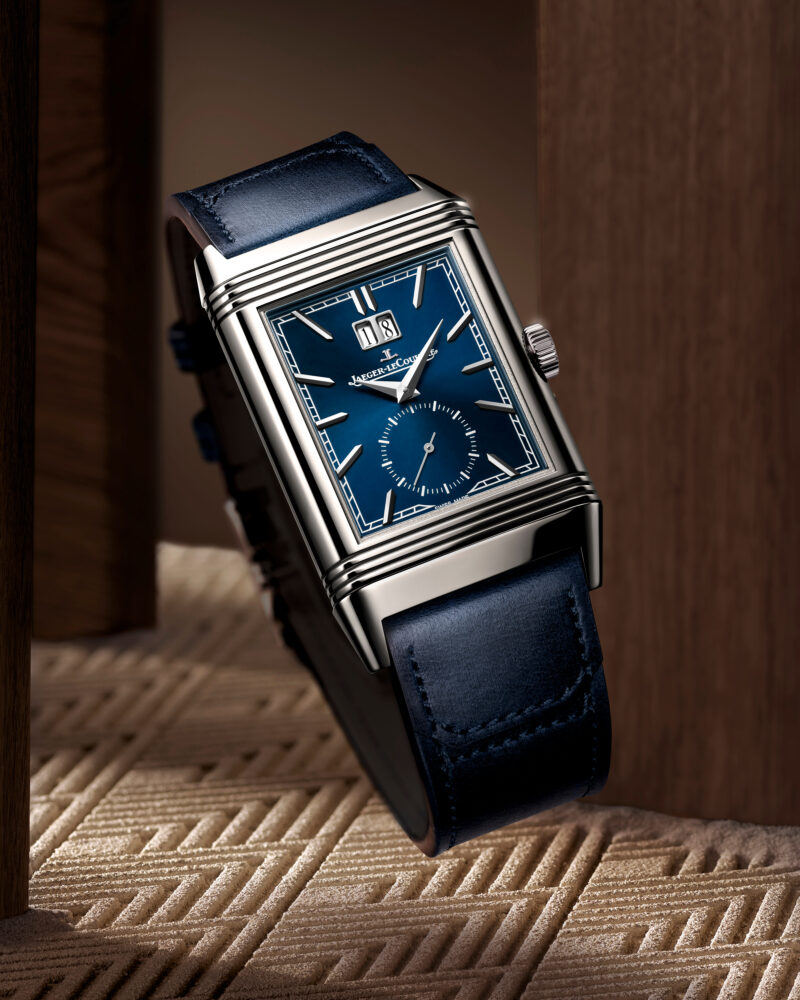
Steel Q714845J, with its blue front dial and large date. Official photograph; courtesy of Jaeger-LeCoultre.
Explore the story
A rectangle of blue sits between polished steel borders. The large date is high on the dial; small seconds occupies a circle below. At first, the Reverso Tribute Geographic offers an orderly, almost private account of the day. Turn its case and the scale changes. A map appears, surrounded by hours and cities. The watch moves from the time immediately in front of you to the time being lived elsewhere.
Introduced in 2025, this Reverso makes its second face useful without asking the first to become crowded. The pleasure lies in that separation: one side for the glance, another for the longer look.
Turn the rectangle
01 / 03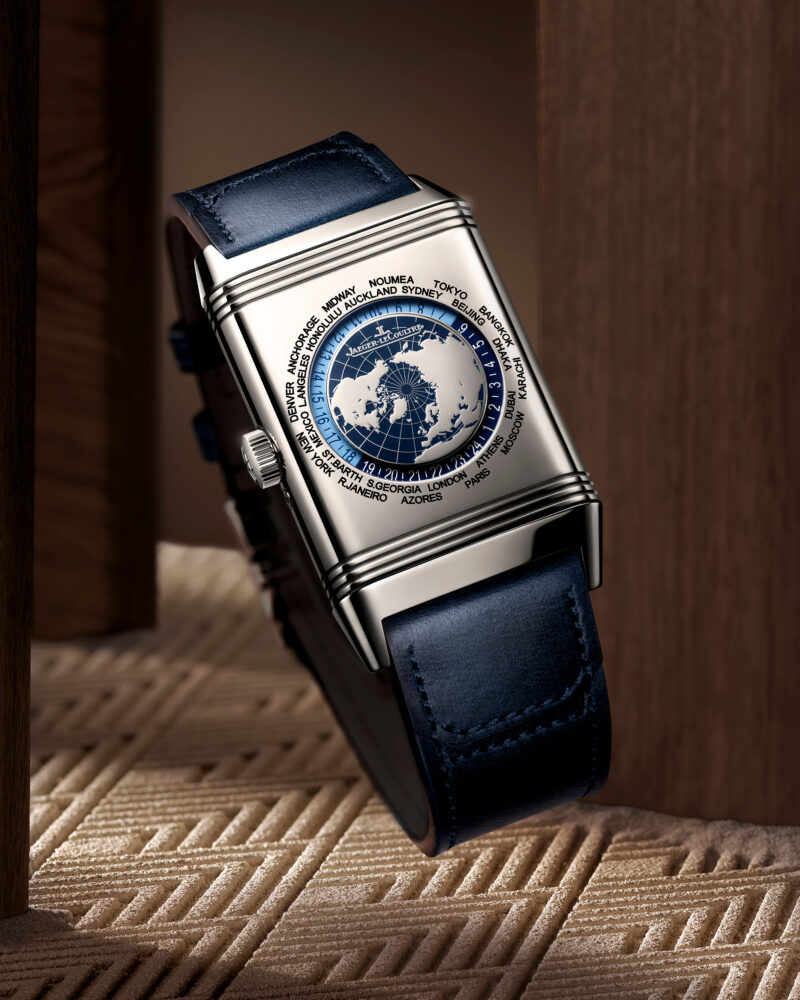
The same steel reference turned to its world-time face. Courtesy of Jaeger-LeCoultre.
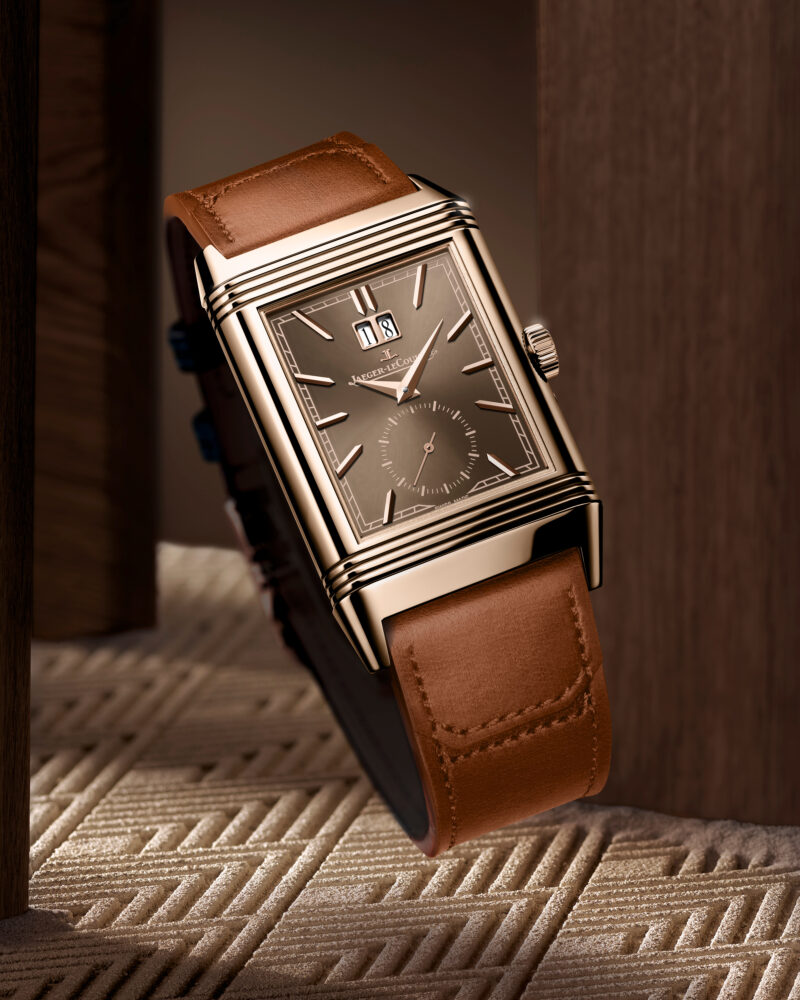
Pink-gold Q714256J: the front face, with chocolate-brown sunray dial. Courtesy of Jaeger-LeCoultre.
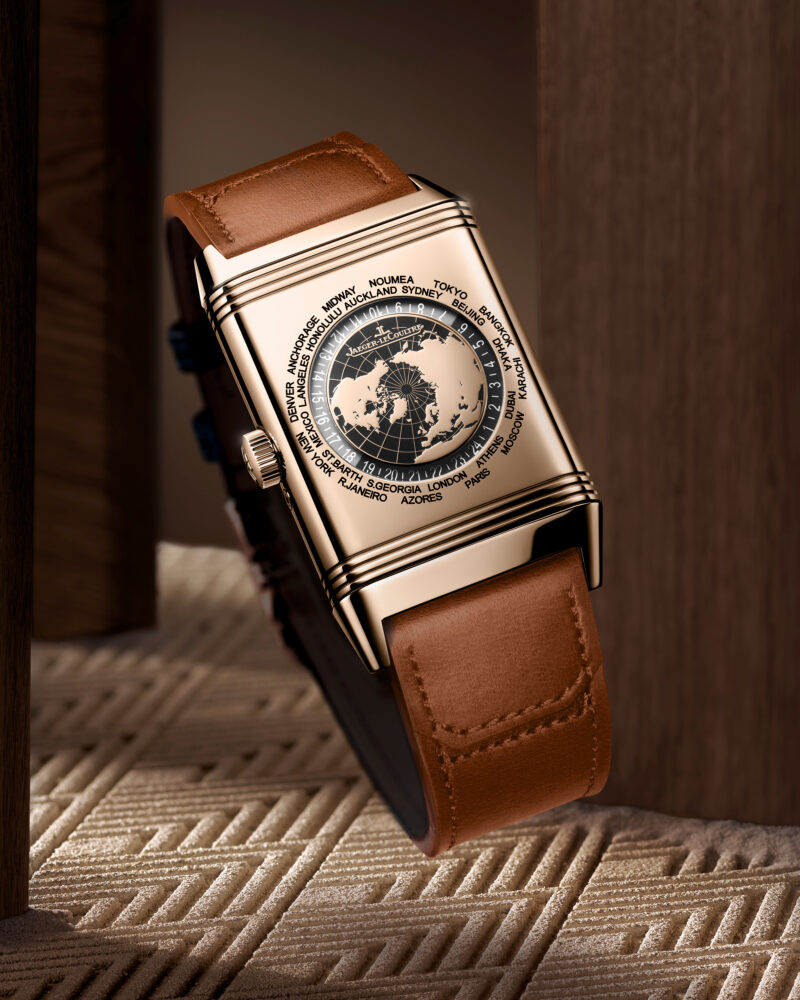
The reverse of Q714256J; the 2025 release specifies a limited edition of 150. Courtesy of Jaeger-LeCoultre.
The steel reference, Q714845J, begins with blue. Sunray finishing gives the front dial a different visual register from the reverse, where blue fills the oceans of a miniature map. The two faces belong together through colour, although their geometries are quite different. Straight hour markers and a rectangular date frame organise the front. Circles take over at the back.
The pink-gold Q714256J changes the temperature of the design. A chocolate-brown dial sits within a warmer case; the reverse exchanges blue oceans for a darker map. Jaeger-LeCoultre’s original release specifies 150 examples of this gold version. More interesting for the eye is how little the architecture needs to change. The same rectangle holds two very different palettes.
Look at the horizontal lines at either end of the case as you move between the photographs. They give both faces a common boundary. Inside it, the Geographic can alternate between the calm of an ordinary time display and the density of a world timer. The case does the work of making those two characters feel like one object.
The cities stay still
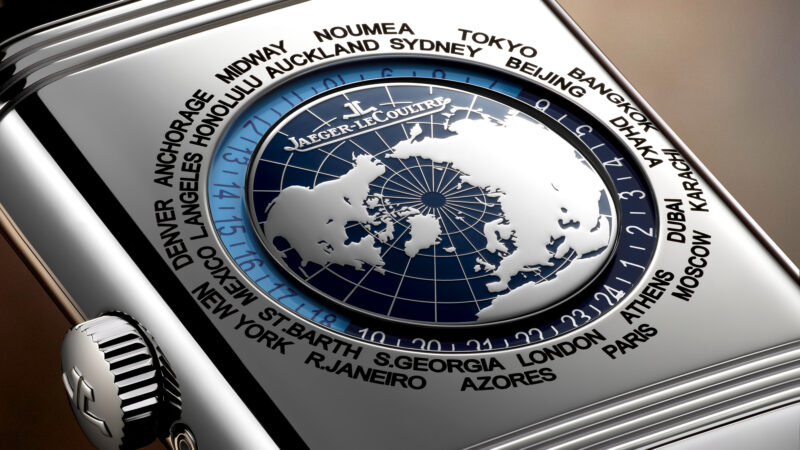
Three layers to read: fixed city names, rotating hour ring and central map. Courtesy of Jaeger-LeCoultre.
On the reverse, the city names are engraved into the caseback. They remain fixed while a 24-hour ring turns inside them. The central map supplies a geographical image; the ring and city scale supply the time reading. Each has a separate job, which makes the layered construction worth studying slowly.
This distinction is useful when approaching the watch for the first time. Start with the familiar city names, then follow the adjacent hour scale. Notice the different light and dark portions that distinguish day from night. The display brings distant hours into one field of view without putting another set of hands on the front dial.
Jaeger-LeCoultre places the setting pusher at the top of the case, concealed when it is seated in its cradle. The release describes correction in one-hour steps. That hidden location keeps an additional control out of the frontal composition. It also makes the turn of the case part of using the complication: revealing the second face reveals the means of adjusting it.
An ocean, applied by hand
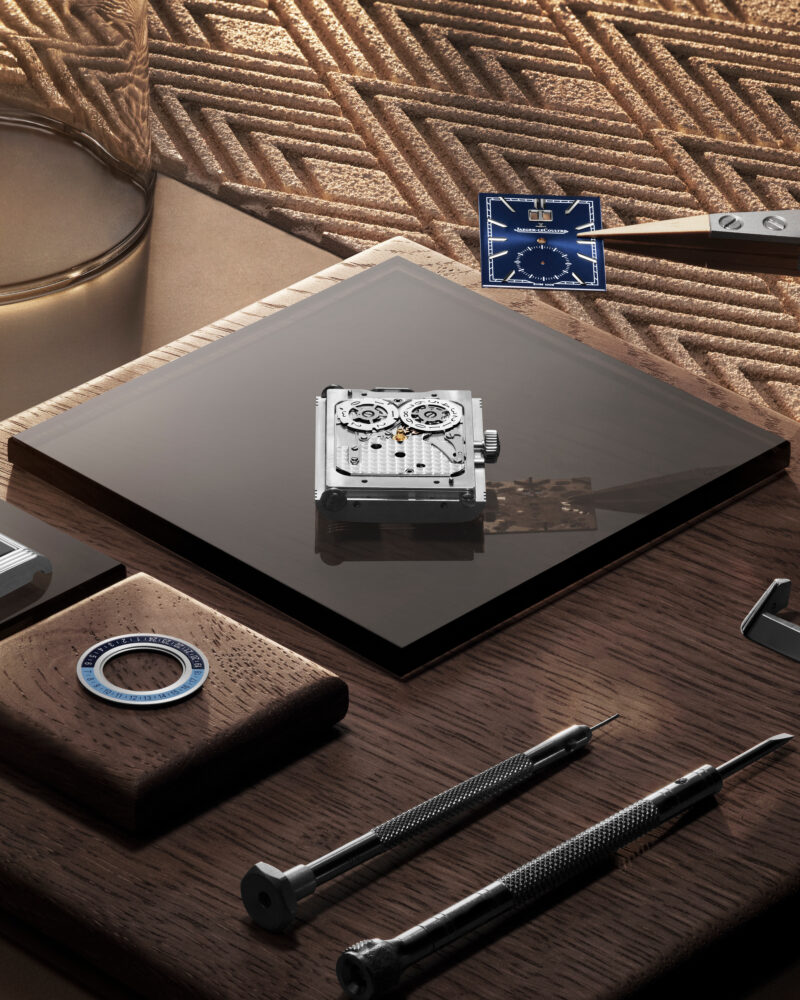
The manufacture’s component study for the Reverso Tribute Geographic. Official staged workshop photograph; courtesy of Jaeger-LeCoultre.
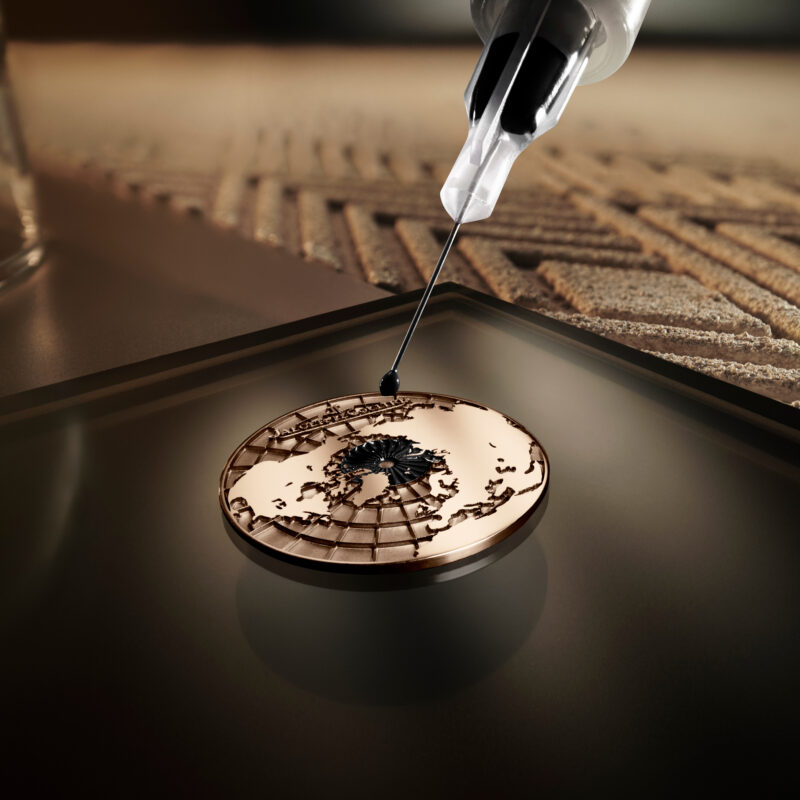
The maison illustrates the hand application of lacquer to the hollowed map disc. Courtesy of Jaeger-LeCoultre.
The map begins as a steel disc. Jaeger-LeCoultre describes laser-hollowing the areas that will become oceans, leaving land masses and meridian lines raised. The 141 hollows are filled with lacquer by hand, using a syringe to place small, controlled drops. Subsequent polishing brings metal and lacquer into a finished surface.
Those details explain the map’s character more clearly than the word decoration could. The blue is held within a network of metal edges. At this scale, the boundary between an ocean and a continent becomes a working edge for the craftsperson. The finished image is both a recognisable world and a pattern of differently reflecting surfaces.
The workshop photographs offer another change of scale. A shaped movement, a dial and separate circular elements are laid out as components; the assembled watch returns them to the small rectangle worn on the wrist. The maison’s photographs document its presentation of the process. They also invite a useful comparison: look at a loose disc, then return to the reverse and find the same shape within the complete display.
Two ways of making room
Space for a date
The Grande Date uses two discs placed beside one another. Jaeger-LeCoultre describes a small hook that allows the units disc to engage its neighbour as the date moves into double figures. Both digits appear on the same plane. It is a mechanical response to a visual problem: giving a large date a balanced place inside a narrow rectangular dial.
Space for a world
The manually wound Calibre 834 integrates the world-time function and the date. The manufacture specifies 209 components and a 42-hour power reserve. Rather than adding every indication to one face, the Reverso’s construction distributes them across two. The result can be understood before its mechanism is understood: the front has room to remain restrained because the reverse carries the geographical display.
Bring the world back to the wrist
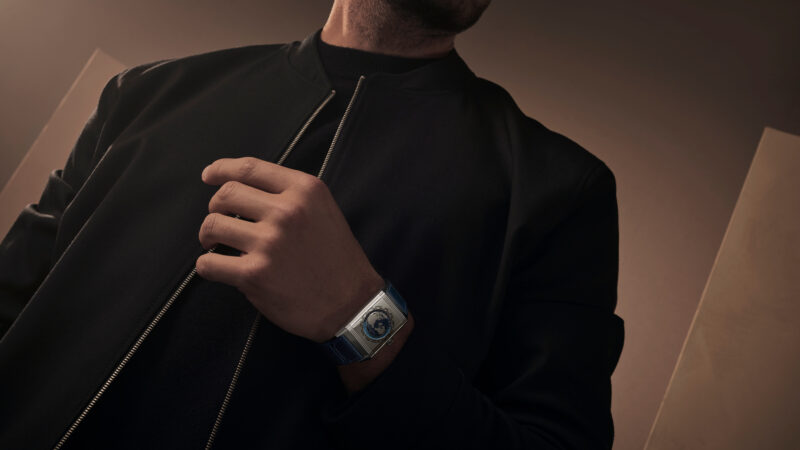
Steel Q714845J on the wrist, in the maison’s official worn photograph. Courtesy of Jaeger-LeCoultre.
The worn photograph restores the watch to a different kind of proportion. Details that filled the screen become a small blue face against a dark sleeve. The case’s straight edges remain clear, while the strap takes the rectangle into the curve of the wrist.
The published dimensions are 49.4 by 29.9 millimetres, with a thickness of 11.14 millimetres. A rectangle asks to be considered in both directions. Its length, the position of the strap and the space available above and below the wrist all contribute to the impression. A fitting is the place to judge those relationships and the action of turning the case; a photograph offers a starting point rather than a wearing test.
On the steel version, the original specification pairs the watch with two Casa Fagliano Design straps: blue calfskin and a blue canvas-and-calfskin combination. Their different surfaces suggest two ways to soften the polished case while keeping the same colour running through the whole object.
A different sense of distance
The Geographic’s most engaging idea is the interval between its faces. The front lets the day remain close and legible. The reverse makes room for elsewhere: another city, another hour, another person’s part of the day. The change happens through a small physical gesture, rather than a more crowded dial. That is a persuasive use of the Reverso’s oldest idea. Turning the watch still changes what it can be.
Sources & further reading
The Edit
Watches stories
Selected stories from the same editorial universe.
Reverso Pegasus: A World Carved Around the Movement
Carved gold, blue lacquer and an open movement give the Reverso Pegasus three ways
Parmigiani Toric Anniversary: A Perpetual Calendar in Peony Gold
A hand-hammered peony dial gives Parmigiani Fleurier’s anniversary perpetual calendar its first impression. Turn
Grand Seiko SLGB015: Lake Suwa in a Smaller Frame
A blue surface catches the light inside a 37mm steel case. Grand Seiko’s SLGB015
A Horse in Crystal: Hermès Arceau Samarcande
On the Arceau Samarcande W408546WW00, Hermès cuts a horse into a Saint-Louis crystal dial
Blancpain Lady B: What Does 19 Millimetres Require?
Blancpain’s 19 mm Lady B is best understood as an exercise in mechanical volume:
When Is a Revived Watch Brand Still the Same Brand? Testing the New Gallet Against the Archive
The archive is real and the manufacturing system is new. We test Flying Officer,