
TheTimeo / Watches
A TOURBILLON,
held inside ten millimetres
The tourbillon is the spectacle; the micro-rotor is the engineering decision that lets Girard-Perregaux keep the new Laureato at 39 mm by 10 mm.
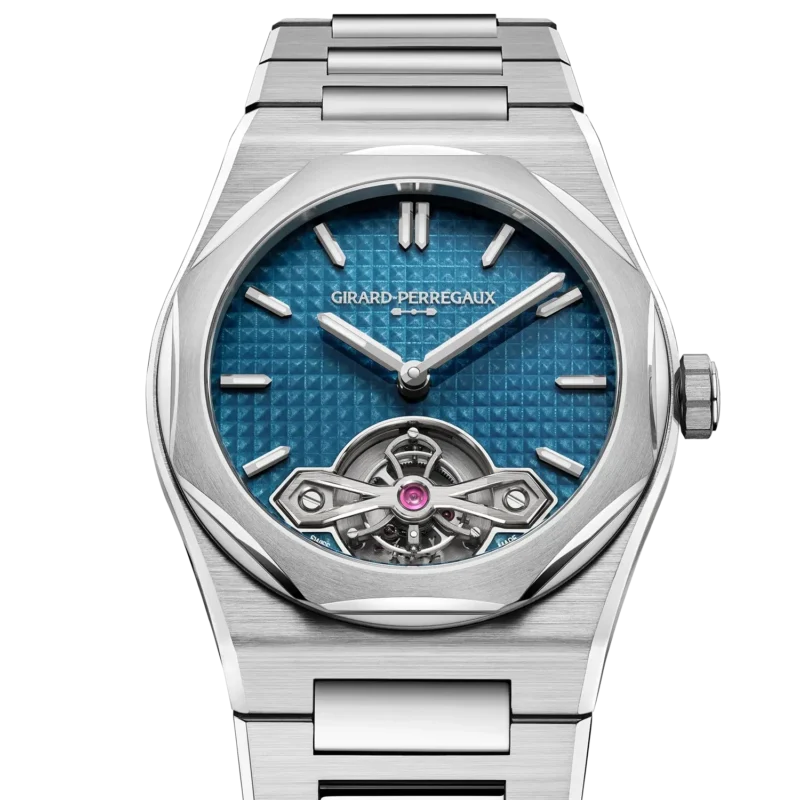
The blue Grand Feu enamel dial changes depth as light moves across its Clous de Paris surface. Courtesy of Girard-Perregaux.
Explore the story
A 10 mm case is easy to ignore on a specification sheet. Here it is the specification that explains almost everything.
The new Girard-Perregaux Laureato Fifty Tourbillon Micro-Rotor 39 mm is not especially large, deliberately theatrical or crowded with indications. It tells the time, exposes a tourbillon at six o’clock and leaves the rest of the dial remarkably calm. Turn it over and the surprise is different: instead of the broad winding rotor that usually sits over an automatic movement, the GP8410 leaves most of its architecture visible. A small oscillating mass occupies one part of the movement; the bridges and gearing remain open to view.
That decision is the core of the watch. The tourbillon is the obvious complication, but the micro-rotor is what allows the whole object to make sense as a Laureato rather than as a complication inserted into a Laureato-shaped case.
Key facts
- Model: Girard-Perregaux Laureato Fifty Tourbillon Micro-Rotor 39 mm
- References: 99116-11-3528-1CM and 99116-11-3615-1CM
- Case: stainless steel, 39 mm diameter, 10 mm thick
- Water resistance: 50 metres
- Movement: manufacture calibre GP8410, automatic
- Movement dimensions: 30.40 mm diameter, 6.10 mm thick
- Components: 207
- Jewels: 31
- Frequency: 21,600 vibrations per hour, 3 Hz
- Power reserve: 72 hours
- Winding: micro-rotor in platinum and pink gold
- Tourbillon: lyre-shaped cage, displayed at 6 o’clock
- Dials: blue Grand Feu enamel or solid 18-carat gold with a pink-gold tone, both with Clous de Paris decoration
The 39 mm case is not a cosmetic choice
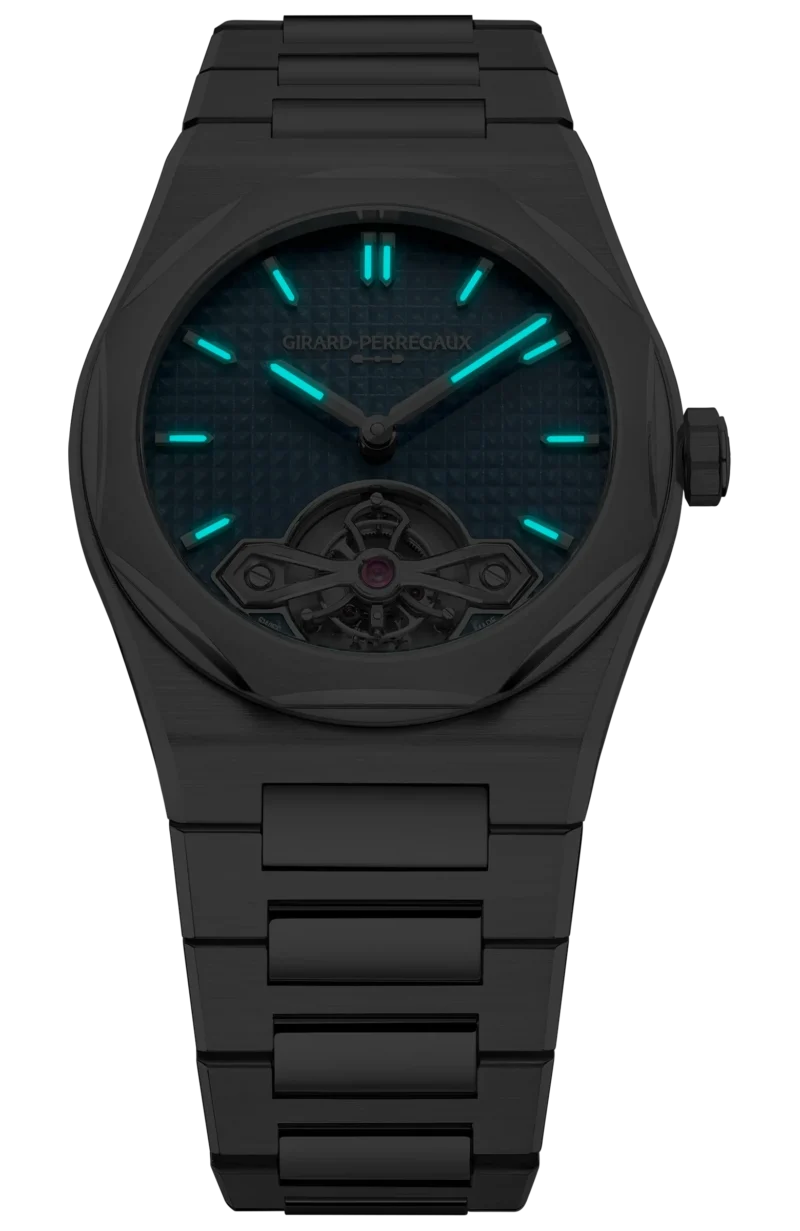
The blue reference keeps its hands and indexes legible after the enamel surface falls into shadow. Courtesy of Girard-Perregaux.
There is a habit in modern watch coverage of treating case diameter as a preference question: 36 or 39, compact or contemporary, vintage-minded or assertive. That discussion is too shallow for this watch.
Girard-Perregaux gives the new tourbillon a steel case measuring 39 mm across and 10 mm in thickness. The dimensions place it directly inside the current Laureato Fifty language, but the interesting number is the second one. A tourbillon, an automatic winding system and 72 hours of reserve have to live inside a case only 10 mm high, while the watch still keeps a sapphire back, an integrated bracelet and 50 metres of water resistance.
There are easier ways to make an automatic tourbillon. A conventional full-size rotor can sit above the movement. A larger case can absorb the additional height. A wider dial can give the tourbillon more visual room. Girard-Perregaux chose none of those shortcuts.
The calibre itself measures 30.40 mm in diameter and 6.10 mm thick. That leaves less than four millimetres, in total, for the dial stack, hands, crystal, caseback crystal, structural clearances, seals and case metal. The 10 mm figure therefore stops being styling information and becomes evidence of packaging discipline.
A Laureato that remembers where the Laureato actually came from
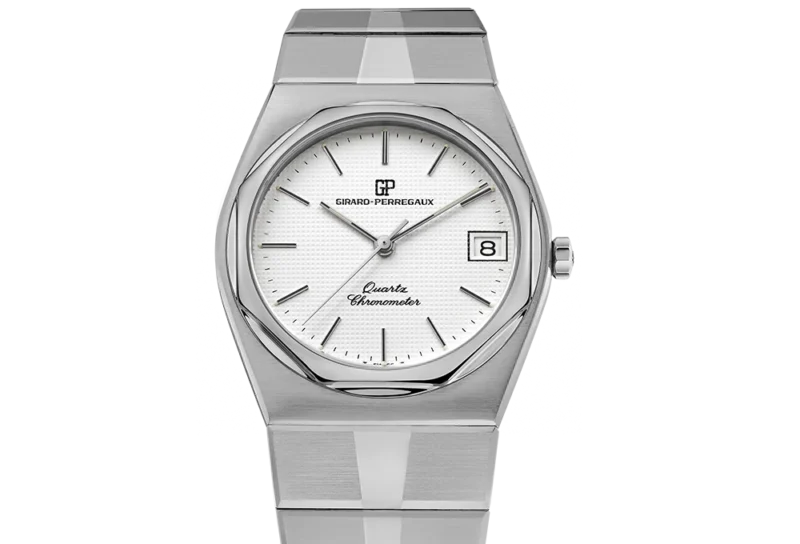
The original 1975 Laureato was a quartz chronometer; its identity began with case and bracelet architecture. Courtesy of Girard-Perregaux.
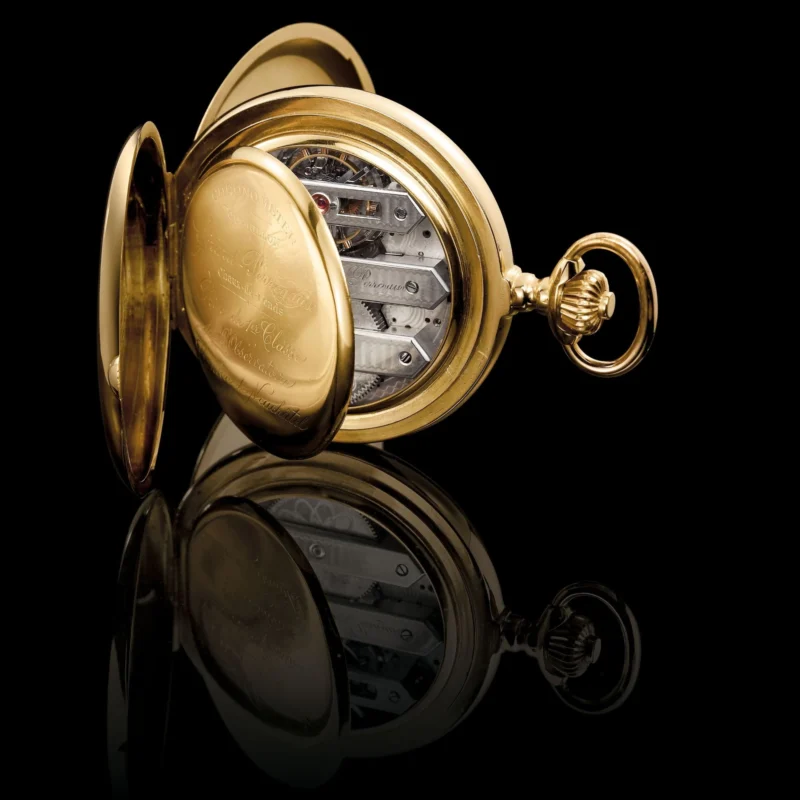
The 1867 Three Bridges chronometer tourbillon established Girard-Perregaux’s idea of visible structure. Courtesy of Girard-Perregaux.
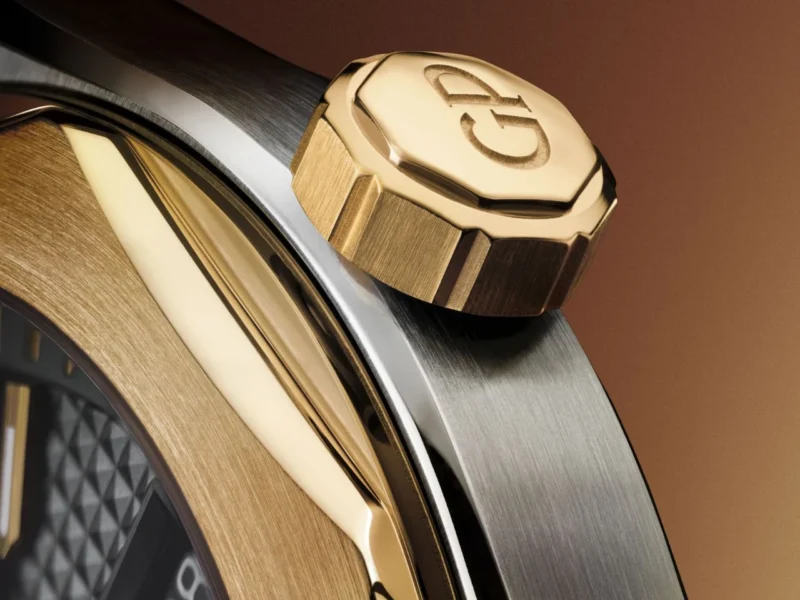
A crown-side detail from the Laureato Fifty provides the present-day case vocabulary around the new calibre. Courtesy of Girard-Perregaux.
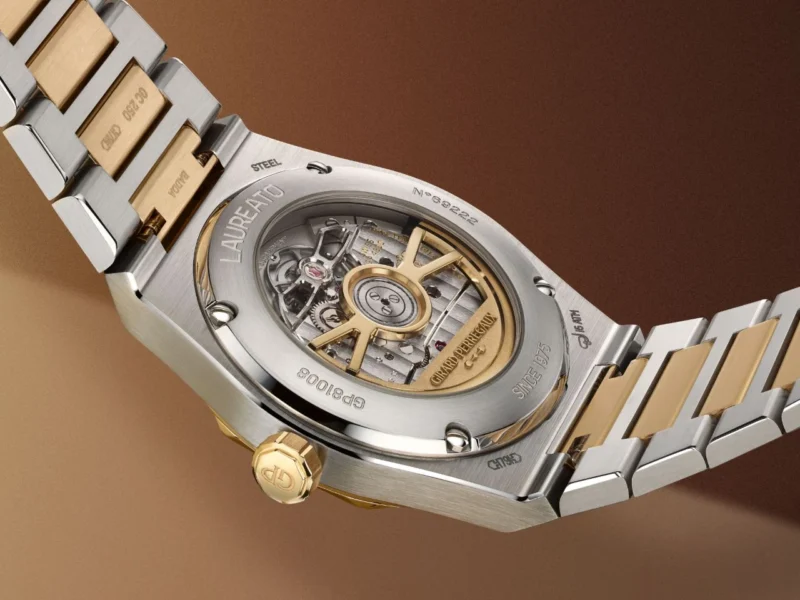
Caseback and bracelet remain one integrated composition rather than separate displays. Courtesy of Girard-Perregaux.
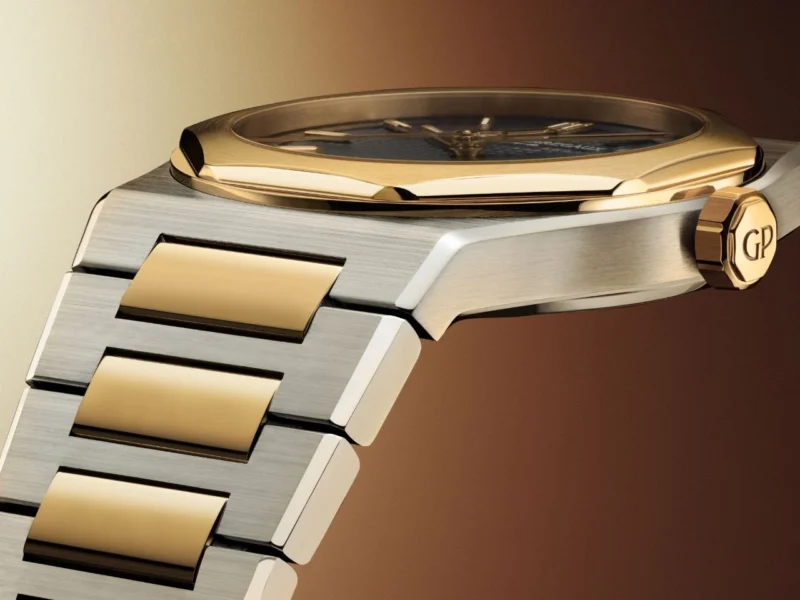
The side profile shows how the Laureato architecture controls height and transition into the bracelet. Courtesy of Girard-Perregaux.
There is a useful irony here. The Laureato is now so comfortably associated with mechanical luxury sports watches that it is easy to forget that the original 1975 watch was a quartz chronometer.
Girard-Perregaux’s own archive presents the first generation as a product of the 1970s, with the octagonal polished bezel and integrated bracelet already doing much of the visual work. The Manufacture also places its 1971 quartz frequency work among its major technical milestones. In other words, Laureato identity was never dependent on one specific mechanical movement architecture.
That matters because the 2026 tourbillon is not convincing simply because a historic manufacture has put an old complication into a familiar sports case. The Laureato has always been more architectural than nostalgic. Its identity comes from the relationship between bezel, case, bracelet, dial and proportion. The movement can change drastically and the watch can remain recognisably Laureato, provided those relationships survive.
This is why 39 mm is so important. The new watch does not ask the Laureato design to expand around the complication. It asks the complication to fit the Laureato.
Five signatures, but only one of them should be called the headline
Girard-Perregaux frames the watch around five house signatures: the Laureato architecture, Clous de Paris decoration, Grand Feu enamel, the arrow-shaped bridge language and the lyre-shaped tourbillon cage. That list can sound like anniversary marketing if it is left unexplained. On the watch, however, the signatures do different jobs.
The Laureato case establishes the volume. The Clous de Paris pattern creates the visual field. Grand Feu enamel changes how light behaves on the blue reference. The bridge gives the tourbillon a recognisable structural frame. The lyre-shaped cage supplies the moving centre at six.
The most interesting detail is that these motifs are not confined to the front. The Clous de Paris pattern continues across the large white-gold bridges on the back of the GP8410. The arrow form appears again on the micro-rotor assembly. The result is unusually coherent: front and back are not designed as two separate showcases.
That matters more than it sounds. Many complicated watches use the dial to establish one visual identity and the movement to demonstrate another. Here, the same vocabulary crosses the watch.
What the micro-rotor actually solves
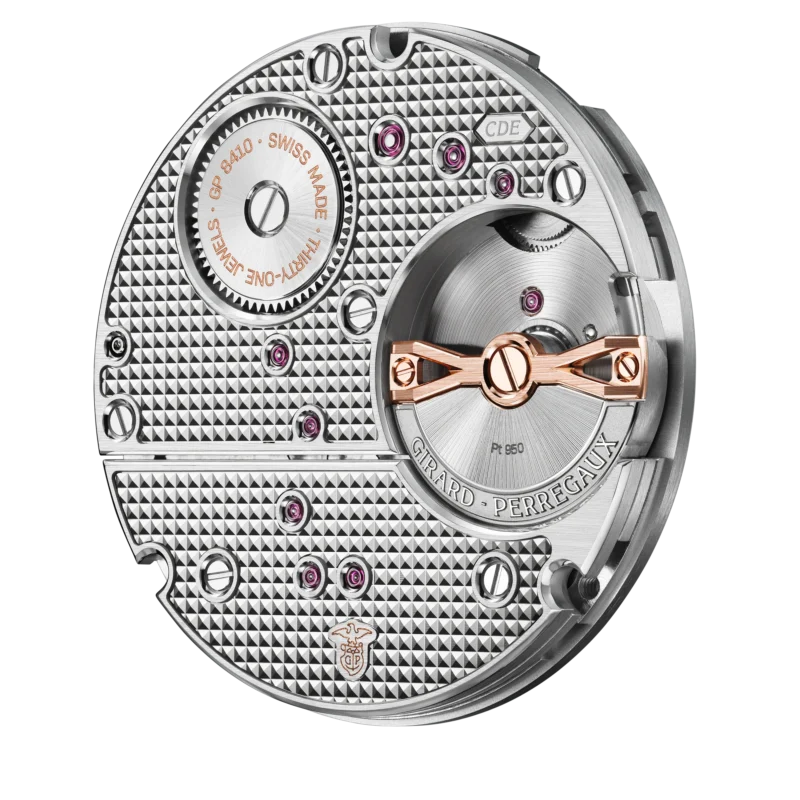
Calibre GP8410 packages automatic winding, a tourbillon and 72 hours of reserve within 6.10 mm. Courtesy of Girard-Perregaux.
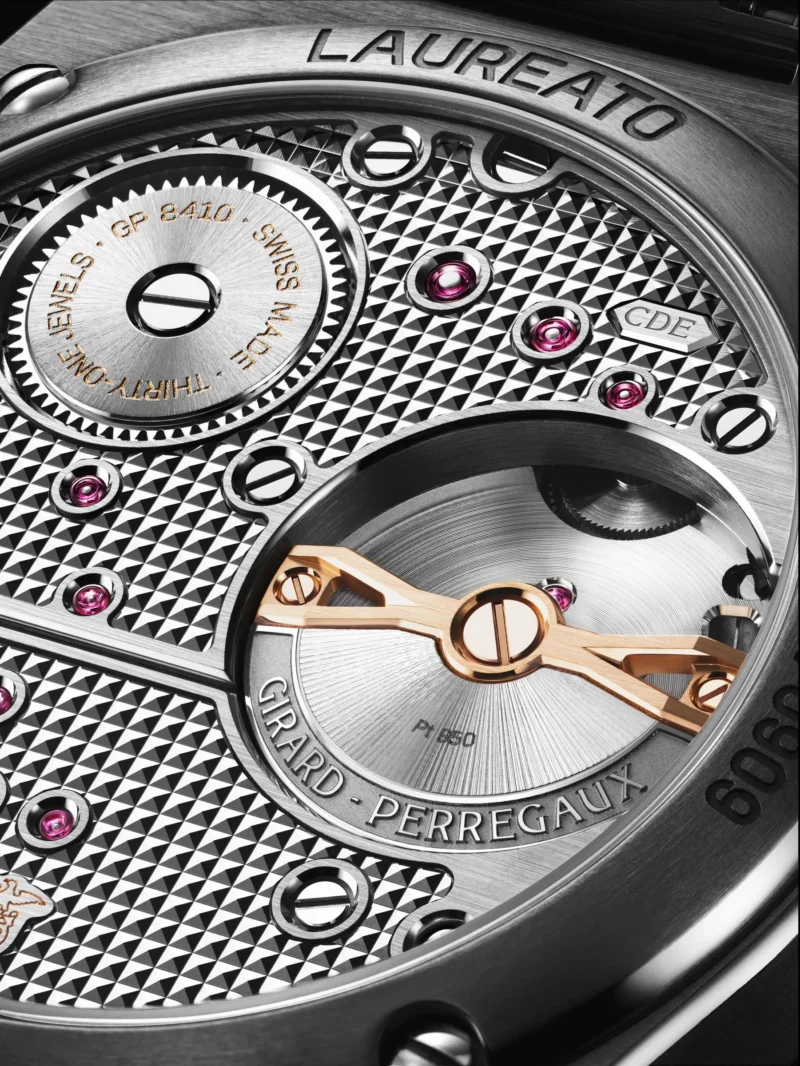
Platinum and pink gold give the compact micro-rotor both density and a visible role in the movement. Courtesy of Girard-Perregaux.
A micro-rotor is often described as an elegant form of automatic winding. That is true, but it does not explain why it is useful here.
A conventional central rotor sits over a large portion of the movement and swings above it. A micro-rotor is smaller and can be integrated into the movement architecture itself. That does not guarantee a thin watch; a poorly packaged micro-rotor calibre can still be thick. What it offers is the possibility of avoiding an additional full-diameter layer above the gear train.
The GP8410 uses that possibility directly. Its micro-rotor is made from platinum and pink gold, materials that give the small winding mass useful density while also making it a visible design element. Through the sapphire back it occupies the upper-left area of the movement rather than masking the entire calibre.
The choice has two consequences. The first is dimensional. The second is visual.
Dimensionally, Girard-Perregaux can keep the movement to 6.10 mm and the complete watch to 10 mm. Visually, the micro-rotor allows the bridges to remain exposed. That is especially important for a company whose historical identity includes the idea that movement structure should be seen rather than hidden.
This is one of those cases where an automatic winding system is doing more than winding the watch. It is helping preserve the design logic of the movement.
The tourbillon is old Girard-Perregaux territory, but this is not a miniature Three Bridges
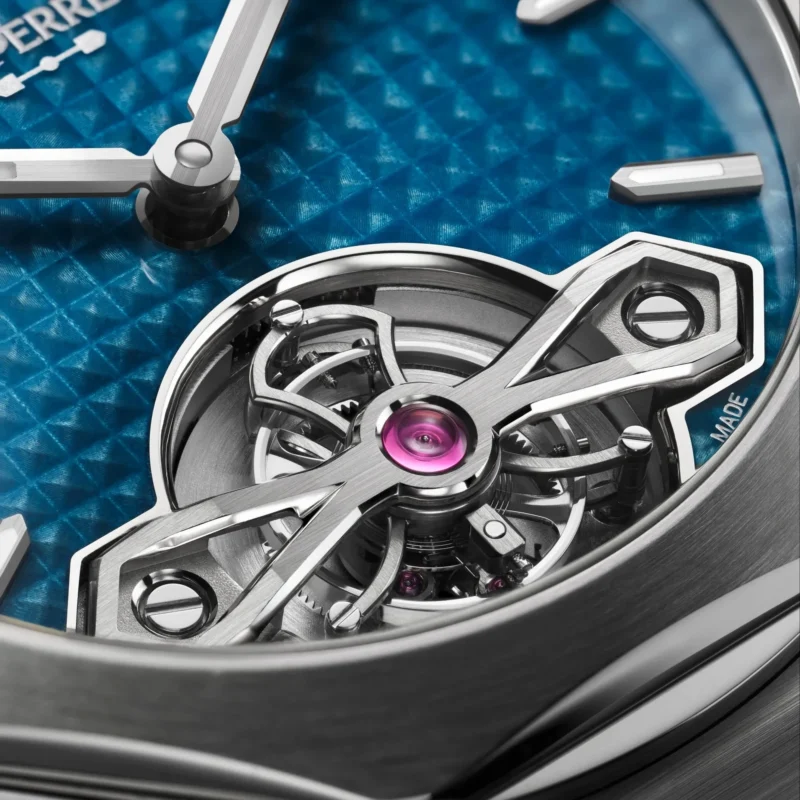
The lyre-shaped tourbillon cage and its bridge turn the mechanism into dial architecture. Courtesy of Girard-Perregaux.
Girard-Perregaux has legitimate reasons to treat the tourbillon as part of its own language. In 1867 Constant Girard presented a chronometer tourbillon with three parallel bridges at the Neuchâtel Observatory and the Paris Universal Exhibition. The Manufacture’s archive describes those bridges as both structural and visible, an early example of mechanism becoming architecture.
The later Three Gold Bridges turned that principle into one of the firm’s defining signatures. The arrow-shaped bridge became recognisable because it was still a working component.
The Laureato Fifty Tourbillon Micro-Rotor does not recreate that movement. Nor should it. The new calibre has one prominent bridge across the tourbillon on the dial side and large decorated bridges on the reverse. Its relationship to the nineteenth-century watches is conceptual rather than literal: structural components are allowed to become part of the design.
That distinction matters. Heritage is more useful when it explains a decision than when it supplies a costume.
The lyre-shaped tourbillon cage at six o’clock is the watch’s visual anchor, but the bridge over it is just as important. It gives the opening a horizontal line and prevents the lower part of the dial from turning into a circular hole with a mechanism inside. The bridge is what integrates the tourbillon with the sharp geometry of the Laureato case.
Calibre GP8410: compact, automatic, and deliberately visible
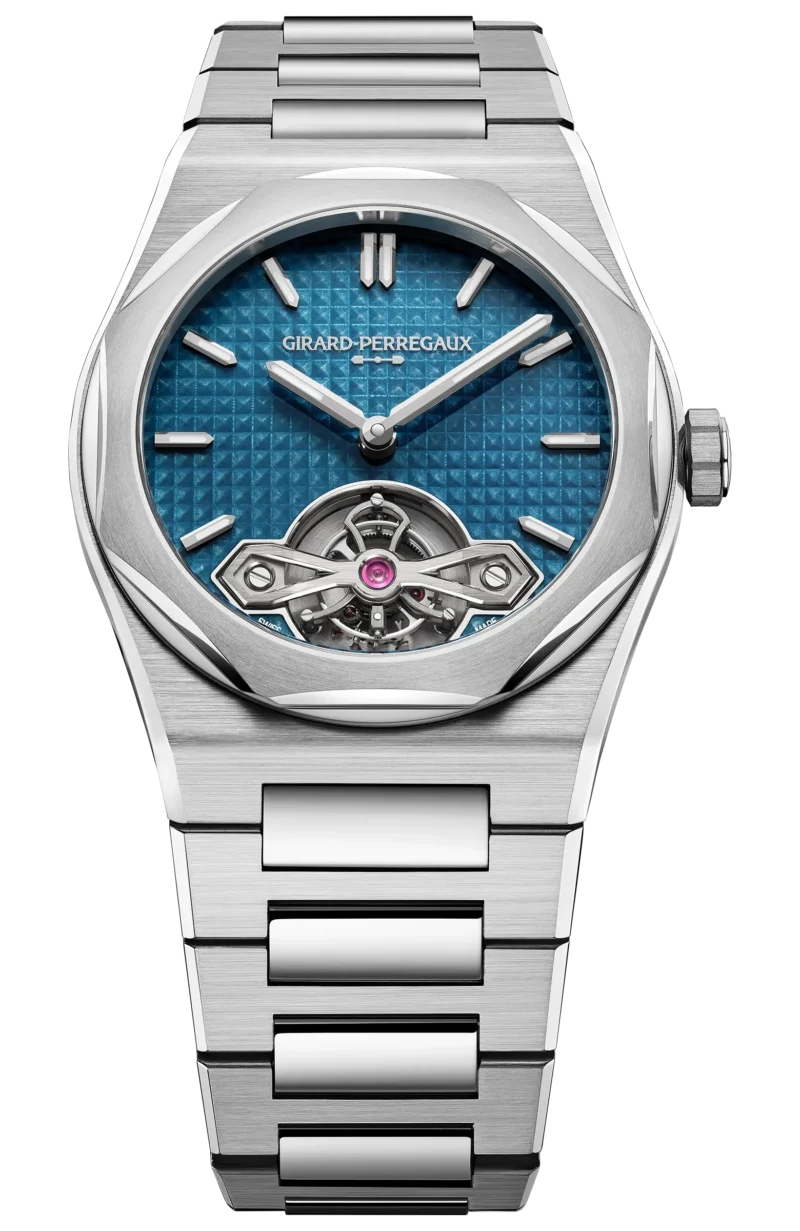
The blue Grand Feu enamel reference establishes the 39 mm Laureato Fifty Tourbillon Micro-Rotor. Courtesy of Girard-Perregaux.
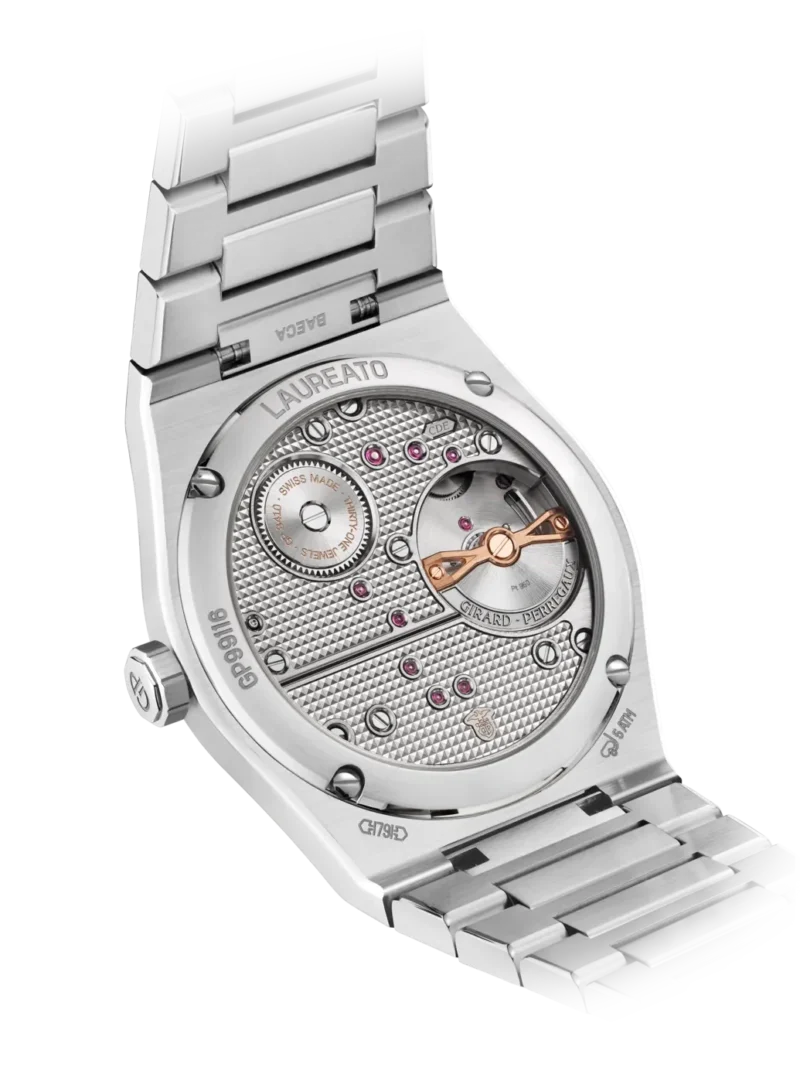
The sapphire back leaves the GP8410 visible because the winding mass is integrated as a micro-rotor. Courtesy of Girard-Perregaux.
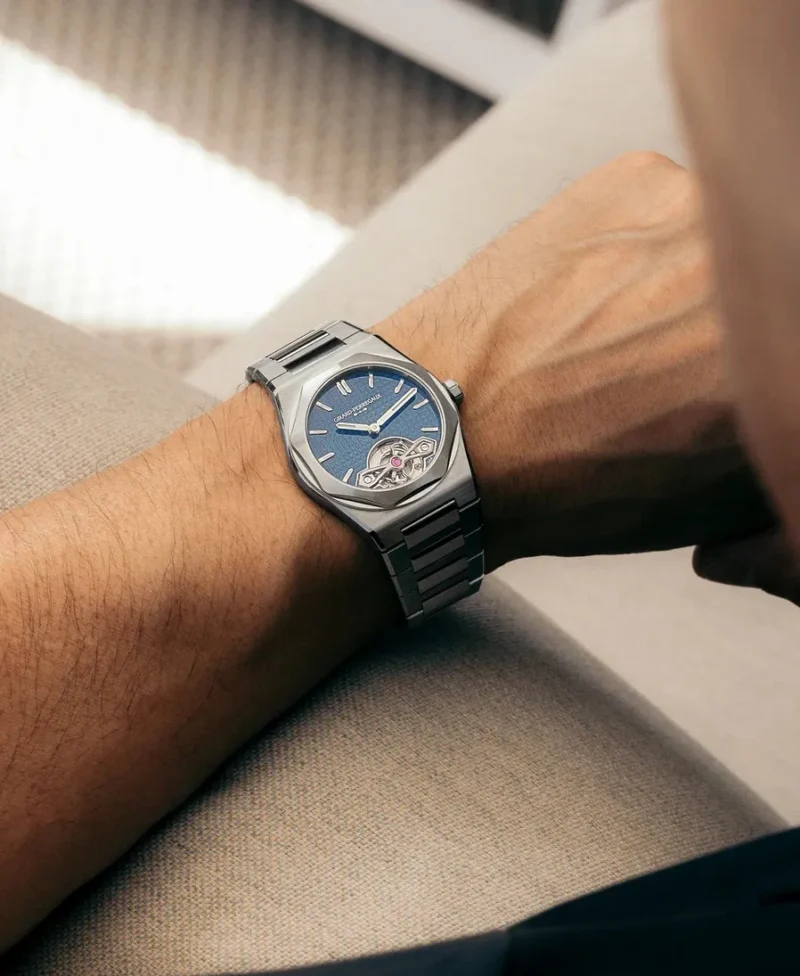
On the wrist, the 39 mm case and integrated bracelet remain proportionally continuous. Courtesy of Girard-Perregaux.
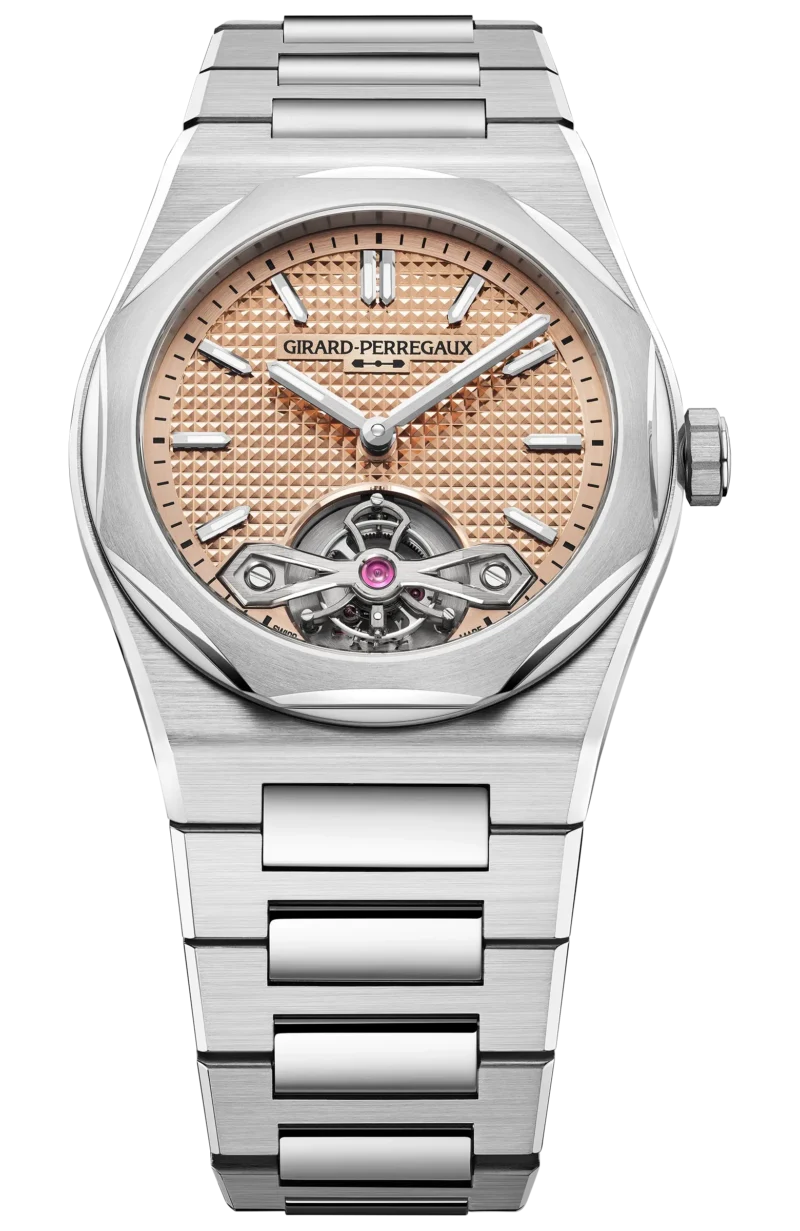
The solid-gold dial gives the second reference a warmer, more graphic reading. Courtesy of Girard-Perregaux.
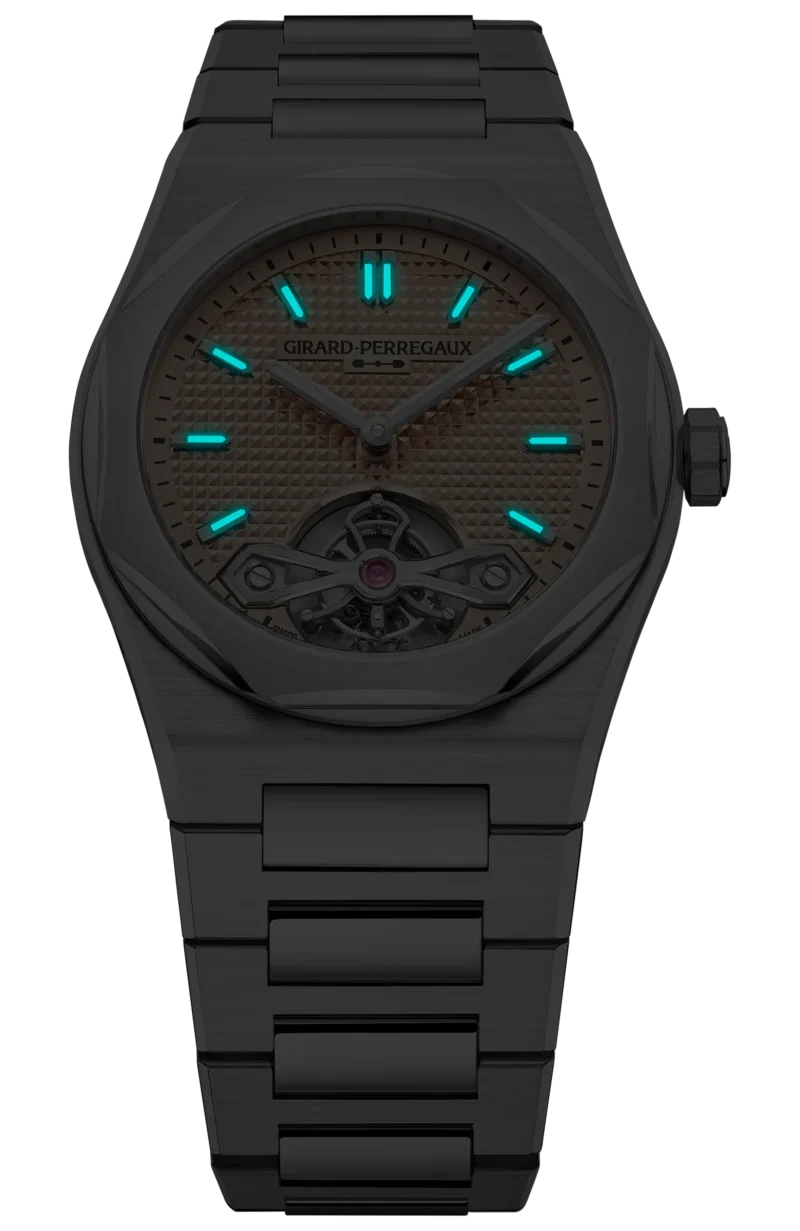
Luminous material preserves the functional hierarchy of the pink-tone reference at night. Courtesy of Girard-Perregaux.
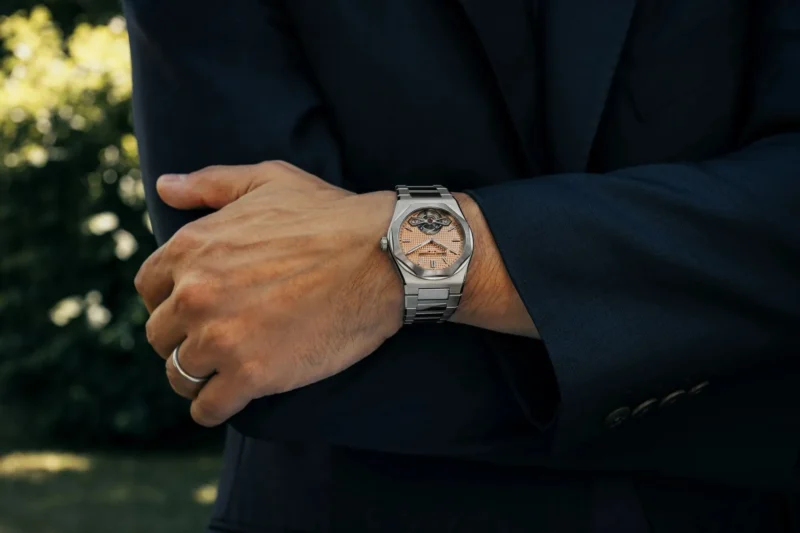
The pink-tone reference changes the emotional temperature without changing the steel Laureato architecture. Courtesy of Girard-Perregaux.
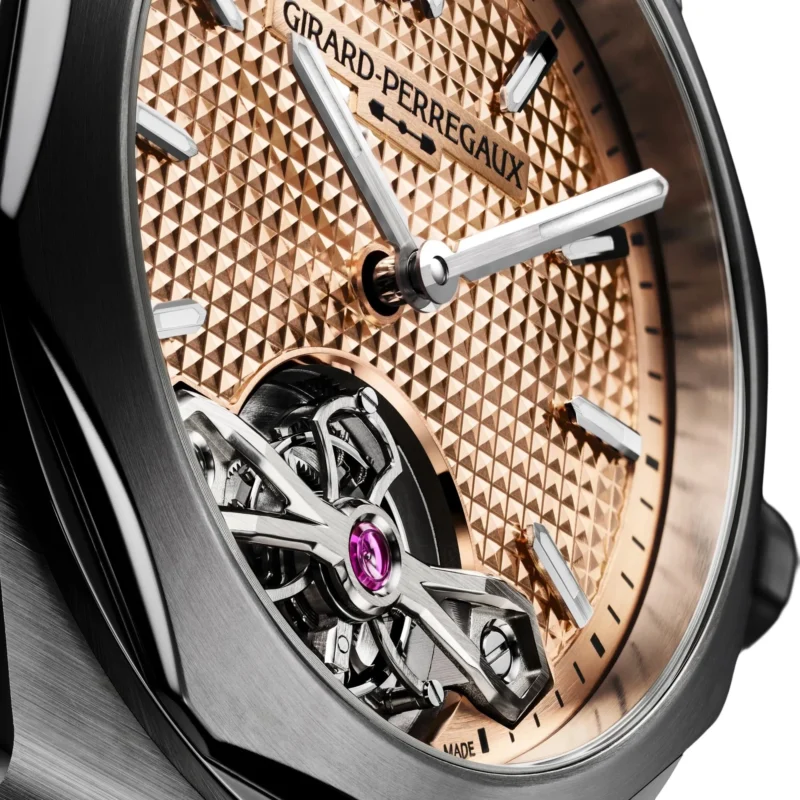
A close view shows the tourbillon held within the same geometry as the solid-gold dial. Courtesy of Girard-Perregaux.
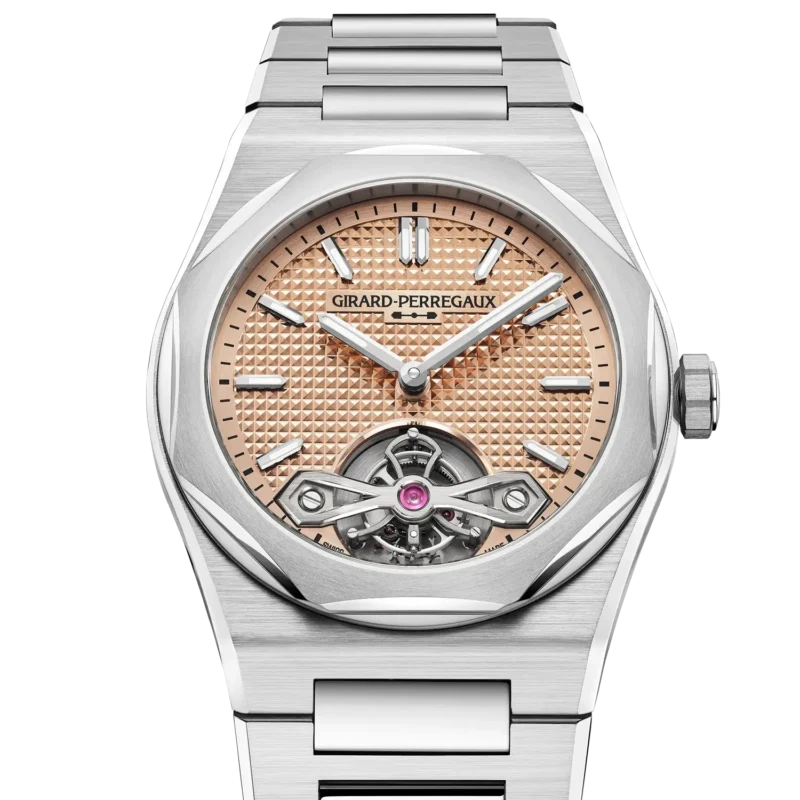
The front view makes the difference between metallic structure and translucent blue enamel explicit. Courtesy of Girard-Perregaux.
The GP8410 is a new manufacture movement. It has 207 components, 31 jewels and runs at 21,600 vibrations per hour, or 3 Hz. Its stated power reserve is 72 hours.
Those figures are sensible rather than spectacular in isolation. The interest lies in how they coexist.
A tourbillon adds a rotating regulating organ. Automatic winding adds another mechanical system. A 72-hour reserve asks the movement to carry enough stored energy to run for three days. All of this is packaged within a 30.40 mm diameter and 6.10 mm height.
The 3 Hz frequency also deserves context. Girard-Perregaux is not using a very high-beat escapement here. A lower frequency reduces the number of balance oscillations per unit of time, which can make energy management easier, although the final efficiency of a movement depends on far more than frequency alone. The important point is that the GP8410 has been designed as a system: tourbillon, reserve, winding and size are not independent specification targets.
The movement’s appearance reinforces this. The Clous de Paris texture on the bridges creates a strong graphic field. The pink-gold arrow across the micro-rotor interrupts it. Jewels, screws and openings remain visible rather than being buried beneath a large oscillating weight.
For a collector, the rear view may be the stronger argument for the watch than the tourbillon itself.
Blue enamel or solid gold: two dials that change the character more than the specification
Explore the comparison
| Reference | Dial | Character |
|---|---|---|
| 99116-11-3528-1CM | Blue Grand Feu enamel | Depth and changing light |
| 99116-11-3615-1CM | Solid 18-carat gold, pink-gold tone | Warmth and graphic structure |
Girard-Perregaux offers two versions of the watch. Reference 99116-11-3528-1CM uses a blue Grand Feu enamel dial with Clous de Paris decoration. Reference 99116-11-3615-1CM uses a solid 18-carat gold dial with a pink-gold tone, again carrying the same geometric pattern.
This is not a trivial colour choice.
The blue enamel dial has depth because light passes through and reflects differently across the patterned surface. The squares do not all read at the same brightness. The dial appears darker or more electric depending on angle, and that movement in the surface makes the static geometry less severe.
The gold dial behaves differently. Its colour is warmer, more direct and more metallic. Because the underlying material is part of the visual effect rather than a translucent fired layer, the Clous de Paris pattern feels sharper and more graphic.
Both versions place the same tourbillon mechanism at six, use the same steel case and bracelet, and share the same dimensions. Yet the dial treatment changes the watch’s emotional temperature. The blue version emphasises depth; the gold version emphasises structure.
That is a better reason to offer two references than simply providing two fashionable colours.
The bracelet matters because the watch has not been allowed to become a display object
A complicated Laureato still has to function as a Laureato on the wrist. The steel bracelet is integrated into the case and uses a folding clasp with fine adjustment. The case retains 50 metres of water resistance.
Neither detail belongs on a list of high complications, but both help explain what Girard-Perregaux is trying to preserve. This is not a tourbillon presented as a delicate formal watch with a leather strap and a precious-metal case. The movement has been made to live inside a steel integrated-bracelet format.
The use of luminous material on the hands and indexes reinforces the same point. Even the night-view images supplied by the Manufacture are useful evidence: the watch is expected to remain legible in low light despite the open tourbillon and textured dial.
That does not make it a sports instrument. It makes it a complicated watch that has not abandoned the everyday visual language of the Laureato.
What the 10 mm figure does not prove
A thin case is not automatically a better watch. A micro-rotor is not automatically a more sophisticated winding system. A tourbillon does not guarantee better real-world rate performance, and Girard-Perregaux does not present this model as a chronometer-certified exercise.
Those distinctions are worth keeping clear.
What the dimensions do establish is that Girard-Perregaux chose to solve the complication inside a strict physical envelope. That is a design constraint. It can be examined, measured and compared without pretending that thinness is a moral virtue.
The same applies to the firm’s historical references. The 1867 tourbillon, the 1975 Laureato and the 2026 GP8410 belong to different technical eras. The new watch does not become historically important because it contains visual echoes of all three. Its success depends on whether those echoes serve the current object.
Here, most of them do.
Why this is a stronger Laureato than a larger tourbillon would have been
The easiest version of this project would have been a 42 or 44 mm Laureato with a larger tourbillon aperture, a broad central rotor and more visual drama. That watch might have been easier to sell from a photograph. It would also have taught us less about Girard-Perregaux.
The 39 mm model is more revealing because it forces priorities. The tourbillon cannot dominate the entire dial. The movement cannot hide behind a rotor. The bridges have to carry visual weight without making the back feel heavy. The integrated case still has to remain recognisable as Laureato from across a room.
In that sense, the most impressive part of the watch is not the tourbillon cage rotating at six. It is the amount of ordinary Laureato that survives around it.
That is the difference between adding a complication to a design and integrating a complication into a design.
Final assessment
Girard-Perregaux describes the Laureato Fifty Tourbillon Micro-Rotor as a meeting point for five signatures. The description is accurate, but the watch is more interesting when you read those signatures as engineering constraints rather than heritage references.
The 1975 Laureato contributes the case architecture. The nineteenth-century tourbillons contribute the idea of visible structural bridges. Grand Feu enamel and Clous de Paris establish the dial surface. The micro-rotor lets the automatic movement remain open to view. The GP8410 has to hold the entire arrangement within 6.10 mm.
Then the case has to close at 10 mm.
That last number is why the watch works. The complication has not been allowed to rewrite the Laureato. Girard-Perregaux has made the complication obey it.
Sources & further reading
- Girard-Perregaux official product, calibre and archive materials, checked against the Maison’s public specifications on 8 September 2026.
- TheTimeo distinguishes official specifications from editorial interpretation and does not claim hands-on inspection.
The Edit
Watches stories
Selected stories from the same editorial universe.
Richard Mille RM 41-01 Tourbillon Soccer: A Watch That Counts Goals
A TheTimeo collector reading of the Richard Mille RM 41-01 Tourbillon Soccer, a manual-winding
Zenith Chronomaster Solo Sport: What Is El Primero Without a Chronograph?
Zenith removes the pushers and counters from Chronomaster but keeps El Primero at 5

Patek Philippe Ref. 6105G: What a Sunrise-and-Sunset Celestial Actually Displays
The Ref. 6105G is not one astronomical display but several kinds of time negotiated
Audemars Piguet Neo Frame Jumping Hour: Why the New Calibre Matters More Than the Vintage Shape
Audemars Piguet returns to a two-window jumping-hour format from the late 1920s, reversing its
Omega Speedmaster 38 (2026): What Changed, What Stayed, and Why the Black No-Date Matters
Seven new references give the Speedmaster 38 a cleaner face and a stronger visual

Bulgari Octo Finissimo Dual Time x Vianney Halter
Bulgari and Vianney Halter give the Octo Finissimo four separate displays, a new calibre