
TheTimeo / Jewelry
L’éclat Solaire:
pearl light in colour.
A pearl collar, a commanding green centre and a fan of descending strands give Mikimoto’s L’éclat Solaire its scale, while blue and green turn pearl light into colour.
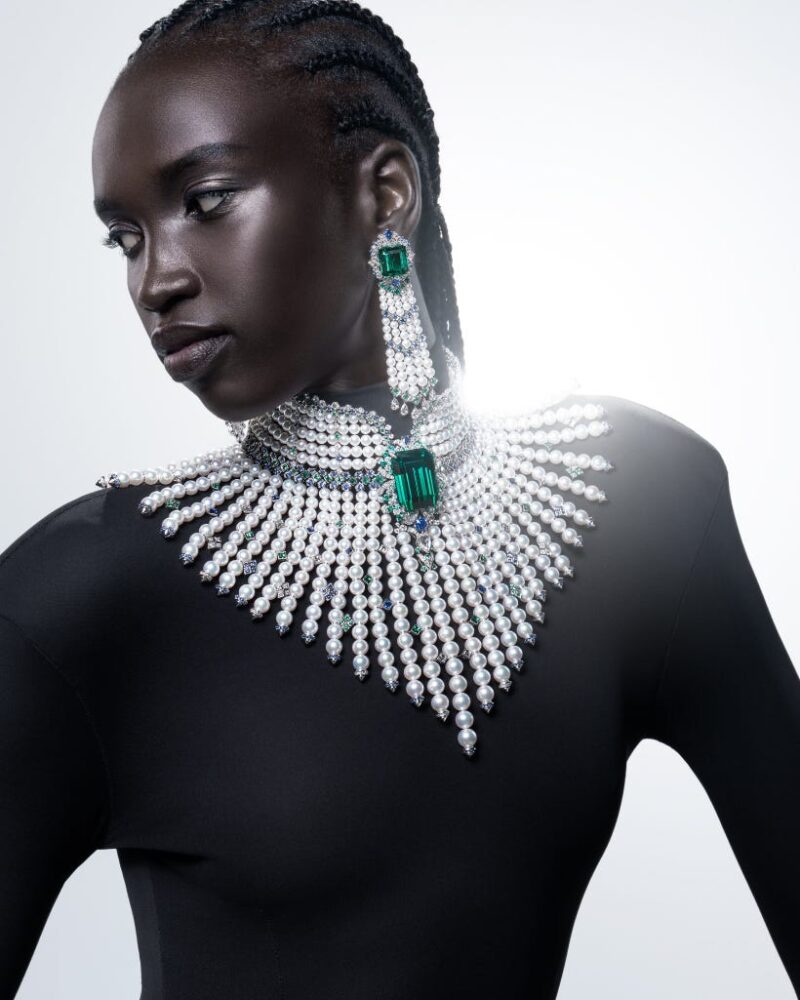
L’éclat Solaire spreads from a pearl collar through a strong green centre into a broad fan across the décolletage.
Explore the story
The first thing L’éclat Solaire asks the eye to read is its shape. A collar of pearls sits high around the neck. At the centre, a large rectangular green element interrupts the white, and below it numerous strands descend and spread across the décolletage in a broad fan. The pierced earrings compress the same idea into a smaller scale, with a green centre and falling pearl lines. Blue enters within that field rather than outside it.
Mikimoto identifies the suite as Akoya cultured pearls, tourmaline, sapphire, emerald, diamonds and 18K white gold. Yet the materials become interesting because of where they sit. Solaire is built around a strong centre, repeated pearl lines and a wide downward spread. Colour is carried by that construction.
Presence and structure
L’éclat Solaire spreads from a pearl collar through a strong green centre into a broad fan across the décolletage.
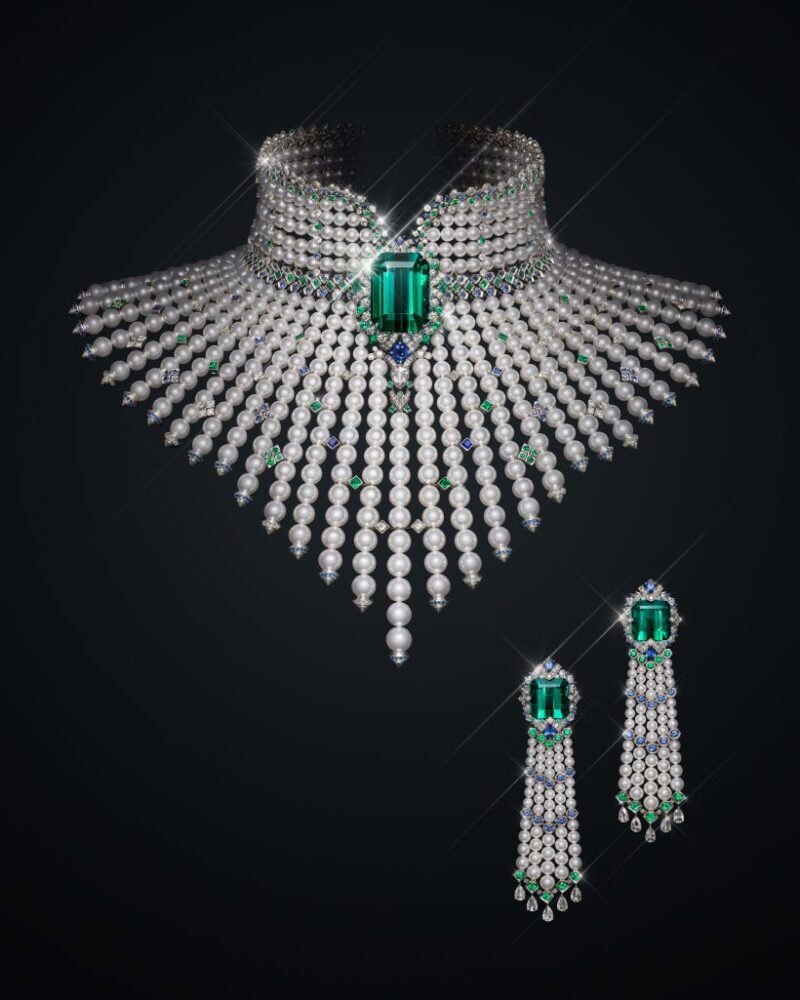
A rectangular green centre anchors the pearl collar and descending fan; the earrings condense the same centre-and-cascade logic.
On the body, the fan becomes scale. In the still life, collar, centre and descending pearl lines can be read together.
The green centre holds the fan together
A rectangular green centre anchors the pearl collar and descending fan; the earrings condense the same centre-and-cascade logic.
The large rectangular green element is impossible to treat as a minor transition. In the exact Solaire frame issued with Mikimoto’s July 2026 release, it acts as the visual anchor of the necklace. The pearl collar establishes a pale horizontal band above it; the lower half then opens out into multiple descending lines.
That centre gives the eye somewhere to settle before the composition starts to move outward and down. It also prevents the fan of strands from reading as a loose fringe. The necklace has a clear hierarchy: collar, centre, descent.
Mikimoto’s material list names tourmaline and emerald among the green stones used in Solaire. The central rectangle functions first as a concentrated block of green set against a much larger field of pearl white, so one area of colour can command the composition without replacing pearls as its dominant graphic material.
Around it, smaller green and blue accents appear within the descending field. Their scale is secondary to the central rectangle. That difference in size gives the lower half of the necklace rhythm rather than uniformity.
Pearls draw the lines
Mikimoto describes L’éclat as a collection inspired by light released from stillness, and Solaire turns that idea into line. Here, pearls do more than provide a familiar house signature. They make the paths of the necklace visible.
The collar reads as a compact band because pearl after pearl repeats along the neckline. Below the centre, the repetition changes direction. The pearls appear along numerous hanging strands that spread like rays, so the same material shifts from encircling the neck to drawing the fan beneath it.
That change of direction is one of the strongest details in the design. A conventional pearl necklace can make repetition feel continuous and calm. Solaire breaks that continuity into a radial composition. The eye first follows the collar laterally, then is pulled down through a succession of lines.
GIA describes pearl lustre as light reflected from the surface and from the layers of nacre beneath it. In Solaire, that soft reflected brightness is repeated many times across the construction. Diamonds and coloured gemstones bring different kinds of brilliance, but the pearls provide the recurring white points that keep the entire field connected.
Blue cools a composition already dominated by green and white
Once the centre and the pearl lines are clear, the blue sapphires become easier to notice. They do not carry the same visual weight as the large green centre. Instead, blue appears as a cooler note within the fan, breaking the alternation between pearl white and green.
That difference is important. The palette is not distributed evenly. White is abundant, green is concentrated and blue is selective. The result is a colour structure with emphasis, rather than a democratic display of materials.
Mikimoto’s own description places lustrous white pearls against the green of tourmaline and emerald and the blue of sapphire. In the image, those colours are not equal in scale: a relatively small amount of saturated colour changes a much larger white construction.
The 18K white gold named by the house keeps the metal from introducing another strong colour into that relationship. Visually, the palette remains cool enough for pearl white, green and blue to do the expressive work.
On the body, the fan becomes scale
L’éclat Solaire spreads from a pearl collar through a strong green centre into a broad fan across the décolletage.
The worn Solaire photograph shows why the necklace cannot be understood as a pendant attached to a pearl collar. Its lower section occupies a broad area of the décolletage. The strands do not fall in one narrow vertical line; they spread across the body, making width part of the design.
The large green centre therefore has two jobs. It catches the eye because of colour and scale, but it also marks the point from which the lower composition seems to open. The collar keeps the upper edge controlled while the fan below enlarges the silhouette.
The earrings extend the idea upward. They do not repeat the necklace literally, but the visible combination of a green centre with descending pearl elements creates a recognisable family resemblance. Worn together, necklace and earrings frame a larger vertical territory, from beside the face to well below the neckline.
That scale is one of Solaire’s most contemporary qualities. Mikimoto’s pearl identity remains immediately present, yet the pearls are no longer confined to a single strand around the neck. They become part of an expansive high jewellery silhouette.
Still life reveals the architecture
Without the body, the exact Solaire still life makes the hierarchy easier to study. The upper collar reads as the most compact section. The rectangular green centre forms a clear hinge between that band and the much more open lower field. Beneath it, the necklace divides into numerous descending lines that widen as they travel away from the centre.
This is where the piece becomes more than a colour exercise. The white pearls create both density and space. Close together around the neck, they form a continuous border. Spaced along the hanging lines, they describe intervals, leaving air between one strand and the next. The fan is therefore built as much from the gaps as from the material.
Green and blue elements interrupt those white lines at different points, stopping the lower half from becoming a regular curtain. The eye keeps returning to the larger central green form, then moving outward through smaller accents and pearl drops.
The earrings offer a concise summary. A green focus sits above a descending pearl cascade, echoing the necklace’s centre-and-fall logic without trying to reproduce its full width. Seen beside the necklace, they make the suite feel composed rather than merely matched.
Pearl light is the constant
L’éclat Solaire belongs to a collection named for light, but its most convincing idea is physical. Mikimoto does not rely on colour alone to create intensity. It organises that colour around repeated pearl surfaces and a strong radial structure.
The suite moves through three scales at once. There is the compact scale of the pearl collar, the concentrated scale of the rectangular green centre, and the expansive scale of the fanned strands across the décolletage. The earrings then echo the central and descending elements in miniature.
That is why the material list feels secondary once the jewel has been seen. Tourmaline, sapphire, emerald, diamonds and white gold matter, but the composition decides how they are experienced. Pearls remain the most repeated material and therefore the visual constant.
For a reader who thinks of Mikimoto first through the classic pearl necklace, Solaire offers a recognisable identity pushed into a different geometry. The pearl is still the beginning of the design, but it is no longer asked simply to form a strand. It draws a collar, marks a fan and carries light across a much larger field.
The memorable detail is the tension between concentration and dispersal: one large green centre holding the eye while scores of pale points move away from it. In L’éclat Solaire, colour does not sit on top of the pearl story. It gives that story a new shape.
The material palette
Akoya pearl white meets green tourmaline and emerald, blue sapphire, diamonds and white gold. Their placement gives the suite its hierarchy.
Explore the comparison
| Element | Material | Visual role |
|---|---|---|
| Pearls | Akoya cultured pearls | The collar and radiating strands form the recurring white field. |
| Green | Tourmaline and emerald | A rectangular green centre anchors smaller green accents within the pearl fan. |
| Blue | Sapphire | Selective blue notes punctuate the pearl fan. |
| Brilliance | Diamonds | Bright accents accompany the pearl and coloured-gemstone composition. |
| Metal | 18K white gold | The cool metal keeps the emphasis on pearl white, green and blue. |
Sources & further reading
The Edit
Jewelry stories
Selected stories from the same editorial universe.
One Butterfly, Twelve Constructions: How Graff Turns a Motif into High Jewellery
Graff holds one butterfly silhouette still, then changes colour, volume, surface and movement across
Piaget Colours of Extraleganza: When Colour Becomes Structure
Piaget’s 2026 High Jewellery collection brings sapphires, opals, Paraíba tourmalines, ornamental stones and worked
Pomellato Stile Libero: colour, gold and openwork
Inside Stile Libero, Pomellato’s 2026 high jewellery collection: sapphires arranged freely, sculptural gold links
The Shape of a Promise: Reading Graff Engagement-Ring Silhouettes
Choosing a Graff Promise ring becomes clearer when you read the whole silhouette: round,
How Do You Make Gold Flexible Without Solder? Inside Bvlgari Tubogas 2026
Two interlocking gold ribbons, a temporary core and controlled tension: Bvlgari’s five 2026 pieces
Cartier Into the Wild 2026: How Do You Make a Jewelled Animal Look Alive Without Copying It?
Tiger, parrot, carp, crocodile and rhinoceros push Cartier into five craft problems, from hardstone