
TheTimeo / Jewelry
ONE BUTTERFLY,
twelve ways to move
Graff holds one butterfly silhouette still, then changes colour, volume, surface and movement across twelve transformable high-jewellery constructions.
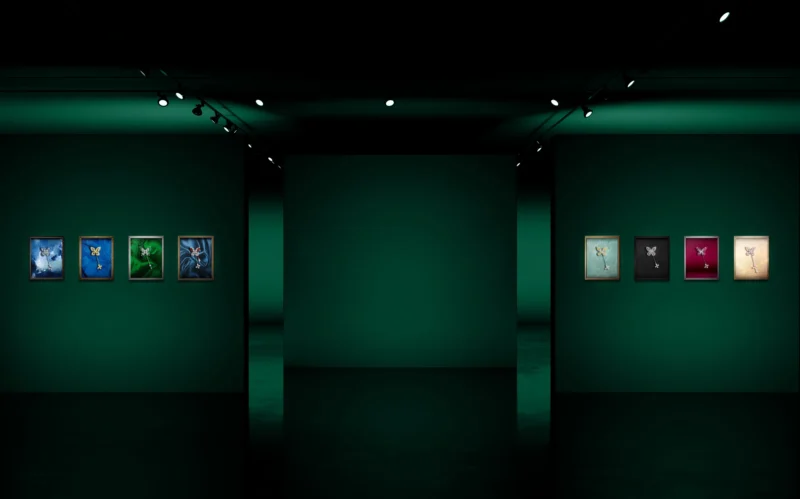
Graff’s Artistry in Motion: twelve butterfly constructions presented as one collection. Courtesy of Graff.
Explore the story
A motif becomes interesting when repetition starts to expose its weaknesses. Draw the same shape once and almost anything can look convincing. Repeat it twelve times, change the stones, change the surface, change the volume, ask it to move, and the design either proves it has range or begins to feel like a logo.
Graff’s Artistry in Motion is built around that test.
The collection takes one of the house’s oldest recurring ideas, the butterfly, and refuses to treat familiarity as an excuse for sameness. Twelve brooches use the motif as a fixed point, then pull it in different directions. Some are dense with colour. Others nearly remove colour altogether. One turns pink opal and a natural seawater pearl into a study in soft light. Another uses black spinel to make the familiar outline feel almost severe. A third pushes emeralds outward in a radiating geometry that has more in common with architecture than with a naturalistic insect.
That is the useful way to read the series. The question is not whether butterflies are beautiful. Jewellery has answered that often enough. The question is how many distinct constructions a house can build from one recognisable silhouette before repetition becomes formula.
Here, the answer is more than twelve.
Key facts
- Collection: Artistry in Motion.
- Format: 12 high-jewellery butterfly brooch designs.
- Presentation: unveiled in Paris during Haute Couture Week in July 2026.
- Graff’s butterfly motif dates to 1975.
- Core house silhouette: two pear-shaped stones and two marquise-cut stones forming the wings.
- The collection is presented as unisex.
- Each design is transformable from brooch to pendant.
- A central butterfly element is set en tremblant, allowing visible movement with the wearer.
- The official collection is organised around four curatorial chapters: Histories Reframed, Systems of Seeing, Material & Phenomenon, and Inner Worlds & Symbolic Space.
- Gem materials across the 12 pieces include diamonds, Fancy Vivid Yellow diamonds, rubies, emeralds, pink sapphires, Paraiba tourmalines, black spinel, opal and natural seawater pearls.
The fixed rule: four stones and a silhouette
Graff has worked with the butterfly since 1975. Over time, one version of the motif became particularly easy to recognise: two pear-shaped stones and two marquise-cut stones arranged as wings around a central body. It is an economical piece of design because the cuts do much of the drawing. No engraved outline is needed to explain the insect. The geometry is already in the stones.
For Artistry in Motion, that silhouette acts less like a finished design than a grammar. Graff can quote it exactly, enlarge it, bury it inside a larger composition, let it float within a halo, or reduce it to a small terminal at the end of a jabot pin. Because the motif is so legible, the surrounding structure can become complicated without losing the subject.
This matters more than the language of “inspiration” that often surrounds high jewellery. A recognisable house code earns its value when it can survive change. If every butterfly required the same setting, same colour and same proportion, it would be a commercial motif rather than a design language. Artistry in Motion is persuasive because the butterflies still look related even when their construction changes substantially.
Graff’s own presentation makes this intention explicit. The collection is framed through art, architecture and designs from the house archive, with four curatorial headings rather than a single gemstone story. The butterfly is the constant. Everything around it becomes variable.
Why make a brooch move?
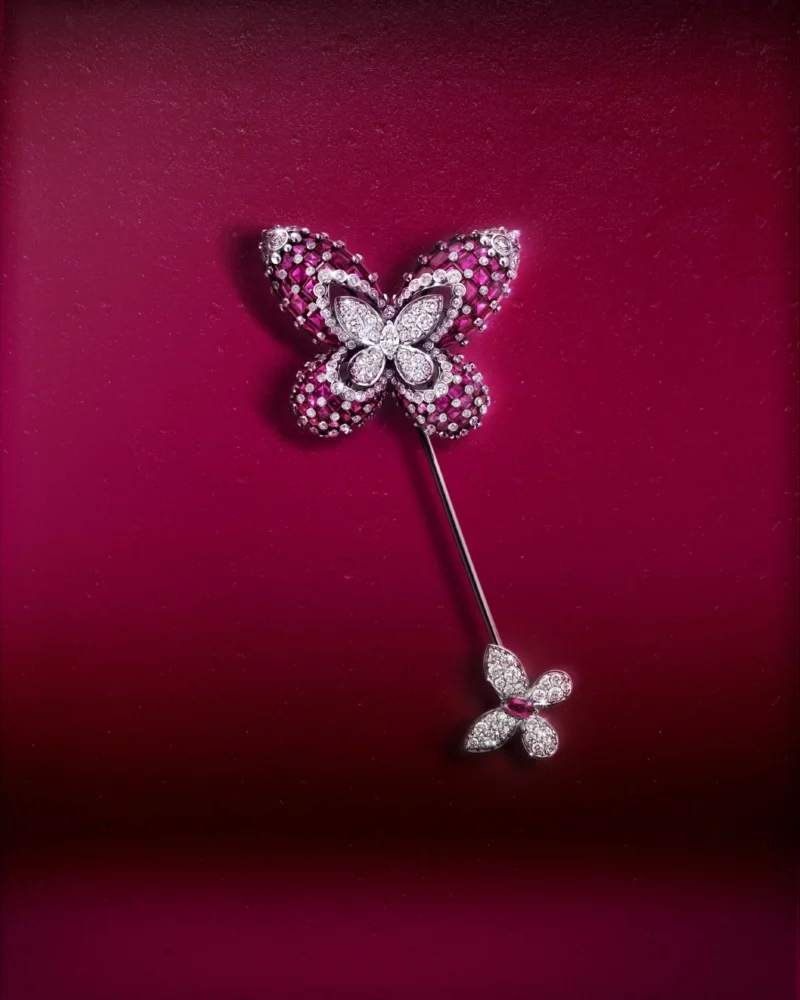
One recognisable silhouette becomes a platform for colour, volume and movement. Courtesy of Graff.
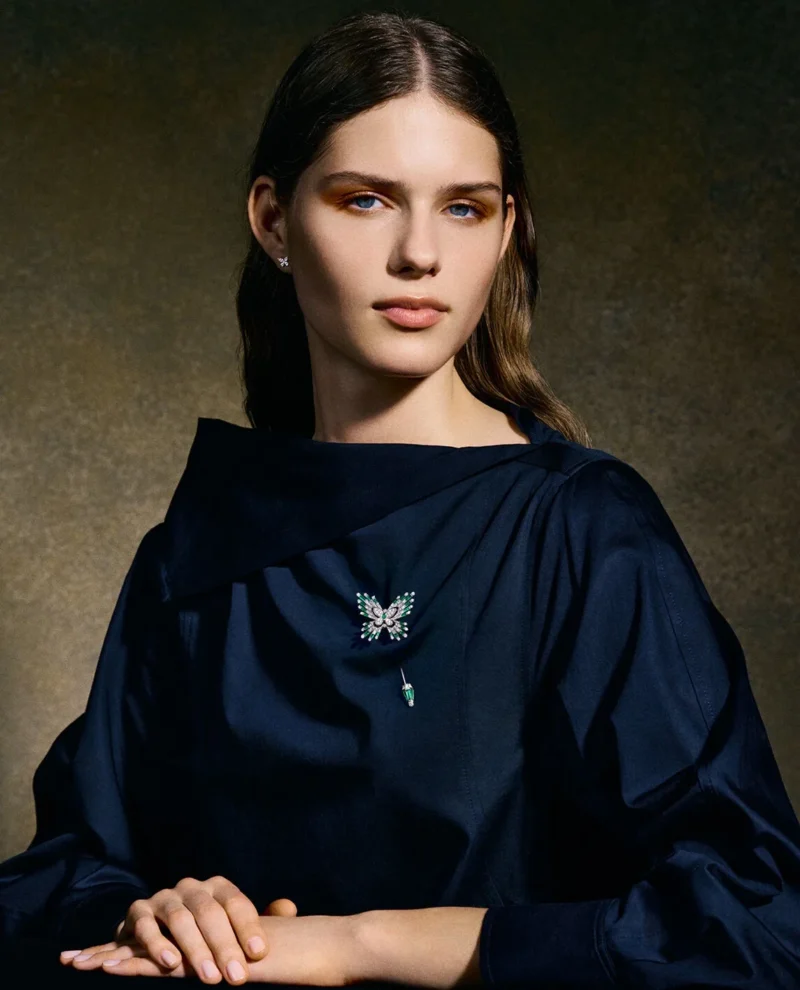
Tamara worn: the jabot-pin line establishes scale and movement on the body. Courtesy of Graff.
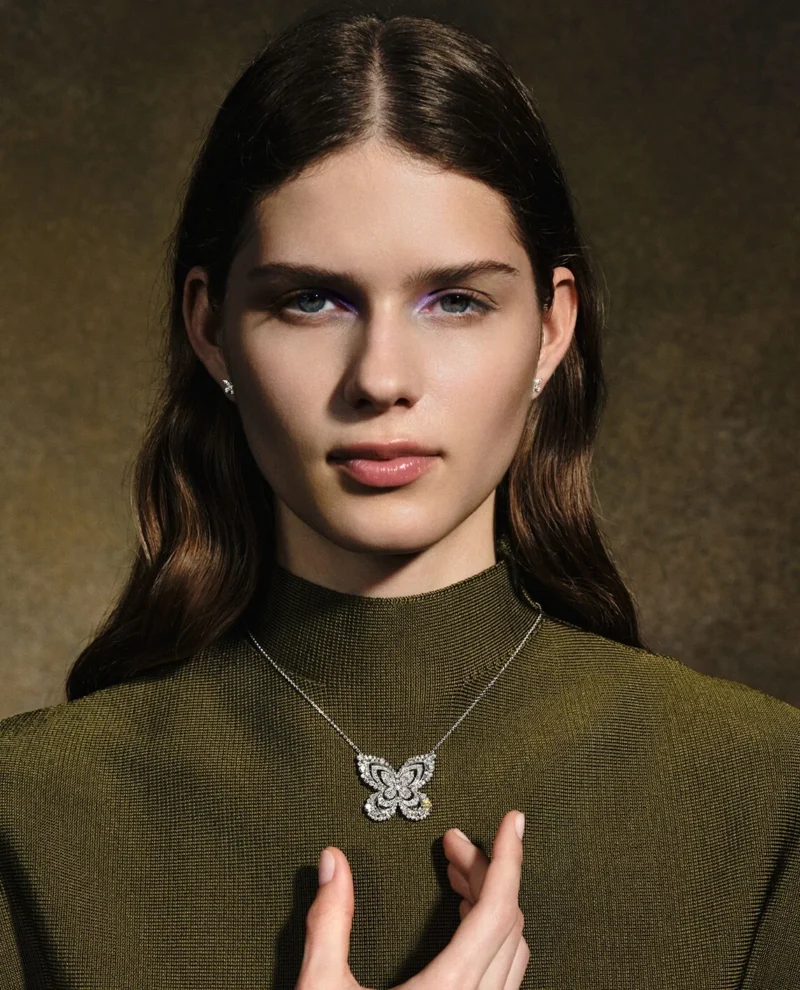
Marina in its pendant configuration, showing how transformability changes the jewel’s relationship to the body. Courtesy of Graff.
The collection’s second rule is mechanical rather than visual.
Each work is designed around a brooch format that can also be worn as a pendant, and the central butterfly is mounted en tremblant. The term is old, but the effect is immediately understandable: part of the jewel is allowed to respond to movement rather than remaining completely rigid. As the wearer moves, the butterfly shifts and catches light differently.
That changes the reading of the stones. A pavé surface fixed flat against the body offers one pattern of reflection. A moving element constantly alters the angle between stone, light and eye. The effect can be subtle, but subtlety is the point. The jewel does not need a motor or an obvious kinetic mechanism. The body supplies the energy.
The jabot-pin format also gives Graff a long vertical line to work with. The butterfly can sit high, while a second element at the tip carries the composition downward. On several pieces that terminal is another butterfly. On others it becomes a diamond, pearl or emblem. The pin is therefore doing more than holding the jewel. It creates distance, tension and a second point of focus.
Transformability adds another layer. A collector is not dealing with one frozen configuration. The brooch can become a pendant, and in at least one case the transformation goes further: Seraphina’s detachable pear-shaped diamond drop can be repositioned on the wing of the butterfly at the tip of the jabot pin. That is a small intervention, but it makes the idea of metamorphosis physical rather than thematic.
Athea and Eva: colour behaves like atmosphere
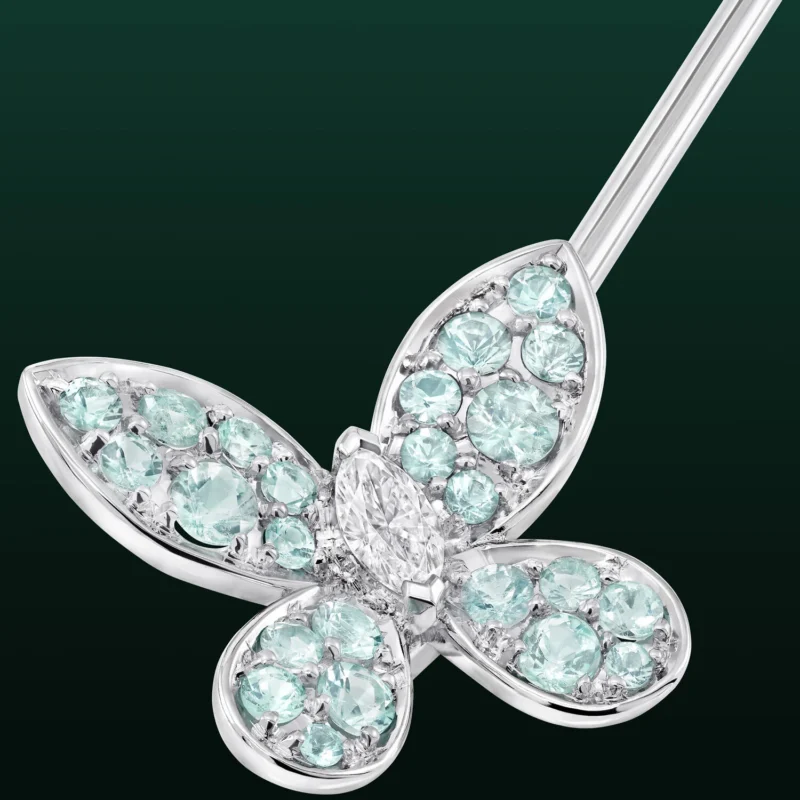
Athea, reference GP110857: Paraiba colour held in an open, airy diamond structure. Courtesy of Graff.
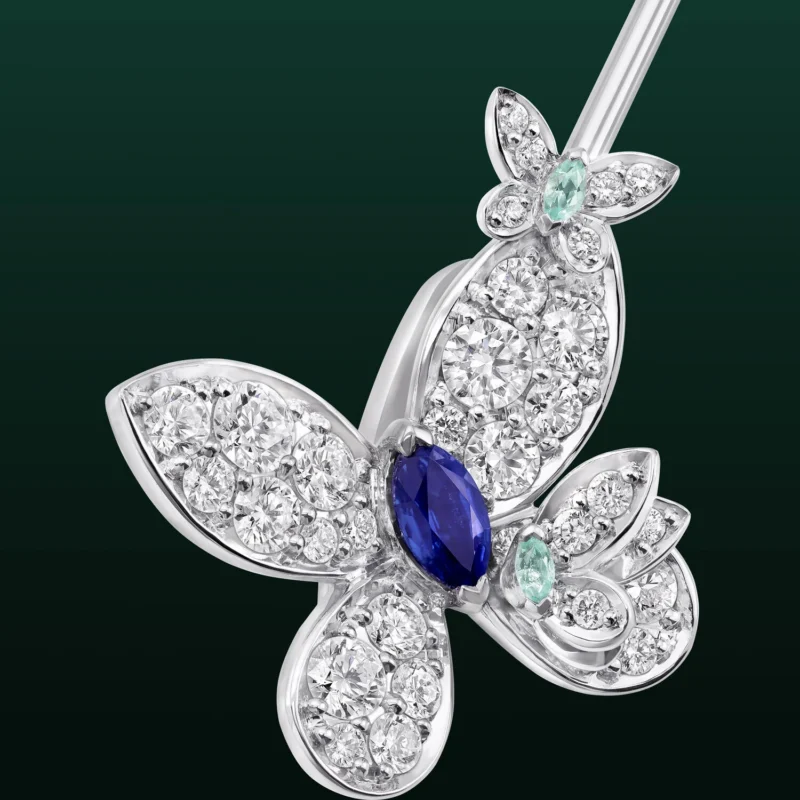
Eva, reference GP110865: a degradé composition that treats colour as atmosphere. Courtesy of Graff.
Athea and Eva are useful to read together because both use Paraiba tourmalines, but they do not use them for the same effect.
Athea is made with Paraiba tourmalines and diamonds. Graff describes the composition as light and airy, and the close-up supports that reading. The colour is not packed into a solid field. Pale electric blue-green stones are distributed through a framework of white metal and diamonds, leaving enough open structure that the butterfly appears to have depth rather than simply surface.
The smaller butterfly on the jabot pin makes the construction easier to understand. There, a marquise-cut diamond forms the centre while round Paraiba tourmalines fill the wings. It is a compact version of the larger argument: cool colour, white light and enough exposed metal to prevent the stones from becoming a flat mosaic.
Eva moves in another direction. Graff explicitly connects its degradé of sapphires, Paraiba tourmalines and diamonds to the fluid brushwork of Monet’s gardens. The important word is degradé. The piece is not using one saturated gemstone as a centre. It is using transition itself as the subject.
Blue sapphires, green-blue Paraiba tones and white diamonds allow the eye to move through colour rather than stop at it. Small butterfly forms extend along the composition toward the jabot tip, which adds a second kind of movement before the central en tremblant element has moved at all. Eva feels pictorial because its colour is organised like atmosphere rather than like a row of stones.
The two pieces show why material choice alone tells us very little. “Paraiba and diamonds” could describe both. The designs are different because the stones have been asked to perform different jobs.
Luna and Sylvie: what happens when brilliance is not the only light
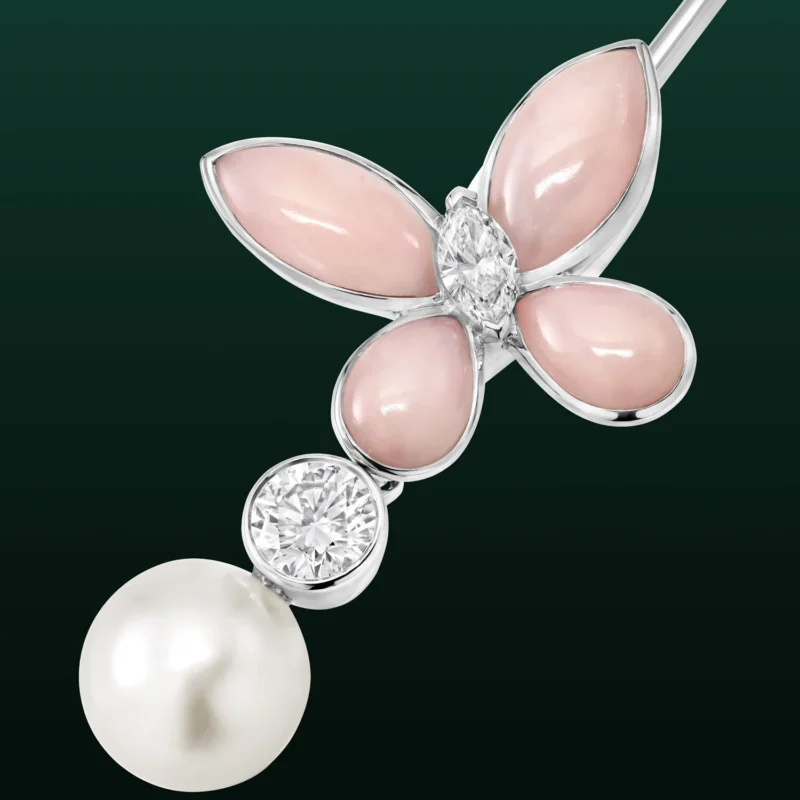
Luna, reference GP110860: pink opal and pearl replace hard brilliance with softer light. Courtesy of Graff.
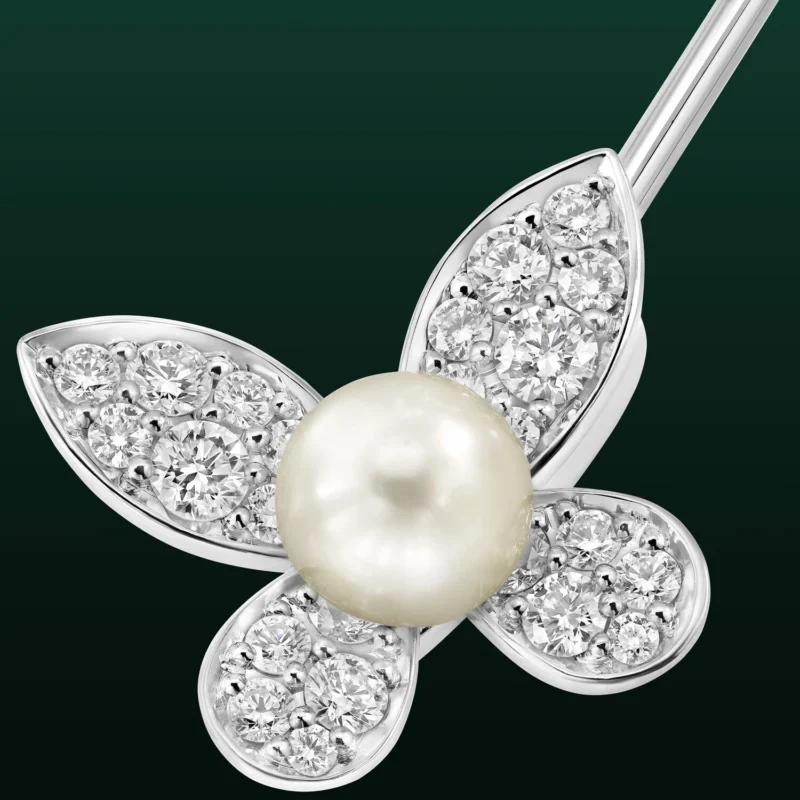
Sylvie, reference GP110861: a pearl changes the volume and centre of the butterfly. Courtesy of Graff.
Graff is strongly associated with diamonds, so Luna and Sylvie are particularly revealing. Both bring pearls into the butterfly vocabulary, and Luna adds pink opal.
Luna’s most striking element is not a faceted stone. The wings of the small butterfly at the tip of the jabot pin are formed from pink opal, and below them hangs a natural seawater pearl. The opal gives a soft, almost waxy surface where a diamond would have produced hard scintillation. The pearl below it continues that softness but with a different lustre.
That matters because it changes the tempo of the jewel. Diamond jewellery often attracts the eye through repeated flashes. Opal and pearl hold light more quietly. In Luna, the round diamonds punctuating the opal surface act almost like points of punctuation rather than the entire sentence.
Sylvie reduces the palette even further. A single pearl becomes the body of the main butterfly, with round pavé diamonds radiating across the wings. The small butterfly at the jabot tip repeats the diamond-and-pearl relationship.
The visual logic is simple, but not simplistic. The pearl is not being used as a coloured accent. It changes the geometry of the body. A sphere sits where a narrow faceted stone might normally create an axis, so the butterfly reads as softer and fuller at its centre.
Together, Luna and Sylvie show Graff allowing non-diamond surfaces to control the mood. That is valuable in a collection whose risk would otherwise be predictable brilliance.
Marina and Selene: remove colour and structure becomes visible
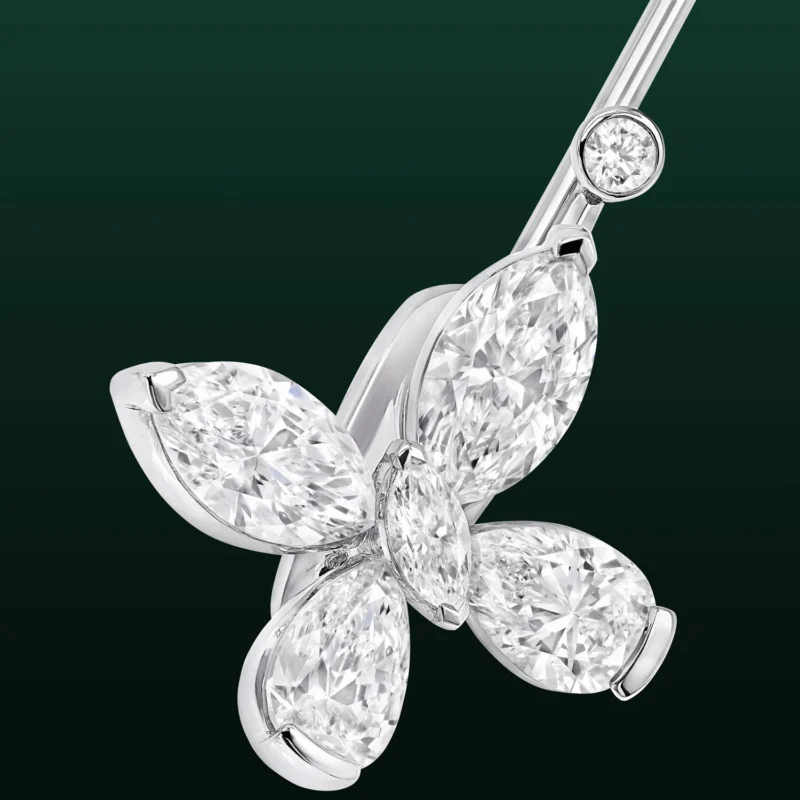
Marina, reference GP110862: diamonds build a domed field around the central motif. Courtesy of Graff.
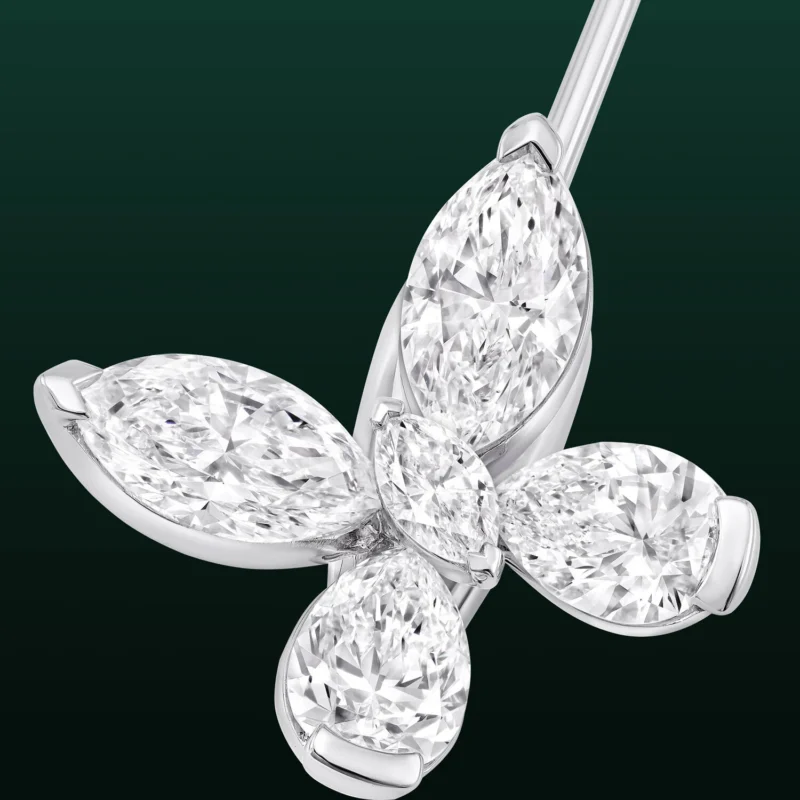
Selene, reference GP110863: black spinel turns contrast into structure. Courtesy of Graff.
Marina and Selene are almost opposites, even though both are restrained in colour.
Marina is diamond-led. A domed halo of round diamonds surrounds the butterfly, and at the tip of the jabot pin Graff returns to the house’s clean four-stone butterfly formula: two pear shapes and two marquise cuts. The main composition is about volume and concentration. The central motif appears nested inside a larger luminous body.
Selene, by contrast, uses black spinel and diamonds to strip the butterfly toward line and contrast. Black is useful in high jewellery because it can make structure legible. Where an all-diamond surface can merge into a field of reflections, black spinel gives the eye edges to follow.
Graff describes Selene as pared back, and that description is fair. It is not minimal in the ordinary sense, because the object remains highly worked, but its logic is economical. Dark surfaces make the white diamonds feel sharper. The four-stone butterfly at the pin tip is especially clear, almost like a diagram of the Graff motif.
Placed together, Marina and Selene make a good lesson in why “white diamond” is not a style. Marina uses diamonds to build volume. Selene uses diamonds against black spinel to build outline.
Seraphina and Lina: saturated colour without losing the butterfly
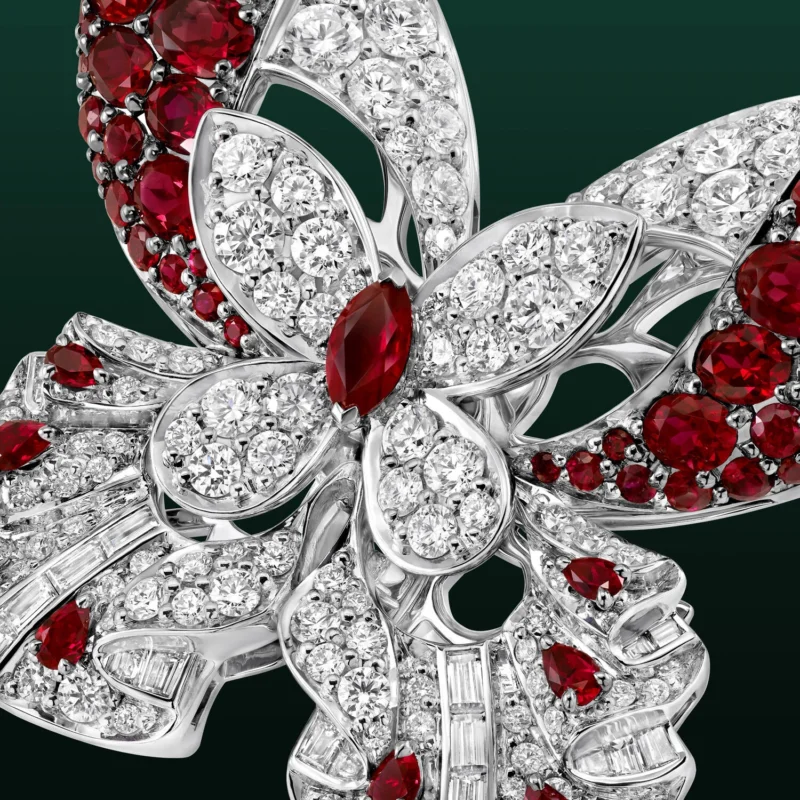
Seraphina, reference GP110858: ruby colour remains legible through a white-diamond framework. Courtesy of Graff.
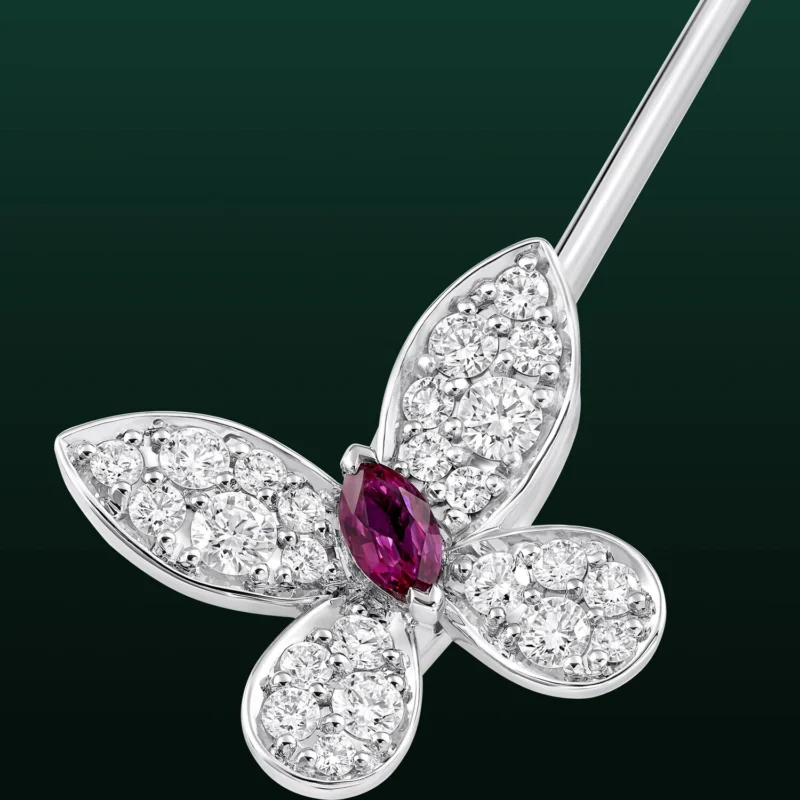
Lina, reference GP110859: pink sapphires form a continuous field edged by diamonds. Courtesy of Graff.
Red and pink can easily overwhelm a small figural motif. Seraphina and Lina avoid that in different ways.
Seraphina uses rubies and diamonds, with a detachable pear-shaped diamond drop. The rubies create strong areas of colour, but the white diamond structure keeps the butterfly legible. That separation is important. Without it, the red could become a single mass and the insect would disappear into the gemstone field.
The movable pear-shaped diamond is also the piece’s most intelligent detail. It can be detached and worn on the wing of the ruby-and-diamond butterfly at the jabot tip. A component that could have been decorative becomes functional in the transformation system.
Lina takes pink sapphire as its dominant colour. Graff describes intense pink sapphire wings punctuated by diamonds, with pavé lines tracing the inner edges. The small butterfly at the jabot tip uses a marquise-cut pink sapphire with pavé diamonds.
The difference from Seraphina is in distribution. Seraphina reads as a sharper dialogue between red and white. Lina reads more as a continuous coloured surface with diamonds used to draw and edge it. Both preserve the same family resemblance, but they arrive there through different setting logic.
Flora and Daphne: the butterfly becomes botanical
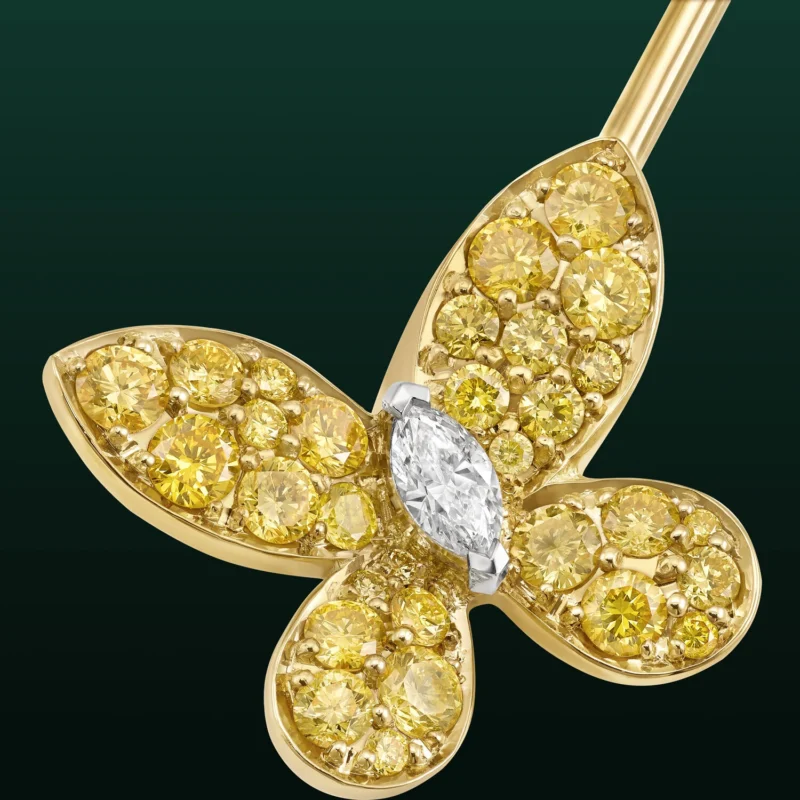
Flora, reference GP110864: yellow and white diamonds move between butterfly and flower. Courtesy of Graff.
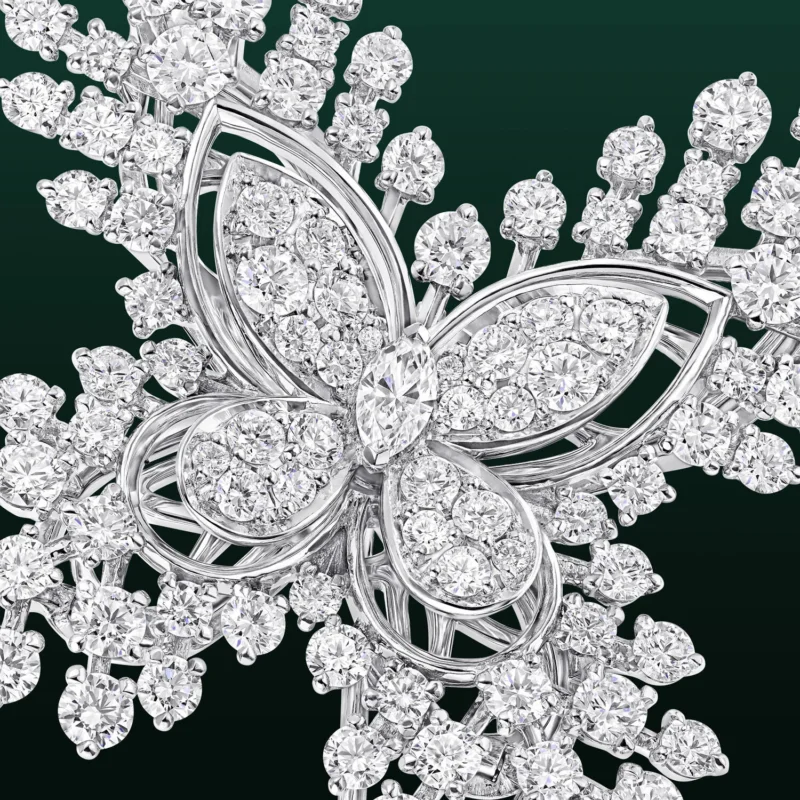
Daphne, reference GP110867: branches, blossoms and butterfly resolve into one construction. Courtesy of Graff.
Flora and Daphne are the clearest examples of the butterfly motif being absorbed into another natural vocabulary.
Flora uses yellow and white diamonds to move between butterfly and flower. White diamond flowers appear across the design, each anchored by a yellow diamond, while the centre develops yellow diamond wings around a floral emblem. The terminal butterfly is also yellow-diamond-led.
The piece is not trying to decide whether it is a flower or an insect. That ambiguity is the design. Both rely on radial symmetry, petals and wings share similar visual rhythms, and yellow stones allow Graff to move between the two without a hard boundary.
Daphne is more structural. White-gold branches open into diamond blossoms and then resolve into the form of a butterfly. It is almost a diagram of growth. Instead of placing flowers onto an existing butterfly, the branch network becomes part of the route by which the butterfly appears.
There is an important difference here between figurative jewellery and literal jewellery. Literal jewellery simply reproduces a recognisable thing. Daphne works because the eye has to complete the transformation. The butterfly emerges from the botanical structure rather than sitting on top of it.
Tamara and Freya: the house at full gemstone volume
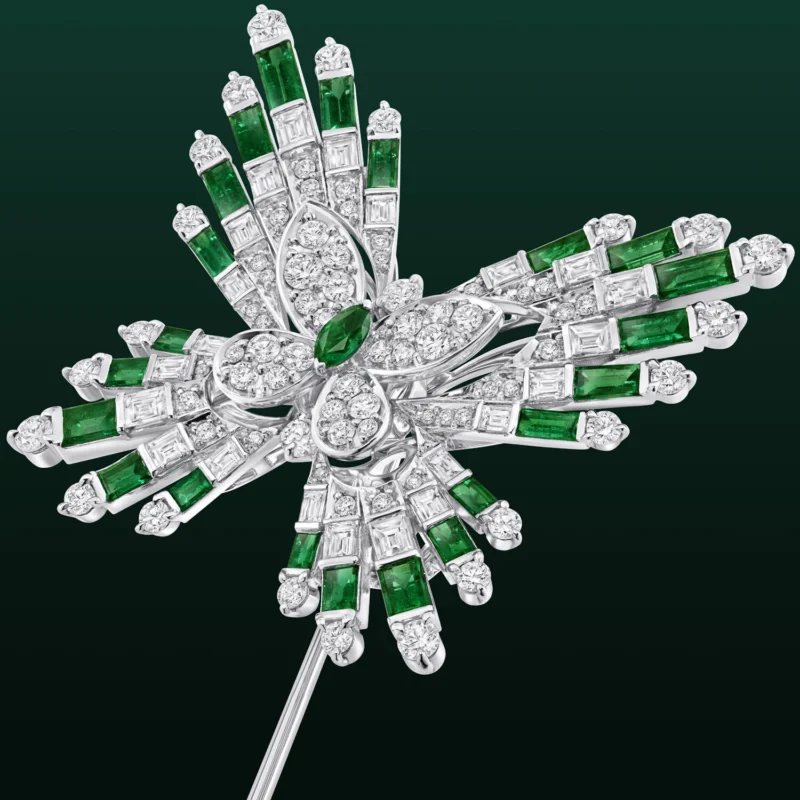
Tamara, reference GP110866: emerald geometry radiates from the butterfly at the centre. Courtesy of Graff.
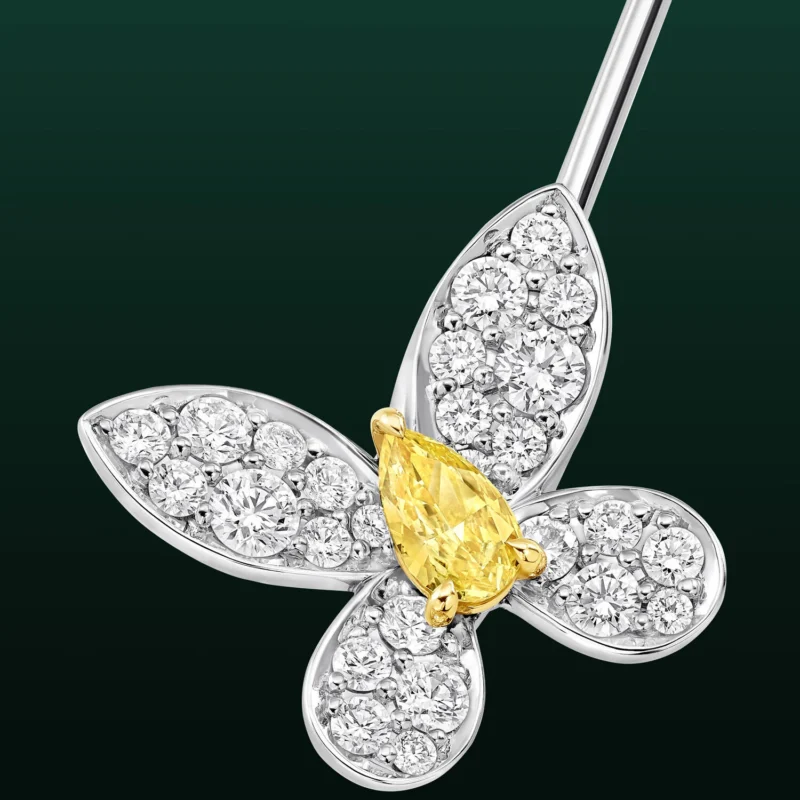
Freya, reference GP110868: saturated yellow diamonds concentrate the house’s gemstone language. Courtesy of Graff.
Tamara and Freya bring the collection back to materials most strongly associated with Graff’s public identity: emeralds and exceptional yellow diamonds.
Tamara uses emeralds and diamonds in radiating lines around a central butterfly with a marquise-cut emerald. The arrangement pushes outward from the centre, giving the jewel a burst-like geometry. Baguette and round diamonds separate the green segments, so colour and white light alternate rather than blending.
The effect is graphic, almost architectural. The butterfly is still visible at the centre, but it also becomes the point from which the whole composition expands.
Freya uses Fancy Vivid Yellow and white diamonds. Graff says the yellow diamonds were selected by the Graff family for saturation and intensity. The small butterfly at the jabot tip is white diamond pavé centred by a pear-shaped yellow diamond.
This is perhaps the most immediately recognisable Graff language in the set. Yellow diamonds have long been a major part of the house’s identity, and Freya does not try to disguise that history. What keeps it from becoming a simple gemstone showcase is the contrast between the concentrated yellow centre and the white-diamond butterfly form around it.
Tamara and Freya are the pieces most likely to be reduced to gemstone headlines. That would be a mistake. Their stones matter, but their construction explains why the colour has authority.
Twelve designs, one collector problem: what exactly belongs to the object?
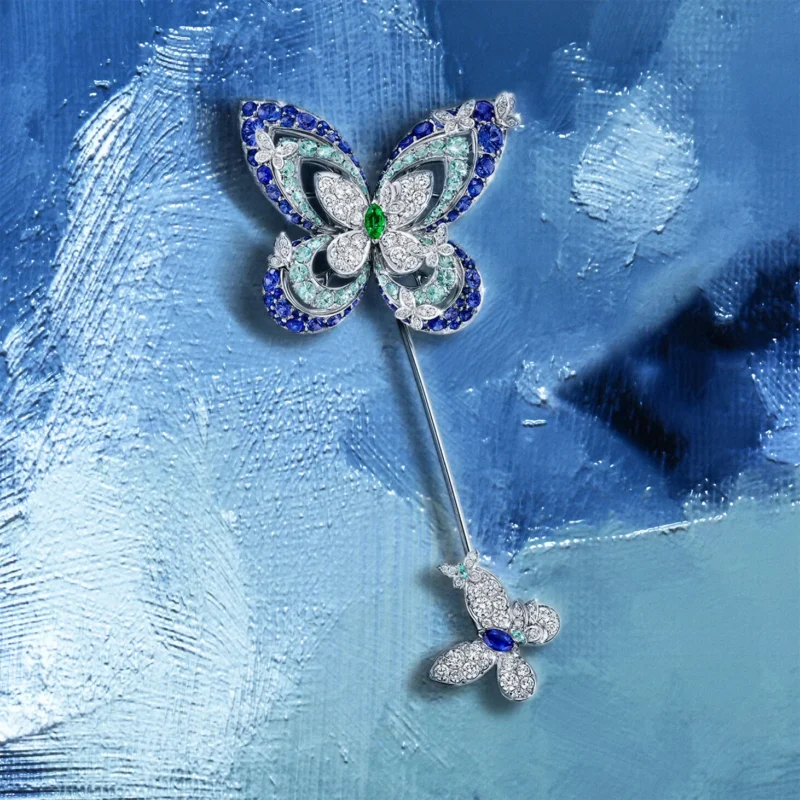
The motif survives twelve changes because the construction, not repetition alone, holds the family together. Courtesy of Graff.
Transformable jewellery asks more from an owner than a fixed brooch does.
A piece can have a jabot pin, detachable elements, a pendant configuration and specific fittings that allow each mode to work. From a collecting perspective, those parts are not accessories in the casual sense. They belong to the identity and completeness of the object.
That makes documentation unusually important. A future owner should be able to establish which elements were supplied with the jewel, how each configuration is intended to be assembled, and whether any component has been replaced or modified. The same principle applies to condition. A moving en tremblant element should be assessed not only for stone security and surface wear but for the behaviour of the moving joint itself.
None of this implies fragility or a defect. It simply recognises that movement and transformation create more states in which a jewel can exist. The collector’s file should be able to follow them.
Graff’s official product pages also make the reference numbers useful here. The 12 designs form a clean sequence from GP110857 through GP110868. That numerical continuity is a practical anchor for an otherwise visually diverse group.
What the series adds to Graff
Graff already has plenty of reasons to be discussed through stones alone. That is precisely why Artistry in Motion is interesting. It shifts attention from the size or rarity of a single gem toward the problem of design consistency.
The house has taken a motif that could easily have become self-referential and put it under pressure. Colour changes. Materials change. The butterfly can be graphic, botanical, almost monochrome, painterly or strongly gemstone-led. It can sit within a dense halo or appear as a small, nearly schematic four-stone sign. It can move. It can detach. It can be worn in more than one way.
The collection does not need every reference to appeal equally. In fact, it is stronger because they do not. A repeated motif should expose different preferences. Someone drawn to Luna’s opal and pearl softness may have little interest in Tamara’s emerald geometry. A collector who finds Freya too declarative may respond to Selene’s black-and-white restraint.
That range is evidence of a design system doing real work.
The most convincing result is not that Graff can make twelve butterfly brooches. It is that, after twelve, the butterfly still has somewhere else to go.
Sources & further reading
- Graff, official Artistry in Motion collection presentation and the twelve referenced product records.
- Object names, reference numbers, materials and transformable functions were checked against Graff’s public pages on 7 September 2026.
- No hands-on inspection, private appointment or atelier access is claimed.
The Edit
Jewelry stories
Selected stories from the same editorial universe.
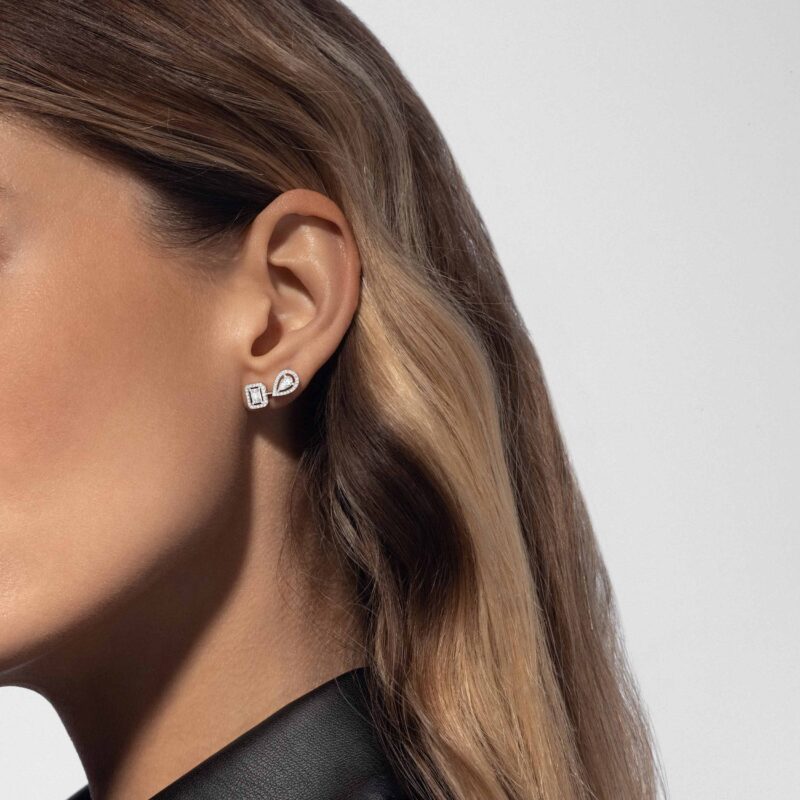
Messika My Twin: Two Cuts, One Bridal Look
An emerald cut, a pear and an unequal pair: the small asymmetry of Messika
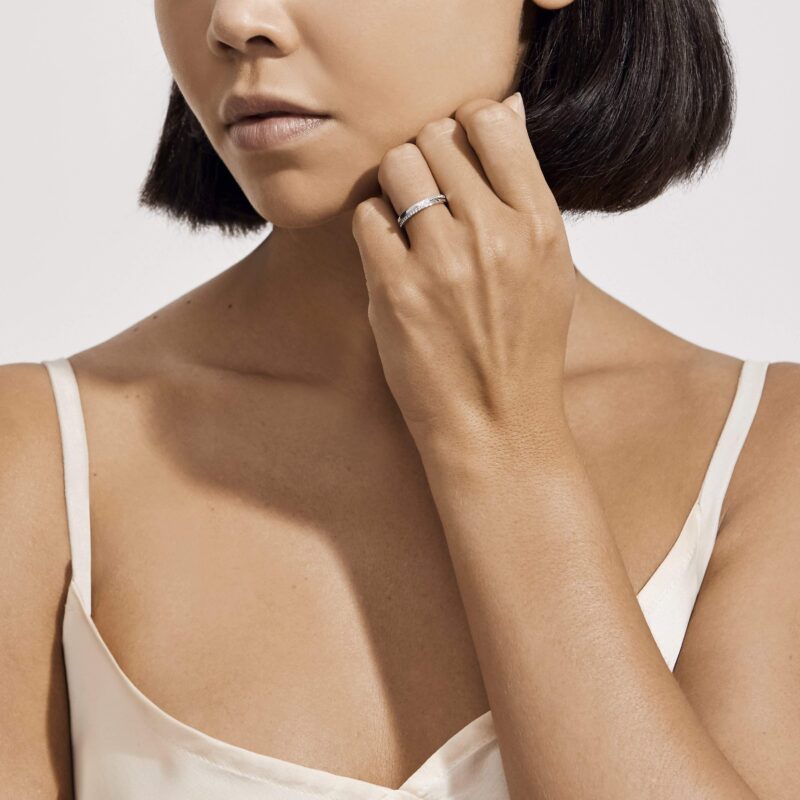
Two Rings, Two People: A De Beers Wedding-Band Edit
A rose-gold court profile, a single diamond in platinum, a fine eternity line or
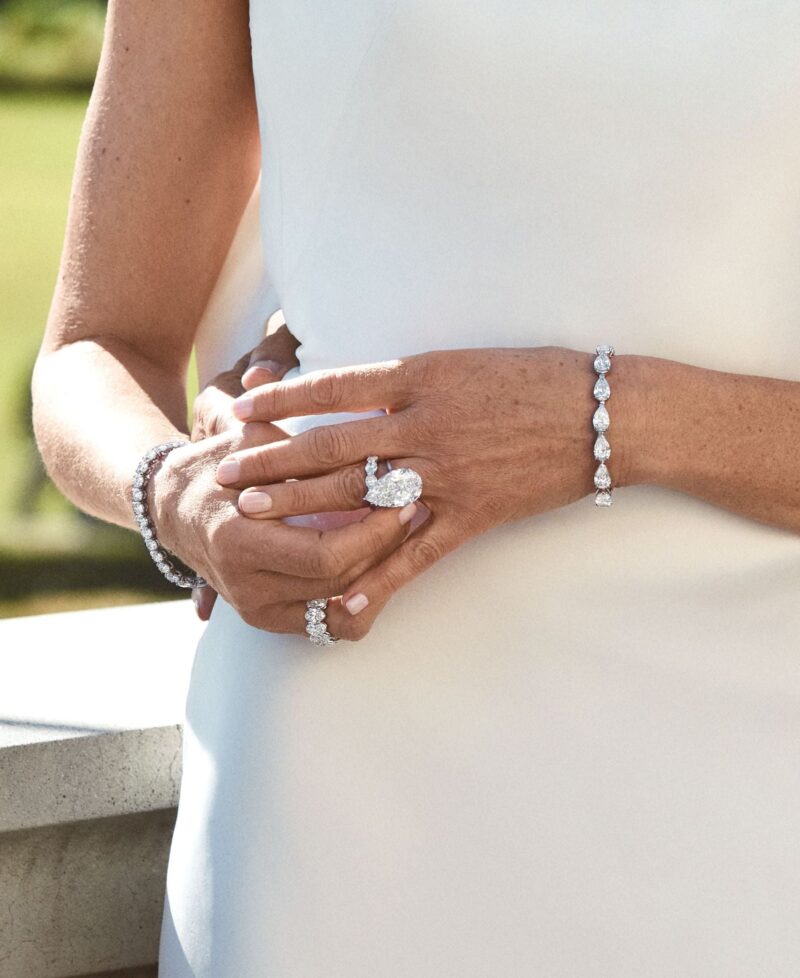
Norman Silverman Bridal: A Ring with Presence
A pear solitaire on the hand, a radiant seen in profile and an emerald-cut
Harry Winston Beyond the Ring: Choosing the Wedding-Day Jewels
The engagement ring does not have to carry the whole wedding look. Harry Winston’s
L’éclat Solaire: Mikimoto Turns Pearl Light into Colour
A pearl collar, a commanding green centre and a fan of descending strands give
The Shape of a Promise: Reading Graff Engagement-Ring Silhouettes
Choosing a Graff Promise ring becomes clearer when you read the whole silhouette: round,