
TheTimeo / Jewelry
The shape
of a promise.
Choosing a Graff Promise ring becomes clearer when you read the whole silhouette: round, oval and pear centres change character beside tapered baguette or pear-shape side stones.
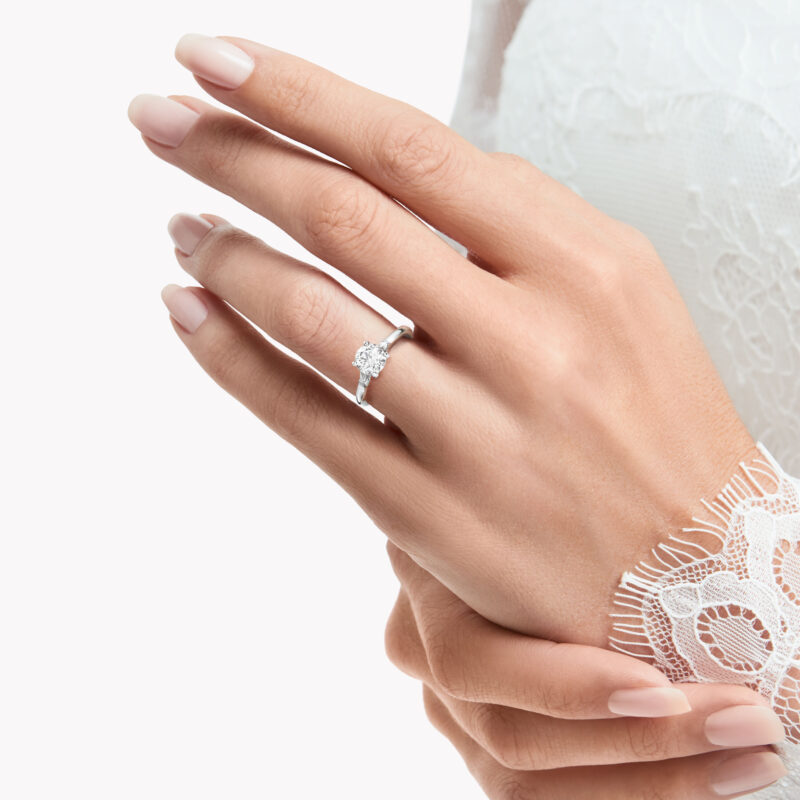
Graff Promise RT01 pairs a round centre diamond with tapered baguette side stones in platinum.
Explore the story
Choosing between two rings with the same centre cut can feel more personal than a list of diamond specifications suggests. In Graff's Promise collection, a round centre with tapered baguette side stones does not read like the same round centre with pear-shape sides. The centre remains the focus, but the outline around it changes, and with it the character of the whole ring.
That makes Promise useful for a bride who is still discovering what she is drawn to. Hold the centre shape steady, change the shoulders, and the difference becomes easy to see. Across the current platinum references considered here, round, oval and pear centres appear with either tapered baguette or pear-shape side stones. There is no universal best combination. The point is to recognise the silhouette that keeps your attention.
A promise on the hand
Graff Promise RT01 pairs a round centre diamond with tapered baguette side stones in platinum.
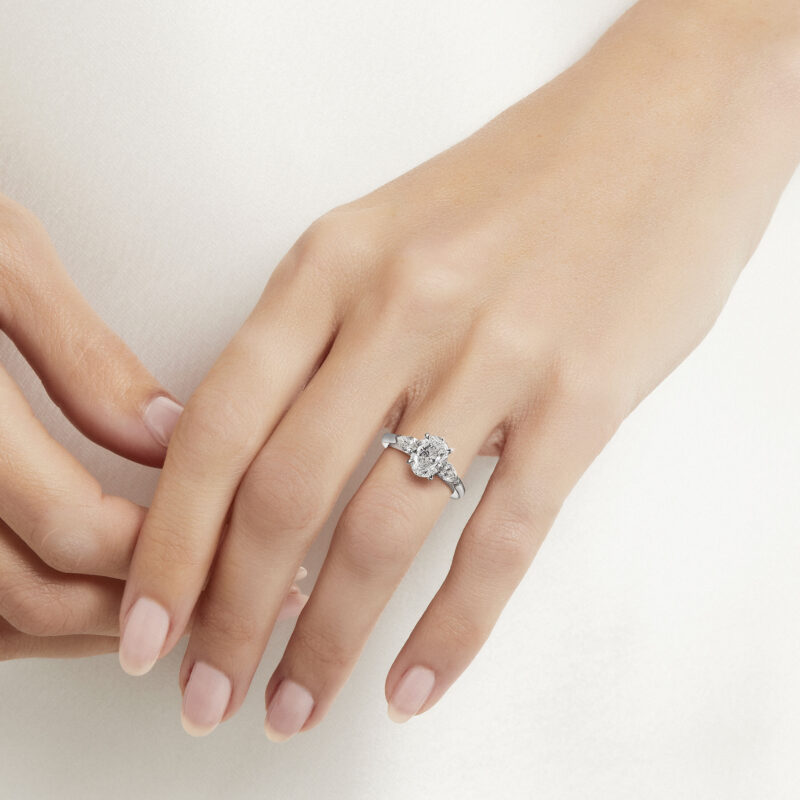
The Promise silhouette is read as a complete ring, not only as a centre-stone shape.
Round with tapered baguettes. Oval with pear-shape sides. Two Promise silhouettes, returned to the hand.
Look at the whole ring first
It is tempting to begin with the centre diamond alone. Promise rewards a wider view. From the front, the centre stone, the two side stones and the visible shoulders form one composition. Change the side stones and the same centre category can feel cleaner and more linear, or more visibly three-stone.
Six references make that comparison especially clear:
Explore the comparison
| Centre shape | Tapered baguette sides | Pear-shape sides | A useful visual question |
|---|---|---|---|
| Round | RT01 | RP01 | Do you prefer a circular centre framed by straight-edged sides or by two small pointed pear forms? |
| Oval | OT01 | OP01 | Do you prefer the oval against tapered straight-edged sides or beside pear shapes that add their own points? |
| Pear | PT01 | PP01 | Do you prefer contrast between a pointed centre and baguette sides, or a repeated pear-shape vocabulary across all three stones? |
These are design references, not photographs calibrated to a common physical scale. Graff states that size, carat weight and stone qualities can vary from one ring to another. That matters when comparing images: the photographs can show the design relationship, but they should not be used to claim a universal centre-to-side size ratio.
Round: the centre stays calm while the shoulders change
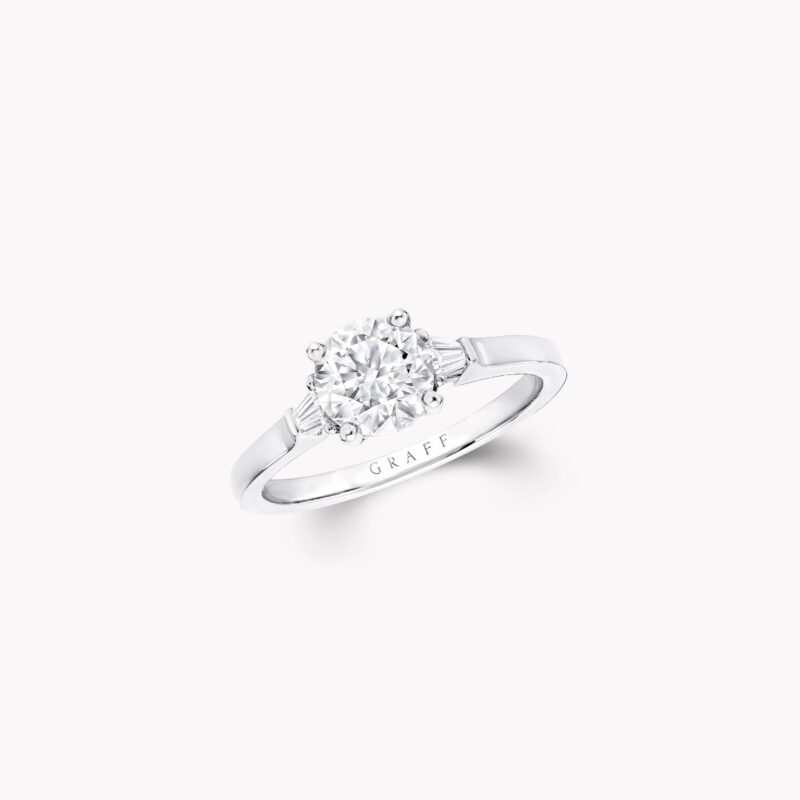
RT01: round centre, tapered baguette side stones.
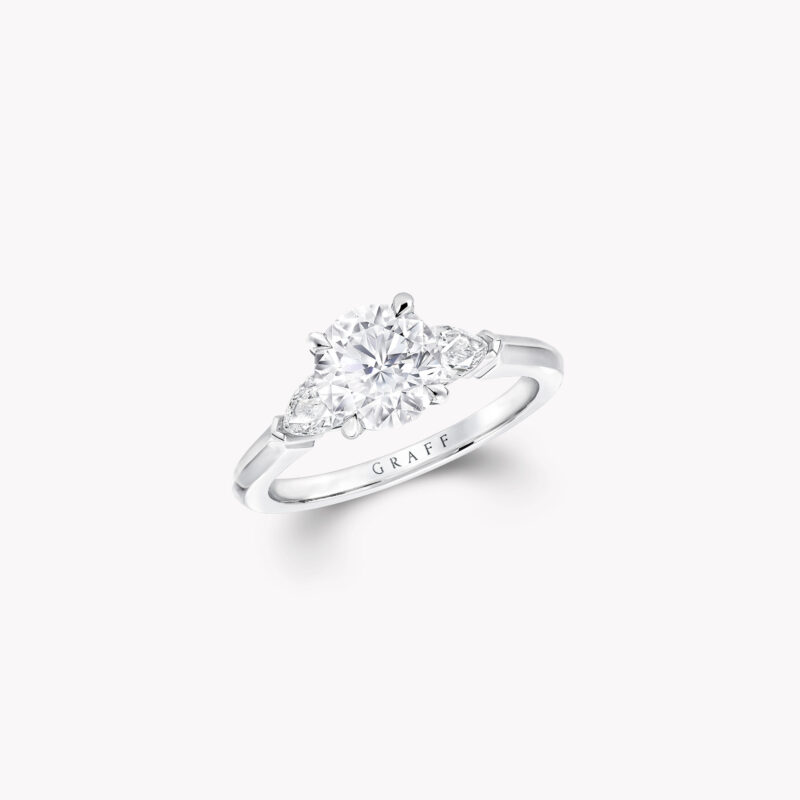
RP01: round centre, pear-shape side stones.
The round centre in RT01 is bordered by tapered baguette side stones. Their straight edges give the shoulders a crisp, graphic quality, so the circular centre reads against a more linear frame.
RP01 changes only the side-stone family in this comparison. Pear-shape diamonds bring rounded bodies and pointed tips beside the same round-centre idea. The ring becomes easier to read as a three-stone composition because the side stones announce their own silhouettes more strongly.
For a future bride, this is a useful distinction because it does not ask whether round is "right" for her hand. It asks a simpler and more personal question: does she keep returning to the clarity of the round centre against straight-edged shoulders, or to the added shape and movement of the pears at either side?
Oval: a continuous curve, then two different ways to frame it
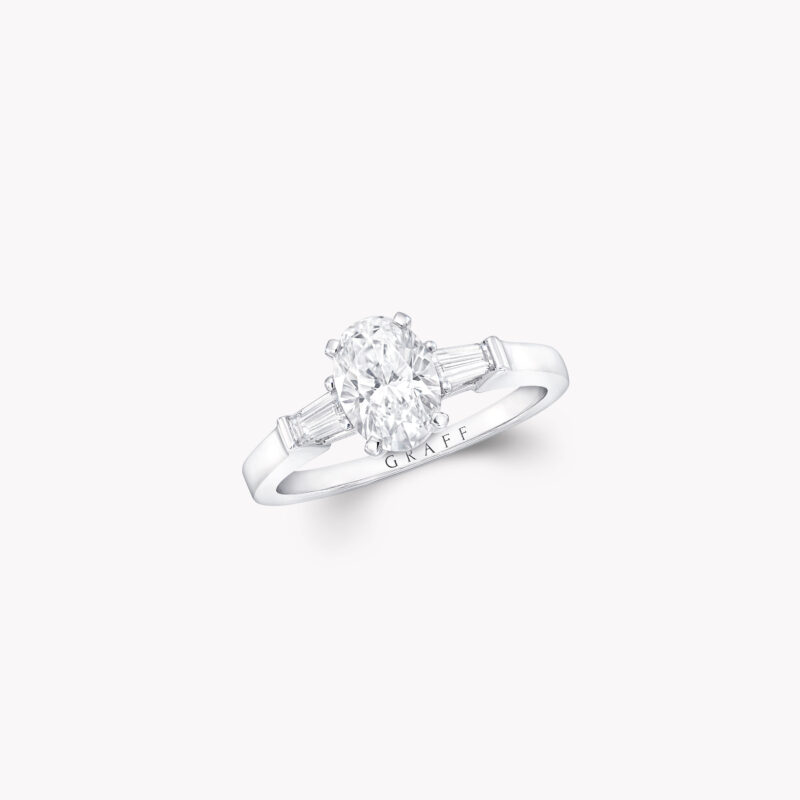
OT01: an oval centre with tapered baguette sides, broader beside the centre and narrowing towards the band in this photograph.
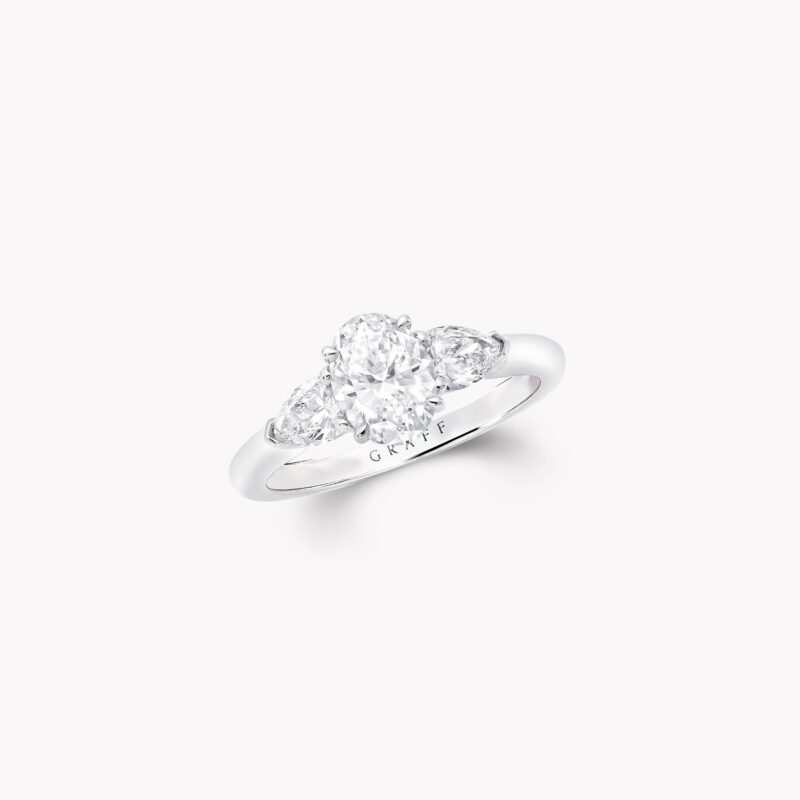
OP01: a continuously curved oval centre beside pear-shape side stones with pointed tips.
An oval centre has an elongated, continuously curved outline. It has no pointed tip. That sounds obvious, but it matters when comparing OT01 with OP01 because the side stones change the vocabulary around that curve.
In the official photograph of OT01, each tapered baguette presents its broader end beside the oval centre and narrows as it moves outward towards the band. The visual effect is a strong meeting point beside the centre followed by a cleaner taper into the shoulder. This is an observation from the photographed OT01 configuration, not a measurement claim about every ring made under the reference.
OP01 keeps the oval centre but replaces those baguettes with pear-shape side stones. The oval remains a continuous curve; the side pears are the forms that introduce pointed tips. That difference makes the sides more individually legible without turning the oval itself into a pointed shape.
This is where an exact worn photograph becomes especially helpful. It lets you see the complete composition on a real hand and judge its presence as an object rather than as an isolated product cut-out. It does not tell you how the ring will fit, feel or flatter another person's hand. It simply gives the silhouette a human context.
Pear: decide whether you want contrast or repetition
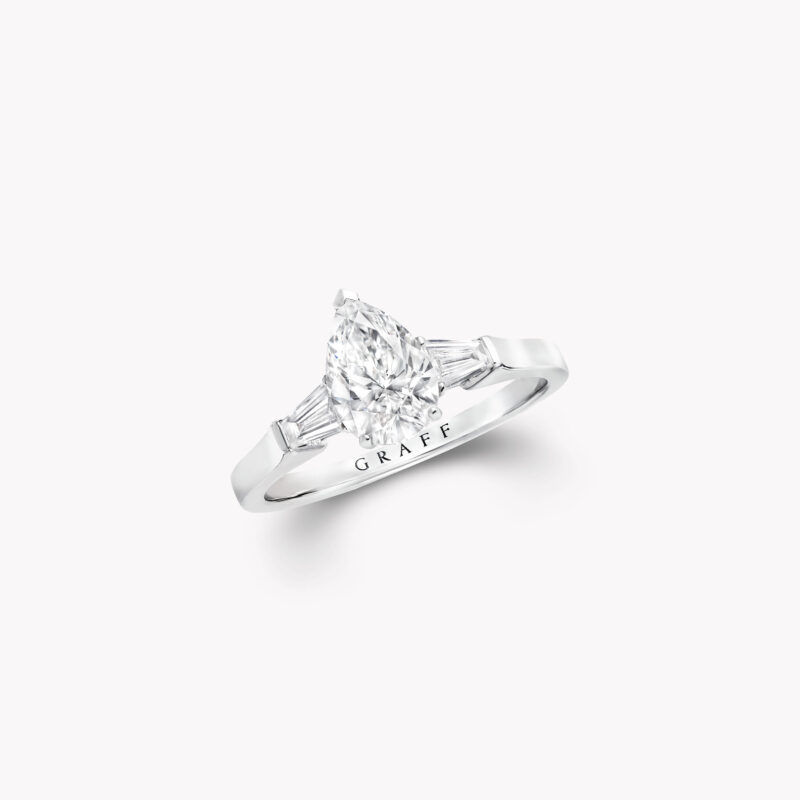
PT01: pear centre, tapered baguette side stones.
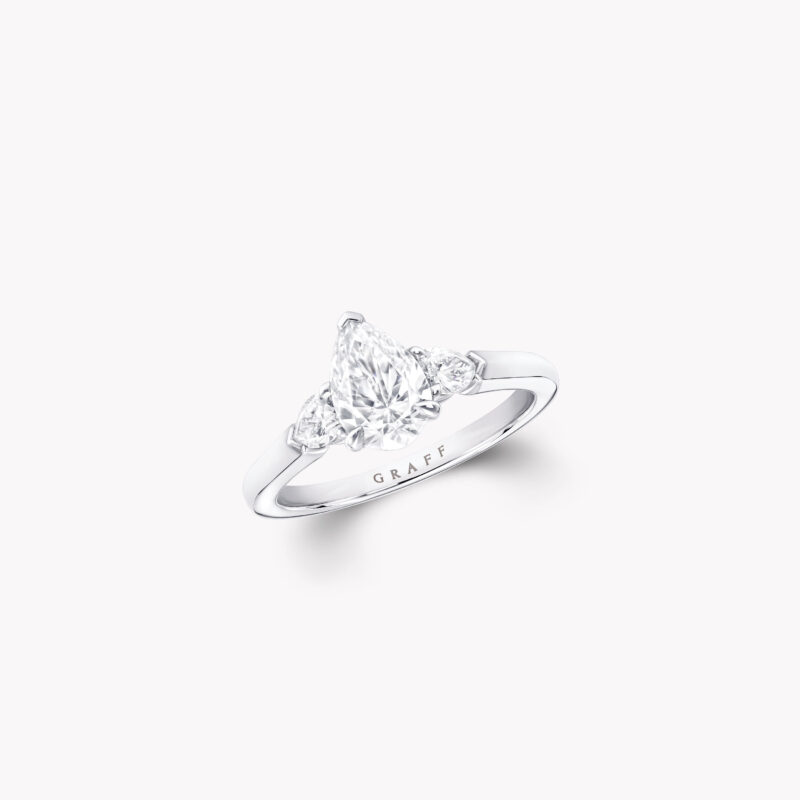
PP01: pear centre, pear-shape side stones.
A pear centre already combines a rounded end with a pointed end, so its direction is built into the outline.
PT01 places tapered baguette side stones beside that pear centre. The straight-edged baguettes contrast with the centre's rounded-and-pointed silhouette, keeping the pear visually distinct from its shoulders.
PP01 uses pear-shape side stones instead. Here the centre and sides share the same basic family of curves and points, even though the individual stones in photographed examples should not be treated as universally scale-matched. The repetition is visual rather than numerical: a pear-shaped centre is answered by pear-shaped stones at either side.
If you find yourself drawn to the pear centre, this comparison can clarify what you actually love about it. You may prefer to let its outline stand apart from straighter side stones, or you may enjoy seeing that pointed language echoed across the three-stone composition.
What the side stones change
Tapered baguettes and pear-shape sides do more than fill space beside a centre diamond.
The baguette variants bring straight edges into the composition. On OT01, the official photograph makes their orientation particularly readable: wider beside the oval, narrower towards the band. Across the comparison, baguettes add linear geometry beside the centre shape.
Pear-shape side stones add curved bodies and pointed tips. Beside a round centre, they create a clear contrast of circle and point. Beside an oval, they place pointed forms around a centre that remains smoothly curved. Beside a pear centre, they repeat the same broad shape family.
Graff describes Promise side stones as individually matched to the centre diamond by a member of the Graff family. That is the maison's account of how the stones are brought together. For the bride looking at the finished ring, the useful result is visual: the centre and the shoulders should be read as one relationship.
Let the worn images answer only what they can
The Promise silhouette is read as a complete ring, not only as a centre-stone shape.
The official worn photographs are among the most valuable images in this story because they return the ring to a person. They show how much visual presence the three-stone composition has when it is no longer floating on a white background.
They are also easy to over-read. A photograph cannot prove comfort, fit or the effect of another carat weight on another hand. Graff's own product pages note that size, carat weight and stone qualities can vary. The worn frame is therefore best used for presence, not prescription.
For a bride choosing slowly, that is enough. Look at the complete ring. Notice whether your eye stays with the centre or travels across all three stones. Notice whether you respond to the clean line of baguettes or to the extra curves and points of pear-shape sides. Then return to the exact ring you are considering, because its individual stones will determine its particular proportions.
The silhouette you recognise as yours
Round, oval and pear are useful names, but they do not finish the choice. Within Promise, each becomes a different ring when the shoulders change.
RT01 and RP01 show how a round centre can sit between straight-edged baguettes or pointed pear sides. OT01 and OP01 show an oval's continuous curve framed first by tapered linear stones and then by pear shapes with their own points. PT01 and PP01 let a pear centre either contrast with baguettes or repeat its shape language through the side stones.
None of those pairings needs to win. The more useful outcome is recognition. When one complete silhouette feels more like the ring you want to keep seeing on your own hand, the comparison has done its job.
Sources & further reading
- Graff Promise collection
- Graff Promise round, tapered baguette sides, RT01
- Graff Promise round, pear-shape sides, RP01
- Graff Promise oval, tapered baguette sides, OT01
- Graff Promise oval, pear-shape sides, OP01
- Graff Promise pear, tapered baguette sides, PT01
- Graff Promise pear, pear-shape sides, PP01
The Edit
Jewelry stories
Selected stories from the same editorial universe.
Why Wedding Bands Do Not Always Sit Flush—and Why That Can Be Better
A visible gap is not automatically a design failure. Profile, basket, shoulders and movement
Reset, Resize or Restore? A Better Future for an Heirloom Ring
An inherited ring can become wearable again without making its earlier life illegible. The
Beyond the 4Cs: Choosing an Engagement Ring for Everyday Life
The diamond report is only half the decision. Height, setting, shoulders, sizing and the
Boucheron Human Being: One Shape, Five Ways of Making It
Rain, Flower, Light, Tattoo and Checkers repeat one high-jewellery silhouette while changing material, technique,
One Butterfly, Twelve Constructions: How Graff Turns a Motif into High Jewellery
Graff holds one butterfly silhouette still, then changes colour, volume, surface and movement across
The Signed Vintage Engagement Ring: A Collector’s Guide to Provenance and Fit
A signature narrows the field, but maker evidence, stone reports, alterations, condition, provenance and