
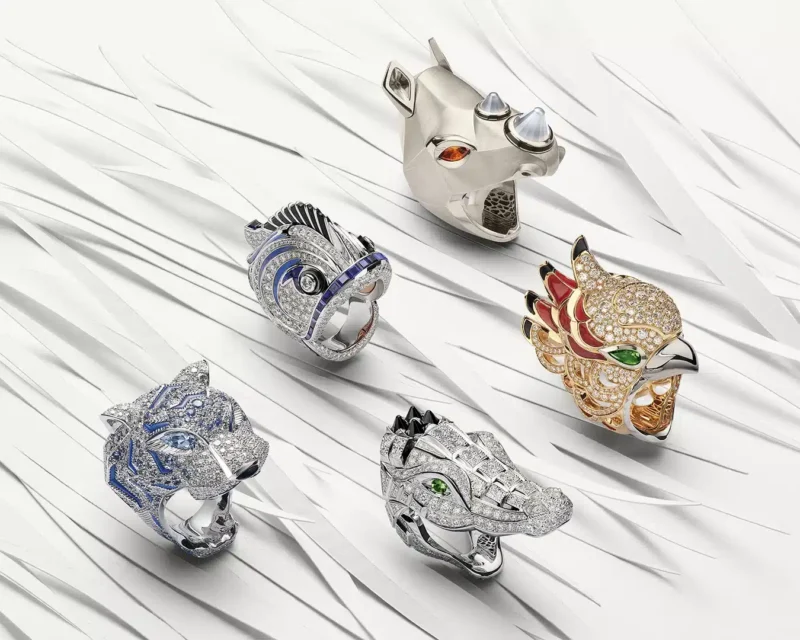
Fauna Intelligence / Anatomy Study
Jewelry
Cartier Into the Wild 2026: How Do You Make a Jewelled Animal Look Alive Without Copying It?
Tiger, parrot, carp, crocodile and rhinoceros push Cartier into five craft problems, from hardstone carving to articulated jaws and hidden clasps.
TheTimeo view
The animal is specific. The movement is abstract.
The five portraits matter less as a zoological inventory than as five different craft problems. Each animal asks another material to carry recognition; the larger pieces then ask movement to carry life.
Keep the species. Change the chromatic rules.
TheTimeo editorial reading
The visual edit
Five species. Five material problems.
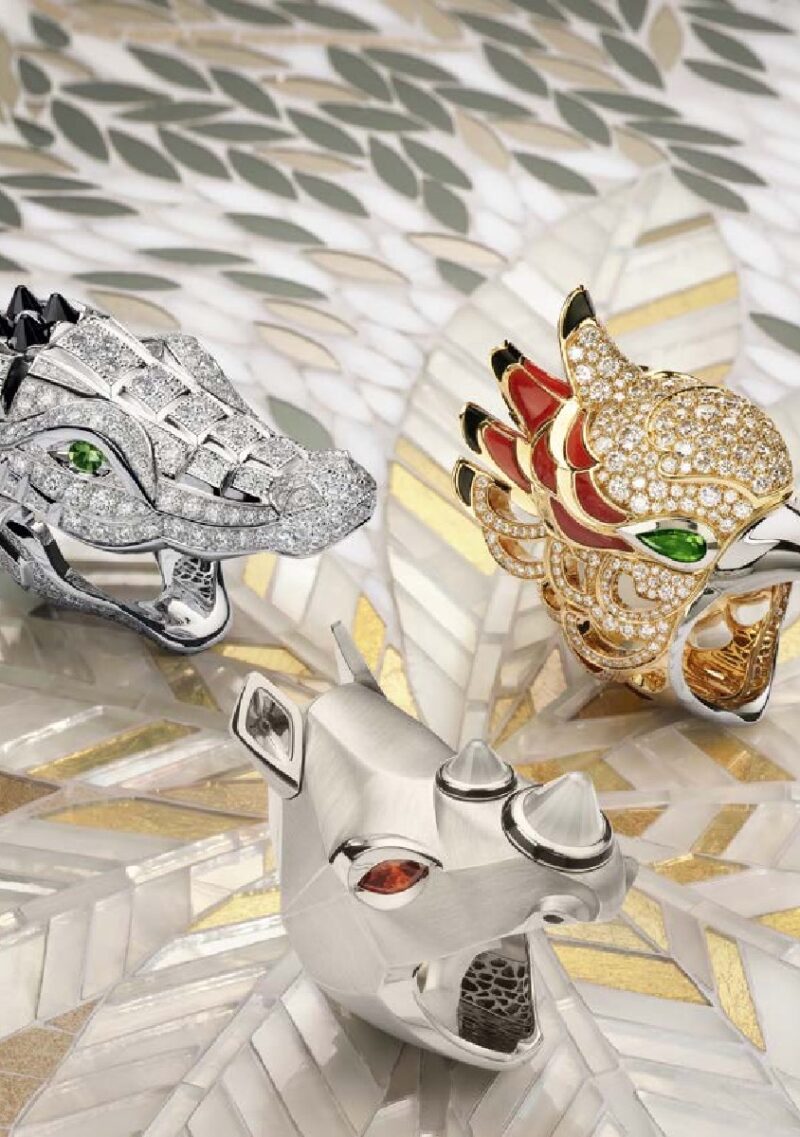
Crocodile, parrot and rhinoceros show three different relationships between silhouette, colour and surface. © Cartier.
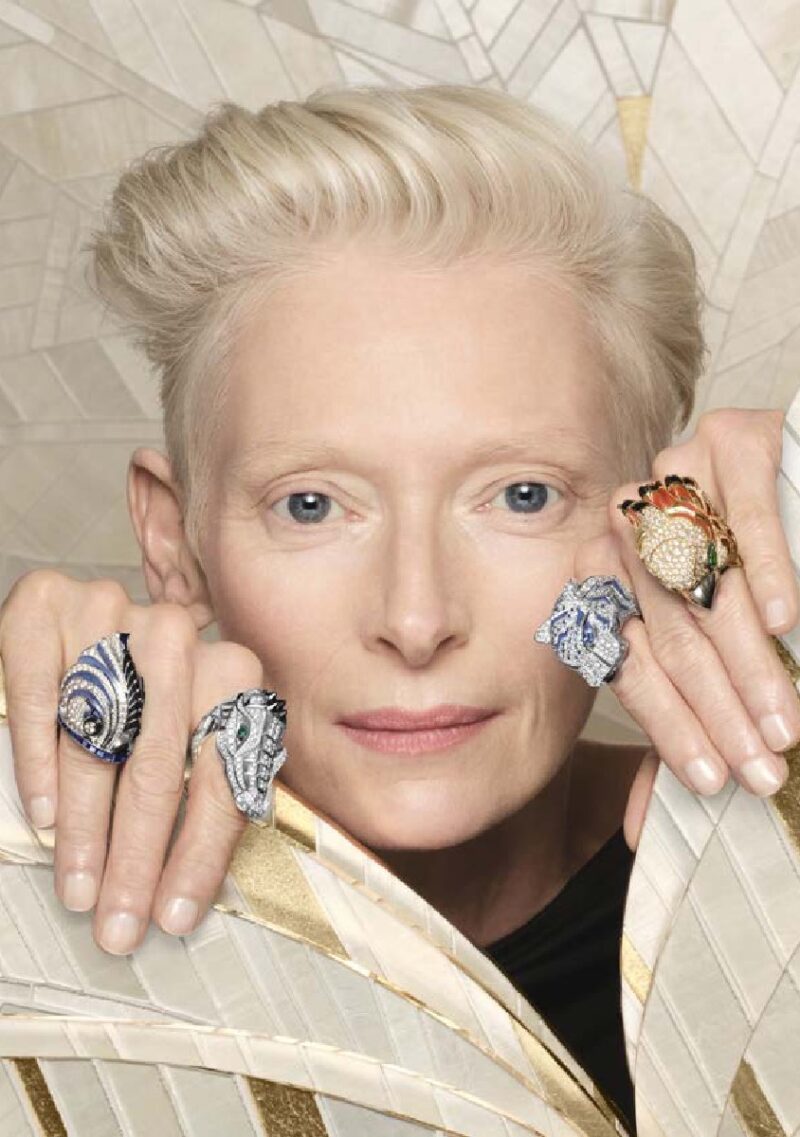
Tilda Swinton wears four animal portraits at once, making their scale and sculptural volume legible. © Cartier.
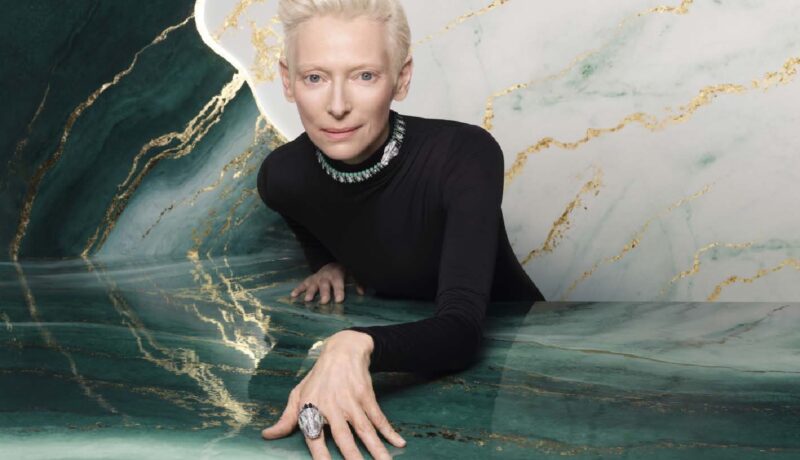
The campaign places a single animal portrait against skin, gesture and negative space. © Cartier.
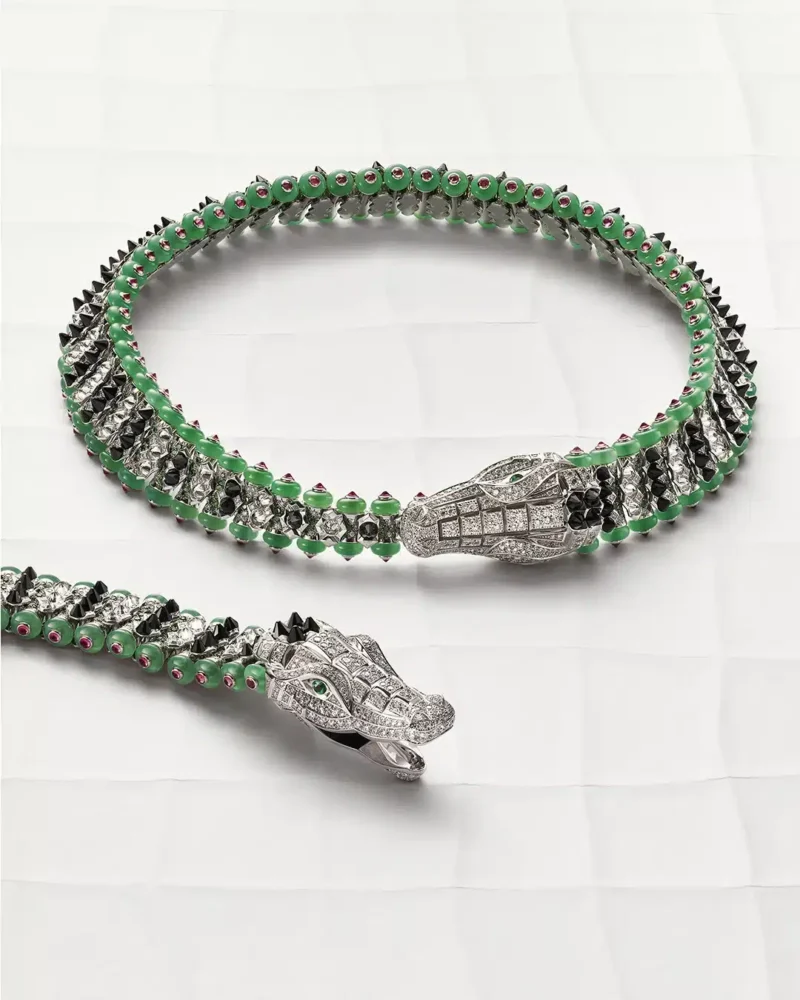
The crocodile moves from rigid portrait to articulated body across necklace and bracelet forms. © Cartier.
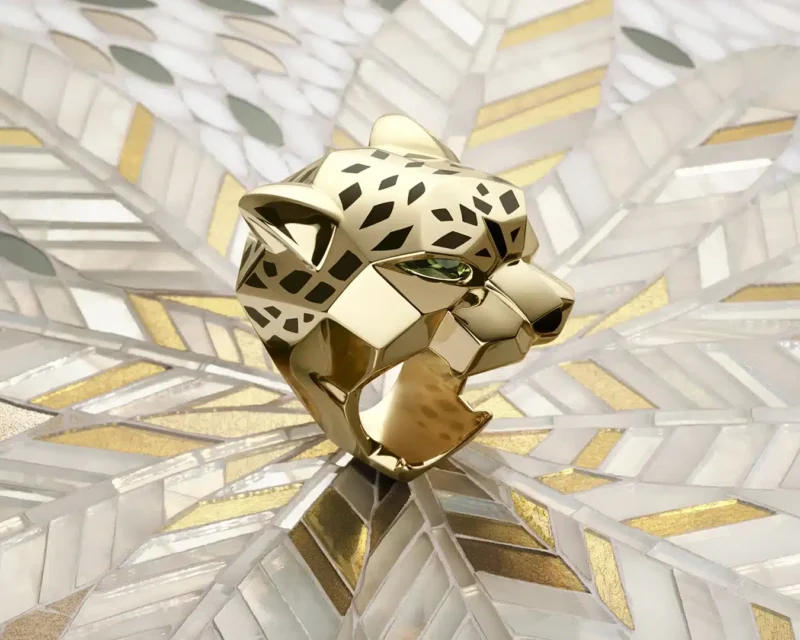
The Panthere head provides a house comparator for sculptural animal portraiture. © Cartier.
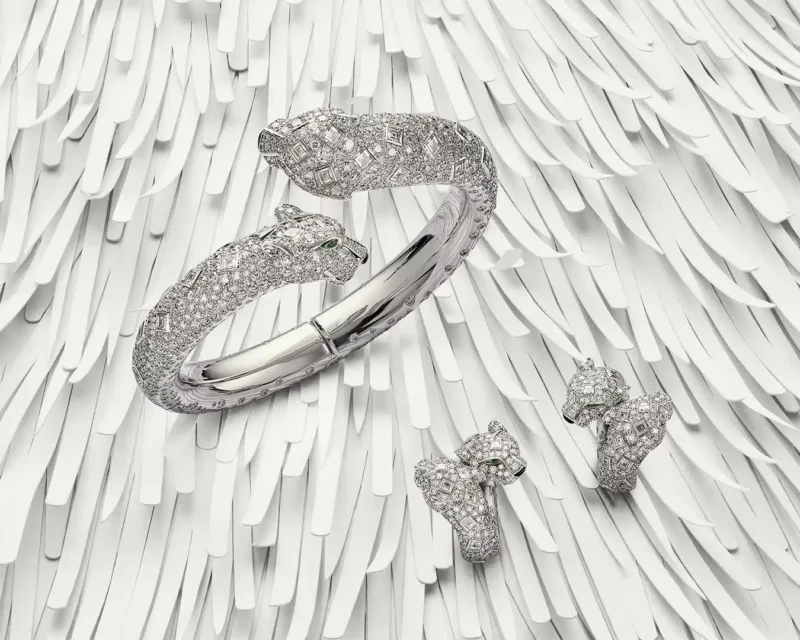
Tete-a-tete compositions turn the animal gaze into the structural centre of the jewel. © Cartier.
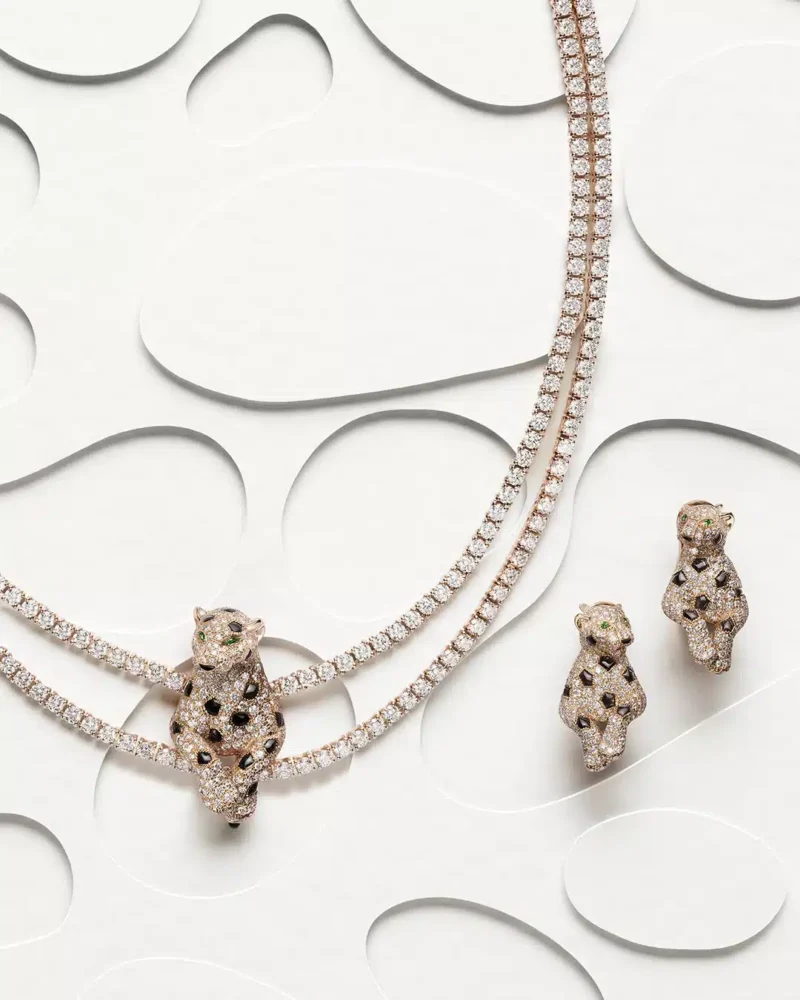
A larger Panthere composition shows how the recognisable head can govern a less literal body. © Cartier.
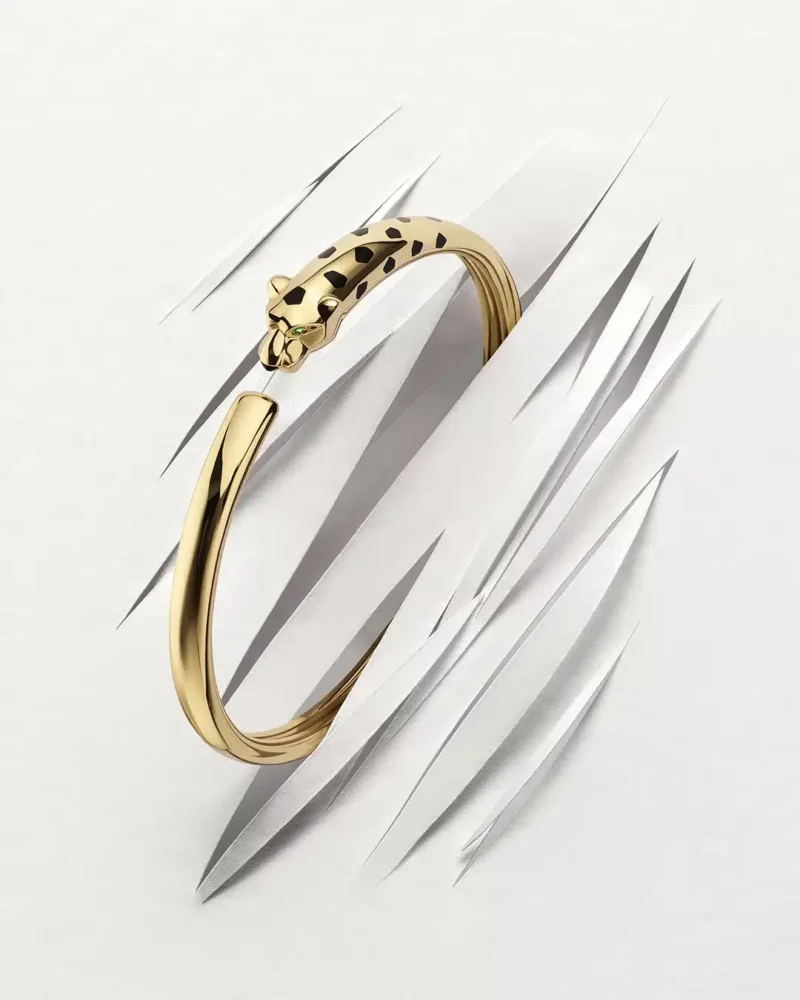
Articulation lets a sculptural animal inhabit the wrist rather than merely sit upon it. © Cartier.
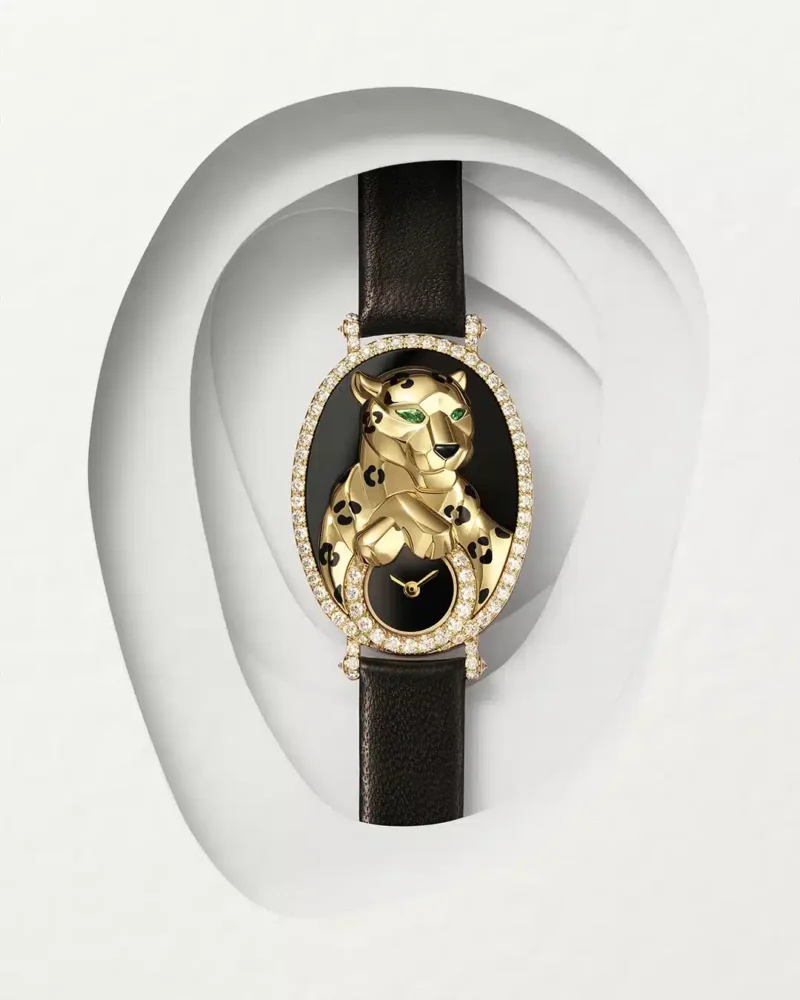
The animal can also become architecture, framing time without losing its expression. © Cartier.
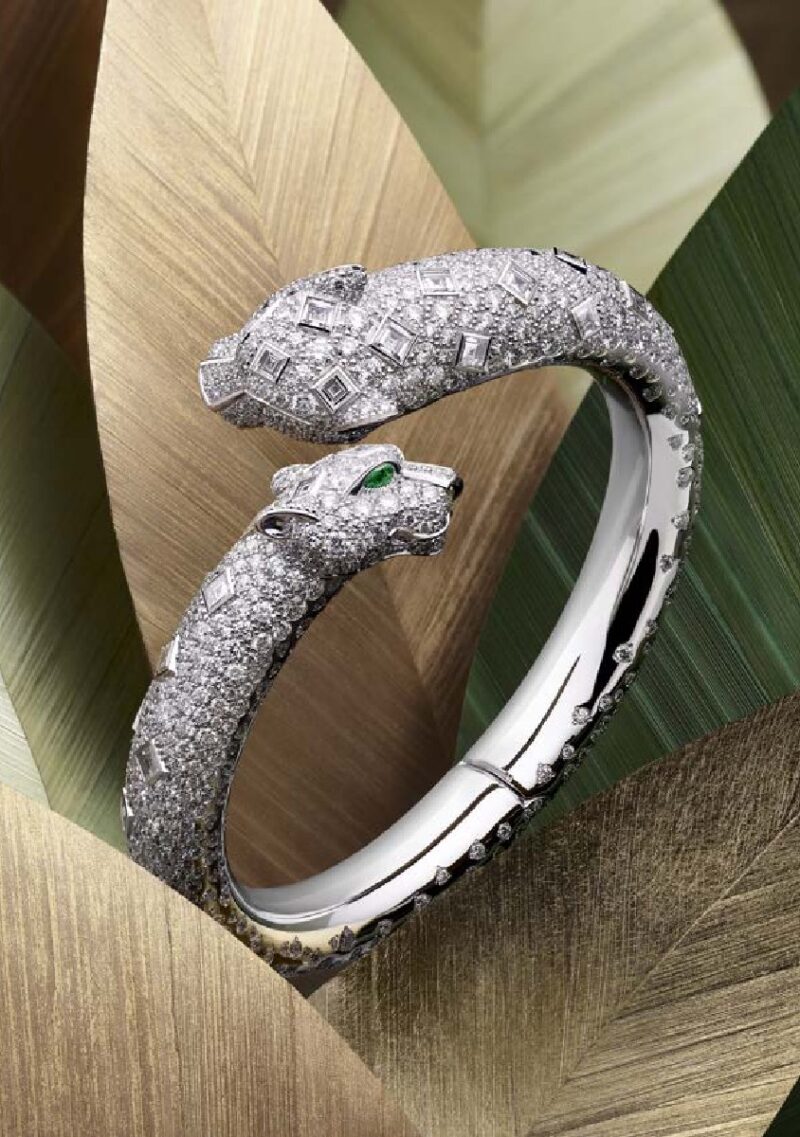
A Panthere bracelet closes the sequence with the house’s enduring grammar of gaze, surface and movement. © Cartier.
The anatomy of character
Anatomy.
Surface. Motion.
Read the animal in three passes: first the species-specific silhouette, then the translated surface, finally the movement that turns a portrait into behaviour.
Key facts
- 2026 animal portraits: tiger, parrot, carp, crocodile, rhinoceros
- Line: Faune & Flore de Cartier
- Launch context: Into the Wild, September 2026
- Portrait format: sculptural animal-head rings
- Extended pieces: fully articulated tiger and crocodile necklaces and bracelets, plus additional pins and animal jewellery
- Tiger palette: sapphires, aquamarine, dumortierite quartz, diamonds, onyx; chalcedony beads on larger articulated pieces
- Parrot palette: white gold and platinum, coral, onyx, tsavorite garnets
- Carp palette: white and rose gold, sapphires, aquamarine, dumortierite quartz, diamonds
- Crocodile palette: white gold, diamonds, onyx, emeralds; larger pieces add chrysoprase, rubellites and tsavorites
- Rhinoceros palette: white gold, spessartite garnet, grey or smoky quartz, black lacquer
- Cartier technique context: fur setting, clawless diamond setting, galuchat-effect pavé, stone carving, metal finishing, articulation, lost-wax construction and hidden clasps
- Primary-source limitation: Cartier’s indexed pages support Into the Wild, Faune & Flore and the Maison’s animal-making techniques, but do not yet expose clean individual product dossiers for all five September 2026 animal portraits
The easiest way to make an animal jewel recognisable is to exaggerate the obvious feature.
A crocodile gets scales.
A tiger gets stripes.
A parrot gets a beak.
A rhinoceros gets a horn.
That can produce a symbol quickly. It does not necessarily produce a convincing animal.
Cartier’s recent fauna work is more demanding because it tries to preserve character through a combination of anatomy and abstraction. The head is often modelled closely enough that the jaw, muzzle, eyes or crest can be read as a specific species. The body, when it exists, is allowed to become much less literal.
That tension defines Into the Wild.
The animal has to be recognisable.
It also has to become jewellery.
Five heads, five material problems
The five new animal-head rings are useful because Cartier does not solve them with one house formula.
The tiger and carp share a cool blue family, using sapphire, aquamarine and dumortierite quartz.
The parrot moves to coral and tsavorite.
The rhinoceros uses spessartite and pale smoky or grey quartz.
The crocodile returns to one of Cartier’s strongest colour combinations: white, black and green through diamonds, onyx and emeralds.
The materials are not being used simply as expensive substitutes for paint.
They are chosen because colour, opacity, translucency and surface finish can stand in for different biological features.
Dumortierite quartz can become a stripe or gill.
Coral can become a crest.
Onyx can produce a hard black contour.
Grey quartz can soften the transition between polished white gold and the rhinoceros horn.
This is high jewellery acting almost like material casting.
One species is reconstructed through several unrelated substances.
Crocodile, parrot and rhinoceros show three different relationships between silhouette, colour and surface. © Cartier.
The rhinoceros is mostly a metal-finishing problem
Among the five rings, the rhinoceros makes the clearest case that gemstones alone are not enough.
Contemporary launch documentation describes the head in white gold with alternating polished and hand-brushed surfaces. The eyes are spessartite garnets. The horn is rendered in smoky or grey quartz with a black-lacquer line.
The most unexpected detail is inside the mouth.
The interior is perforated to evoke the cracked, thick texture associated with the animal’s hide.
That choice is important because the rhinoceros has less natural colour patterning than a tiger or parrot.
Cartier cannot rely on stripes or brilliant colour to carry recognition.
The metal itself has to do more work.
Brushing and polishing become equivalents of skin texture.
A hole pattern inside the mouth becomes an anatomical cue.
The quartz horn does not need to reproduce horn keratin literally. It needs to create the correct visual density and opacity against white gold.
This is a sculptural strategy rather than a gem-first strategy.
The parrot pushes carving ahead of pavé
The parrot ring uses a different hierarchy.
White gold and platinum form the head.
Coral and onyx build the crest.
Tsavorite garnets create the eyes.
Here the central problem is not fur or skin.
It is feathers and beak volume.
A parrot’s identity is strongly concentrated in profile. The curve of the beak and the height of the crest can make the species legible before the viewer has processed any stone setting.
That gives the lapidary unusual importance.
Coral is not merely adding red.
It is being cut and adjusted to create the feather tuft itself.
Onyx sharpens the graphic transitions.
The tsavorite eye then acts as a small colour concentration inside a much larger sculpted form.
The ring demonstrates a recurring Cartier method: reserve the most saturated colour for the point that controls expression.
The whole head can be complex.
The eye still gets the final word.
Sculpture / setting / articulation
Life appears when technique stops announcing itself.
Tilda Swinton wears four animal portraits at once, making their scale and sculptural volume legible. © Cartier.
The campaign places a single animal portrait against skin, gesture and negative space. © Cartier.
The crocodile moves from rigid portrait to articulated body across necklace and bracelet forms. © Cartier.
Species / material / movement
The portrait becomes behaviour.
Five portraits
The ring format concentrates character in the head, allowing each species to be solved through a different hierarchy of silhouette, colour and surface.
- Format
- Sculptural animal-head rings
- Species
- Tiger / parrot / carp / crocodile / rhinoceros
- Technique
- Carving, setting and metal finishing
- Evidence
- Cross-checked 2026 launch
- Material logic
- Material chosen by biological cue
Bodies in motion
Necklaces and bracelets shift the problem from portrait to kinematics: the animal must move, close and sit on the body without losing expression.
- Format
- Necklaces and bracelets
- Species
- Tiger / crocodile
- Technique
- Articulation and hidden closures
- Evidence
- Result established; internals not diagrammed
- Material logic
- Anatomy at the head, abstraction in the body
The carp has to look wet without water
The carp is conceptually stranger.
A fish does not offer the jeweller fur, hair or feathers.
Its surface identity comes from overlapping scales, gills, fins and reflected light.
The new carp ring uses white and rose gold, sapphire, aquamarine and dumortierite quartz. Launch descriptions identify carved dumortierite-quartz gills and a diamond surface treated to evoke the optical grain of skin or water.
This is where Cartier’s galuchat-effect language becomes useful.
Galuchat refers to the granular appearance associated with stingray skin. In Cartier setting language, varying diamond sizes and tightly controlled spacing can create a textured field instead of a flat pavé sheet.
On a fish, that texture does not need to imitate one literal scale at a time.
It can suggest a continuous wet surface.
The carp therefore sits between anatomical detail and optical abstraction.
The gill is carved specifically.
The surrounding skin is allowed to become a pattern.
The tiger translates stripes into depth
The tiger gives Cartier a problem it already knows well.
Stripes have appeared throughout the Maison’s animal vocabulary for decades.
The new blue tiger does not reproduce the expected orange-black-white palette.
Instead it uses sapphire, aquamarine and dumortierite quartz.
The eyes are aquamarine.
The stripes are built with dumortierite quartz.
Sapphires occupy the coat.
Diamonds appear through a galuchat-effect setting, while contemporary reports describe calibrated sapphires set in rails to produce a striped surface without making the head look printed.
The colour substitution matters.
A tiger remains recognisable even after its natural orange is removed.
That means the identity is being carried by stripe rhythm, anatomy and eye placement rather than by naturalistic colour alone.
This is one of Cartier’s most effective ways of avoiding literalism.
Keep the species.
Change the chromatic rules.
The crocodile adds a moving jaw
The crocodile head ring adds one more variable: articulation.
Its palette is white, black and green.
Diamonds cover the head.
Onyx produces spikes and graphic breaks.
Emeralds create the eyes.
Contemporary launch documentation says the jaw itself articulates.
That is not a decorative flourish.
A crocodile’s mouth is one of the most recognisable parts of its anatomy. Making it move changes the animal from portrait into interaction.
The mechanism is not publicly diagrammed in Cartier’s currently indexed pages, so the article does not invent its hinge construction or retention system.
What is established is the result: the ring can alter its expression.
Closed mouth.
Open mouth.
The same head produces two emotional states.
That turns anatomy into mechanism.
Cartier already had the vocabulary for fur and scales
The new 2026 pieces do not appear in a technical vacuum.
Cartier’s own Indomptables documentation explains several setting methods used to simulate animal surfaces.
Onyx elements are cut to measure for spots and stripes.
The Maison describes a signature fur setting in which small grains of metal are stretched and curved around onyx to suggest the softness of a coat.
Cartier also describes a clawless diamond setting designed to increase stone exposure and sparkle.
For crocodile surfaces, the Maison has previously faceted the metal itself according to the stone layout.
These are useful primary-source precedents because they show how Cartier thinks about animal texture.
The goal is not always to set more stones.
Sometimes the surrounding metal is reshaped so the boundary between stone and structure becomes less obvious.
That is why the 2026 rings should be read as part of a longer technical language rather than as five isolated novelties.
The animal body creates a different problem from the head
A head ring can be rigid.
A necklace cannot.
The larger tiger and crocodile pieces take the same species into a completely different engineering category.
Contemporary coverage of the tiger and crocodile necklaces and bracelets describes fully articulated bodies.
The heads remain sculptural and recognisable.
The bodies become sequences of moving sections.
Cartier’s own broader fauna documentation describes a similar logic in earlier crocodile work: sculpture and articulation are treated as twin sources of life, with the animal first modelled in plasticine and wax before precious-metal sections are produced and joined to create fluid motion.
This is the critical split.
The head is anatomy.
The body is kinematics.
The jeweller does not need every link of a necklace to be anatomically literal.
It needs the necklace to move the way the animal feels as if it should move.
Hidden clasps turn the bite into function
The tiger and crocodile pieces add another layer.
Multiple contemporary launch sources describe closures hidden inside the animal’s mouth.
The head appears to bite the body or tail closed.
That is a particularly Cartier solution because it removes the visible distinction between representation and mechanism.
The mouth is anatomically correct enough to make sense as a mouth.
It is mechanically useful enough to function as a closure.
The clasp stops being separate hardware.
It becomes behaviour.
This is more sophisticated than simply hiding a clasp under a decorative animal head.
The animal’s action explains the mechanism.
The crocodile bites.
The jewel closes.
The crocodile body is intentionally less literal
The crocodile necklaces and bracelets are especially revealing.
The head is highly sculpted.
The body is not built from individual naturalistic crocodile scales repeated one by one.
Launch coverage describes a flexible wave of diamonds, onyx, chrysoprase and rubellite.
The body becomes rhythm.
This is consistent with Cartier’s broader animal philosophy documented in its current fauna material: realism and abstraction are allowed to coexist.
The face establishes species.
The body establishes movement.
That division gives the jeweller more mechanical freedom.
A literal crocodile torso would be bulky and rigid.
An abstract articulated sequence can wrap the neck or wrist.
The animal becomes more wearable by becoming less anatomically complete.
The tiger uses beads to create a body that can bend
The tiger’s larger pieces use sapphire, aquamarine, dumortierite quartz and chalcedony beads.
Beads solve a very different movement problem from pavé plates.
A bead can rotate slightly.
A sequence can flex.
The body can change curvature without requiring a single continuous metal surface to deform.
This is important because a tiger necklace has to suggest a long feline body while sitting on a human neckline.
The jewel cannot simply reproduce a tiger at miniature scale and hope it drapes.
It needs an articulated grammar.
The head remains the visual anchor.
The body becomes a flexible system.
Again, species identity and wearability are split across two different kinds of making.
Into the Wild is broader than five rings
The five animal portraits are the cleanest editorial entry point, but the September chapter is larger.
Panthère returns in multiple expressions.
Contemporary Cartier-supplied imagery shows a white-gold tête-à-tête bracelet with two diamond panther heads, emerald eyes and alternating surface treatments.
There are additional panther earrings, necklaces and a jewellery watch.
The panther watch uses sculpted yellow gold over an onyx dial, tsavorite eyes, black lacquer and diamonds around bezel and lugs.
Tiger and crocodile extend into articulated necklaces, bracelets and pins.
The important editorial distinction is that “Into the Wild” functions as a broad fauna chapter and campaign context, while individual pieces remain distributed across Cartier’s existing animal languages such as Faune & Flore and Panthère de Cartier.
The public Cartier website does not yet expose one clean master product catalogue for the entire September launch.
That limitation belongs in the dossier.
Primary-source visibility is unusually fragmented
This release presents a source problem that is worth stating explicitly.
Cartier’s official digital ecosystem currently supports the broad fauna story.
The Maison has live pages on Faune & Flore.
It has current Into the Wild campaign material in regional environments.
Its official 365 editorial platform explains wild fauna, sculpture, articulation, lost-wax manufacture and glyptics.
Its Indomptables pages explain fur setting and clawless setting.
What is not yet cleanly indexed is a full primary product dossier for all five new September animal-head rings.
The exact five-piece inventory, their current material combinations and the Gallery of Animal Portraits name are instead repeated consistently across multiple independent contemporary reports carrying Cartier-supplied imagery.
The article uses that evidence.
It does not pretend those secondary pages are Cartier pressroom pages.
That difference is recorded in the source dossier and media rights file.
The panther remains the control group
The most useful historical reference is still the panther.
Cartier’s official material dates its first appearance in the Maison’s aesthetic language to 1914.
The three-dimensional animal became a much stronger sculptural code later, and the panther-head ring eventually established a recognisable format for animal portrait jewellery.
The five new rings reuse that format without making five variations of the panther.
This is important because the panther becomes a control group.
What happens when Cartier applies the same sculptural ambition to a fish?
A rhinoceros?
A parrot?
The answer cannot be the same fur setting every time.
Each species forces another part of the atelier to become more important.
Lapidary.
Metal finishing.
Articulation.
Pavé.
Carving.
Colour.
The 1975 María Félix crocodiles are the harder comparison
The crocodile has a more specific archival burden.
Cartier’s broader fauna history repeatedly returns to María Félix and her two-crocodile necklace.
That 1970s object established a powerful model for articulated animal jewellery: two creatures that could form a necklace together or separate into brooches.
The 2026 crocodile is not a remake.
Its colour language, stone selection and body treatment are different.
But the mechanical expectation remains.
A Cartier crocodile is not allowed to be merely a rigid reptile motif.
It has to demonstrate movement.
That historical pressure helps explain why the new crocodile receives both an articulated ring jaw and fully articulated necklace/bracelet bodies.
The animal already carries a house memory of mobility.
What the evidence does not establish
Several attractive claims should remain outside the article.
The five new animal-head rings do not yet have a complete, cleanly indexed Cartier primary dossier showing reference numbers, dimensions, stone counts and carat totals.
Those should not be invented from photographs.
The crocodile jaw mechanism is not publicly diagrammed in the sources reviewed here.
The hidden mouth clasps of the tiger and crocodile larger pieces are described in contemporary launch reporting, but the exact internal construction is not publicly documented.
The phrases “fur setting” and “galuchat effect” describe Cartier surface languages. They should not be treated as universal jewellery-industry terms with one fixed technical definition outside the Maison’s use.
Claims that the carp or rhinoceros are the first such animals ever made by Cartier are not fully established from the primary archive reviewed here.
And no claim should be made that one animal requires more craft than another simply because it uses more materials.
Different animals shift difficulty into different departments.
That is the point.
The animal looks alive when the technique stops calling attention to itself
Cartier’s best animal jewellery often appears simple only after the atelier has divided the problem correctly.
The rhinoceros becomes a study in metal skin.
The parrot becomes a study in carving and profile.
The carp becomes a study in reflected surface.
The tiger becomes a study in stripe rhythm.
The crocodile becomes a study in articulation.
Then the necklaces and bracelets add a second layer: the head can remain recognisable while the body becomes abstract enough to move.
That is how jewellery avoids becoming a small sculpture with a chain attached.
The object has to change species twice.
First from animal to image.
Then from image to wearable mechanism.
Into the Wild is strongest where that second transformation becomes visible.
Sources & credits
Sources & methodology
- Cartier, The Wild World of Cartier Fauna, used for the Maison’s documented relationship between sculpture, articulation, glyptics and lost-wax construction.
- Cartier, Into the Wild, official campaign context.
- Something About Rocks and Watchonista, used to cross-check the current 2026 launch inventory and Cartier-supplied imagery.
- This is an independent editorial analysis, not a hands-on review. Cartier primary sources establish house technique and history; current launch reporting establishes the five portraits. Reference numbers, dimensions, carat totals and undocumented internal mechanics are intentionally omitted.
The Edit
Stories selected by TheTimeo
How Do You Make Gold Flexible Without Solder? Inside Bvlgari Tubogas 2026
Two interlocking gold ribbons, a temporary core and controlled tension: Bvlgari’s five 2026 pieces
Van Cleef & Arpels Fascinations d’Égypte: How to Read Egypt Without Copying the Museum
A century after its first Egyptian jewels, Van Cleef & Arpels returns to the
Why Leave a Diamond Rough? What De Beers Talisman Still Preserves After Twenty Years
A rough diamond arrives with its own geometry. Twenty years after Talisman, De Beers
Why Wedding Bands Do Not Always Sit Flush—and Why That Can Be Better
A visible gap is not automatically a design failure. Profile, basket, shoulders and movement
Reset, Resize or Restore? A Better Future for an Heirloom Ring
An inherited ring can become wearable again without making its earlier life illegible. The
Beyond the 4Cs: Choosing an Engagement Ring for Everyday Life
The diamond report is only half the decision. Height, setting, shoulders, sizing and the