
Jewellery Intelligence / Tension Study
Jewelry
How Do You Make Gold Flexible Without Solder? Inside Bvlgari Tubogas 2026
Two interlocking gold ribbons, a temporary core and controlled tension: Bvlgari’s five 2026 pieces ask Tubogas to taper, flare and change colour without losing its flexibility.
TheTimeo view
The technique is not decorated. Its geometry is changed.
Classic Tubogas hides its labour inside a surface that looks inevitable. The 2026 collection makes the underlying problem visible: if the mesh changes width, every turn must remain coherent while travelling around a changing form.
The core disappears. The geometry remains.
TheTimeo editorial reading
The visual edit
Five pieces. One geometry under tension.
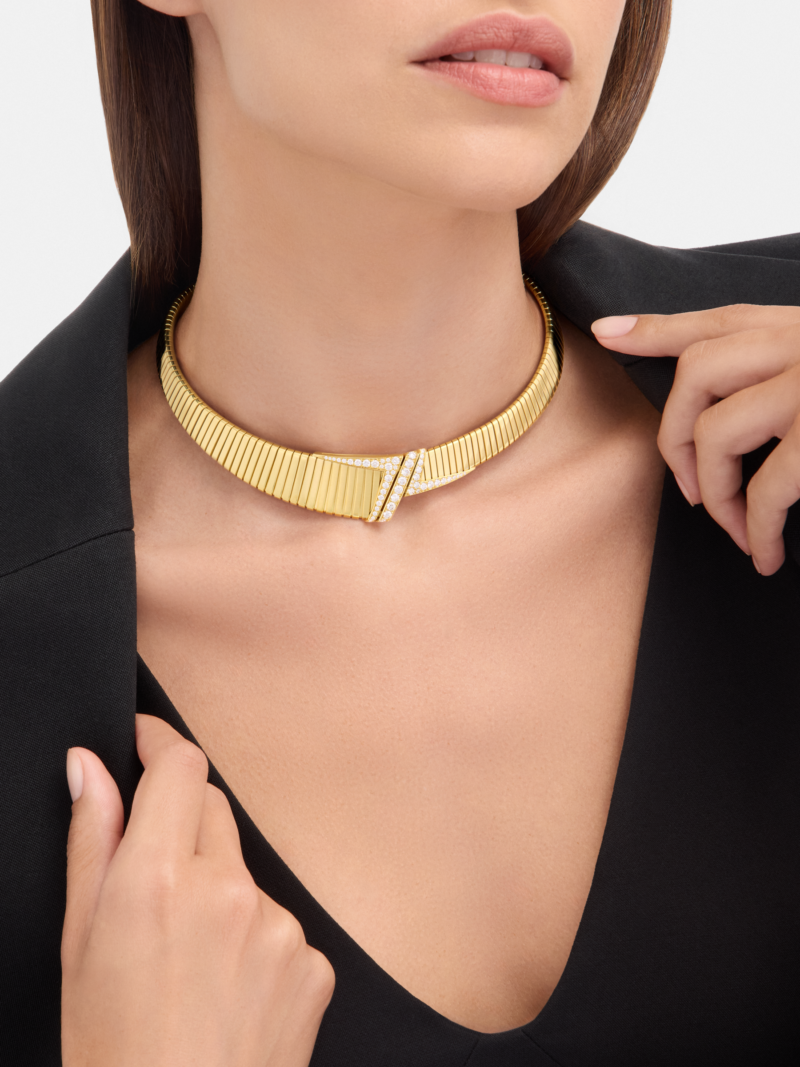
On the body, the necklace reads as a continuous flexible band rather than a rigid ornament with attached terminals. © Bvlgari.
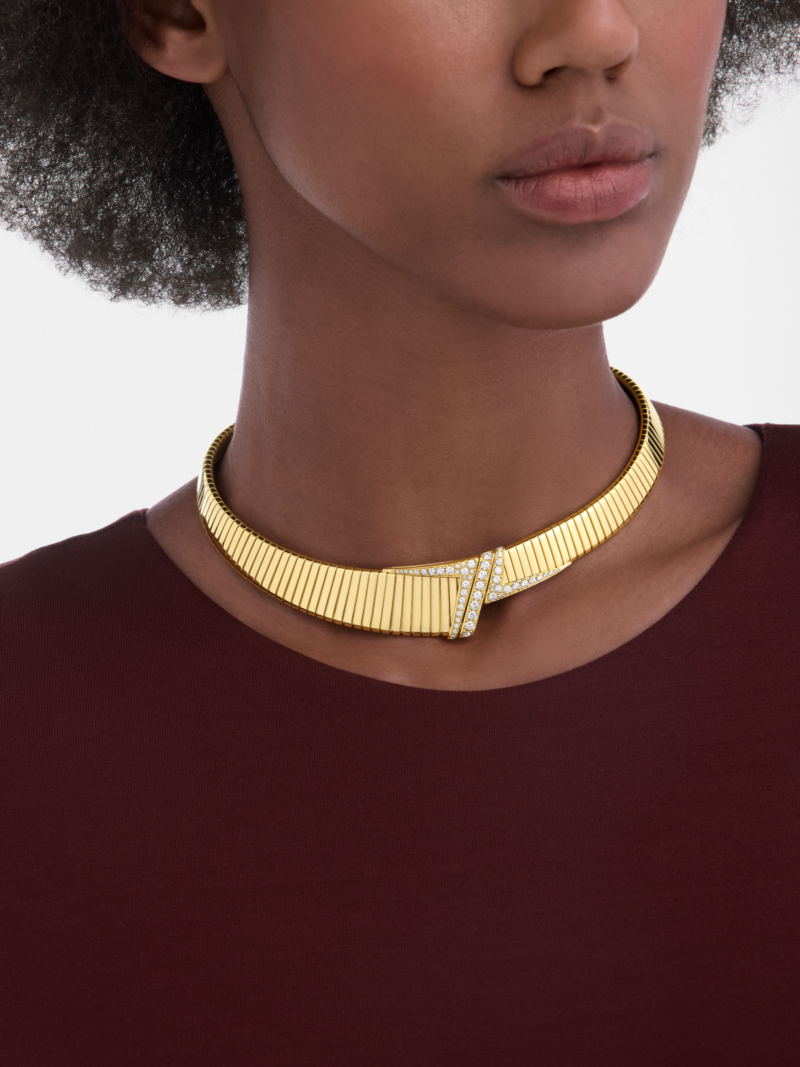
A worn detail shows how the flared geometry remains close to the neckline. © Bvlgari.
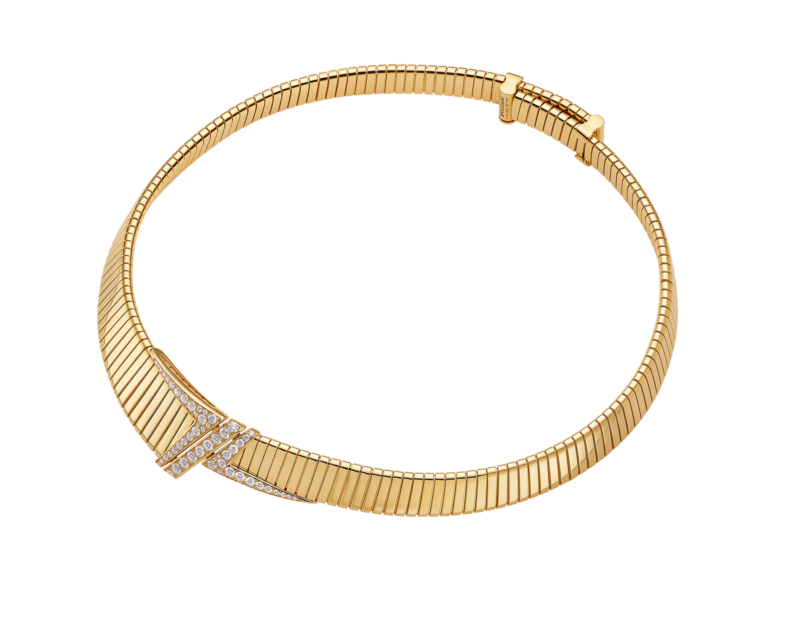
The reverse view makes the adjustable closure and the changing width of the gold mesh legible. © Bvlgari.
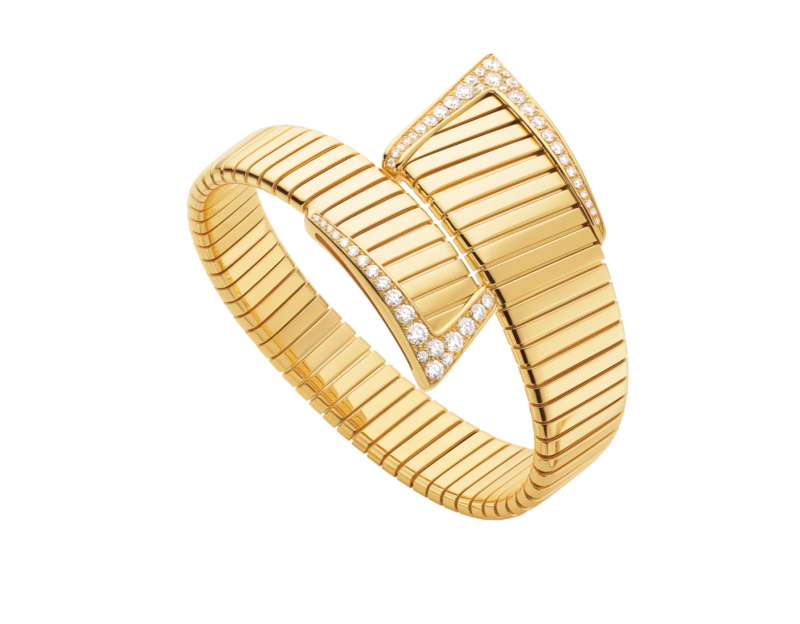
The bracelet compresses the progressive-width problem around the smaller circumference of the wrist. © Bvlgari.
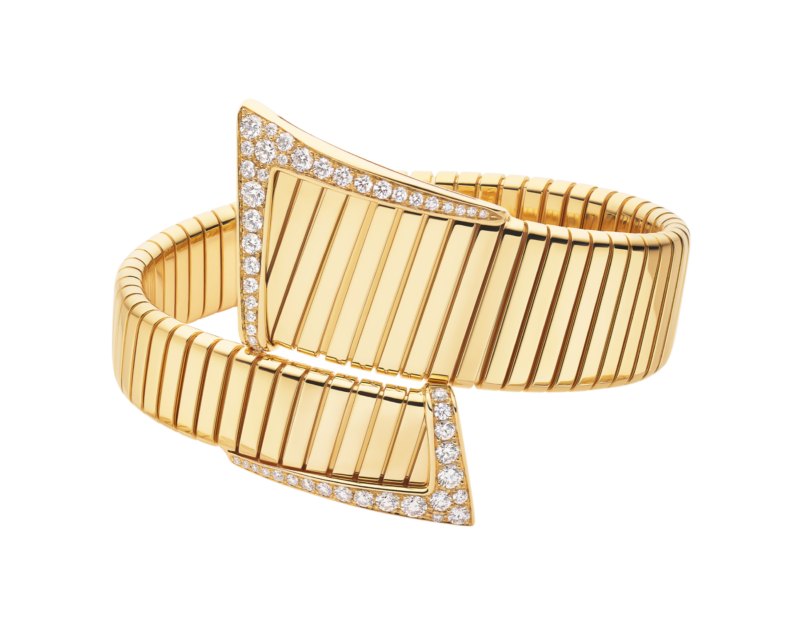
The alternate view exposes the open construction and the transition from narrow coil to sculptural end. © Bvlgari.
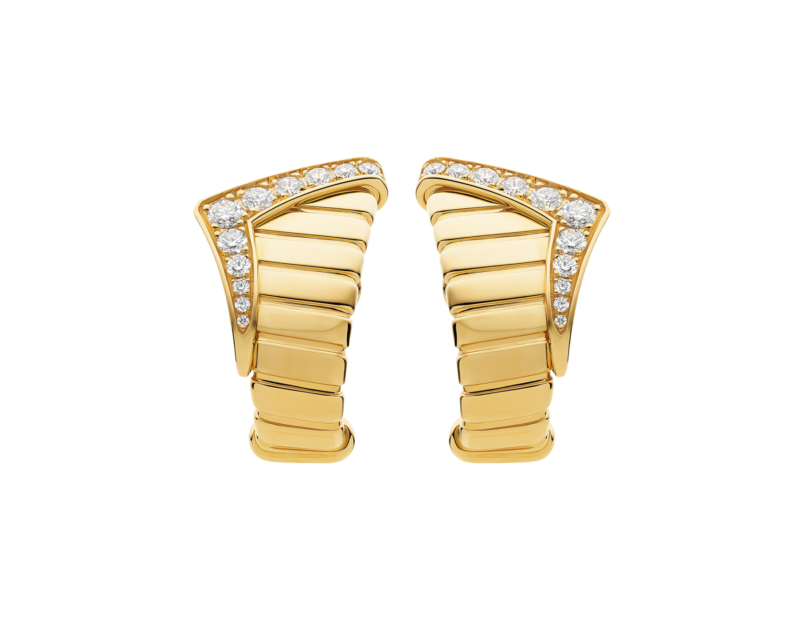
The asymmetric earrings condense the same taper and diamond-set terminal into a much shorter transition. © Bvlgari.
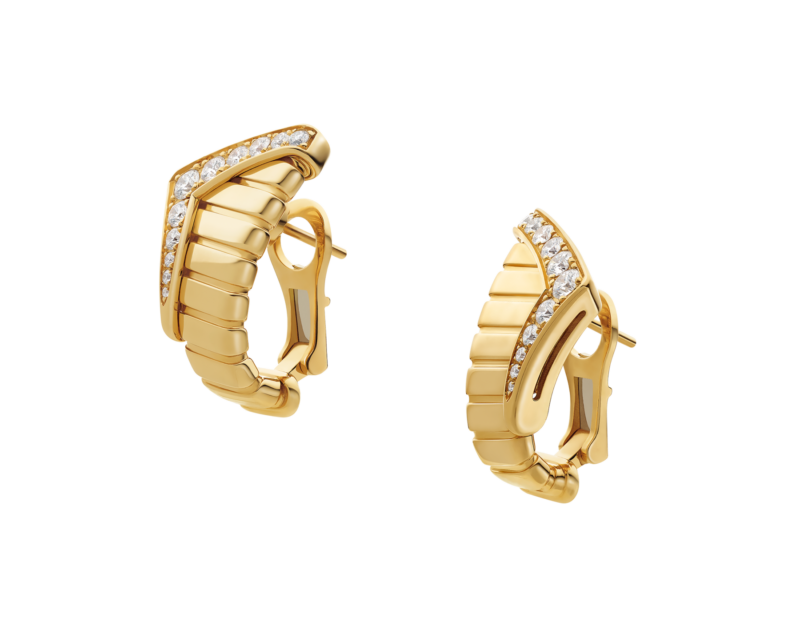
Their reverse view reveals how much of the form is carried by ribbed gold rather than a conventional hoop. © Bvlgari.
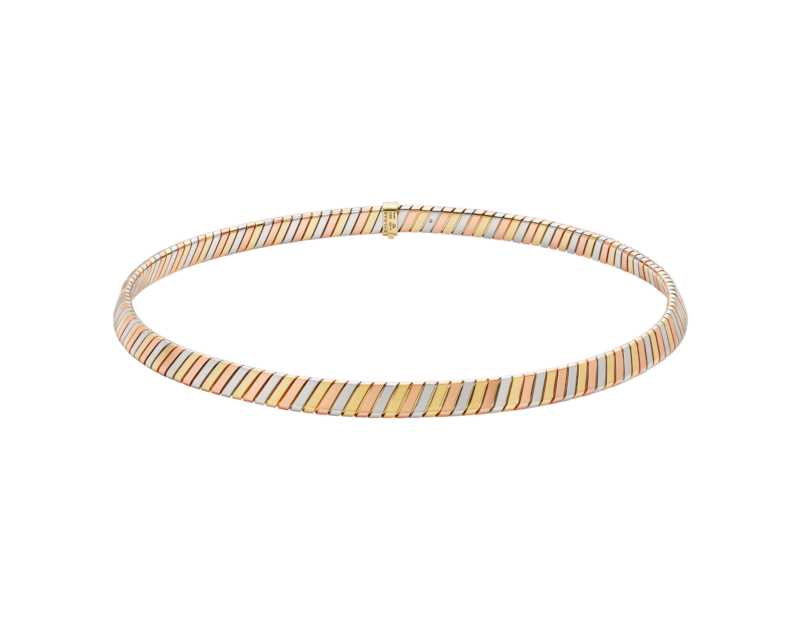
Yellow, white and rose gold turn the regular winding into a visible rhythm across the flat mesh. © Bvlgari.
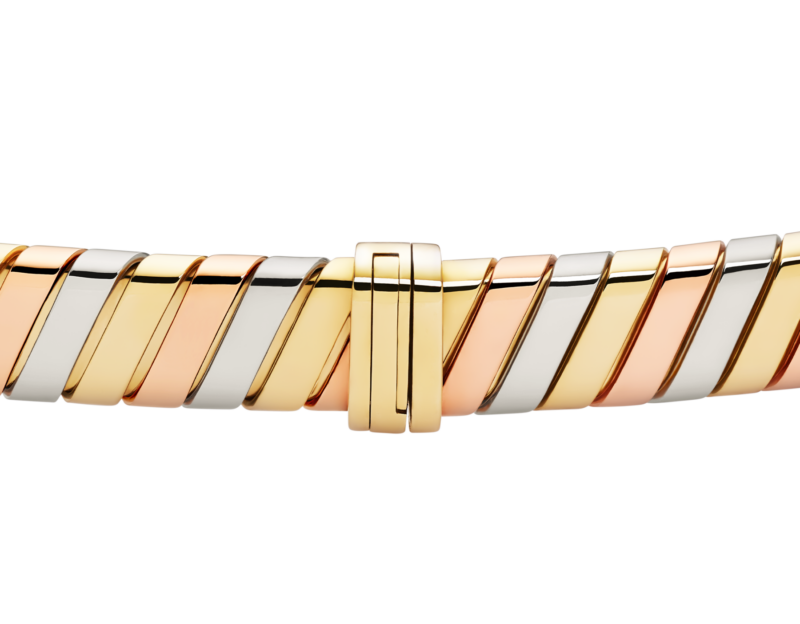
The reverse view shows the uninterrupted tricolour sequence around the necklace. © Bvlgari.
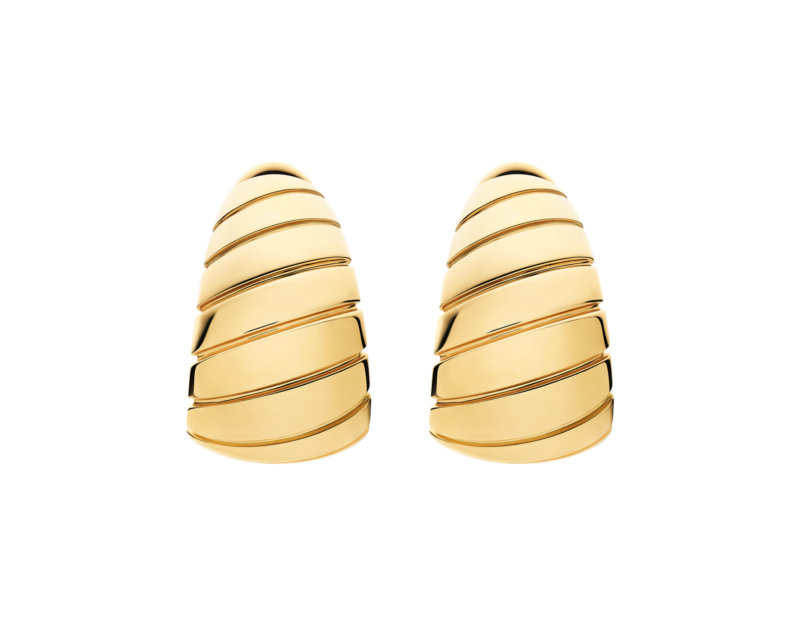
The rounded earrings remove pavé and asymmetry, leaving curve and repeated winding as the entire visual argument. © Bvlgari.
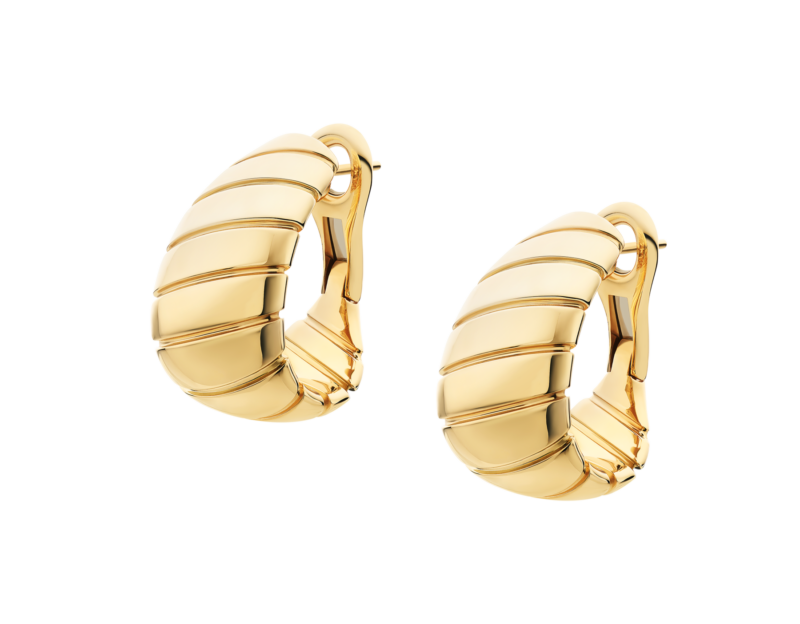
From the side, the compact half-hoop preserves the unmistakable Tubogas rib. © Bvlgari.
The grammar of the coil
Wind. Lock.
Release.
Follow two ribbons around a temporary core: their raised edges interlock, the core disappears and controlled tension leaves a continuous flexible surface.
Key facts
- Release: September 2026
- New pieces: five
- Asymmetric set: necklace ref. 362515, bracelet ref. 362616 / BR860836, earrings ref. 362521
- Additional pieces: three-colour gold necklace ref. 362629 / CL860075; rounded yellow-gold earrings ref. 362566
- Asymmetric set material: 18K yellow gold with brilliant-cut diamond pavé
- Historical reference: a Serpenti Tubogas bracelet-watch from circa 1974
- Construction challenge: a dedicated forming structure was developed so the Tubogas mesh could increase in width progressively toward the flared ends
- Asymmetric necklace: more than 17 hours of handwork according to Bulgari Japan’s release; adjustable sliding clasp
- Classic Tubogas principle: interlocking metal ribbons wound around a temporary core, constructed without soldering along the flexible tube
- Bulgari use: adopted in the 1940s; first Tubogas bracelet documented by Bulgari in 1941, first Tubogas watch in 1948-49, with the technique becoming a major house signature in later decades
The wrong way to understand Tubogas is to think of it as a chain with unusual links.
There are no conventional links.
The classical construction begins with long ribbons of metal whose edges are formed so they can engage one another. The ribbons are wound around a core. As each turn follows the previous one, the raised edges interlock. Once the tube is complete, the temporary core can be pulled out or dissolved.
What remains is hollow.
There is no solid spine running through the finished classical band.
There is also no continuous solder seam along the coil.
The structure holds because the metal has been formed, interlocked and tensioned correctly.
That is why Bvlgari’s historical description places so much emphasis on uniform tension. If the winding is inconsistent, the problem is not simply cosmetic. The spacing, curvature and mechanical behaviour of the whole band can change.
The five new pieces presented in September 2026 take this familiar principle and deliberately disturb its easiest geometry.
Instead of asking the tube to remain constant, Bvlgari asks it to change.
The core is temporary, but it determines the shape
Bvlgari’s own historical documentation describes gold strips being wrapped around a central structure to create flexible rounded bands without soldering.
A more detailed Bulgari publication goes further. It describes two long gold ribbons with raised edges wound around an inner core made from wood or a non-precious metal such as copper. The edges fit into one another. After the winding is completed, the core is removed or dissolved in acid.
This detail matters because the word “core” can be misunderstood.
The classical Tubogas jewel does not need a permanent rigid bar inside it to remain intact.
The core is a forming tool.
It establishes the diameter and profile around which the ribbons are wound. Once it has done that job, it disappears.
The finished object must then maintain coherence through the interlocking geometry and the residual tension of the wound metal.
A museum description of a Bulgari Heritage Collection Tubogas choker explains the process in essentially the same way: two long gold strips are wrapped so their raised edges interlock, then the core is removed.
This makes the 2026 asymmetrical set much easier to read.
If the finished tube must widen gradually toward one end, the forming geometry can no longer be uniform.
On the body, the necklace reads as a continuous flexible band rather than a rigid ornament with attached terminals. © Bvlgari.
Asymmetry turns the mandrel into part of the design problem
The new yellow-gold necklace, bracelet and earrings all use asymmetric silhouettes with flared geometric terminals set with brilliant-cut diamonds.
Bulgari’s September release says the pieces are inspired by a Serpenti Tubogas bracelet-watch from around 1974.
The important technical statement comes immediately after the historical reference.
Bulgari says a dedicated special framework had to be developed so the mesh could become progressively thicker toward the ends.
That is the mechanical heart of the launch.
A constant-width Tubogas can be wound around a constant forming profile.
A tapered Tubogas cannot.
If the ribbons are expected to expand gradually while continuing to interlock cleanly, the forming support has to control the change in section. The worker has to preserve the relationship between neighbouring turns even while the circumference they travel around is changing.
The difficulty is therefore not simply making the necklace asymmetrical after the Tubogas has been produced.
The asymmetry enters the construction of the Tubogas itself.
That is a much stronger design claim.
The flared ends must remain flexible
A sculptural terminal can be made easily if flexibility is abandoned.
Cast enough gold into a rigid volume and almost any flare can be created.
The 2026 Tubogas set has a harder brief.
Bulgari explicitly says the progressive construction preserves the characteristic suppleness of Tubogas while allowing the ends to expand into sculptural geometry.
This creates a tension between two visual readings.
The ends need enough volume to look deliberate and architectural.
The body still has to behave like a Tubogas.
If the widening section becomes visually or mechanically rigid too early, the piece stops reading as one continuous flexible band and begins to look like a flexible necklace with separate hard ornaments attached to it.
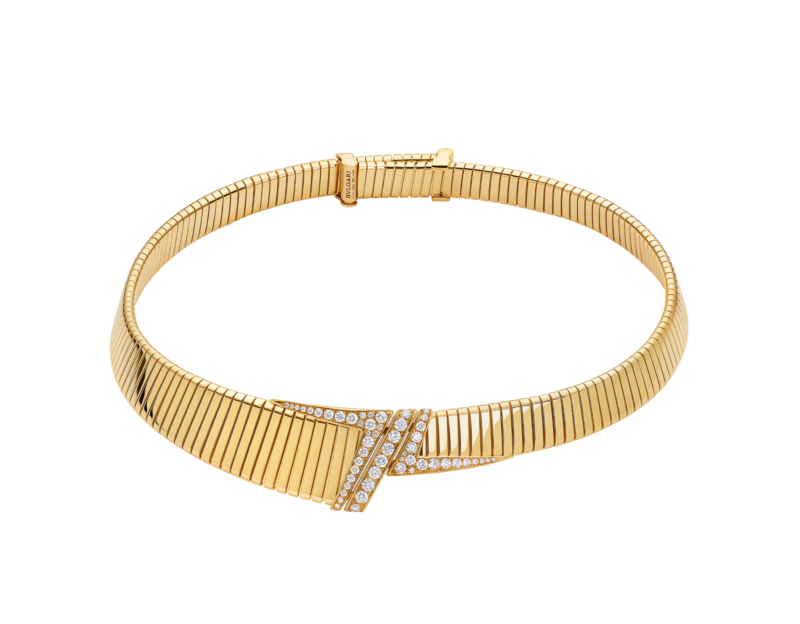
The product photography shows why the solution is effective.
The flared terminals do not appear as foreign objects bolted onto a standard-width coil. The band itself seems to grow into them.
That continuity is the point.
Ribbon / edge / tension
A continuous surface built from two ribbons.
On the body, the necklace reads as a continuous flexible band rather than a rigid ornament with attached terminals. © Bvlgari.
A worn detail shows how the flared geometry remains close to the neckline. © Bvlgari.
The bracelet compresses the progressive-width problem around the smaller circumference of the wrist. © Bvlgari.
Form / reference / evidence
One coil, two directions of travel.
Asymmetric architecture
The necklace, bracelet and earrings make changing width part of the Tubogas construction itself, then mark the flared ends with brilliant-cut diamond pavé.
- Format
- Necklace / bracelet / earrings
- References
- 362515 / 362616 / 362521
- Technique
- Progressive-width Tubogas and pavé terminals
- Evidence
- Official September 2026 release
- Making
- >17 hours of handwork stated for the necklace
Continuity in colour
The three-colour necklace and rounded earrings remove the dramatic taper to test two quieter properties: winding regularity and uninterrupted curve.
- Format
- Three-colour necklace / rounded earrings
- References
- 362629 / 362566
- Technique
- Hand-drawn ribbons / rounded Tubogas
- Evidence
- Official release and product pages
- Making
- Yellow, white and rose gold / plain yellow gold
More than seventeen hours does not mean seventeen hours for the whole jewel
Bulgari Japan’s official September release states that the asymmetric necklace requires more than 17 hours of meticulous handwork.
That number is useful, but it needs careful wording.
The public release does not provide a full manufacturing time study for every operation in the necklace.
It does not break the 17 hours into ribbon preparation, forming, winding, polishing, diamond setting, clasp assembly and final quality control.
The safest statement is therefore the one Bulgari actually supports: the necklace requires more than 17 hours of careful handwork.
The figure should not be expanded into a claim that the complete jewel takes exactly 17 hours from raw metal to finished necklace.
What the number does establish is relative complexity.
The asymmetrical mesh is not produced as a simple industrial tube and then decorated later.
The forming process itself is labour-intensive enough for Bulgari to make it part of the launch story.
The sliding clasp solves a second asymmetry problem
The necklace also receives an adjustable sliding clasp.
This sounds secondary beside the mesh construction, but it changes how an asymmetric object can sit on the body.
A fixed-length necklace establishes one stable relationship between the two flared ends and the wearer’s neckline.
A sliding closure changes that relationship.
Length can be adjusted, which means the height, fall and apparent balance of the asymmetric terminals can change with the wearer.
The clasp therefore adds a controlled variable after the goldsmith has already built an intentionally unequal form.
Bulgari does not publish the internal mechanism of the sliding closure in the source material reviewed here, so the article does not reverse-engineer it.
Its design purpose is clear enough.
A sculptural asymmetric necklace benefits from adjustable positioning.
The bracelet tests asymmetry against the wrist
The matching bracelet faces a different physical constraint.
A necklace can use gravity to establish its fall.
A bracelet has to remain coherent around a much smaller circumference while moving with the wrist.
Bulgari describes the asymmetrical bracelets as having flexible open constructions that sit naturally around the wrist.
Again, the key is that the widening Tubogas cannot become a separate rigid end-piece too early.
The bracelet has to preserve enough spring and conformity to maintain contact around the wrist while presenting a strong directional flare.
This is where the absence of solder along the classical Tubogas band becomes mechanically relevant.
The wound structure is allowed to articulate along its length.
The new challenge is distributing that articulation through a section whose width is no longer constant.
Bulgari does not publish stiffness curves, fatigue testing or dimensional tolerances.
Those remain outside the article.
But the construction question can still be described accurately: the wider geometry must coexist with the flexibility for which the technique exists.
The earrings reveal how far the same architecture can shrink
The third member of the asymmetric set is ref. 362521.
The earrings use the same yellow gold, asymmetric flared language and diamond pavé.
Their scale changes the problem again.
A necklace has room for a long progressive transition.
An earring has much less distance in which to move from narrow Tubogas to a flared geometric end.
That compresses the visual gradient.
The object still needs to read as Tubogas rather than as a conventional gold earring with a short ribbed section.
The 2026 set therefore demonstrates the same construction idea at three body scales: neck, wrist and ear.
The design is not simply copied smaller.
The proportion of transition, terminal and flexible mesh has to be recalibrated each time.
Three colours create a different kind of continuity
The fourth new piece is a necklace in yellow, white and rose gold, ref. 362629 / CL860075.
It removes the diamond-set flared terminals and returns attention to the mesh itself.
Bulgari’s press material says the gold strips are individually drawn by hand and brought together into a continuous flat Tubogas mesh.
The technical interest here is not tapering.
It is colour continuity.
Three metal colours have to travel through a structure whose identity depends on regular winding and clean edge relationships.
If the coloured strips drift visually or the spacing becomes inconsistent, the tricolour composition will expose that error immediately.
A monochrome Tubogas can hide small differences in the play of reflection.
A three-colour one creates its own reference grid.
The change of material colour therefore acts almost like a measuring system for the craft.
The half-hoop earrings remove almost everything except the curve
The fifth new piece, ref. 362566, is a pair of plain yellow-gold half-hoop earrings.
There are no diamonds.
There is no tricolour effect.
There is no asymmetric flared terminal.
Bulgari describes them through soft, rounded craftsmanship.
Placed beside the asymmetric set, they are useful because they isolate another property of Tubogas: the ability of repeated metal winding to produce a continuous curved volume.
This is the quietest of the five releases.
It is also the cleanest demonstration that Tubogas does not require a serpent, a watch head, gemstones or a medallion to be recognisable.
The ribbed metal and the way it curves through space are enough.
“Without solder” needs one qualification
Bulgari repeatedly describes Tubogas as solder-free.
That is correct for the flexible Tubogas coil itself.
It should not be expanded into the claim that an entire finished piece of jewellery contains no solder anywhere in every clasp, terminal, gem setting or attached component.
The technique’s defining claim concerns the way the interlocking bands form the flexible tube.
This distinction becomes especially important in the 2026 asymmetric pieces.
Diamond-set terminals, closures and other functional elements can involve construction operations beyond the basic Tubogas winding.
The article therefore uses “without soldering” specifically for the Tubogas band unless Bulgari provides component-level evidence for a broader claim.
This is a small wording decision with a large effect on technical accuracy.
Tubogas is older than Bulgari
Another historical shorthand should also be avoided.
Bulgari did not invent the underlying Tubogas principle in the 1940s.
The Maison’s own heritage material states that the technique developed during the second half of the nineteenth century and took its name from corrugated gas pipes associated with industrial infrastructure.
Bulgari adopted the language in the 1940s.
Its Milan flagship history identifies a first Tubogas bracelet from 1941 and a first Tubogas watch from 1948-49.
The Serpenti history likewise places the first Serpenti bracelet-watches with Tubogas construction in 1948.
In the 1970s the technique became even more central to Bvlgari’s design vocabulary, appearing in jewellery, watches, mixed metals, coins and increasingly sculptural forms.
That chronology is more useful than a simple invention claim.
Bulgari’s importance lies in turning an industrially derived construction principle into a sustained jewellery language.
The 1974 reference is structural, not simply visual
The new asymmetric set is linked by Bulgari to a Serpenti Tubogas bracelet-watch from circa 1974.
The reference should not be reduced to a seventies mood board.
Bulgari’s archive from that period is full of experiments with width, colour, metal combinations and large flexible volumes.
The new flared terminals pick up that willingness to distort the basic tube.
The connection is particularly interesting in 2026 because the Maison has also revisited a 1974 Tubogas Manchette watch in its watchmaking programme.
But the two constructions should not be conflated.
The new Tubogas Manchette watch uses a modern modular architecture in which individually formed and polished elements are assembled on a titanium blade.
That is different from the historical two-ribbon, removable-core Tubogas construction described elsewhere by Bulgari.
“Tubogas” in contemporary Bvlgari therefore refers to a design and engineering family, not one single immutable manufacturing recipe applied identically to every object.
This distinction is essential if the technique is going to be discussed seriously.
Gold and steel belong to another 2026 chapter
The current Bvlgari catalogue also marks Gold & Steel Tubogas pieces as new.
They are real 2026 additions, but they belong to a separate spring release.
Bulgari launched Gold & Steel in April 2026, reviving the Maison’s long-standing experiments with noble gold and industrial steel.
The current bracelet and necklace use stainless steel with yellow-gold studs.
They share the broader Tubogas story, but they are not among the five September “New Expressions of an Icon” pieces that form the core of this article.
Keeping those launches separate matters.
Otherwise the 2026 collection becomes an artificial single drop assembled from products introduced months apart.
TheTimeo’s object is the September technical step: asymmetry, progressive mesh, three-colour winding and rounded half-hoops.
What the public documentation does not establish
The source material is unusually specific about the principle but still leaves important engineering questions open.
Bulgari does not publish the cross-section dimensions of the two ribbons.
It does not state the precise edge profile used to make them interlock.
It does not publish winding pitch, forming force, residual tension, bend radius or fatigue-cycle testing.
The special former developed for the asymmetric pieces is described functionally, but its material, dimensions and exact profile remain undisclosed.
The more-than-17-hour figure is not broken into manufacturing stages.
The product pages for refs. 362515, 362616 and 362521 say brilliant-cut pavé diamonds, but the accessible pages reviewed here do not publish a complete diamond count or total carat weight for the asymmetric set.
None of these gaps should be filled with plausible workshop language.
They mark the boundary between what can be understood from public evidence and what still belongs to Bvlgari’s bench.
The real engineering is hidden when the jewel succeeds
A Tubogas band is easy to describe visually.
It looks like a corrugated tube.
That description explains almost nothing about why it works.
The flexibility comes from a temporary forming core that disappears, two ribbons that remain engaged without a longitudinal solder seam and enough control of tension that the tube holds its shape while continuing to bend.
The 2026 pieces make the system harder to ignore.
A constant tube becomes a taper.
A symmetric volume becomes an asymmetric one.
One gold colour becomes three.
A long flexible object becomes a compact earring.
The strongest new pieces are therefore not interesting because Bulgari has decorated Tubogas differently.
They are interesting because the Maison has changed the geometry the technique is asked to survive.
That is the real test of an old construction.
Not whether it can be repeated.
Whether it can be deformed without losing the reason it worked in the first place.
Sources & credits
Sources & methodology
- Bvlgari Japan, New Expressions of an Icon, the primary September 2026 release for the five-piece launch, progressive-width framework and more-than-17-hour statement.
- Bvlgari, 1940s: Birth of an icon, for the removable-core, even-tension and early Serpenti context.
- Bvlgari Tubogas collection and current official product pages, used for references, materials and imagery.
- This is an independent editorial analysis, not a hands-on review or workshop report. “Without solder” refers to the flexible Tubogas coil, not every clasp, terminal or setting. Unpublished ribbon profiles, winding force, tolerances, bend radius and fatigue data are not inferred.
The Edit
Stories selected by TheTimeo
Cartier Into the Wild 2026: How Do You Make a Jewelled Animal Look Alive Without Copying It?
Tiger, parrot, carp, crocodile and rhinoceros push Cartier into five craft problems, from hardstone
Van Cleef & Arpels Fascinations d’Égypte: How to Read Egypt Without Copying the Museum
A century after its first Egyptian jewels, Van Cleef & Arpels returns to the
Van Cleef & Arpels: inside the Mystery Set
Beneath a seamless surface of rubies or sapphires lies meticulous stone-cutting and hidden metalwork.
Why Leave a Diamond Rough? What De Beers Talisman Still Preserves After Twenty Years
A rough diamond arrives with its own geometry. Twenty years after Talisman, De Beers
Why Wedding Bands Do Not Always Sit Flush—and Why That Can Be Better
A visible gap is not automatically a design failure. Profile, basket, shoulders and movement
Reset, Resize or Restore? A Better Future for an Heirloom Ring
An inherited ring can become wearable again without making its earlier life illegible. The