
TheTimeo / Jewelry
A small watch.
A life ahead.
A silver flinqué dial, blue hands and a closely linked steel bracelet: Longines Mini DolceVita L5.200.4.71.6, considered as a gift that stays in use.
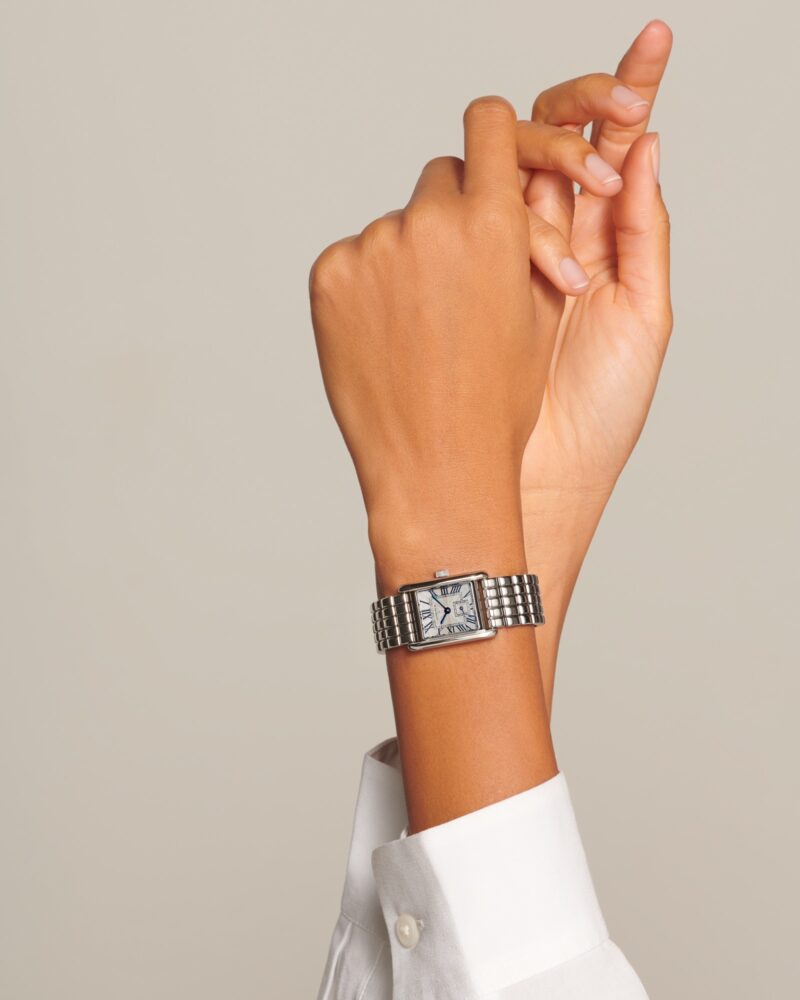
L5.200.4.71.6 on the wrist in Longines’ product photography, with a white cuff and room around the case. Courtesy of Longines.
Explore the story
The cuff is white, the hand is lifted and the watch makes a small silver rectangle at the wrist. Longines' photograph of the Mini DolceVita leaves room around the object. Its presence comes from the meeting of a shaped case, a closely linked bracelet and a dial whose blue hands are visible even at this distance.
Reference L5.200.4.71.6 is the stainless-steel bracelet version with a silver flinqué dial. For a bridal gift, its appeal begins with a pleasing possibility: an object chosen for a particular day can find its place among the gestures and clothes of ordinary life. The photographs offer a way to consider that possibility through the watch itself.
The rectangle, at the wrist
01 / 02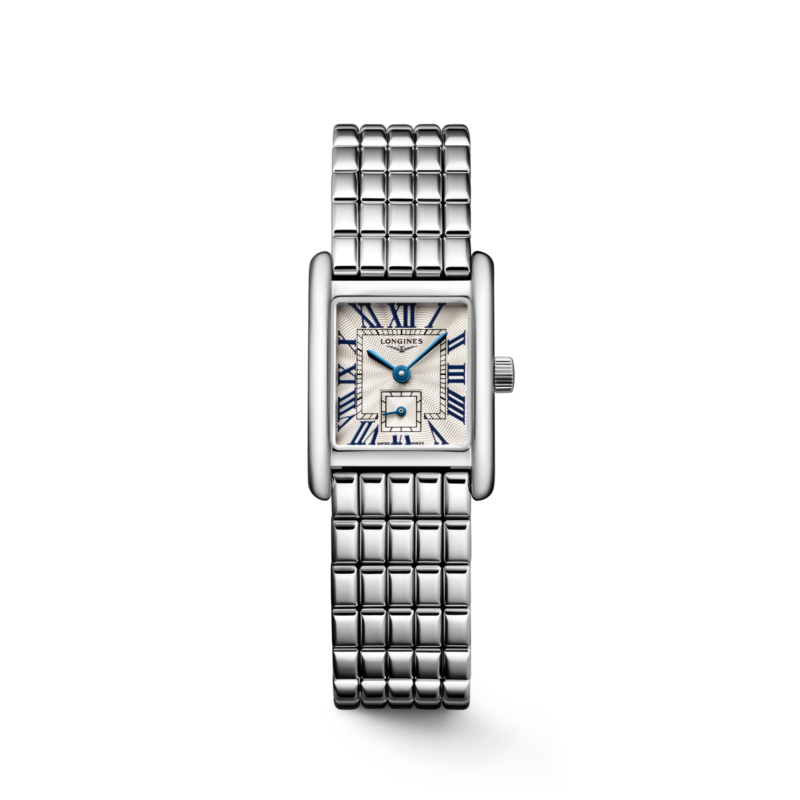
The complete steel bracelet reference, with its 21.50 × 29.00mm case and silver flinqué dial. Courtesy of Longines.
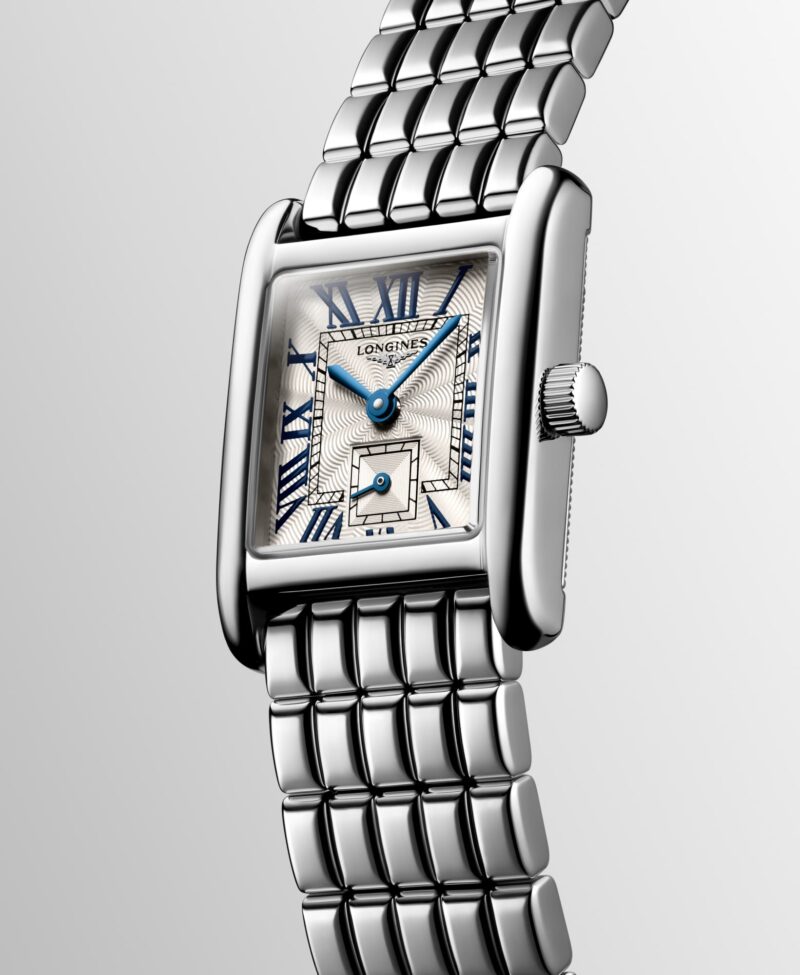
The same reference at an angle: the case, crown and rounded bracelet links. Courtesy of Longines.
The case measures 21.50 by 29.00 millimetres. On the page those figures look modest; on the wrist they become a relationship between the dial, the bracelet and the visible space around them. The photograph with the white cuff is useful because it shows the whole relationship in one frame.
Look at where the bracelet meets the case. Its rows continue the width of the watch, giving the rectangular centre a clear connection to the wrist. The case remains the focal point, while the bracelet makes it part of a longer silver line.
The complete front view brings another detail into focus. The dial's markings extend towards the rectangular boundary, but the small seconds display forms its own square near six o'clock. That smaller geometry gives the lower half of the dial a separate rhythm. It is a rewarding detail in a watch whose overall shape can be understood at a glance.
Blue on silver
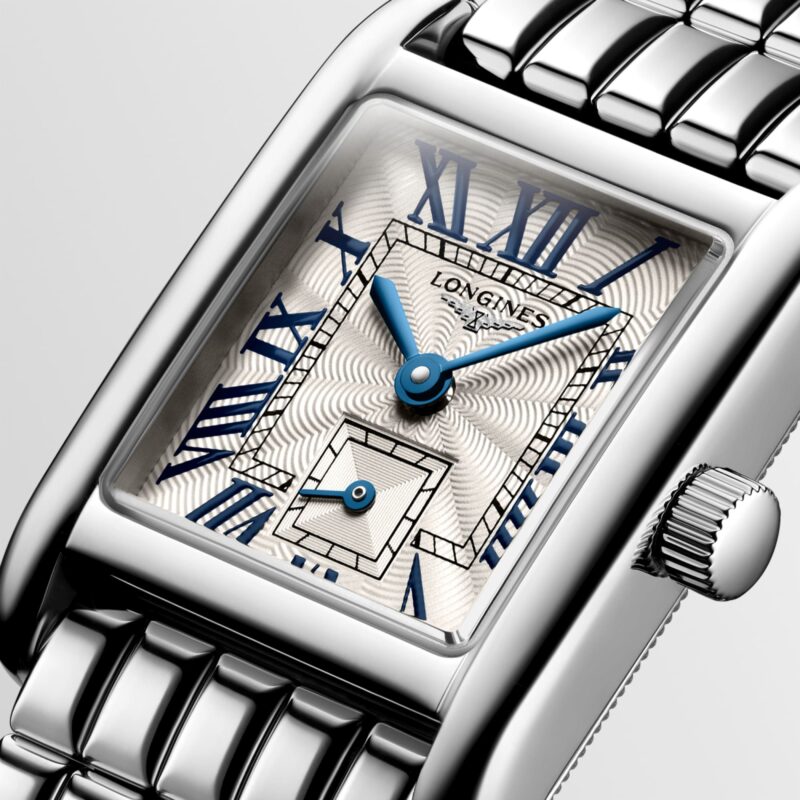
Blue hands and Roman numerals above the textured silver dial; the small seconds display sits below. Courtesy of Longines.
The close photograph of the dial is where the Mini DolceVita becomes more particular. Blue Roman numerals stretch around its edge. The hands have a fuller shape near the centre and narrow towards their tips. Beneath them, the silver surface carries a fine pattern that changes direction as your eye moves across it.
Longines calls this finish flinqué. In the photograph, the texture gives the space between the numerals a visible structure. The small seconds hand repeats the blue at the bottom of the dial, connecting the separate display to the main hands above.
These details are small enough to belong to the wearer. From across a room, the watch reads as a steel rectangle. Closer to the wrist, the blue and silver reveal a more intricate composition. That change of distance is part of the pleasure of a small watch: the object offers something further when you choose to look.
The bracelet makes the line
01 / 02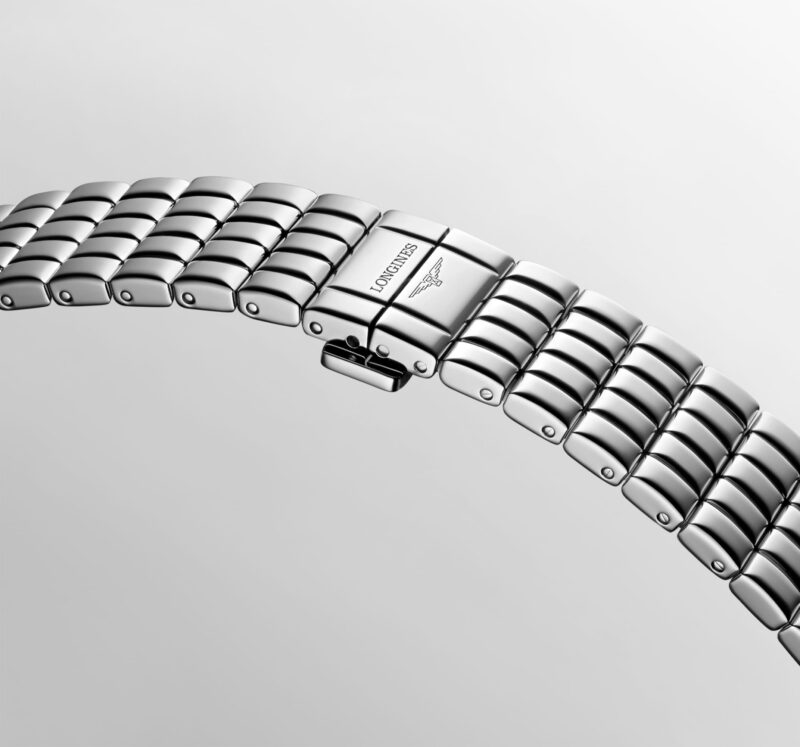
The bracelet with its clasp closed, showing the repeated rounded link surfaces. Courtesy of Longines.
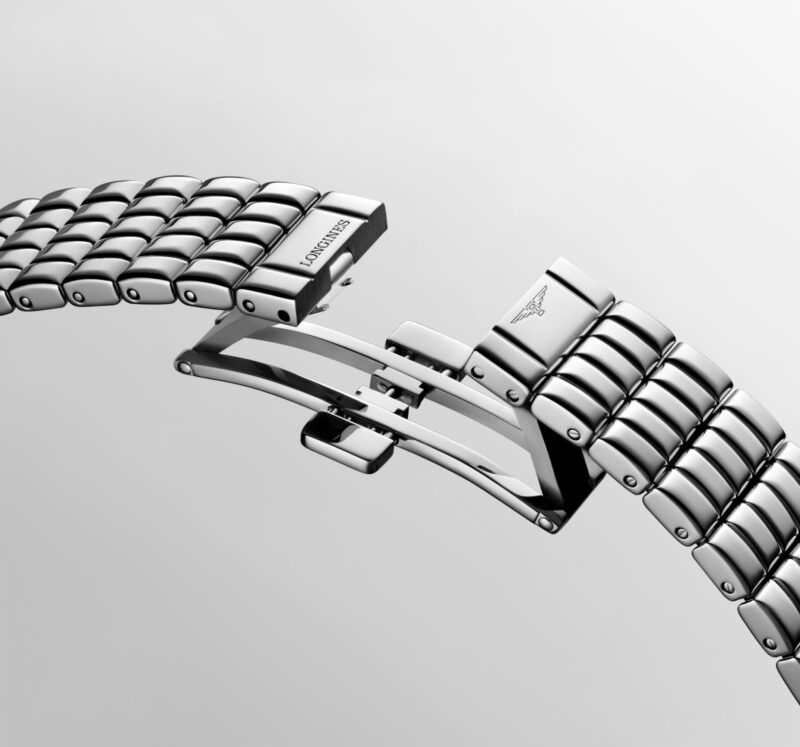
The same clasp open: the folding structure becomes visible within the steel bracelet. Courtesy of Longines.
The bracelet deserves its own chapter because it occupies so much of what is seen and touched. The rounded links catch light in successive bands. In the angled photographs, those repeated surfaces carry the eye towards the case, then continue beyond it.
There is a useful distinction between the watch seen flat and the bracelet shown in a curve. The first makes the outline easy to compare with other objects. The second reveals the sequence of connected pieces that will wrap around a wrist. A linked bracelet has a visual rhythm of its own, and here that rhythm gives the compact case a substantial setting.
Longines specifies a triple safety folding clasp with push-piece opening. The open-clasp photograph shows how the folding structure sits within the bracelet. That view brings the object closer to an everyday act: opening it, putting it on and closing it again. Those repeated gestures are part of the life a gift acquires after it has been given.
A different kind of keepsake
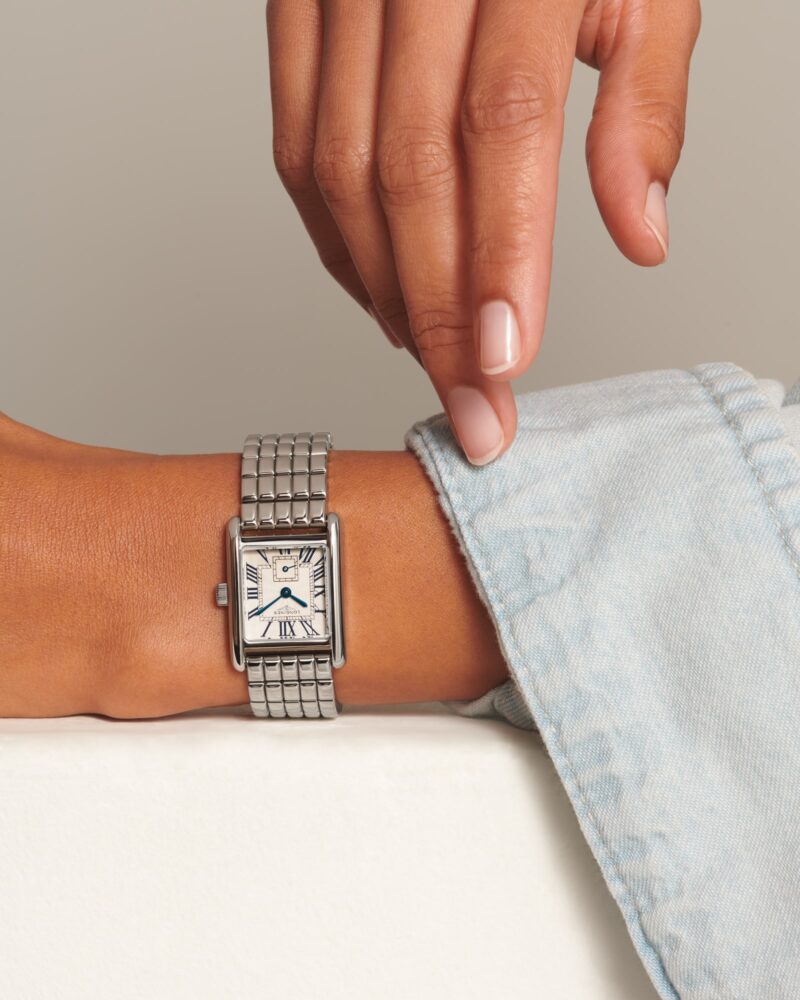
The same watch in another worn photograph, beside a pale blue sleeve. Courtesy of Longines.
This reference uses a quartz movement. The specifications also include a sapphire crystal, anti-reflective treatment on both sides and water resistance rated to 3 bar. They describe the watch's construction and operating basis; the choice still has a visual and personal dimension that specifications alone leave open.
For a wedding-day gift, the steel bracelet provides a starting point for that personal reading. It can sit beside white fabric, as in the house's photograph, or meet the pale blue of a casual sleeve in another worn view. The same watch remains recognisable while the surrounding clothes change its atmosphere.
That second photograph is especially relevant to the idea of keeping the object in use. The wrist rests horizontally, the sleeve is relaxed and the dial is turned towards the viewer. The Mini DolceVita has moved into another setting without needing a new explanation of what it is. The case, hands and bracelet retain their relationship.
The day, and the days after
Longines places the Mini DolceVita within the wider DolceVita family and relates its rectangular vocabulary to a house design from 1927. That history supplies context for the shape. The more immediate reason to choose this particular reference is the way its elements come together now: small case, patterned silver dial, blue details and a continuous steel bracelet.
A meaningful gift leaves room for the recipient's taste. The giver can notice a preference for compact watches, a liking for silver metal or the habit of wearing a bracelet. Those observations make the choice specific to a person, and give the object a connection to a life that already exists.
Return to the lifted hand in the opening photograph. The watch is present, the cuff still has room to fall and the fingers remain the most animated part of the picture. That balance is the proposition worth considering. A small rectangle can mark a significant day and remain something its wearer wants to put on the following morning.
Sources & further reading
The Edit
Jewelry stories
Selected stories from the same editorial universe.
Chaumet Joséphine: Something Blue, Chosen Your Way
An aquamarine beside the face, a sapphire at the centre of a solitaire: Chaumet
Two Rings, Two People: A De Beers Wedding-Band Edit
A rose-gold court profile, a single diamond in platinum, a fine eternity line or
Buccellati Macri Giglio: Gold with a Grain
On the wrist, Buccellati Macri Giglio becomes a broad field of engraved gold. A

Mikimoto M: A Pearl with a Graphic Edge
White South Sea pearls, golden warmth and a sharply drawn setting: Mikimoto M offers
Norman Silverman Bridal: A Ring with Presence
A pear solitaire on the hand, a radiant seen in profile and an emerald-cut
Harry Winston Beyond the Ring: Choosing the Wedding-Day Jewels
The engagement ring does not have to carry the whole wedding look. Harry Winston’s