
TheTimeo / Jewelry
1735:
Blue,
with room beside it.
A sapphire cluster establishes the centre; a narrow diamond band adds a second line. Garrard’s 1735 pairing makes the space between two rings part of the design.
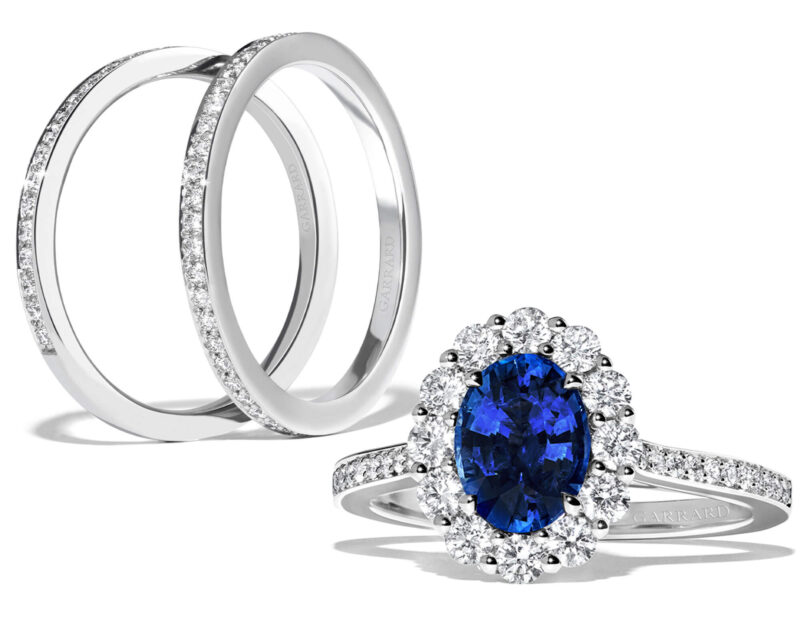
The sapphire cluster and accompanying bands, photographed separately in Garrard’s 1735 guide. Courtesy of Garrard.
Explore the story
An oval of blue gives the ring its centre. Around it, diamonds establish a brighter edge; beside it, a narrow band can draw a second line across the finger. Garrard’s 1735 sapphire ring makes that relationship part of the setting, leaving room for a wedding band beneath the cluster.
The centre and the second line
01 / 03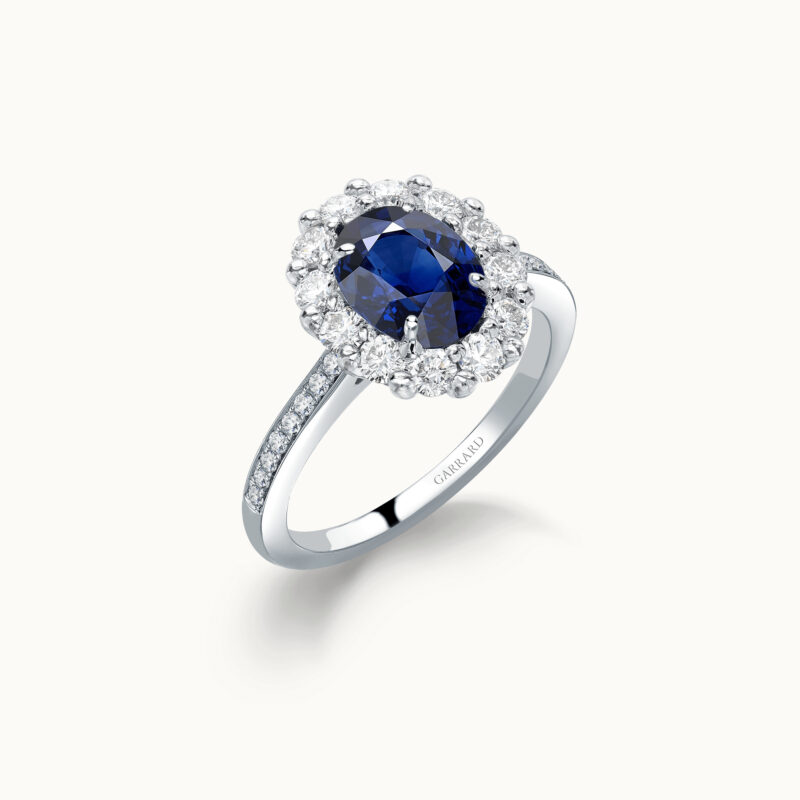
The oval sapphire and diamond cluster from the official 1735 product record. Courtesy of Garrard.
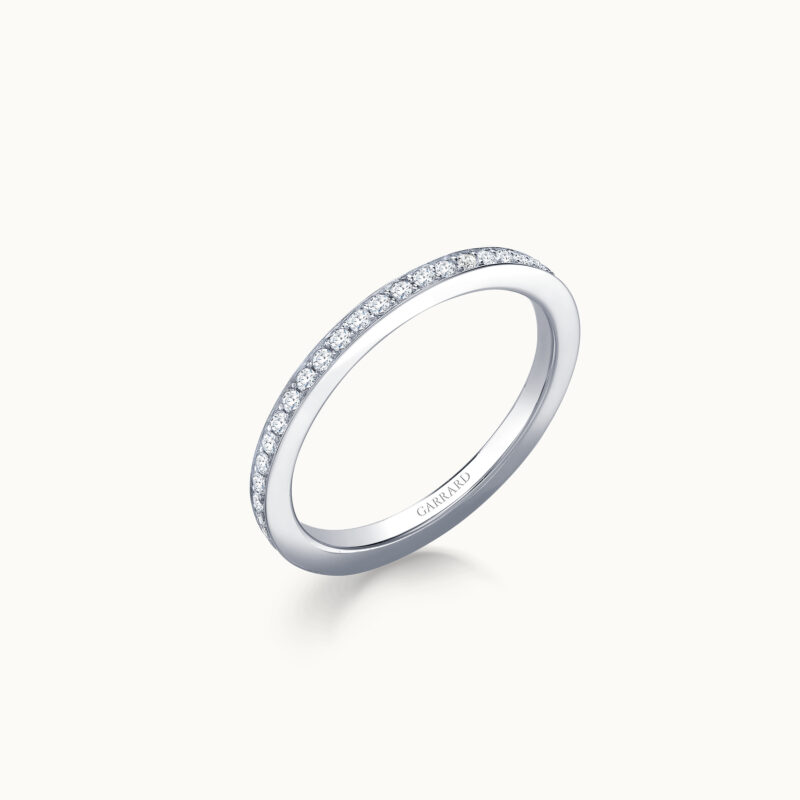
The 1.5mm platinum 1735 diamond band, from product family 2015351. Courtesy of Garrard.
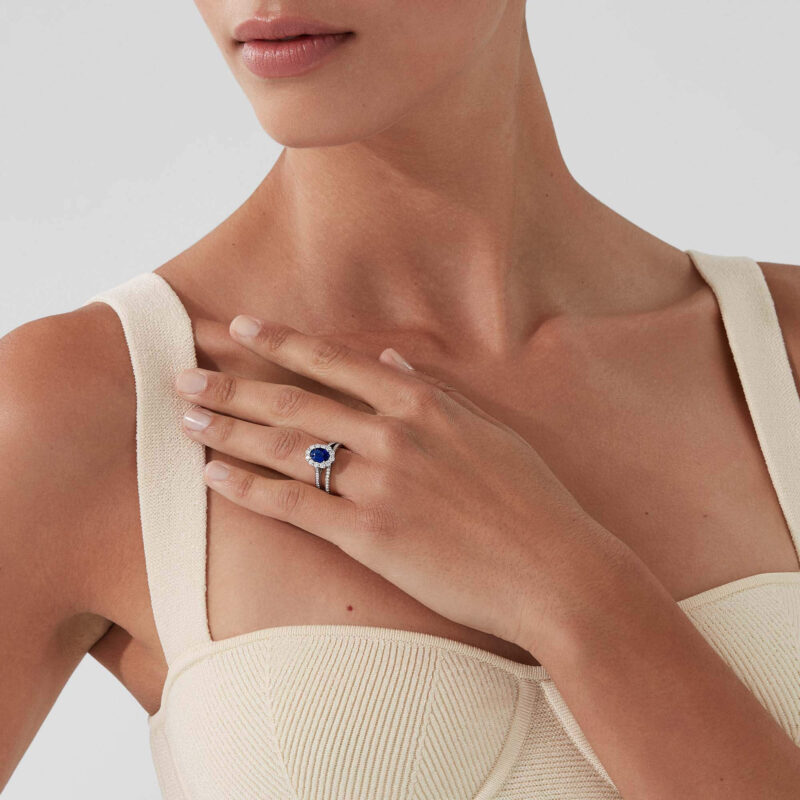
The 1735 sapphire and platinum diamond-band pairing on the hand, from the house’s band gallery. Courtesy of Garrard.
The complete ring photograph begins with a familiar contrast: a blue oval within a border of round diamonds. Yet the oblique view reveals more than the face of the cluster. The platinum setting lifts the stones above the curve of the shank, and small diamonds continue down part of the band. The centre has both a colour and a position in space.
The official record describes an oval sapphire measuring approximately 8 by 6mm, with 30 round diamonds totalling approximately 0.60 carats. Those figures belong to the selected product record. In the photograph, the more immediate impression comes from the difference between the broad blue centre and the smaller, brighter points surrounding it.
The neighbouring 1735 diamond band has another job. At 1.5mm wide, the platinum design presents a much narrower line. Its complete photograph shows a row of small diamonds between rounded metal edges, with no single stone taking command. The eye follows its circumference rather than stopping at a centre.
Garrard describes the raised setting of its 1735 engagement rings as WedFit: a construction intended to make space for the matching 1735 wedding band to sit flush beside the engagement ring. That is a specific relationship within the collection. It gives a reason to look beneath the cluster as well as directly at the sapphire.
The photograph of the pair on the hand makes the idea visible as a composition. The blue oval remains the focal point, while the narrow diamond band extends the brighter line beside it. The second ring changes the width and rhythm of the arrangement without asking to become a second centre stone.
Seen separately, the rings have clearly different proportions. Seen together, the narrow band can read as a companion edge to the cluster. The interesting detail lies in that transition: two complete objects beginning to form a connected picture. It is a more useful starting point for a pairing than the assumption that any two rings will sit together in the same way.
One ring, then a companion
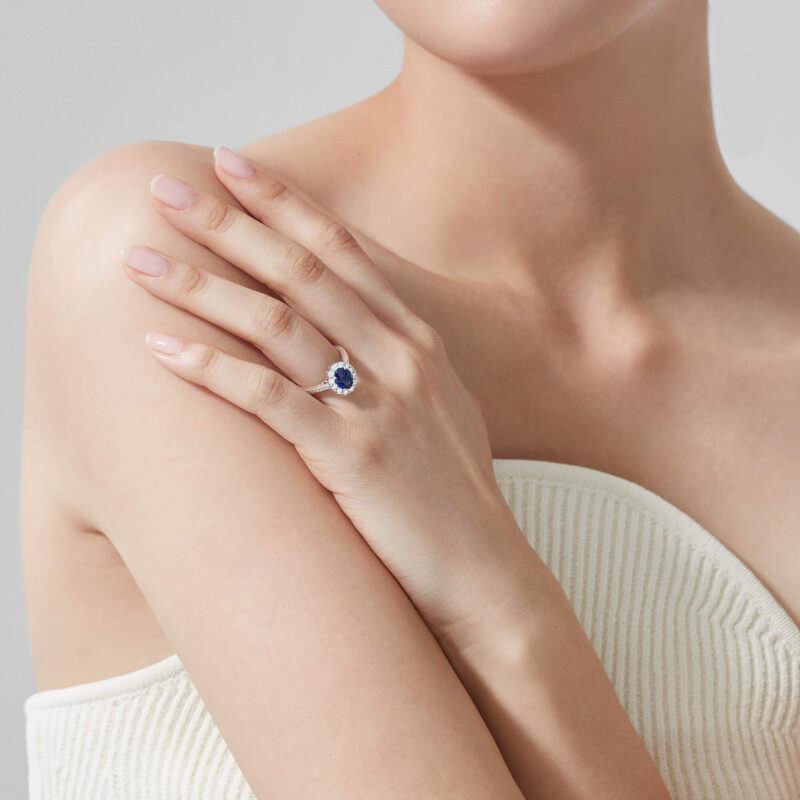
The cluster ring worn alone in Garrard’s sapphire product portrait. Courtesy of Garrard.
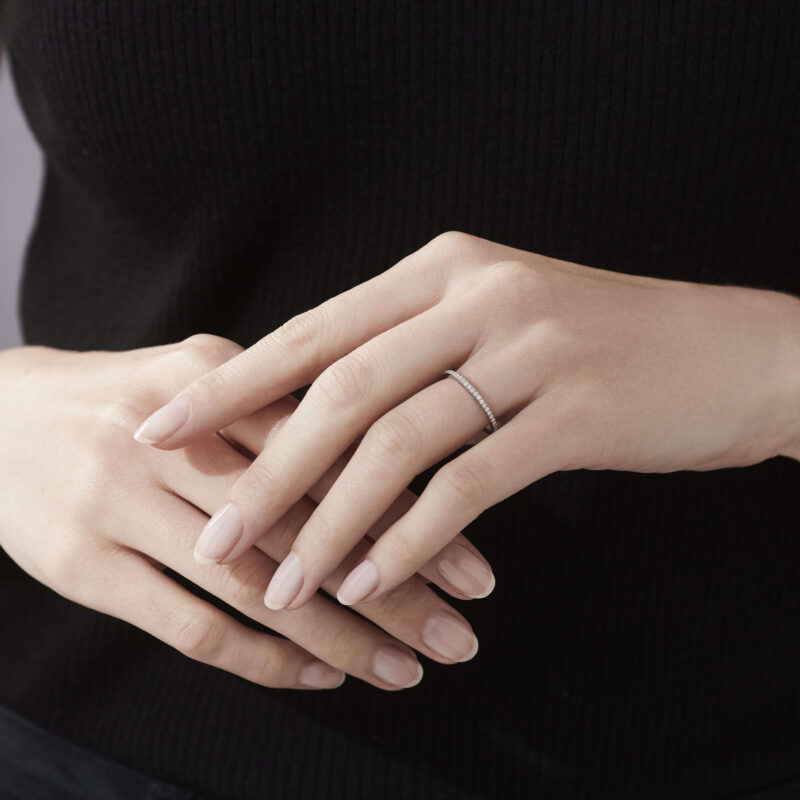
The platinum 1735 band worn alone, from the official 1.5mm product gallery. Courtesy of Garrard.
In the sapphire ring’s wearing portrait, a hand is raised towards the collarbone above a pale knitted top. The blue appears as a concentrated mark within a field of skin and soft fabric. The diamond border helps define its outline, but the colour carries across the image first.
The separate portrait of the diamond band offers a quieter scene. A hand rests over another hand against black knitwear. The band becomes a fine, bright line across one finger. There is no large coloured stone to organise the picture; the curve of the hands supplies most of its shape.
These views give each ring an identity of its own. The engagement ring has a clear front, established by the oval cluster. The narrow band keeps its interest distributed around the circle. Together they can create a fuller arrangement, but neither has to depend on the other to make visual sense.
The opening photograph places the cluster and two bands apart. That separation is useful: it lets the eye compare height, width and outline before deciding how the elements might be combined. The two bands in that composition should not be mistaken for a requirement to wear both. The product gallery also provides the more focused view of the sapphire ring with one matching band on the hand.
For its 1.5mm platinum band, Garrard lists 46 round diamonds totalling 0.25 carats. The scale matters here as much as the quantity. The stones establish a slender line around the finger, while the metal edges hold that line in place. A close product view and an image at normal wearing distance explain different aspects of the same choice.
The house’s flush-fit description concerns the intended geometry of the matching rings. Photographs can show that arrangement, but cannot establish how a particular pair will feel on an individual hand. The useful next step is to try the two together, looking at their alignment from above and from the side, then moving the fingers as you normally would.
Begin with the space beside the stone
It is natural to choose a sapphire ring by looking first at the blue. With a wedding band in mind, the space around that blue deserves an equally careful look. The cluster’s height, the curve of the shank and the line beside it all affect the finished arrangement.
A raised centre does not have to appear visually heavy. In the complete photograph, the setting gives the oval a defined position above a comparatively fine band. The diamonds along the shoulders connect the cluster to the finger, while the separate eternity band can continue that brightness across a wider area.
Return to the three views in the first sequence: the sapphire ring alone, the narrow band alone and the pairing on the hand. Each answers a different question. The first establishes the centre and its support. The second reveals the width of the companion line. The third shows how much those two forms contribute to the total picture when they are worn together.
The choice can then become more personal. Do you prefer the strong blue point of the ring worn alone, or the slightly broader arrangement with the diamond band? Which version feels most convincing beside a bare hand, a long sleeve or another piece you regularly wear? The photographs make those differences visible before an appointment resolves the physical fit.
This is a contemporary study of Garrard’s current 1735 designs, rather than a claim to the ownership or identity of an original royal ring. Nor does the blue in a photograph establish a sapphire’s origin or treatment. Here the interest is more immediate and tangible: a coloured centre, a companion line and a setting designed to give both room on the hand.
Sources & further reading
The Edit
Jewelry stories
Selected stories from the same editorial universe.
Mikimoto Akoya: The Line of Light
A pearl strand draws the eye towards the face. With Mikimoto Akoya, length, rhythm
Graff’s Art of Colour: Blue at the Centre, Green in Motion
A blue centre, an emerald line and the clothes around them: Graff’s September campaign
Boucheron Quatre: Shared Lines, Different Wedding Bands
Ribbed white gold, warm yellow gold and a platinum band with two faces: Boucheron
Garrard Wings Rising: A Wing Drawn in Green
Faceted malachite gives Garrard’s Wings Rising a vivid, patterned edge. A pendant, earrings and
Messika Moderniste: Gold with an Architectural Edge
A broad gold plane, a brushed surface and a small diamond held at the
Chaumet Envol: A Tiara in Motion
Blue wings move from hair to face and cloth. Chaumet’s Envol invites a bridal