
TheTimeo / Jewelry
Wings Rising:
Green,
in motion.
Faceted malachite gives Garrard’s Wings Rising a vivid, patterned edge. A pendant, earrings and a ring carry the same wing into three different relationships with the body.
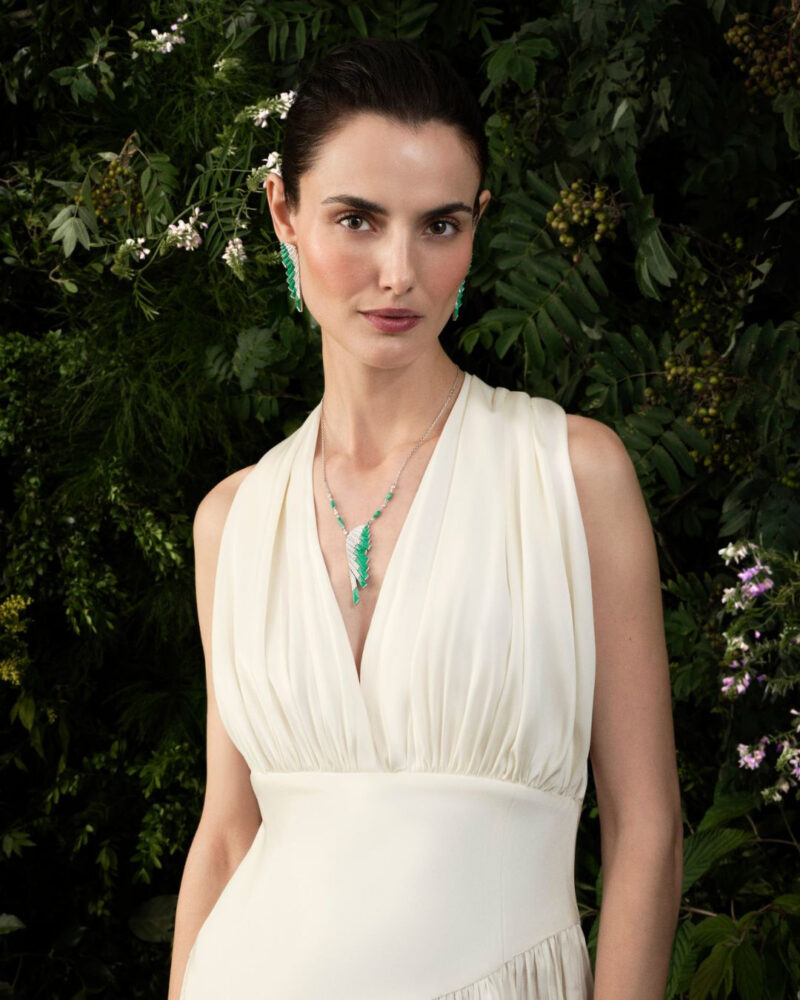
Wings Rising in Garrard’s campaign setting: green against a white dress. Collection context. Courtesy of Garrard.
Explore the story
Green runs along the edge of a wing, broken into small, sharply drawn feathers. Beside it, diamonds establish a finer, brighter line. Garrard’s Wings Rising in apple malachite begins with that contrast: patterned colour given an angular outline, then placed close to the neck, beside the face or across the hand.
Three ways to draw a wing
01 / 03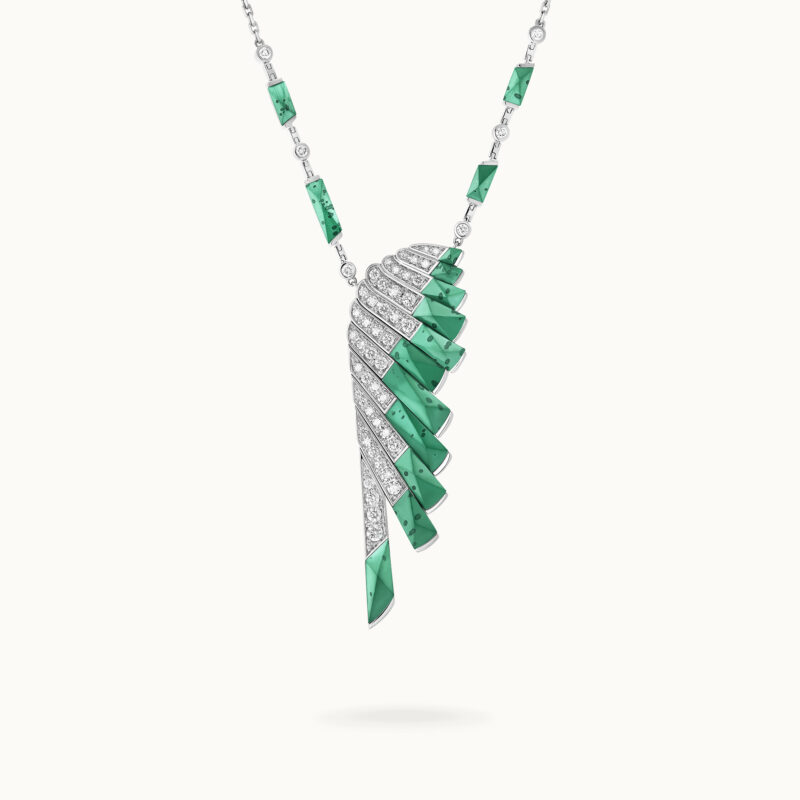
The complete apple malachite slider pendant, 2018615. Courtesy of Garrard.
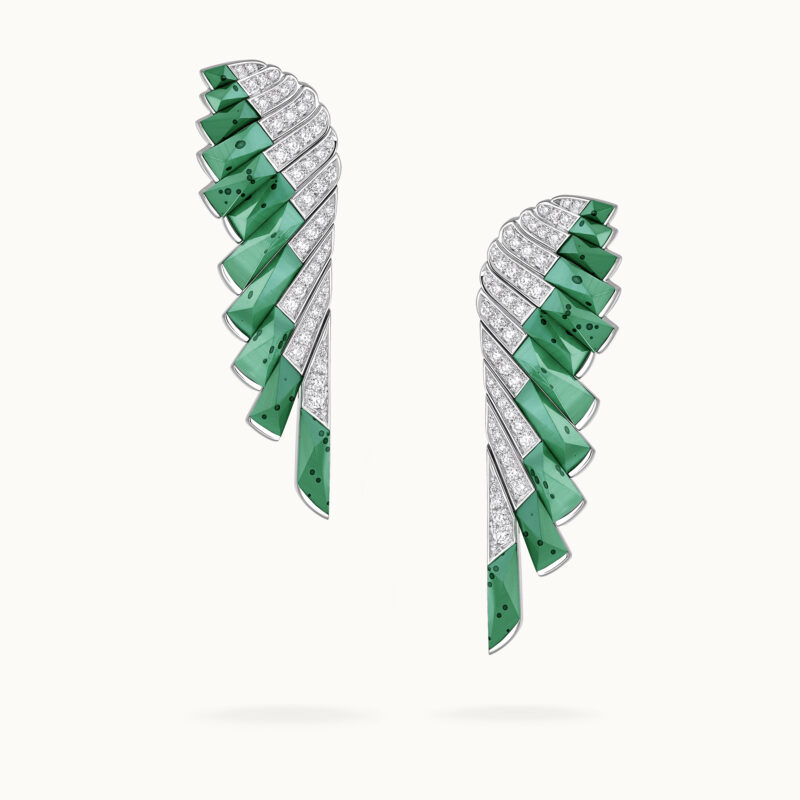
The matching Wings Rising earrings, 2018622,seen as a complete pair. Courtesy of Garrard.
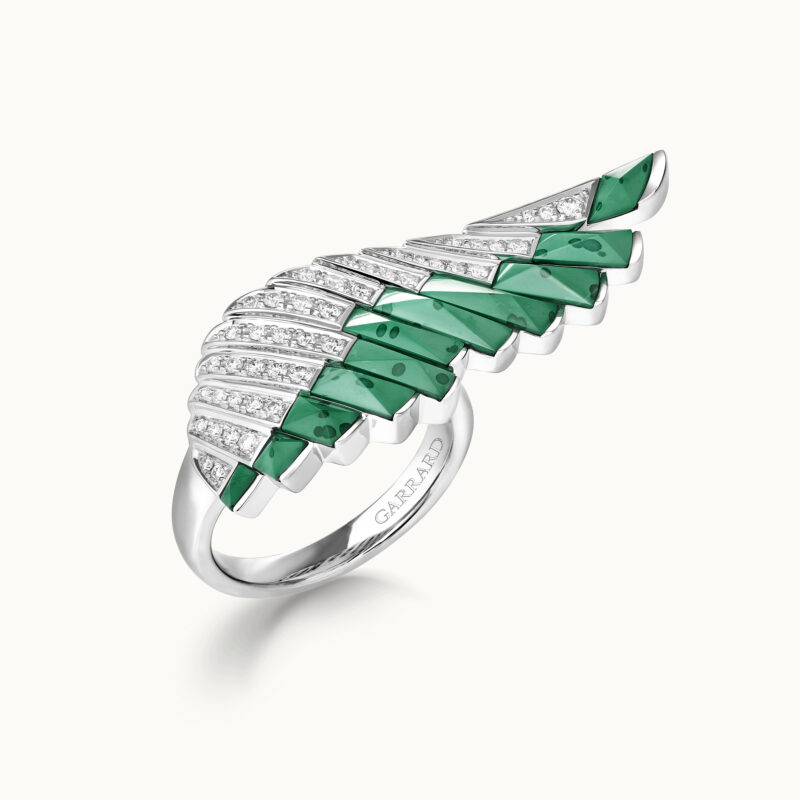
The Wings Rising ring,seen obliquely so its setting and upper outline are visible together. Courtesy of Garrard.
The complete pendant shows how little a wing needs to become recognisable. A curved upper line narrows towards one end, while a succession of longer forms opens beneath it. The green sections create a strong outer edge. Diamonds trace another rhythm within the same outline, separating areas of colour with flashes of white.
Look more closely and the green is already varied. Light and dark bands cross the malachite, sometimes following the shape of a section and sometimes cutting across it. The outline has a clear direction, but the pattern inside it is less regular. That relationship gives each small area something to contribute beyond its place in the silhouette.
Garrard describes the malachite inlay as faceted. In the product photograph, those changes of plane break a broad green area into several differently lit surfaces. The result is quite distinct from a flat, coloured panel. Some edges turn pale in the light; others deepen towards a darker green. The feather shapes acquire volume before the viewer considers how the jewel moves.
The earrings and ring carry that drawing into different proportions. Seen together, the earrings make a pair of related outlines, each with its own graduated lower edge. The ring stretches the motif sideways, with the white-gold setting visible beneath its upper surface. Its shape can be read from above and from the side, where the construction gives the wing a position above the finger.
These are specific malachite versions within Wings Rising. Their interest comes from the meeting of three different visual elements: the stone’s banding, the geometric shape cut around it and the bright diamond-set framework. Follow any one of those elements and the same jewel offers a slightly different route through its design.
One pendant, two positions
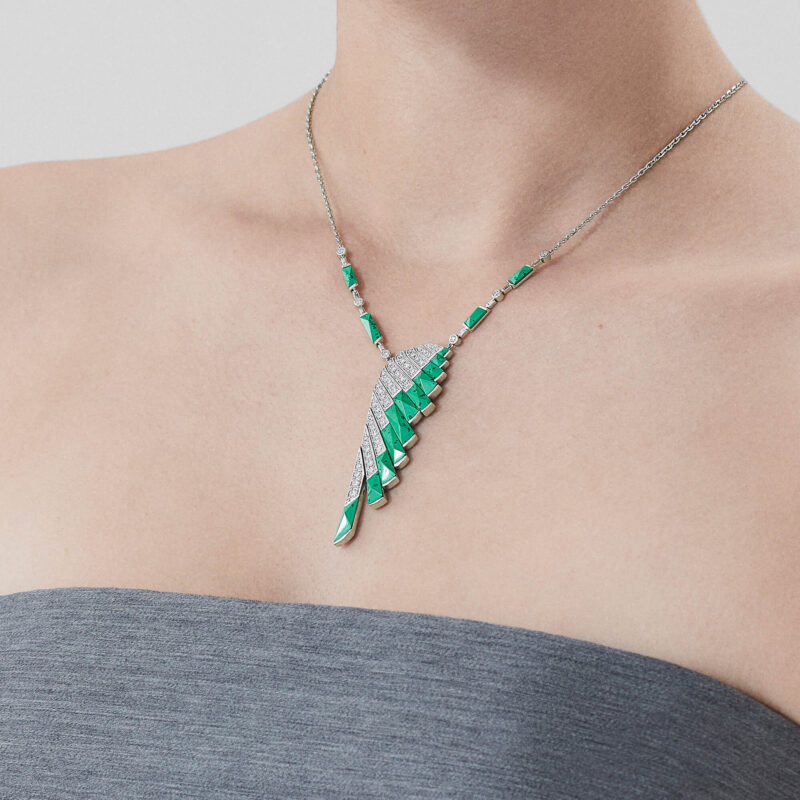
The slider pendant worn high,in the house’s product photograph. Courtesy of Garrard.
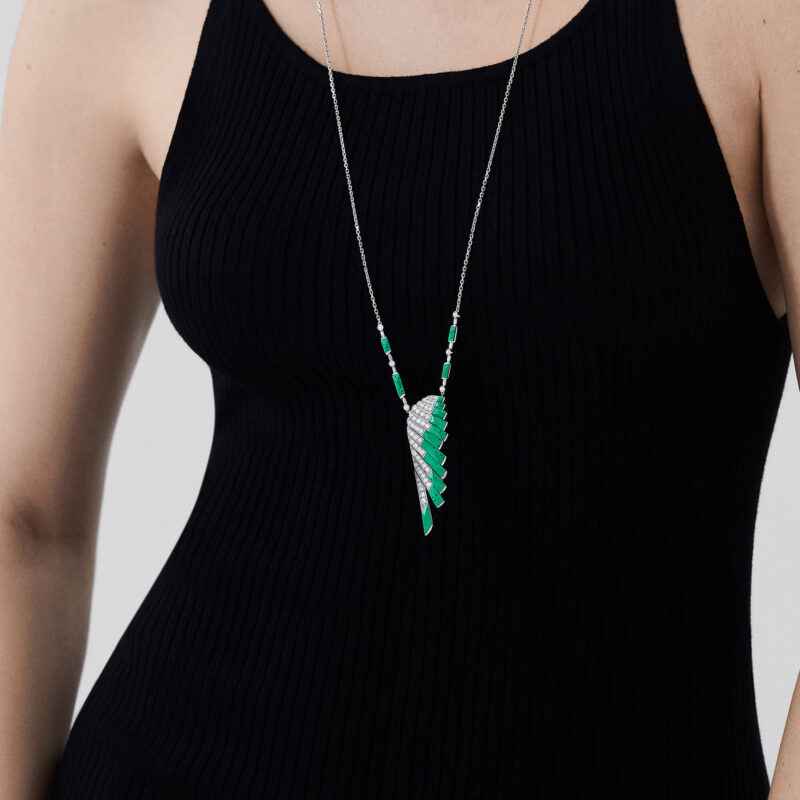
A longer wearing position places the same pendant against black. Courtesy of Garrard.
The first wearing photograph brings the pendant high, just above a pale strapless neckline. At that height, its long edge occupies the open area beneath the collarbone. The chain’s green details become part of the necklace’s drawing, leading towards the larger wing rather than disappearing into the background.
Against the black top in the second image, the chain extends much farther down the body. The pendant now sits within a larger field of clothing. The green becomes more concentrated and the diamond-set areas read as small, bright marks against the dark fabric. The jewel has kept its outline while changing its relationship with everything around it.
Garrard gives the slider pendant an adjustable clasp so it can be worn long or short. The two photographs make that feature easy to understand as a compositional choice. A higher position connects the wing to the neckline; a longer position lets it establish a separate point of interest within the clothes. The useful comparison begins with the image you want the necklace to create.
The official record for pendant 2018615 lists 17 pieces of faceted apple malachite, with 56 round diamonds totalling 1.48 carats, set in 18-carat white gold. More revealing than the quantity alone is the way the parts are distributed. Colour continues into the chain, while the larger central form carries the most pronounced change in scale.
The house also describes articulation in the lower half of the pendant’s feather shapes. That construction belongs to the object’s physical design; the still images show the graduated outline it supports. A complete view and a wearing view answer different questions, and the pleasure of this pendant becomes clearer when both are given room.
Close to the face, across the hand
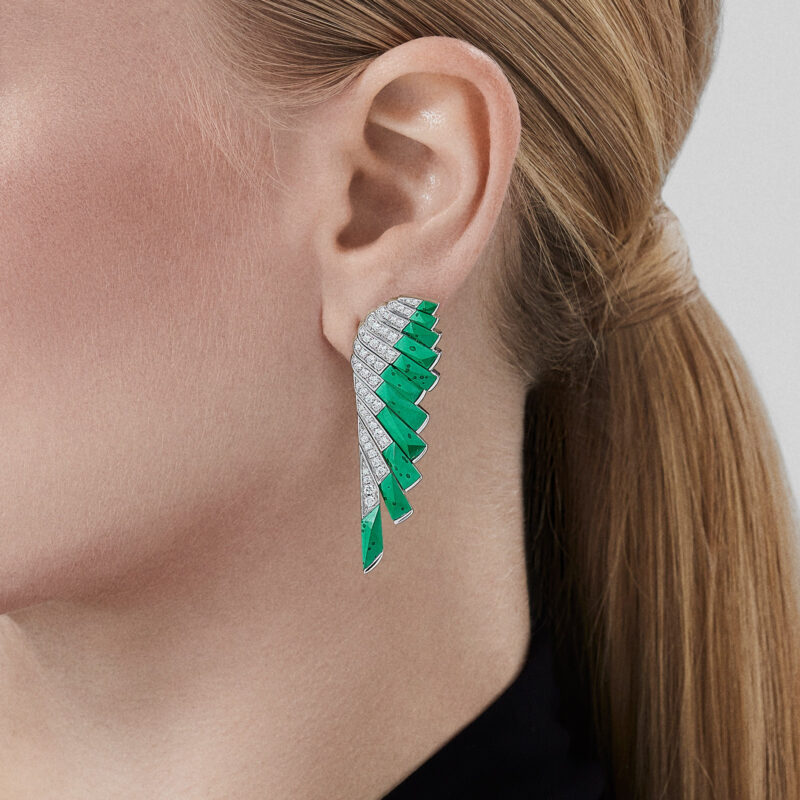
The earring beside the ear,with its lower feather shapes visible. Courtesy of Garrard.
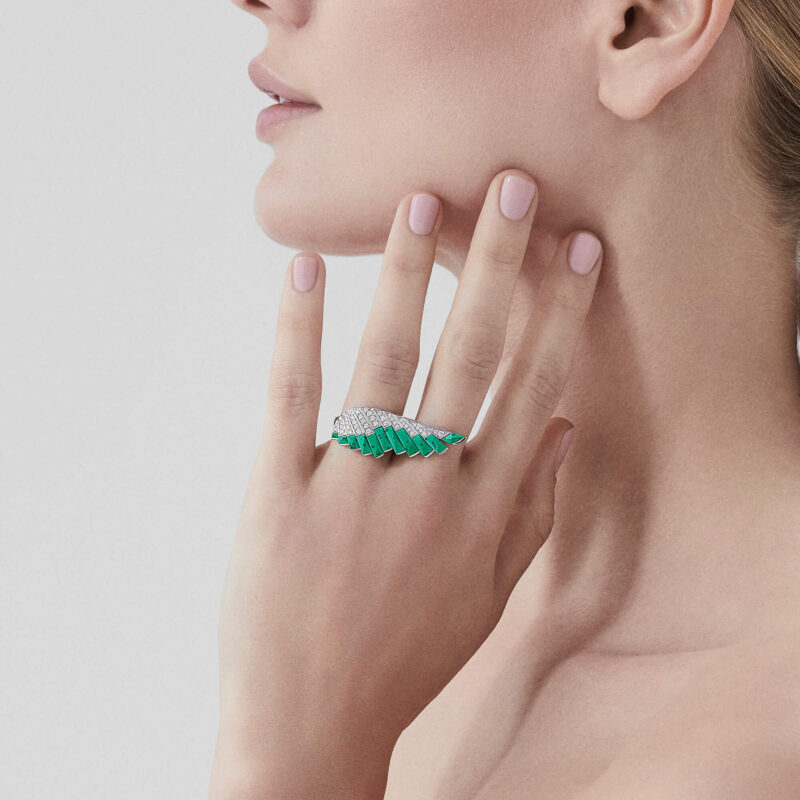
The wing crosses the hand: a contemporary wearing view of the malachite ring. Courtesy of Garrard.
Beside the ear, the wing takes on a more intimate scale. Swept-back hair leaves its upper edge visible, and the lower feather shapes extend towards the jaw. Green appears in a series of small planes, with the diamond-set line introducing a brighter border between the jewel and the skin.
Garrard specifies an articulated lower section for the matching earrings too. Their form suggests a downward opening, in contrast to the ring’s lateral sweep. The pair does not simply repeat a pendant at a smaller size: the relationship between the upper attachment, the face and the graduated edge changes how the motif occupies space.
The ring photograph makes another difference immediately apparent. The wing crosses two fingers, giving its longest dimension a broad surface on which to rest visually. In the house’s wearing image, a hand held near the face brings the green into the same frame as the skin and jaw. It is a particularly clear example of a jewel changing character through gesture.
From the side, the setting beneath the ring’s upper surface becomes part of the attraction. White gold supports the pointed green sections, while the diamond line gives them a bright counterweight. The wing has enough structure to remain legible even when the hand is turned and the complete silhouette is no longer seen straight on.
Choosing between these forms is partly a choice of where colour enters a look. Earrings place it within the frame of the face; the ring brings it into the movement of the hands; the pendant lets its position vary with the neckline and clothing. Each preserves the same material language while giving it a different place in an ordinary gesture.
The pattern inside the outline
The malachite makes the motif particularly rewarding to revisit. A single green tone could emphasise the wing’s silhouette, but the bands inside these sections supply another layer of direction. Some small areas appear almost striped; others hold broader changes of colour. The stone contributes a drawing of its own within the jeweller’s drawing.
Faceting strengthens that relationship. The surrounding shape tells the eye where an individual feather begins and ends, while changes in light reveal the planes across it. The diamond-set areas respond differently, breaking the brightness into much smaller points. Those two scales of reflection let the green remain substantial without making the whole composition feel visually solid.
There is no need to wear every version together for that language to be understood. One earring, pendant or ring can introduce the entire idea: patterned material, a purposeful edge and a graduated movement through the shape. The most persuasive choice may be the one whose placement gives those qualities the clearest expression in your own clothes.
In Garrard’s campaign portrait, a white dress and a garden setting give the green a softer surrounding world. In the close product photographs, white backgrounds reveal the construction with much less atmosphere. Between those views, Wings Rising keeps its identity. Its wing is recognisable at a glance, and the pattern within it gives a reason to keep looking.
Sources & further reading
- Garrard — Wings Rising apple malachite slider pendant, product 2018615
- Garrard — Wings Rising apple malachite earrings, product 2018622
- Garrard — Wings Rising apple malachite ring, official product record
- Garrard — Wings: Inspired by Nature, Crafted by Garrard, official campaign
- Garrard — The Wings collection and official source photographs
The Edit
Jewelry stories
Selected stories from the same editorial universe.
Graff’s Art of Colour: Blue at the Centre, Green in Motion
A blue centre, an emerald line and the clothes around them: Graff’s September campaign
Garrard 1735: A Sapphire Ring with Room for Two
A sapphire cluster establishes the centre; a narrow diamond band adds a second line.
Boucheron Quatre: Shared Lines, Different Wedding Bands
Ribbed white gold, warm yellow gold and a platinum band with two faces: Boucheron
Chaumet Envol: A Tiara in Motion
Blue wings move from hair to face and cloth. Chaumet’s Envol invites a bridal
Messika My Twin: Two Cuts, One Bridal Look
An emerald cut, a pear and an unequal pair: the small asymmetry of Messika
Chaumet Joséphine: Something Blue, Chosen Your Way
An aquamarine beside the face, a sapphire at the centre of a solitaire: Chaumet