
TheTimeo / Jewelry
Quatre:
A shared line,
your own rhythm.
Ribbed white gold, warm yellow gold and a platinum band with two faces: Boucheron offers a common language for wedding rings that keep their own character.

Yellow-gold Grosgrain in Boucheron’s product styling for JAL01169. Other jewellery belongs to the styling. Courtesy of Boucheron.
Explore the story
A wedding band can be a quiet circle and still have a particular way of catching the light. In Boucheron’s Quatre family, a ribbed surface turns that circle into a recognisable rhythm. White gold, yellow gold and a platinum design with two different faces offer three starting points for a choice that need not be identical for two people.
The rhythm at close range
01 / 03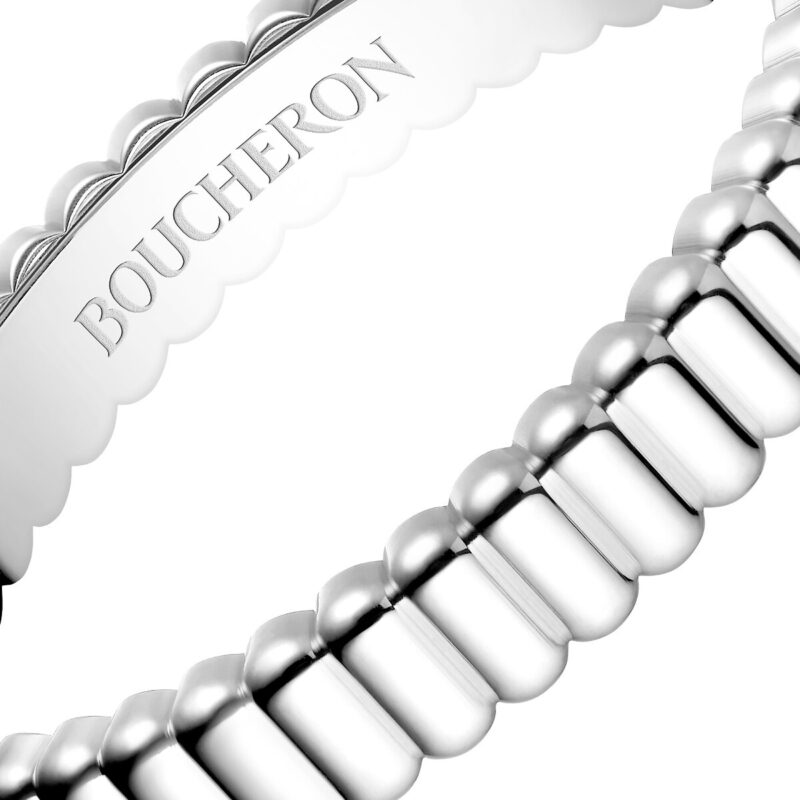
JAL01170 at close range, as framed by the house. Courtesy of Boucheron.
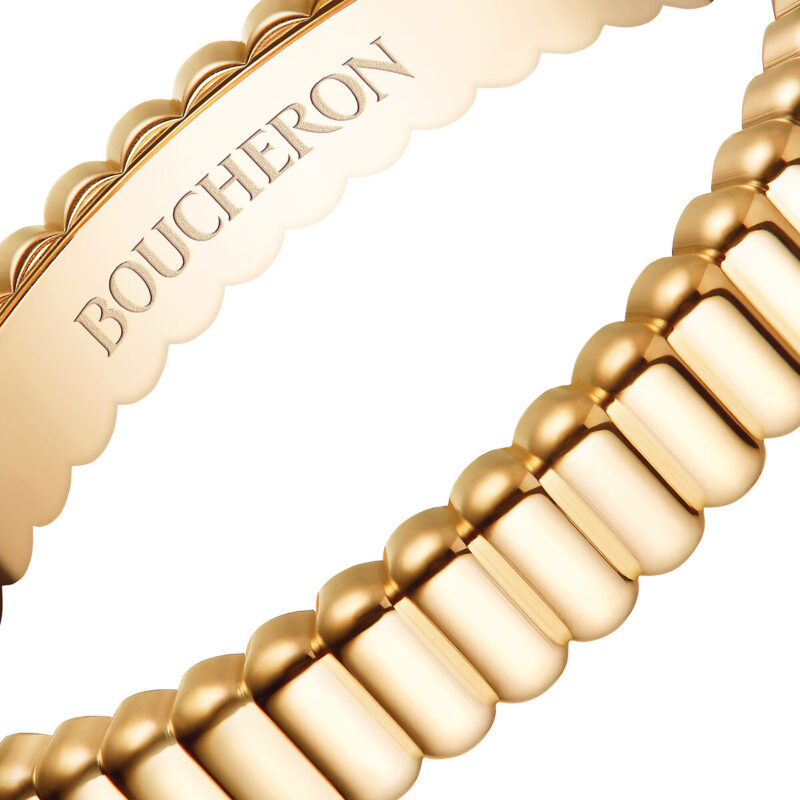
The yellow-gold Grosgrain detail, from the JAL01169 gallery. Courtesy of Boucheron.
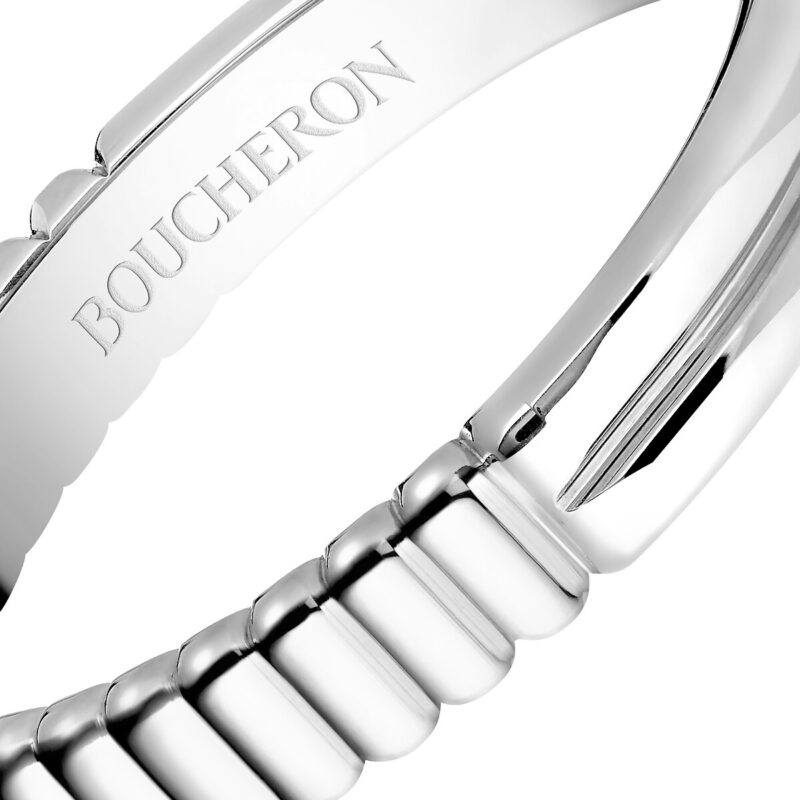
The two surfaces of platinum JAL00312, in the house’s original detail frame. Courtesy of Boucheron.
The close photographs change the scale of the pattern. What looked like a fine texture now becomes a succession of rounded, almost cushioned forms. Their upper surfaces are bright; the narrow spaces between them create the darker beats. The repetition is regular, but the reflection across it keeps changing.
These are detail frames supplied by Boucheron for the specific white- and yellow-gold references. Inside each ring, the house’s name is visible on a smoother surface. The photograph gives the outer relief and the inner curve different roles: one holds the visual detail, the other completes the circle beneath it.
Grosgrain takes its name from a ribbed textile, and Boucheron connects the motif with the family’s origins in drapery. The relationship is easy to see here without imagining that gold behaves like fabric. Closely spaced ridges give the surface a direction and a tempo, translating a textile reference into the much firmer language of metal.
In white gold, the bright ribs and the pale interior belong to a cool, nearly monochrome picture. In yellow gold, colour adds another layer. The recessed areas deepen towards amber while the upper edges become much paler. It is the same type of visual rhythm, with a different range of tones within it.
This is where a wedding band can reward a slower look. A plain circle might first be judged by width and colour. Grosgrain asks for attention to the surface as well: how fine the repetition appears, where the highlights collect and whether that activity feels right beside the other jewellery you already wear. The complete view keeps those details in proportion; the close view explains where they come from.
Three rings, a recognisable line
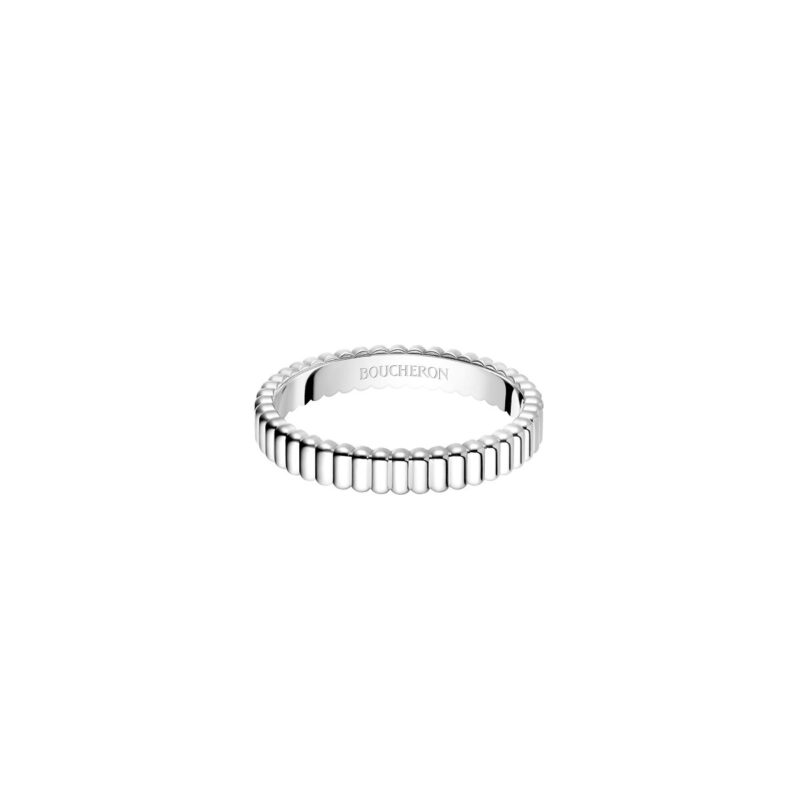
Grosgrain JAL01170 in 18-carat white gold. Courtesy of Boucheron.
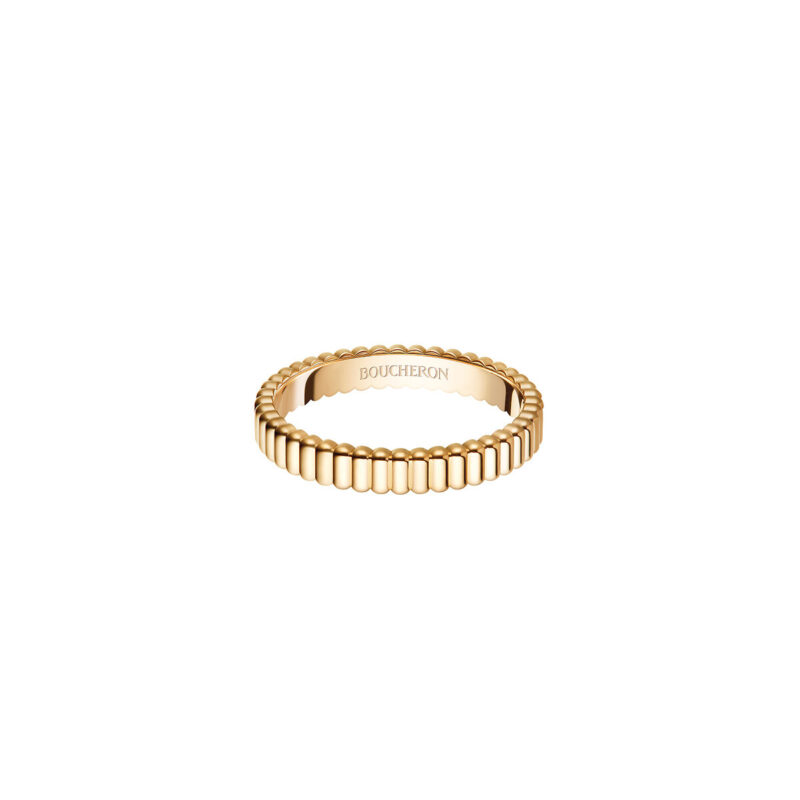
The same Grosgrain language in yellow gold: JAL01169. Courtesy of Boucheron.
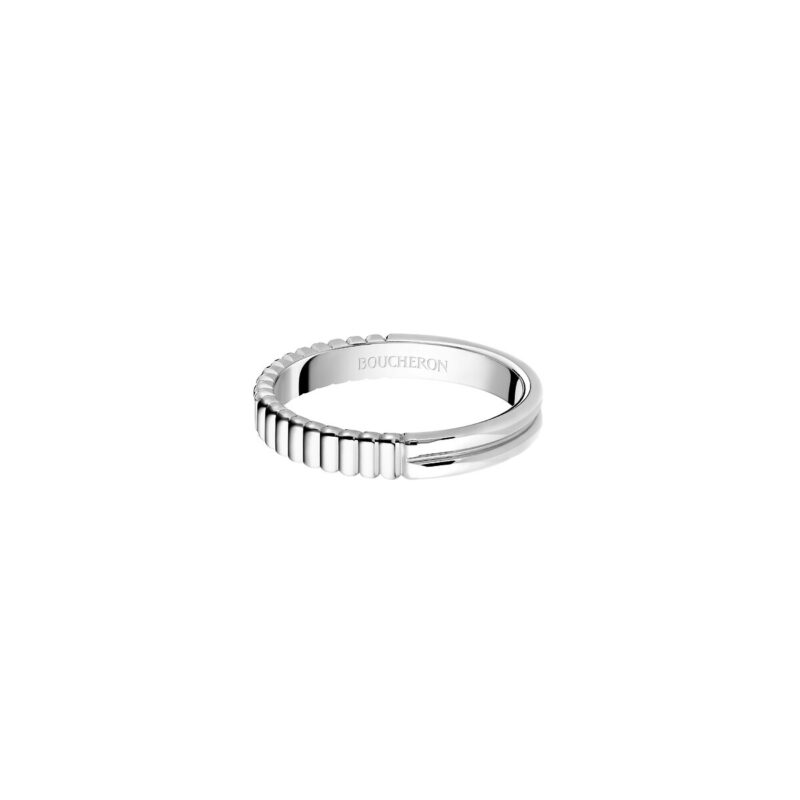
Quatre Radiant Edition JAL00312 in 950 platinum. Courtesy of Boucheron.
The white-gold Grosgrain band is the clearest place to begin. Seen complete, it has a continuous series of rounded ribs around its outside. Each catches a small bright reflection, with a darker interval beside it. From a distance those alternating marks merge into a single textured line; closer to the hand, their repetition becomes the main event.
Boucheron lists this version, JAL01170, in 18-carat white gold. The yellow-gold Grosgrain band, JAL01169, carries the same motif into a warmer colour. Their complete photographs make a useful comparison because neither depends on a centre stone. The surface of the metal supplies the detail, and the ring retains an unbroken circular outline.
The platinum Quatre Radiant Edition band, JAL00312, introduces a different balance. Part of its outer surface is ribbed; another part forms a smoother, rounded line. Boucheron identifies these as Grosgrain and Double Godron, brought together in 950 platinum. It is a separate design, rather than the white-gold Grosgrain ring made in another metal.
Look at the contrast within that platinum ring. The smooth area gathers a longer reflection, while the ribbed area breaks light into smaller pieces. One band therefore offers two scales of detail. Its character depends on which surface faces the eye and how much of the circular outline is visible.
For wedding rings, that creates an appealing possibility. Two choices can share a recognisable language without sharing every feature. A warm Grosgrain band and a cooler platinum band have something in common before they are placed beside each other: a rhythm that continues around the finger.
A ring within the clothes

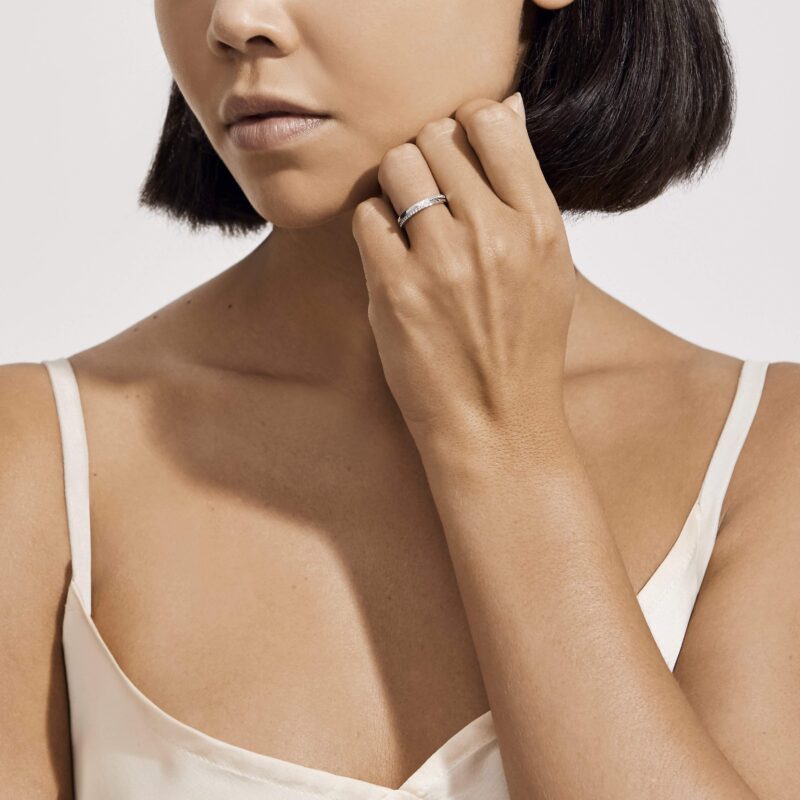
The white-gold band in the house’s JAL01170 wearing portrait. Other rings and bracelet are styling context. Courtesy of Boucheron.
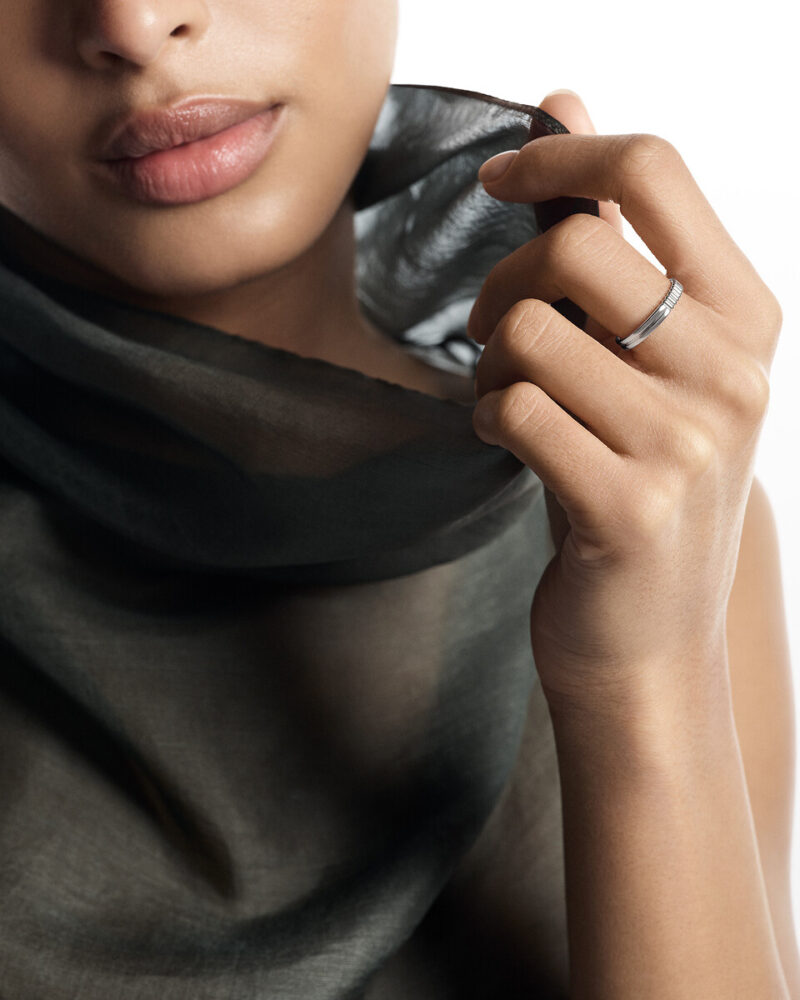
JAL00312 on the hand, in Boucheron’s product portrait. Courtesy of Boucheron.
The wearing portraits bring the rings back from the scale of the detail. In Boucheron’s image for the white-gold Grosgrain band, a hand is raised against a burgundy blouse. Other rings and a bracelet are part of the styling. The band enters that fuller arrangement as a relatively small line of light, with enough texture to remain distinct.
In the platinum portrait, a hand holds a soft dark scarf near the neck. The ring sits within folds of fabric and the curves of the fingers. Its rounded and ribbed surfaces now read together within a much wider picture. What seemed highly graphic in isolation becomes a quieter part of an ordinary gesture.
The yellow-gold portrait at the opening offers another context: structured black tailoring, a hand against the front of the jacket and a small warm accent at the finger. The suit gives the photograph large, clear shapes. The ring supplies a more intimate scale of detail within them.
These images are useful because a wedding band rarely lives alone on a white background. It appears beside cuffs, knitwear, a watch, another ring or simply the changing position of the hand. A design that interests you in a close photograph should also make sense at that everyday distance.
The portraits show Boucheron’s styling, rather than a rule for how the rings should be worn. They are separate product photographs, not a photographed couple choosing matching bands. Their value is in the comparison: the same family of ideas can sit within very different clothes and gestures without losing its identity.
A shared language, without a matching rule
Begin a comparison with the three complete rings, then return to the hands. The white- and yellow-gold Grosgrain versions keep the motif continuous. The platinum Radiant Edition introduces a smoother companion surface. Those differences give a conversation about wedding bands something more specific than a preference for warm or cool metal.
For two people choosing together, a common detail can be enough. Both may like the ribbed rhythm while preferring different colours; one may want the uninterrupted pattern while the other prefers the two faces of the platinum design. There is no need for the choices to produce the same picture on each hand.
The final judgement belongs at the scale of your own fingers, alongside the clothes and jewellery that will surround the ring. An appointment can establish the fit and proportions that photographs cannot settle. The photographs offer a place to start: a clear line, an interesting surface and a shared vocabulary with room for an individual decision.
Sources & further reading
The Edit
Jewelry stories
Selected stories from the same editorial universe.
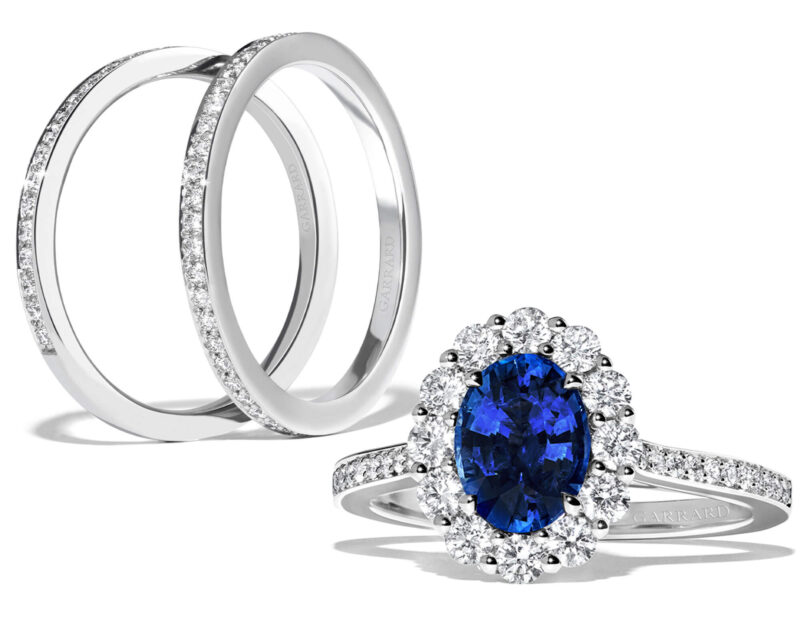
Garrard 1735: A Sapphire Ring with Room for Two
A sapphire cluster establishes the centre; a narrow diamond band adds a second line.
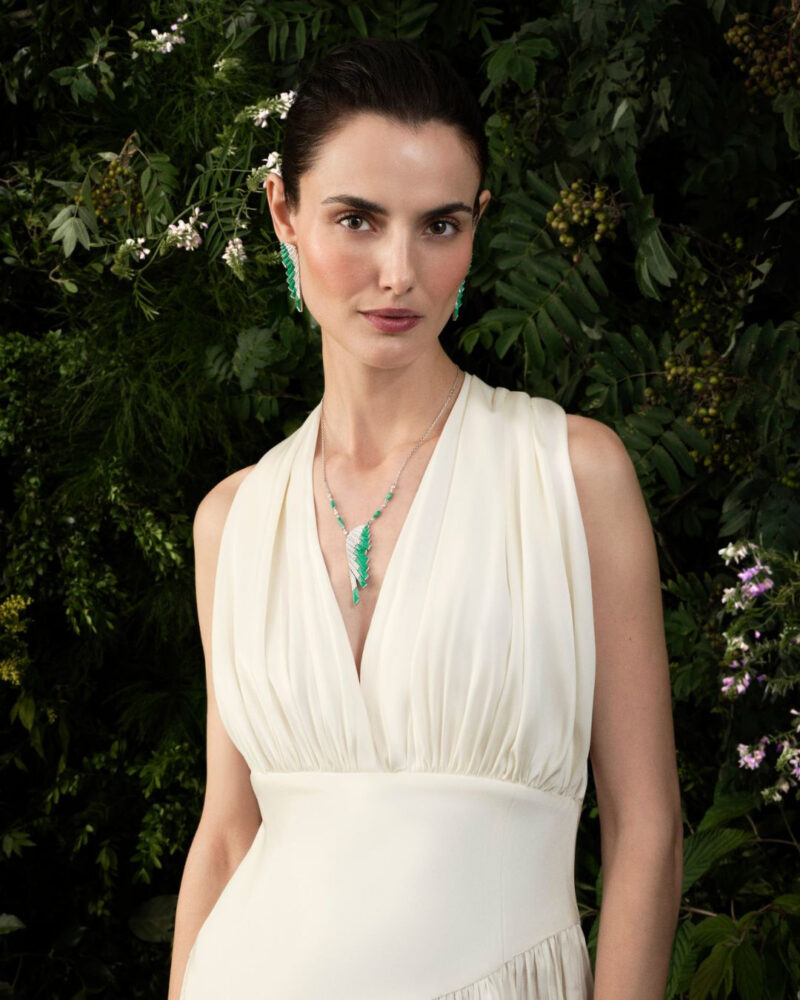
Garrard Wings Rising: A Wing Drawn in Green
Faceted malachite gives Garrard’s Wings Rising a vivid, patterned edge. A pendant, earrings and
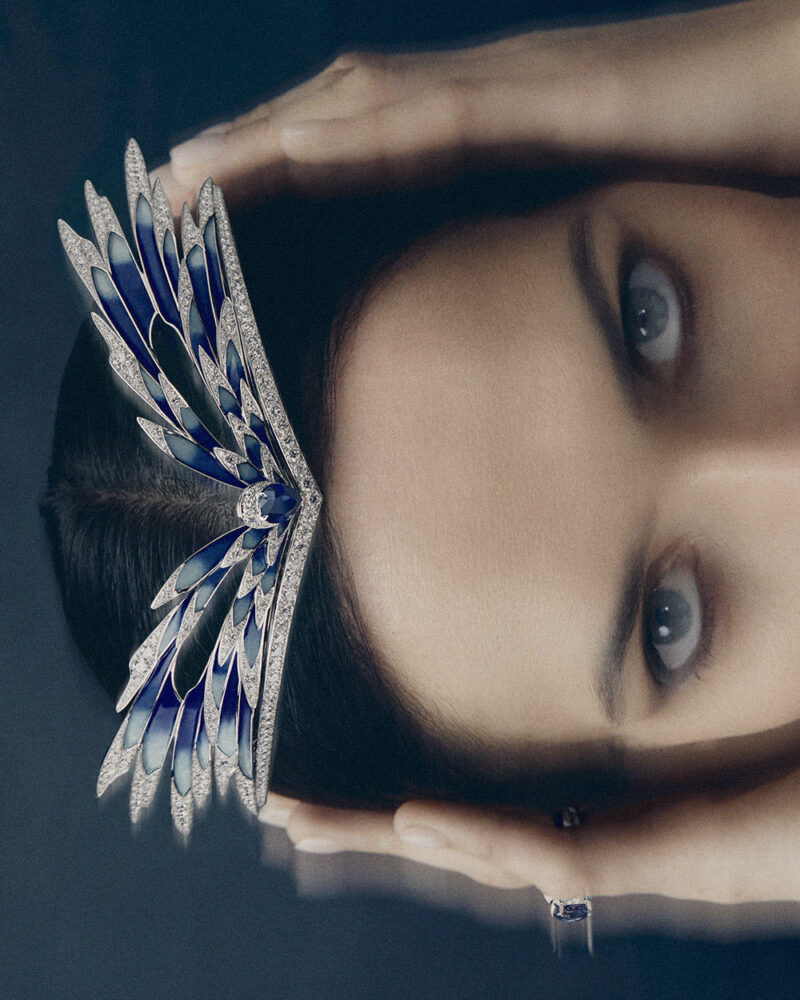
Chaumet Envol: A Tiara in Motion
Blue wings move from hair to face and cloth. Chaumet’s Envol invites a bridal
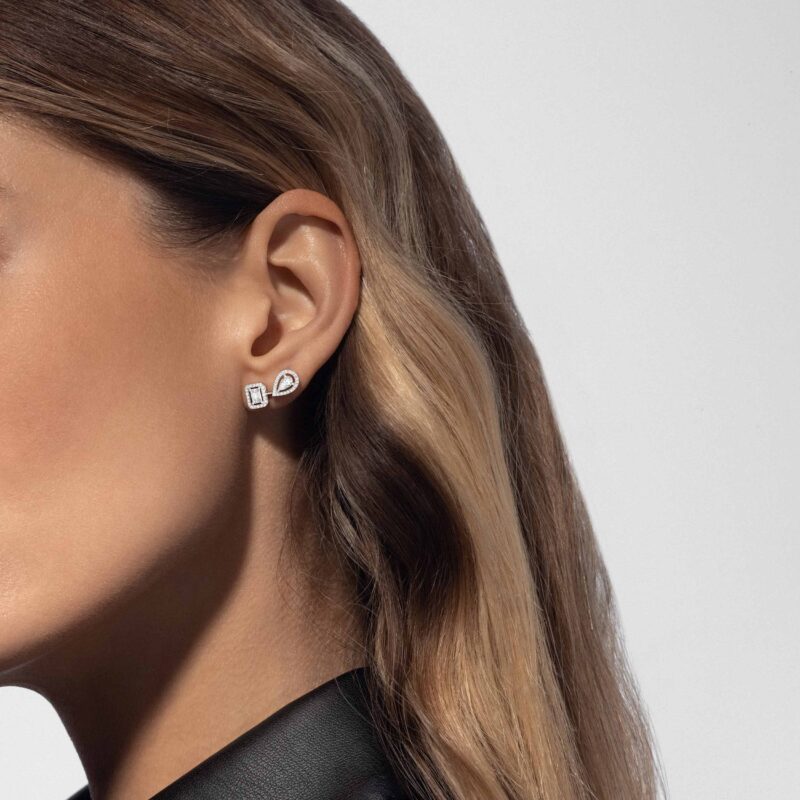
Messika My Twin: Two Cuts, One Bridal Look
An emerald cut, a pear and an unequal pair: the small asymmetry of Messika
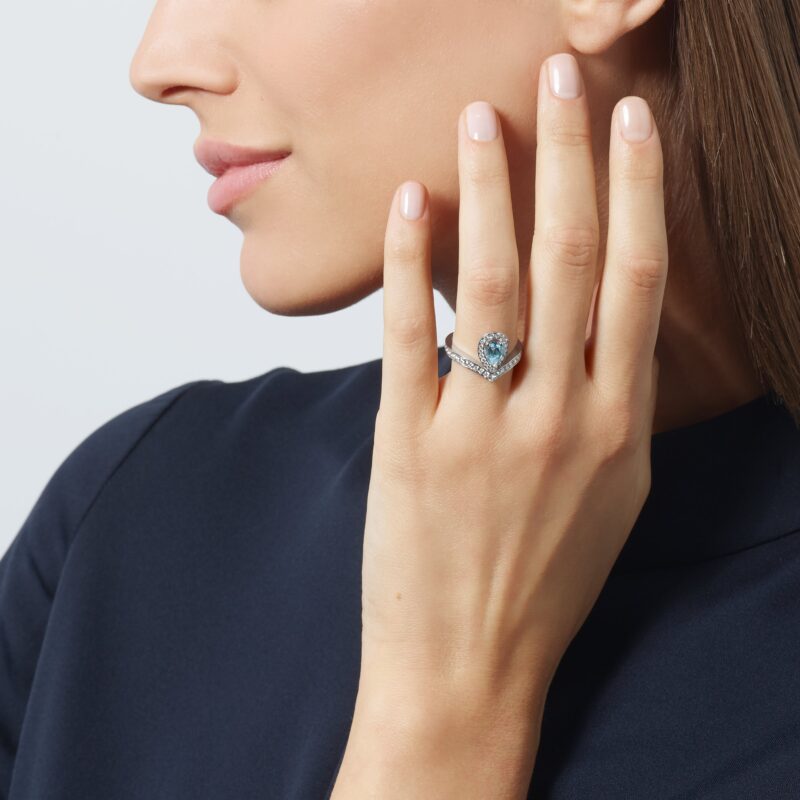
Chaumet Joséphine: Something Blue, Chosen Your Way
An aquamarine beside the face, a sapphire at the centre of a solitaire: Chaumet
Two Rings, Two People: A De Beers Wedding-Band Edit
A rose-gold court profile, a single diamond in platinum, a fine eternity line or