
TheTimeo / Jewelry
Moderniste:
Gold,
given an edge.
A broad gold plane, a brushed surface and a small diamond held at the centre. Messika’s Moderniste gives the architecture of a jewel room to become the main attraction.
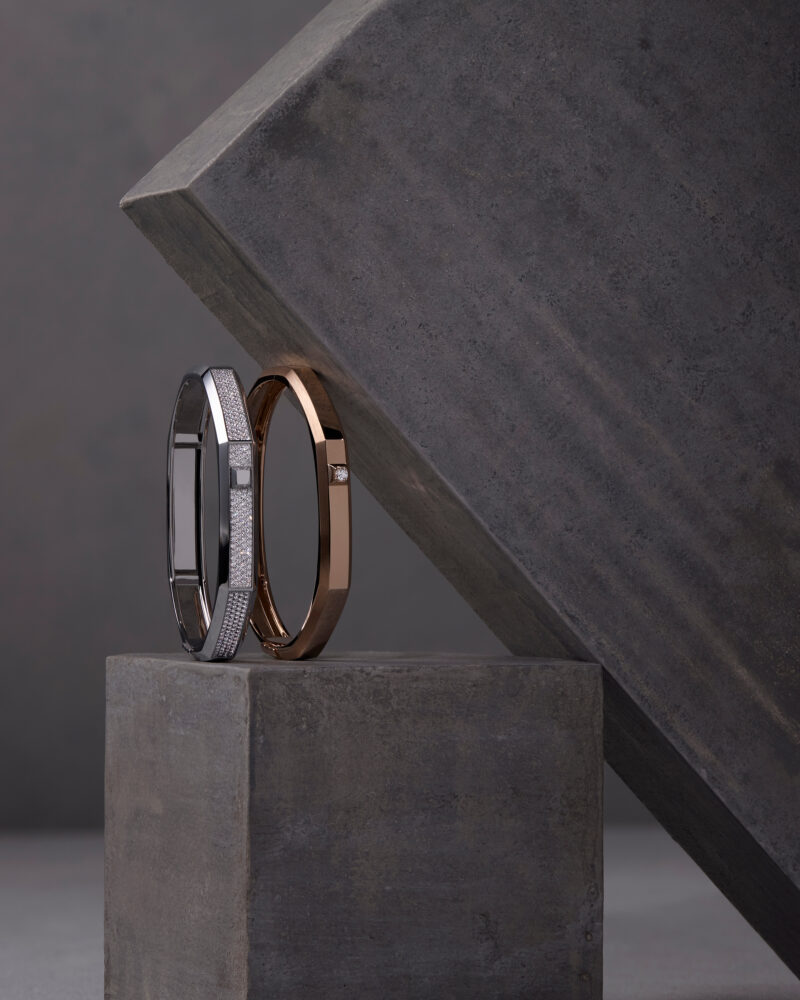
Moderniste bracelets in the house’s architectural still-life series. Courtesy of Messika. Photograph: Olivia Haudry.
Explore the story
A broad gold surface catches the light, then gives way to a darker plane at its edge. In Messika’s Moderniste, the metal does much of the expressive work. A small diamond marks the centre, while the shape around it turns the bracelet into a study of angles, reflections and the curve of a wrist.
In the movement of a wrist
01 / 03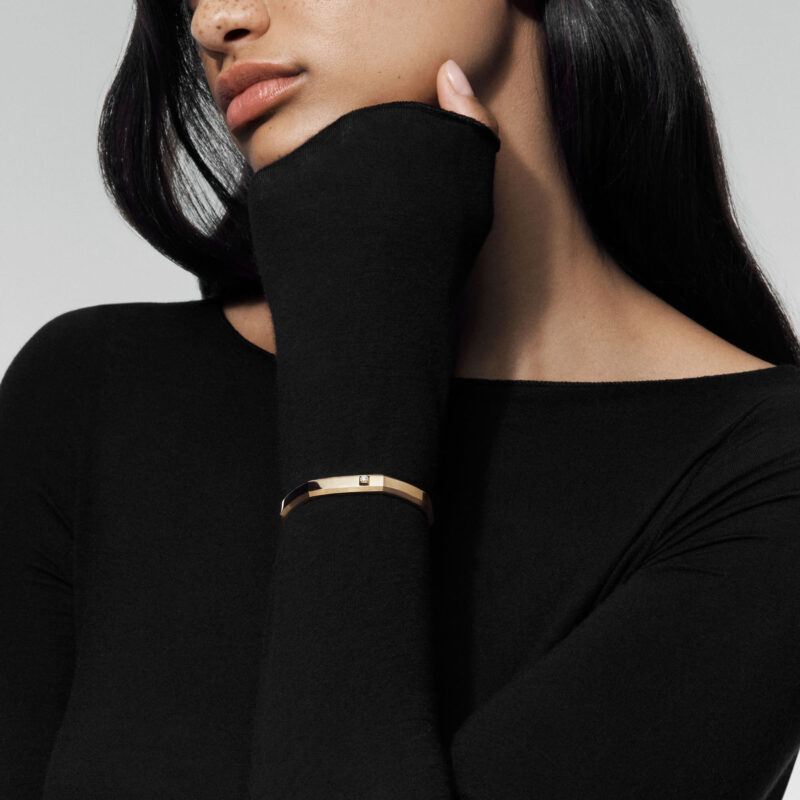
A single yellow-gold bracelet in a contemporary wearing photograph. Courtesy of Messika. Photograph: Mathieu Rainaud.
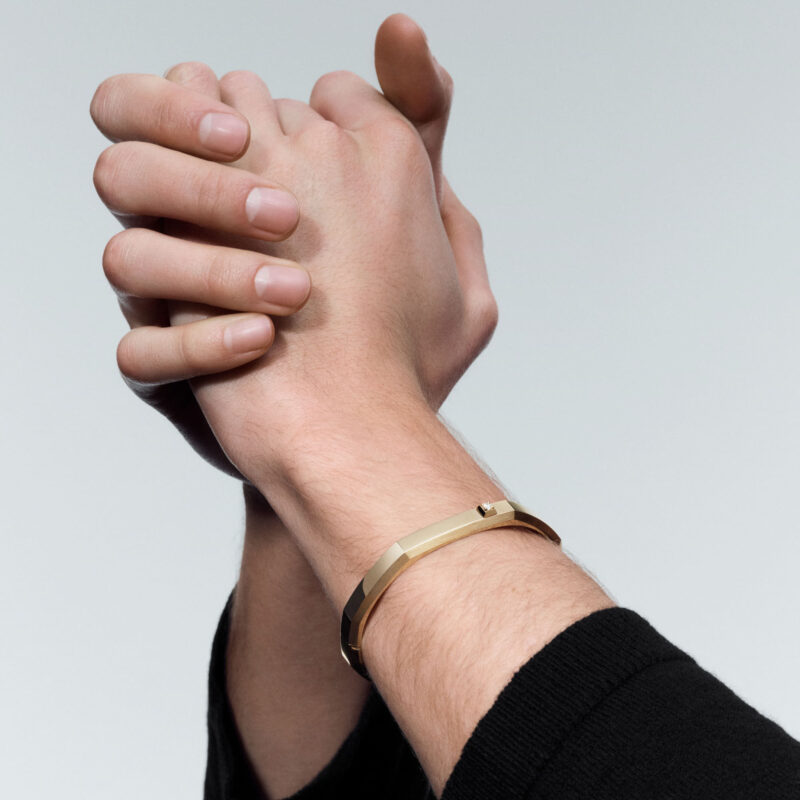
The same bracelet language seen beside a different gesture and cuff. Courtesy of Messika. Photograph: Mathieu Rainaud.
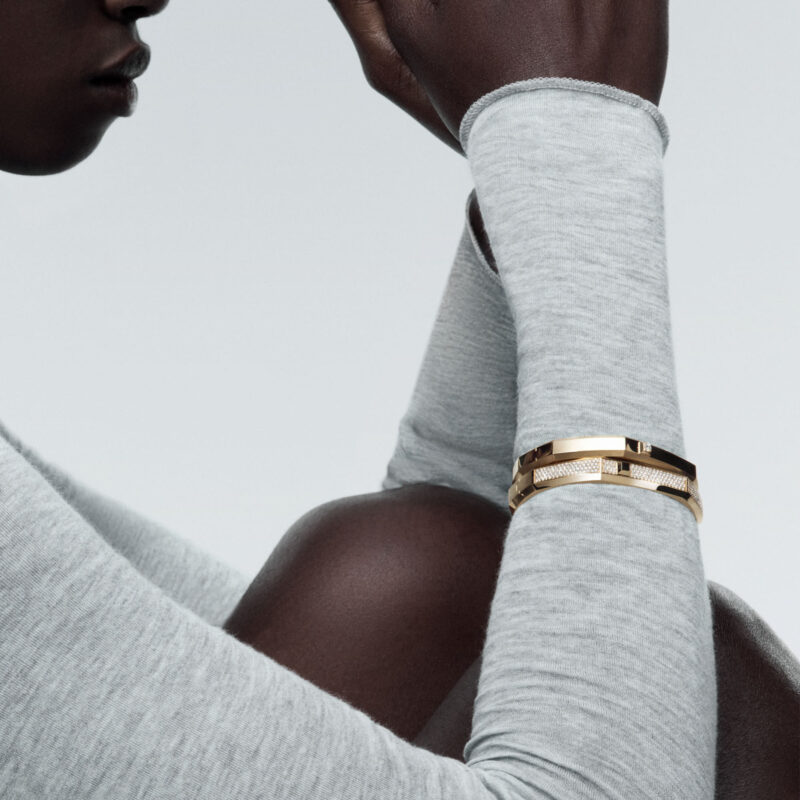
Plain and pavé Moderniste bracelets worn together in the official collection shoot. Courtesy of Messika. Photograph: Mathieu Rainaud.
The wearing photographs introduce Moderniste through ordinary gestures. One hand rises towards the neck. Two hands meet beside a dark sleeve. A bracelet appears above a pale cuff, with another gold band close beside it. The same angular line enters each picture differently, sometimes as a quiet border and sometimes as a more concentrated group of reflections.
In the first image, black fabric makes the bracelet’s upper surface especially clear. A long, bright plane runs across the wrist, ending in a change of direction towards the side. The small diamond is visible, but it does not fill the picture with sparkle. The larger impression belongs to the gold and the outline it draws against the sleeve.
That outline becomes easier to understand in the photograph of clasped hands. The wrist is rounded; the bracelet introduces a sequence of straighter edges around it. The contrast gives the jewel presence without requiring a pendant, a coloured stone or an added motif. Its shape supplies the main point of interest.
The image with two bracelets changes the rhythm again. A plain surface sits beside a diamond-set one, so the repeated outline meets two different qualities of light. One band gives a broader reflection, while the other breaks brightness into smaller points. The interval between them matters too: it lets each remain visible as a separate object.
Moderniste works particularly well in these changes of context because its design is legible before its details are counted. The eye finds a strong line, then a turn in the metal, then the central diamond. A single bracelet leaves that sequence open and concentrated. A pair makes the repetition itself part of the look.
Polished, brushed, differently lit
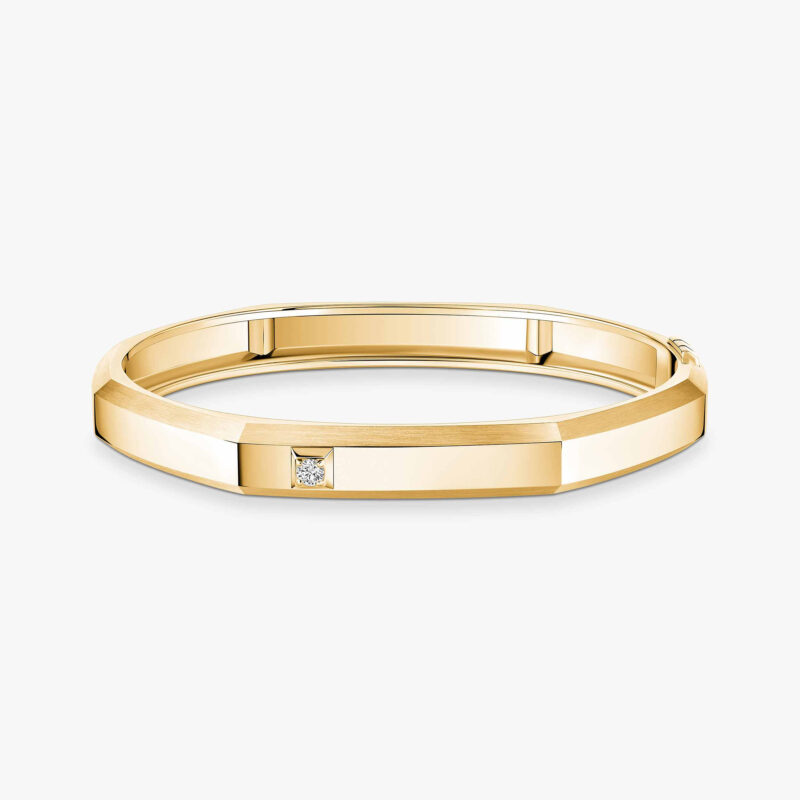
Moderniste 14539-YG: the complete yellow-gold bracelet. Courtesy of Messika.
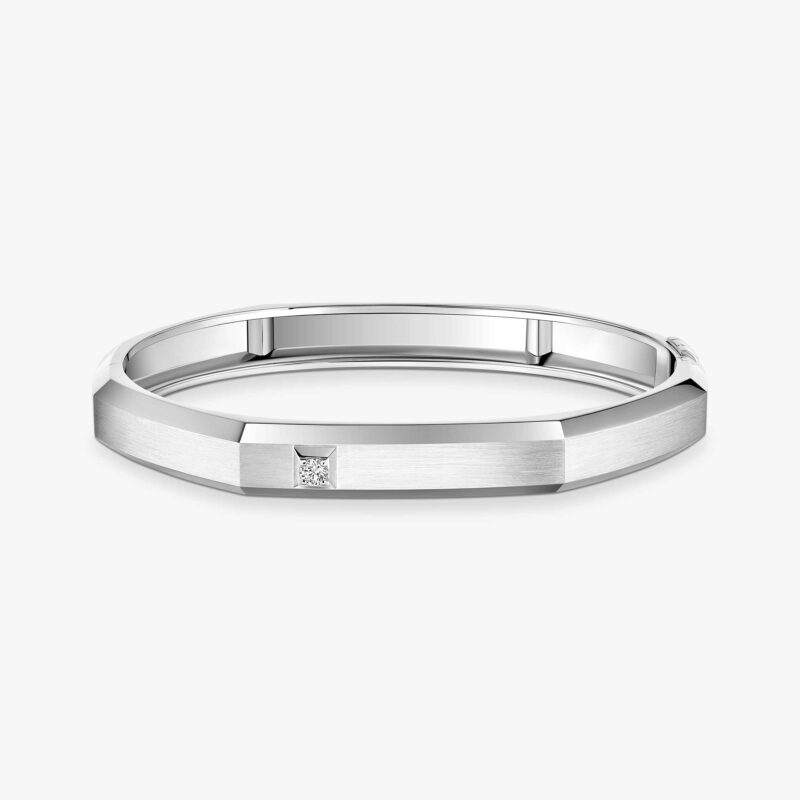
The brushed white-gold 14628-WG offers a different surface relationship. Courtesy of Messika.
The complete product photographs bring the surfaces forward. Messika’s yellow-gold bracelet 14539-YG combines mirror-polished areas with a finer brushed finish. The broad front is quieter than the highly reflective edges around it. In the photograph, those differences allow a continuous piece of metal to read as several connected planes.
The house describes an octagonal inspiration for Moderniste. The useful detail is how that idea becomes a wearable outline. The outer contour changes direction through a series of angles, while the inner profile forms a smoother curve around the wrist. Straightness and curvature occupy the same object, each doing a different job within its shape.
The brushed white-gold version shown here is reference 14628-WG. Its cool tone changes the overall impression, but the finish is just as important as the colour. Fine texture spreads the light across a surface, while a polished edge returns a more defined reflection. Those areas can appear close in one view and much farther apart when the angle changes.
Both official bracelet records list a width of 0.7cm and a total diamond weight of 0.07 carats. The dimensions help explain why the metal remains such a prominent part of the design. The diamond supplies a precise focal point within a much broader gold surface. It punctuates the form rather than replacing it.
This makes the comparison more interesting than a choice between two metal colours. Consider which part of each photograph holds your attention: the warm plane across the front, the cooler brushed texture, the bright turn at a corner or the small diamond at the centre. The answer begins to describe the kind of presence you want the bracelet to have.
One plane, at the scale of a ring
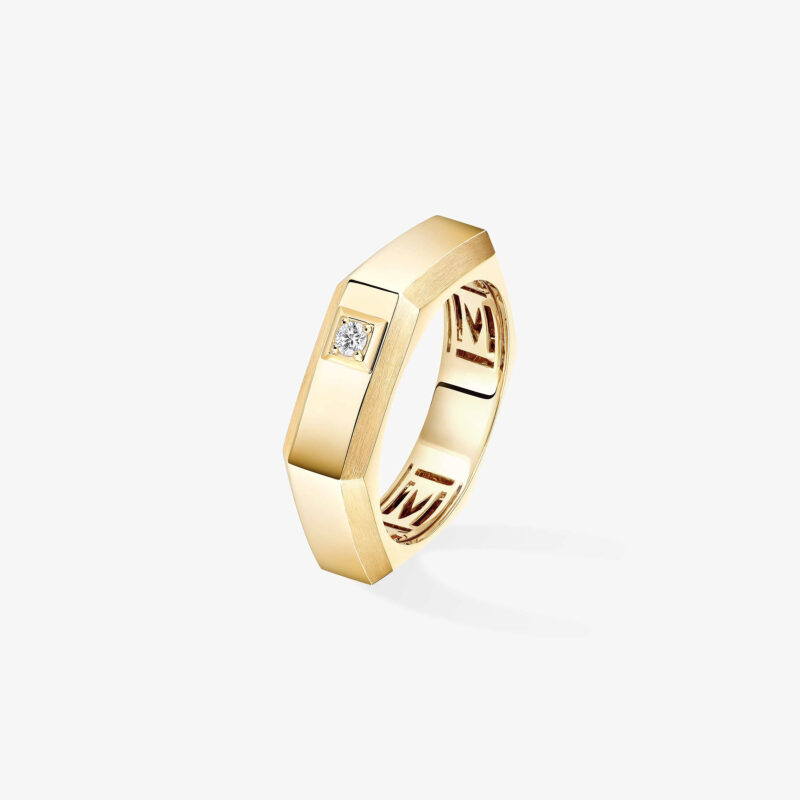
The yellow-gold Moderniste ring 13558-YG,seen obliquely. Courtesy of Messika.
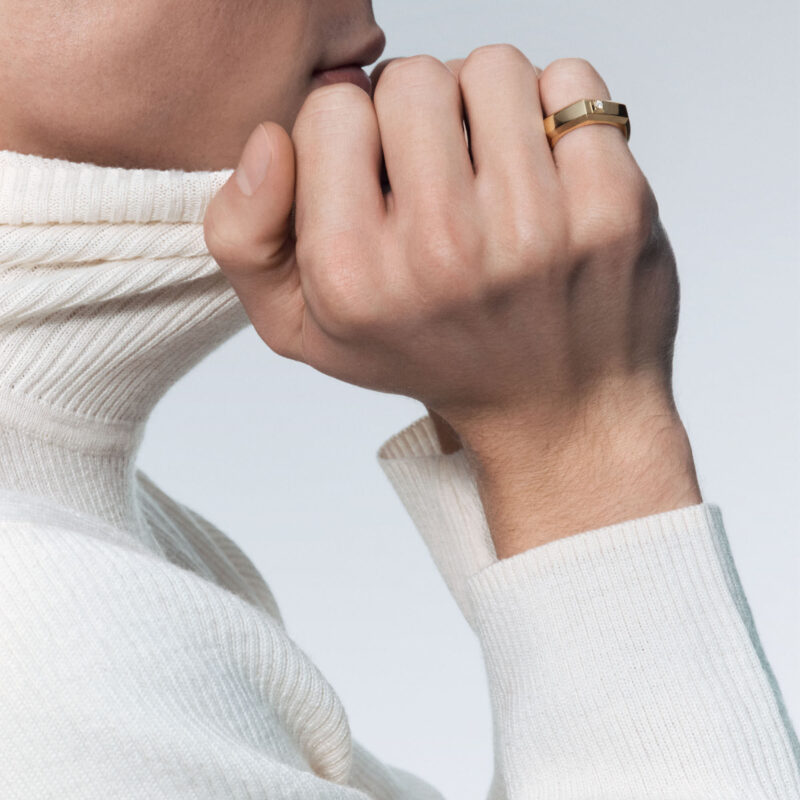
The 13558-YG ring on the hand,in the house’s product sequence. Courtesy of Messika. Photograph: Mathieu Rainaud.
The yellow-gold Moderniste ring brings the same language into a more compact object. Its top gives the central diamond a broad setting, while the oblique product photograph reveals the depth beneath that face. A flat frontal image could make the ring appear almost graphic; the angled view shows how much of its character depends on volume.
Look at the relationship between the top and the opening below it. The upper part reads as a distinct plane, with edges that turn towards the sides. Within the ring, the house’s mark appears as part of the structure. The photograph allows the viewer to see the object as something made all the way around, rather than a decorated surface alone.
On the hand, its scale becomes more immediately understandable. In the official wearing view for reference 13558-YG, a white knitted cuff provides a soft, textured neighbour for the sharply outlined gold. The diamond remains a small point within the composition, while the ring’s upper surface gives the hand a clear accent.
The comparison with the bracelet is a change in proportion. A long plane across the wrist becomes a shorter, more concentrated area on a finger. The ring can retain the bracelet’s visual character without duplicating its dimensions. That continuity is what makes a collection feel connected across different kinds of jewellery.
A cuff or another ring would alter the surrounding picture again. The useful starting point is the view in which the Moderniste shape feels most convincing to you: isolated against skin, emerging from a sleeve or placed beside a softer texture. The object has a strong outline, but the amount of space left around it helps determine how that outline is read.
Gold, allowed to hold the picture
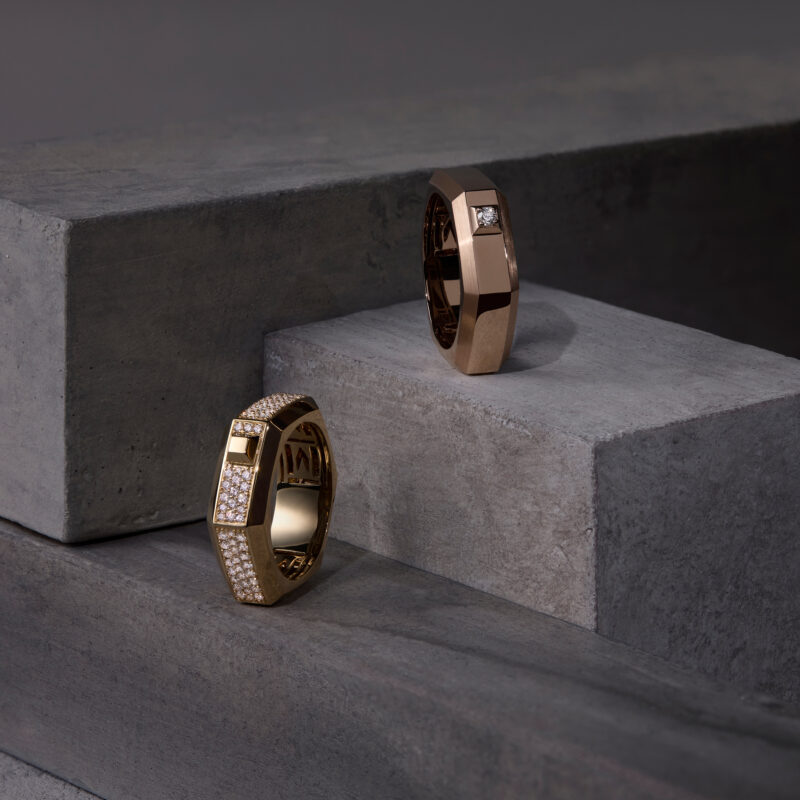
Moderniste rings in a second still-life composition from the house. Collection context. Courtesy of Messika. Photograph: Olivia Haudry.
Olivia Haudry’s still-life photographs give these forms a more architectural setting. Rings stand on blocks, and bracelets lean beside changes in level and direction. The grey surfaces provide broad, restrained areas against which a gold edge can become very bright. The setting makes the jewel’s planes easier to notice without changing their shape.
In the final ring composition, a diamond-set surface and a quieter gold one occupy the same small scene. The contrast is immediately visible. Dense points of light give one ring a different texture, while the smoother neighbouring surface holds a longer reflection. Their related contours provide the continuity between them.
The most distinctive quality of Moderniste is that the gold remains worth looking at on its own. Brushing, polishing and changes of angle give it several ways to handle the light. The diamond adds another scale of detail, but the surrounding metal continues to carry the object’s volume and much of its visual identity.
Return from the still life to the wrist photographs and that identity becomes less formal. A sleeve shifts, hands meet, a bracelet turns towards the light. The same carefully drawn edges remain, entering a picture that is always changing. Moderniste gives a familiar material a particularly clear shape, then leaves the body to supply the next view.
Sources & further reading
The Edit
Jewelry stories
Selected stories from the same editorial universe.
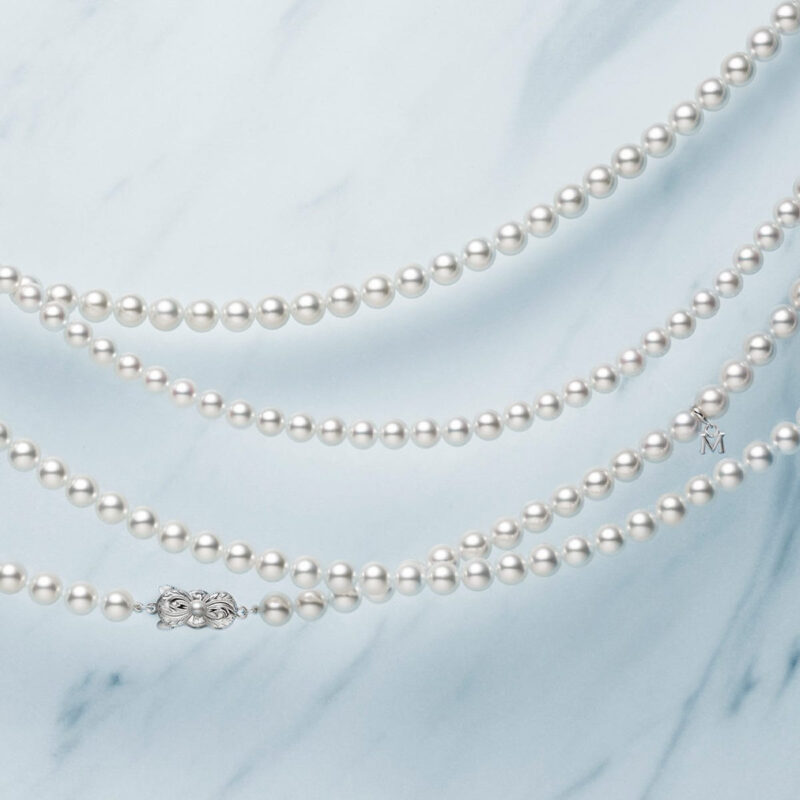
Mikimoto Akoya: The Line of Light
A pearl strand draws the eye towards the face. With Mikimoto Akoya, length, rhythm
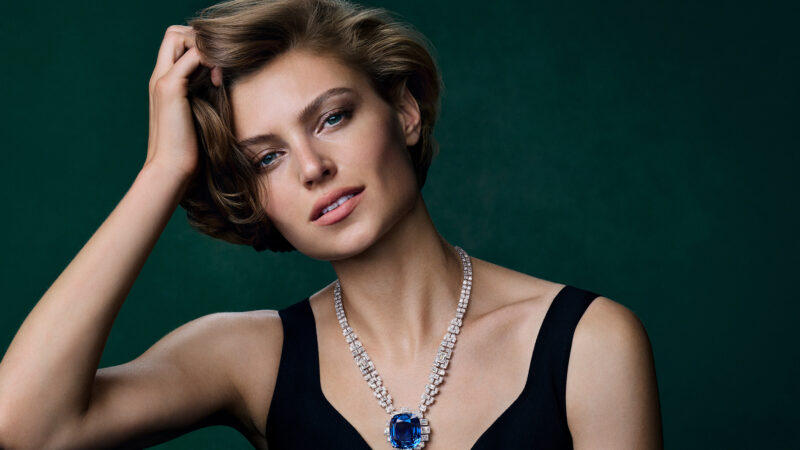
Graff’s Art of Colour: Blue at the Centre, Green in Motion
A blue centre, an emerald line and the clothes around them: Graff’s September campaign
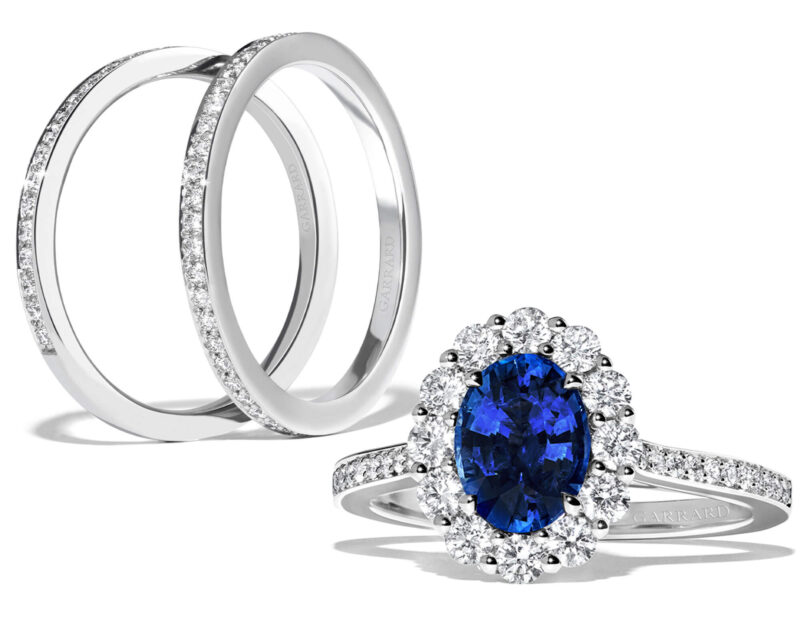
Garrard 1735: A Sapphire Ring with Room for Two
A sapphire cluster establishes the centre; a narrow diamond band adds a second line.
Messika My Twin: Two Cuts, One Bridal Look
An emerald cut, a pear and an unequal pair: the small asymmetry of Messika
Two Rings, Two People: A De Beers Wedding-Band Edit
A rose-gold court profile, a single diamond in platinum, a fine eternity line or
Norman Silverman Bridal: A Ring with Presence
A pear solitaire on the hand, a radiant seen in profile and an emerald-cut