
TheTimeo / Jewelry
The art of colour:
Blue holds.
Green flows.
A blue centre, an emerald line and the clothes around them: Graff’s September campaign shows how the same vocabulary of diamonds can frame very different kinds of colour.
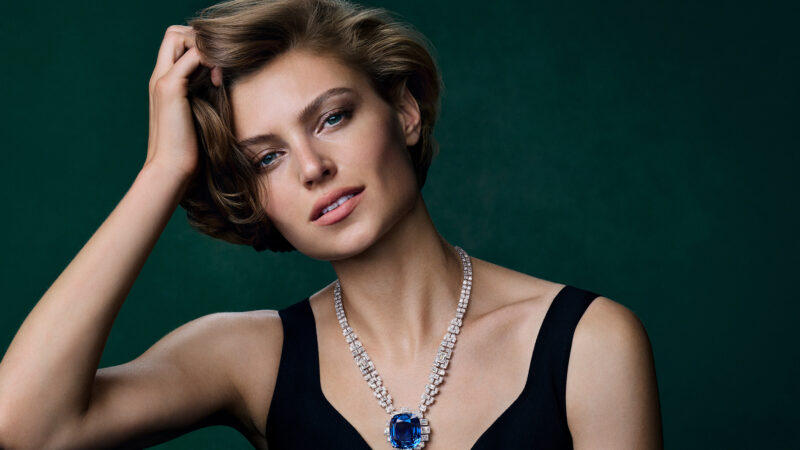
Bibi Breslin wearing sapphire necklace GN15238 in Graff’s September 2026 campaign. Photograph: Liz Collins. Courtesy of Graff.
Explore the story
A blue sapphire stops the eye; an emerald line leads it somewhere else. In Graff’s September 2026 campaign, photographed by Liz Collins with Bibi Breslin, colour is given more than one role. The interest lies in how a jewel holds a portrait together, then changes character when seen on its own.
Colour enters the portrait
01 / 02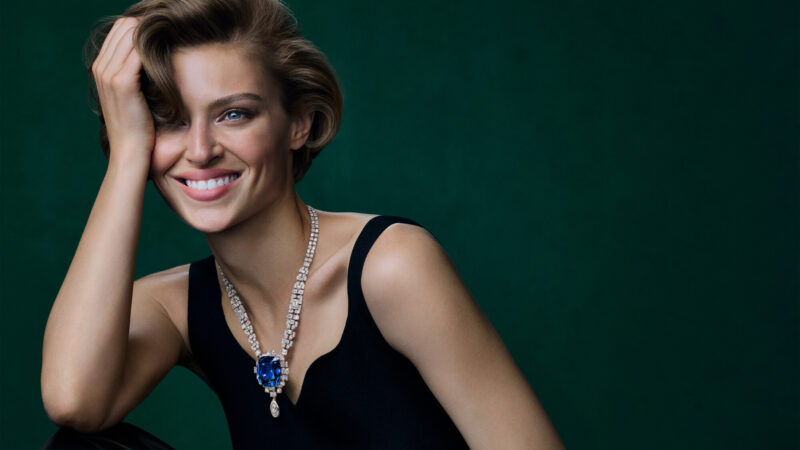
A second campaign portrait of GN15238. Photograph: Liz Collins. Courtesy of Graff.
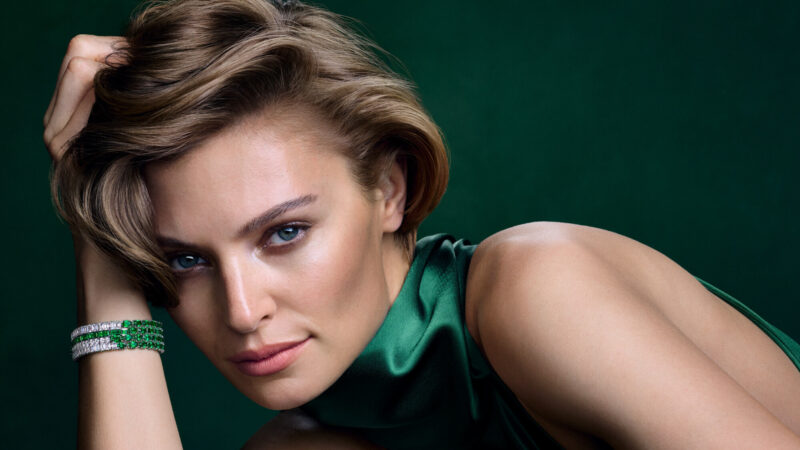
Emerald and diamond bracelet GB33236 in the campaign portrait. Photograph: Liz Collins. Courtesy of Graff.
The sapphire necklace has a particularly clear centre. Against a black sleeveless top, the blue sits within a much brighter field of diamonds. The green background is deep enough to give the colour another surface to work against, while the dark clothes leave the outline of the necklace easy to follow.
In one portrait, a raised hand and a broad smile loosen the arrangement. The jewellery remains highly structured, but the picture around it feels less formal. The necklace continues to establish a central line even as the head and shoulders move away from perfect symmetry. That difference gives the photograph its energy.
The bracelet portrait changes the direction of attention. A wrist is brought close to the face and the emeralds form bright rows across it. The green of the jewel is close to the colour of the clothes and background, yet the diamonds introduce a sharper edge between them. Instead of looking towards the centre of the chest, the eye moves across the wrist and back to the face.
These are different jewels within the same campaign world. The sapphire necklace is identified in the official assets as GN15238, the emerald bracelet as GB33236. They share the surrounding light and green setting, which makes the differences in their outlines easier to read. One concentrates colour around a large centre; the other distributes it through a repeated pattern.
Neither photograph needs a large number of accessories to make its point. The clothes provide a broad surface, the gesture sets a direction and the jewel introduces a much finer scale of detail. The pleasure is in that relationship: looking first at the whole portrait, then discovering how precisely the stones organise a smaller part of it.
Green changes the direction
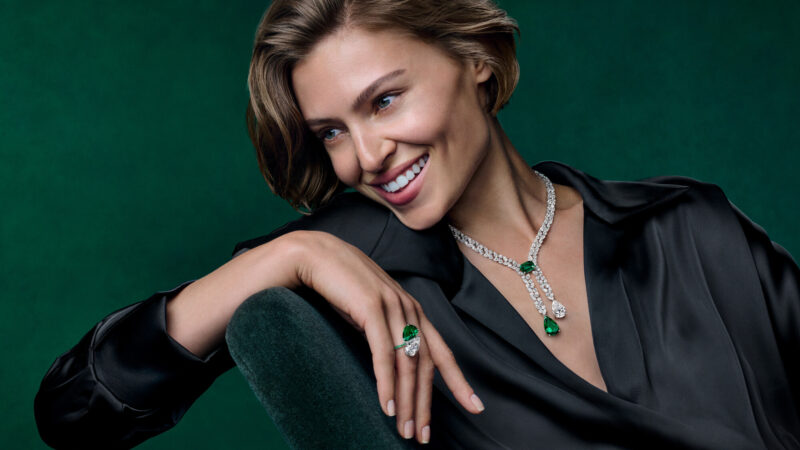
Emerald necklace GN14852 and ring GR282585 within the campaign styling. Photograph: Liz Collins. Courtesy of Graff.
The emerald necklace and ring enter a more relaxed composition. A black shirt opens around the neck, a hand rests near the shoulder and the body leans against a green chair. The necklace’s longer lines are allowed to follow that arrangement, with green and white drops establishing distinct points below the collarbone.
The ring adds another meeting of green and white, this time at the hand. Its two pear-shaped stones have different colours but related outlines. From the wider view, that small pairing connects the gesture of the fingers with the longer arrangement at the neck. There is repetition without an exact copy of scale.
The colour is particularly effective because the photograph contains several different greens. Fabric and background provide quieter, broader tones. The emeralds introduce smaller areas with much brighter changes of light. Those differences give the jewels a clear place within the image even though the colour family is shared.
It is also useful to notice what the portrait leaves open. There is space around the necklace, a dark area beneath the collar and an interval between the hand and the main stones. Those areas let the separate forms remain legible. The jewel’s complexity is supported by a comparatively simple surrounding picture.
In the official assets, this necklace is GN14852 and the ring is GR282585. Their shared presence in the portrait establishes the pairing shown here. It does not turn every emerald jewel into part of the same set; the complete views reveal quite different ways of constructing a line.
Three objects, three kinds of line
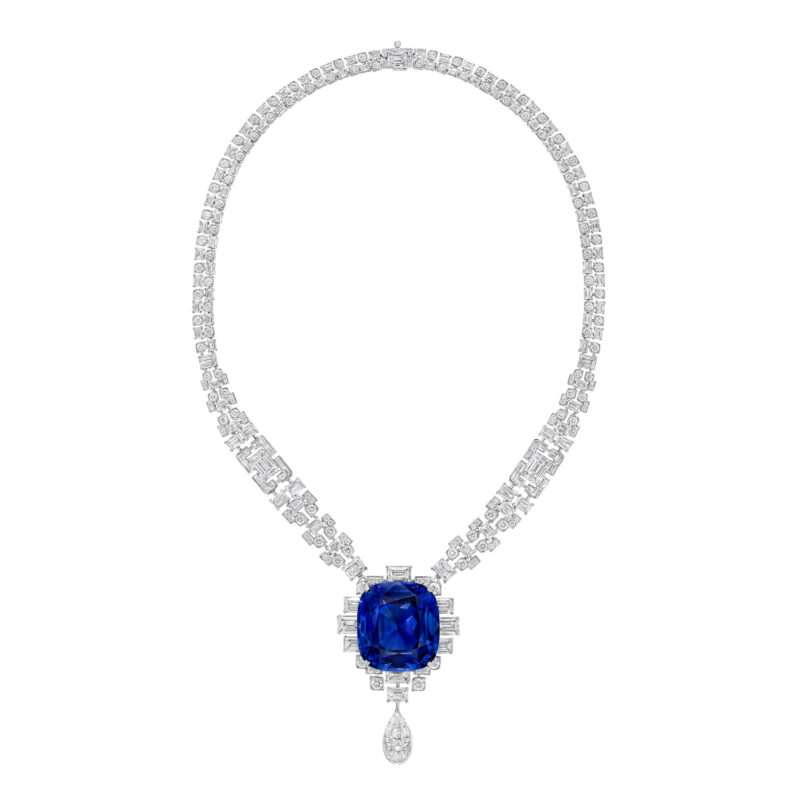
The complete sapphire and diamond necklace GN15238, from Graff’s official campaign assets. Courtesy of Graff.
The sapphire necklace concentrates the composition. Graff describes its centre as a 118-carat cushion-cut sapphire; here the photograph makes its broad blue shape and position immediately clear. The surrounding diamonds extend the necklace outwards, while a smaller pear-shaped drop continues below the centre. The result has a strong vertical direction without becoming a single unbroken column. Follow the outline from one side to the other and the changes in stone shape become part of the rhythm around the blue.
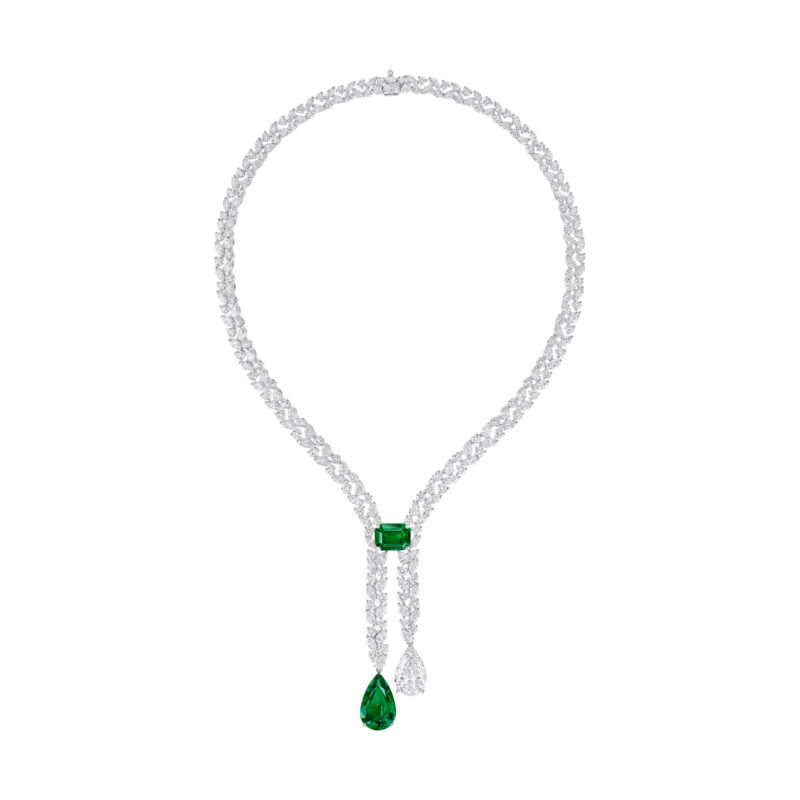
Emerald and diamond necklace GN14852, seen complete. Courtesy of Graff.
The emerald necklace divides the attention differently. Its complete view places a rectangular green stone above longer hanging forms, including a pear-shaped emerald and a diamond drop. Small white stones link those larger elements into a more open drawing. Compared with the sapphire necklace, the colour appears at several points along the structure. The eye travels between them, finding a longer route through the jewel rather than returning immediately to one dominant centre.
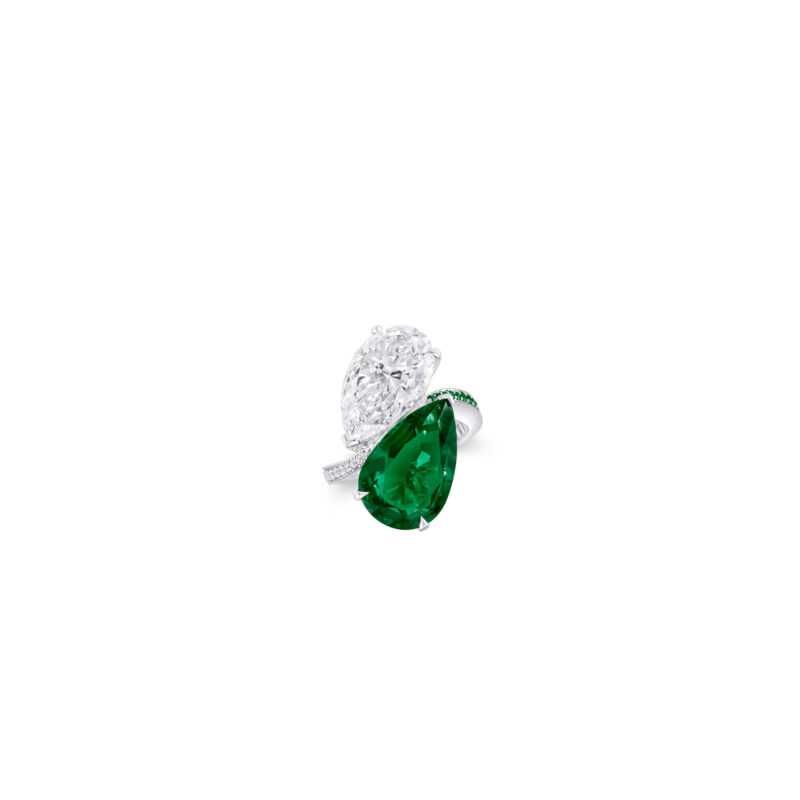
The emerald and diamond toi et moi ring GR282585. Courtesy of Graff.
The toi et moi ring compresses the conversation into two stones. A green pear and a white pear sit on opposing curves, each retaining its own direction. Graff identifies them as a seven-carat emerald and an eight-carat diamond. More revealing in the photograph is the balance between their outlines: related shapes, different colours and a setting that brings them close without making them identical. It is a small-scale counterpart to the campaign’s wider use of contrast.
What holds the picture together
The point of colour
Begin with the coloured stone and the design becomes a question of placement. The sapphire establishes a centre; the emerald necklace sets up several green points; the ring brings two outlines into a close exchange. Colour tells the eye where to begin, but its position determines where the eye goes next. A jewel can feel concentrated, extended or balanced between two parts even before its dimensions are considered.
The white framework
The diamonds do more than surround the colour. They establish borders, intervals and connecting lines. In the portraits, those white marks separate the jewels from skin, clothes and background; in the complete views, they explain how the larger stones belong to a single composition. Returning from the isolated objects to the campaign is rewarding for that reason. The atmosphere is memorable, but the design remains interesting when the scenery falls away.
Sources & further reading
The Edit
Jewelry stories
Selected stories from the same editorial universe.
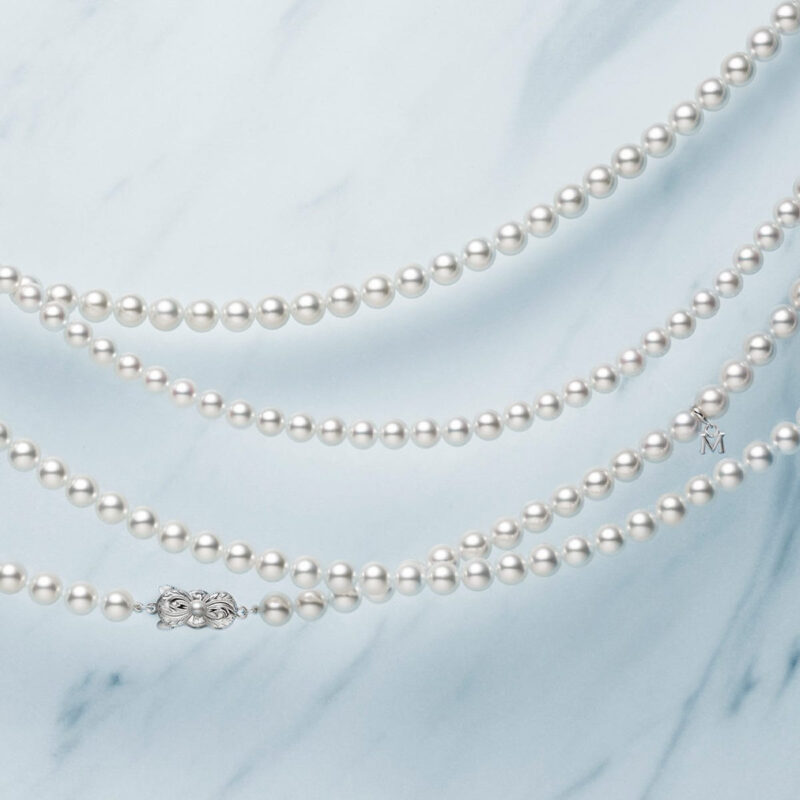
Mikimoto Akoya: The Line of Light
A pearl strand draws the eye towards the face. With Mikimoto Akoya, length, rhythm
Garrard 1735: A Sapphire Ring with Room for Two
A sapphire cluster establishes the centre; a narrow diamond band adds a second line.
Messika Moderniste: Gold with an Architectural Edge
A broad gold plane, a brushed surface and a small diamond held at the
Garrard Wings Rising: A Wing Drawn in Green
Faceted malachite gives Garrard’s Wings Rising a vivid, patterned edge. A pendant, earrings and
Chaumet Envol: A Tiara in Motion
Blue wings move from hair to face and cloth. Chaumet’s Envol invites a bridal
Messika My Twin: Two Cuts, One Bridal Look
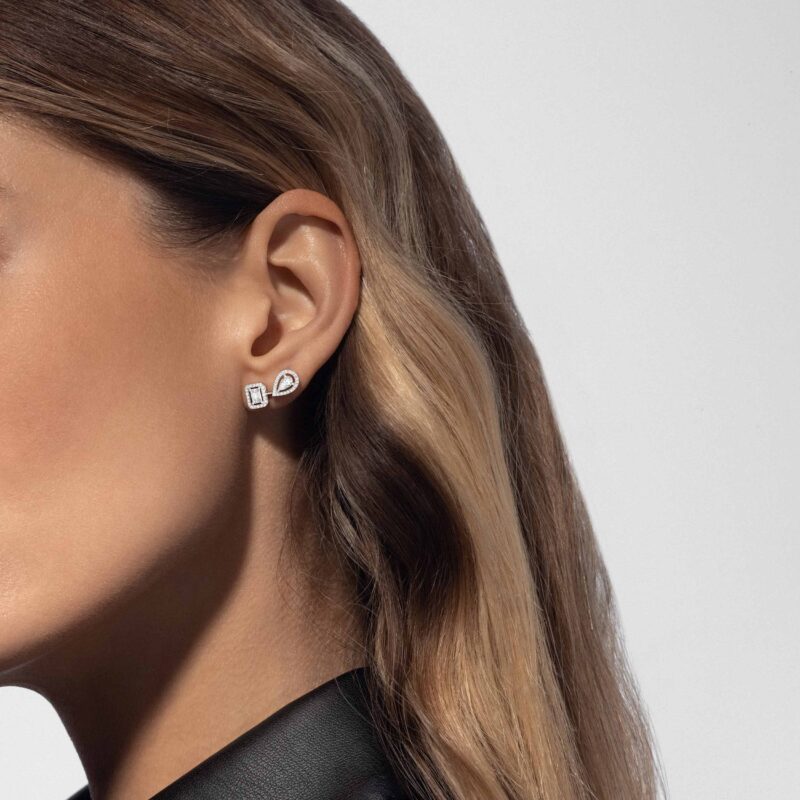
An emerald cut, a pear and an unequal pair: the small asymmetry of Messika