
TheTimeo / Jewelry
AFTER THE WORK:
reading what changed
Repair does not erase a jewel’s history. The useful question is what changed, what remains and which evidence now travels with the object.
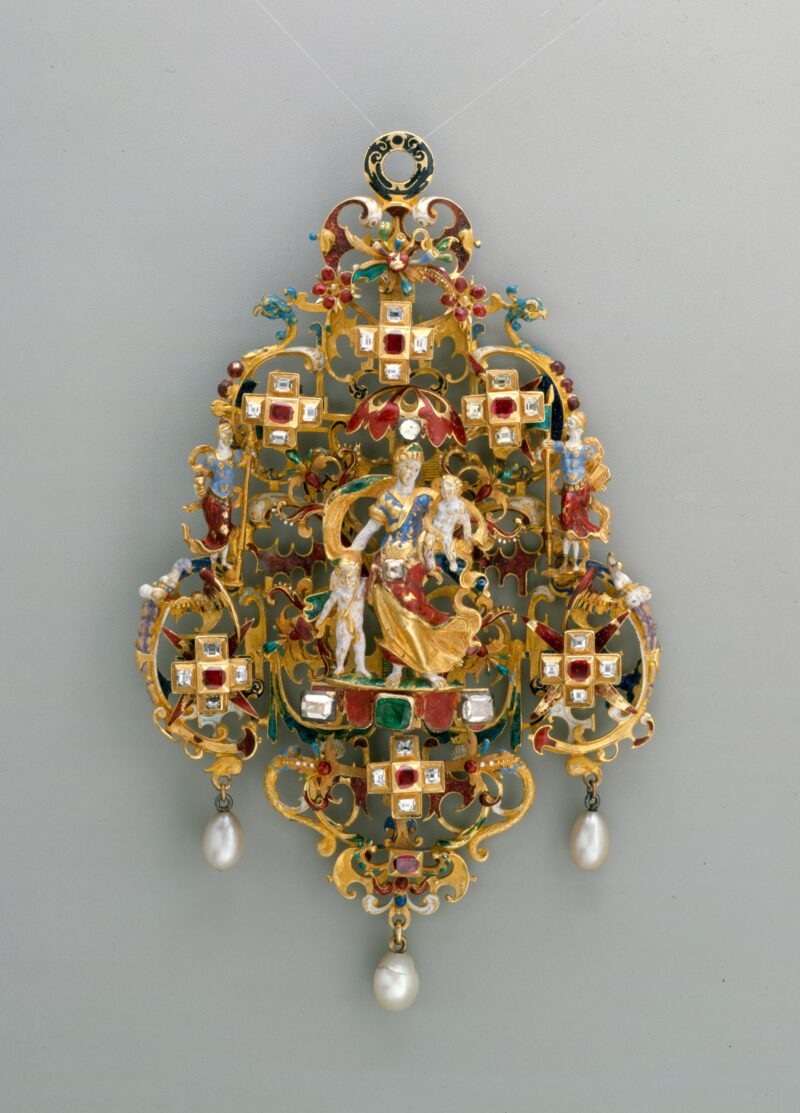
A historic jewel whose museum record distinguishes original construction from later repair. Public Domain, The Metropolitan Museum of Art.
Explore the story
A late-sixteenth- or early-seventeenth-century pendant in The Metropolitan Museum of Art has a repair history that would make a one-word condition label almost meaningless.
The museum records that the jewel was broken in two. Its back was soldered together. Small figures were added to strengthen the repair. Six cross-shaped jewel settings were repaired or, more likely, newly made. Another goldsmith replaced or re-enamelled the base and reset the stones.
The pendant did not stop being an important historic jewel because later hands had worked on it.
Its description simply had to become more precise.
That is the right way to read repaired jewellery.
A repair is not one condition. It is an event in the life of the object.
The collector’s task is to establish what was changed, why it was changed, how much original material remains, what was added, and how confidently any of those conclusions can be supported.
That is more useful than asking whether a jewel is “all original”, “restored” or “in good condition”. Those phrases can hide several different histories.
Start with an intervention record, not a verdict
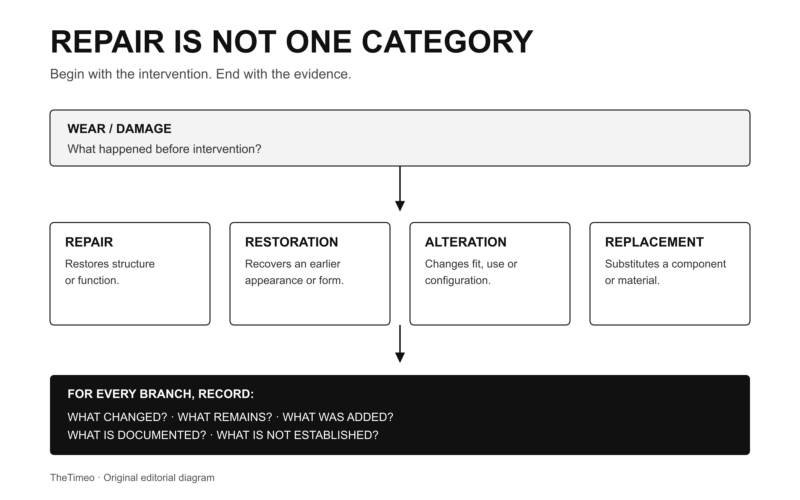
Repair is not one category: four interventions, four different questions.
For this article, TheTimeo uses a working vocabulary rather than pretending the jewellery trade has one universal set of definitions.
Wear is change from use, age, handling or environment.
Damage is physical loss, fracture, deformation, breakage or deterioration that compromises the object or part of it.
Repair is work intended primarily to restore function or structural integrity: closing a broken chain, rebuilding a worn prong, joining a fractured element or making a ring wearable again.
Restoration is work intended to recover an earlier appearance, form or function, often with more interpretive judgement about what the object should look like.
Alteration changes the object for a new fit, use or design requirement: resizing a ring, changing a brooch fitting, shortening a necklace or converting one jewel type into another.
Replacement substitutes a missing, damaged or worn component with another component or material.
Conservation is a preservation-led approach in which the treatment decision, materials and documentation are governed by the long-term survival and legibility of the object.
These categories can overlap.
A ring resize is an alteration and a repair if the shank was also fractured. A new clasp can be a repair and a replacement. Re-enamelling may be restoration, while changing a brooch pin into a pendant fitting is usually alteration.
The label matters less than the record underneath it.
The first layer is structure
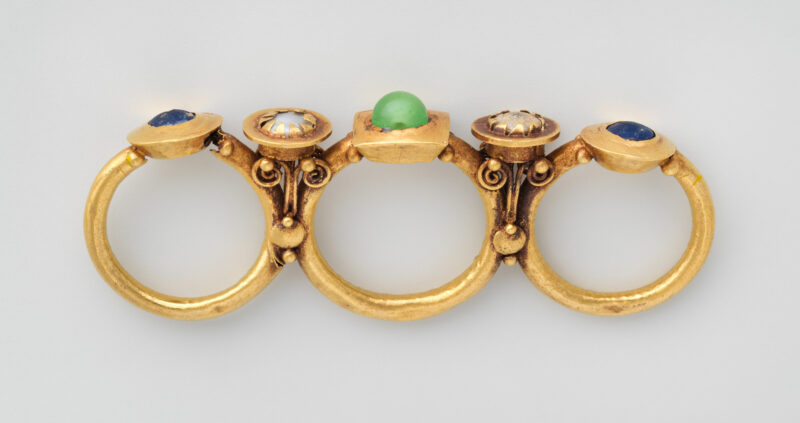
A multi-part ring makes structure and evidence of intervention easier to read. Public Domain, The Metropolitan Museum of Art.
A jewel has to hold together before it can be evaluated as an historic object.
Chains break. Hinges wear. Brooch pins bend. Ring shanks thin. Claws lose metal. Soldered joints fail. Settings can distort after years of pressure and impact.
Modern jewellery repair therefore includes a wide range of legitimate structural work.
GIA’s current Quality Assurance Benchmarks treat ring sizing, assembly, setting, finishing and metal identification as distinct areas of bench workmanship. Its ring-sizing material shows that a ring may be cut, adjusted and joined using a torch or laser welder, with the quality of the joint and the final ring geometry forming part of the workmanship assessment.
This is useful because it removes a common assumption: a sizing joint is not automatically evidence of poor work.
It is evidence that the ring has been altered.
Those are different statements.
For an owner file, record:
- where the structural intervention occurred;
- the date or approximate date;
- the jeweller or workshop, if known;
- the technique stated by the workshop;
- whether new metal was added;
- whether any component was removed or replaced;
- what the piece looked like before and after.
If the work is visible under magnification, photograph it. Do not turn the photograph into a diagnosis unless a qualified specialist has examined the object.
A colour change, line, texture difference or irregular joint can be a reason to investigate. It is not, by itself, proof of exactly what was done.
Resizing changes fit — and creates a new chapter
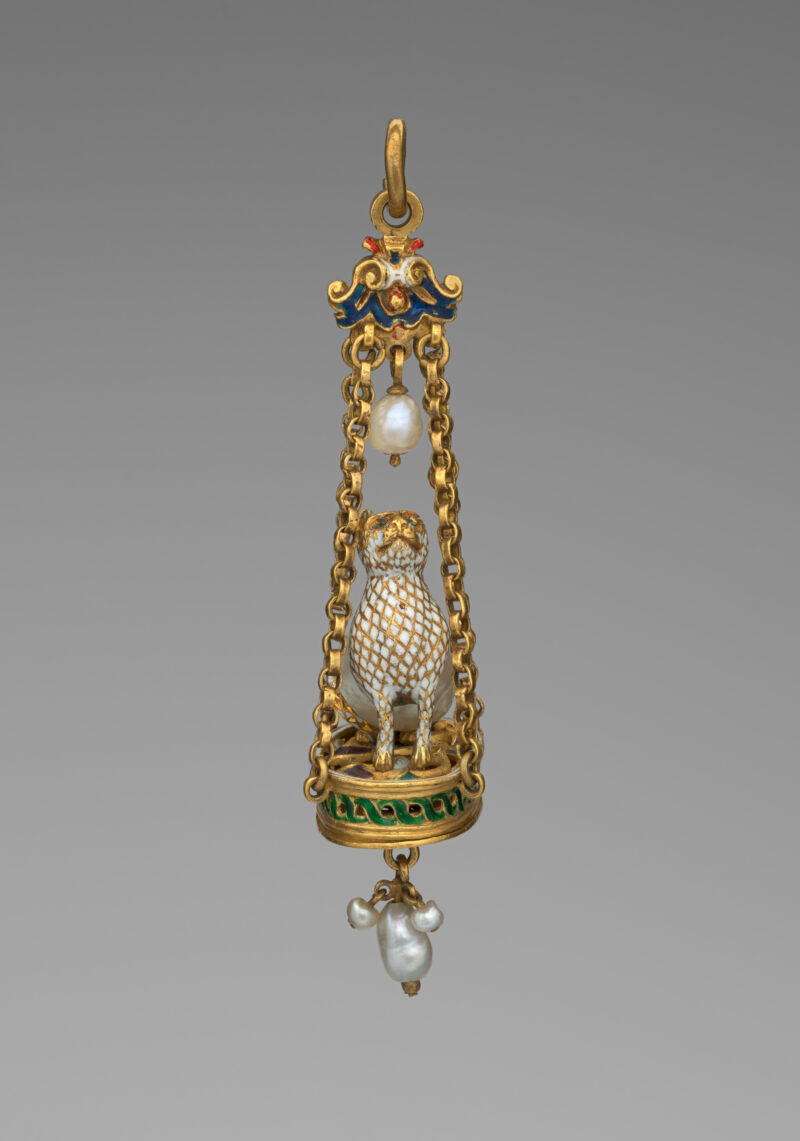
The front view records enamel, stones and the visible surface. Public Domain, The Metropolitan Museum of Art.
Ring sizing is one of the most ordinary jewellery interventions and one of the easiest to describe badly.
A catalogue may say only “resized”.
That leaves important questions unanswered.
Was the ring made larger or smaller? Was metal inserted or removed? Was the work performed through a torch-soldered joint or laser welding? Were stones present in the shank? Was the ring rounded and refinished afterwards? Were any engravings, markings or design details affected?
GIA’s platinum sizing benchmarks show the physical logic clearly: the shank is opened, adjusted and joined, and the ring is then brought back to the required shape and finish. In its laser-welded example, the joined area is filled and worked after welding before final rounding.
None of that makes a resized ring undesirable.
It does mean that “original size” and “current size” are separate facts.
For an antique or signed ring, that distinction becomes more important because the shank may also carry maker’s marks, assay marks, serials, engravings or design detail.
Do not infer that a missing or faint mark was removed during sizing unless the physical evidence supports that conclusion. Record the present marks, the resize location and any earlier photographs or documents that show the ring before intervention.
A replacement stone solves one problem and creates another question
A missing stone is a practical problem.
Replacing it may be the most responsible way to return a jewel to use.
But the replacement should not disappear into the description.
The Metropolitan Museum of Art describes a Roman triple-finger ring whose central green bead is a modern replacement. That phrase is valuable because it separates the historic object from a later component without suggesting that the entire jewel has become inauthentic.
A replacement can be:
- modern but visually sympathetic;
- period but not original to the jewel;
- newly cut to match adjacent stones;
- an imitation replacing a gem;
- a natural gem replacing another natural gem;
- a laboratory-grown or synthetic material replacing a natural stone;
- a stone reset from another object.
Each possibility creates a different record.
A laboratory report can help establish the identity, treatment status and, for some gem types, geographic-origin opinion of a stone. It does not establish that the stone was originally mounted in the jewel.
That distinction is fundamental.
GIA’s current coloured-stone reporting describes the material submitted, whether it is natural or laboratory-grown, detectable treatments and, where applicable and determinable, an origin opinion. Mounted stones can be submitted for many coloured-stone services, but the scope of examination is still the gemological object in front of the laboratory.
The historical question — was this stone always part of this jewel? — requires different evidence.
That evidence may include archive photographs, old valuations, invoices, family photographs, earlier auction catalogues, workshop records, matching wear, historical descriptions or specialist examination.
Keep those sources separate from the laboratory report.
A jewel can be genuine while containing later components
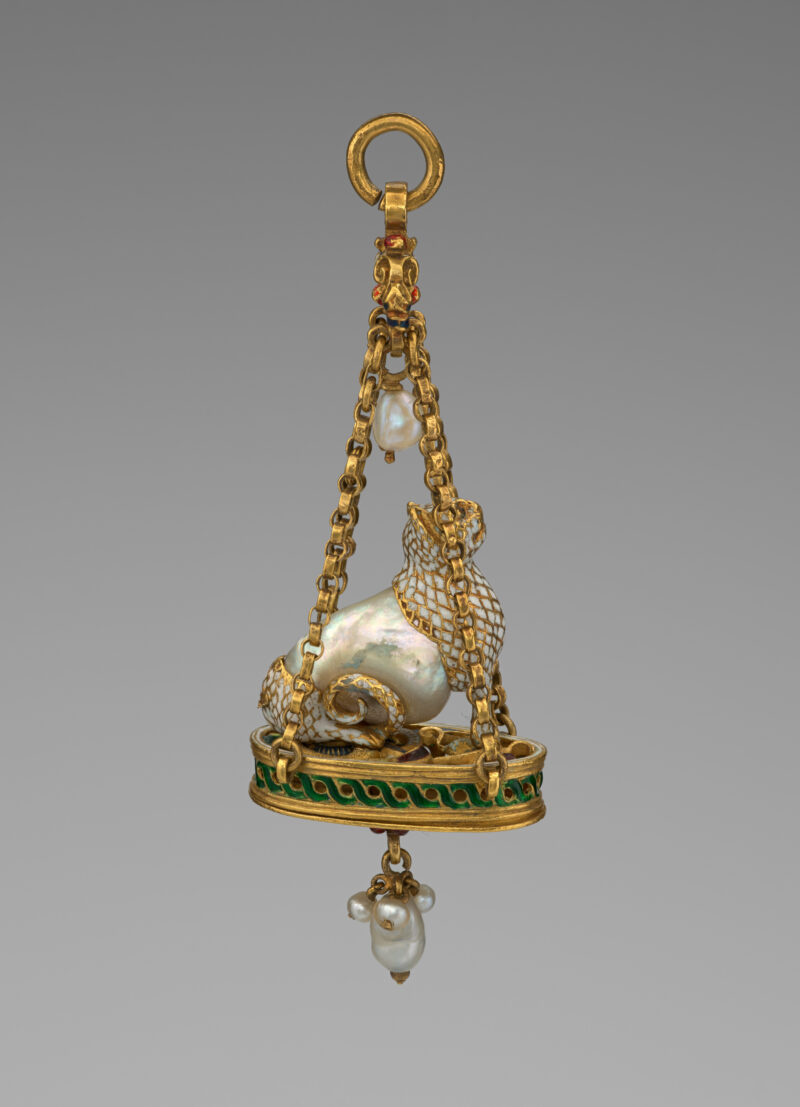
The reverse often carries the structural evidence absent from a beauty shot. Public Domain, The Metropolitan Museum of Art.
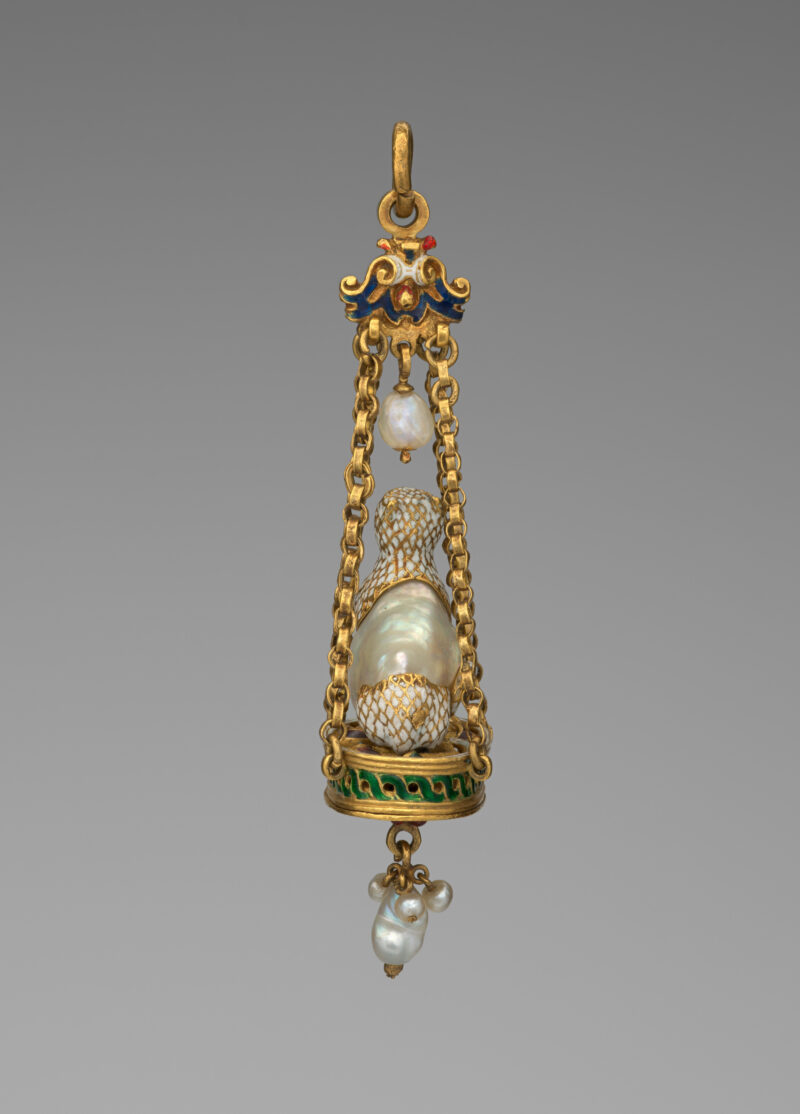
The side view reveals thickness, joins and the relationship between components. Public Domain, The Metropolitan Museum of Art.
Collectors often use “authentic” and “original” as though they mean the same thing.
A repaired jewel shows why they do not.
The Met’s repaired Charity pendant still has an institutional attribution, date range, materials record and museum identity even though the museum also records later repairs, newly made or repaired settings, added figures and reset jewels.
Another late-sixteenth- or early-seventeenth-century pendant in The Met, in the form of a seated cat, has an underside that the museum describes as possibly a later replacement.
The correct description is not forced into one of two boxes:
authentic
or
not authentic.
Instead, the object is read component by component.
This is the stronger collector habit.
Ask:
What is original to the object as made?
What is later but historic?
What is modern?
What is restored?
What is only suspected?
What is not established?
A jewel can preserve important authorship, design and historical identity while containing a replacement clasp, later stones or a repaired fitting.
The purpose of the record is to stop those distinctions being lost.
Surface work deserves its own line in the condition file
Polishing is often treated as routine maintenance.
For a historically important jewel, it is an intervention.
GIA’s current platinum prefinishing benchmark explicitly instructs the bench worker to remove little or no metal where possible, maintain design and engineering details, preserve dimensions and retain flat areas.
Its guidance on refinishing worn platinum also shows that not every worn ring is automatically a candidate for refinishing; in the example, one ring is judged unsuitable for refinishing, although its diamonds could be reused in a new mounting.
That distinction matters.
Cleaning removes contamination.
Polishing or refinishing changes the metal surface.
Replating adds a surface layer.
Re-enamelling replaces or renews a vitreous surface.
Re-engraving can recreate lines that are no longer legible.
Each should be recorded separately.
A glossy surface is not the same thing as an untouched surface.
Nor is an untouched surface automatically the correct ownership goal. A badly abraded, unstable or unsafe jewel may need intervention. The decision depends on the object, its use and the owner’s priorities.
What should not happen is for cosmetic work to erase its own history.
The gemstones can limit the repair method
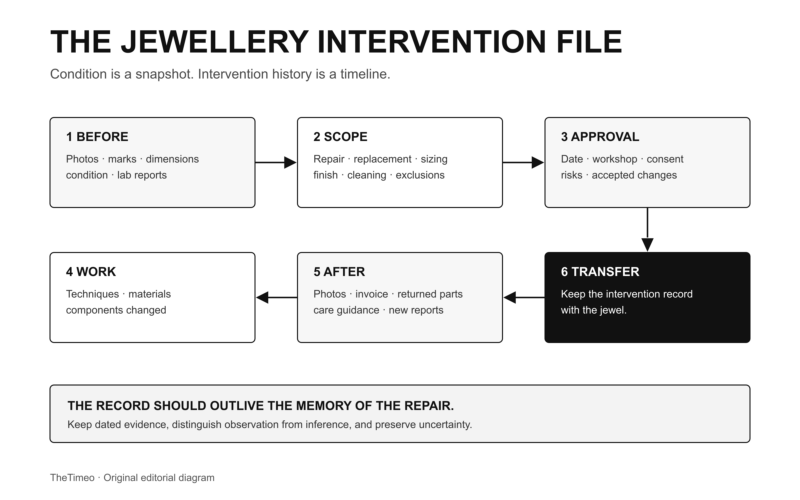
A practical record from condition before work to the evidence transferred with the jewel.
Repair is not only a metal problem.
The stones matter before the torch, laser, steam cleaner or ultrasonic cleaner is used.
GIA’s care guidance is explicit that different gem materials respond differently to heat, sudden temperature changes, chemicals, steam and ultrasonic cleaning. Emeralds, for example, can be damaged by heat, particularly where fractures are present, and commonly used fracture fillers can be affected by heat, chemicals, steam or ultrasound. Pearls can be damaged by high heat and should not be cleaned ultrasonically or with steam.
That does not mean a collector should specify a bench procedure from an article.
It means the pre-repair intake should identify what is set in the jewel and what is already known about treatment.
Before authorising work on an important piece, the owner should give the workshop any available laboratory reports and disclose known treatments, previous repairs and fragile materials.
If the stone identity or treatment status is uncertain and the repair method could expose the jewel to heat or aggressive cleaning, specialist gemological review may be the safer first step.
Restoration can improve legibility while reducing certainty
Restoration becomes more complicated when material is missing.
A goldsmith may have to decide what shape a lost element had, how an enamel colour should be reconstructed or how a missing setting should relate to the surviving design.
That introduces interpretation.
The American Institute for Conservation’s Code of Ethics and Guidelines for Practice is written for cultural-property conservation, not commercial jewellery repair, but its logic is useful for collectors. It calls for careful examination, suitable treatment, documentation of interventions, and permanent records of the nature and extent of alterations. It also treats documentation as part of the object’s history rather than administrative residue.
The Smithsonian Museum Conservation Institute describes documentation as the first and last step in a conservator’s workflow: condition is recorded before treatment, then the completed work and findings are documented afterwards.
A private owner does not need a museum laboratory to adopt the same principle.
The important rule is simple:
the more interpretive the intervention, the more important the record.
If a missing element is reconstructed, say so.
If an old photograph guided the reconstruction, keep it.
If the workshop could not establish the original form and made a sympathetic replacement, record that uncertainty rather than letting the replacement become “original” through repetition.
Condition reports are snapshots, not complete biographies
Auction condition reports are useful because they force the object into the present tense.
Christie’s describes a condition report as a specialist’s written assessment of an object’s physical state at the time of auction. It may cover previous damage, fading, restoration and repair.
Christie’s also states that condition reports are for guidance, may not refer to every fault, restoration, alteration or adaptation, and are not a substitute for personal inspection or independent professional advice.
Sotheby’s gives a similar warning: lots are offered “as is”, condition information is not a complete description, and the absence of a reference to restoration or repair does not mean none exists.
That gives collectors a useful hierarchy.
A condition report records what is observed or reported at a date.
A treatment record records what a workshop actually did.
A laboratory report records gemological findings within its scope.
A provenance record documents the object’s ownership and history.
One document cannot replace the others.
Build a jewellery intervention file
For an important jewel, keep a permanent intervention file alongside the normal purchase and provenance documents.
Before work
Record:
- overall front, back and side photographs;
- macro images of marks, serials, joints, clasps, settings and damaged areas;
- dimensions, gross weight and ring size where useful;
- current condition;
- known previous repairs;
- current laboratory reports;
- any fragile or treated gem materials already identified;
- the owner’s objective: safety, fit, function, conservation, appearance or a combination.
Proposed work
Ask for a written scope that distinguishes:
- structural repair;
- stone setting work;
- replacement components;
- sizing or other alteration;
- polishing or refinishing;
- plating or re-enamelling;
- cleaning;
- optional work versus work required for safe use.
The estimate should say what the workshop expects to remove, add, replace or materially change.
During and after work
Keep:
- dated approval;
- workshop identity;
- final invoice;
- description of techniques and materials where the workshop provides them;
- list of stones or components replaced;
- returned original components, where available and safe to retain;
- post-work photographs;
- any new laboratory report;
- care instructions;
- warranty or service terms.
The objective is not paperwork for its own sake.
It is to prevent the next owner, auction specialist or jeweller from having to reconstruct the intervention from memory.
Five questions to ask when buying a repaired jewel
1. What exactly was repaired?
Do not accept “restored” as the entire answer.
Ask whether the work involved metal, stones, enamel, clasp, pin, shank, chain, setting or surface finish.
2. What was replaced?
A replacement stone, clasp or setting is a different fact from a repaired original component.
Ask whether the removed part survives and whether there are photographs from before the work.
3. What evidence supports the description?
Look for invoices, workshop reports, conservation records, previous auction catalogues, archive photographs, laboratory reports and dated images.
If the attribution is based only on present appearance, keep the confidence level modest.
4. Does the intervention affect use or future work?
Ask whether the repair created a new weak point, whether gem treatments require special care, and whether later servicing should avoid a particular process.
This is a specialist question, not one to answer from a sales photograph.
5. Does the comparison still make sense?
Two otherwise similar jewels can have very different intervention histories.
A period jewel with its original setting and a documented repaired clasp is not automatically comparable to an example rebuilt around replacement stones and heavily renewed enamel.
The difference is not an automatic percentage deduction.
It is a difference in the objects being compared.
Do not turn every repair into a penalty
There is a temptation to make condition reading punitive.
That is not the point.
A jewel exists to be handled, worn, fastened, sized, serviced and sometimes rescued from damage.
A competent repair can preserve an object that would otherwise be unwearable or structurally unstable.
A replacement clasp may be the reason a necklace survived another generation. A rebuilt prong may prevent the loss of a stone. A resized ring may allow an inherited object to remain in use.
The collector’s standard should therefore be clarity, not purity.
The record should show what survives from manufacture, what changed during ownership, what was replaced, and which conclusions remain uncertain.
That is the same principle a museum record applies when it says that a component is a modern replacement or that a jewel has been refurbished more than once.
The intervention becomes part of the object’s biography without being confused with its birth.
The most useful word is not “original”
A repaired jewel is often easier to understand after one phrase is removed from the conversation:
all original.
Replace it with a component record.
Original mounting.
Later clasp.
Shank resized in 2018.
Two side stones replaced, workshop invoice retained.
Enamel restored in 2004.
Central stone laboratory-tested in 2026; historical originality to the jewel not established.
No pre-restoration photographs located.
That language is less seductive than a blanket claim.
It is also far more useful.
A repair does not erase a jewel’s identity.
Silence about the repair can.
Sources & further reading
This article treats repair history as an evidence and documentation problem rather than offering bench instructions or object-specific authentication. Structural repair and refinishing examples are grounded in GIA’s current Quality Assurance Benchmarks; gem-care claims use GIA care guidance. Conservation documentation principles are drawn from the American Institute for Conservation and the Smithsonian Museum Conservation Institute. Auction-condition limitations are taken from Christie’s and Sotheby’s current buyer guidance. The historical examples are Metropolitan Museum of Art collection records whose images are marked Public Domain under The Met’s Open Access programme.
- The Metropolitan Museum of Art — Pendant with Charity and Her Children
- The Metropolitan Museum of Art — Gold triple-finger ring
- The Metropolitan Museum of Art — Pendant in the form of a seated cat
- The Met Open Access
- GIA — Quality Assurance Benchmarks
- GIA — Sizing Down: Platinum Cobalt with no Diamonds in the Shank Using a Torch
- GIA — Sizing Down: Platinum Cobalt Rings with Diamonds in the Shank Using a Laser Welder
- GIA — Techniques for Refinishing Worn Platinum Jewelry
- GIA — Prefinishing Platinum
- GIA — Tips on Caring for Jewelry
- GIA — Emerald Care and Cleaning Guide
- GIA — Pearl Care and Cleaning Guide
- GIA — Colored Stone Reports & Services Details
- GIA — Jewelry Reports & Services
- American Institute for Conservation — Code of Ethics and Guidelines for Practice
- American Institute for Conservation — Hiring a Professional Member
- Smithsonian Museum Conservation Institute — Documentation Matters
- Christie’s — What are condition reports?
- Christie’s — Conditions of Sale
- Sotheby’s — Guide for Buyers
- Sotheby’s — Glossary & Important Notices
- TheTimeo — Reading a Coloured-Stone Jewellery Lot at Auction
Historical intervention example — checked 5 September 2026
The Met records the Pendant with Charity and Her Children as a late-sixteenth- to early-seventeenth-century jewel, probably German, Augsburg. The museum states that it was broken in two, the back was soldered together, small figures were added to strengthen the repair, six cross-shaped settings were repaired or likely newly made, and another goldsmith replaced or re-enamelled the base and reset the jewels.
This object is used as a documented example of how one jewel can contain several distinct interventions.
Gemological scope note
GIA coloured-stone reports identify and describe the submitted material, disclose detectable treatments and, for eligible materials where determinable, may include a geographic-origin opinion. The report does not by itself establish that a gemstone has always belonged to the same mounting.
Auction condition note
Christie’s and Sotheby’s both state that condition information is guidance rather than a complete description and that absence of a reported repair or restoration does not prove that none exists. The article therefore treats auction condition reports as dated observations, not complete treatment histories.
The Edit
Jewelry stories
Selected stories from the same editorial universe.
Van Cleef & Arpels Fascinations d’Égypte: How to Read Egypt Without Copying the Museum
A century after its first Egyptian jewels, Van Cleef & Arpels returns to the
The Signed Vintage Engagement Ring: A Collector’s Guide to Provenance and Fit
A signature narrows the field, but maker evidence, stone reports, alterations, condition, provenance and
Emerald or Sapphire? Choosing a Coloured-Stone Engagement Ring
Emerald and sapphire can both belong in an engagement ring, but setting, treatment history
Signed jewellery: looking beyond the name
A signature is the beginning of a jewel’s story. How craftsmanship, marks, condition and

Chaumet Envol: A Tiara in Motion
Blue wings move from hair to face and cloth. Chaumet’s Envol invites a bridal

Messika My Twin: Two Cuts, One Bridal Look
An emerald cut, a pear and an unequal pair: the small asymmetry of Messika