
TheTimeo / Insights & Investment
THE AUCTION LOT:
read every layer
A laboratory report, maker’s mark, condition note, repair record and provenance answer different questions. The safest reading keeps those lines of evidence separate.
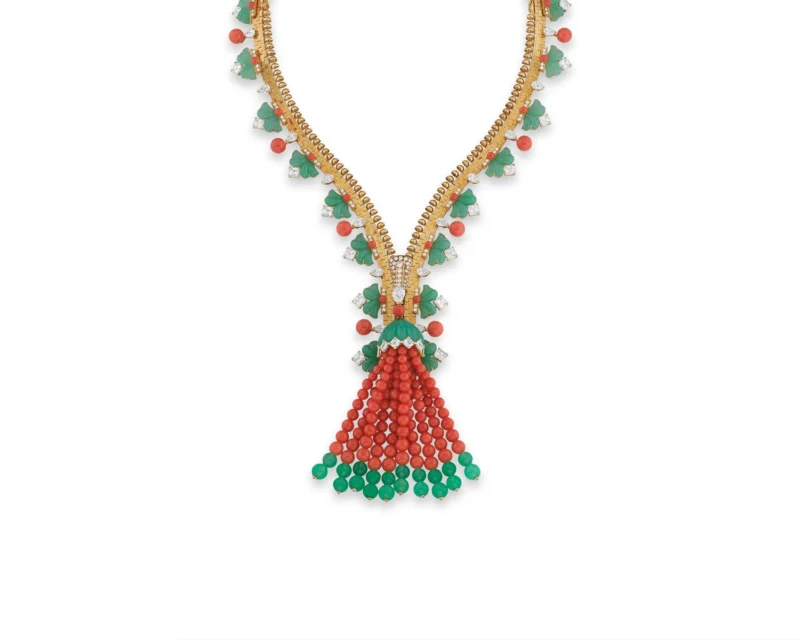
The Geneva Jewels Auction: VI brought signed jewels, coloured stones and distinguished provenance into one sale. Courtesy of Phillips.
Explore the story
Category: Collecting Intelligence Format: INTELLIGENCE_BRIEFING Series: The Ledger / Method
A Christie’s archive page for a Cartier sapphire ring is a useful place to begin because almost every kind of evidence sits in one compact listing.
The ring is signed Cartier. It carries an 18CT mark and a number that Christie’s describes as partly obscured. A GIA report states that the sapphire is of Cambodian origin with no indications of heating. The lot is accompanied by copies of a customs invoice and Cartier paperwork from London dated 21 September 1976, as well as a Cartier box. Then the condition report moves to a different subject: abraded facet junctions on the sapphire, wear to the gold and dents to the prongs.
It is tempting to read all of that as one large certificate of confidence. It is not.
The laboratory report is evidence about the stone within the scope of that report. The signature and marks are evidence about the mounting and its attribution. The paperwork helps build a documentary history. The condition report describes what the auction specialist observed about the object when it was catalogued. None of those records automatically does the work of the others.
That distinction is the point of this guide.
A jewellery lot is easier to understand when you stop asking whether it has “good paperwork” and start asking a narrower question: which sentence is each piece of evidence actually allowed to support?
Key takeaways
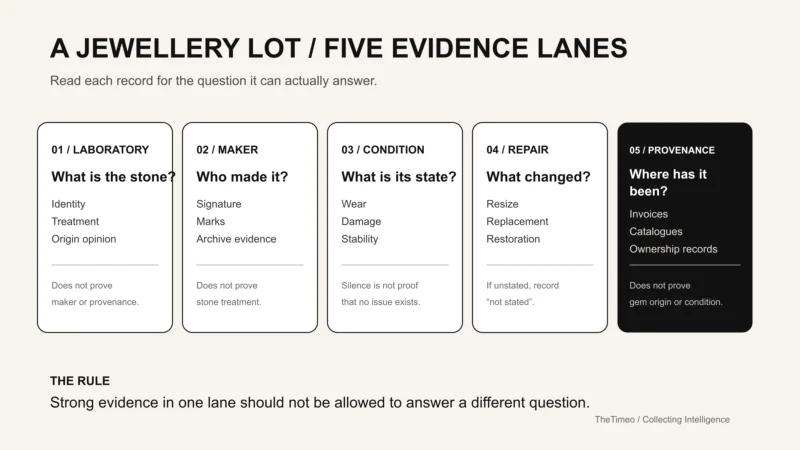
Laboratory report, maker, condition, repair and provenance should be read as separate evidence lanes. Courtesy of TheTimeo.
- A gemological report can identify a stone, disclose detectable treatment and, for some report types, state a geographic-origin opinion. It does not identify the maker of the mounting or prove the jewel’s ownership history.
- A signature, maker’s mark or number belongs to the object record. It should not be stretched into proof that every stone, component or later alteration is original to the jewel.
- A condition report is about physical state at a point in time. Auction houses themselves describe these reports as guidance and may sell lots “as is”.
- Repair and restoration deserve their own line. If no repair is mentioned, the careful conclusion is “not stated”, not “never repaired”.
- Provenance is a history of ownership or association. A laboratory origin opinion for a gemstone is a different kind of “origin”.
- Saleroom notices, updated catalogue notes and report dates matter. A later correction can change how an earlier description should be read.
One lot, five questions
Laboratory report. Stone and mounting. Provenance and condition.
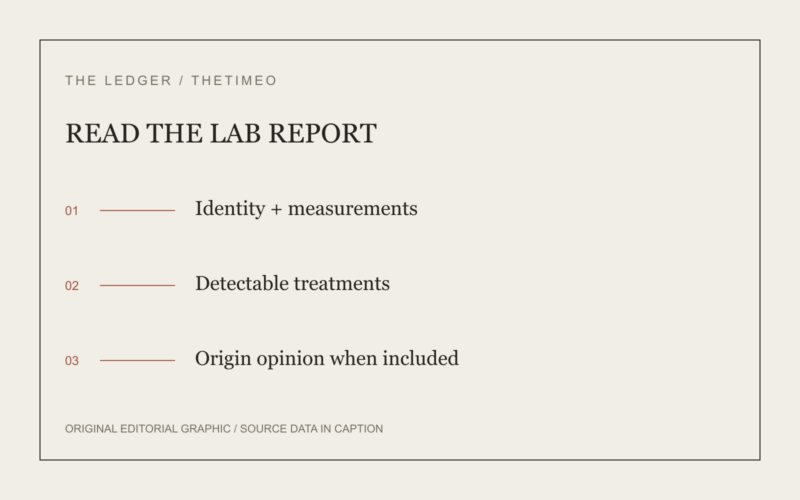
Identity + measurements. Detectable treatments. Origin opinion when included.
The cleanest way to read a jewellery catalogue is to separate the evidence before you interpret it.
Explore the comparison
| Evidence lane | The question it answers | Typical material | What it does not automatically prove |
|---|---|---|---|
| Laboratory | What is the stone, and what did the laboratory detect? | GIA/SSEF/Gübelin/AGL report, report number, date, measurements, treatment wording, origin opinion | maker, ownership history, current mounting condition, value |
| Maker / attribution | Who made or signed the jewel, and what marks are present? | signature, maker’s mark, assay mark, number, archive reference, maison authentication where available | gemstone treatment, unbroken provenance, untouched condition |
| Condition | What is the physical state now? | scratches, chips, abrasions, loose fittings, wear, missing elements, structural issues | original authorship, ownership history, absence of undisclosed repair |
| Repair / alteration | What has changed? | resizing, solder, replacement stones, altered fittings, shortened links, restored enamel, changed clasp | that the change was authorised by the original maker, unless documented |
| Provenance | Where has the jewel been, and who has owned or held it? | invoices, auction catalogues, inventories, correspondence, photographs, estate records | gemological origin, current condition, originality of every component |
Those five lanes can support one another, but they should remain visible as separate records.
The moment they are allowed to blur, weak evidence in one area starts borrowing authority from strong evidence in another.
Start with the catalogue description, then slow down
Auction catalogues compress a great deal of information into very little space. That is useful, but it encourages fast reading.
Begin by recording the exact wording of the lot heading and description. Note the maker attribution, materials, stated stone weights, dimensions, marks, report numbers, estimated period and any wording such as “signed”, “attributed to”, “circa”, “with report”, “accompanied by” or “property from”. Those phrases are not interchangeable.
Then read the auction house’s terms.
Sotheby’s buyer guidance is unusually clear about why this matters. It states that catalogue statements about authorship, attribution, origin, date, age, provenance and condition are statements of opinion, subject to the applicable conditions and authenticity guarantee. Its jewellery guidance also warns that the absence of a condition note does not mean a lot is free from wear or imperfections.
That does not make catalogue descriptions unhelpful. It tells you how to use them.
A catalogue is a professional sale document, not a substitute for knowing which claims are warranted, qualified, observed or still open.
Laboratory report: read the scope before the conclusion
A laboratory report often looks like the most scientific document in a jewellery lot, which can make it feel more comprehensive than it is.
GIA’s current coloured-stone services provide a good example. A Colored Stone Identification Report identifies and describes the material and lists detectable treatments. An Identification & Origin Report adds a geographic-origin opinion for certain eligible gemstones. The distinction matters because origin is not present in every report type.
For natural coloured diamonds, GIA separates report types again. A full grading report can include colour grade, clarity and colour origin — natural versus treated — while other reports have different scopes. GIA’s own sample diamond report also states plainly that the results refer to the diamond described and that the report is not a guarantee or valuation.
The practical reading order is simple:
- laboratory name;
- report type;
- report number and date;
- object or stone described;
- weight and measurements;
- identification;
- treatment wording;
- geographic-origin opinion, if present;
- comments and limitations;
- verification route.
Then match the report back to the lot.
If the stone is mounted, ask how the auction house matched the report to the jewel. Compare measurements, photographs, inscriptions and any identifying details that are available. If the report is old, ask what may have happened since the examination.
A report dated ten years ago is still evidence of what the laboratory concluded then. It is not a condition report dated today.
Maker: a signature is a field, not a verdict
“Signed Cartier” or “Tiffany & Co.” can carry enormous weight in a catalogue. It should also trigger a more precise reading.
Record exactly what the auction house says it sees:
- signature;
- maker’s or workshop mark;
- assay mark;
- numbered mark;
- serial or inventory number where applicable;
- period attribution;
- archive or maison document, if any.
Do not collapse those entries into “authenticated by the house” unless that is what the documentation actually says.
Cartier illustrates the difference well. The maison says its archives document creations from design through commercialisation, and Cartier Tradition states that antique pieces selected for that programme are authenticated by maison experts with the help of the archives before restoration. That is a defined house process.
A signed Cartier jewel appearing at auction is not automatically in that Cartier Tradition process.
Tiffany provides the opposite kind of clarity. Its current customer FAQ says Tiffany & Co. does not offer a general authentication programme. A catalogue entry that describes a jewel as signed Tiffany therefore should not be rewritten as “authenticated by Tiffany” unless a separate, specific document supports that statement.
This is not scepticism for its own sake. It is simply clean grammar.
Write: “signed Cartier, numbered, with French assay and maker’s marks” when that is what the lot says.
Do not silently upgrade it to: “Cartier confirms the jewel is authentic.”
Condition: the part of the page that deserves more attention
Collectors often spend more time on the glamorous sentence in a catalogue than on the condition report. The balance should usually be reversed.
Christie’s defines a condition report as a specialist’s written description of an object’s physical state. Its guidance says these reports may cover previous damage, fading, restoration and repair, while also stressing that lots are sold “as is” and that reports are provided for guidance.
Sotheby’s current buyer guide makes a similar point: the absence of a condition reference does not imply that a lot is free from faults, imperfections, restoration or repair.
For jewellery, read condition by component.
Stone: chips, abrasions, cavities, surface-reaching inclusions, damage at facet junctions, evidence of wear, stability concerns. Mounting: scratches, dents, thinning, deformation, solder, worn prongs, missing metal, damaged galleries. Setting: loose stones, replaced stones, altered claws, signs of re-setting. Fittings: clasp, pin, ear fittings, hinge, safety chain, screw threads. Enamel or decorative surfaces: losses, later infill, restoration. Size and geometry: resizing, shortened links, altered length, modified fittings.
“Overall in good condition” can be a useful summary. It should never replace the observations that sit underneath it.
In the Christie’s Cartier sapphire ring mentioned at the beginning, the sentence about the jewel being in good condition sits alongside abraded sapphire facet junctions and dents to the prongs. Both pieces of information belong in the record.
Repair: make absence of evidence visible
Repair is where catalogue reading becomes especially vulnerable to assumption.
A jewel can be genuine, signed and well documented while still having been resized, repaired, restored or fitted with later elements. Those interventions may be entirely appropriate. The important question is whether they are known and recorded.
A Sotheby’s Cartier bracelet from 1927 provides a useful example. The lot carried several gemological reports and a Cartier certificate of authenticity. The condition report also stated that the bracelet had been shortened since the certificates were issued.
That single sentence is a reminder to align dates.
The certificates belong to one moment in the object’s record. The shortening belongs to a later intervention. Neither cancels the other, but they cannot be treated as though they describe the same state of the jewel.
When reading a lot, look for:
- resizing;
- shortened or lengthened bracelets and necklaces;
- converted clips, brooches or earrings;
- replacement clasps or fittings;
- solder repairs;
- replacement stones;
- re-polishing or refinishing;
- restored enamel;
- recut or repolished gemstones;
- changes made after a laboratory report was issued.
If the catalogue does not mention repair, write repair history not stated.
That is more accurate than “no repairs”.
Provenance: ownership history is not gemstone origin
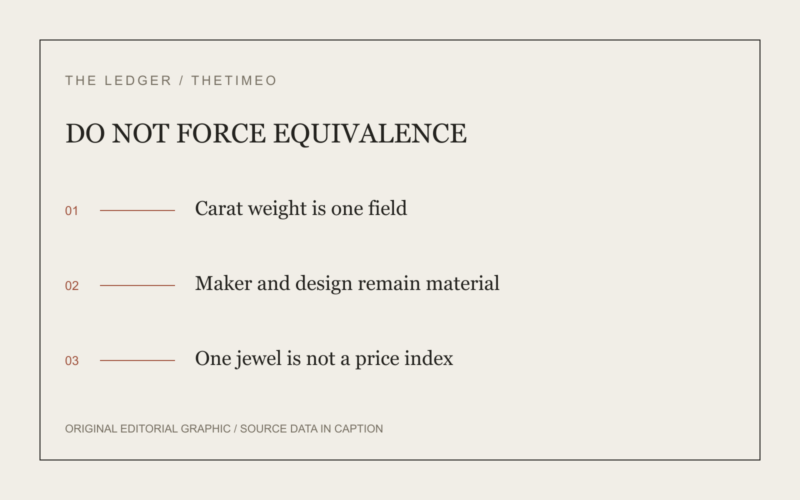
Carat weight is one field. Maker and design remain material. One jewel is not a price index.
Jewellery uses the word “origin” in two completely different ways, which is why confusion comes easily.
A laboratory may give an opinion on the geographic origin of an emerald, sapphire, ruby or other eligible gemstone. Provenance concerns the ownership history of the jewel or object.
Christie’s defines provenance as the documented history of ownership. Its guidance lists records such as invoices, auction catalogues, exhibition catalogues, museum inventory numbers, archival correspondence and certificates as possible evidence within provenance research.
The important word is history.
A fitted Cartier box is not an ownership chain. A family story is not automatically a documented chain. A 1976 Cartier invoice can support a transaction or early-life event, but it does not tell you every owner between 1976 and the present unless other records fill those years.
The same restraint applies to famous-name provenance. “Formerly in the collection of…” should lead to the supporting record, not end the inquiry.
A strong provenance note tells you:
- the named person or collection;
- the nature of the connection;
- the dates or bounded period;
- the documentary source;
- any gap in the chain;
- whether the statement is direct evidence, attributed history or catalogue research.
A gap is not a defect to be hidden. It is simply part of what is known.
The most useful habit: keep the evidence from spilling sideways
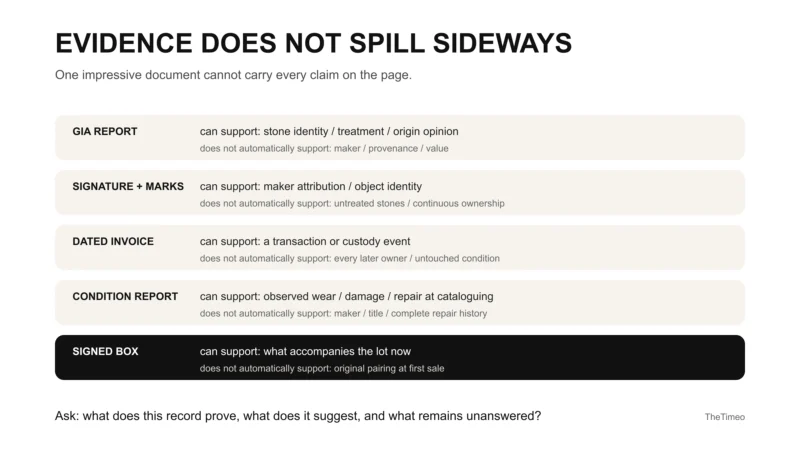
A fact established in one evidence lane should not silently become a claim in another. Courtesy of TheTimeo.
The easiest mistake in an auction catalogue is to let one impressive document answer a neighbouring question.
A GIA report can be excellent evidence that a sapphire showed no indications of heating when examined. It does not prove that the mounting is Cartier.
A Cartier signature can be important evidence about maker attribution. It does not prove that the sapphire is untreated.
A 1976 invoice can support an early transaction. It does not prove the jewel was never altered in 1985 or resized in 2004.
A condition report can document chipped facet junctions and worn prongs. It does not tell you who owned the ring in 1976.
A Cartier box is useful context. It does not, by itself, establish that the box and jewel have travelled together since first sale.
This sounds obvious when written out. It is much harder to maintain when all five pieces of evidence are compressed into a polished catalogue page.
Read the latest notice, not only the original PDF
Auction information can change between cataloguing and sale.
Christie’s has an archived pair of Cartier ruby and diamond earrings where a saleroom notice corrected an error in the accompanying GIA report. The report image had labelled the gram weight of each earring as “cts” or carats. Christie’s told bidders to rely on the corrected catalogue information for the ruby weights when bidding.
The lesson is broader than that one error.
Before bidding, check:
- online lot page;
- condition report;
- saleroom notice or update;
- revised estimate, if any;
- additional laboratory reports;
- amended provenance;
- new measurements or corrected weights;
- changes to the lot’s description.
Save the version you relied on. If a material statement changed, keep both the earlier and later record.
Auction research is chronological. The final pre-sale description matters more than a screenshot saved before the correction.
A worked evidence audit: the Cartier sapphire ring
Return to the Christie’s Cartier sapphire ring from the opening and separate the claims.
Explore the comparison
| Claim | Evidence | What can safely be said | What remains open |
|---|---|---|---|
| Sapphire identity / treatment / origin | GIA report 1192028153, dated 29 January 2018 | GIA reported Cambodian origin and no indications of heating for the sapphire described | present condition beyond report scope; later intervention; value |
| Maker attribution | Christie’s catalogue: signature Cartier; 18CT mark; number partly obscured | the lot is catalogued as signed Cartier with those observed marks | whether Cartier itself authenticated this exact auction lot is not stated |
| Early documentary record | copies of customs invoice and Cartier London paperwork dated 21 September 1976 | those documents support a dated documentary event connected to the jewel | continuous ownership from 1976 onward is not established by that line alone |
| Condition | Christie’s condition report | abraded facet junctions, visible wear and dents to prongs were observed | a complete restoration history is not supplied |
| Box | Cartier box accompanies lot | a Cartier box is included in the lot | box originality to first sale is not established by that statement alone |
| Repair | no specific repair history stated in the extracted condition note | repair history not stated | absence of repair cannot be assumed |
That table is much less romantic than the catalogue photograph. It is also much more useful if you are comparing the lot with another Cartier ring.
Questions worth asking before you bid
You do not need to interrogate every modest jewellery lot as if it were a museum acquisition. The level of diligence should rise with price, rarity, attribution and the claims being made.
For a material purchase, these questions usually earn their place:
- Can I see the complete laboratory report and verify the report number?
- Does the report describe the loose stone or the mounted jewel, and how was it matched to the lot?
- What exact signature, maker’s marks, assay marks and numbers are present?
- Is the maker attribution covered by an auction-house authenticity guarantee, a maison document, or catalogue opinion?
- Can I have the complete condition report and additional close photographs?
- Are any repairs, replacements, resizing, re-setting or restorations known?
- Have any changes occurred since the laboratory report or certificate was issued?
- What documents support the provenance line, and where are the gaps?
- Are the box, papers or archive records original to this jewel or simply accompanying it now?
- Has the lot description changed since the catalogue was first published?
The answers do not all need to be perfect. They need to be specific enough for you to understand where certainty ends.
What this method does not establish
Reading an auction lot carefully does not turn a catalogue into a laboratory, a condition inspection into a legal title search or an old invoice into a guarantee of authenticity.
It also does not produce a valuation.
A strong evidence file can help you compare two objects more intelligently. Price still depends on the object, sale venue, timing, condition, demand, estimate strategy and many other variables. A laboratory report is not a price certificate, and the presence of a famous signature does not create a fixed premium.
For coloured-stone lots, TheTimeo’s existing guide Reading a Coloured-Stone Jewellery Lot at Auction goes deeper on laboratory wording, treatment, origin opinions and comparable results. This article has a different job: it provides the broader evidence audit that can be applied to signed jewellery, diamond pieces, pearls and mixed-material lots as well.
The last check before bidding
A catalogue can be beautifully written and still require careful reading. That is not a criticism of auction houses; it is a consequence of putting an object, its documents and its sale terms onto one page.
Instead of asking “Does this lot have paperwork?”, ask: what does each document prove, what does it only suggest, and what question is still unanswered?
Once those boundaries are clear, the lot becomes easier to read. The name, stone, condition and history can each remain interesting without being asked to prove more than they know.
Sources & further reading
This guide was checked on 5 September 2026 against current GIA report descriptions and sample-report limitations, Christie’s guidance on condition and provenance, and Sotheby’s buyer guidance for jewellery. Cartier’s published archive and Cartier Tradition material, Tiffany & Co.’s current authentication FAQ, and specific archived auction lots were used for the maker and worked examples. The article does not authenticate, appraise or provide legal title advice for any jewel.
The Edit
Insights & Investment stories
Selected stories from the same editorial universe.
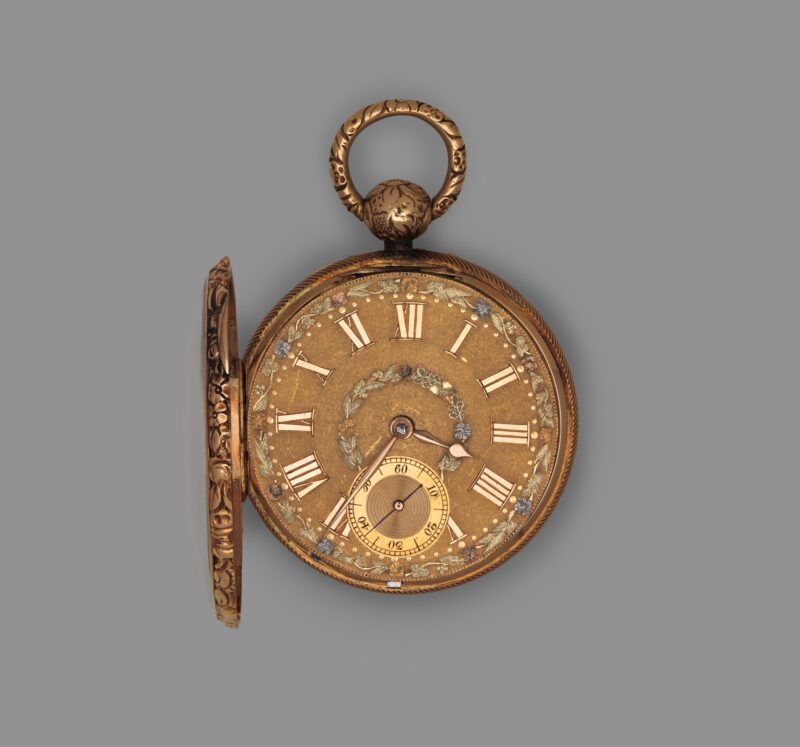
Inside a Gold Roskell: The Date in the Case
A richly worked gold dial, an engine-turned back and a signed movement: a Robert
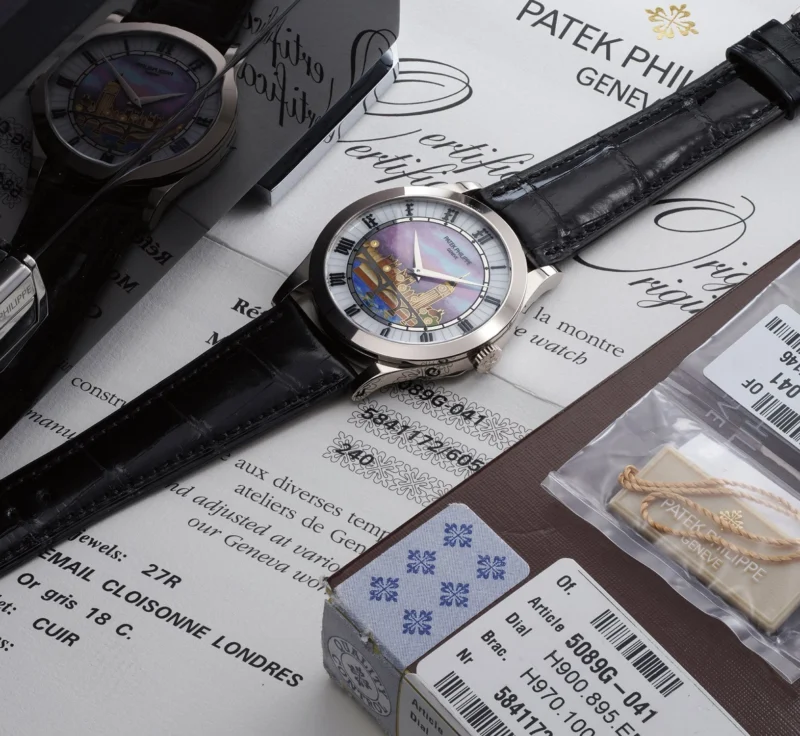
The TheTimeo Provenance Standard: What Should Travel With an Object
A collectible object needs more than a pile of accessories. Identity, ownership, service, condition,
How to Audit a Luxury Watch Listing: Nine Details That Matter
Before judging price, audit the listing: identity, configuration, condition, service, documents, photography, seller claims,
Auction Estimates, Hammer Price and Buyer’s Premium Explained
The fall of the hammer is wonderfully clear; the number that appears afterwards can

Watch Documents and Provenance: Build the File, Test the Claims
A watch can become more captivating when its past comes into focus. An archive
Watch Service History: Build a Record That Travels With the Object
The best service history reads like a biography of the watch. It shows how