
TheTimeo / Jewelry
Messika My Twin:
Two cuts,
one look.
An emerald cut, a pear and an unequal pair: the small asymmetry of Messika My Twin offers a different way to frame a bridal face.
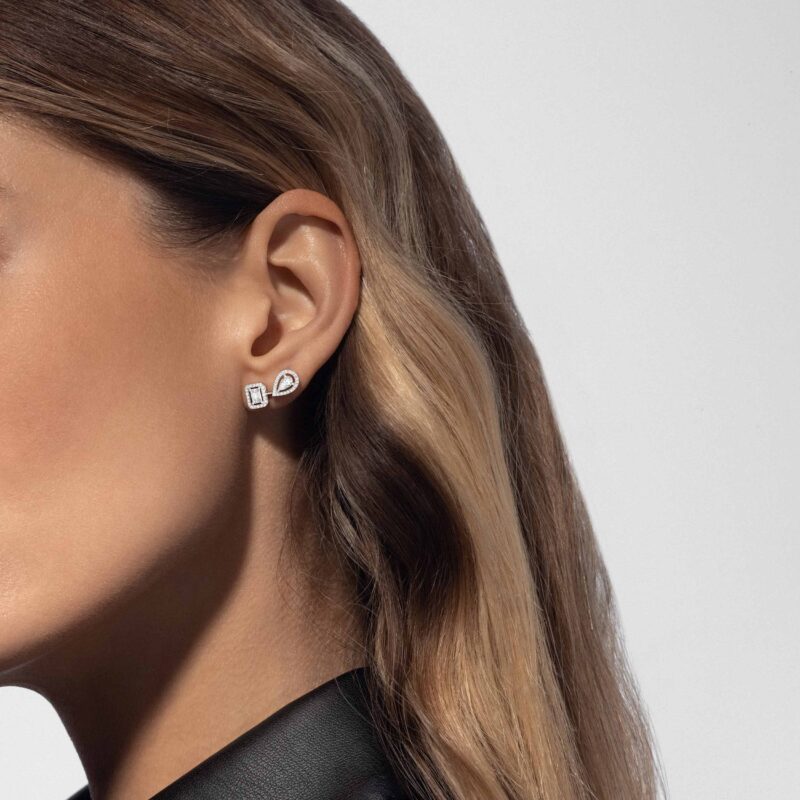
My Twin 1+2, reference 12886-WG, seen on the ear. Courtesy of Messika.
Explore the story
One ear carries a small rectangle of light. The other adds a pear, turned outwards along the lobe. The difference is quiet enough to register only when the face turns, but it changes the whole idea of a matching pair. Messika’s My Twin earrings make their connection through two diamond cuts, then leave room for each side to behave differently.
For a bridal look, that is an appealing place to begin. You can keep the intimacy of small earrings and still introduce a deliberate gesture. The decision becomes less about finding something sufficiently formal and more about choosing the line you want beside your face: compact, extended, softly curved or a little unexpected.
One rectangle, then a pear
01 / 02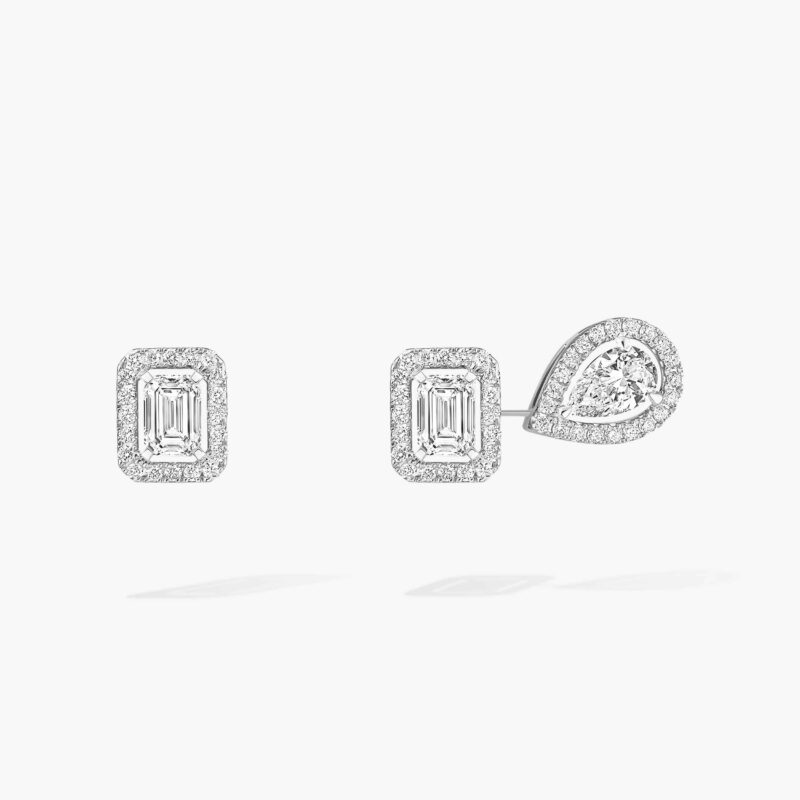
The asymmetric pair: one emerald-cut centre on the right, an emerald and pear on the left. Courtesy of Messika.
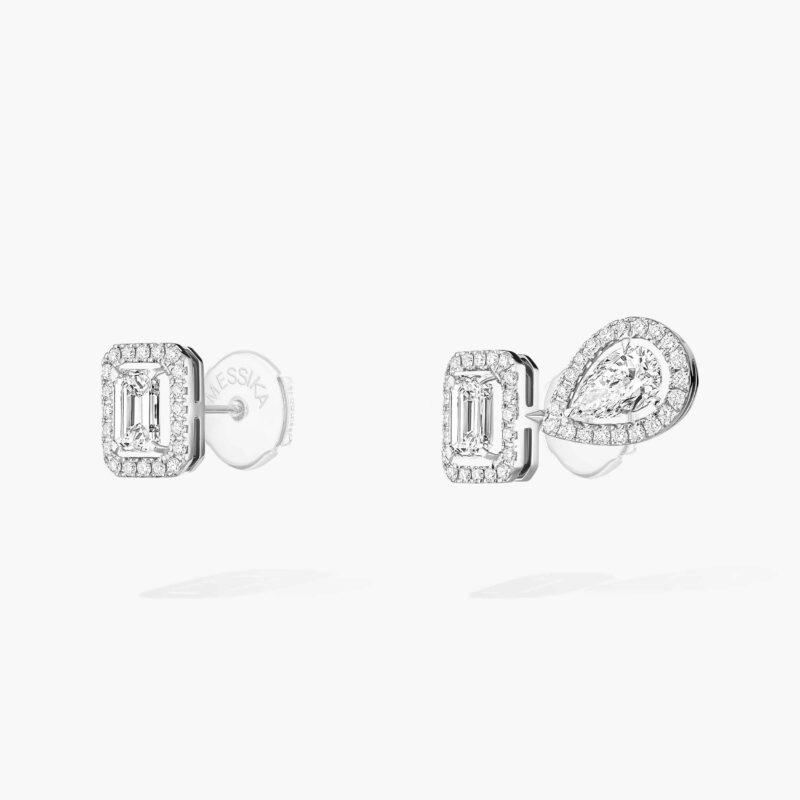
An angled view shows the shared rectangular setting and the added pear. Courtesy of Messika.
The medium 1+2 model, reference 12886-WG, puts an emerald-cut diamond on the right ear and an emerald-and-pear arrangement on the left. The rectangular outline gives the pair its steady point of reference. The pear introduces a different direction, with one rounded end and one fine tip. Smaller diamonds trace the edges of both shapes.
Seen as a complete pair, the earrings have a pleasing imbalance. Your eye recognises the shared rectangle before noticing that one side has continued further. The addition sits beside the lobe instead of forming a conventional drop below it. That placement gives the design its particular character: a small change in width, close to the face, rather than a long vertical line.
Look at the worn photograph before deciding how much presence you want. A product view makes every stone available for inspection; an ear restores proportion. Here the arrangement reads as a compact accent. Imagine it with your intended hairstyle and neckline, then consider whether you want that small asymmetry to be discovered gradually or clearly visible from the front.
A bright edge around a clear shape
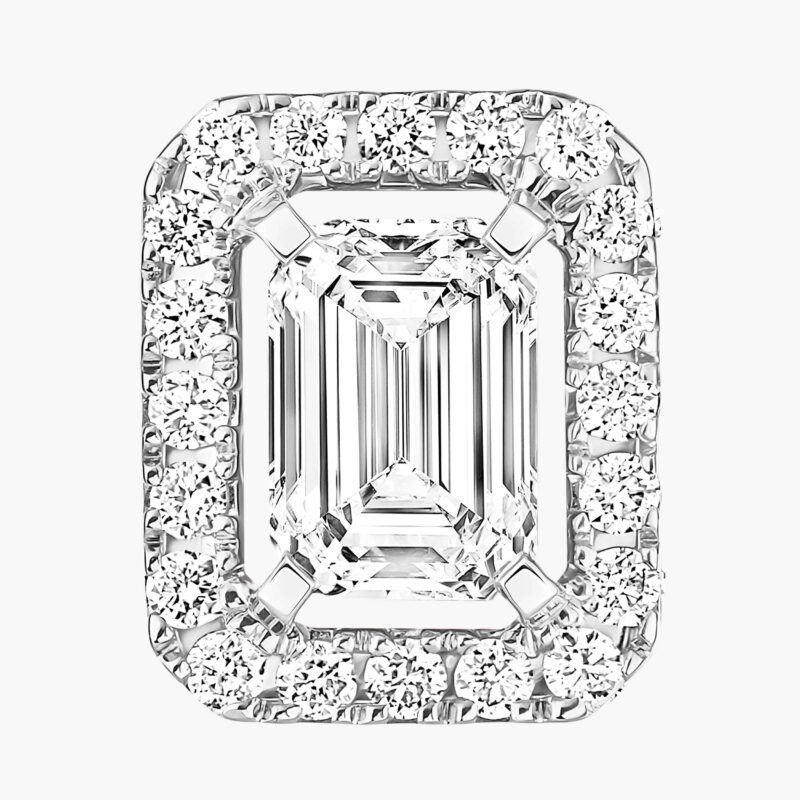
The clipped corners of the emerald cut remain distinct inside the diamond halo. Courtesy of Messika.
The close view shows how the halo surrounds the rectangular centre. Tiny round diamonds make a continuous, textured border, while the larger stone retains its clipped corners and straight sides. You can follow the outline without needing to identify every facet. The setting becomes a frame within the larger composition of the earring.
Messika lists three centre diamonds of 0.20 carats each for this white-gold pair, with a total diamond weight of 0.81 carats and G/VS quality. Those figures describe this reference. In choosing how the earrings look, the more useful first question is how you respond to the relationship between the centre and its border. Do you notice the calm rectangle, the sparkling perimeter, or the meeting of the two?
At a fitting, look once from the distance of a normal conversation and once close up. A detail that delights you in a mirror should still belong to the whole face. Bring a photograph of the dress if it helps you remember the neckline, but give your own reflection the final say over scale.
The line behind the illusion
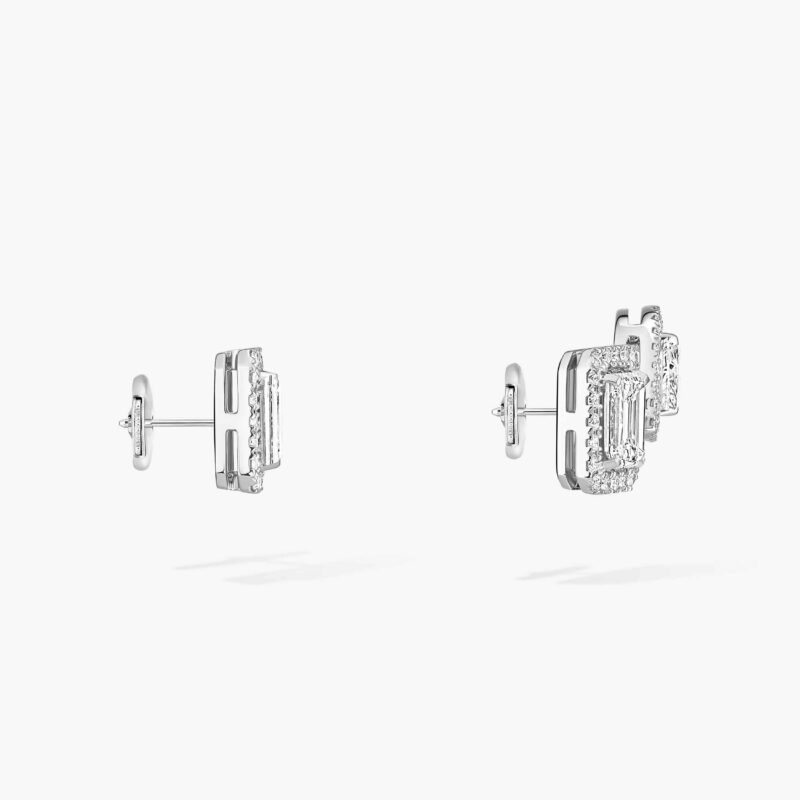
The side view reveals the short structure behind the two arrangements. Courtesy of Messika.
The side view reveals the difference between the two earrings especially clearly. Each begins with a post at the emerald-cut setting. On the double version, a second element carries the pear towards the side of the ear. It is a short construction with a very visible consequence: the two stones appear to occupy different positions along the lobe.
Messika describes this as an illusion of a double piercing. That effect depends on where the jewel sits, so the worn view matters as much as the face-on photograph. If you are trying the pair, ask to see how the double element is positioned and how the earring is secured. Let the actual piece establish its fit rather than expecting the photograph to predict it.
It is also worth looking at the pair with your hair in the style you are considering. Hair tucked behind both ears reveals the difference directly; a loose section may conceal one side and change what remains visible. Neither arrangement needs a rule. The pleasure is in deciding whether the unequal pair should be the main gesture or a detail that appears with movement.
Give the face the first word
With an open neckline
Begin with the earrings on their own. Look at the space between lobe, jaw and fabric. If the dress already has a defined edge or embellished surface, see whether the compact diamond shapes give you enough interest before adding a necklace. A quiet area can make a small jewel easier to notice.
With jewellery you already love
Try the pair beside the ring or bracelet you expect to wear. You might enjoy repeating a straight line, or prefer the contrast with a round stone. Compare the whole arrangement while standing naturally. A bridal choice becomes more personal when it has a relationship with the objects you will keep wearing afterwards.
A language beyond the pair
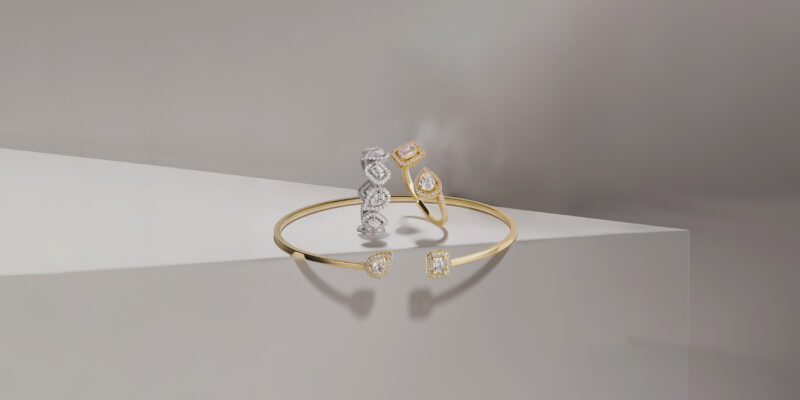
My Twin rings and a bangle: the emerald-and-pear pairing continues across the collection. Courtesy of Messika.
Across My Twin, the emerald and pear recur in different relationships. In this collection photograph, rings and a bangle bring the two outlines together around open spaces. They are other pieces in the family, rather than alternate views of the earrings. The shared idea is easy to read: two shapes can belong together without becoming identical.
That thought can carry the bridal decision beyond one day. Consider whether the earrings would feel at home with the clothes you already choose: a shirt collar, a plain knit, a dark evening neckline. The scale shown on the ear gives you something tangible to judge. You are choosing a small drawing beside the face, one whose unequal lines may become familiar through use.
Begin with the side you notice first. Then turn your head and let the second complete the picture.
Sources & further reading
The Edit
Jewelry stories
Selected stories from the same editorial universe.
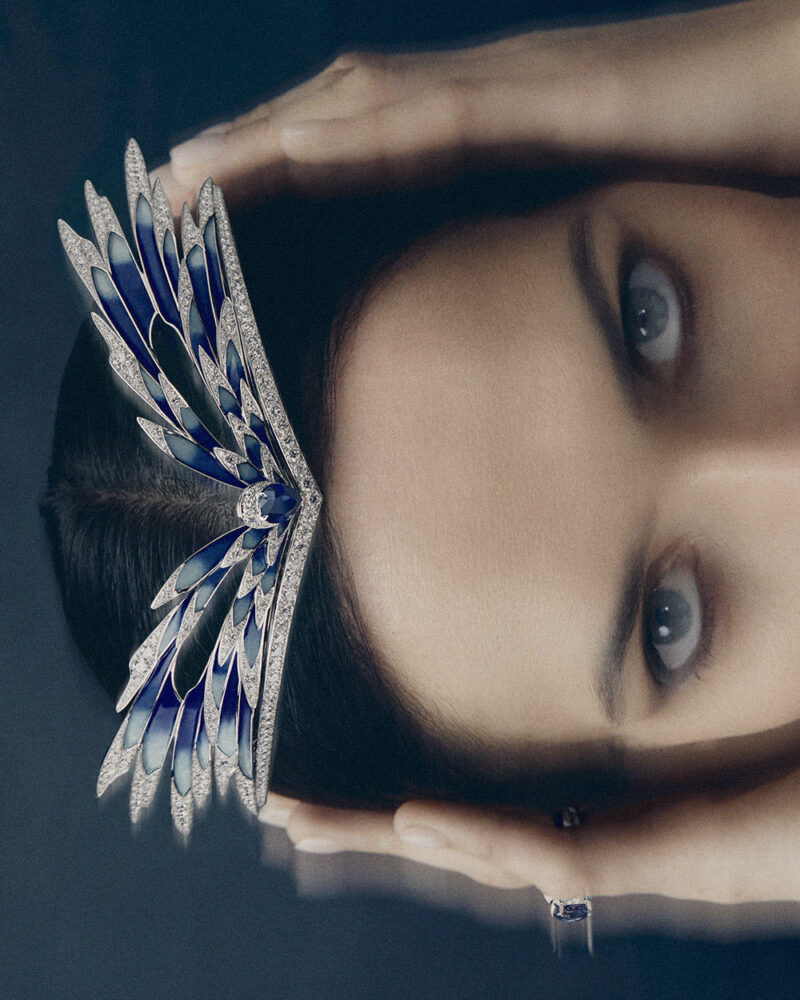
Chaumet Envol: A Tiara in Motion
Blue wings move from hair to face and cloth. Chaumet’s Envol invites a bridal
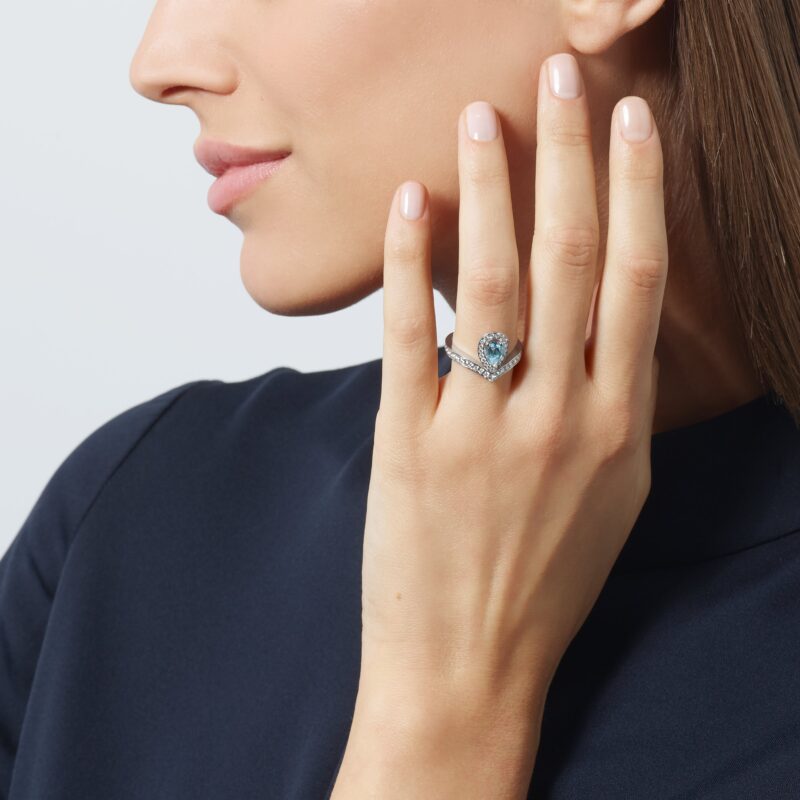
Chaumet Joséphine: Something Blue, Chosen Your Way
An aquamarine beside the face, a sapphire at the centre of a solitaire: Chaumet
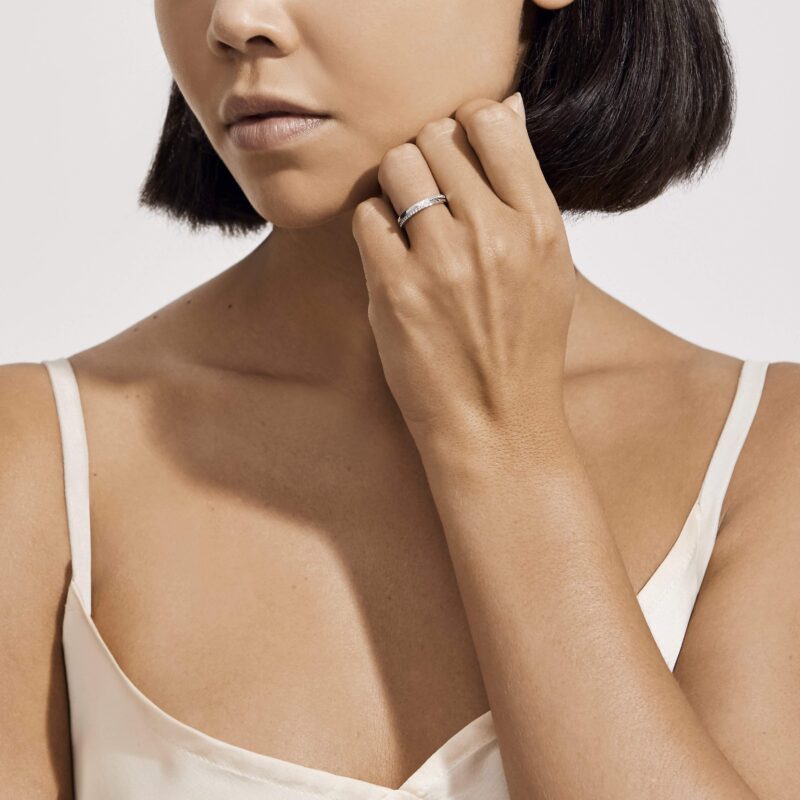
Two Rings, Two People: A De Beers Wedding-Band Edit
A rose-gold court profile, a single diamond in platinum, a fine eternity line or
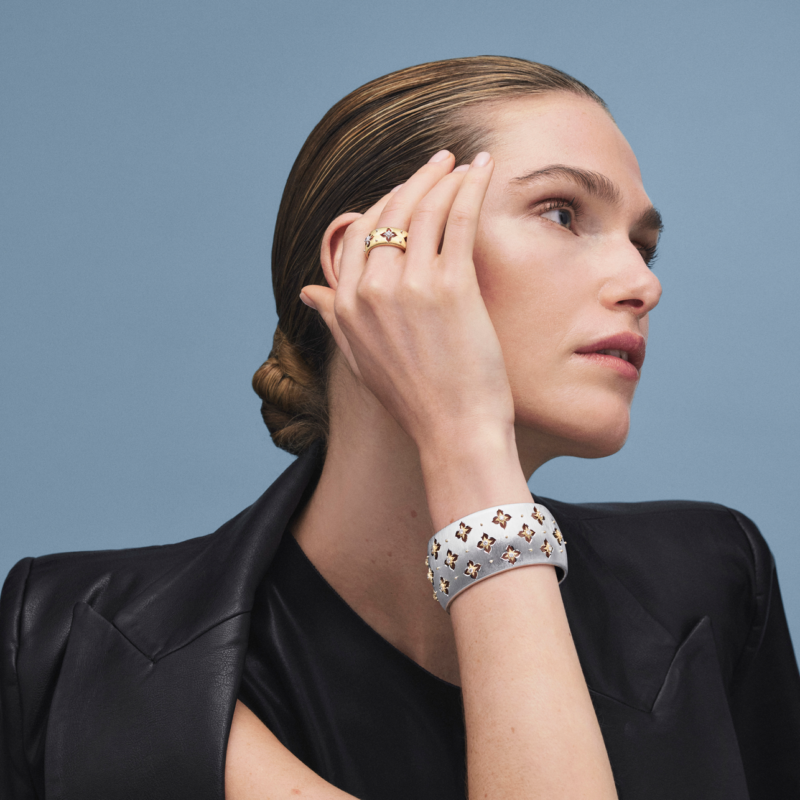
Buccellati Macri Giglio: Gold with a Grain
On the wrist, Buccellati Macri Giglio becomes a broad field of engraved gold. A

Mikimoto M: A Pearl with a Graphic Edge
White South Sea pearls, golden warmth and a sharply drawn setting: Mikimoto M offers
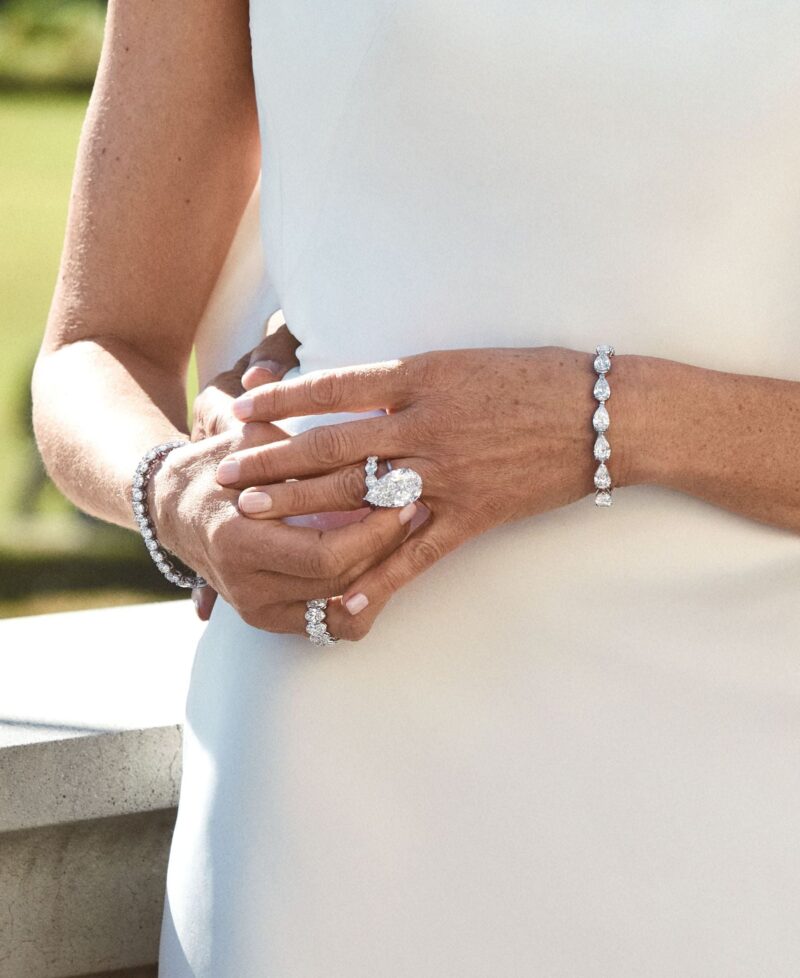
Norman Silverman Bridal: A Ring with Presence
A pear solitaire on the hand, a radiant seen in profile and an emerald-cut