
TheTimeo / Jewelry
Signed jewelleryBeyond the name
A signature is the beginning of a jewel’s story. How craftsmanship, marks, condition and documents help explain the piece behind the name.
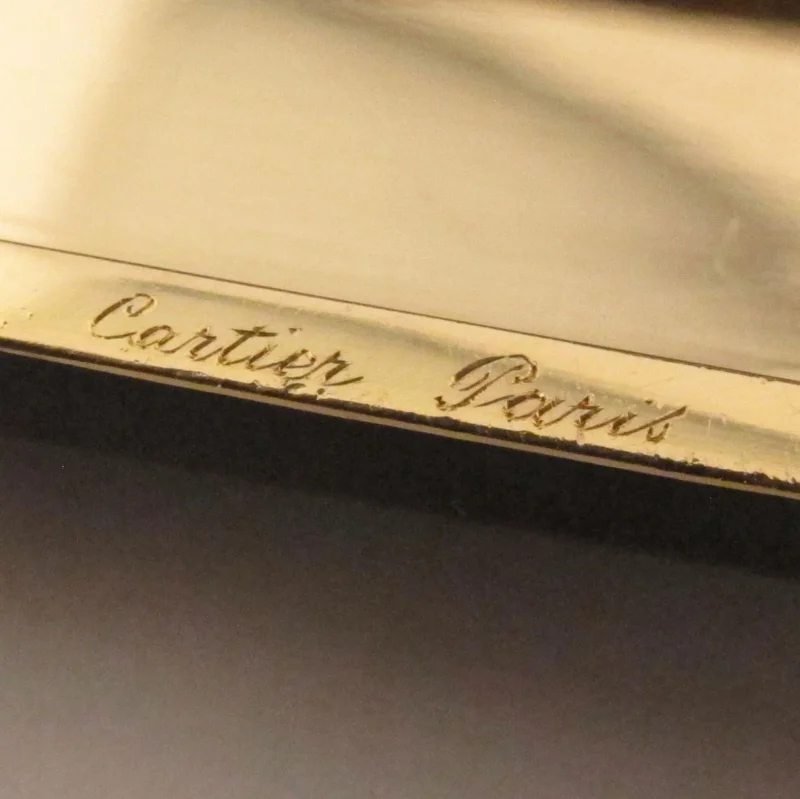
Macro photograph of a Cartier signature on a jewel. Courtesy of Christie’s Images Ltd..
Explore the story
Turn a jewel over and a small engraved name can open a much larger story. Nearby may be a number, a metal-purity mark or the stamp of a workshop whose name is different from the one on the box.
These details reward attention because they help connect a beautiful object with the people and businesses behind it. Understanding their different purposes also makes it easier to judge a description, ask useful questions and preserve the history of a piece you own.
The signature belongs to the whole jewel
A house signature can be an important clue to authorship. Its lettering, position and wear need to make sense alongside the construction and period of the jewel. The presence of a famous name is a reason to examine the object carefully, not a substitute for that examination.
Consider where the signature sits. A name inside a ring shank may be affected by resizing. A signed clasp may have been replaced. An earring fitting can change while the principal ornament remains. A mark is most informative when its relationship to the surrounding metal is understood.
Clear close-up photographs are useful, especially before repair or polishing. Include the entire jewel and the location of the inscription, rather than keeping only a tightly cropped image of the letters.
A hallmark answers a different question
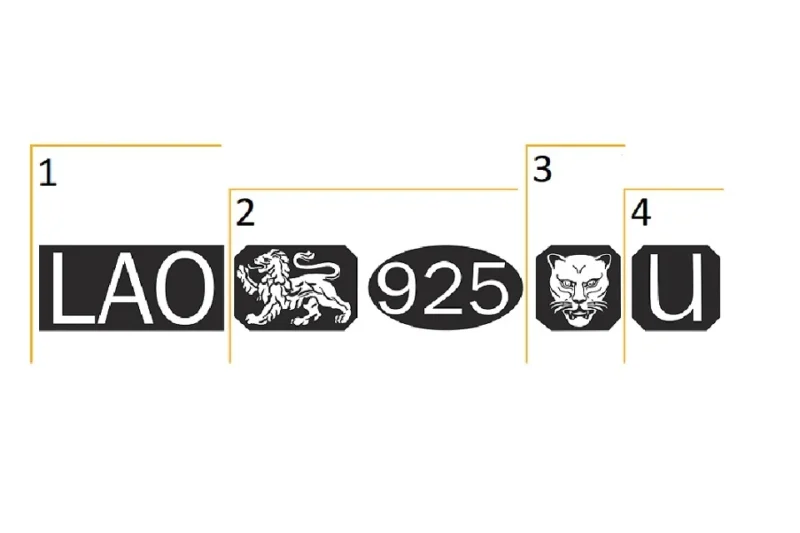
Reference key explaining the components of a UK hallmark. Courtesy of UK Government.
In the UK system, a hallmark includes a sponsor’s mark, a precious-metal fineness mark and an Assay Office mark. The sponsor is the registered person or company submitting the item for hallmarking; that is not necessarily the workshop that physically made it.
The fineness mark concerns the metal content, while the Assay Office mark identifies where the item was tested and hallmarked. An optional date letter records the hallmarking year. These details are separate from a designer’s or jewellery house’s signature.
Other countries use different systems, and historical marks need to be read in their own context. If a mark is unclear, consult the relevant assay authority or an experienced specialist. A resemblance to one symbol found online is a useful lead, not a complete identification.
Why two names can belong on one piece
A jewellery house may have commissioned work from a specialist workshop. The finished piece can therefore carry both the house signature and a maker’s mark. That combination is part of its production history, rather than an inherent contradiction.
Van Cleef & Arpels’ archive documents its relationships with outside workshops. Such records remind us that important jewellery was often the result of several kinds of expertise: design, fabrication, stone-setting and the presentation of the finished object to a client.
When reading a catalogue, notice whether these roles have been distinguished. “Signed and numbered” is useful information, but a separate workshop identification may add a more precise account of how the jewel was made.
An authentic jewel can have been altered
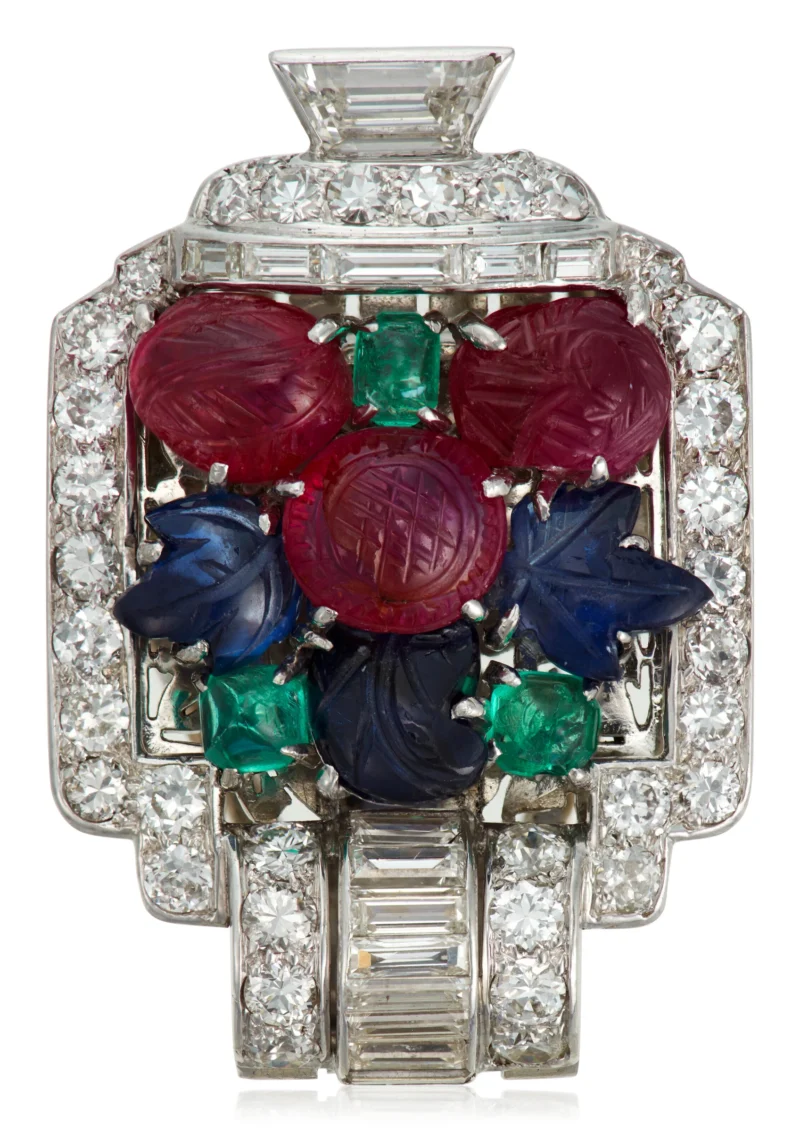
Signed Cartier Art Deco Tutti Frutti clip showing an identifiable house object. Courtesy of Christie’s Images Ltd..
The Cartier Tutti Frutti clip pictured here combines carved coloured stones with diamonds in a compact composition. Christie’s catalogued it as signed, while also recording that the clipback had been altered.
Both facts belong in the description. The signature concerns attribution; the changed fitting concerns the condition and form in which the jewel survives. One does not make the other disappear.
Alterations vary in significance. A replacement safety fitting, a resized ring and a brooch converted into a pendant are different interventions. Ask what was changed, when it was done and whether any original components or documentation remain. Then consider whether the piece, as it exists now, suits your interests.
What an archive can add
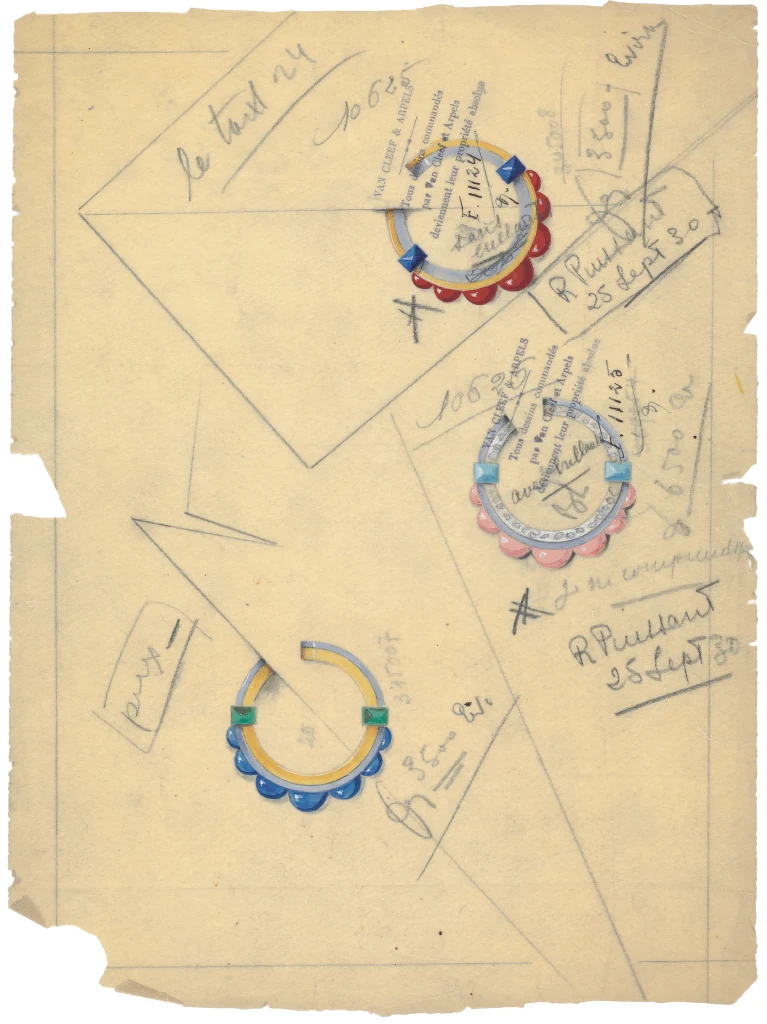
1930 Van Cleef & Arpels design drawing from the Patrimonial Collection. Courtesy of Van Cleef & Arpels.
A drawing, stock record or original invoice may connect a jewel with the house that made or sold it. Numbers can help locate that record, but they become meaningful through the match between the document and the object.
The Van Cleef & Arpels drawing shown here illustrates the value of keeping design records. A photograph tells us how a finished piece looks; a drawing can preserve another stage of its history. Dimensions, annotations and details of the composition may help a specialist pursue an attribution.
An unsigned jewel can still merit research, particularly if wear or an alteration explains the absence of a mark. Conversely, a visible signature should still be checked against the rest of the object. Archive access and authentication services vary by house, so establish what is available before relying on a future letter or certificate.
The stone’s report is not the jewel’s biography
A gemmological report describes the stone examined. Depending on the service, it may record characteristics such as weight, colour, clarity, treatments or an origin opinion. It does not by itself identify the maker of the mounting or reconstruct the jewel’s ownership history.
Likewise, a house signature does not tell you whether an emerald has been treated. The two kinds of evidence complement each other. For a significant gemstone, have the relevant report checked and its relationship to the stone confirmed by an appropriately qualified professional.
Purchase receipts, service invoices and valuation documents have other purposes. Keep their original descriptions and dates rather than referring to the folder simply as “papers”. The more precisely you understand each document, the more useful the collection becomes.
Preserving the next chapter
If you own a signed jewel, photograph its marks before authorising work. Ask the workshop to avoid unnecessary disturbance to inscriptions and to record any replaced fittings or stones. Keep the final invoice with photographs of the finished piece.
For an inherited object, gather old photographs, receipts and correspondence before setting out to research the name. Family recollections can provide valuable leads, but distinguish them from events supported by documents.
The aim is a clear story, not an impressive stack of certificates. A jewel becomes more interesting when its craftsmanship, marks, condition and history can be understood together. The signature invites that closer look; the object rewards it.
Sources & further reading
UK hallmarking guidance and the Goldsmiths’ Company Assay Office explain the marks; Van Cleef & Arpels’ archive history provides workshop context.
The alteration example is Christie’s Cartier Tutti Frutti clip catalogue record. Laboratory records can be checked through GIA Report Check where applicable.
The Edit
Jewelry stories
Selected stories from the same editorial universe.
Harry Winston Beyond the Ring: Choosing the Wedding-Day Jewels
The engagement ring does not have to carry the whole wedding look. Harry Winston’s
Van Cleef & Arpels Fascinations d’Égypte: How to Read Egypt Without Copying the Museum
A century after its first Egyptian jewels, Van Cleef & Arpels returns to the
Beyond the 4Cs: Choosing an Engagement Ring for Everyday Life
The diamond report is only half the decision. Height, setting, shoulders, sizing and the
The Signed Vintage Engagement Ring: A Collector’s Guide to Provenance and Fit
A signature narrows the field, but maker evidence, stone reports, alterations, condition, provenance and
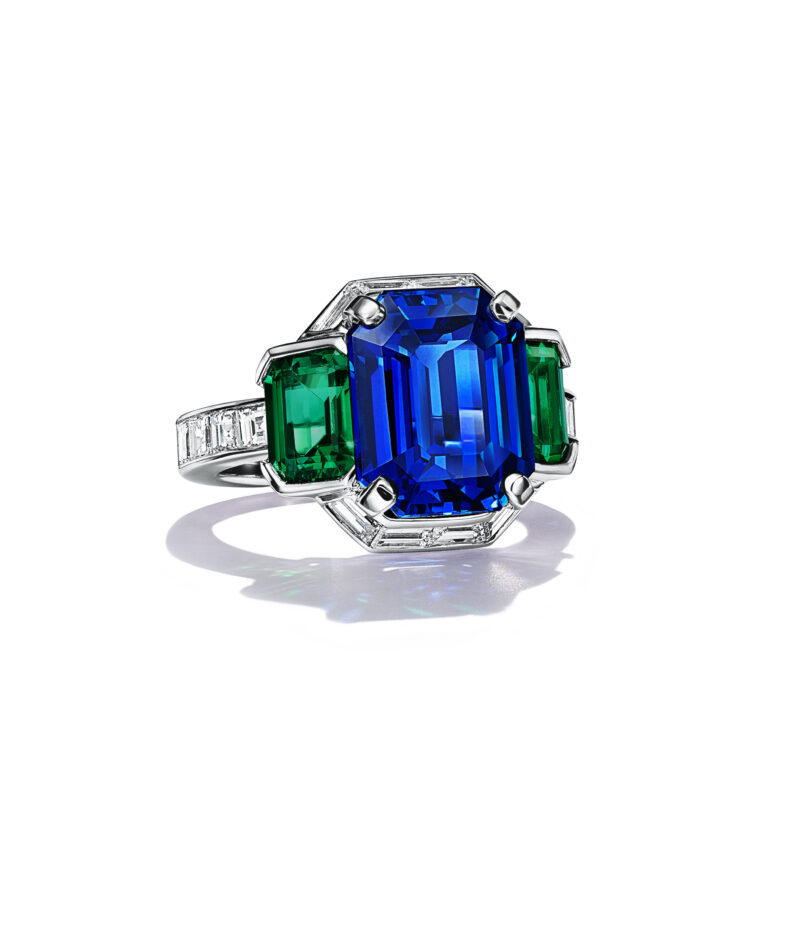
Emerald or Sapphire? Choosing a Coloured-Stone Engagement Ring
Emerald and sapphire can both belong in an engagement ring, but setting, treatment history
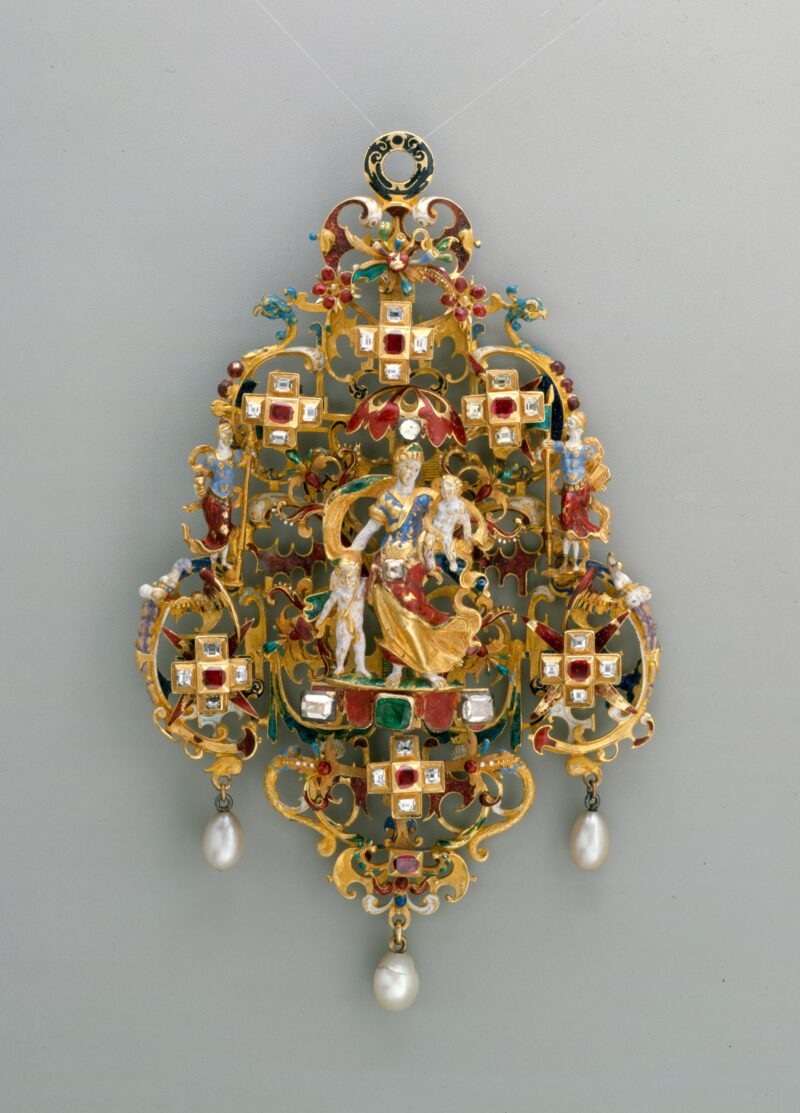
When a Jewel Has Been Repaired: How to Read Restoration and Condition
Repair does not erase a jewel’s history. The useful question is what changed, what