
TheTimeo / Jewelry
EMERALD OR SAPPHIRE?
a life with colour
Emerald and sapphire can both belong in an engagement ring, but setting, treatment history and daily care matter as much as colour.
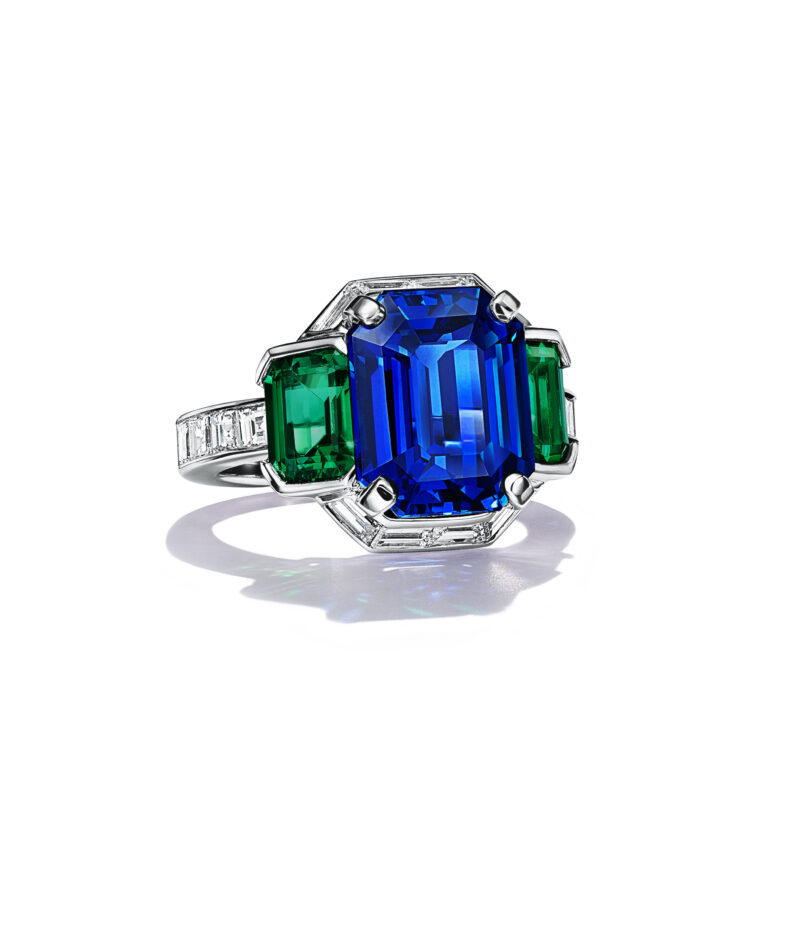
A sapphire and emerald composition shows how colour and setting architecture work together.
Explore the story
A coloured-stone engagement ring is usually sold through colour first. Deep blue. Vivid green. A rare origin. A romantic association with a place or a family.
Those things may matter. They do not tell you how the ring should be built or cared for.
Emerald and sapphire are both established jewellery stones and both can be worn in rings. Yet they behave differently enough that a buyer should not reduce the choice to “which one is harder?” Sapphire is corundum, with high hardness and excellent toughness. Emerald is beryl: hard enough for jewellery, but generally more vulnerable to impact because fractures are common and clarity enhancement is widespread.
That difference affects setting design, workshop handling, cleaning and the kind of documentation worth keeping.
The practical question is therefore not whether emerald or sapphire is “better” for an engagement ring. It is what the stone has experienced, how the ring protects it, and whether the owner understands the maintenance implied by that combination.
Key takeaways
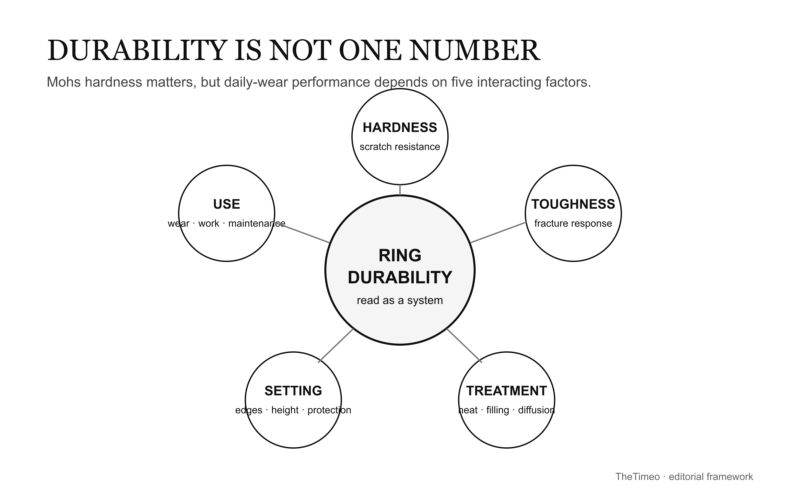
Durability is a system of hardness, toughness, treatment, setting and use.
- Mohs hardness describes resistance to scratching; it is not a complete score for daily-wear durability. Toughness, fractures, treatments and setting architecture also matter.
- GIA describes corundum — ruby and sapphire — as relatively hard and tough, with sapphire at 9 on the Mohs scale and excellent toughness. Untreated and heat-treated sapphire is generally robust for ring wear.
- GIA places emerald at 7.5–8 on the Mohs scale with fair-to-good toughness and warns that heat, steam and ultrasonic cleaning can be risky because natural emeralds commonly contain surface-reaching fractures filled with oils, resins or polymers.
- A coloured-stone laboratory report is not a price certificate. GIA identifies whether an emerald or sapphire is natural or laboratory-grown, reports detectable treatments and can provide an origin opinion when requested and possible; it does not grade coloured stones on a universal quality scale.
- Setting design should be chosen around the actual stone. A heavily included emerald and an untreated sapphire of similar size do not present the same workshop or wear considerations.
Start by separating hardness from toughness
The Mohs scale is useful and regularly misused.
Hardness measures resistance to scratching. It does not directly tell you how a gemstone will respond to a sharp blow, an existing fracture, heat at a jeweller’s bench or a treatment that changes its stability.
Sapphire ranks 9 on the Mohs scale. GIA describes corundum as having excellent toughness and no cleavage, which is one reason sapphire has long been used in rings. Emerald ranks 7.5 to 8, still relatively hard, but GIA gives it fair-to-good toughness and notes that emerald requires more care than ruby or sapphire.
That distinction matters in an engagement ring because the object is exposed to repetitive, ordinary contact: door frames, desk edges, gym equipment, kitchen surfaces, luggage handles, other jewellery.
A hard stone can still be damaged. A durable stone can still be vulnerable if it contains a significant fracture, has an exposed corner or has undergone a treatment that changes how it should be cleaned.
So the correct starting point is not a single number. It is a material profile.
Sapphire: robust does not mean treatment-blind
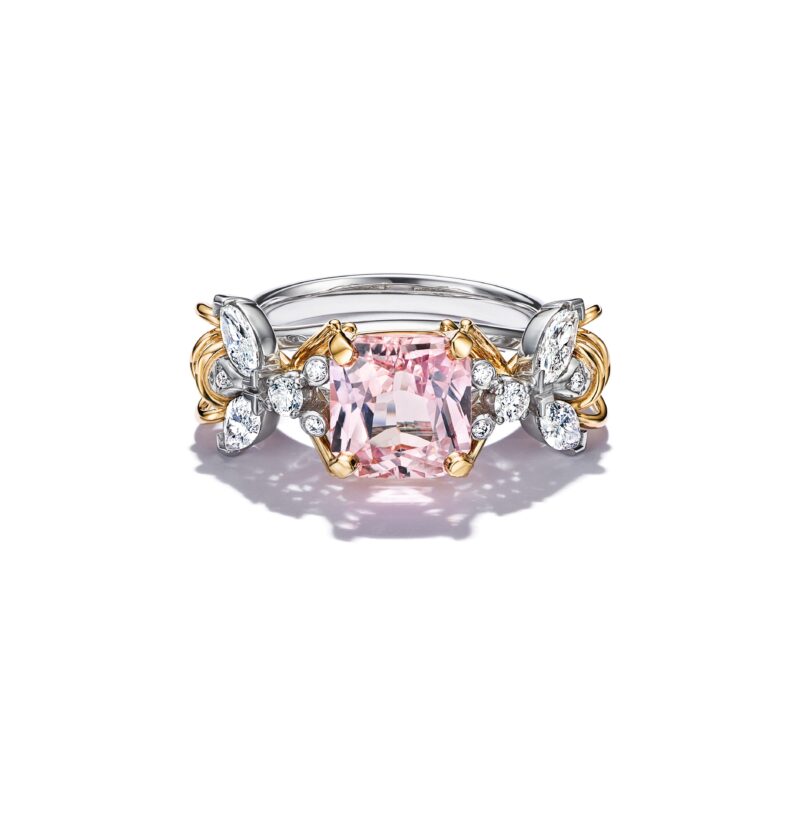
Setting geometry determines how exposed edges and corners meet daily wear.
For daily ring wear, sapphire begins from a strong position.
GIA states that corundum is relatively hard and tough and describes sapphire as a good choice for jewellery subject to regular wear. Its care guidance says warm, soapy water is always safe. Ultrasonic and steam cleaning are usually safe for untreated, heat-treated and lattice-diffusion-treated stones.
The qualifier is important: usually.
Sapphire can also be fracture-filled, cavity-filled or dyed. GIA advises that those materials should be cleaned only with a damp cloth because the fillers or dyes may be damaged. A sapphire sold simply as “natural” therefore does not tell you enough about care.
Heat treatment is not the same as diffusion
Heat treatment is common in sapphire and is accepted in the trade. A laboratory report can indicate whether evidence of heating is present.
Lattice diffusion is different. GIA describes it as a treatment in which heat and chemicals introduce colour-causing elements into the gemstone. In some diffusion-treated sapphires, the added colour penetrates deeply; in others it can be shallow. GIA specifically warns that surface damage or recutting can remove colour where the treated layer is shallow.
That has a practical consequence for a ring owner: a future repair involving repolishing or recutting should not begin before the treatment history is understood.
The setting may be made of platinum or gold, but a jeweller still needs to know what the gemstone can tolerate.
Emerald: the issue is not softness but fractures and filling
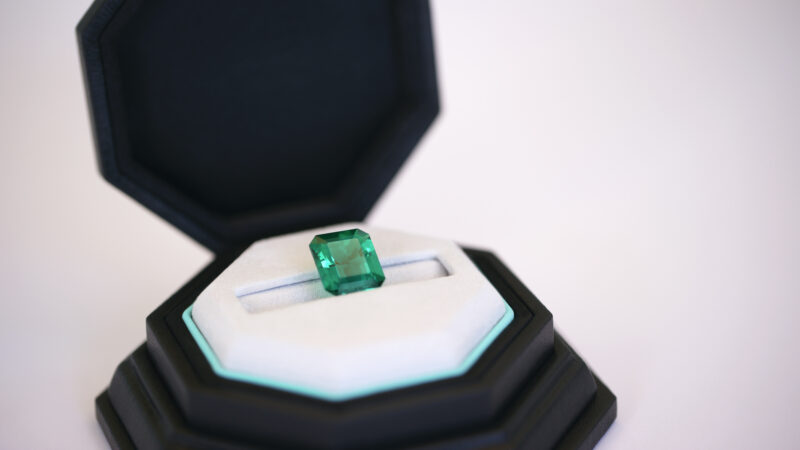
A prominent emerald makes protection, inclusions and treatment disclosure part of the design conversation.
Emerald is sometimes dismissed as “too soft” for an engagement ring. That is an imprecise diagnosis.
At 7.5 to 8 on the Mohs scale, emerald is not soft in ordinary jewellery terms. The more important issue is that natural emerald commonly contains fractures, and those fractures are often filled to reduce their visibility.
GIA’s emerald care guidance says that heat can extend existing fractures and that oils, resins and polymers used to fill surface-reaching fractures can alter or deteriorate under heat, light or chemicals. It warns against ultrasonic and steam cleaning and recommends warm, soapy water with gentle scrubbing as the safest routine.
This means an emerald engagement ring can be entirely viable, but it asks the owner to accept a more conservative approach to wear and service.
The filling is part of the care question
Historically, emerald treatment is often discussed vaguely as “oiling”. That can obscure important differences.
GIA announced in December 2024 that its emerald-report service would add optional identification of filler type. The current system can identify Type A fillers, which may include oil, wax and/or natural resin; Type B artificial resin; or state when the material cannot currently be identified. GIA also evaluates the degree of clarity enhancement.
For a buyer, the useful point is not to turn the filler type into a simple ranking. It is to know that the emerald’s fractures and filling are part of the object’s technical record.
If that information is available, keep it with the ring.
A laboratory report answers different questions from a sales description
Coloured-stone language becomes unreliable when one document is expected to establish everything.
A seller may describe an emerald as “Colombian” or a sapphire as “unheated Ceylon”. A laboratory report can add independent evidence, but it still has a defined scope.
GIA says its coloured-stone reports can:
- identify the gemstone;
- determine whether it is natural or laboratory-grown;
- report detectable treatments;
- record weight, measurements, shape, cutting style and colour;
- provide a geographic-origin opinion when requested and when the evidence permits one.
GIA also states that it does not grade emerald, sapphire or other coloured stones on a universal quality scale.
That matters because the word “certificate” can encourage false confidence. A laboratory report does not prove that a ring is fairly priced, beautifully cut, securely set or appropriate for a particular wearer. It documents gemological observations and conclusions within the laboratory’s scope.
For an engagement ring, treat the lab report as one layer of the file, alongside the invoice, setting description, photographs and future service history.
Setting architecture: protect the actual stone, not an abstract species
There is no single emerald setting and no single sapphire setting that is correct for every ring.
The stone’s shape, size, inclusions, fracture position, girdle condition and treatment history all matter. So does how the ring will be worn.
A jeweller working with an emerald should be alert to surface-reaching fractures and the risks of pressure and heat. The famous emerald cut itself developed with bevelled corners that reduce the vulnerability of sharp corners compared with an unprotected rectangle, but the shape does not make every emerald equally robust.
A sapphire may tolerate more demanding daily wear, but exposed points on pear, marquise or other shapes can still deserve protection. Any ring with pavé shoulders, a delicate gallery or a high centre stone introduces structural considerations that are separate from gem hardness.
Prongs, bezels and halos are engineering choices
A bezel can provide more edge protection than widely spaced prongs, but it also changes light, visual proportion and access for cleaning. A halo may visually enlarge the centre stone while adding small stones and more setting work that must be inspected over time. A high setting can improve clearance for a wedding band but increases how far the stone projects into daily contact.
These are design trade-offs, not universal rankings.
The important question to put to the jeweller is concrete:
Given this specific emerald or sapphire, where are its vulnerable areas, and how does this setting protect them?
That question is more useful than asking whether “bezel is safer” in the abstract.
Two real maison examples show why the ring has to be read as an object
Current maison imagery is useful when it is treated as evidence of design choices rather than as an endorsement.
Cartier’s current coloured-stone engagement selection includes 1895 solitaires with oval- and emerald-cut emeralds. The product architecture demonstrates that a major maison is willing to use emerald as a centre stone in rings intended for engagement, but that does not establish that every emerald is suitable for the same use. The specific stone and setting still determine the care burden.
Tiffany & Co.’s official press archive provides another useful contrast: a high-jewellery ring in platinum centred on a Sri Lankan sapphire of more than seven carats, with emeralds and diamonds. The object combines corundum and emerald in the same ring, immediately showing why “gemstone durability” cannot be reduced to a single instruction for the whole jewel. The sapphire, emerald accents, diamonds and metal all have different handling implications.
TheTimeo uses these maison images here as real object references, not as proof of superiority and not as substitutes for gemological evidence.
Daily wear should be planned, not romanticised
An engagement ring may be worn every day, but “every day” is not one activity.
The safest habits depend on the ring, but a few principles are broadly sensible:
- remove the ring before work that exposes it to hard impact, crushing or strong chemicals;
- do not assume a sapphire and emerald can be cleaned together using the most aggressive method tolerated by the sapphire;
- have prongs, bezels and the shank inspected if the ring is knocked, catches repeatedly or begins to move on the finger;
- tell the jeweller about known treatments before resizing, resetting, soldering or refinishing;
- keep the laboratory report and service history available for future work.
For emerald specifically, GIA recommends warm, soapy water and gentle cleaning, not ultrasonic or steam cleaning. For sapphire, warm, soapy water is always safe, while more aggressive cleaning depends on treatment state.
This is a better ownership model than the phrase “suitable for everyday wear”, which is often too broad to guide actual behaviour.
Cleaning: use the most sensitive component as the limit
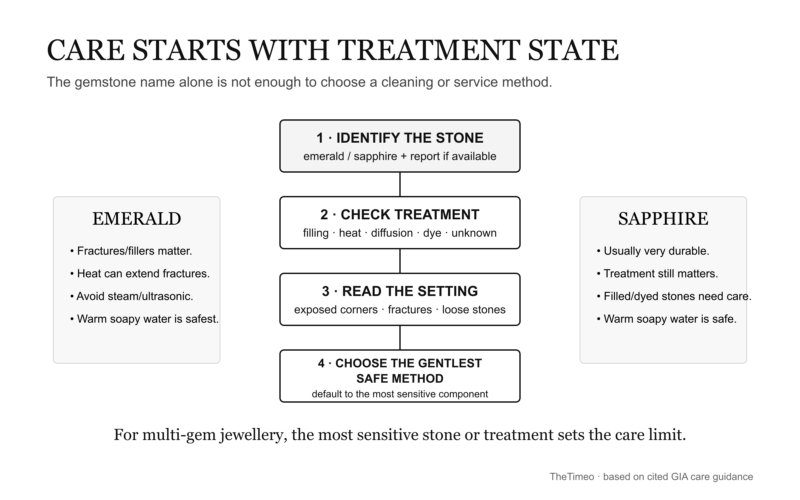
Cleaning begins with the stone’s treatment state and the most sensitive component.
A ring is a system.
If a sapphire centre stone is accompanied by fracture-filled emeralds, the sapphire’s tolerance does not set the cleaning rule. The emeralds do. If a jewel combines sapphire with pearls, enamel or another sensitive material, the whole piece should be cleaned according to the component with the narrowest safe range.
That sounds obvious, yet many care instructions are written as though the centre stone were the only material present.
The same logic applies to workshop heat. A routine metal operation may require a different approach when a treated or fractured coloured stone remains in the setting.
When in doubt, the jeweller should know the treatment history before work begins.
Emerald versus sapphire: a practical comparison
Explore the comparison
| Question | Emerald | Sapphire |
|---|---|---|
| Mineral | Beryl | Corundum |
| Mohs hardness | 7.5–8 | 9 |
| Toughness | Fair to good | Excellent, according to GIA |
| Common treatment issue | Surface-reaching fractures often filled with oils/resins/polymers | Heat treatment common; diffusion, fracture filling and dyeing also exist |
| Routine safe cleaning | Warm, soapy water and gentle scrubbing | Warm, soapy water |
| Ultrasonic / steam | Generally avoid because fractures/fillers may be affected | Usually safe for untreated, heat-treated and diffusion-treated stones; not for fracture-filled/cavity-filled/dyed stones |
| Lab report value | Identity, treatment, degree/type of filling where applicable, origin opinion when possible | Identity, detectable treatment, origin opinion when possible |
| Daily-wear implication | Requires more conservative handling and setting decisions | Generally more tolerant, but treatment and setting still matter |
The table explains material tendencies. It cannot certify the condition of a specific ring.
What to ask before buying an emerald engagement ring
- Is the emerald natural or laboratory-grown?
- Is clarity enhancement present, and to what degree?
- Is the filler type reported?
- Is there an independent laboratory report?
- Where are the significant fractures relative to the prongs or bezel?
- Has the jeweller assessed the stone specifically for the proposed setting?
- What cleaning method does the seller recommend in writing?
- What happens if the ring later needs resizing or stone work?
A provenance claim such as Colombian origin should be separated from a visual sales description and supported by laboratory evidence where origin materially affects the purchase decision.
What to ask before buying a sapphire engagement ring
- Is the sapphire natural or laboratory-grown?
- Is there evidence of heat treatment?
- Has diffusion, fracture filling, dyeing or another treatment been detected?
- Is geographic origin being claimed, and what supports it?
- Does the stone have exposed points or areas of damage?
- How does the setting protect the girdle and corners?
- What cleaning methods are safe for this specific treatment state?
- If the stone is diffusion treated, could future repolishing or recutting affect the colour?
Again, the point is not to demand “untreated” at any cost. It is to understand what you are buying and what future care it implies.
Colour can be emotional; ownership still needs evidence
There is no need to strip romance out of an engagement ring. A sapphire chosen for its blue or an emerald chosen for its green can carry enormous personal meaning.
But romance copy becomes unhelpful when it replaces information.
A sapphire is not automatically maintenance-free because it is hard. An emerald is not automatically unsuitable because it is more care-sensitive. A prestigious maison name does not remove the need to understand treatment. A laboratory report does not tell you whether the setting is well suited to your life.
The strongest buying decision joins four records:
stone identity → treatment history → setting architecture → ownership routine.
If those four are clear, the colour can be chosen for the reason it should be chosen: because you want to live with it.
Sources & further reading
Gemological claims are based primarily on GIA guidance for emerald and sapphire identification, treatment, care and coloured-stone reports. Current Tiffany & Co. and Cartier pages are used only as documented object/design examples and service context; maison statements are not treated as independent gemological conclusions.
Primary and authoritative sources
- GIA — Emerald Care and Cleaning Guide: https://www.gia.edu/emerald-care-cleaning
- GIA — Emerald Buyers Guide: https://www.gia.edu/emerald/buyers-guide
- GIA — GIA Enhances its Emerald Reports, 12 December 2024: https://www.gia.edu/gia-news-press/gia-enhances-emerald-reports
- GIA — Does GIA grade emerald?: https://www.gia.edu/FAQ/gia-faq-grade-emerald
- GIA — Sapphire Care and Cleaning Guide: https://www.gia.edu/UK-EN/sapphire-care-cleaning
- GIA — Sapphire Buyers Guide: https://www.gia.edu/sapphire/buyers-guide
- Cartier — Colored Stone Solitaires: https://www.cartier.com/en-us/engagement-rings-precious-colored-stones.html
- Tiffany & Co. Press — sapphire, emerald and diamond ring: https://press.tiffany.com/assets/ring-in-platinum-with-an-esteemed-sri-lankan-tiffany-co-sapphire-over-7-carats-emeralds-and-diamonds/
- Tiffany & Co. Press — The Tiffany Muzo Emerald: https://press.tiffany.com/assets/the-tiffany-muzo-emerald-of-over-10-carats/
Limit: No article can determine whether a particular emerald or sapphire is safe for a proposed setting without examination of the actual stone. Treatment, fracture position, girdle condition and prior damage are object-specific.
The Edit
Jewelry stories
Selected stories from the same editorial universe.

Chaumet Envol: A Tiara in Motion
Blue wings move from hair to face and cloth. Chaumet’s Envol invites a bridal

Messika My Twin: Two Cuts, One Bridal Look
An emerald cut, a pear and an unequal pair: the small asymmetry of Messika
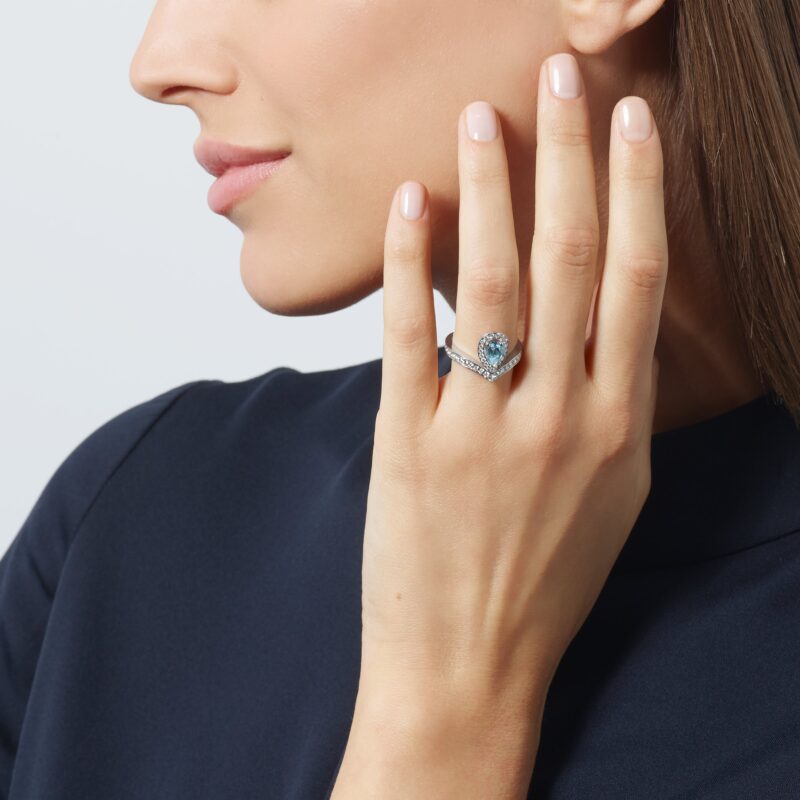
Chaumet Joséphine: Something Blue, Chosen Your Way
An aquamarine beside the face, a sapphire at the centre of a solitaire: Chaumet

Two Rings, Two People: A De Beers Wedding-Band Edit
A rose-gold court profile, a single diamond in platinum, a fine eternity line or
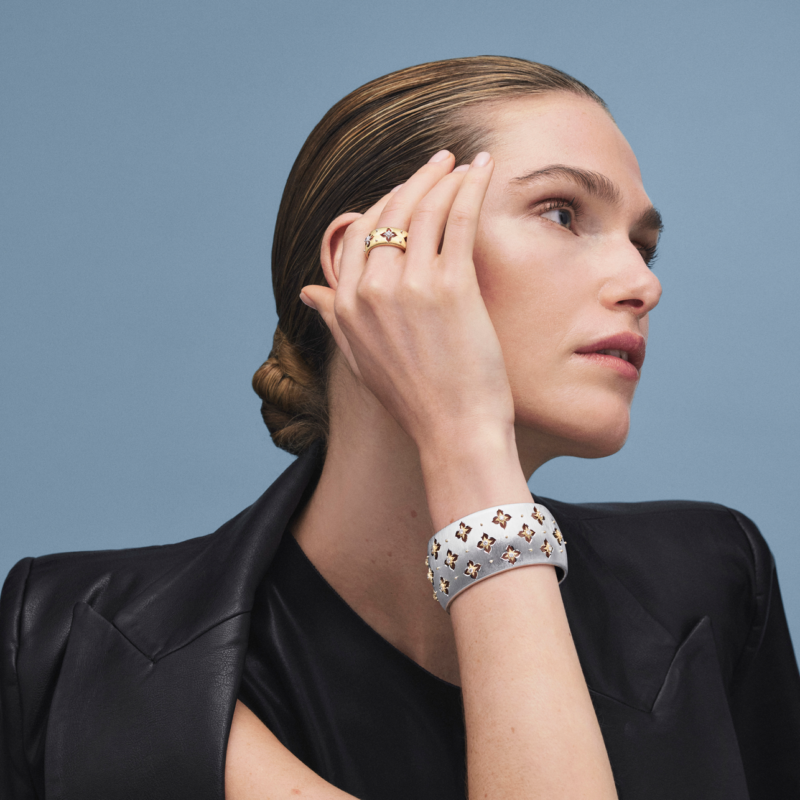
Buccellati Macri Giglio: Gold with a Grain
On the wrist, Buccellati Macri Giglio becomes a broad field of engraved gold. A

Mikimoto M: A Pearl with a Graphic Edge
White South Sea pearls, golden warmth and a sharply drawn setting: Mikimoto M offers