
TheTimeo / Jewelry
BEYOND THE 4Cs:
the ring you actually wear
The diamond report is only half the decision. Height, setting, shoulders, sizing and the future wedding band determine how an engagement ring lives on the hand.
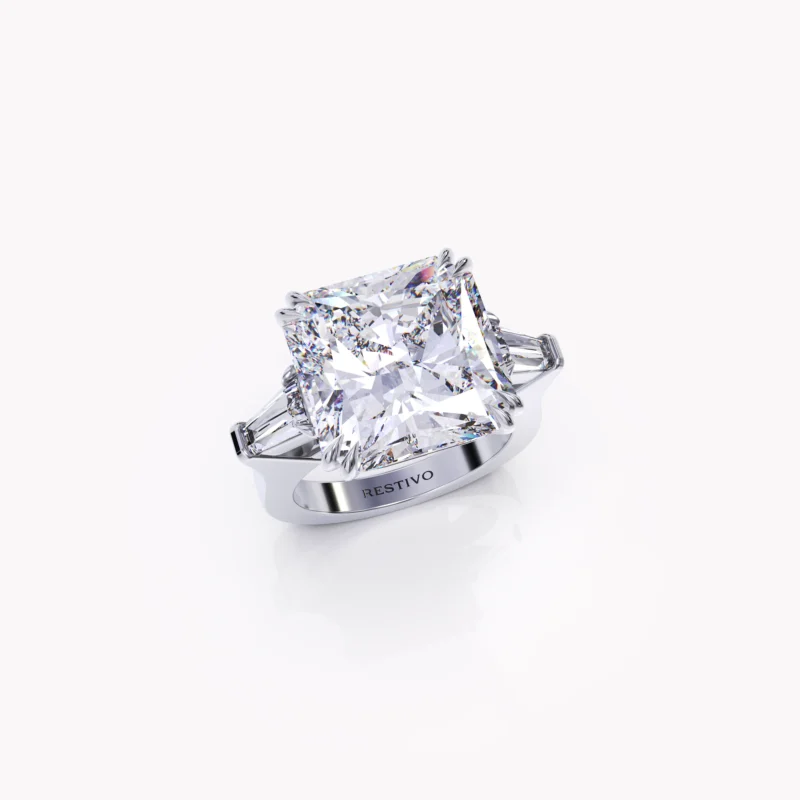
A radiant-cut centre stone gives the ring an architectural starting point. Courtesy of Restivo Diamonds.
Explore the story
A grading report can tell you that a round diamond weighs 1.00 carat. It can record its measurements, colour, clarity and cut grade. It cannot tell you whether the finished ring will sit low enough for a glove, whether its shoulders will force a wedding band away from the shank, or whether a future resize will run through a line of small diamonds.
Those are not secondary details. They are part of the object you will actually wear.
The 4Cs remain the right language for describing important qualities of a diamond. The problem begins when they are treated as a complete specification for an engagement ring. A ring adds another system around the stone: head, shoulders, shank, prongs or bezel, side stones, height, contact points, sizing area and the way another band may sit beside it.
So rather than asking which C matters most?, ask: how do the stone’s recorded characteristics and the ring’s physical architecture work together for the person who will wear it?
That shift changes what to inspect before purchase.
Key takeaways
- Carat is weight, not face-up size. For a diamond, measurements and proportions help explain how that weight is distributed.
- The setting is an engineering decision as well as a design decision. It determines how the stone is held, how exposed it is and how the ring behaves in daily wear.
- Profile height changes practical exposure. A higher head may show more of the stone but is also more likely to meet clothing, gloves, furniture and other objects.
- Fit cannot be reduced to one ring-size number. Shank width, interior shape, bridal-set width and the ring’s geometry affect how a finished ring fits.
- Future service belongs in the buying decision. Ask how prongs are checked, where the ring can be resized, what happens to pavé or channel-set stones, and whether the intended wedding band has been tested beside it.
Read the diamond in two dimensions before imagining it in three
Carat weight is often allowed to stand in for size because it is easy to compare. GIA’s definition is narrower: a metric carat is a unit of weight equal to 200 milligrams. It is not a measurement of diameter, length or visible area.
That distinction is practical, not semantic.
Two diamonds of the same shape and nominal carat weight can distribute their weight differently. GIA has long warned that a diamond cut too deeply may carry weight below the girdle that contributes little to its face-up appearance. Conversely, visible dimensions can sometimes be close even when weight differs.
For a round brilliant, the grading report therefore deserves to be read as a small geometry sheet rather than a line of four grades. Look at the millimetre measurements. Read the proportions diagram. Read the cut grade in the context of the complete report rather than pulling one percentage from an online chart.
GIA’s cut system for standard round brilliant diamonds considers visual factors such as brightness, fire and scintillation, but also design and craftsmanship factors including weight ratio, durability, polish and symmetry. That is a useful reminder that “spread” cannot be pursued in isolation. A shallow-looking stone is not automatically a clever way to obtain more visible diameter, just as a deeper stone is not automatically inferior. The complete cut assessment matters.
For fancy shapes, the logic becomes even more dependent on the actual outline and measurements. A carat is still a carat, but an oval, emerald cut, pear and cushion do not present that weight to the eye in the same way.
The collector habit to borrow here is simple: record the stone as an object, not a price bracket.
Before moving to the setting, keep:
- report number and laboratory;
- carat weight;
- shape and cutting style;
- length, width and depth measurements;
- colour and clarity grades;
- cut grade where the laboratory provides one for that report type;
- polish, symmetry and fluorescence where reported;
- inscription details where present.
None of those fields tells you whether you will enjoy wearing the finished ring. They establish what stone the ring is being built around.
The setting is the other half of the specification
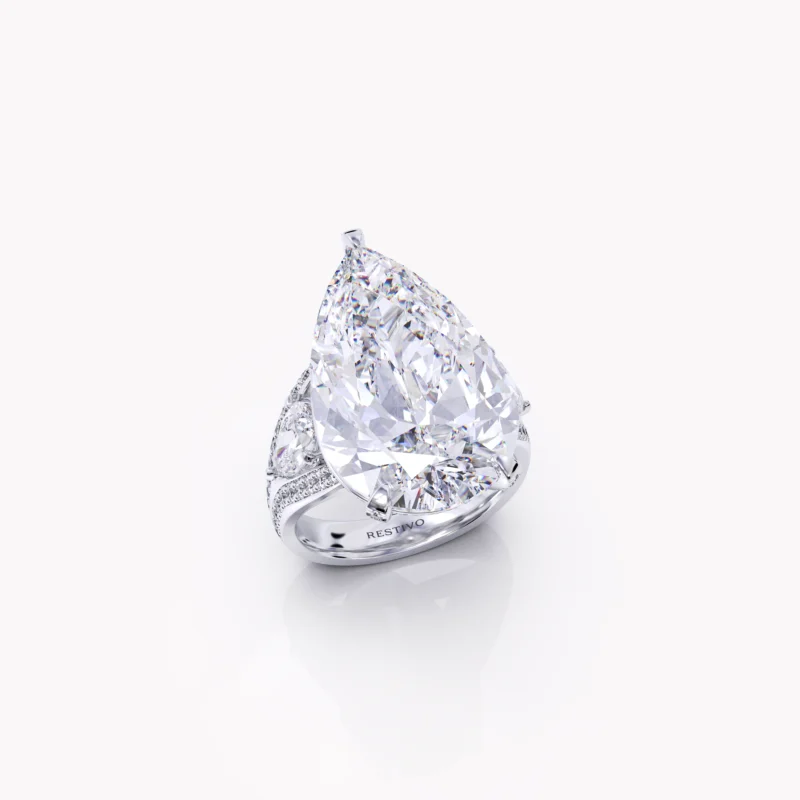
The centre diamond and its shoulders are read together, not selected in isolation. Courtesy of Restivo Diamonds.
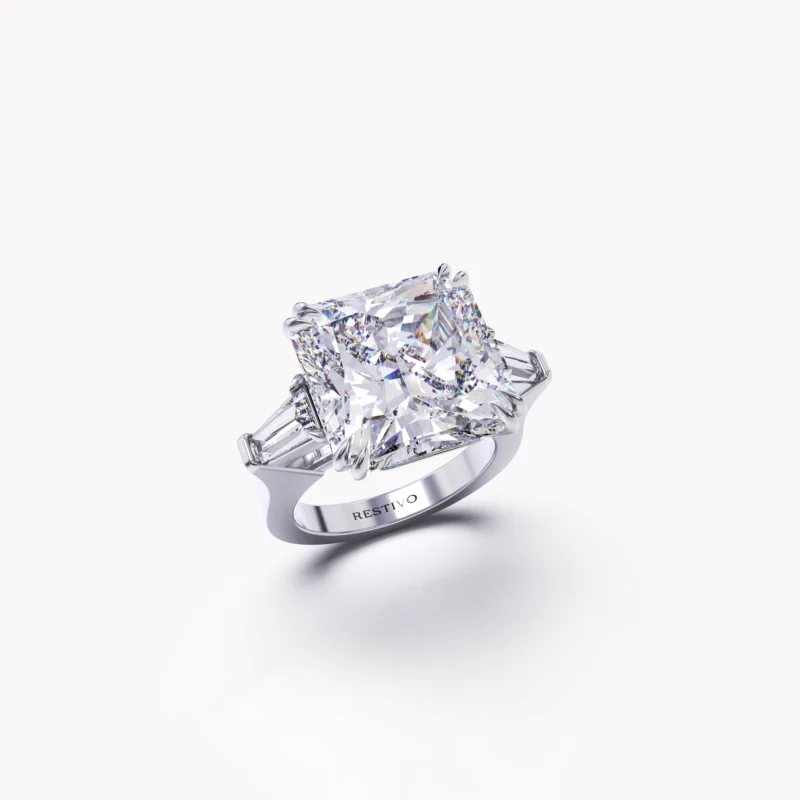
A higher-resolution view makes the relationship between prongs, shoulders and stone more legible. Courtesy of Restivo Diamonds.
GIA’s current guide to engagement-ring settings describes a typical ring through three main components: the head, which holds the centre stone; the shoulders, which rise or transition toward the head; and the shank, which wraps around the finger.
That vocabulary is more useful than a style name alone.
“Solitaire” tells you that one centre stone dominates the design. It does not tell you whether the stone sits in a low basket, a tall cathedral, a six-prong head, a full bezel or a tension-like architecture. Two solitaires can behave very differently in daily use.
When comparing rings, read the side view before the glamour photograph.
From the side, you can see:
- how far the stone sits above the finger;
- how much of the pavilion is exposed;
- where the head joins the shoulders;
- whether the setting creates a straight path for a wedding band;
- whether the shank narrows significantly near the head;
- whether small stones continue around the lower shank;
- how much metal protects vulnerable stone edges or points.
This is where a high-profile ring stops being an abstract style choice. GIA notes that higher settings can make more of a diamond visible but may be more likely to snag, while lower profiles are less likely to catch on clothing or other objects. A bezel, by surrounding the stone’s edge, offers a smoother and more protective profile than an open prong setting, although it also changes how much of the stone’s side remains visible.
That does not make a bezel “better”. It identifies a trade-off.
Prongs are small components with a large job
A prong setting is visually light because relatively little metal covers the stone. The same openness that makes it attractive also leaves more of the diamond exposed.
GIA’s 2026 setting guide notes that prongs should be checked periodically because they can loosen or wear. Its bench-quality material goes further: prong geometry, contact with the stone and the integrity of the setting are treated as workmanship issues because a displaced or damaged prong can allow a stone to loosen.
For the buyer, that translates into questions that are more useful than “four prongs or six?”
Ask the jeweller:
- How is the centre stone supported below the girdle?
- Are the prongs individually serviceable?
- What signs of wear should prompt an inspection?
- Does the maker recommend a regular inspection interval?
- If a prong needs rebuilding, can the work be done without disturbing adjacent stones or decorative finishes?
The answers will vary by construction and maker. What matters is that there is an answer.
A delicate claw can be entirely appropriate for a wearer who removes the ring for manual work and accepts periodic inspection. A lower, more enclosed setting may make more sense for someone whose daily routine puts the ring into frequent contact with gloves, equipment or hard surfaces.
GIA’s Quality Assurance Benchmarks make this lifestyle link explicit. They recommend understanding when and how the jewellery will be worn, and note that people working with tools, equipment or machinery, or taking part in impact sports, run a significant risk of damaging jewellery. For higher-activity use, the guidance points toward lower-profile and more protective setting approaches, while also advising that jewellery should be removed for vigorous activity.
This is not a judgement about occupation or taste. It is a test of whether the object suits its intended use.
“Every day” should be translated into actual actions
Daily wear is too vague to design around.
One person types at a desk and removes jewellery for exercise. Another works in clinical gloves. Another handles textiles, children, garden tools or camera equipment. Someone may sleep in a ring; someone else places it in the same box every evening.
Write down the recurring actions that matter.
For example:
Explore the comparison
| Daily situation | What to inspect in the ring |
|---|---|
| Frequent gloves | Overall profile, projecting prongs, sharp transitions |
| Hands-on work | Exposure of stone edges, setting protection, whether ring should be removed |
| Layering with a wedding band | Clearance below head, shoulder geometry, contact between rings |
| Frequent hand washing | Crevices that retain residue, access for cleaning, maker care guidance |
| Weight training / impact activity | Plan to remove the ring; do not treat a “strong setting” as permission for impact |
| Work with fabrics | Prong finish, raised galleries and details that can catch threads |
| Future size changes expected | Plain sizing area, stone-set shank, alloy and construction constraints |
The purpose is not to engineer risk out of jewellery. That is impossible. It is to avoid discovering after purchase that the design fights the wearer’s routine.
Height changes more than appearance
High and low settings are often discussed as visual preferences. They also change the ring’s spatial relationship with everything around it.
A higher head can create clearance for a straight wedding band. It can expose more of the centre stone. It can also put the stone and prongs farther from the finger and closer to door frames, pockets, coat linings and gloves.
A lower head can reduce that exposure. But it may leave less room for another band to sit beneath or beside the setting. Depending on the shoulders and basket, the wearer may need a shaped, contoured or deliberately separated wedding band.
This is why the side profile should be tested with the intended band rather than judged from product photography.
If the engagement ring and wedding band will be worn together, place both on the same finger before committing where possible. Look at them from the side and underside. Check where metal touches metal. Check whether one ring pushes the other off-axis. Check whether small stones, exposed girdles or prongs on one ring rub against the other.
The later Bridal guide on non-flush wedding bands will treat that geometry in depth. At the buying stage, the essential rule is simpler: do not assume “flush” from a front photograph.
Resizing is part of the architecture, not an afterthought
A ring size is not a universal physical dimension detached from design.
GIA’s finger- and ring-sizing benchmarks distinguish narrow rings, wide bands, tapered rings, convex interiors, bridal sets and rings with open space above the finger. Bridal sets worn together may require different consideration from a single narrow solitaire because the total width on the finger changes the fit.
The practical consequence is that a ring that is comfortable as a loose sample may fit differently once paired with a wedding band.
Construction matters again when the size needs to change.
A plain section of shank usually gives a bench jeweller more options than an eternity design with stones around the full circumference. Pavé, channel settings, complex alloys, engraved areas and structural elements near the sizing zone can make an alteration more involved. GIA’s consumer guidance specifically notes that pavé, channel-set and eternity-style rings may be difficult to resize.
Before purchase, ask:
- Where is the intended sizing zone?
- What size range does the maker consider practical for this exact construction?
- Would resizing disturb stones, engraving, hallmarks or structural details?
- If the ring is bespoke, will the maker record the original and finished sizes?
Do not accept a generic “it can always be resized” for a design that clearly gives the bench worker nowhere simple to work.
Small diamonds in the shank change the service question
Pavé and bead-set shanks can make the centre stone feel visually integrated with the ring. They also add dozens of small metal-to-stone relationships that may require inspection over time.
GIA’s bench guidance for diamonds set in platinum shanks treats maintenance and alteration as part of good engineering. That is the right frame for a buyer too.
Ask whether the ring’s small stones continue halfway, three-quarters or completely around the shank. Find the plain metal, if any. Look at the underside where wear occurs. Ask how a missing melee stone would be matched and set. Ask whether refinishing, resizing or rebuilding the lower shank could affect the stone setting.
These questions are not an argument against pavé. They are an argument for knowing what you own.
A simple solitaire and a fully stone-set shank can carry the same centre diamond report while having very different future service paths.
The report cannot judge comfort
Gemological documentation is powerful precisely because its scope is defined.
A GIA diamond grading report records characteristics of the loose diamond examined by the laboratory. It does not appraise monetary value, and it does not certify the comfort, structural quality or suitability of the ring in which that diamond is later mounted.
GIA also offers jewellery reports for certain mounted pieces, but even those describe and analyse the item within the limits of what a mounting permits. They are not a substitute for trying the ring on, inspecting the setting or understanding the maker’s service policy.
This is where good buying becomes deliberately low-tech.
Put the ring on.
Close your hand. Open it. Put on a coat. Slide the hand into a pocket. If gloves are part of your work, test the relevant type where appropriate. Rest the hand on a table. Wear the engagement ring beside the intended band. Notice rotation, pressure, sharpness and height.
The objective is not to simulate years of wear in a showroom. It is to discover obvious conflicts while they can still be solved.
A practical pre-purchase file
An engagement ring deserves a small technical record from the beginning.
Keep the diamond report, but add the ring-level information that the report cannot supply.
Stone record
- laboratory and report number;
- stone measurements and report details;
- inscription, if present and verified;
- purchase description matching the stone actually supplied.
Ring record
- metal and fineness as represented by the seller;
- ring size at delivery;
- centre setting type;
- number and type of centre-stone securing points;
- presence and extent of side-stone setting;
- maker/model/reference where applicable;
- hallmarks, maker’s marks and serials where present;
- photographs from front, side, underside and marks.
Use and service record
- maker care instructions;
- recommended inspection route;
- resize limitations stated at purchase;
- wedding-band pairing tested or planned;
- any later repair, resize, replacement or refinishing.
The two-layer engagement-ring test
Before deciding, read the ring in two layers.
Layer 1 — the diamond
What does the laboratory report establish about the stone’s identity and quality characteristics? How is its carat weight distributed into real measurements and proportions? Are you comparing stones on like-for-like documentation?
Layer 2 — the ring
How is the stone held? How high does the object sit? What will touch clothing, tools or another ring? Where can the shank be altered? Which elements require periodic inspection? Does the fit remain correct when the bridal set is worn together?
Sources & further reading
This guide uses GIA laboratory and Quality Assurance material as the primary technical source for diamond reporting, setting terminology, lifestyle considerations, prong construction, ring sizing and service constraints. GIA’s scope statements are also used to separate a laboratory report from appraisal or wearability judgements.
Primary and authoritative sources checked:
- GIA, GIA Guide to Engagement Ring Settings, 14 August 2026: https://4cs.gia.edu/en-us/blog/guide-to-ring-settings/
- GIA, Diamond Carat Weight: https://4cs.gia.edu/en-us/diamond-carat-weight/
- GIA, Understanding Carat Weight: GIA Diamond Grading Reports: https://4cs.gia.edu/en-us/blog/gia-diamond-grading-reports-understanding-carat-weight/
- GIA, Recommending Platinum Rings Based on Customer Lifestyle: https://www.gia.edu/quality-assurance-benchmark/recommend-platinum-ring-lifestyle
- GIA, Accurate Determination of Finger and Ring Sizes: https://www.gia.edu/quality-assurance-benchmark/accurate-determination-finger-ring-size
- GIA, Features of Platinum Prong Settings: https://www.gia.edu/quality-assurance-benchmark/features-of-platinum-prong-settings
- GIA, Bead-setting Diamonds in a Platinum Ring Shank: https://www.gia.edu/quality-assurance-benchmark/bead-setting-diamonds-in-a-platinum-ring-shank
- GIA, How to Select a Round Diamond Engagement Ring: https://4cs.gia.edu/en-us/blog/how-to-select-round-diamond-engagement-ring/
- GIA, How to Make Your Diamond Engagement Ring Look Bigger: https://4cs.gia.edu/en-us/blog/engagement-ring-settings-that-make-your-diamond-look-bigger/
- GIA, Does GIA certify or appraise diamonds and other gemstones?: https://www.gia.edu/FAQ/gia-faq-analysis-grading-certify-appraise-diamond-gemstone
- GIA, Jewelry Reports & Services: https://www.gia.edu/gem-lab-service/jewelry
This article does not prescribe a universal “best” setting, ring height, proportion set or inspection interval. Those decisions depend on the actual stone, construction, wearer and maker. Bench work, resizing and stone-security questions should be assessed by a qualified jeweller familiar with the piece.
The Edit
Jewelry stories
Selected stories from the same editorial universe.

Chaumet Envol: A Tiara in Motion
Blue wings move from hair to face and cloth. Chaumet’s Envol invites a bridal

Messika My Twin: Two Cuts, One Bridal Look
An emerald cut, a pear and an unequal pair: the small asymmetry of Messika
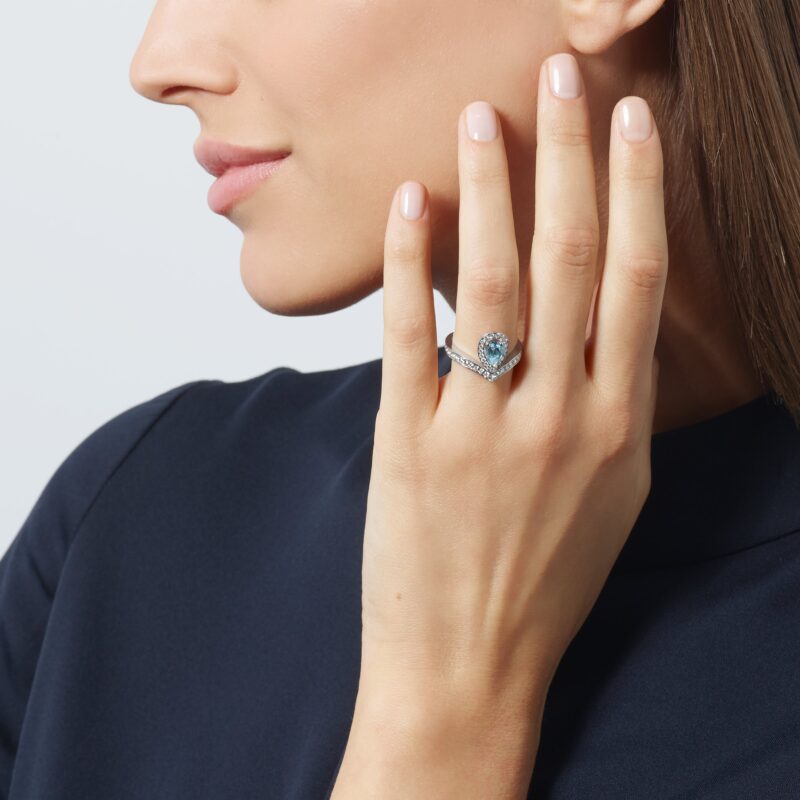
Chaumet Joséphine: Something Blue, Chosen Your Way
An aquamarine beside the face, a sapphire at the centre of a solitaire: Chaumet

Two Rings, Two People: A De Beers Wedding-Band Edit
A rose-gold court profile, a single diamond in platinum, a fine eternity line or
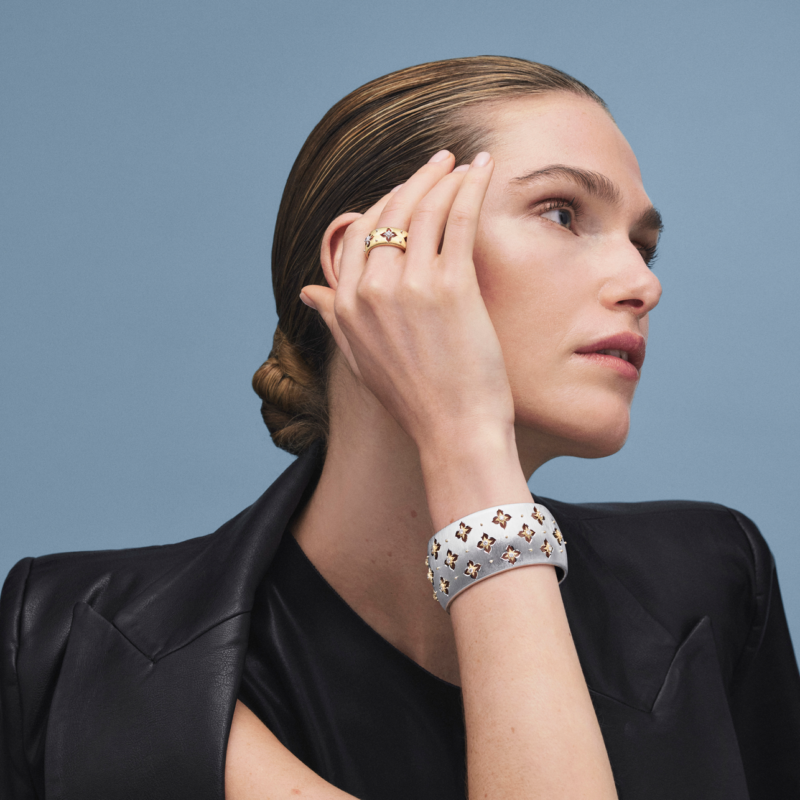
Buccellati Macri Giglio: Gold with a Grain
On the wrist, Buccellati Macri Giglio becomes a broad field of engraved gold. A

Mikimoto M: A Pearl with a Graphic Edge
White South Sea pearls, golden warmth and a sharply drawn setting: Mikimoto M offers