
TheTimeo / Jewelry
THE SPACE BETWEEN:
designing a ring pair
A visible gap is not automatically a design failure. Profile, basket, shoulders and movement determine whether two rings truly belong together.
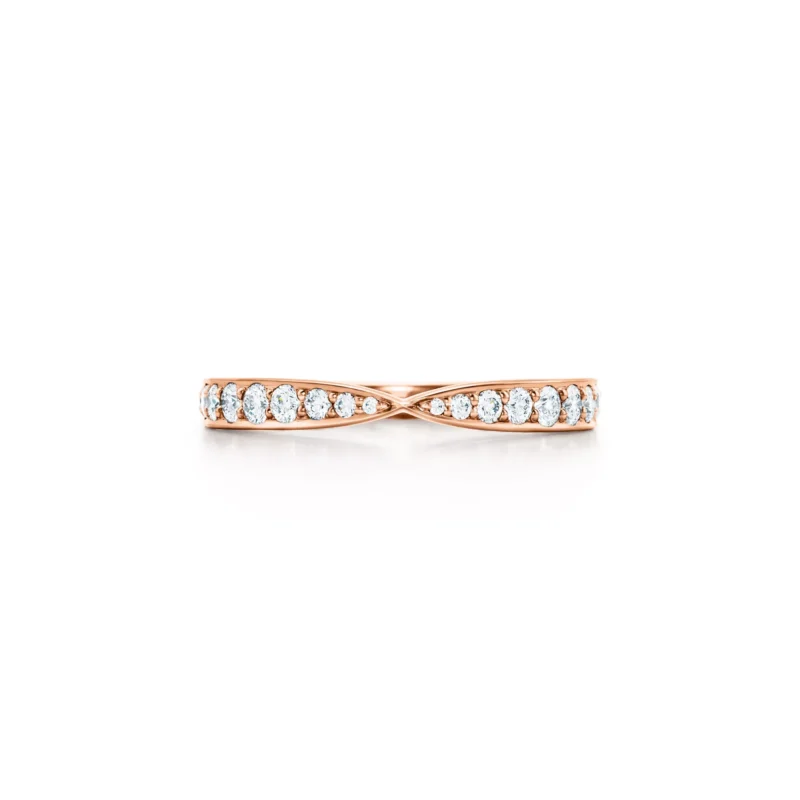
The tapered Tiffany Harmony band is shaped to approach an engagement ring closely Courtesy of Tiffany & Co..
Explore the story
Category: Bridal Format: BRIDAL_DECISION_GUIDE Series: TheTimeo Bridal — Permanent Decision Library
A wedding band can sit perfectly against an engagement ring and still be the wrong companion for it.
The reverse is also true. Two rings can leave a visible gap and function beautifully together.
That distinction matters because “flush fit” is often treated as a default sign of good design. It is not. Flushness is only one geometric outcome. The more useful question is whether the two rings can coexist without unwanted contact, instability, discomfort or the loss of the design character that made either ring worth choosing.
The explanation is usually found in profile rather than from above.
A centre stone needs a structure beneath it. A halo may need a gallery. A basket may extend beyond the line of the shank. Cathedral shoulders may rise toward the head. A low-set bezel may occupy the exact space where a straight wedding band would otherwise pass. Once those decisions are made, the neighbouring band has to negotiate them.
Sometimes that produces a flush stack. Sometimes it produces a deliberate gap. Sometimes the right answer is a contoured or notched band. And sometimes the most coherent choice is to let the two rings remain visibly separate.
Key takeaways
- A wedding band sits flush only when the engagement ring leaves enough uninterrupted space at finger level for the band to approach.
- The head, gallery, basket, shoulders and shank matter as much as the centre stone when assessing a future stack.
- A curved, notched or tapered wedding band is not automatically a compromise; it can be the correct response to the engagement ring’s architecture.
- Forcing two rings into contact can create wear, scratching or pressure at exposed settings. GIA notes that stacking can increase scratching and wear between rings.
- The best pairing should be assessed in profile, on the hand, and as a moving system rather than as two isolated product images.
Flush is geometry, not quality
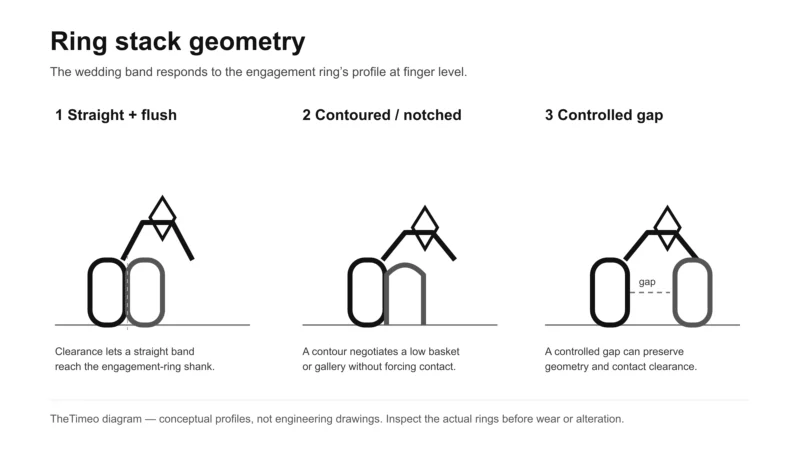
The profile—not the top view—reveals why a band sits flush, leaves a gap or needs a contour. Courtesy of TheTimeo.
Put two simple bands next to each other and they can usually meet along a clean line. Introduce a raised centre stone and the problem changes.
GIA describes the principal parts of a ring setting as the head, shoulders and shank. The head secures the centre stone; the shoulders transition from the shank toward that head. Those parts create the profile a wedding band has to fit beside.
If the head begins above the top line of the shank and leaves an open channel beneath it, a straight band may be able to slide close to the engagement ring. If the basket drops lower, flares outward or meets the finger line, the same straight band stops earlier.
That is the basic reason some rings stack flush and others do not.
It is not an abstract problem. Tiffany’s current bridal catalogue makes the geometry visible. The house describes the Tiffany Harmony® band as gently tapered and proportioned to nest with its corresponding engagement ring. It also offers a Tiffany® Setting nesting narrow band designed explicitly around the profile of the engagement ring. Cartier maintains a dedicated matching-bands environment in which engagement designs and wedding bands are presented as compatible families rather than as interchangeable circles of metal.
The important word is designed.
A flush fit is easiest when the relationship between the two rings was considered in advance.
The parts that create the gap
The basket
The basket is the structural framework below and around the centre stone. On some rings it sits high and narrow. On others it descends toward the finger and occupies lateral space.
A low or broad basket can prevent a straight band from reaching the shank. The resulting gap may be only a millimetre or two, but the band is responding to a real structure, not to poor sizing.
The gallery
The gallery is the area beneath the centre stone and between the upper setting and the shank. Decorative galleries, hidden halos and supporting crossbars can all change the space available beside the ring.
A wedding band that appears compatible in a top-down photograph may touch the gallery once both rings are on the finger.
The shoulders
Cathedral shoulders rise toward the centre stone. Split shoulders divide before reaching the head. Pavé shoulders may carry diamonds into the transition area.
Those decisions affect both visual width and physical clearance. A band that is too thick, too high or too rigidly straight may meet the shoulder before it reaches the shank.
The centre-stone shape
The stone itself may also change the equation, especially when the setting protects points or corners with extra metal.
GIA’s guidance on setting design emphasises that vulnerable corners and points need adequate protection. A pear, marquise or princess-cut stone may therefore require prongs, V-prongs or bezel structures that influence the profile of the ring.
The goal of a wedding band should not be to crowd those protective elements simply to erase a visible gap.
Three broad ways rings can meet
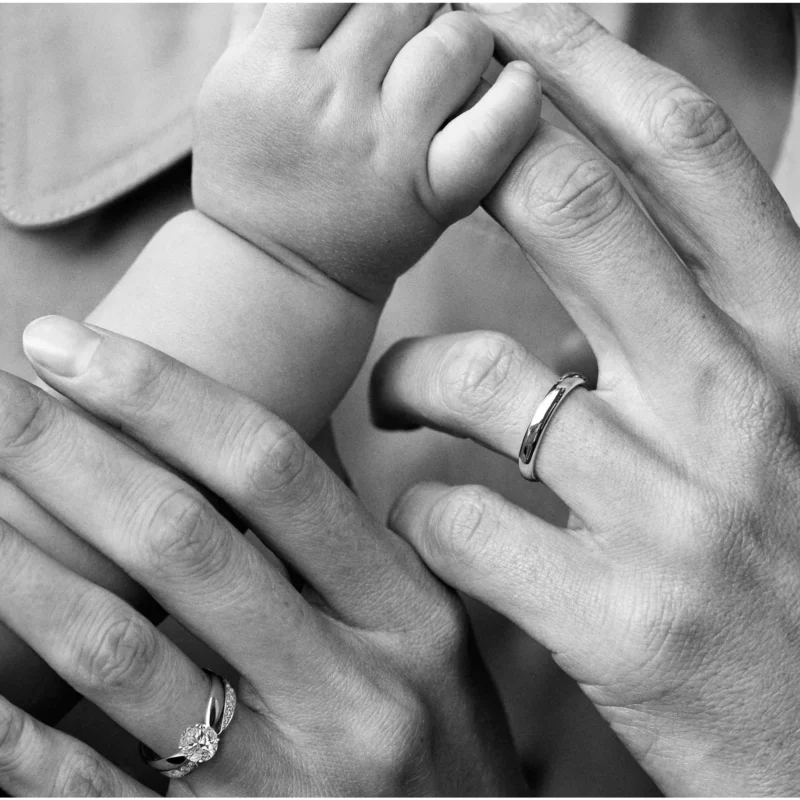
A worn view reveals how profile, centre taper and stone height meet on the hand Courtesy of Tiffany & Co..
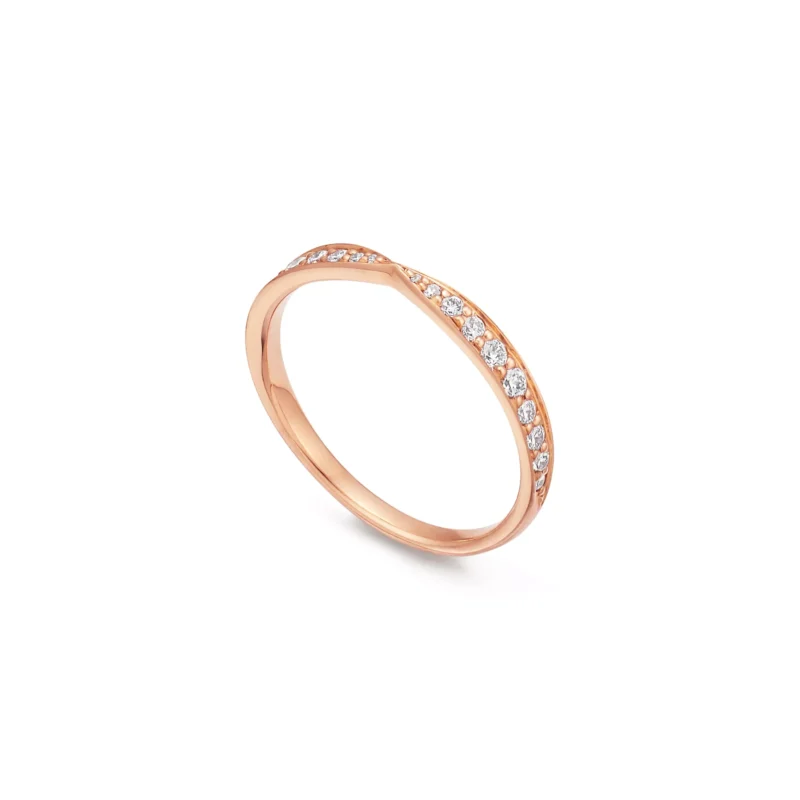
The side view is where clearance, setting height and potential contact become visible Courtesy of Tiffany & Co..
Most engagement-ring and wedding-band pairings fall into one of three geometric relationships.
1. Straight and flush
The engagement ring leaves sufficient clearance at finger level for a straight band to sit directly beside it.
This is visually simple and easy to understand. It can also make future band changes easier because the wedding ring is not dependent on a highly specific contour.
But flush does not mean friction-free. The contact line still needs to be examined, particularly if either ring carries exposed pavé, shared prongs or delicate edges.
2. Contoured or notched
The wedding band bends around, tapers toward or contains a notch for the engagement ring.
This can make the pair read as a single designed composition. Tiffany’s nesting bands are a clear contemporary example of this logic: the band is shaped to accommodate the engagement ring rather than asking the engagement ring to change.
The trade-off is dependence. A deeply contoured band may look incomplete when worn alone, and future changes to the engagement ring can disrupt the fit.
3. Deliberately separated
The rings do not meet along their full edge and a visible gap remains.
That can be the correct design when preserving the original engagement-ring profile matters more than creating a unified silhouette.
A gap may also reduce unwanted contact between a wedding band and vulnerable setting components. It can allow both rings to remain visually legible as separate objects.
The gap becomes a design problem only when it produces instability, catching, uncomfortable movement or repeated impact between the rings.
Why forcing a flush stack can be a mistake
The common response to a visible gap is to search for a thinner band, a more aggressively contoured band, or an alteration to the engagement ring.
That sequence starts with appearance and works backward.
A better sequence starts with contact.
GIA’s ring-stacking guidance notes that stacking can increase the risk of scratches and wear. Different metals, different profiles and exposed settings can behave differently when repeatedly rubbed together. GIA also recommends ongoing inspection of prong and pavé settings because those structures can require maintenance over time.
Two rings worn together are not static. They rotate. They tilt as the finger bends. They move when the hand grips a handle or reaches into a bag. The contact point seen on a jeweller’s tray is not necessarily the only contact point created during a day of wear.
That is why a tight visual fit can occasionally be worse than a small controlled gap.
If a diamond-set wedding band sits directly against the prongs of the engagement ring, the diamonds or shared-setting edges may abrade the neighbouring metal. If a hard edge catches under a basket, the two rings may repeatedly lever against one another. If the stack becomes too wide, the combined fit on the finger can also tighten.
GIA specifically notes that multiple stacked rings may change how tight the overall fit feels.
Flushness is therefore not a sufficient test.
Width changes fit as well as appearance
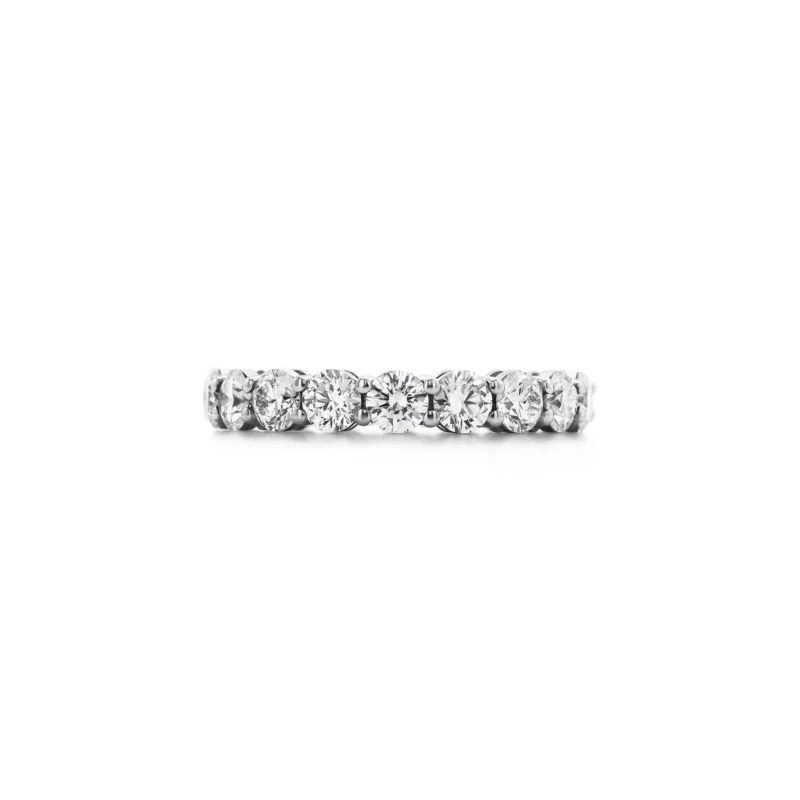
A full-circle diamond band creates an independent line of light beside a solitaire Courtesy of Tiffany & Co..
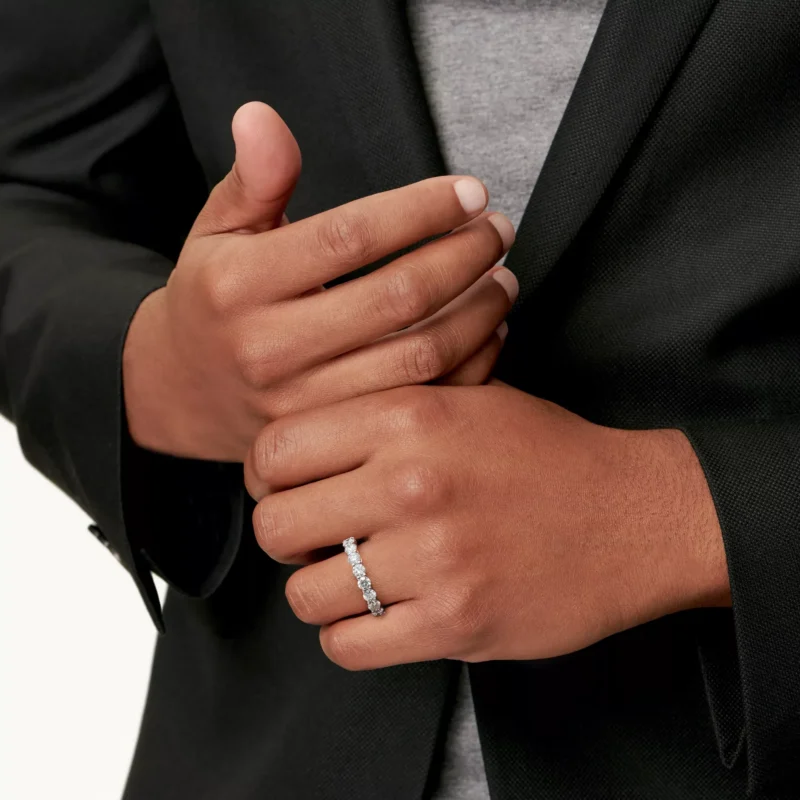
Scale on the hand matters as much as the ring seen alone Courtesy of Tiffany & Co..
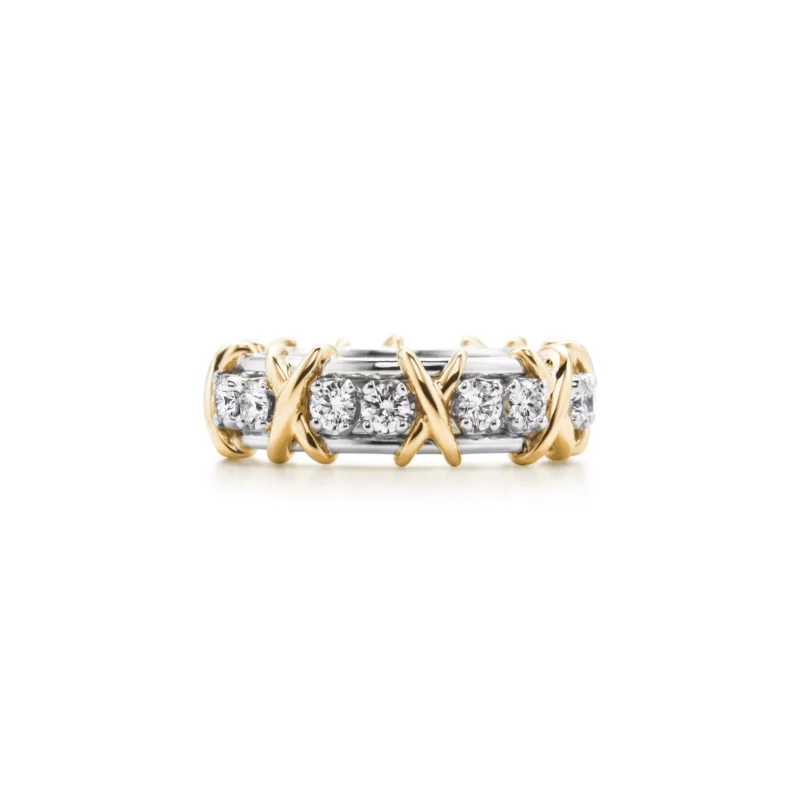
An alternating diamond-and-gold rhythm offers a stronger independent-band proposition Courtesy of Tiffany & Co..
Band width is usually discussed as a styling decision. It is also a fit decision.
Cartier’s current ring-sizing guidance notes that wider rings can require a larger size than narrower rings. That becomes relevant when an engagement ring and wedding band are worn together, because the combined width changes how much of the finger is enclosed by metal.
A narrow engagement-ring shank that feels correct on its own may feel tighter once a substantial wedding band is added.
This is one reason the pairing should be tried on as a pair, not sized independently from a chart and assumed to work together.
The same principle applies to future additions. An anniversary band placed on the other side of the engagement ring can change the way the entire stack sits.
Ring size is only part of the question. The better test is: “How does this complete stack fit this finger through a normal day?”
A straight band is not always the most versatile band
It is tempting to assume that a straight wedding band is the neutral option and a contour band is the specialised one.
Sometimes the opposite is true.
A straight band may only work if the engagement ring has been set high enough to create clearance. Raising the centre stone to achieve that clearance can affect snagging, balance and the way the ring feels in daily use.
GIA’s setting guide treats wearability and daily-use durability as design considerations, not afterthoughts. A lower setting may be preferable for an owner who values a compact profile, even if that choice means the wedding band cannot sit flush.
In that case, the contour band is not compensating for a defect. It is preserving a deliberate engagement-ring decision.
When a gap is useful
A visible space between the rings can provide several practical advantages.
It can preserve a low-set centre stone without lifting the head.
It can keep a diamond-set band away from exposed prongs or a delicate gallery.
It can allow two rings from different periods, makers or families to remain visually distinct.
It can make room for a shaped heirloom band that was never designed as part of the engagement ring’s original system.
And it can make future alteration less necessary.
None of these arguments means that a gap is inherently better. The point is narrower: the absence of a flush fit is not evidence that the pairing has failed.
How to assess a wedding band properly
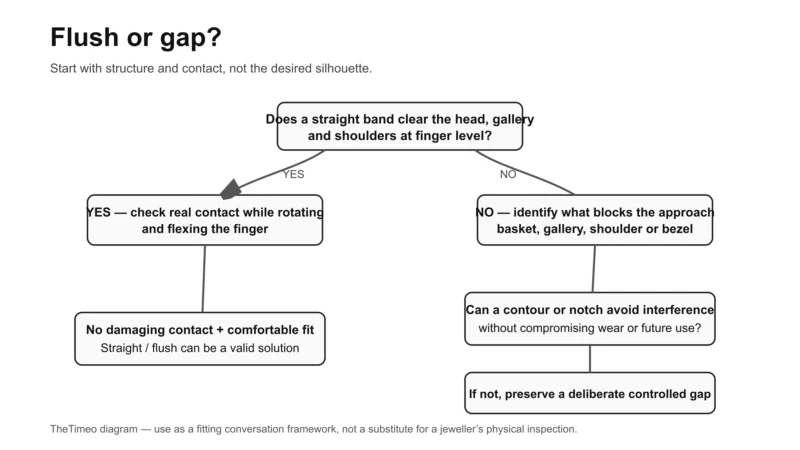
The right pairing balances clearance, contact, comfort and the character of both rings. Courtesy of TheTimeo.
The useful fitting appointment should include more than a top-down mirror check.
Look from the side
Check where the band stops and what causes it to stop. Is it touching the basket, a halo, a prong, the shoulder or simply the shank?
Rotate both rings
A pair that behaves well at twelve o’clock may contact differently after the rings rotate.
Flex the finger
Bend the hand, make a loose fist and hold an everyday object. The stack should remain comfortable and stable.
Check the contact surfaces
Ask the jeweller where metal touches metal and where stone-setting edges may touch metal. A white gap seen from above may be less important than a hidden contact point underneath.
Try the wedding band alone
If wearing the wedding band without the engagement ring matters to you, assess whether a contour or notch still looks and feels intentional on its own.
Consider the next ring now
If an anniversary band or heirloom ring is likely to join the stack later, leave room for that possibility rather than engineering the first two rings into a composition that has no flexibility.
A practical geometry matrix
Explore the comparison
| Engagement-ring profile | Straight band likely to sit flush? | Alternative to test | Main issue to inspect |
|---|---|---|---|
| High solitaire with open clearance under head | Often | Straight or lightly tapered band | Prong/band contact during rotation |
| Low basket solitaire | Often not | Contoured or notched band | Basket clearance |
| Halo with low gallery | Often not | Contour, V-band or deliberate gap | Halo/gallery contact |
| Cathedral shoulders | Depends on shoulder height and band profile | Tapered or curved band | Shoulder interference |
| Wide bezel | Often limited | Shaped band or separate wear | Edge contact and overall width |
| Pavé shank with exposed side setting | Geometry may allow flush fit, but contact needs review | Spacer or controlled gap | Abrasion between settings |
This matrix is a starting point, not a prescription. Actual compatibility depends on the specific ring dimensions and construction.
The pair should be designed as a moving system
The best wedding-band choice may be the one that almost disappears beside the engagement ring. It may also be the one that refuses to disappear.
A straight platinum band can frame a solitaire without touching it. A diamond band can add a second texture. A curved ring can complete the negative space around a low-set centre. An heirloom band can sit slightly apart and still belong to the same hand.
The test is not whether the pair produces an uninterrupted outline in a product photograph.
The test is whether the rings respect each other’s structure and remain comfortable, secure and coherent in use.
Flush is one solution.
It is not the standard by which every wedding stack should be judged.
Sources & further reading
This article treats engagement-ring and wedding-band pairing as a geometry and wear problem rather than as a style-ranking exercise. Technical setting terminology and wear guidance are anchored to GIA. Tiffany & Co. and Cartier are used as primary maison examples of intentionally matched, nesting and stackable bridal designs. No photographed ring is used to infer technical details beyond what the manufacturer states or what is visibly apparent at a general design level.
Primary and authoritative sources
- GIA 4Cs — Complete Guide to Engagement Ring Settings: Types vs. Styles (14 August 2026): https://4cs.gia.edu/en-us/blog/guide-to-ring-settings/
- GIA 4Cs — How to Wear Your Engagement Ring and Wedding Band: https://4cs.gia.edu/en-us/blog/how-to-wear-engagement-ring-wedding-band/
- GIA 4Cs — Ring Stacking Guide: How to Style and Stack Your Rings: https://4cs.gia.edu/en-us/blog/guide-on-how-to-stack-rings/
- GIA — How to Protect Your Diamond from Chipping: https://www.gia.edu/gia-news-research/how-protect-diamond-chipping
- Tiffany & Co. — Women’s Diamond Wedding Bands: https://www.tiffany.com/engagement/womens-wedding-bands/diamond/
- Tiffany & Co. — How to Choose a Wedding Band for Your Engagement Ring: https://www.tiffany.com/world-of-tiffany/style-guides/how-to-choose-wedding-band-for-your-engagement-ring.html
- Tiffany & Co. Press — The Tiffany® Setting nesting narrow band ring in platinum: https://press.tiffany.com/assets/the-tiffany-setting-nesting-narrow-band-ring-in-platinum-3-mm-wide/
- Cartier — Wedding Bands: https://www.cartier.com/en-us/jewelry/wedding-bands/
- Cartier Diamonds — Matching Bands: https://diamonds.cartier.com/en-us/matching-bands
- Cartier — Ring Size Guide: https://www.cartier.com/en-qa/services/jewellery/size-guide/rings/
Limit: This guide does not determine whether two specific rings can safely be worn together. A qualified jeweller should inspect the real contact points, setting condition and fit of the complete stack.
The Edit
Jewelry stories
Selected stories from the same editorial universe.
Reset, Resize or Restore? A Better Future for an Heirloom Ring
An inherited ring can become wearable again without making its earlier life illegible. The
Beyond the 4Cs: Choosing an Engagement Ring for Everyday Life
The diamond report is only half the decision. Height, setting, shoulders, sizing and the
Restivo Diamonds: The Engagement Ring Beyond the Configurator
An engagement ring is more than a list of filters. Restivo Diamonds begins with
Chopard Miracles 2026: How 79 High Jewellery Pieces Avoid Becoming One Idea
Chopard’s Red Carpet Collection becomes most compelling when the festival theme recedes and each

One Butterfly, Twelve Constructions: How Graff Turns a Motif into High Jewellery
Graff holds one butterfly silhouette still, then changes colour, volume, surface and movement across
The Signed Vintage Engagement Ring: A Collector’s Guide to Provenance and Fit
A signature narrows the field, but maker evidence, stone reports, alterations, condition, provenance and