
TheTimeo / Jewelry
ONE SHAPE,
five material lives
Rain, Flower, Light, Tattoo and Checkers repeat one high-jewellery silhouette while changing material, technique, engineering and surface.
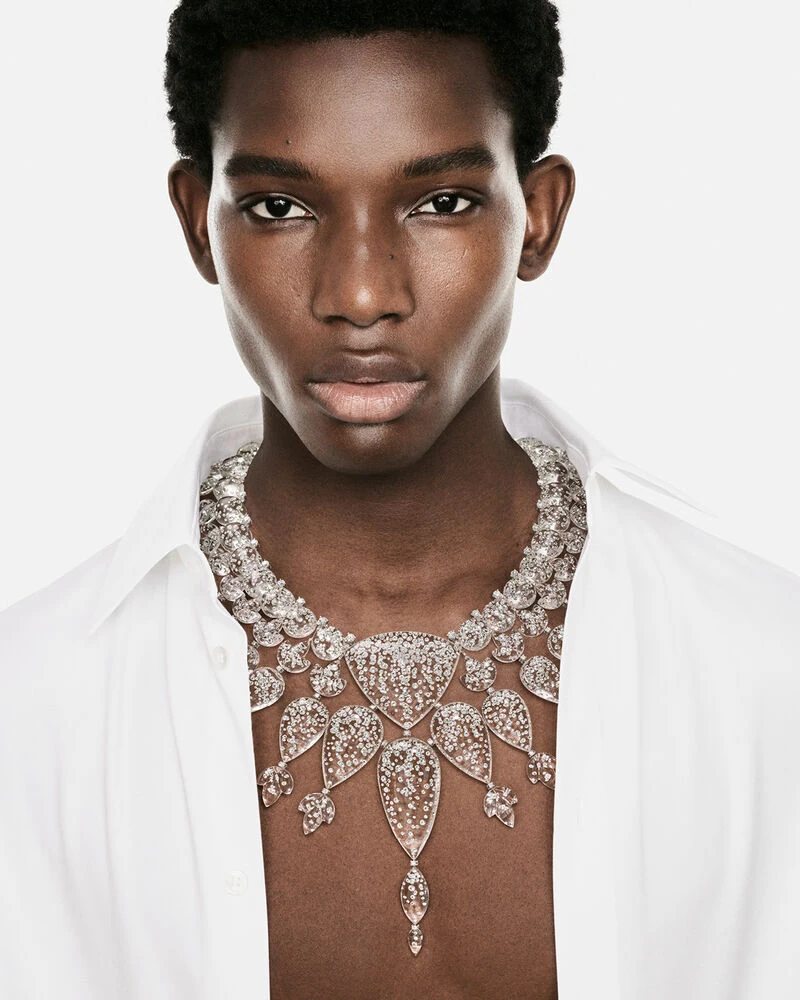
Rain makes the shared Human Being silhouette appear almost weightless on the body. Courtesy of Boucheron.
Explore the story
Key facts
- Collection: Carte Blanche 2026, Human Being.
- Creative direction: Claire Choisne with the Boucheron studio.
- Structure: five jewellery sets built from one recurring form.
- Sets: Rain, Flower, Light, Tattoo and Checkers.
- Rain: hollow rock crystal drops, plant-based resin and more than 4,800 diamonds; 1,550 hours.
- Flower: individually micro-painted rose quartz; 3,290 hours.
- Light: more than 1,500 carats of colour-matched morganites, with diamonds set into the stones through a concealed metal framework; 3,750 hours.
- Tattoo: reverse-carved smoky quartz using glyptic techniques; more than 200 purpose-made tools; 3,740 hours.
- Checkers: 163 onyx elements engraved with a femtosecond laser and coordinated through extensive CAD work; 1,990 hours.
- Combined workshop time stated for the five sets: 14,320 hours.
Place the five necklaces next to one another and the first thing you notice is how little their silhouettes change. The second thing is how completely everything else does.
Rain is almost colourless. Flower is pale pink and crowded with painted detail. Light is warm, transparent and gem-heavy. Tattoo turns smoky quartz into something closer to carved skin. Checkers is black, graphic and so precisely patterned that the stones begin to read like cloth.
That repetition is the point. Boucheron’s Human Being collection does not ask five different forms to carry five different ideas. It keeps the outline steady and changes the way the jewellery is made. The result is unusually useful for anyone trying to understand what high jewellery actually means beyond rarity and stone size. If the silhouette stays broadly constant, then material, technique, engineering and finish become much easier to read.
This makes Human Being less like a conventional collection and more like a controlled experiment.
The same necklace, on purpose
Boucheron describes the collection in direct terms: one and the same shape runs through all five sets, but each requires a different savoir-faire. The Maison frames that repetition as a way to talk about human similarity and individual difference. From a technical perspective, the choice does something even more interesting. It removes one variable.
The five necklaces do not compete by inventing five unrelated profiles. Instead, they return to the same cluster-like composition, with a dense central element, repeated droplet forms and a broad collar structure. The corresponding rings continue the idea on a smaller scale.
Several reports published when the collection was unveiled in July add an important piece of context. Le Monde and Vogue France both reported that Claire Choisne had asked an artificial-intelligence system what it considered the archetypal form of high jewellery. The answer was a cluster necklace. Rather than reject that conservative result, she used it as the baseline.
That origin matters because Human Being is not an anti-technology exercise. Quite the opposite. One of the five sets depends on a femtosecond laser and extensive CAD modelling. Another depends on a vacuum process. The collection’s position is subtler: tools can generate, cut, model or assist, but the character of the finished object still depends on hundreds of decisions about material behaviour, pressure, depth, colour, repetition, articulation and wear.
The common form gives those decisions somewhere to show themselves.
Rain: making structure disappear
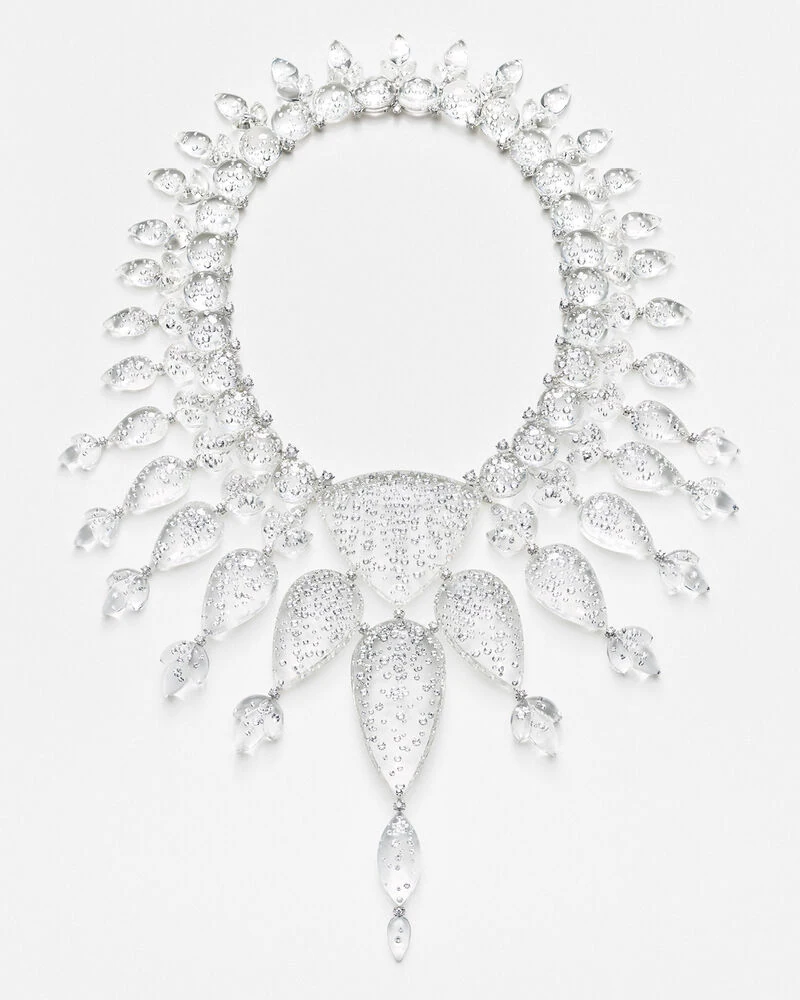
Hollow rock crystal, resin and diamonds build Rain from depth rather than visible metal. Courtesy of Boucheron.
Rain is the easiest set to understand visually and one of the hardest to explain physically.
The necklace appears to be made from clear drops with diamonds suspended inside them. The effect is closer to water caught in motion than to a conventional diamond necklace because the usual signs of setting are difficult to read from a distance. Boucheron achieved that by hollowing rock crystal into droplet forms, then building successive layers of plant-based resin inside them. More than 4,800 diamonds were placed by hand within those drops, layer after layer and in a specific order to create depth.
The process was performed under vacuum to prevent microscopic particles and air bubbles from contaminating the transparent construction.
The number 4,800 is striking, but the more revealing detail is the need for emptiness. Traditional diamond setting usually asks metal to hold a stone visibly and securely. Rain wants the opposite visual result. The diamonds must appear to exist inside transparent volume with as little interruption as possible.
That changes the job of the structure. It still has to control every diamond, connect every drop and let the necklace move on the body, but it must recede from view.
Boucheron states 1,550 hours of work for the set, the lowest figure among the five. That should not be read as a quality ranking. Workshop hours tell us something about labour and technical difficulty, but they do not convert cleanly into artistic value. What they do show is that Rain’s challenge is concentrated. Once the transparent system works, the visual idea is immediate.
The necklace succeeds because the method is legible without being obvious. You can understand the illusion before you understand the engineering.
Flower: repetition without looking mechanically repeated
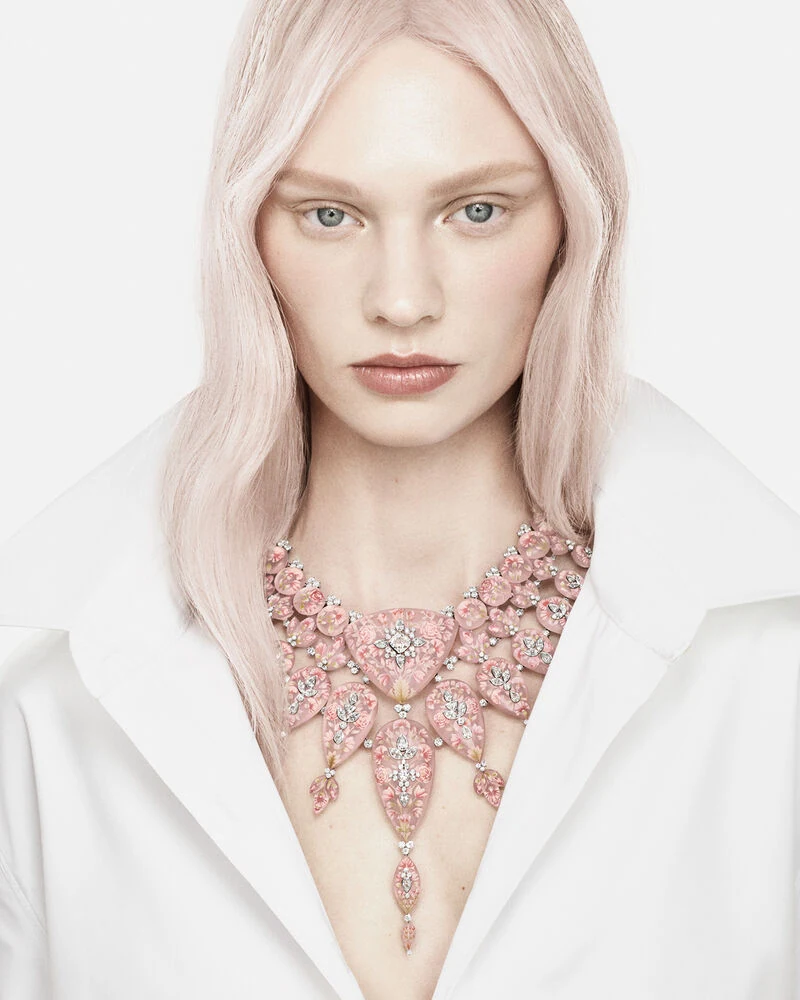
Flower turns the repeated outline into a field of hand-painted colour. Courtesy of Boucheron.
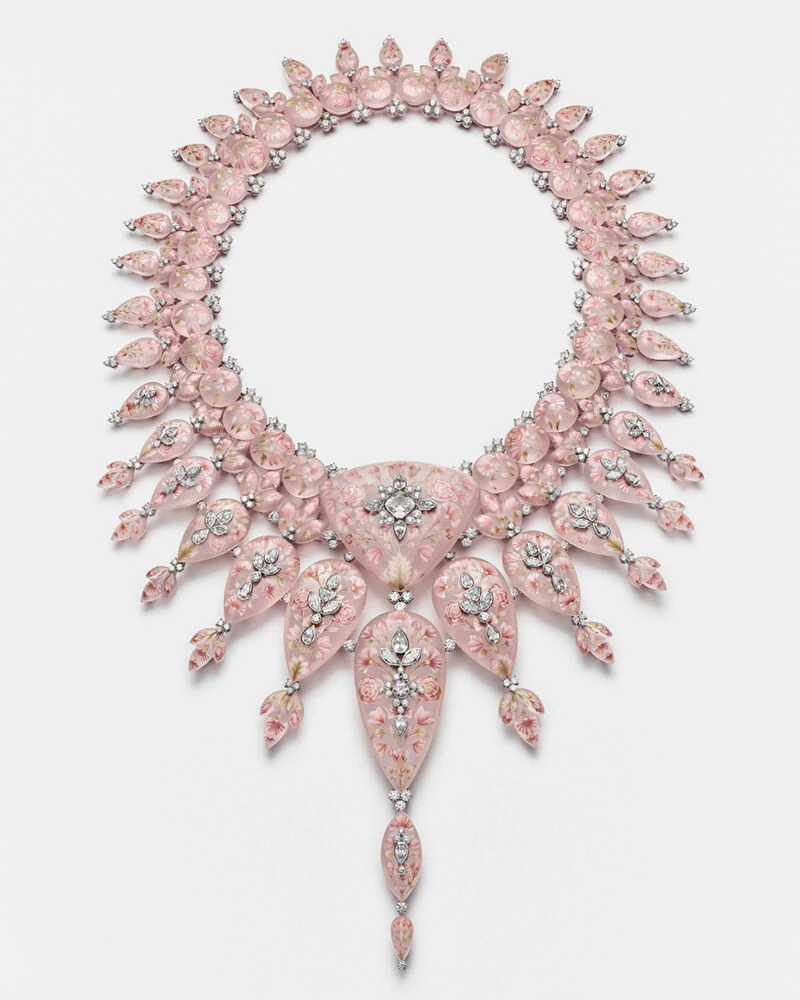
Individually painted rose quartz makes repetition feel organic rather than mechanical. Courtesy of Boucheron.
Flower takes the same outline in the opposite direction.
Instead of suppressing surface detail, it fills the stones with it. Each rose quartz element is painted individually with a floral composition by a specialist in micro-miniature painting. The work is done under magnification, using light and shadow to suggest depth inside a stone that is already translucent and softly coloured.
The technical problem here is repetition.
A printed pattern would be easy to repeat. A hand-painted one is not. Boucheron says the floral design had to be reproduced with precision on every rose quartz component. Yet the finished piece cannot look like industrial duplication. The hand has to deliver consistency without flattening the life out of the image.
That distinction is important. High jewellery often celebrates one exceptional centre stone because individuality is built into the gem itself. Flower asks the opposite of its maker. The stones form a family and the painting needs to maintain a coherent visual rhythm across all of them.
Boucheron records 3,290 hours for the set. That figure starts to make sense when the necklace is viewed as dozens of small painted surfaces rather than one large jewel. The making time is distributed across repeated acts of observation, colour control, brushwork and correction.
The rose quartz also matters. Its pale body colour becomes part of the painting rather than merely a support for it. The floral motifs do not sit on a neutral white ground. They live inside an already coloured material, which means every painted decision has to account for the tone and translucency beneath it.
Rain hides its structure. Flower accumulates evidence of the hand.
Light: when the stone becomes the engineering problem
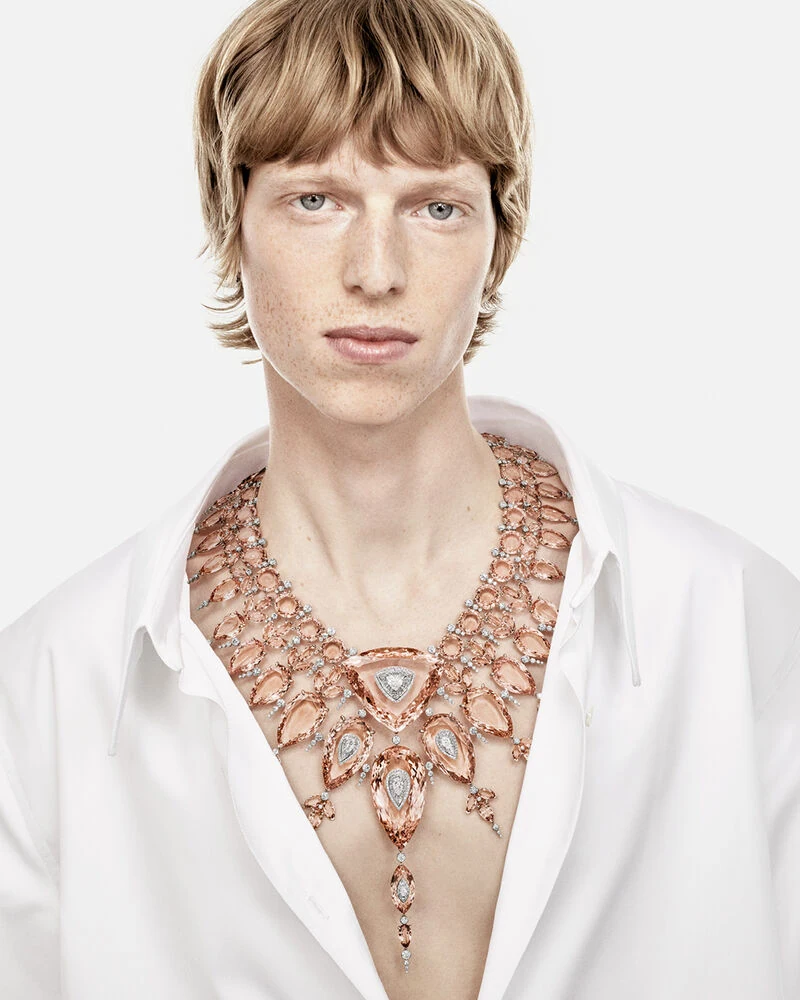
Light uses morganite transparency to alter the visual weight of the same form. Courtesy of Boucheron.
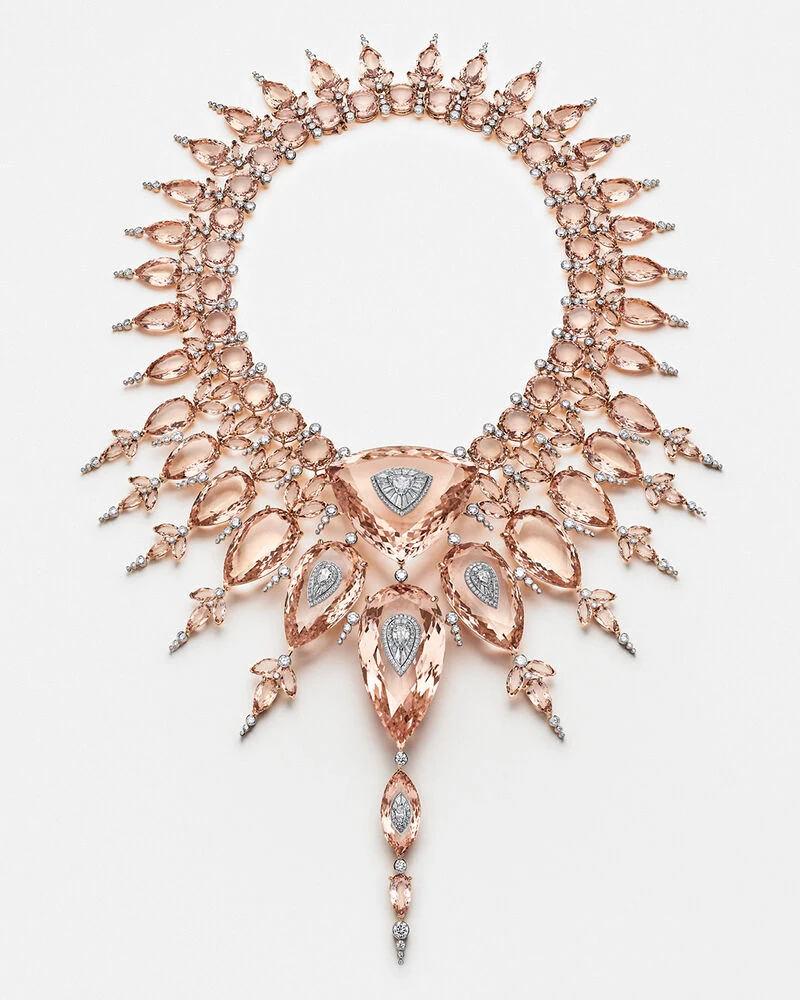
A concealed framework allows diamonds to appear within the morganites. Courtesy of Boucheron.
Light may be the most conventionally precious-looking necklace in the group. It is also the set in which the material itself creates the greatest mechanical difficulty.
Boucheron assembled more than 1,500 carats of morganites matched to the same colour intensity. That quantity alone would make consistency difficult. The real challenge, according to the Maison, came from mounting the stones without subjecting them to damaging pressure.
The solution was unusual. The prongs were fitted and screwed around each morganite rather than simply forced into place. The design then added another complication: diamonds appear to be set directly into the morganites. To make that possible, the morganites were hollowed to receive a concealed metal framework, and the diamonds were set into that internal support.
It is a useful reminder that “setting a diamond into another gemstone” is not as simple as the phrase sounds. The diamond needs a secure seat. The morganite needs to survive machining and assembly. The metal structure needs to remain largely invisible. The whole unit then has to be connected into a flexible necklace capable of being worn.
The visual effect is one of light coming from inside the stone, which is exactly what the construction is trying to achieve. Instead of treating morganite as a coloured background around diamonds, the design makes the diamond appear embedded within the morganite’s volume.
Boucheron gives 3,750 hours for the set, the highest figure in the collection by a narrow margin.
Again, the hours are less interesting than the reason for them. Light is slow because fragile material, hidden structure and visual purity are all asking for different things at once.
This is where the repeated silhouette earns its keep. Compare Light with Rain and the outlines are cousins, but the engineering philosophies are almost reversed. Rain builds transparent containers around diamonds. Light modifies gemstones so that diamonds can appear to exist inside them.
Tattoo: carving from the back
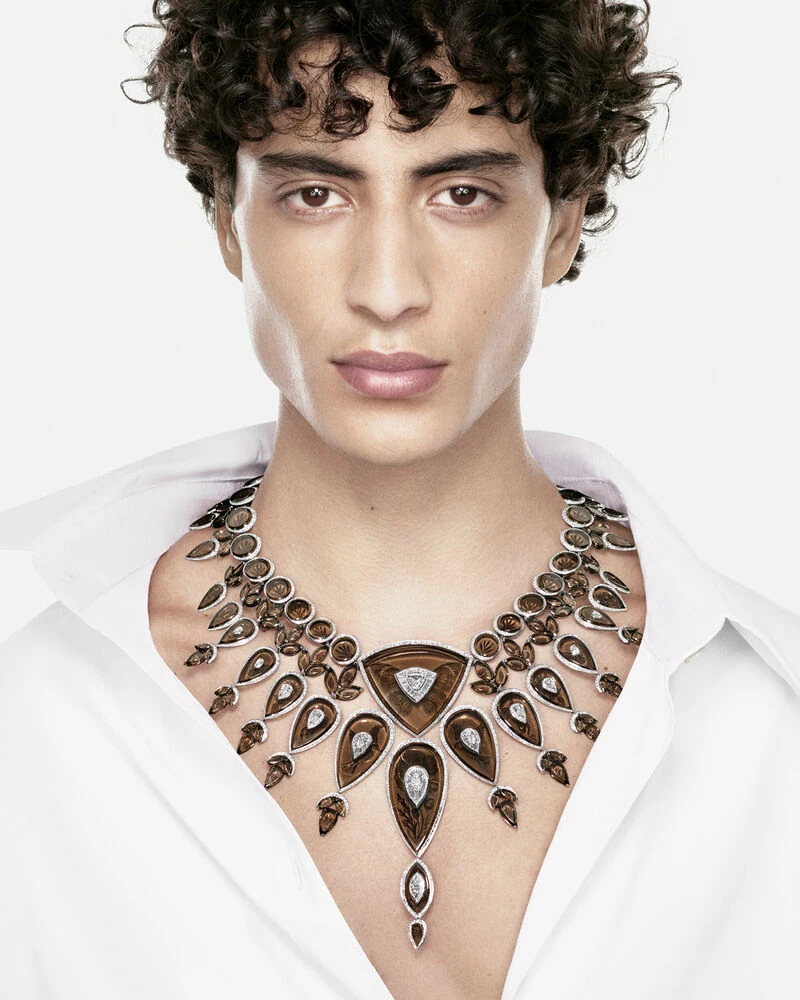
Tattoo reads like carved skin when placed against the body. Courtesy of Boucheron.
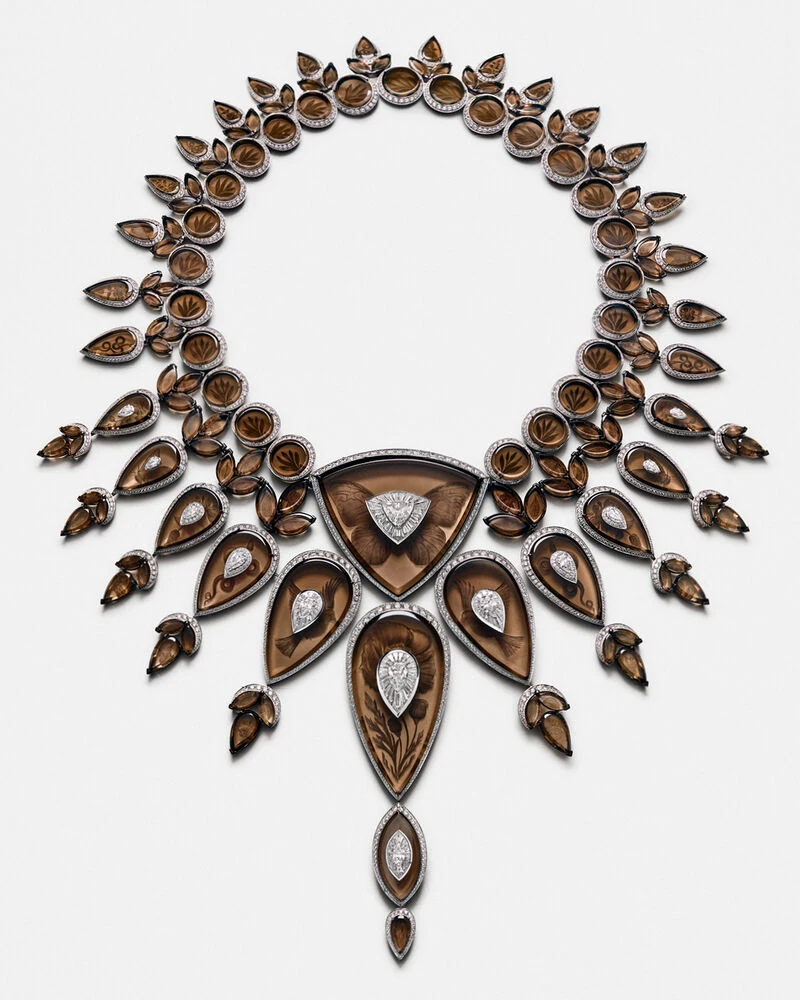
Reverse-carved smoky quartz gives Tattoo its depth and shadow. Courtesy of Boucheron.
Tattoo is darker and more intimate.
The set uses smoky quartz and an old carving discipline, glyptics, to create motifs inspired by Victorian tattoo imagery. Boucheron’s artisans carved the reverse side of the stones so that the design emerges through the material as a low relief.
That choice changes how the image is read. The motif is not painted onto the front surface. It is made through depth. Because colour is not available to define the smaller details, the artisan has to rely on variations in carving depth and relief to separate one line from another.
Boucheron says the specialist responsible for the work created more than 200 dedicated tools to achieve the required motifs and their symmetry.
That number is revealing because it tells us the craft was not simply selected from a menu of known techniques. The technique itself had to be adapted to the project.
Tattoo is also the clearest example of how Human Being uses the body without illustrating the body literally. The jewellery does not reproduce skin. It borrows the logic of marking skin and transfers it into stone. The smoky quartz becomes a medium through which the carved image is seen, so the motif appears embedded rather than applied.
The set required 3,740 hours, almost as much as Light.
Where Light’s time is tied to fragile mounting and hidden engineering, Tattoo’s time is tied to irreversibility. A carved line cannot be wiped away and repainted. Symmetry across repeated components has to be achieved through control of depth, pressure and tool geometry.
The result is quieter than the technical story behind it. That is one of the reasons it works.
Checkers: technology is still a craft decision
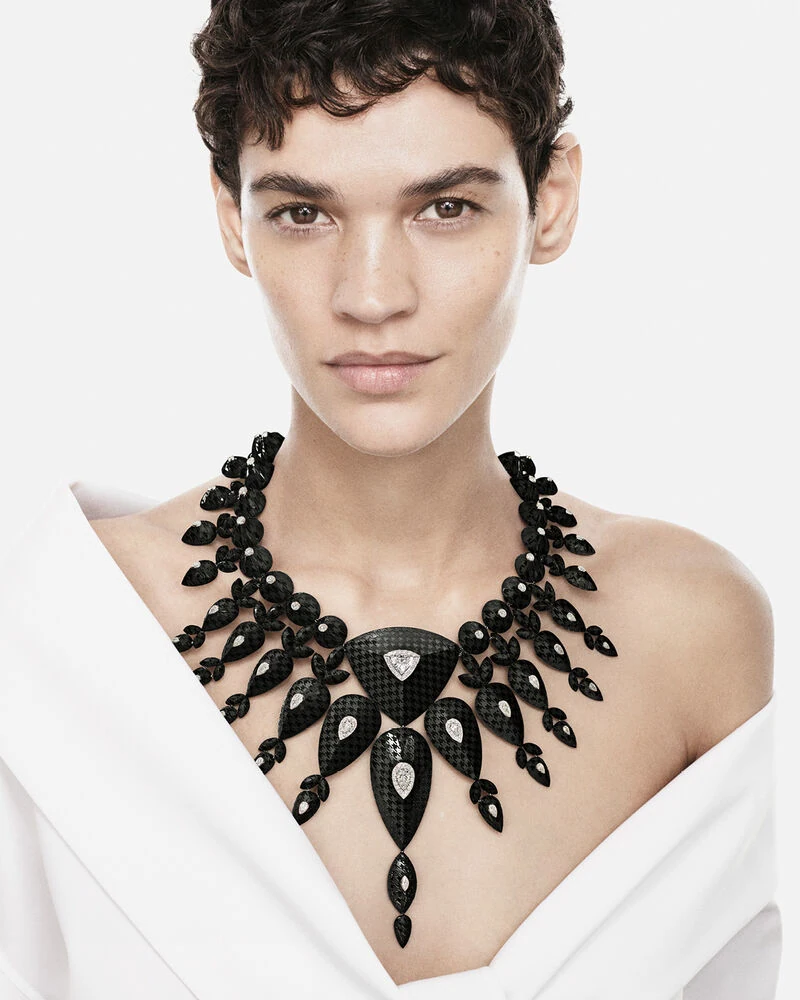
Checkers turns a technical grid into a graphic surface on the body. Courtesy of Boucheron.
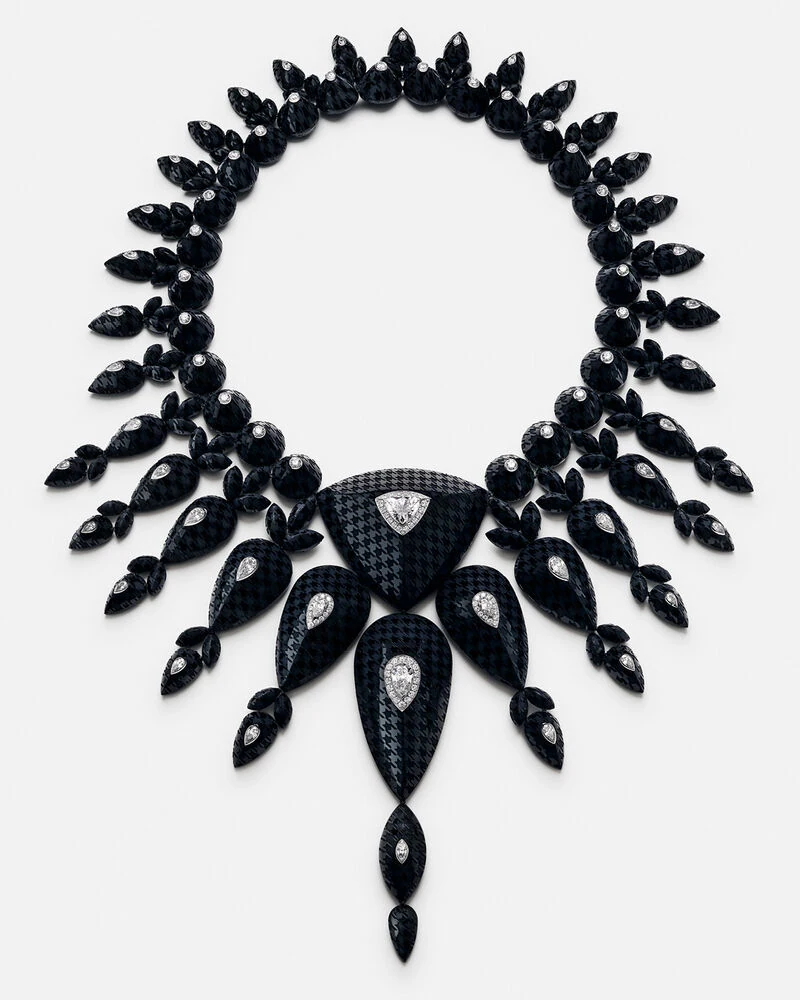
Laser-engraved onyx and CAD coordination still depend on exacting human decisions. Courtesy of Boucheron.
Checkers is the set most likely to complicate simplistic arguments about handwork and technology.
The necklace uses 163 onyx stones engraved with a houndstooth pattern. Boucheron used a femtosecond laser, a highly precise system that removes material through extremely short pulses, allowing the pattern to be cut without compromising the integrity of the stones. Extensive CAD modelling was then used to coordinate the pattern so the eye reads it as a continuous textile rather than a collection of individually marked components.
The target is oddly familiar: fabric.
That matters because the necklace is made from materials that are anything but fabric-like. Onyx is hard. The stones are separate. Their surfaces curve and change orientation around the neck. Yet the design asks the houndstooth to flow across those interruptions as if it had been woven in one piece and draped over the body.
The challenge is therefore not the laser alone. The difficult part is mapping a flat-looking pattern across multiple three-dimensional stones while preserving continuity from one element to the next.
Boucheron states 1,990 hours for the set.
Checkers is a useful endpoint for the collection because it makes the central argument difficult to reduce to nostalgia. Human Being is not claiming that only traditional hand tools create meaningful jewellery. The collection includes micro-painting, glyptics and conventional gem-setting, but it also uses plant-based resin, vacuum processing, laser engraving and CAD.
The human contribution lies in deciding what each tool is being asked to achieve, and then carrying the result through materials that do not behave perfectly.
14,320 hours, but hours are not the point
Add Boucheron’s stated figures for the five sets and the total is 14,320 hours.
It is tempting to treat that number as proof of importance. That would be too easy. Time is evidence of labour, not an automatic measure of quality. A piece can take longer because it is inefficient. Another can take less time because a process has been solved elegantly.
What the figures do reveal is how differently the same outline can consume labour.
Rain takes 1,550 hours. Checkers takes 1,990. Flower climbs to 3,290. Tattoo requires 3,740. Light reaches 3,750. The spread is wide because the underlying problems are different.
This is where the collection becomes unusually informative. Instead of presenting five unrelated masterpieces and asking the viewer to admire each one independently, Boucheron gives us a basis for comparison. The visual skeleton stays similar enough that process can come forward.
The hours become a map of difficulty rather than a scoreboard.
Why the collection is more interesting than its theme
“Humanity” is a dangerous theme for luxury. It can turn vague very quickly. Words such as individuality, connection and authenticity are easy to print and hard to prove in an object.
Human Being is strongest when it stops explaining the theme and lets the construction do the work.
Rain asks how diamonds can appear suspended. Flower asks how repeated painting can remain alive. Light asks how a fragile gemstone can carry another setting inside itself. Tattoo asks how an image can be cut into depth and read through stone. Checkers asks how rigid components can behave visually like cloth.
Those are specific questions. Each requires an answer that can be examined.
The collection’s relationship with technology becomes clearer from that perspective too. The reported starting point involving artificial intelligence is almost a provocation. An algorithm returns an average idea of what high jewellery looks like: a cluster necklace. Boucheron then spends more than 14,000 workshop hours demonstrating how little the average silhouette tells you about the finished object.
That is a sharper statement than claiming that machines cannot be creative. Machines are present in the process. The femtosecond laser proves it. What the five sets show is that execution is not a single act. It is a chain of decisions, adjustments and material negotiations.
The jewellery becomes individual because those chains diverge.
What to look at when seeing the five together
The useful way to read Human Being is comparative.
Start with the central forms and follow them around each necklace. Notice which edges are carried by metal and which appear to disappear. Look at how transparency changes the perceived weight of Rain and Light. Compare the painted surface of Flower with the carved depth of Tattoo. Then look at Checkers and ask where the pattern actually breaks from one stone to the next.
The collection becomes much more interesting once you stop asking which necklace is the most beautiful.
The better questions are physical. Which one most successfully hides its support? Which one depends most heavily on repeated manual precision? Which one asks the gemstone to do something structurally unusual? Which one would be impossible without contemporary technology?
Those questions are closer to how the objects were made.
Final view
Boucheron could have expressed Human Being through five radically different necklaces. That would have been easier to read as a conventional collection and harder to learn from.
Keeping one shape was the stronger decision.
It turns Rain, Flower, Light, Tattoo and Checkers into five answers to the same brief. Their similarities make the differences visible. The diamonds suspended in rock crystal, the individually painted rose quartz, the hollowed morganites, the reverse-carved smoky quartz and the laser-engraved onyx are no longer isolated displays of technique. They can be compared directly.
That is what makes Human Being useful beyond the season in which it was launched. It shows that high jewellery is not defined by silhouette alone, or by the presence of expensive stones. The same outline can become five fundamentally different objects once material, process and judgement begin to act on it.
The shape is the control. The making is the identity.
The Edit
Jewelry stories
Selected stories from the same editorial universe.
Beyond the 4Cs: Choosing an Engagement Ring for Everyday Life
The diamond report is only half the decision. Height, setting, shoulders, sizing and the
Natural, Laboratory-Grown and Treated Diamonds: How to Read the Report
Natural or laboratory-grown describes origin; treatment describes what happened later. A diamond report should
Restivo Diamonds: When High Jewellery Begins with the Stone
Restivo Diamonds makes a stone-first proposition: natural diamonds and coloured gems lead the brief;
Chopard Miracles 2026: How 79 High Jewellery Pieces Avoid Becoming One Idea
Chopard’s Red Carpet Collection becomes most compelling when the festival theme recedes and each
One Butterfly, Twelve Constructions: How Graff Turns a Motif into High Jewellery
Graff holds one butterfly silhouette still, then changes colour, volume, surface and movement across
Emerald or Sapphire? Choosing a Coloured-Stone Engagement Ring
Emerald and sapphire can both belong in an engagement ring, but setting, treatment history