
TheTimeo / Jewelry
THE HEIRLOOM RING:
change without erasure
An inherited ring can become wearable again without making its earlier life illegible. The choice is whether to reset, resize or restore—and how to document the work.
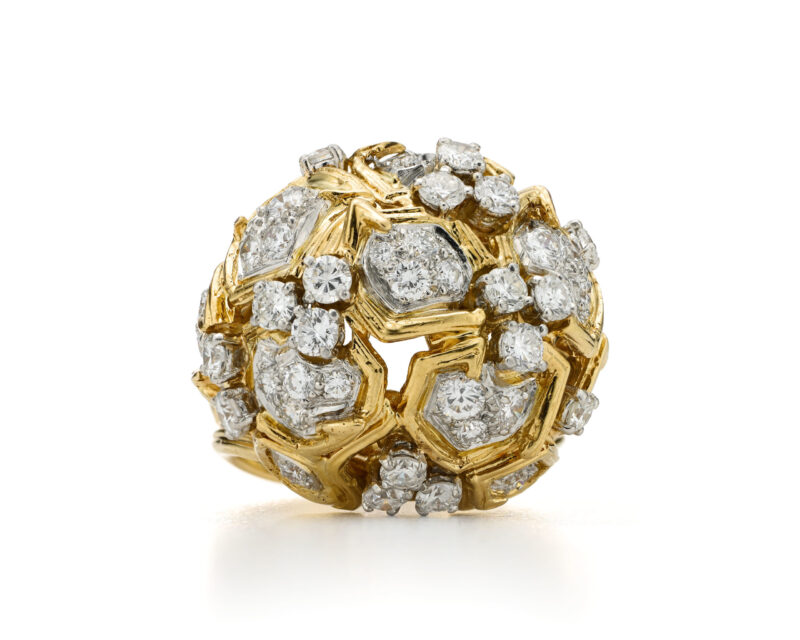
An archival object is strongest when the signature, design record and physical ring can be read together.
Explore the story
Category: Bridal Format: BRIDAL_DECISION_GUIDE Series: TheTimeo Bridal — Permanent Decision Library
An heirloom ring rarely arrives as a blank design problem. It may be too small. A claw may be worn thin. The shank may have been resized before. A centre stone may sit in a mount made for another generation’s taste, or the setting may be damaged enough that wearing it every day is no longer sensible.
That raises one practical question: what should be changed? A second is easier to overlook: what happens to the ring’s record when the object changes?
The two questions should be handled together.
Resizing can involve much more than changing the number on a ring-size chart. Resetting keeps a stone in use but changes the mounting around it. Restoration is different again; its purpose is not necessarily to make an old jewel look new. Any of these interventions can remove material, introduce new material, change proportions, disturb marks, move stones, obscure earlier repairs or make future identification easier. Some interventions are highly reversible. Others are not.
For an heirloom ring, the best outcome is therefore not always the least altered ring. It is the ring whose material decisions and documentary record remain intelligible.
Key takeaways
- Before any work, create a baseline record of the ring as received: front, profile and underside photographs, marks, dimensions, visible repairs, stone arrangement and any documents that travelled with it.
- Ring sizing is a structural intervention. GIA’s bench-quality guidance shows that sizing can involve cutting, removing or inserting metal, reforming the shank, joining it and then refinishing it; feasibility depends on construction, stones and alloy, not on ring size alone.
- Resetting separates the history of the gemstone from the history of its mounting. If the old setting is retained and documented, the object’s earlier state remains easier to reconstruct.
- Restoration should begin with a stated objective. “Make it look new” and “stabilise it while preserving evidence of age” are not the same brief.
- Provenance is not automatically destroyed by alteration, but undocumented alteration makes the object harder to read. The treatment record should travel with the ring.
An heirloom ring carries more than one kind of information
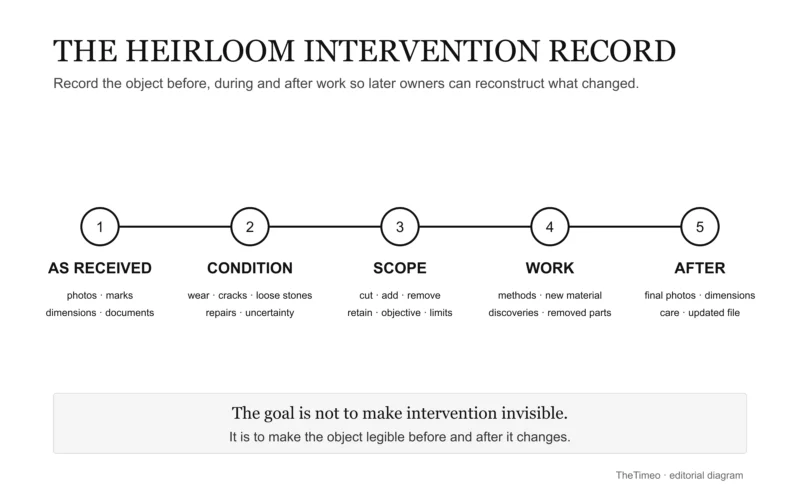
A before-and-after record keeps structural and documentary changes intelligible. Courtesy of TheTimeo.
The sentimental meaning of an inherited ring may be obvious to the family that owns it. The physical object can be less straightforward.
A ring can contain evidence of manufacture, use and previous intervention at the same time: an original hallmark, a later sizing seam, replacement claws, a stone that may have been remounted, a soldered gallery repair, an engraving added decades after manufacture. Those details do not necessarily make the ring “less authentic”. They describe its biography.
The mistake is to reduce that biography to a binary choice between original and altered.
For a collector, jeweller or future family member, more useful questions are:
- Which components are believed to belong to the earlier state of the ring?
- Which are later additions or replacements?
- What was changed, and why?
- Was material removed?
- Was anything retained after removal?
- Can the intervention be identified later?
- Is there a written and photographic record?
The American Institute for Conservation’s professional guidelines are written for cultural property rather than ordinary jewellery retail, so they should not be treated as a rulebook for every jeweller. They are useful, however, because they make one principle unusually clear: examination, treatment and alteration should be documented, and records should be maintained with the object. The logic translates well to an heirloom ring.
If a ring matters because of where it came from, the record of what is done to it becomes part of what should travel with it next.
Before the bench: make a baseline record
A practical intervention starts before the first tool touches the ring.
Photograph the piece in a consistent, well-lit way. At minimum, capture the face, both profiles, the underside, the shank, the inside of the band and any hallmarks, maker’s marks, serials, inscriptions or repair seams. Photograph each side stone and visible area of the setting if the ring is complex.
Then record what can be measured without taking the jewel apart:
- ring size;
- overall dimensions;
- shank width and approximate thickness where useful;
- visible stone arrangement;
- known gemstone report numbers;
- inscriptions and marks;
- obvious areas of thinning, soldering, cracking or previous work.
Do not turn an owner’s assumption into a fact. “Grandmother said the stone was Colombian” belongs in the family record as a statement of family history, not as a laboratory conclusion. “The ring is Cartier” should not be upgraded from family belief to attribution merely because a signature appears plausible.
This baseline does two jobs. It lets the jeweller plan the work, and it gives the future owner a reference point for understanding what changed.
TheTimeo intervention record
For any meaningful alteration, keep five stages together:
- As received — photographs, dimensions, marks and known history.
- Condition — what is worn, loose, cracked, distorted or uncertain.
- Proposed work — what will be cut, added, removed, replaced or retained.
- Work completed — techniques, new materials, replacement components and anything discovered during the job.
- After treatment — final photographs, new dimensions, new setting details and updated care instructions.
That is more useful than an invoice that says only “resize and polish”.
Resizing: a small word for a structural intervention
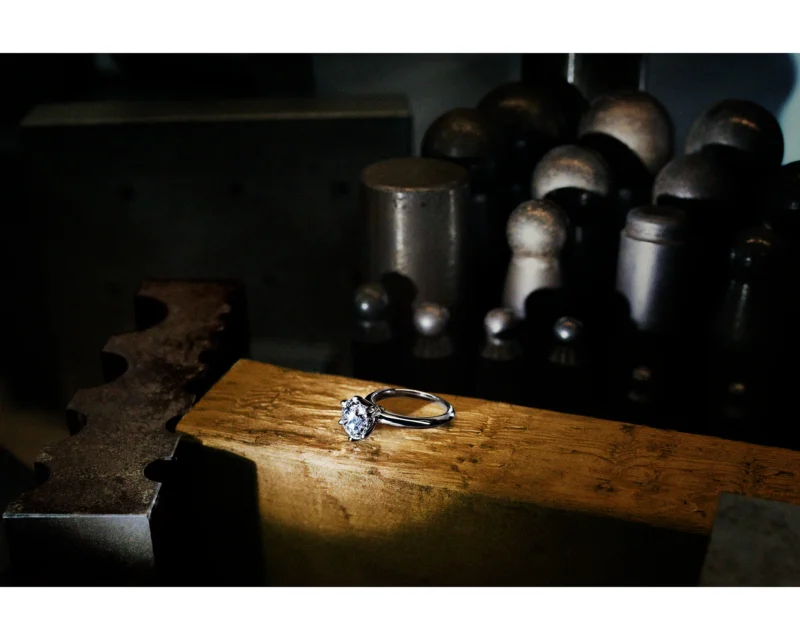
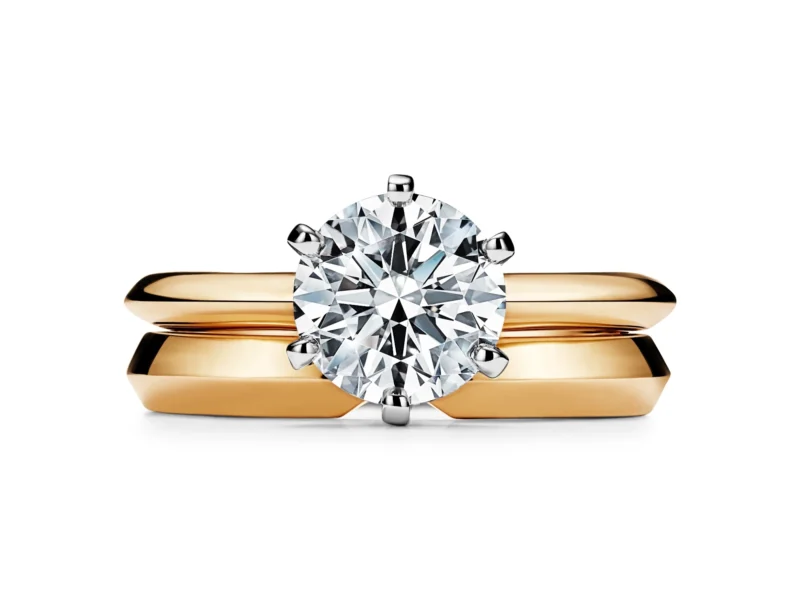
Bench work changes a jewel physically; the brief and the record should be equally precise. Courtesy of Tiffany & Co..
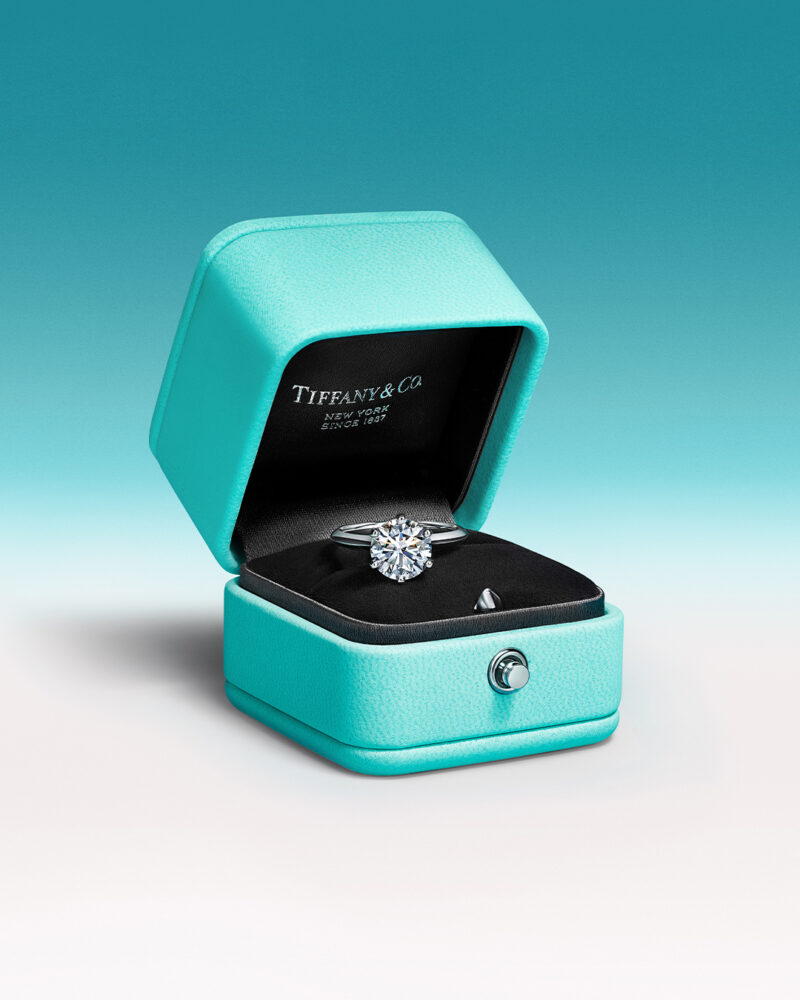
A presentation box can support context, but it is not provenance by itself.
Owners often discuss resizing as though the ring were being adjusted with a dial. In many cases, it is a fabrication operation.
GIA’s Quality Assurance Benchmarks for platinum ring sizing show why. Depending on the job, the shank may be cut, a section removed or a piece of matching sizing stock inserted, the ring re-formed, joined with a torch or laser, filed, rounded and refinished. Where stones are set in the shank, reforming the ring can change the relationship between those stones and the metal that holds them.
That does not mean resizing is inherently damaging. It means the ring must be evaluated as a construction, not only as a circumference.
A plain or lightly set shank may offer a straightforward working area. A continuous pavé or eternity design can be much less forgiving. Cartier’s current jewellery-service guidance, for example, says ring sizing is subject to feasibility and excludes pavé rings from its initial complimentary sizing policy. Tiffany similarly states that resizing is available only for selected items. Those maison policies are not universal technical laws; they are useful evidence that even large houses treat resizeability as design-dependent rather than automatic.
What can change during resizing
Depending on the ring, sizing may alter:
- the amount of original metal in the shank;
- the location or visibility of an earlier seam;
- the distance between hallmarks, inscriptions or engraved dates;
- the geometry of shoulders and galleries;
- stone spacing in set shoulders;
- the circularity and profile of the band;
- the surface finish if the entire ring is polished after work.
If material is cut out, ask whether it can be returned. GIA’s bench guidance even notes that consumers sometimes request the removed piece. For an heirloom ring, that is a sensible question: the removed metal may have little practical use, but keeping it with the file preserves evidence of the intervention.
Resizing can also reveal earlier history
A jeweller may discover an old solder line, porosity, a previous insert or thinning that was not obvious from the outside. That information should not disappear into the workshop.
Ask for it to be added to the service note.
A ring that has been resized twice is not necessarily a poor heirloom. A ring that has been resized twice with no record can be harder to understand than one whose interventions are visible and documented.
Resetting: when the stone and the mount take different paths
Resetting is often proposed when an inherited gemstone is emotionally important but the existing mount is damaged, impractical or simply not something the new owner wants to wear.
The crucial point is that the gemstone and the mounting have related but distinct records.
A laboratory report may describe a loose stone or a mounted stone at one point in time. A maker’s mark belongs to the mounting. An engraving may refer to a marriage or owner. A later setting can preserve the gemstone while ending the physical continuity of the original ring as a wearable object.
That may be the right decision. It should not be described as though nothing changed.
Before removing the stone
Record the original arrangement thoroughly. Photograph the setting from above, profile and underside. Record marks and inscriptions before any part of the ring is cut, polished or obscured. If there are side stones, establish whether they are intended to move into the new design or remain with the old mount.
If the centre stone has a laboratory report, reconcile the report number, measurements and inscription where applicable before work begins. For coloured stones, do not assume that an old report answers every modern question about treatment or origin. A new laboratory examination may be worth considering if the stone is already being unset, particularly where treatment or identity is material to the owner’s decisions.
Keep the old mount when practical
One of the simplest ways to preserve the earlier state is to retain the original setting rather than trading it in for scrap automatically.
The old mount may contain the signature, maker’s mark, date letter, serial, engraving or construction details that connect the gemstone to its earlier history. Once melted, that evidence is gone.
If the mount is kept, store it with the before-work photographs and invoice. If some components are reused, document which ones. If the jeweller supplies a new head, new claws or a completely new shank, say so.
This is the point at which family language often becomes misleading. “We kept the original ring” might actually mean “we kept the original centre stone”. The distinction matters.
Restoration is not the same as making an old ring look new
The word restoration can hide several different objectives.
One owner may want a ring stabilised so that it can be worn while keeping as much earlier material and surface evidence as possible. Another may want missing decorative elements reconstructed. A third may want the piece refinished until scratches and wear are largely removed.
These are not equivalent interventions.
Cartier’s own service menu distinguishes ordinary repair from restoration and reconstruction. That distinction is useful because it acknowledges that restoration can involve a broader intervention than replacing a worn component.
For an heirloom ring, define the objective before agreeing to the work.
A useful brief might say:
Stabilise the ring for occasional wear, preserve existing hallmarks and engraving, replace only structurally necessary components, retain removed parts and document all new material.
That is very different from:
Return the ring to an as-new appearance.
Neither is automatically correct. The point is to know which one you are choosing.
Surface finish can be historical information
Polishing deserves specific attention because it is easy to treat it as routine cleaning.
Refinishing removes or redistributes surface material. On a heavily worn ring, careful refinishing may improve comfort and appearance. On an old signed ring, repeated polishing can soften edges, reduce engraving depth and blur marks. The correct approach depends on the object, but the owner should know whether polishing is included in the job.
A service document that lists “repair” without saying that the ring was also refinished tells only part of the story.
Reversibility is useful, but it is not a magic standard
In conservation, reversibility and future retreatability are important concepts. In jewellery, some practical interventions are inherently less reversible.
A new ring built around an heirloom stone can be taken apart later, but the original mount may not be recoverable if it was cut or melted. A sizing insert can sometimes be removed, but the shank has already been cut. A replacement claw can be replaced again, but original metal may have been removed in preparation.
Instead of asking only, “Can this be reversed?”, ask three more precise questions:
- What original material will be removed?
- What evidence will become harder to read?
- What can be retained physically or documented before it disappears?
This shifts the conversation away from a false promise of perfect reversibility and toward record preservation.
Does alteration destroy provenance?
Not necessarily.
Provenance is a record of origin, ownership and custody supported by evidence. A documented resize or reset can become another event in that record. The problem begins when later owners cannot tell what happened.
Consider two inherited rings with the same family history.
The first has an envelope containing a 1978 purchase receipt, photographs of the original setting, a 2026 jeweller’s report explaining that the centre stone was transferred to a new platinum mount, images of the removed mount, and the retained original setting stored with the file.
The second has the same stone in a new mount and no paperwork.
Both may carry the same family story. Only one preserves a strong material record of the transition.
The intervention does not erase the earlier history. Documentation determines how much of that history remains demonstrable.
The decision matrix: reset, resize or restore?
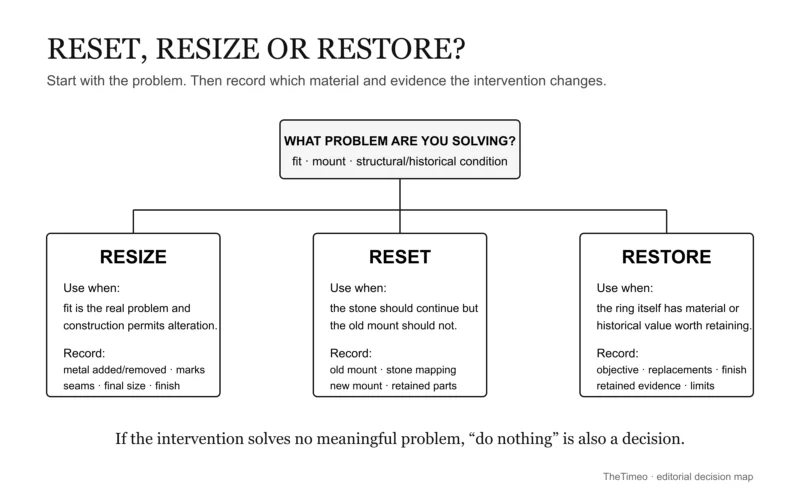
Resetting, resizing and restoration solve different problems and leave different traces. Courtesy of TheTimeo.
The right answer depends on the problem you are actually solving.
Explore the comparison
| Decision | Best suited to | Main record risk | What to preserve |
|---|---|---|---|
| Resize | Fit problem where the existing construction can tolerate alteration | Metal removed/added; shank geometry or marks affected | Before photos, size, marks, removed metal if practical, work description |
| Reset | Important stone but unsuitable, damaged or unwanted mount | Stone becomes separated from original mounting history | Full old-mount record, lab documents, old mount or components, new setting record |
| Restore | Historic/design integrity matters and the ring requires stabilisation or reconstruction | New work may be visually merged with old; refinishing may remove evidence | Condition report, treatment objective, replaced parts, materials, before/during/after images |
| Leave unchanged | Ring is stable and documentary integrity matters more than daily wear | Continued wear may worsen existing damage if condition is poor | Condition assessment, storage/care plan |
This table is not a substitute for a jeweller, conservator or gemologist examining the actual ring. It is a way to make the owner’s objective explicit before the intervention begins.
Five questions to ask before approving the work
1. What exactly must be altered?
Ask the jeweller to point to the areas that will be cut, built up, removed or replaced. “Resize” is not enough detail for an heirloom file.
2. Which parts can be retained?
If a component must come off, ask whether it can be returned. This applies to a removed shank section, old head, damaged clasp component, side stones or an entire previous mount.
3. Will marks, engraving or serial information be affected?
Photograph them first. If work must occur near a hallmark or engraving, record that risk in advance.
4. What will the finish look like afterward?
Will the ring be polished, lightly refinished or left with existing surface wear? Ask before the job, not after the historical surface has been changed.
5. What documentation will I receive?
A useful final record should identify the ring, date the work, name the service provider, describe what was done, list significant replacement materials or components and include after-work photographs where the intervention is substantial.
What should travel with the ring afterward
An heirloom ring should not leave the workshop with less information than it entered with.
Keep together:
- the pre-work photographs;
- the jeweller’s condition assessment or estimate;
- the approved scope of work;
- the final invoice and treatment description;
- after-work photographs;
- laboratory reports;
- receipts or earlier ownership documents;
- any removed original components;
- care instructions and future service notes.
If the ring will eventually be passed to another family member, add a short plain-language note explaining the intervention: what was inherited, what was changed and what was retained.
That note may prove more valuable than a future owner trying to reconstruct the story from a polished surface and a half-remembered family conversation.
The object can change without the record becoming vague
There is no virtue in preserving an heirloom ring so rigidly that nobody can safely wear it. There is also no reason to treat every inherited ring as raw material for a new design.
The useful middle ground is deliberate intervention.
Resize when fit is the real problem and the construction permits it. Reset when the stone should continue but the mount should not. Restore when the ring itself — not only its gemstones — is worth preserving as an object. Leave it alone when intervention would solve no meaningful problem.
Whatever the choice, document the point at which the ring changed.
An heirloom is not made more authentic by pretending that repairs never happened. It becomes easier to trust when the next owner can see what was inherited, what was altered and why.
Sources & further reading
This article uses GIA bench-quality guidance for ring sizing and gemstone-handling context; current Tiffany & Co. and Cartier service policies as examples of maison-specific feasibility limits; and the American Institute for Conservation Code of Ethics and Guidelines for Practice as an analogous documentation framework for objects with historical significance. AIC guidance is not presented as a retail-jewellery regulation.
Primary and authoritative sources
- GIA — Accurate Determination of Finger and Ring Sizes: https://www.gia.edu/quality-assurance-benchmark/accurate-determination-finger-ring-size
- GIA — Sizing Down: Platinum Cobalt Rings with Diamonds in the Shank Using a Laser Welder: https://www.gia.edu/gia-website/quality-assurance-benchmark/sizing-down-platinum-cobalt-rings-with-diamonds-in-the-shank-using-a-laser-welder
- GIA — Sizing Up: Platinum Ruthenium with Diamonds in the Shank Using a Laser Welder: https://www.gia.edu/quality-assurance-benchmark/sizing-up-platinum-ruthenium-ring-diamond-using-laser-welder
- Tiffany & Co. — resizing FAQ: https://www.tiffany.com/faq/shopping-faq/does-tiffany-offer-resizing/
- Cartier — jewellery adjustments: https://www.cartier.com/en-it/services/jewellery/our-jewellery-services/adjustments
- Cartier — jewellery care and repair FAQ: https://www.cartier.com/it-it/services/your-purchase-concierge/faq/creations/jewellery
- American Institute for Conservation — Code of Ethics and Guidelines for Practice: https://www.culturalheritage.org/conservation-at-work/uphold-professional-standards/code
Limit: No general rule for how many sizes an heirloom ring can safely be altered is given because feasibility depends on alloy, construction, existing repairs, setting geometry and stones. The ring must be examined by a qualified professional.
The Edit
Jewelry stories
Selected stories from the same editorial universe.
Why Wedding Bands Do Not Always Sit Flush—and Why That Can Be Better
A visible gap is not automatically a design failure. Profile, basket, shoulders and movement
Beyond the 4Cs: Choosing an Engagement Ring for Everyday Life
The diamond report is only half the decision. Height, setting, shoulders, sizing and the
Restivo Diamonds: The Engagement Ring Beyond the Configurator
An engagement ring is more than a list of filters. Restivo Diamonds begins with
The Signed Vintage Engagement Ring: A Collector’s Guide to Provenance and Fit
A signature narrows the field, but maker evidence, stone reports, alterations, condition, provenance and
Emerald or Sapphire? Choosing a Coloured-Stone Engagement Ring
Emerald and sapphire can both belong in an engagement ring, but setting, treatment history
The Engagement Ring File: A Record for the Life of a Ring
A ring is chosen in a moment and worn for years. The photographs, certificates