
TheTimeo / Jewelry
THE STONE
sets the terms
A rough diamond arrives with its own geometry. Twenty years after Talisman, De Beers still builds the gold around what geology chose not to standardise.
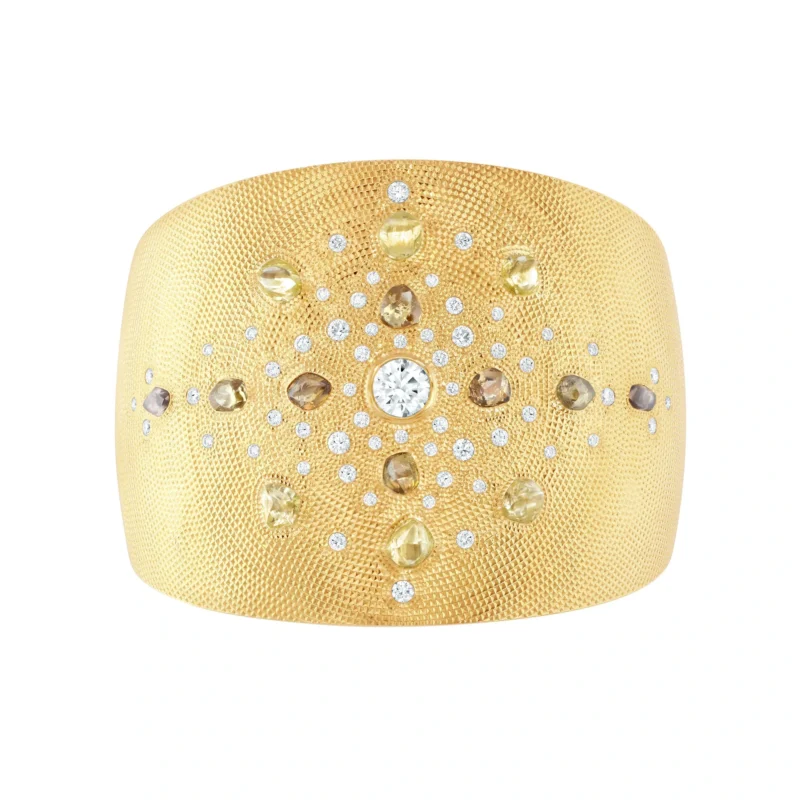
The Talisman High Jewellery cuff places fourteen warm-toned rough diamonds beside polished stones and a white central diamond.
Explore the story
De Beers launched Talisman in 2005 by placing rough diamonds beside polished ones and reviving a shallow, hand-hammered setting language it calls serti poinçon. Two decades later, the useful question is not whether rough diamonds still look unconventional. It is what has to change in jewellery design when the stone arrives with its own irregular geometry and the setter is asked to preserve rather than erase it.
The premise, in eight facts
- Talisman launch: 2005
- 20th-anniversary chapter: 2025
- Current status in 2026: active De Beers High Jewellery signature and Fine Jewellery collection
- Core idea: rough and polished diamonds used together in one jewel
- Signature setting: serti poinçon, involving hand-hammered precious metal around stones and a shallower setting than conventional deep settings
- Current High Jewellery examples: Talisman Cuff, Ring, Earrings, Medals, Trio Ring, Chandelier Earrings and Lines Bracelet
- Anniversary locket: limited series of 20, 18K yellow gold, 3.57 ct rough diamonds, approximately 5.33 ct total
- Current Lines Bracelet: approximately 9.33 ct total, including 5.70 ct yellow rough diamonds and a 3.30 ct round brilliant centre
- Current sculptural yellow-gold ring: approximately 4.50 ct total, including about 3 ct rough brown/yellow diamonds and a 0.70 ct G VS1 round brilliant centre
The modern diamond industry is built around transformation.
Rough is scanned, planned, sawn, cleaved, brut-ed, faceted and polished until its natural crystal becomes a controlled optical object. Weight is lost so proportion, symmetry, polish and light return can be gained.
Talisman interrupts that sequence.
It asks whether a diamond needs to pass through all of those stages before it can become jewellery.
For some stones, De Beers answers no.
That refusal changes more than the surface appearance. A rough diamond does not arrive with a calibrated girdle, standard pavilion angle or predictable seating plane. Its external geometry may reflect crystal growth, breakage, twinning and resorption. Its surface may carry trigons, terraces, frosting or other natural features. Its colour may be distributed differently from the way a polished stone is normally read.
The design therefore has to respond to the stone that exists.
That is the real Talisman idea.
The anniversary was 2025, not 2026
- 2005 — Talisman launches.
- 2025 — the twentieth-anniversary chapter and limited locket arrive.
- 2026 — the collection remains active; this is a technical reading, not a fictional new launch.
The chronology should be kept clean.
De Beers launched Talisman in 2005. Its own corporate history describes it as the first collection in the House to showcase rough diamonds alongside polished ones and links the launch to the revival of serti poinçon.
The twentieth anniversary therefore fell in 2025.
That year produced an anniversary locket in a limited series of 20 pieces and an expanded High Jewellery chapter. By 2026, the collection remains active on De Beers’ current High Jewellery and Fine Jewellery pages.
This article is therefore not reporting a fictional 2026 anniversary release.
It is reading the current collection after the anniversary and asking which technical ideas have proved durable enough to survive twenty years.
The answer is surprisingly consistent.
Rough and polished still sit together.
The metal remains visibly worked.
The settings continue to accommodate stones of different outlines.
And the design still treats irregularity as information rather than as a defect to be cut away.
Two authorships, held in one jewel
Geology writes first
The word “rough” can be misleading.
A rough diamond is uncut as a gemstone, but it is not formless.
GIA’s recent work on rough diamond morphology shows how many shapes can emerge before a cutter intervenes. The familiar octahedron is only one possibility. Growth, twinning, breakage and natural resorption can produce cuboids, macles, dodecahedroidal forms, rounded crystals and irregular fragments.
Some surfaces are records of growth.
Others are records of dissolution.
GIA describes how an octahedral crystal can be progressively rounded by resorption during geological processes. Trigons and other surface features can also form during the diamond’s passage through the mantle and kimberlite.
This matters for jewellery because a rough diamond is not simply a polished diamond waiting to happen.
Its exterior already contains a geometry.
Cutting can replace that geometry with another.
Talisman often chooses not to.
Lapidary intervention is a different state
Talisman is often described as showing the journey from rough to polished.
That is a useful metaphor, but it can become technically misleading.
The rough stone beside a polished diamond is usually not the exact same crystal at an earlier stage.
The jewel is not a literal transformation sequence where one rough becomes the neighbouring brilliant.
Instead, the collection places different diamonds in different states of human intervention beside each other.
One may retain its natural skin.
Another may be rose cut.
Another may be round brilliant.
Another may be baguette cut.
The contrast therefore compares treatments of material, not stages of one documented stone.
That distinction matters because it keeps the article from inventing provenance relationships that the jewellery does not claim.
The story is conceptual.
The stones remain individual objects.
The setter loses the standard girdle
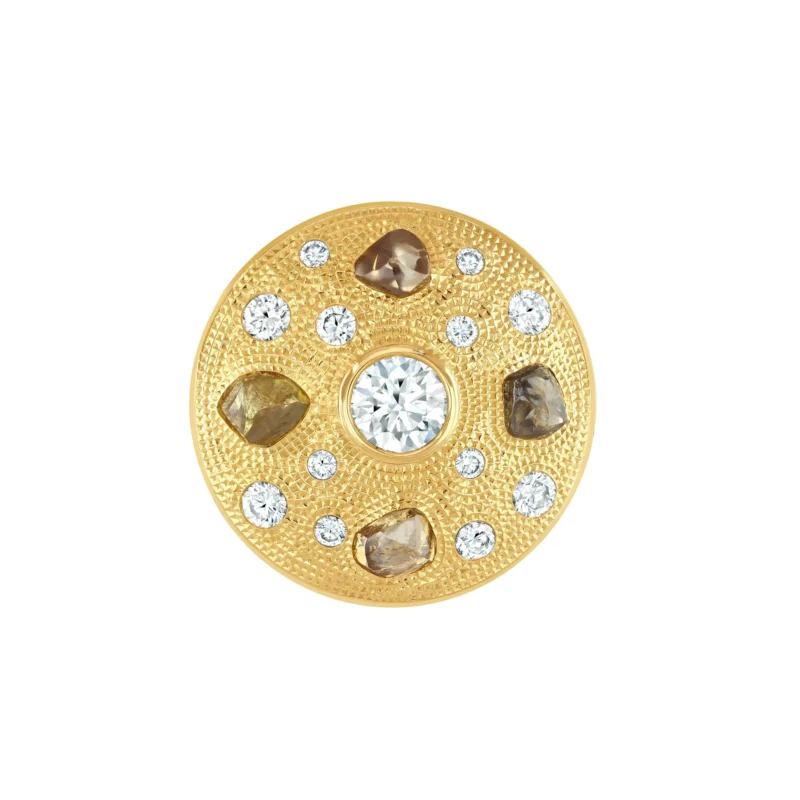
Irregular rough-diamond silhouettes rise from a hand-worked field of gold in a current Talisman High Jewellery ring.
A conventionally faceted diamond gives the setter something extremely useful: a girdle.
That boundary between crown and pavilion provides a predictable zone around which prongs, bezels, channels or other setting structures can be designed.
A rough crystal may offer nothing comparable.
It can have pointed octahedral corners, curved resorbed surfaces, shallow natural faces or irregular broken edges. One stone can sit low and broad; another may rise sharply from the metal.
That explains why Talisman’s setting language matters as much as its stone selection.
De Beers says serti poinçon allows rough and polished diamonds of different shapes and sizes to sit together and permits a shallower setting than conventional deep settings.
The metal is hand-hammered around the stones.
This does two things at once.
Structurally, it creates an individual seat around an irregular object.
Visually, it keeps more of that object above the metal.
The point is not to make a rough diamond behave like a calibrated brilliant.
It is to build the gold around the rough diamond.
Serti poinçon: build the gold around the stone
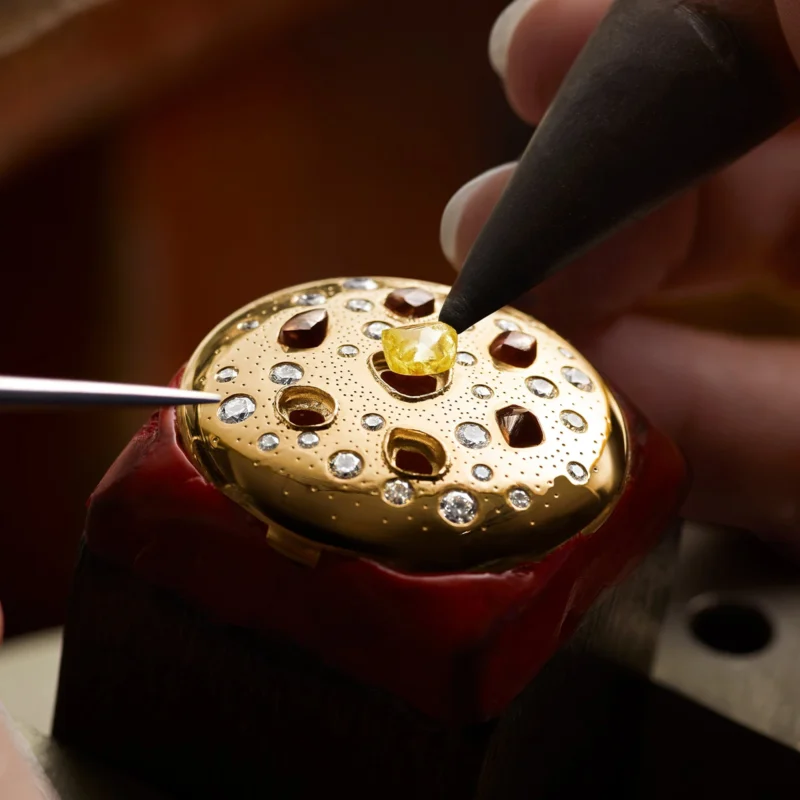
The serti poinçon surface is built locally around stones that do not share a standard outline.
Seat. Read the footprint and height of an individual crystal.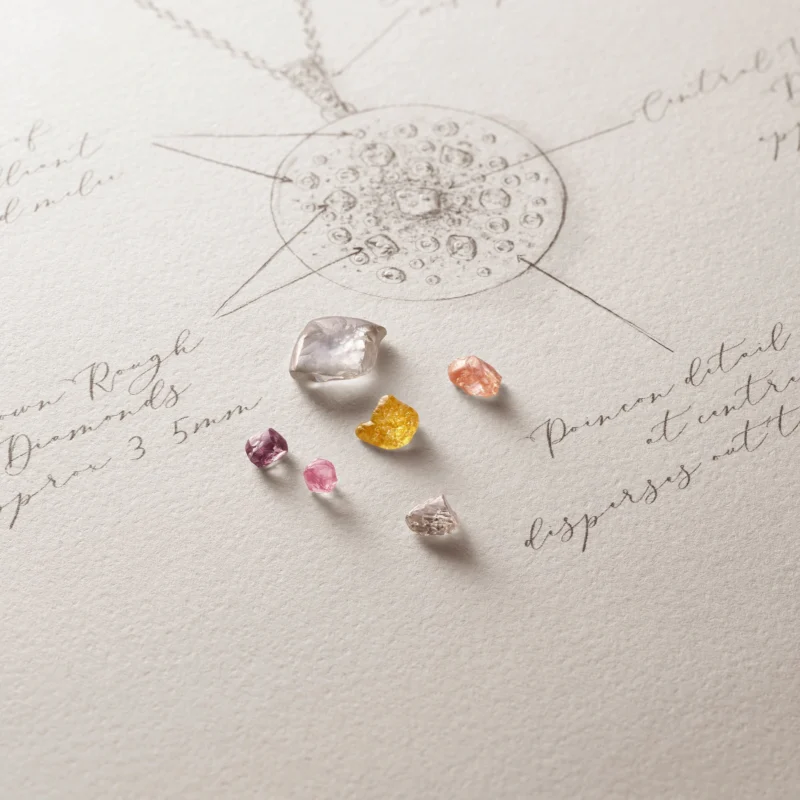
A white-gold medallion shows the hand-worked setting language and the reverse-side construction of Talisman.
Hammer. Work the precious metal locally around non-standard geometry.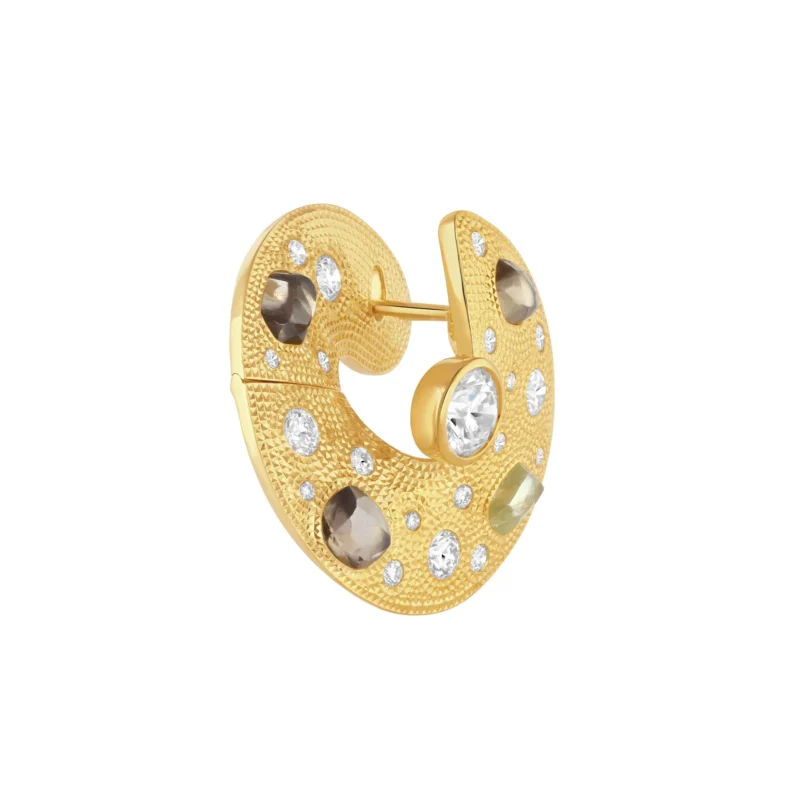
Talisman earrings extend the rough-and-polished composition around both front and back of the ear.
Reveal. Keep more of the stone and its natural surface above the setting.
The hammered surface is one of the easiest parts of Talisman to recognise.
Tiny indentations across the gold give the metal a granular texture, often compared with earth or an archaeological surface. It can look decorative enough that the setting logic behind it disappears.
De Beers describes the technique more functionally.
Its Diamond Journey material says the House revived a traditional setting method involving meticulous hand-hammering of precious metal. The shallower setting allows differently shaped diamonds to sit together while increasing exposed surface and light interaction.
Current product pages repeatedly use the verb “encapsulate”.
That is useful.
A claw grips a stone at specific points.
A conventional bezel creates a more regular metal rim.
Serti poinçon behaves less like a repeated standard fitting and more like local metalwork built around each stone.
This is particularly important with rough diamonds because the setting cannot assume the next stone has the same profile as the previous one.
The visual texture is therefore a consequence of a method that also solves a geometric problem.
Three jewels, three geometry problems
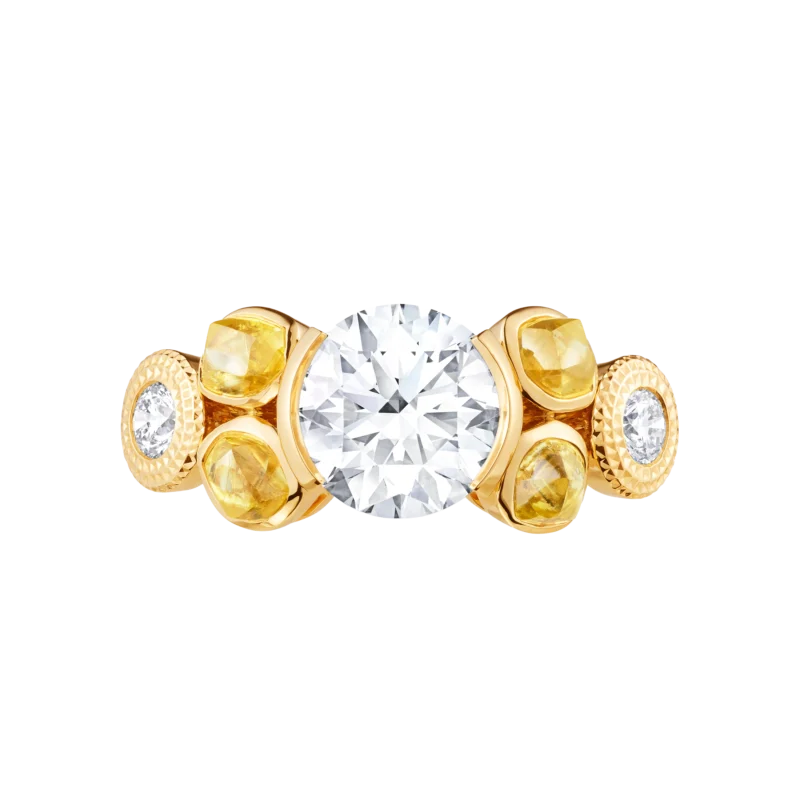
The Talisman Trio ring gathers differently oriented stones into one sculptural gold architecture.
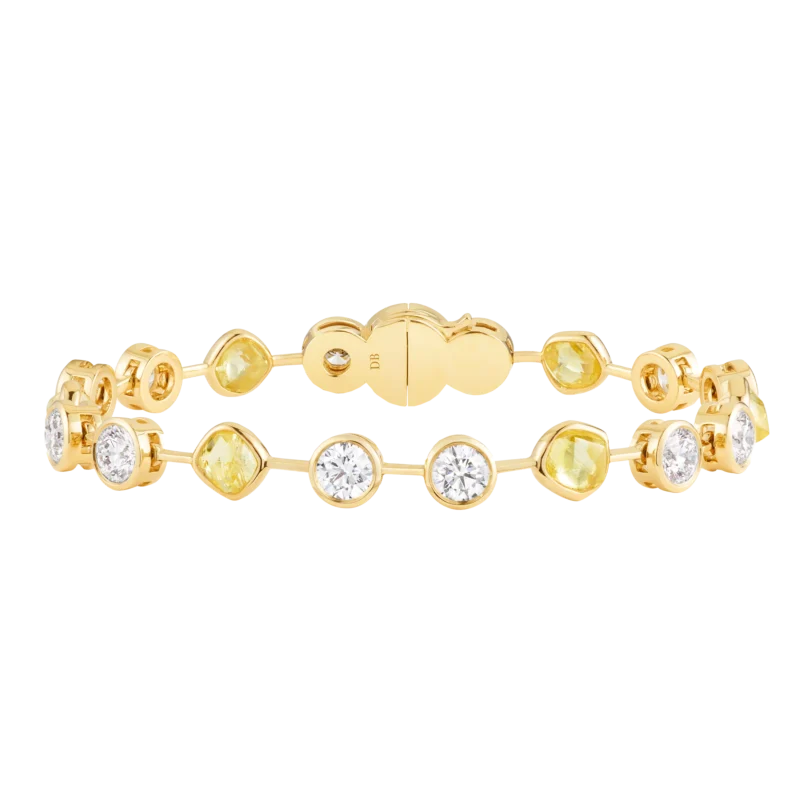
The Lines bracelet translates the rough-and-polished contrast into a linear sequence of bespoke settings.
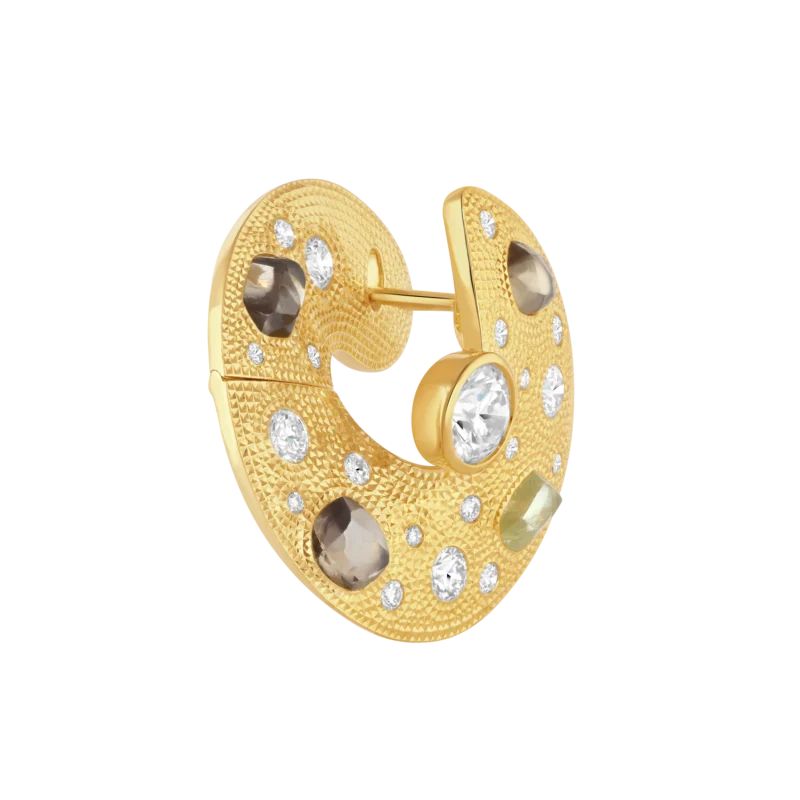
Current yellow-gold Talisman earrings place polished centres beside rough diamonds with individual geometry.
The present collection is not built around one kind of rough.
The High Jewellery cuff uses 14 warm-hued rough diamonds beside polished stones and a white central diamond. De Beers’ regional pages currently disagree slightly on its approximate total weight, with some listing about 11 carats and one German page showing about 9 carats. The discrepancy should remain open rather than be silently normalised.
The current High Jewellery ring uses six rough diamonds whose irregular silhouettes rise from the gold around flush-set white brilliant stones.
The current earrings place a polished white centre beside warm rough and white brilliant diamonds while extending the construction around both front and back of the earlobe.
The Lines Bracelet uses yellow rough diamonds in bespoke bezel settings beside polished stones. Its current product specification gives 5.70 carats of yellow rough, a 3.30-carat round brilliant centre and approximately 9.33 carats total.
A newer yellow-gold ring lists about 3 carats of brown and yellow rough diamonds around a 0.70-carat G VS1 round brilliant centre, with approximately 4.50 carats total.
These are not one setting problem repeated.
A rough in a flush field, a rough in a line bracelet and a rough projecting from a sculptural ring all impose different requirements on surrounding metal.
The common principle is that the stone keeps its irregular identity.
The locket turns surface into mechanism
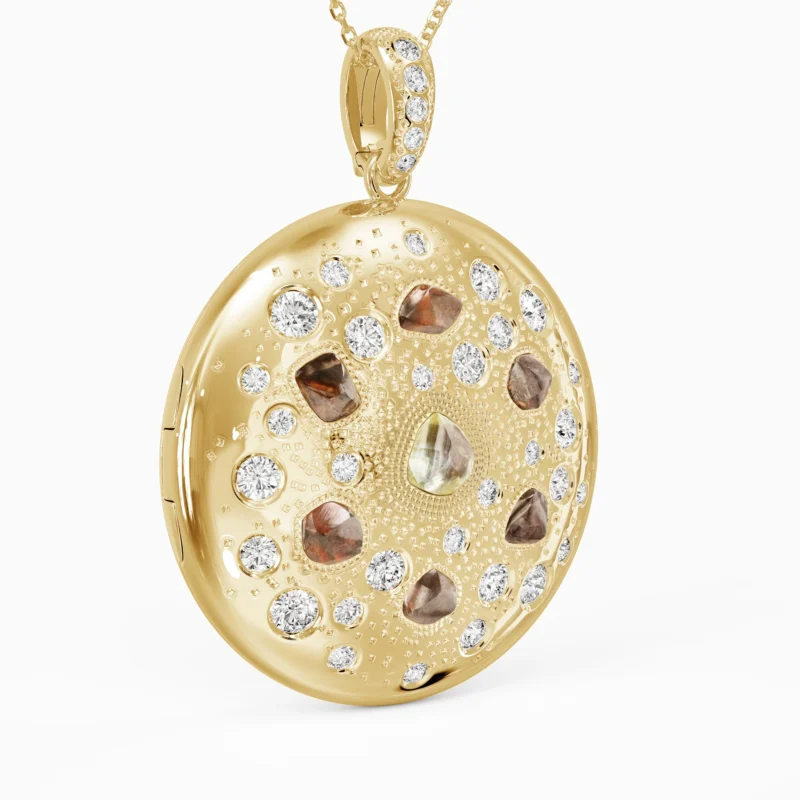
The twentieth-anniversary locket carries the familiar Talisman surface across a functional, three-dimensional object.
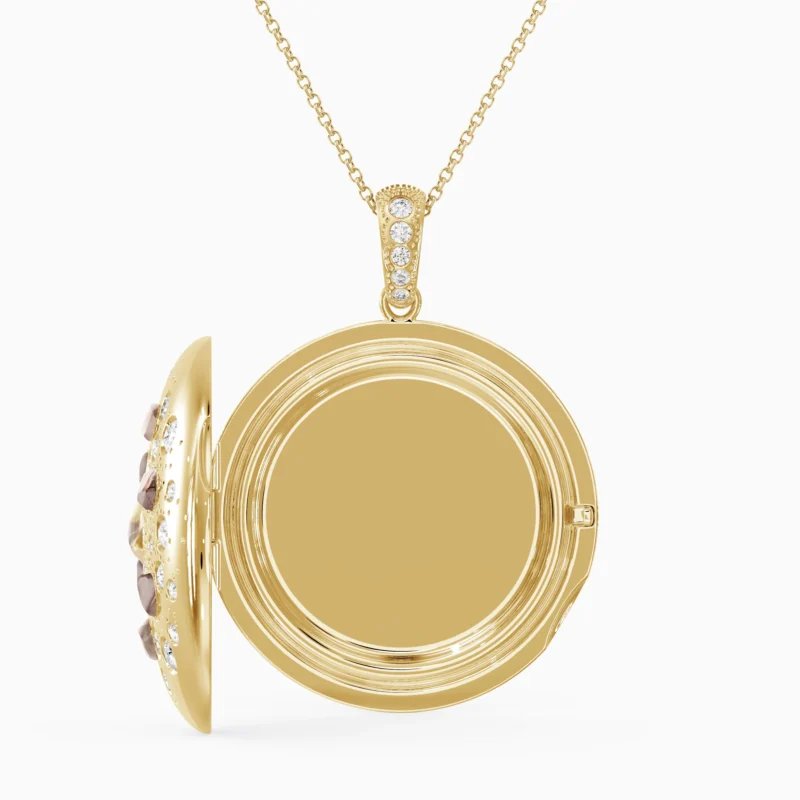
Opened, the locket reveals the compartment, removable frame and hidden mechanical brief behind the decorated exterior.
Explore the comparison
| Closed | Open |
|---|---|
| Rough and polished diamonds occupy a 34 mm hammered-gold exterior. | A hidden clasp, compartment, engravable disc and removable frame make volume and closure part of the brief. |
The 2025 anniversary locket is especially useful because it takes the Talisman surface language off a flat medallion and puts it on a functional object.
De Beers produced it as a limited series of 20.
The 34 mm yellow-gold locket combines 3.57 carats of yellow and brown rough diamonds with polished white diamonds for an approximate total weight of 5.33 carats.
The front retains the serti poinçon and hand-hammered language.
The object then has to open.
A hidden clasp reveals an internal compartment, an engravable gold disc and a removable frame for a photograph or note.
This makes the thickness meaningful.
A conventional medallion can use its back largely as structural support or as a second decorative plane. A locket has to preserve enough internal volume, hinge geometry and closure security to function as a container.
The rough diamonds therefore occupy the exterior while the metal body has to satisfy another mechanical brief behind them.
The anniversary piece is important because it proves the visual code can survive a more complicated object.
The rear can change the way the front is read
One current white-gold Talisman medal makes another construction decision explicit.
De Beers describes the back of each diamond as opened through mise à jour.
Removing metal behind the stones allows more light to pass through them.
This is common high-jewellery logic for transparent faceted stones, but Talisman complicates the situation because rough diamonds do not all transmit light in the same way.
Some rough crystals are relatively transparent.
Some are translucent.
Some carry body colour, surface texture or inclusions that change the balance between transmitted and reflected light.
Opening the reverse therefore does not make every rough diamond behave like a brilliant.
It gives each one more opportunity to show its own optical character.
This is another example of the metalwork adapting to the stone rather than forcing the stone into one standard appearance.
Preserving material creates a different constraint
Faceting removes material.
That is unavoidable.
GIA’s cutting literature regularly shows how a rough diamond can be planned into one or more polished stones, with the cutter balancing carat retention against clarity, shape and optical performance.
Leaving a diamond rough obviously avoids the material removed by faceting that specific stone.
But that does not mean rough use is automatically an exercise in maximum value retention.
The designer gives up standardisation.
The setter gives up the regular girdle.
Matching becomes harder.
Orientation becomes more important.
The final jewel must accommodate height differences and irregular footprints.
A rough diamond can also contain features that a cutter would normally remove or reposition through planning.
So the trade is not simply “more carat weight for less work”.
The craft moves.
Less lapidary transformation can mean more jewellery-specific adaptation.
Natural surface is part of the design brief
De Beers repeatedly refers to rough diamonds retaining their natural skin.
GIA provides a more technical reason that wording matters.
Rough diamond surfaces can record growth and geological alteration. Terraces, trigons, hillocks, frosting, rounded resorption and breakage surfaces are not cosmetic additions made by the jeweller.
They belong to the crystal’s history.
Once the stone is polished, most of that exterior record disappears.
A polished facet records a different intervention. It shows the cutter’s chosen plane, orientation and finish.
Talisman’s juxtaposition therefore places two authorship systems beside one another.
The rough surface is primarily geological.
The polished surface is geological material rewritten by lapidary decisions.
Goldsmithing holds both.
That is more precise than describing the collection as simply “raw versus refined”.
Both states are refined in the sense that the jeweller has selected, arranged and set them carefully.
The difference is where intervention stops.
Colour resists standardisation
Current Talisman pieces use brown, yellow, green, orange, blue and white rough diamonds.
That colour language should be described carefully.
Colour in rough diamond can sit in the body, be affected by surface features or appear differently once a stone is cut and viewed through polished facets.
The product pages also warn that individual rough diamonds are unique and that exact colour and carat weight may vary.
This has a direct design consequence.
If a piece is repeated commercially, the next example cannot necessarily be assembled from stones that are visually identical to the previous one.
A rough-diamond collection therefore tolerates a degree of controlled variation that would be less acceptable in a line built around calibrated white brilliants.
This is not a defect in production consistency.
It is part of the material premise.
But it also means photographs should not be treated as exact specifications for every example unless De Beers says the piece is unique.
Why the 2005 idea survived
Fashion can keep a motif alive for a few seasons.
Talisman has lasted because its organising principle works at several scales.
The small bands can place one or a few rough stones into hammered gold.
The medallions can arrange many rough and polished stones concentrically.
The chandelier earrings can make yellow rough diamonds part of a long articulated construction.
The Lines Bracelet converts the contrast into a linear sequence.
The High Jewellery cuff turns the same language into a broad sculptural surface.
The setting method remains recognisable even when the object changes.
That is what makes Talisman a house code rather than a single 2005 design.
The rough diamond is only one part of the code.
The code is the relationship between rough, polished and worked gold.
What changed after twenty years
The collection has expanded in scale and typology.
The original 2005 identity was strongly associated with medallions and compact fields of rough and polished diamonds. Current Talisman includes cuffs, asymmetric earrings, large rings, line bracelets, chandelier earrings and lockets.
The rough stones also move through different colour families and different levels of visual prominence.
But the current pieces do not abandon the original tension.
A polished white centre often remains the visual anchor.
Rough coloured diamonds interrupt its precision.
The poinçon surface mediates between them.
In some pieces, bespoke bezels replace or supplement the classic hammered field.
That is evolution, but not a change of premise.
The collection still asks the same question it did in 2005.
How much of the diamond should the jeweller leave alone?
What the evidence does not establish
Several claims should remain outside the article.
There is no basis for saying a rough diamond is inherently rarer or more valuable than a polished diamond simply because it is uncut.
Value depends on many variables, including quality, size, colour, shape, potential polished yield, provenance and market context.
There is also no evidence that Talisman roughs are selected to maximise theoretical polished yield. De Beers says they are selected by eye for character, colour, shape and their role in the composition.
The exact mechanical details of each individual rough setting are not published.
De Beers explains serti poinçon at the collection level, but it does not provide engineering drawings showing how every irregular crystal is undercut, supported or secured.
And the current 2026 High Jewellery page should not be misdated as a new 2026 launch.
The anniversary was 2025.
The collection is current in 2026.
Those are different facts.
Why leave a diamond rough?
Because cutting is not the only way to reveal a diamond.
Faceting is extraordinarily effective at organising light. It can improve apparent brightness, expose or avoid inclusions through planning, standardise geometry and make a stone easier to integrate into conventional jewellery architecture.
Talisman chooses a different priority for selected stones.
It preserves the exterior that geology produced.
That decision pushes complexity away from the lapidary bench and toward selection, composition and setting.
The designer has to accept asymmetry.
The setter has to respond to non-standard geometry.
The gold surface has to connect objects that do not share a common girdle or profile.
The polished diamonds then provide the optical counterpoint.
Twenty years after Talisman’s launch, that contrast still works because the collection does not ask rough diamonds to imitate polished ones.
It builds around the fact that they never needed to.
Sources & further reading
- De Beers Talisman High Jewellery and current product pages, checked 20 September 2026.
- GIA, Diamond Reflections and Diamond Dissolution, used for morphology and surface context.
- TheTimeo distinguishes official specifications from editorial interpretation and does not claim hands-on inspection.
The Edit
Jewelry stories
Selected stories from the same editorial universe.
Beyond the 4Cs: Choosing an Engagement Ring for Everyday Life
The diamond report is only half the decision. Height, setting, shoulders, sizing and the
Natural, Laboratory-Grown and Treated Diamonds: How to Read the Report
Natural or laboratory-grown describes origin; treatment describes what happened later. A diamond report should
Boucheron Human Being: One Shape, Five Ways of Making It
Rain, Flower, Light, Tattoo and Checkers repeat one high-jewellery silhouette while changing material, technique,
Chopard Miracles 2026: How 79 High Jewellery Pieces Avoid Becoming One Idea
Chopard’s Red Carpet Collection becomes most compelling when the festival theme recedes and each
One Butterfly, Twelve Constructions: How Graff Turns a Motif into High Jewellery
Graff holds one butterfly silhouette still, then changes colour, volume, surface and movement across
Emerald or Sapphire? Choosing a Coloured-Stone Engagement Ring
Emerald and sapphire can both belong in an engagement ring, but setting, treatment history