
TheTimeo / Jewelry
SEVENTY-NINE MIRACLES,
no single formula
Chopard’s Red Carpet Collection becomes most compelling when the festival theme recedes and each jewel reveals a different feat of scale, structure, movement or concealment.
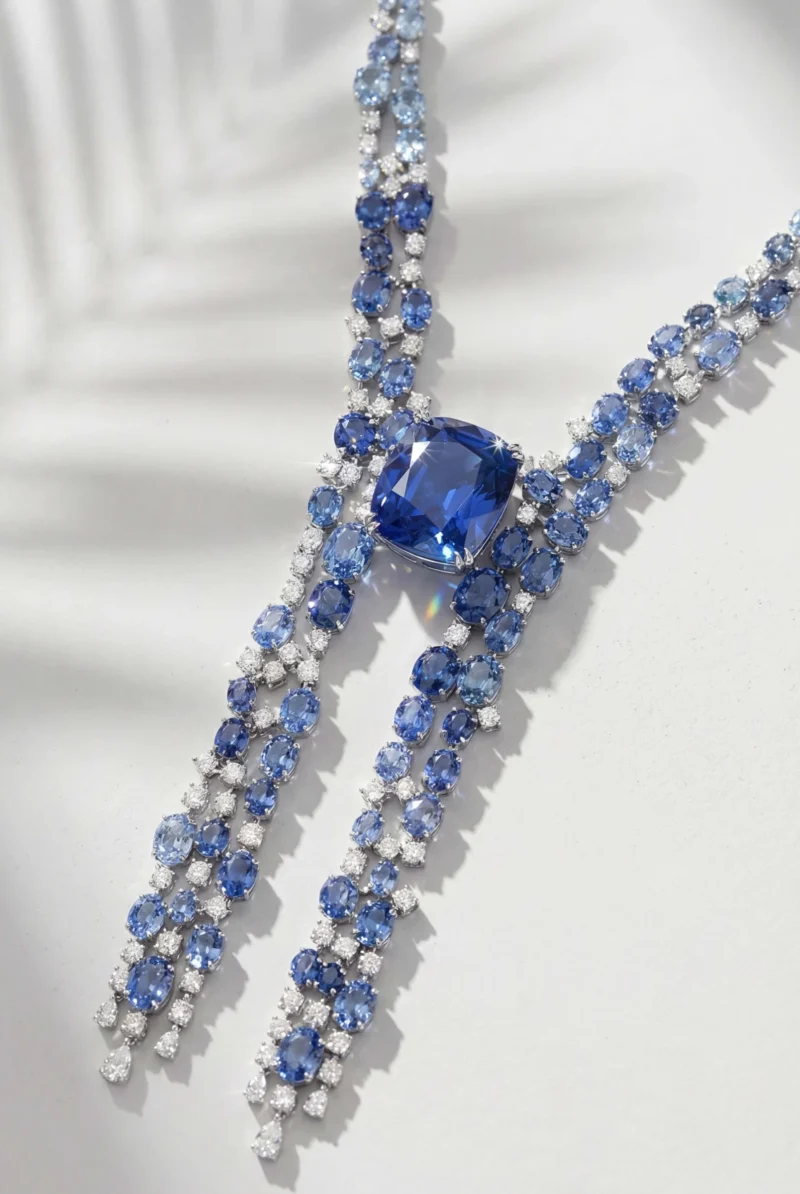
The 88-carat sapphire establishes the centre of gravity for a necklace that carries blue outward through sapphires, aquamarines and diamonds. Courtesy of Chopard.
Explore the story
Seventy-nine is an awkward number for a jewellery collection.
It is large enough to become a catalogue. Large enough for a theme to start doing too much work. Large enough for the best pieces to disappear behind the headline that was supposed to make them memorable.
Chopard has a reason for the number. The 2026 Red Carpet Collection was made for the 79th Cannes Film Festival, continuing the Maison’s annual practice of linking the number of high jewellery creations to the Festival edition. This year the title is Miracles. Chopard talks about small flashes of wonder: light breaking through cloud, a moon changing colour, a flower opening, an animal caught in motion.
That language is pleasant, but it is not the useful way to read the collection.
The useful way is to forget the theme for a moment and ask what each object had to solve.
The 88-carat sapphire necklace has to make a very large blue stone feel like the centre of a composition rather than a stone with decoration attached. The emerald pieces have to manage weight, repetition and flexibility without turning the body into a display stand. A phoenix brooch has to look alive even though every gram of gold, titanium and gemstone is fixed. A secret watch has to let a butterfly hide a dial while still behaving convincingly as jewellery.
Once the collection is read this way, Miracles stops being a broad nature story. It becomes a set of very different construction problems placed under one annual title.
Key facts
- Chopard’s Red Carpet Collection 2026 is titled Miracles and comprises 79 high jewellery creations.
- Chopard has been an official partner of the Cannes Film Festival since 1998 and links the annual number of Red Carpet pieces to the Festival edition.
- Caroline Scheufele is Chopard Co-President and Artistic Director and leads the creative direction of the collection.
- Chopard identifies the principal sapphire necklace as centred on an 88-carat Royal Blue sapphire, set in Ethical white gold with sapphires, aquamarines and diamonds.
- The official 2026 presentation also highlights an all-diamond jewellery watch, an emerald choker, emerald-centred cuffs and phoenix brooches.
- Chopard’s own high jewellery material identifies lost-wax carvers and casters, jewellers, lapidaries, gemsetters and polishers among the crafts involved in its high jewellery workshops.
- Chopard states that its workshops have used 100% of the gold it defines as Ethical Gold since July 2018, sourced through responsible artisanal mining and RJC Chain of Custody-certified refineries.
Cannes gives the count. The jewels need to earn it

The 2026 Palme d’Or: Cannes explains the annual count, but not the design of the jewels. Courtesy of Chopard.
Chopard’s relationship with Cannes began in 1998, when Caroline Scheufele’s redesigned Palme d’Or appeared at the Festival. The Maison still produces the Palme and the other closing-ceremony trophies in its workshops. The Red Carpet Collection grew within that relationship, and the annual piece count has become part of its structure.
There is a commercial logic to that ritual. Cannes gives Chopard visibility, clients, press attention and an unusually concentrated stage for high jewellery. But none of that tells us whether the jewellery is good.
That distinction matters because celebrity placement can make a collection look stronger than it is. A jewel can photograph beautifully on a red carpet and still be conceptually thin. Conversely, an object that looks almost excessive in a press image can turn out to be much more intelligent once its construction is understood.
Miracles deserves to be separated from the event that launches it.
The strongest pieces are not interesting because they were designed for actresses, gala dinners or photographs. They are interesting because they show different ways Chopard handles scale, colour, articulation and visual weight.
The 79-piece format creates another pressure. Repetition is difficult to avoid. A house could easily make the same necklace five times with different centre stones, turn every animal into a pavé brooch, and call consistency a design language. Chopard does repeat signatures, but the better objects change the underlying problem.
That is where the collection becomes worth studying.
An 88-carat stone changes the whole necklace
The most obvious object is the necklace built around the 88-carat blue sapphire.
Chopard describes the stone as Royal Blue. That wording should be handled carefully. In this article it is treated as Chopard’s descriptor, not as an independently established laboratory grade. The public collection page does not identify an origin for the sapphire, and TheTimeo has not examined a gemmological report for it.
What can be established is the design response.
The sapphire sits at the centre of an Ethical white-gold necklace surrounded by smaller sapphires, aquamarines and diamonds. The colour moves outward rather than stopping abruptly at the centre. Darker blue around the main stone gives way to lighter blue and then to flashes of white. Chopard describes the composition through the meeting of earth and sky, but the more interesting point is structural: the designers avoid treating the large stone as an isolated trophy.
A stone of this scale creates gravity in every sense that matters to jewellery design. Visually, it dominates the eye. Physically, it creates weight. Proportionally, it can make every neighbouring stone look like filler. The setting therefore has to give the centre stone authority without making the rest of the necklace irrelevant.
The answer here is rhythm rather than symmetry alone. The surrounding blue stones form fluid lines that extend the colour field of the sapphire. Aquamarines soften the transition. Diamonds interrupt it. The necklace becomes a gradient with a centre of mass.
That is more difficult than simply selecting smaller stones that match.
High jewellery often begins after the important gem has already been chosen. Caroline Scheufele has said in a 2026 interview that at Chopard the stones can precede the design. That idea is especially legible here. The sapphire is not dropped into a pre-existing necklace architecture. Its size and colour appear to determine the scale of the entire piece.
The useful question for a collector is therefore not whether 88 carats sounds impressive. It obviously does. The useful question is whether the design makes the stone more legible as an object.
Here, it does.
Emerald is volume, not just colour
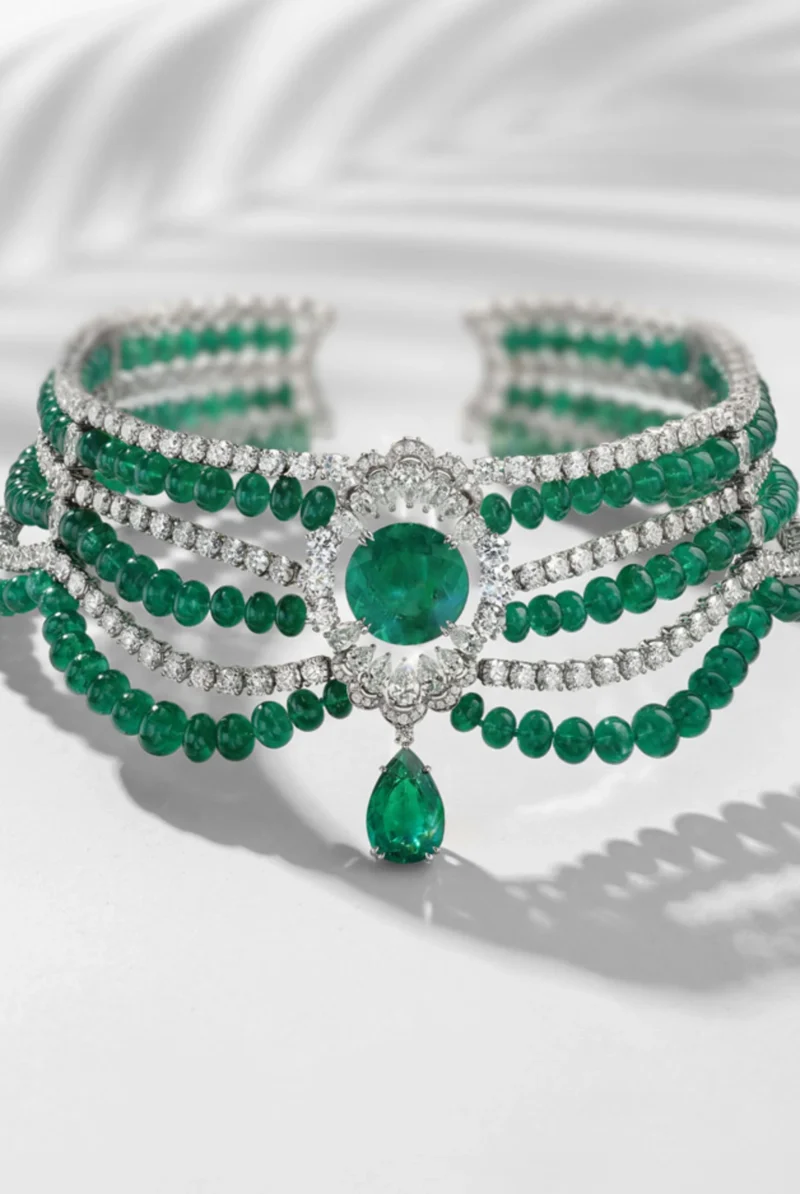
The emerald choker treats exceptional stone volume as an articulated architecture around the neck. Courtesy of Chopard.
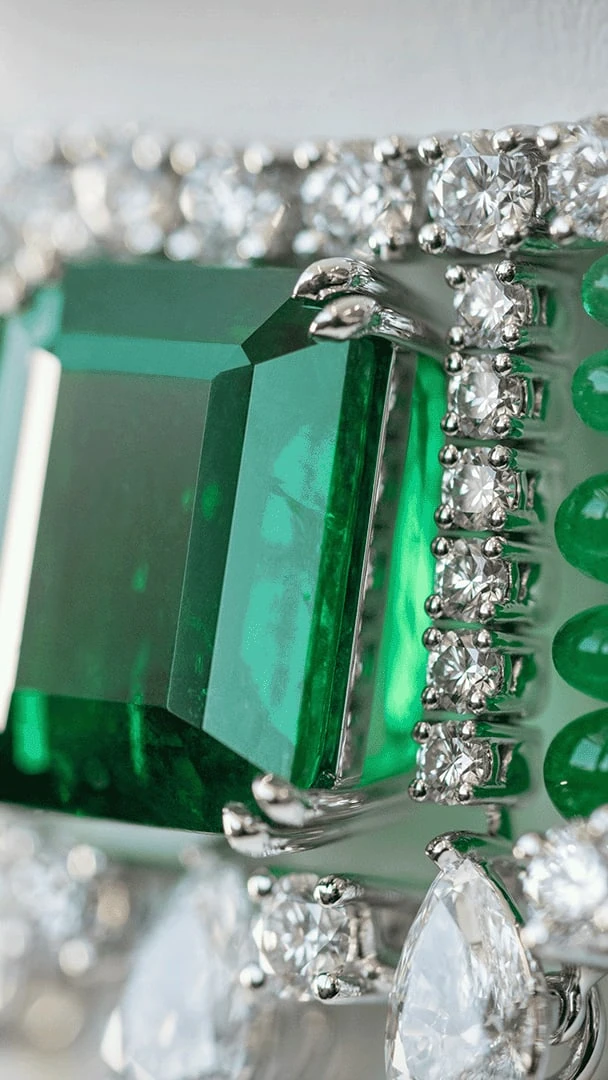
A close setting view reveals the metal, spacing and diamond framework around the emerald composition. Courtesy of Chopard.
The emerald group is more revealing because the pieces are built around a different problem.
Chopard’s public 2026 page shows an emerald choker and refers to emerald-centred cuffs. Secondary reporting based on Chopard-supplied specifications gives a clearer picture of the scale. Numéro Switzerland describes the choker as set with emerald-cut emeralds totalling more than 87 carats, with more than 40 carats of diamonds. In a direct interview feature with Caroline Scheufele, Only Natural Diamonds reports 87.35 carats of emeralds and 57.15 carats of diamonds for the necklace worn at Cannes.
The exact totals matter less than the architecture they create.
A choker constructed from large emeralds has almost no margin for laziness. The stones need enough metal to stay secure, enough articulation to sit around the neck, and enough spacing to avoid reading like a rigid belt. The eye also notices irregularity immediately because emeralds, even when matched, do not behave like a row of calibrated white diamonds.
The Miracles choker solves this by letting the emeralds form distinct green lines rather than one dense uninterrupted mass. Diamond rows give the green room to breathe. The central emerald and pear-shaped drop create a vertical axis, while the side structure spreads the weight horizontally.
The result is visually substantial without becoming block-like.
The cuffs push the problem further. One reported example centres on a 50.99-carat vivid green Colombian emerald cabochon framed by diamonds. Another uses a 50.45-carat emerald cabochon with pastel sapphires reported at 91.65 carats, plus emeralds and diamonds.
Those are not small jewellery decisions. A cabochon of roughly 50 carats is a volume, not simply a colour. It sits above the wrist. It catches on clothing. It changes balance. The cuff has to become a support system around it.
This is where high jewellery separates itself from a gemstone inventory. The valuable material is only the beginning. The piece succeeds when the metal and secondary stones distribute the visual and physical mass so that the wearer does not look as though a specimen has been strapped to the body.
Chopard’s emerald pieces are at their best when they make that support architecture visible enough to understand, but not so visible that the jewellery turns technical.
To make a phoenix fly, the metal must disappear
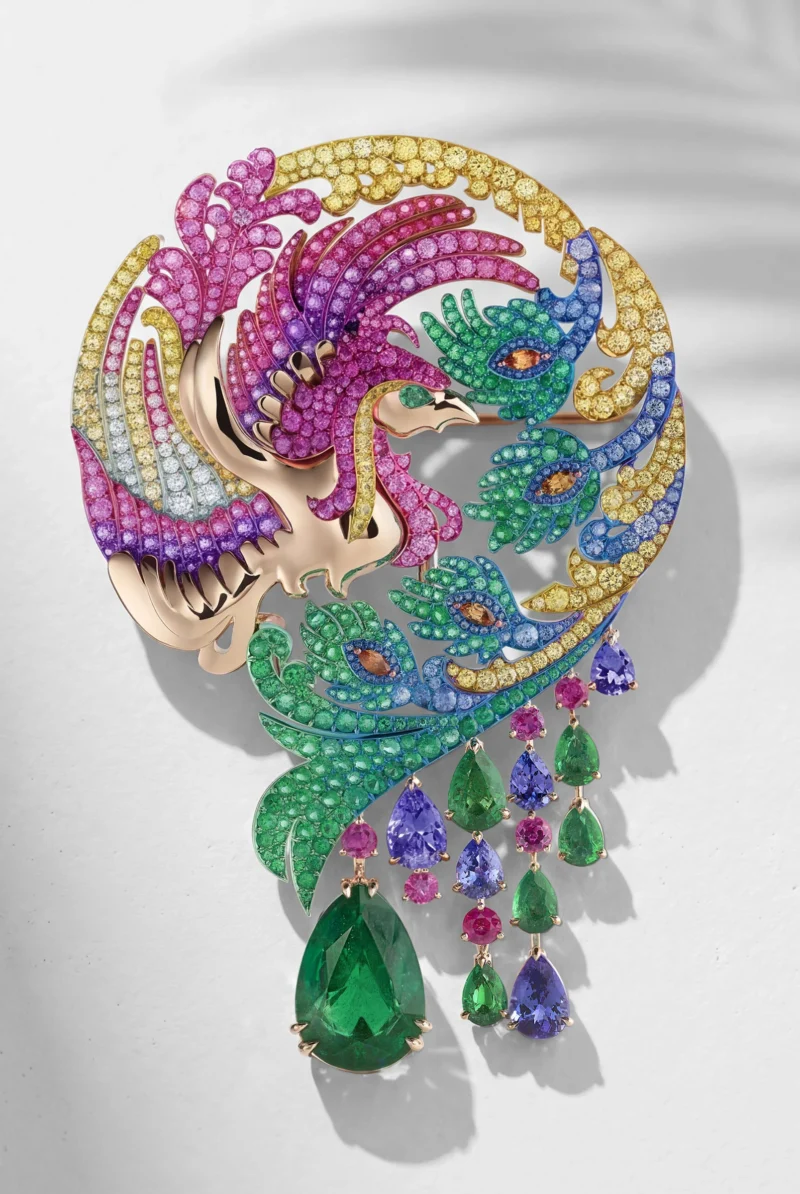
The phoenix builds motion through sweeping colour fields, titanium-supported breadth and suspended drops. Courtesy of Chopard.
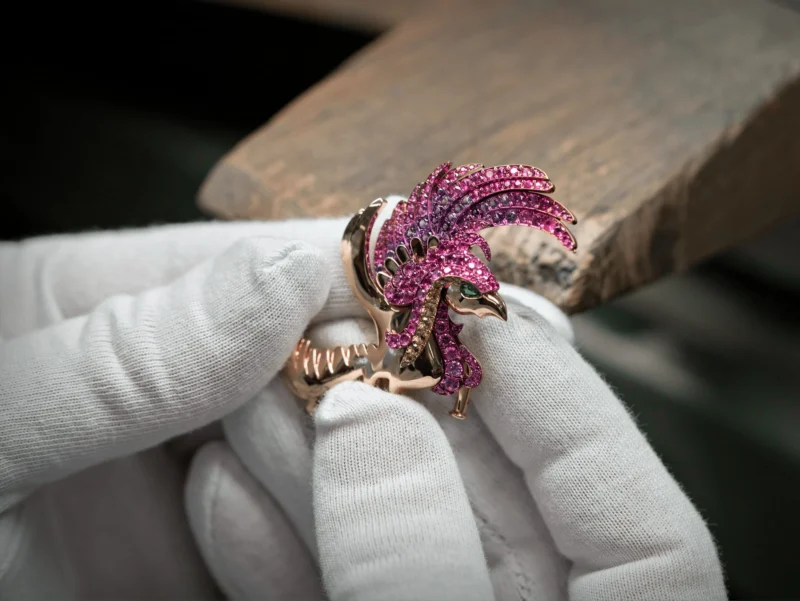
In the workshop, the structure beneath the phoenix becomes visible before the final colour field takes over. Courtesy of Chopard.
The phoenix brooch is a completely different exercise.
A large coloured-stone necklace can accept weight. A bird in flight cannot. At least not visually.
Chopard uses Ethical rose gold and titanium for the multicoloured phoenix, with emeralds and sapphires building the plumage. The official image makes the reason for titanium easy to understand even before the technical language begins. The object needs breadth, sweeping feathers and several distinct colour zones. If all that structure were expressed as dense precious metal, the bird would look anchored.
Instead, much of the framework recedes behind the stones.
The body is not naturalistic in the scientific sense. There is no attempt to make a taxidermic bird in gemstones. The form is exaggerated: feathers arc in broad coloured bands, the tail falls in suspended drops, and the head is almost graphic. Those distortions are what give the brooch motion.
The making-of image is particularly useful. Seen without the finished colour field, the brooch reveals the amount of engineering hidden by the final surface. Gemstone seats, supporting metal and articulation have to coexist with the illusion that the phoenix is turning through space.
This is a good example of why “craftsmanship” is too vague a word unless the article explains what the craft is doing.
Here, the craft is reducing visible structure while keeping enough structure to hold a complicated composition together.
The stone setter is not merely adding colour to a bird. The setter is helping determine the bird’s silhouette. The metalworker is not simply providing a base. The metalworker is deciding which parts of that base can disappear.
The difference is important.
How scales give the carp its motion
The carp brooch, described in Chopard’s 2026 press material and subsequent coverage, takes the same question into water.
The piece uses Ethical white gold and titanium with diamonds and sapphires arranged across the scales. The design is intended to suggest an undulating body, the fish caught in the sort of movement that would normally disappear before the eye had time to study it.
The risk with animal jewellery is obvious. Pavé can freeze everything. Once the whole surface is filled, a creature can become a rigid silhouette whose only motion comes from sparkle.
The carp avoids that trap by using the scales as a directional system. Repetition becomes useful because each scale helps the eye read the curve of the body. The gemstones are not only colour. They are vectors.
This is the sort of design move that makes Miracles more coherent than its theme suggests. The phoenix uses feathers to create centrifugal movement. The carp uses scales to create a wave. The two objects may sit under the same “nature” heading, but their construction logic is different.
That difference is what keeps the collection from feeling like a box of motifs.
When a butterfly decides whether time is visible
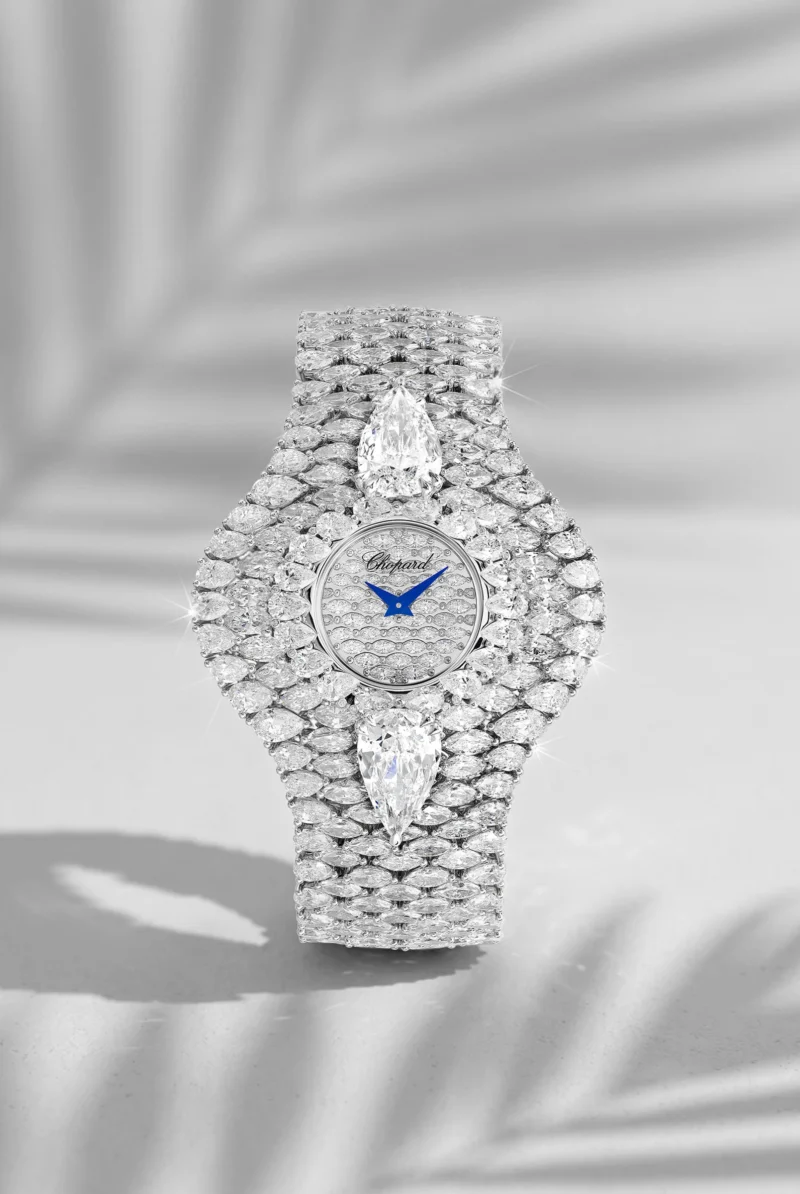
The all-diamond jewellery watch lets time recede into a continuous surface of light. Courtesy of Chopard.
Then there is the watch.
Chopard’s 2026 material describes a secret watch shaped as a butterfly resting on a flower, with a wing that closes over the dial. Diamonds and coloured sapphires carry the scene, and a matching brooch extends the idea into pure jewellery.
This is a useful object because it changes the role of time.
A normal watch tries to make the dial legible. A secret watch does the opposite. It asks the wearer to decide when time should appear.
That sounds romantic until you consider the mechanics of the object. The cover has to open and close cleanly. The decorative surface has to survive handling. The dial must remain readable once revealed. The hinge cannot destroy the line of the butterfly. The piece needs to feel like jewellery when the time display is hidden, not like a watch with an ornamental lid.
The best secret watches are convincing precisely because the mechanism disappears into the theme.
Miracles also includes an all-diamond jewellery watch that Chopard describes as set with approximately 46 carats of diamonds. It takes the opposite approach. Instead of hiding time beneath a figurative cover, it absorbs the watch into a continuous diamond surface. The dial becomes one component inside a jewellery object that is read first as light and texture.
Put the two watches together and a useful contrast appears. One conceals time through narrative. The other submerges time through material continuity.
That is a much more interesting watch story than simply noting that the collection contains jewellery watches.
Seventy-nine pieces need a workshop system
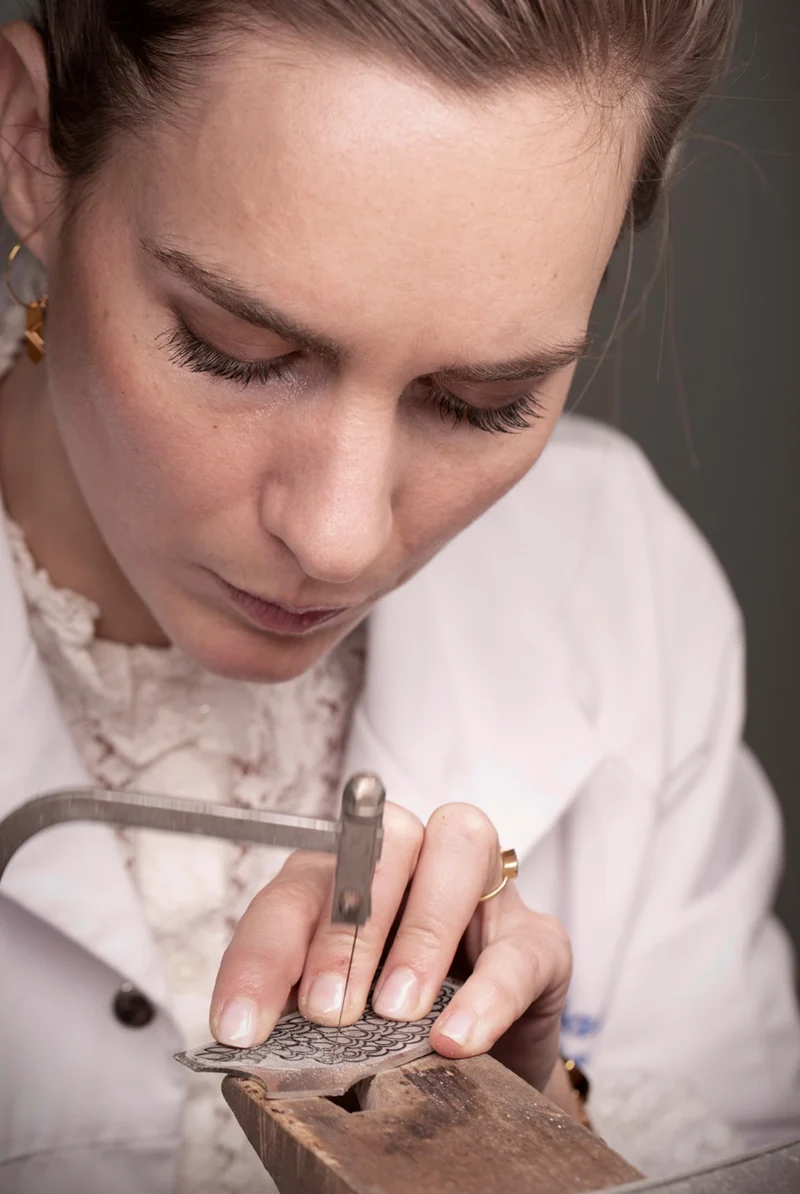
Model-making gives a proposed jewel volume before precious production begins. Courtesy of Chopard.
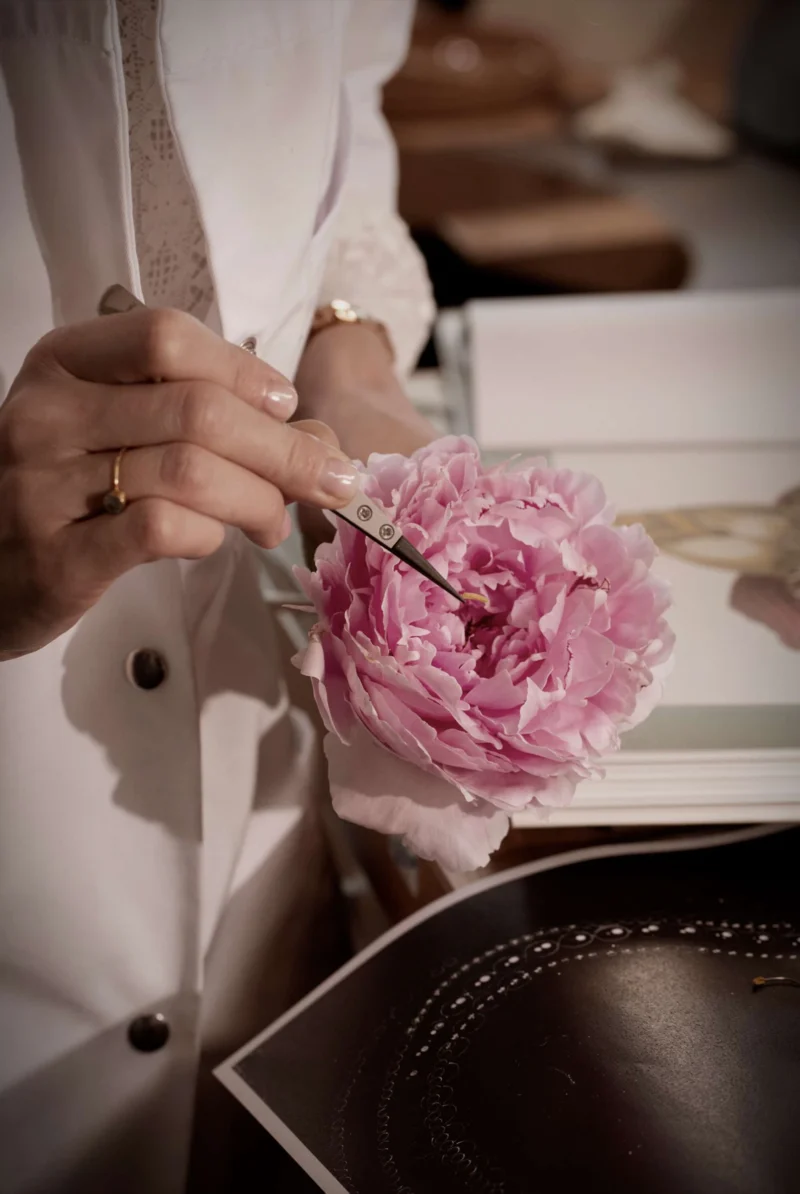
Observed natural form becomes a prompt rather than a shape to copy literally. Courtesy of Chopard.
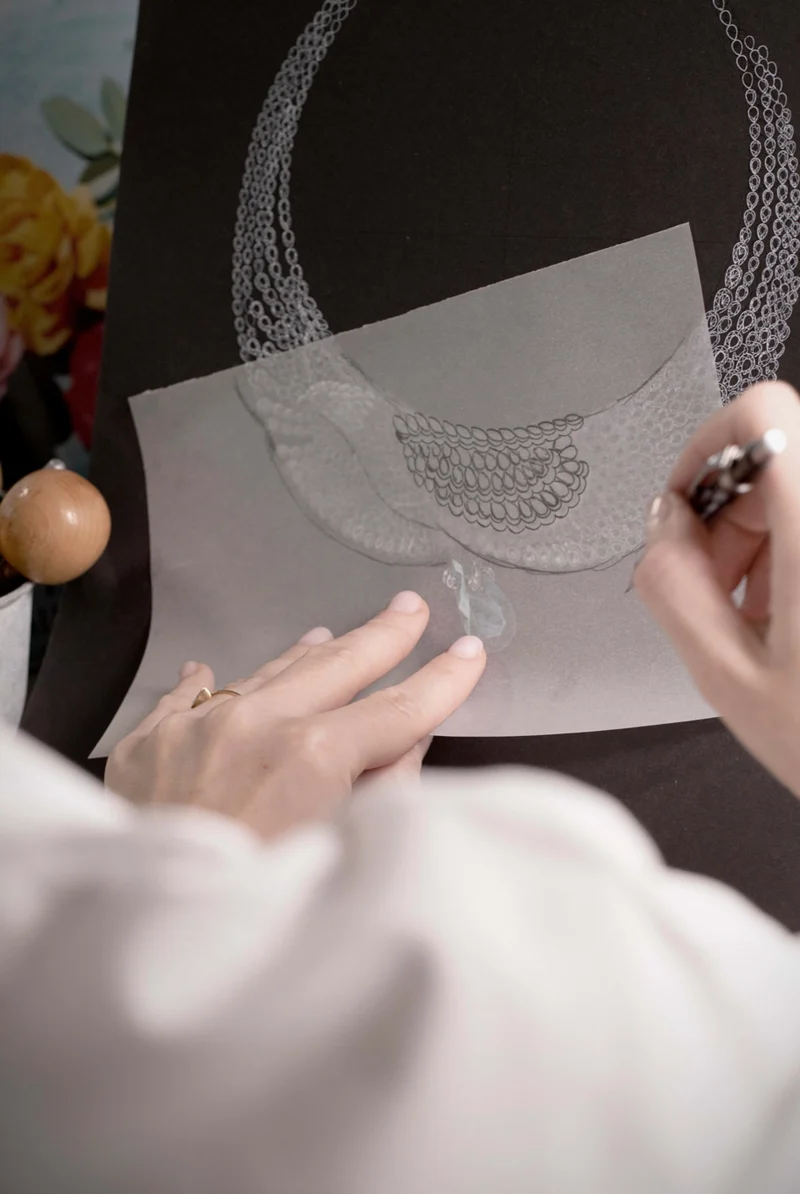
Drawing and three-dimensional modelling establish the relationships the later workshops must preserve. Courtesy of Chopard.
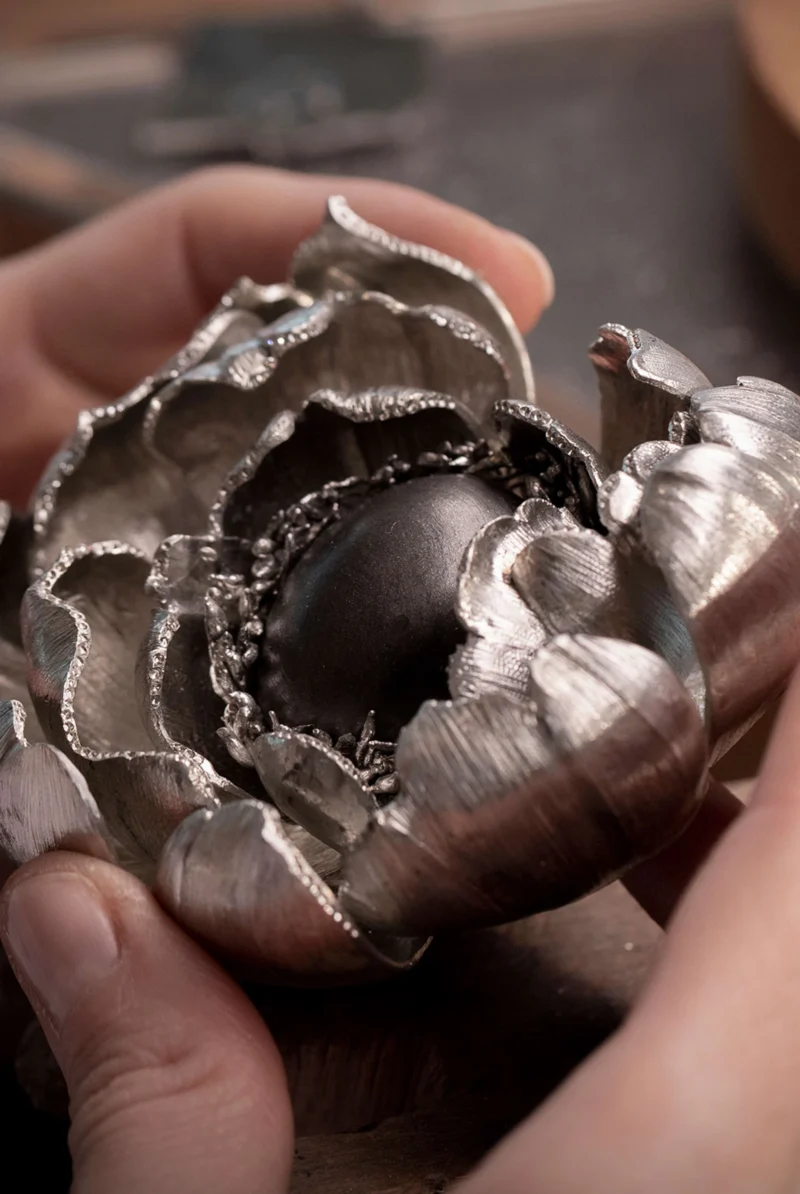
A flower model exposes the sculptural decisions normally hidden by gemstones and polish. Courtesy of Chopard.
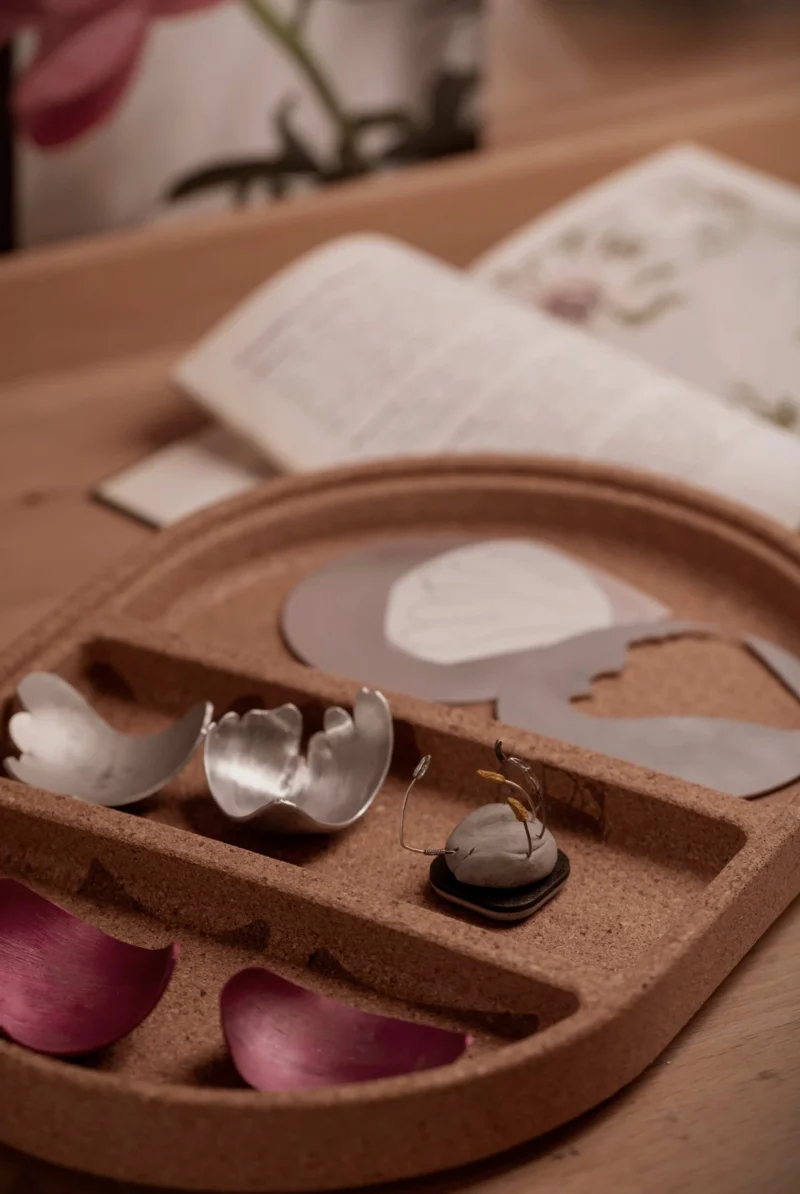
Tools, models and component studies: a large collection depends on a repeatable workshop language. Courtesy of Chopard.
There is another reason the scale of Miracles matters.
Chopard publicly identifies several distinct crafts within its high jewellery workshops: lost-wax carving and casting, jewellery making, lapidary work, gemsetting and polishing. Its artisan material also shows an intermediate modelling stage in which a three-dimensional version of a proposed jewel can be made in pewter and crystals before the precious version exists.
This matters because 79 pieces cannot be treated as 79 isolated flashes of inspiration.
Each object needs a route from drawing to volume. Stones have to be selected and sometimes recut or matched. Metal structures have to be engineered. Settings have to be planned around actual gem dimensions. Surfaces have to be finished. Pieces with movement, such as brooches and secret watches, add further tolerances.
The Red Carpet Collection therefore tells us something about Chopard that a single necklace cannot. The Maison is using Cannes as an annual test of workshop range.
The challenge is not simply to make many pieces. It is to make many pieces that require different kinds of intelligence from the workshop.
The sapphire necklace is a stone-led composition. The emerald choker is an exercise in flexible architecture. The phoenix is sculpture and setting. The secret watch adds concealment and movement. The all-diamond watch turns gemsetting into a continuous surface.
That range is the real achievement of a 79-piece collection.
TheTimeo has not established the total number of hours required to produce Miracles, the staffing assigned to the collection, or the production calendar for each object. Those figures should not be guessed. What can be said is that Chopard’s own description of its high jewellery process involves a chain of specialised crafts rather than a single bench operation.
Ethical Gold: what Chopard is actually claiming
The metal description deserves its own clarification because Chopard uses the phrase Ethical Gold throughout the collection.
According to the Maison, since July 2018 its workshops have used only gold that meets Chopard’s responsible-sourcing criteria. Chopard says this gold comes through two channels: responsibly produced artisanal gold and Chain of Custody gold from Responsible Jewellery Council-certified refineries.
That is the company’s stated sourcing framework. TheTimeo has not independently audited the supply chain for the individual Miracles pieces, so the article does not turn the phrase into a broader claim than Chopard itself supports.
This distinction is worth making because high jewellery increasingly mixes design language with sourcing language. One is not evidence for the other. A beautiful object does not prove responsible sourcing, and responsible-sourcing documentation does not make a design successful.
Both questions can be asked at the same time.
When “Miracles” falls silent
The word Miracles is broad enough to cover almost anything. That is its weakness as a theme and, strangely, its advantage as a collection title.
A narrower theme might have forced the 79 pieces into visual repetition. Chopard instead allows stones, animals, flowers, watches and large architectural jewels to sit together with only a loose conceptual link.
The best pieces do not need that link once you understand them.
The 88-carat sapphire necklace would still be interesting without the earth-and-sky story because the colour transition solves the problem created by the centre stone. The emerald choker would still be interesting without Cannes because its architecture manages an unusually large quantity of green material around the neck. The phoenix does not need a paragraph about rebirth when the colour and metalwork already make the bird feel as though it has been caught mid-turn.
This is where Chopard’s 2026 collection earns its scale.
Not every object in a 79-piece programme can carry the same weight editorially, and the public material does not provide enough technical detail for every creation to be judged individually. But the pieces that are documented show a house willing to change its methods according to the brief.
That is more valuable than visual uniformity.
After the red carpet
The easiest way to cover Chopard’s Red Carpet Collection is to count the pieces, list the largest stones and move on to who wore what at Cannes.
That would miss the useful part.
Miracles becomes more interesting when the 79 pieces stop being a number and start being separate design problems. A large sapphire needs a field around it. Emeralds need architecture. A phoenix needs to lose visual weight. A carp needs its scales to carry movement. A secret watch needs the mechanics of concealment to disappear inside the jewel.
That is what makes the collection worth returning to after the red carpet has been cleared.
The Cannes connection explains why there are 79 pieces. The objects themselves explain why anyone should still care about them once the Festival is over.
Sources & further reading
- Chopard, official Miracles Red Carpet Collection 2026 presentation.
- Chopard, official Cannes Film Festival and high jewellery workshop presentations.
- Chopard, responsible-sourcing framework for the Maison’s use of Ethical Gold.
- Product names, collection count, materials and stated carat weights were checked against Chopard’s public pages on 7 September 2026.
- ‘Royal Blue’ is Chopard’s descriptor. No independent gemmological grading, sapphire origin, hands-on inspection, market valuation or production-hour claim is made.
The Edit
Jewelry stories
Selected stories from the same editorial universe.
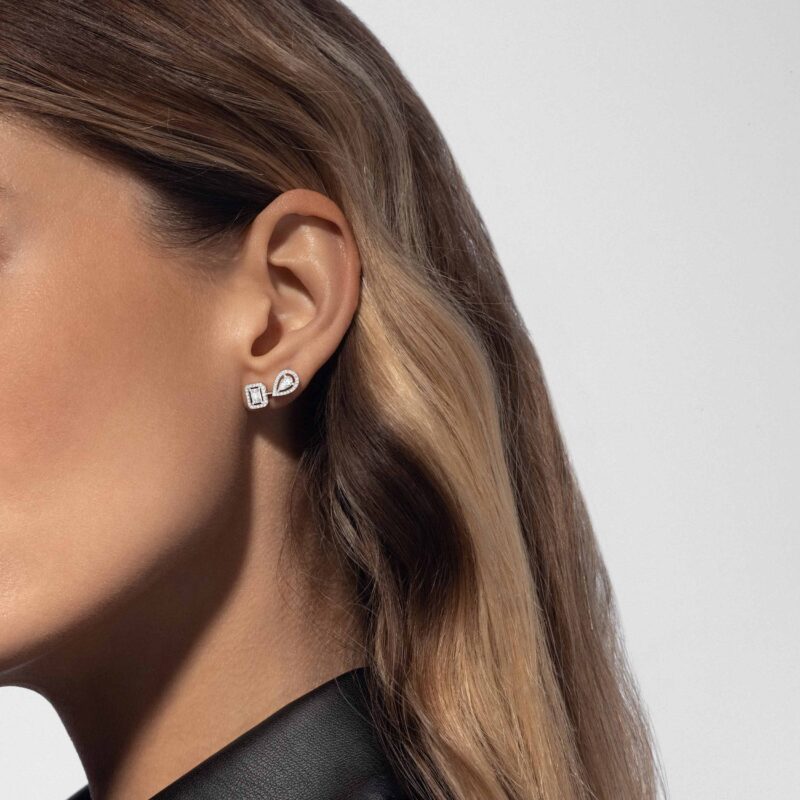
Messika My Twin: Two Cuts, One Bridal Look
An emerald cut, a pear and an unequal pair: the small asymmetry of Messika
Two Rings, Two People: A De Beers Wedding-Band Edit
A rose-gold court profile, a single diamond in platinum, a fine eternity line or
Norman Silverman Bridal: A Ring with Presence
A pear solitaire on the hand, a radiant seen in profile and an emerald-cut
Harry Winston Beyond the Ring: Choosing the Wedding-Day Jewels
The engagement ring does not have to carry the whole wedding look. Harry Winston’s
Why Leave a Diamond Rough? What De Beers Talisman Still Preserves After Twenty Years
A rough diamond arrives with its own geometry. Twenty years after Talisman, De Beers
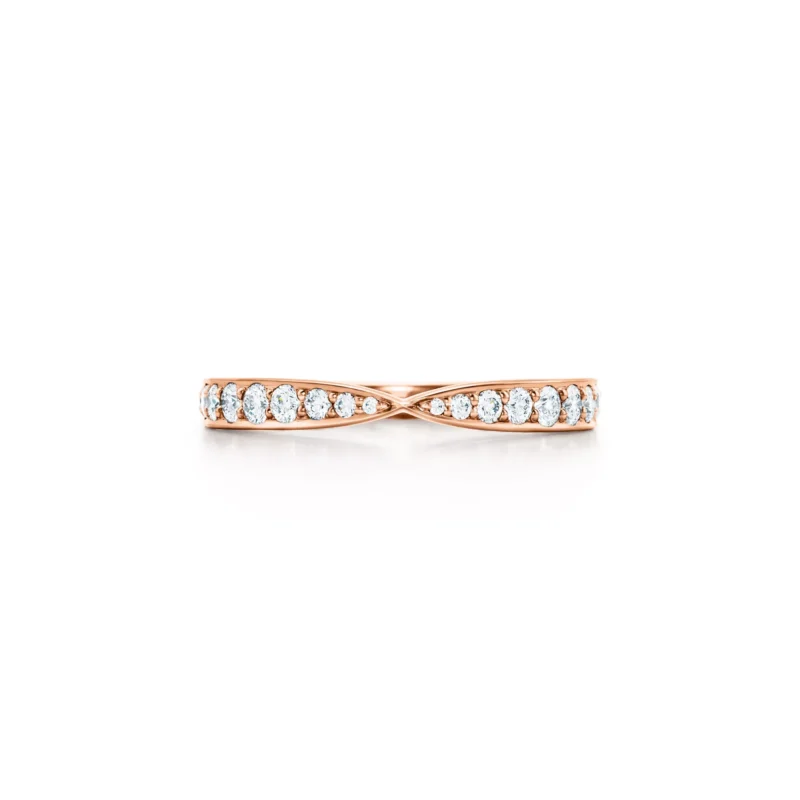
Why Wedding Bands Do Not Always Sit Flush—and Why That Can Be Better
A visible gap is not automatically a design failure. Profile, basket, shoulders and movement