
TheTimeo / Insights & Investment
The stone.
Then the
words.
A blue sapphire draws the eye before its laboratory reports enter the conversation. A real ring and its accompanying documents show how to read colour, origin and heating separately.

The sapphire ring from Phillips’ Geneva Jewels VII, lot 423, in the auction house’s portrait. Photograph courtesy of Phillips.
Explore the story
On the hand, the blue comes first. A cushion-shaped sapphire fills the centre of a ring, with narrow diamond shoulders drawing light towards it. Phillips catalogues the stone at 16.40 carats; two laboratory reports accompany it. Their words add another way of seeing. Learning to read those separate statements makes it easier to enjoy the jewel and understand precisely what its documents say.
Blue, before the paperwork
01 / 02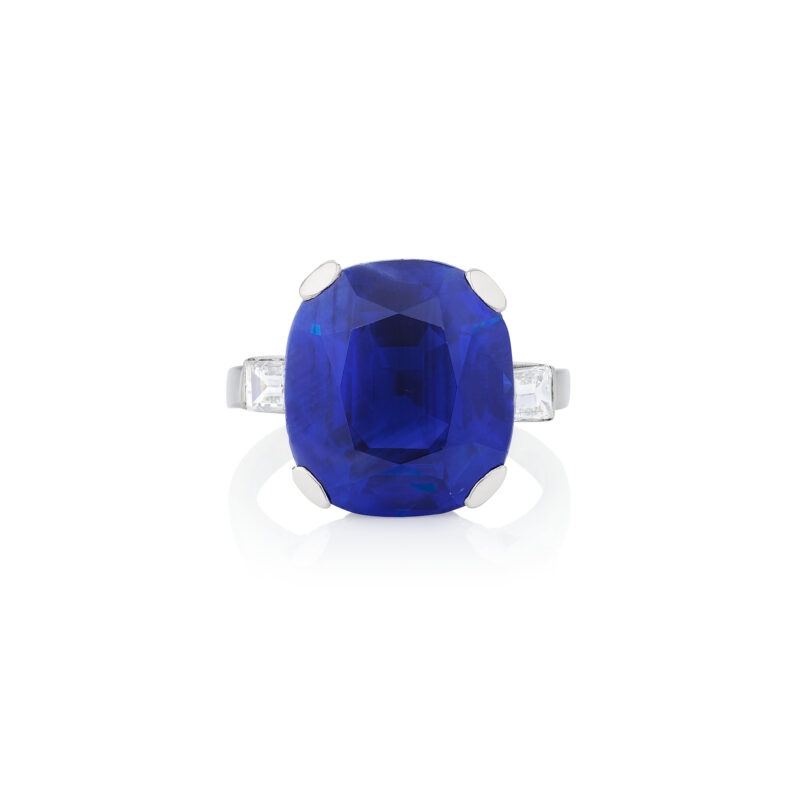
Lot 423: the catalogue lists a 16.40 ct sapphire between baguette diamond shoulders. Photograph courtesy of Phillips.
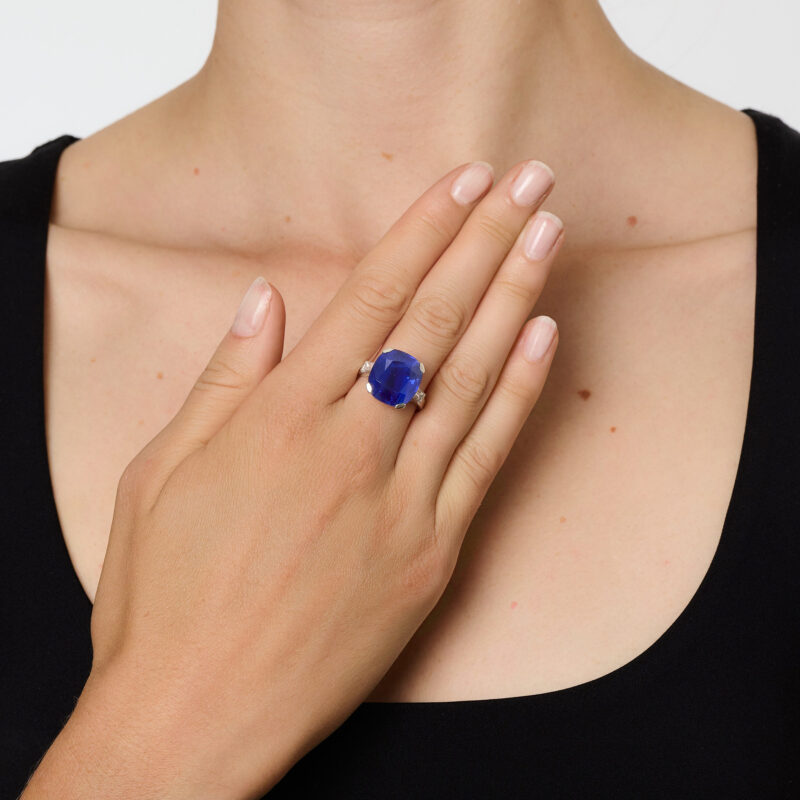
The same ring shown on the hand, in official catalogue photography. Courtesy of Phillips.
The complete photograph gives the sapphire a broad, clear outline. The baguette diamonds sit to either side, extending the shape across the finger while leaving the blue as the centre of attention. In the worn view, the ring has a different scale. The hand and dark clothing tell us something about its presence that a white-background portrait cannot convey alone.
This is lot 423 in Phillips’ Geneva Jewels VII catalogue. Its accompanying documents are identified as SSEF report 155711 and Gübelin report 26070131. The catalogue attributes Kashmir origin and findings of no indications of heating to both. Those are useful statements to read closely, alongside the actual photographs and descriptive fields in the reports.
Begin with the jewel, then keep the paperwork beside it. The aim is to connect each observation with the question it answers. A stone can attract you through its colour and proportion while its documents explain identity, examination and an opinion about origin. The two readings belong together, with room for each to do its own work.
Four lines. Four different questions.
- Identity — what is the material?
The identification field gives the material a name. Sapphire belongs to the mineral corundum; blue describes one of the appearances that mineral can have. Read the laboratory’s identification before letting an evocative colour name stand in for it. The document should make clear what was examined, including whether the material is natural or laboratory-grown. This is a foundation for every other description on the page.
- Colour — what does the laboratory describe?
A colour description is a statement about the examined gem. SSEF’s explanation distinguishes hue and saturation; its report photograph is representative and does not promise an exact display of colour or size. Keep the words beside the image rather than treating either as a replacement for viewing. A screen is useful for following shape and design, while a personal comparison deserves its own lighting and time.
- Heating — what was found in the examination?
Read the comments as carefully as the identification. The wording “no indications of heating” concerns a particular treatment finding. It does not turn every other question about the stone into an answer. Continue through the remaining comments, including any separate disclosure about fissures or other treatment. The value of this habit is simple: a short, attractive phrase no longer causes the eye to skip the rest of the document.
- Origin — what is the opinion based on?
Geographic origin is an expert opinion. SSEF explains that it draws on microscopic, chemical and spectroscopic evidence compared with reference material. The place named on a report is therefore a different kind of information from the colour you see in a photograph. It also differs from ownership history: an origin statement does not describe the people who have owned a jewel or the occasions on which it was worn.
Return to the shape
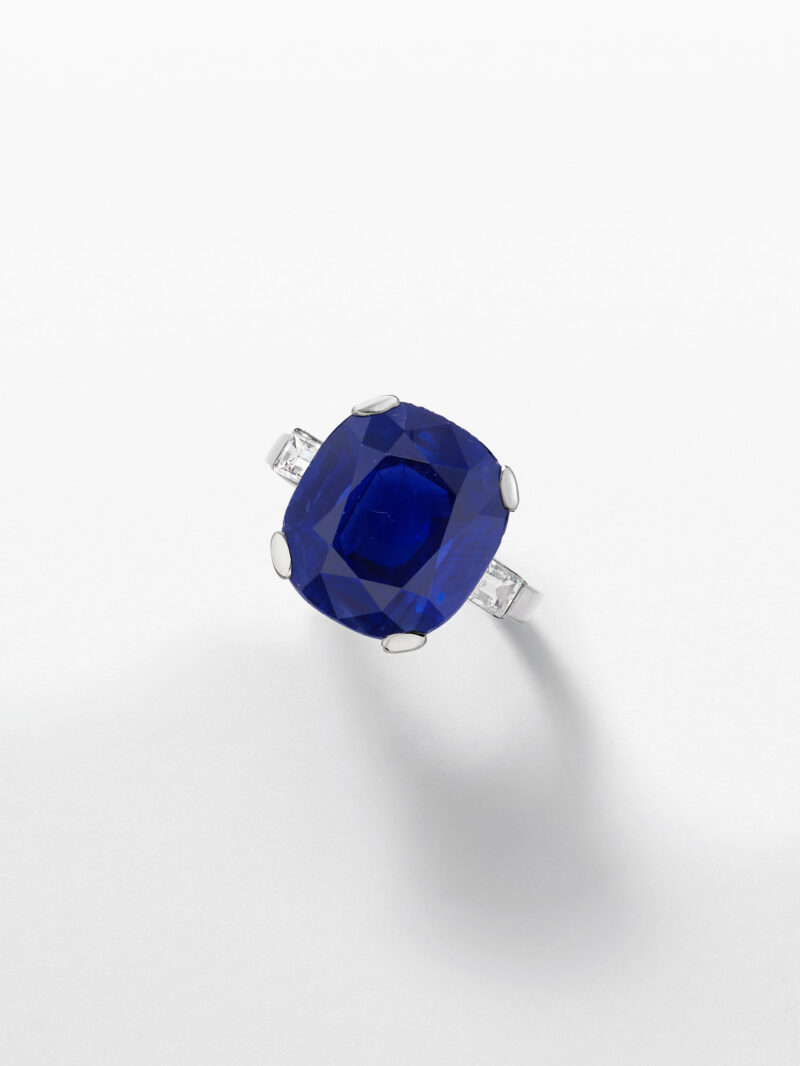
An oblique portrait of the ring reveals its outline and setting. Courtesy of Phillips.
After reading the fields, look again at the oblique portrait. The setting becomes more apparent, and the sapphire’s outline feels less like a flat patch of blue. You can follow the claws around its perimeter and see how the diamond shoulders meet the central stone. These details invite a slower visual reading, one that neither an origin name nor a short treatment comment can complete for you.
The same exercise works with a ring you are considering in person. Look from above, then from the side; notice the balance on the hand and the space the setting occupies. Ask how the mount fits your way of wearing jewellery. Documentary information and the experience of a jewel have different roles, and a thoughtful decision has room for both.
A report can help establish which material was examined and what the laboratory concluded. Your response to the design remains personal. The arrangement of stone, metal and diamonds, the outline against the finger and the way a piece belongs with your clothes are questions you can give time to, without asking a laboratory document to make the aesthetic decision.
Two laboratories, one sapphire
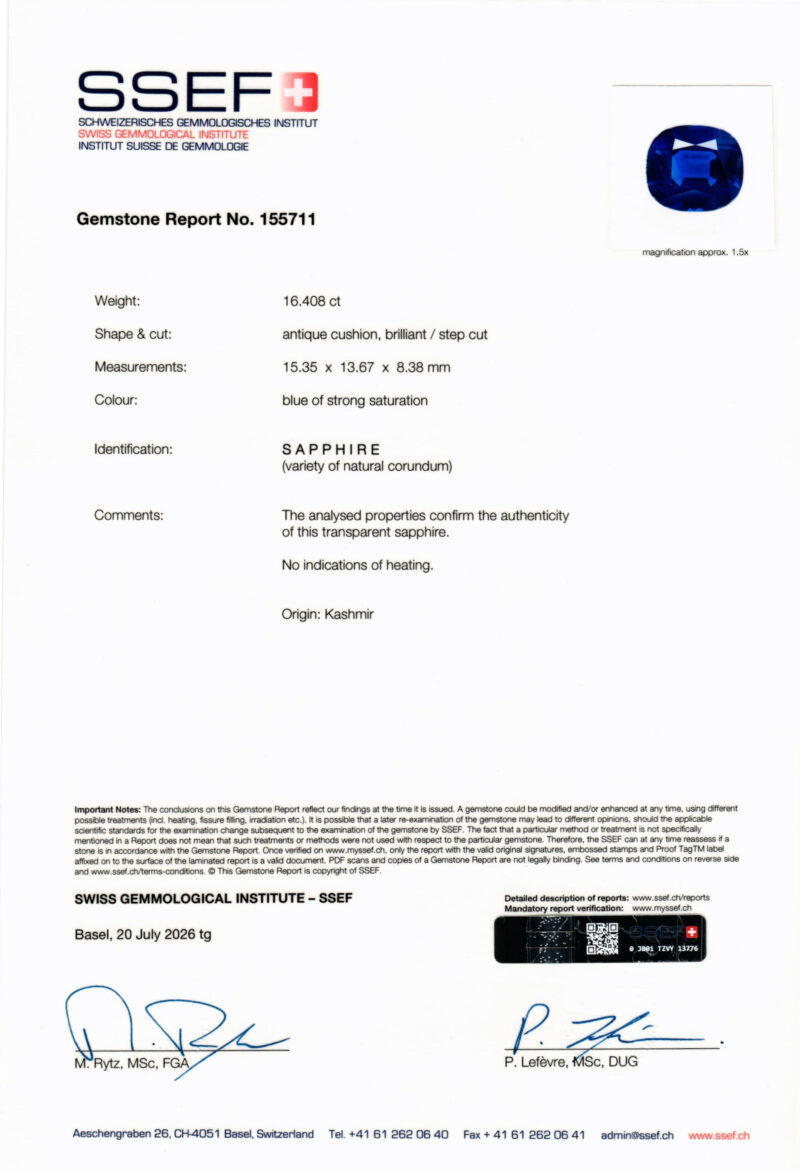
SSEF report 155711, reproduced in Phillips’ catalogue for lot 423. This is the accompanying document, not a sample report. Image courtesy of Phillips.
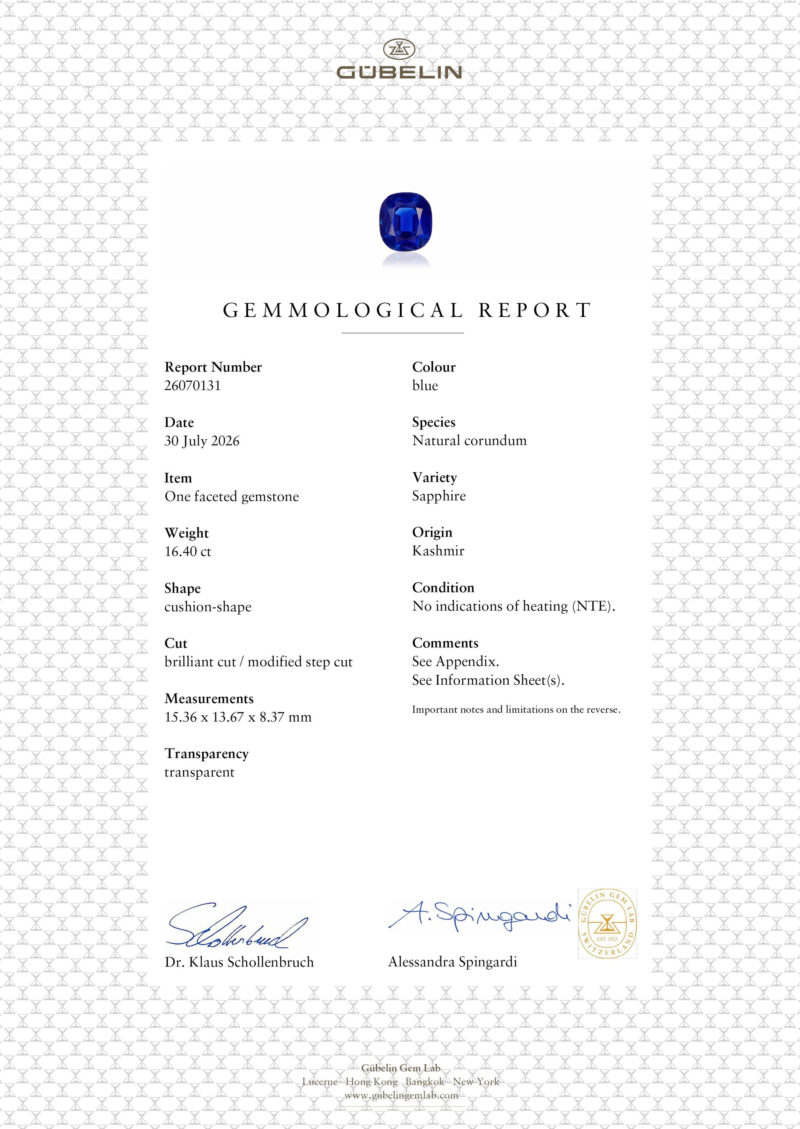
Gübelin report 26070131 for the same catalogued sapphire. Report image supplied in the Phillips catalogue; courtesy of Phillips.
The complete report images shown here are the documents reproduced with this ring in Phillips’ catalogue. Open either image to read its fields at a larger scale. Follow the report number, description and photograph together, then compare how the two laboratories organise their statements. Their layouts differ; the useful discipline is to find the answer to the same question in each.
Keep the exact report with the exact jewel. If a piece is being offered to you, request the complete current documents and use the issuing laboratory’s verification service where available. Matching a report to a physical stone is specialist work, so an independent examination may be appropriate when you need that assurance. A photograph of a document alone cannot perform that examination.
The report date belongs in this reading too. It dates the laboratory record you are reading. It is worth asking whether there have been later reports, a change to the stone or work on the setting. These are ordinary questions to bring to the seller or specialist, alongside the questions that first drew you to the jewel’s appearance.
Keep the stone in the picture
A useful reading begins with four separate questions: identity, colour, treatment and origin. Keep their answers in their own places, then return to the ring as a whole. The blue, the shape and the presence on the hand will still be there, now accompanied by a clearer understanding of the words beside them.
That clarity should make looking more pleasurable. You can follow the beauty that caught your attention, ask informed questions and leave the meeting with a more complete picture of the object you are considering.
Sources & further reading
The Edit
Insights & Investment stories
Selected stories from the same editorial universe.

Queen Mary’s Hennell Necklace: The Meaning of a Second Version
Commissioned from Hennell in 1928, Queen Mary’s cultured pearl and diamond necklace revisits a
Geneva, Before the Hammer: Three Watches Worth a Closer Look
A steel chronograph, a retailer’s signature and a constellation of gold stars. Three lots
Inside a Gold Roskell: The Date in the Case
A richly worked gold dial, an engine-turned back and a signed movement: a Robert
The Emerald Brooch: A Jewel Worth Turning Over
An emerald, a fine platinum framework and the fittings on the reverse: a close
A Name on the Dial: Looking Closely at a Skeleton Watch
A gold skeleton watch, a visible mechanism and a famous name: the Met’s attribution

Market Price Is Not One Number: Seven Values, Seven Different Jobs
Retail, asking price, estimate, hammer, premium-inclusive result, dealer offer and insurance value answer different