
TheTimeo / Insights & Investment
Queen Mary:
A pattern,
made personal.
Commissioned from Hennell in 1928, Queen Mary’s cultured pearl and diamond necklace revisits a royal design. Its second life begins with the differences.
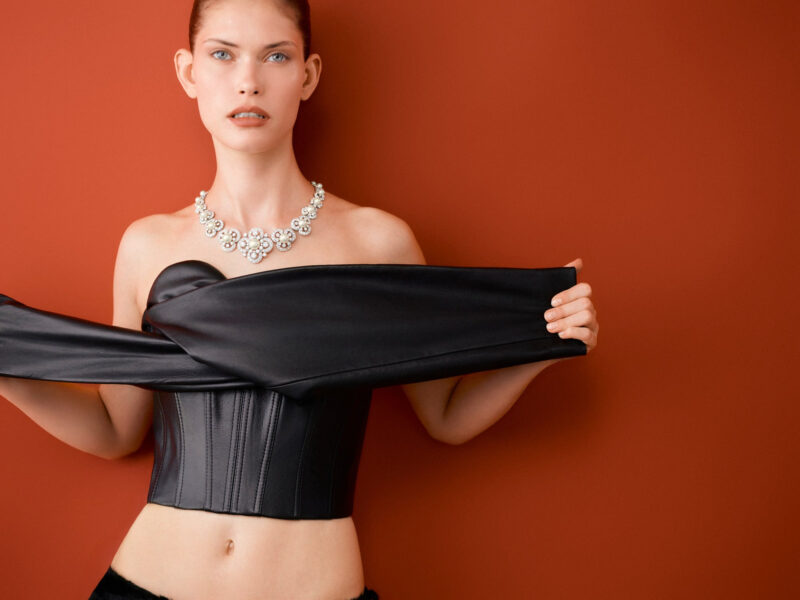
The Hennell necklace in Phillips’ contemporary presentation. This is a modern wearing photograph. Courtesy of Phillips.
Explore the story
A diamond framework opens across the collarbone, its pearl drops drawing the eye towards the centre. In a contemporary portrait, black fabric gives the necklace a strong, simple setting. The jewel has a much older story: commissioned for Queen Mary in 1928, it carries a royal pattern into a second, more personal version.
The whole, and its place on the body
01 / 02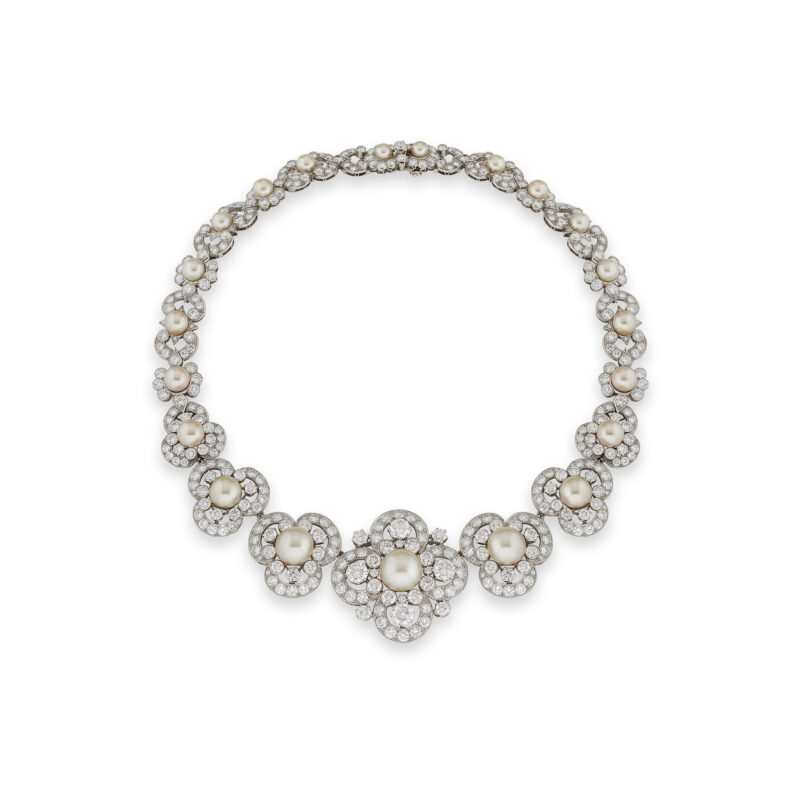
Lot 336: the complete necklace, with openwork floral motifs and cultured pearl drops. Courtesy of Phillips.
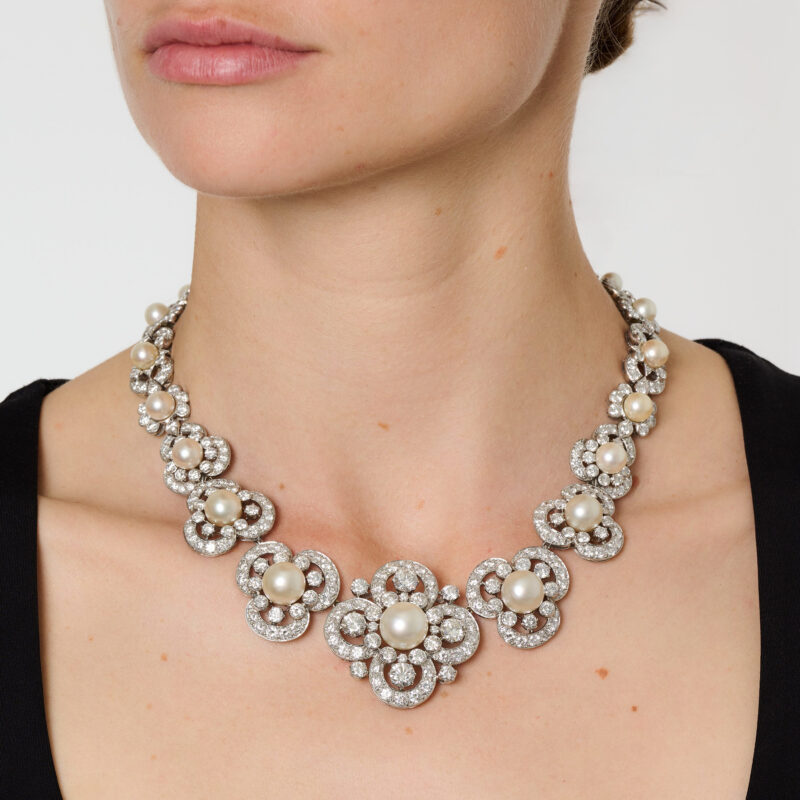
A contemporary close wearing view makes the necklace’s scale and central drop legible. Courtesy of Phillips.
Seen alone, the necklace looks almost architectural. Small openwork units join a larger central motif, each interval admitting a patch of white through the diamonds. Pearls interrupt that light framework with smooth, rounded forms. The arrangement grows towards the middle, where a longer drop establishes a clear destination for the eye.
The wearing photograph restores the curve that a flat presentation can only suggest. The upper edge follows the neck, while the suspended elements occupy the space below it. A necklace of this kind uses the body as part of its drawing: the central drop falls into the open area above the neckline, and the smaller elements lead towards it from either side.
Phillips offers the Hennell necklace as lot 336 in Geneva Jewels VII on 9 November 2026. The catalogue describes 21 cultured pearls, ranging approximately from 5.85mm to 13.50mm, within a framework set with circular-cut diamonds. Its listed inner circumference is about 430mm. Those particulars establish scale; the two photographs show how the dimensions become a pattern at the neck.
The pearls have two visual roles. Their rounded surfaces soften the edges of the diamond motifs, while the repeated drops give the lower outline a distinct cadence. Between them, the open spaces keep the design from reading as a solid band. In the complete photograph, the eye can follow a bright line of diamonds and then pass through it to the white ground beneath.
On the body, the same spaces reveal skin. That change makes the framework feel less like a drawing on a page and more like an arrangement of separate forms suspended together. The central quatrefoil remains the anchor, but the areas around it contribute to the impression of lightness. The necklace’s scale is substantial; its open construction gives that scale room to move visually.
This is also why the neckline matters. A clean area beneath the jewel allows the graduated outline to remain legible. In Phillips’ modern photographs, the clothing supplies broad shapes rather than small competing details. The necklace can then carry the finer rhythm of the image, with each pearl and diamond motif contributing to a larger contour.
What a second version changes
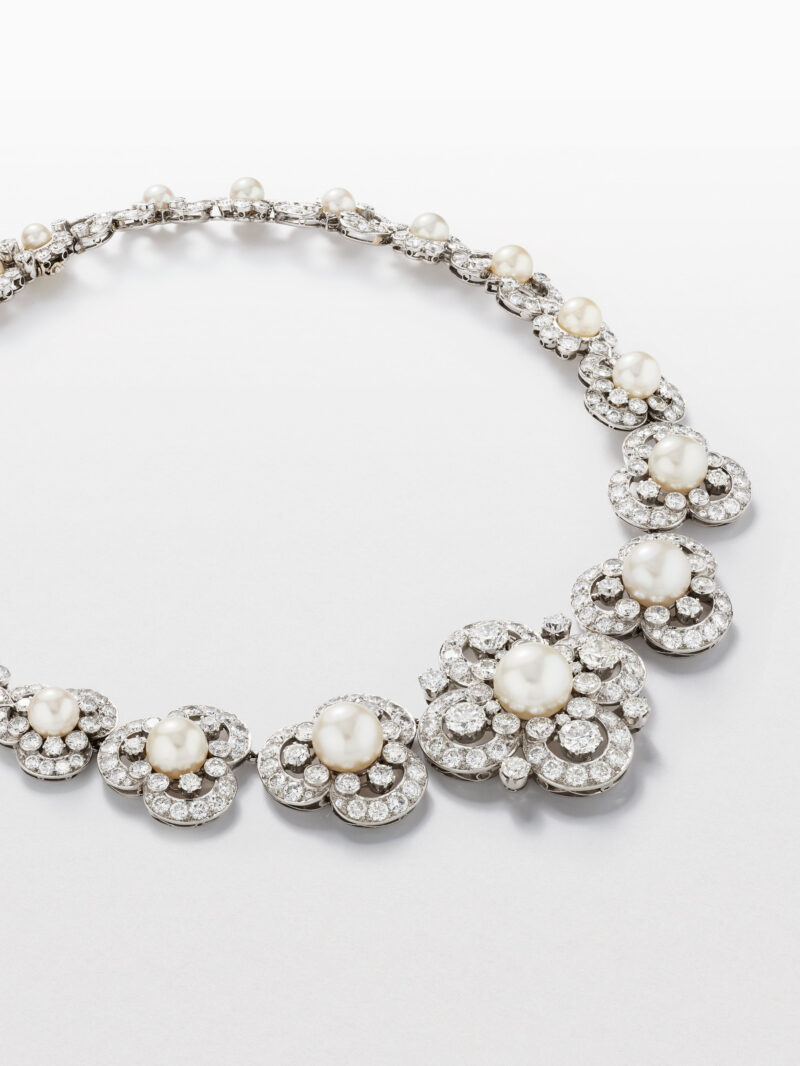
An oblique detail of the diamond framework and pearl drops, in the auction house’s source framing. Courtesy of Phillips.
The auction house traces the design to Queen Victoria’s Golden Jubilee necklace, made by Carrington & Co. and presented in 1888. According to its account, Queen Mary later asked Hennell to create a closely related necklace for her own collection. The 1928 commission kept the distinctive arrangement while introducing changes in materials and detail.
Phillips identifies cultured pearls and platinum in Mary’s version, replacing the natural pearls and gold of the Victorian original. It also notes the omission of the small crown above the central quatrefoil. The relationship between the two jewels therefore involves more than a repeated outline: a familiar design was interpreted through a new commission, with choices that made the second necklace distinct.
The oblique detail makes the framework particularly rewarding to examine. The motifs overlap in depth, with pearls projecting beyond the diamond-set edges. A frontal view gathers those elements into a coherent pattern; from an angle, the individual units become more apparent. The necklace has a thickness and a sequence of connections that its symmetrical silhouette can easily conceal.
Its central area also invites a slower reading. The quatrefoil gives the design a recognisable focus, and the pearl beneath it lengthens the composition downwards. Around that centre, the surrounding motifs step towards smaller forms. The result is both repetitive and graduated: enough repetition to establish continuity, enough change to give the middle greater emphasis.
The current catalogue adds an important qualification: the necklace has been slightly altered from its original design. It does not identify the precise alteration in the public lot description. The present photographs show the object offered today; they cannot, by themselves, establish which detail changed or when. That boundary is part of reading an older jewel carefully, alongside appreciation of its appearance.
One small wording detail deserves the same care. Phillips records a case signed Hennell. That refers to the presentation case and should not become a claim that the necklace itself bears a maker’s signature. With a jewel whose appeal includes its history, the distinction between the object, its accompanying material and the catalogue’s account remains useful.
A history carried into the present
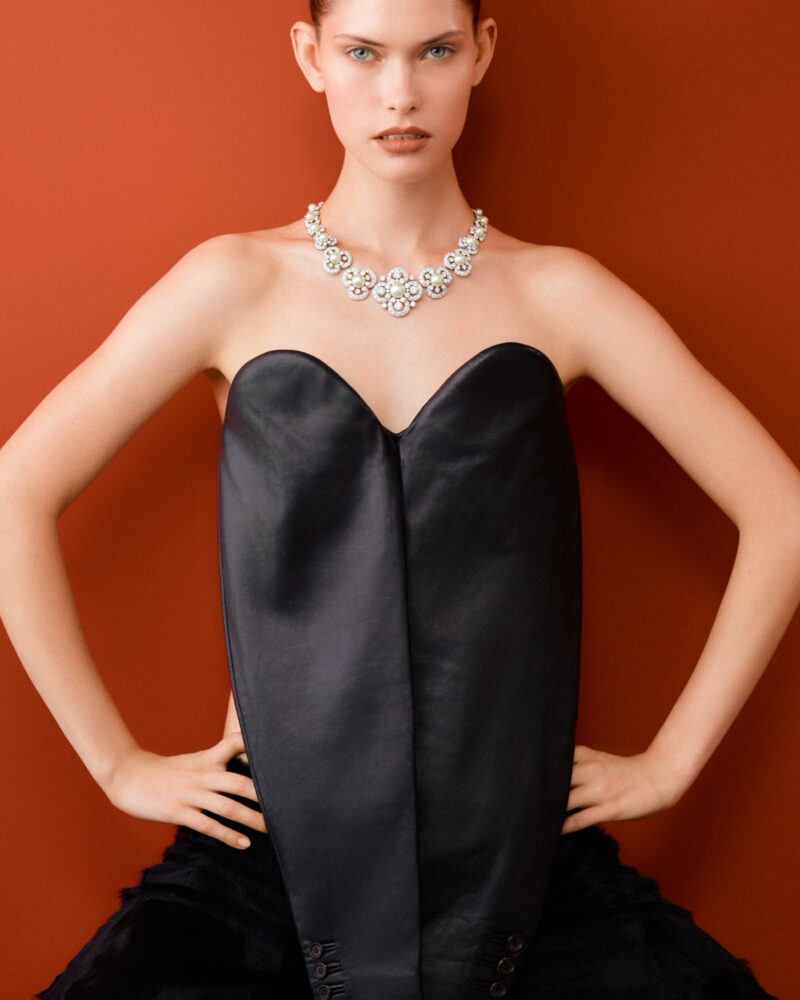
The same jewel in a modern portrait: a new setting for an existing design. Courtesy of Phillips.
Phillips’ provenance narrative follows the necklace from Queen Mary to her niece, Mary Cambridge Somerset, Duchess of Beaufort, and then to a sale in 1986 and subsequent private collections. That history belongs to this Hennell version. The celebrated necklace worn by Elizabeth II at the State Opening of Parliament in 1952 was Victoria’s original, a separate object sharing the underlying design.
Keeping those identities clear makes the later necklace more interesting. Its story concerns a collector’s decision to commission a familiar royal pattern for her own jewellery collection. The second version has its own materials, its own passage through owners and its own present condition. The association with the earlier design supplies context, while the particular object carries the history being offered at this sale.
The modern portrait introduces another kind of continuity. Against black clothing and a warm red background, the necklace retains the clear hierarchy visible in the complete product photograph. The eye still finds the central drop, then moves out through the smaller motifs. A different setting changes the atmosphere around the jewel without removing the design’s ability to organise attention.
The fabric is broad and sculptural, the necklace intricate and graduated. Together they offer a convincing image of how an inherited visual language can occupy a contemporary picture. This is an auction-house presentation, rather than evidence of historical royal wearing. Its value here is visual: it allows the reader to see the jewel beyond a white-ground catalogue image, in relation to clothing, skin and the frame of a portrait.
Before the sale, the necklace can be understood through those different views. The whole establishes its drawing, the detail reveals its construction, and the body gives it scale. Provenance adds another dimension, provided the histories of the two versions stay distinct. What remains is a jewel with both continuity and individuality: a familiar pattern, commissioned again, and carried forward through a life of its own.
Sources & further reading
The Edit
Insights & Investment stories
Selected stories from the same editorial universe.
The Emerald Brooch: A Jewel Worth Turning Over
An emerald, a fine platinum framework and the fittings on the reverse: a close
A Sapphire Report: The Stone and Its Words
A blue sapphire draws the eye before its laboratory reports enter the conversation. A
Geneva, Before the Hammer: Three Watches Worth a Closer Look
A steel chronograph, a retailer’s signature and a constellation of gold stars. Three lots
Inside a Gold Roskell: The Date in the Case
A richly worked gold dial, an engine-turned back and a signed movement: a Robert
A Name on the Dial: Looking Closely at a Skeleton Watch
A gold skeleton watch, a visible mechanism and a famous name: the Met’s attribution
Market Price Is Not One Number: Seven Values, Seven Different Jobs
Retail, asking price, estimate, hammer, premium-inclusive result, dealer offer and insurance value answer different