
The collector’s eye
The date
in the case.
A richly worked gold dial, an engine-turned back and a signed movement: a Robert Roskell pocket watch shows how the parts of an object can be read together.
Discover the story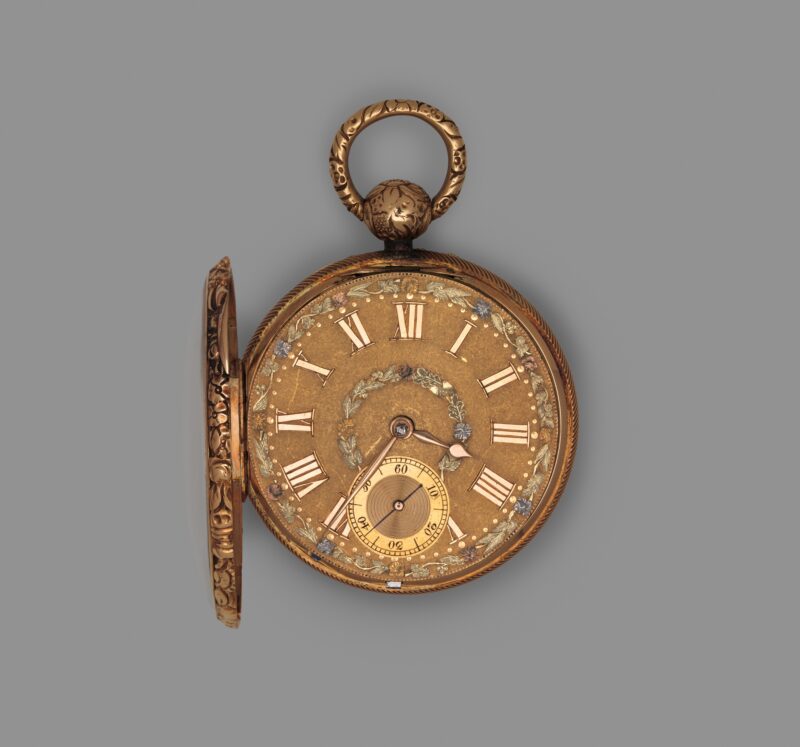
Robert Roskell pocket watch, 1820–21: a worked gold dial, coloured-gold ornament and a subsidiary seconds display. The Metropolitan Museum of Art, New York.
Inside the story
The dial has the richness of a small piece of goldsmiths’ work. Roman numerals rise against a softer gold ground; an intricate border moves around them, and a seconds dial settles near the bottom. Turn the watch over and the decoration changes to an engine-turned pattern. Open views reveal a third language: the movement, with its maker’s name and number.
The Robert Roskell pocket watch in the Metropolitan Museum of Art is dated 1820–21. Read through its photographs and catalogue, it becomes a compact lesson in how a dial, a case and a mechanism contribute different kinds of information to one object.
From the surface to the mechanism
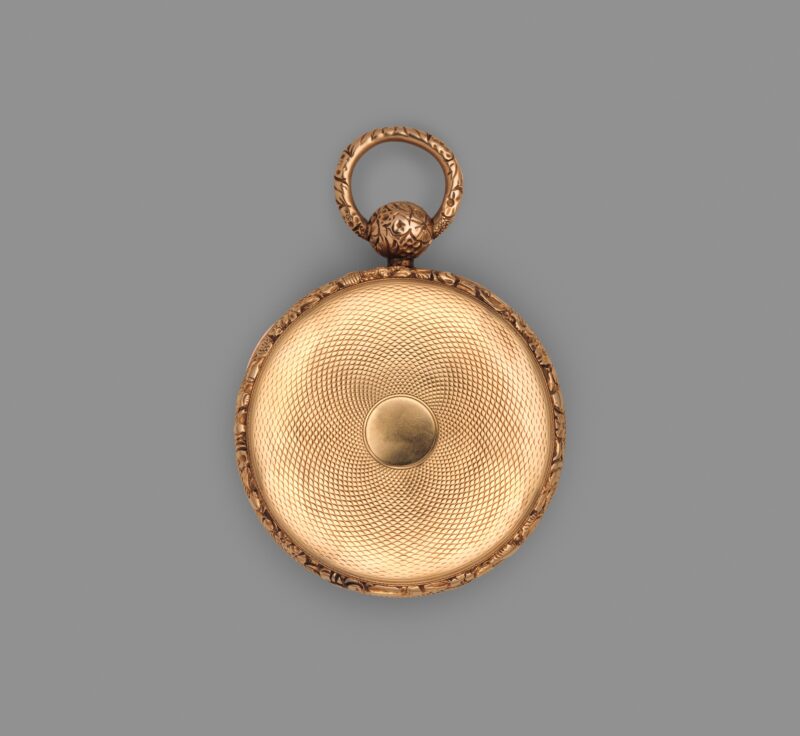
The back changes the visual rhythm from intricate dial ornament to an engine-turned surface. The Metropolitan Museum of Art, New York.
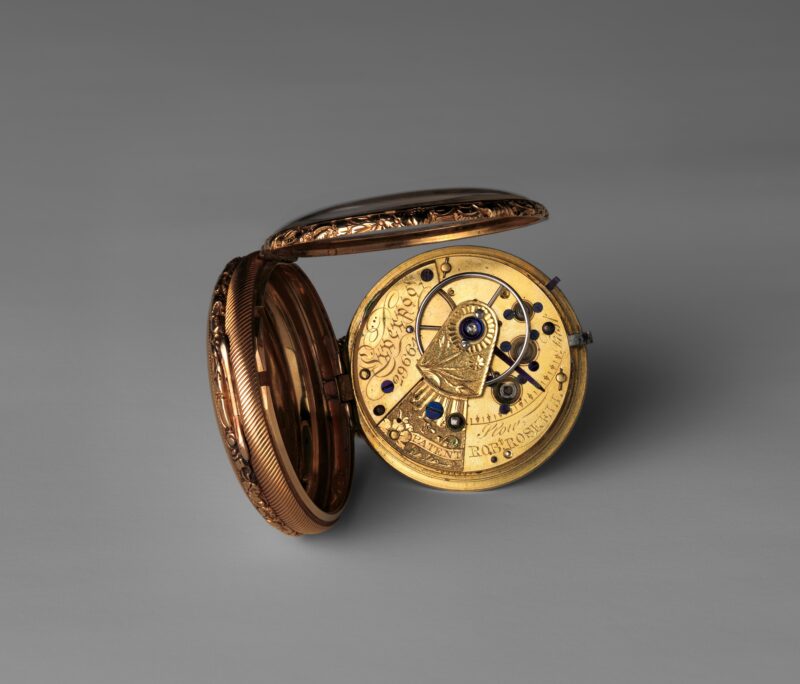
The open museum view reveals the movement; the catalogue identifies the Roskell signature, Liverpool and number 29664. The Metropolitan Museum of Art, New York.
The two additional museum views take the eye away from the dial. One presents the back as a circular field of engraving. The other opens the case and brings the movement into the composition. Together with the front, they give the watch three distinct visual identities without losing the recognisable outline of the whole.
That is a useful photographic sequence for a collector to request from an appropriate specialist. It connects appearance with construction and makes a description easier to follow. A maker’s signature or a case mark has more context when the complete watch is also visible. A set of pictures can introduce the relationship between parts before a technical explanation begins.
Gold, with more than one voice
The Met describes the dial’s Roman numerals as polished gold against a fine matte gold ground. The surrounding vegetation uses gold alloys in different colours, including white, blue, pink and green. The decoration therefore depends on differences within the metal itself, bringing a varied surface to a watch that might initially be described with a single word: gold.
Look at the contrast between the broad numerals and the finer ornament. The numerals organise the face; the border encourages a slower circuit around it. At six, the smaller seconds dial introduces another circle. Its presence gives the lower half of the design a point of focus while keeping the main hour display open.
These details are worth putting into ordinary language when discussing a watch. Is a surface polished or matte? Does the ornament belong to the dial, the case or both? Where does the eye settle first? Careful description brings personal taste into focus. It can also help distinguish two watches that share a general period or material but create very different impressions.
A case date and a maker’s name
The date in the gold
The museum identifies Chester assay marks used in 1820–21 on the case. Its discussion associates the case makers’ initials with Thomas and John Helsby.
The name on the movement
The movement carries Robert Roskell’s name, Liverpool and the number 29664. These are separate particulars to preserve alongside the description of the case.
A watch can contain several histories
The distinction between case maker and watchmaker makes the object especially revealing. The museum’s account brings separate names into one description, showing how a richly finished watch can embody the work of more than one specialist. Reading those contributions together gives a fuller view of manufacture than relying on the most prominent signature alone.
A date drawn from a case hallmark answers a particular question about that case. A movement signature identifies another part of the account. Keeping their roles clear is a good habit when studying an older watch, particularly if a catalogue explains how the components relate. Let the specialist’s description establish that relationship for the object in front of you.
The broader lesson is to preserve detail without compressing it too quickly. In a personal inventory, give a case mark its location, a movement number its own field and a maker’s name its exact spelling. Add the catalogue or specialist explanation that connects them. Those small separations can make a later conversation much more productive.
The back has its own character
The engine-turned back offers a change of pace after the busy dial. Its repeated lines spread across a broad surface, creating an effect that depends on direction and reflection. The outline remains substantial, with the pendant and ring continuing the object’s worked-gold character. It is worth giving this side a full photograph rather than treating it as a minor supporting view.
The open movement photograph then changes the scale again. Individual components and the arrangement of the plates become part of the watch’s appearance. The catalogue discusses a rack-lever escapement, a chain fusee and fullplate construction. Those terms can be followed with a specialist or the museum’s longer account; an attractive image is a welcome route into the subject.
For everyday record keeping, the useful starting point is simpler. Keep the three surfaces connected: the face you recognise, the case that surrounds it and the mechanism described inside. Record who supplied the explanation and when. If the watch is later examined or serviced, add the new account so that its history can develop in an orderly way.
Keep the parts of the story together
Roskell’s watch offers several pleasures at once: the warmth of its dial, the pattern of its back and the compact engineering revealed within. Learning where its date comes from adds another layer. It connects a visual object with the work of identifying and describing it.
A collector can begin with the view that feels most compelling and gradually build the rest of the picture. Good photographs, carefully located numbers and an informed explanation belong together. Kept that way, they help the object remain recognisable through future conversations and changes of custodianship. The beauty stays visible; its story becomes easier to carry.
Sources & further reading
- The Metropolitan Museum of Art: object record and curatorial account.
- The Met: collection data and image record.
Last verified:18 October2026. Photographs: The Metropolitan Museum of Art, New York.
The Edit
Further discoveries
Objects, makers and the questions worth asking.
The TheTimeo Provenance Standard: What Should Travel With an Object
A collectible object needs more than a pile of accessories. Identity, ownership, service, condition,
How to Read a Jewellery Auction Lot: Five Separate Lines of Evidence
A laboratory report, maker’s mark, condition note, repair record and provenance answer different questions.

Watch Documents and Provenance: Build the File, Test the Claims
A watch can become more captivating when its past comes into focus. An archive
Watch Service History: Build a Record That Travels With the Object
The best service history reads like a biography of the watch. It shows how
Phillips New York Watch Auction XIV: Beyond the Record Total
An early F.P. Journe Chronomètre à Résonance held the New York room for nearly
How to Read Watch Condition and Originality
A fine watch carries its history in the smallest details: the sharpness of a