
TheTimeo / Insights & Investment
MARKET PRICE:
seven numbers, seven jobs
Retail, asking price, estimate, hammer, premium-inclusive result, dealer offer and insurance value answer different questions. They should never be compared without context.
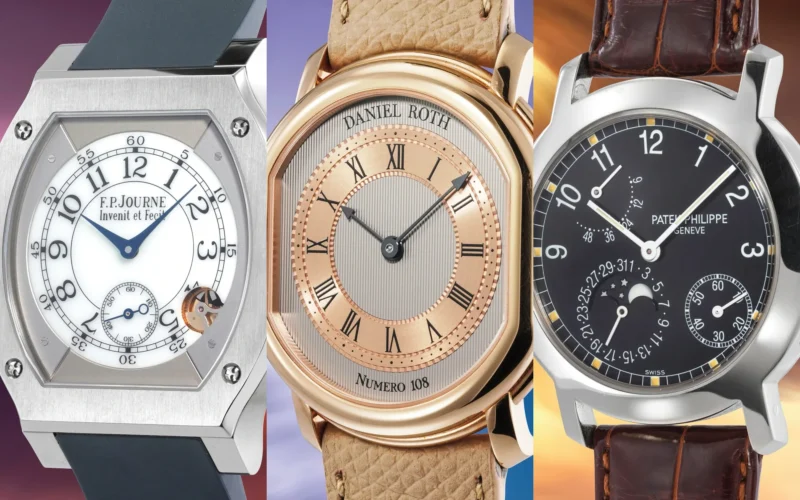
Three Geneva lots, three distinct results: the object and the sale basis must always remain attached to the number. Courtesy of Phillips.
Explore the story
Category: Collecting Intelligence Format: INTELLIGENCE_BRIEFING Series: The Ledger / Method
A collector can look at one object and encounter seven prices before lunch.
The maison lists a current retail price. A secondary dealer publishes an asking price. An auction house assigns an estimate. The bidding ends at a hammer price. The result page adds the buyer’s premium. A dealer offers the owner a different amount to buy the object outright. An insurance appraisal may show a higher replacement figure still.
None of those numbers is automatically the “real price”.
They belong to different transactions, different parties and different purposes.
The practical mistake is not finding a high or low number. It is using a number created for one purpose to answer a different question.
TheTimeo’s rule is therefore simple: before comparing any price, label what kind of number it is, who created it, what transaction it describes, what costs it includes and when it was observed.
Key takeaways
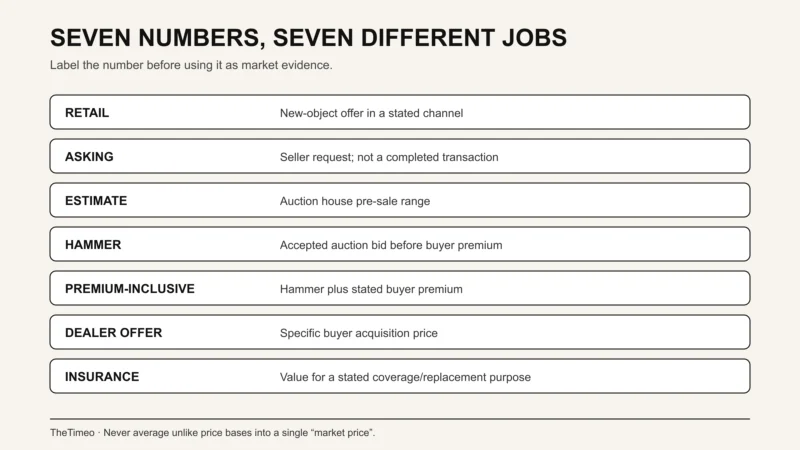
Retail, asking, estimate, hammer, premium-inclusive result, dealer offer and insurance value are not interchangeable. Courtesy of TheTimeo.
- Retail, asking, auction estimate, hammer, premium-inclusive result, dealer offer and insurance value are different price or valuation concepts.
- An asking price is evidence of what a seller is requesting, not evidence of a completed transaction.
- An auction estimate is a pre-sale opinion and normally excludes buyer’s premium and taxes.
- Hammer price is the accepted bid before buyer’s premium; a published “price realised” may include premium.
- A dealer offer is the amount a buyer is willing to pay the owner under that dealer’s own stock, condition, service and risk assumptions.
- Insurance replacement value is designed for an insurance purpose and should not be treated as a resale forecast.
- Comparisons are useful only when the price basis, date, currency, object, condition and fee treatment are aligned.
Start with the question, not the number

Tank Louis Cartier watch illustrating the collection’s enduring rectangular design. Courtesy of Cartier.

The architectural outline of a radiant-cut diamond establishes the ring’s geometry before the band is resolved. Courtesy of Restivo Diamonds.
“What is it worth?” is usually too broad.
Worth to whom, for what purpose, on what date, in which market and under what transaction structure?
Professional valuation standards make the same distinction. RICS and the International Valuation Standards framework separate observed prices from valuation concepts such as market value. A price can be asked, offered or paid; a valuation is an opinion formed for a stated basis and purpose.
Collectors need the same discipline without the jargon.
A current retail price can help answer what a new object costs from an authorised seller today. It cannot tell an owner what a dealer will pay for a used example.
A dealer’s public asking price can show the level at which inventory is being offered. It cannot tell you whether a buyer eventually paid that amount.
An auction hammer can show where bidding stopped. It does not tell you the buyer’s full invoice or the consignor’s net proceeds.
An insurance appraisal can help set coverage. It is not a cash bid.
Once those distinctions are visible, the market becomes less mysterious.
1. Retail price — the current new-object reference
Retail price is the amount at which a new object is offered for sale through the relevant retail channel at a specific time and in a specific market.
That sounds obvious, but even this first number needs a label.
A manufacturer’s suggested retail price may be exactly that: suggested. The US Federal Trade Commission notes that MSRP is a manufacturer’s suggested figure and that a dealer may set its own retail price independently. In luxury categories, some maisons sell directly online at a displayed price, some operate through authorised retailers and some disclose prices only on request.
A current Cartier product page provides a clean example of an observable retail figure. On 5 September 2026, the US page for the classic yellow-gold LOVE bracelet displayed a price of US$7,950. That figure is useful for one narrow statement: the product was offered on Cartier’s US site at that retail price when checked.
It does not establish:
- what a pre-owned example should sell for;
- what a dealer will pay to acquire one;
- what an auction result should be;
- what an insurer should use for a different configuration or older object;
- what the same product costs in another currency or tax jurisdiction.
Retail is a current-channel observation, not a universal valuation anchor.
For discontinued watches and jewels, the historical retail price can still be useful context. It should be dated and, where necessary, adjusted only through a stated method. Do not compare an old retail figure to a current secondary result and call the difference “performance” without explaining inflation, currency and transaction costs.
2. Asking price — what a seller wants, not what a buyer paid
An asking price is the amount at which a seller offers an object.
It is visible supply-side evidence.
That makes it useful. A group of asking prices can reveal what dealers believe the market may tolerate, how inventory is positioned and whether similar pieces are clustering around a range.
It is still not transaction evidence.
The object may sell at the ask, below it, after a discount that is never disclosed, as part of a trade, or not at all. The listing may be stale. The watch may have been withdrawn. The seller may have priced high because replacement stock is scarce or because the piece carries exceptional condition, provenance or warranty.
A useful database therefore records asking prices as asking prices.
For each observation keep:
- seller;
- object/reference;
- condition description;
- accessories;
- stated warranty;
- asking currency;
- asking amount;
- date observed;
- whether the listing remained active, was withdrawn or was marked sold if known.
Do not convert “marked sold” into “sold at asking price” unless the transaction amount is actually known.
The distinction between ask and bid also appears in financial markets: the US Securities and Exchange Commission defines the ask as the price at which a seller is prepared to sell and the bid as the price at which a buyer is prepared to buy. Luxury objects are not securities, but the basic directional distinction is useful. An asking price belongs to the seller side of the market.
3. Auction estimate — a pre-sale range, not a promise
Christie’s defines an estimate as a monetary range reflecting its specialists’ expectation of the price a lot may achieve at auction, excluding premium and taxes. The house says estimates are informed by factors including condition, rarity, quality, provenance and comparable auction prices and may be revised.
Sotheby’s likewise describes its pre-sale estimate as a guide for prospective buyers and notes that a lot can realise above or below the range.
The estimate is therefore an informed pre-sale opinion within a specific auction strategy.
It is not:
- the reserve;
- the hammer price;
- the buyer’s total cost;
- the seller’s guaranteed proceeds;
- an insurance value;
- a statement that the object will sell within the range.
The low and high estimate should be stored in the original currency with the sale date and lot number. If the auction house later revises the estimate, use the final published version for sale analysis and retain the earlier number only if the change itself is relevant.
Estimate-to-result comparisons can be informative, but only on the same basis. Comparing a fee-exclusive high estimate with a premium-inclusive result exaggerates the percentage by construction.
TheTimeo already treats this as a separate auction-reading problem. This article goes wider: the estimate is only one of several numbers that may surround the object before and after the sale.
4. Hammer price — where the bidding stopped
The hammer price is the final accepted bid when the auctioneer closes the bidding.
Christie’s and Sotheby’s both define hammer separately from the buyer’s premium.
For market analysis, hammer is often the cleanest public measure of bidding because it isolates the accepted bid from the buyer-side fee schedule.
But hammer is still not “the amount everyone paid or received”.
The buyer pays more once premium and potentially taxes, duties or other charges are added.
The seller may receive less after seller commission and agreed expenses. The economics can also be affected by guarantees, advances or other arrangements disclosed under the relevant auction terms.
A hammer result therefore answers a specific question:
At what bid did the auctioneer close the lot?
It does not answer what the buyer’s bank account ultimately lost or what the consignor’s bank account ultimately gained.
5. Premium-inclusive result — useful, but define what “all-in” means
Auction houses often publish a result that includes buyer’s premium.
Christie’s glossary defines “price realised” as hammer plus buyer’s premium, while noting that taxes may be additional. Sotheby’s says the buyer’s premium is added to hammer as part of the total purchase price and may be accompanied by other charges depending on the sale.
This is why the phrase all-in needs care.
In collector conversation, “all-in” can mean hammer plus buyer’s premium. On an actual invoice, the buyer may also face tax, import charges, shipping, insurance, storage or other amounts.
TheTimeo therefore recommends two explicit fields rather than one loose label:
price_including_buyers_premium;additional_buyer_costs_known_or_excluded.
If a house publishes “price realised”, preserve the house’s own label and definition.
Do not assume every auction database uses the same convention.
A dated fee example
Christie’s schedule effective 1 September 2026 listed a 28% buyer’s premium on the first US$2 million of hammer for most collecting categories in New York, before applicable taxes. A hypothetical US$14,000 hammer falling entirely inside that first tier would therefore produce US$3,920 of buyer’s premium and a US$17,920 price including premium, before tax or other charges.
That example is useful only for the method. Fee schedules change and the exact sale conditions govern.
6. Dealer offer — a buyer-side number shaped by the dealer’s model
A dealer offer is different from a dealer asking price.
The asking price is what the dealer wants from a future buyer.
The dealer offer is what the dealer is prepared to pay the current owner.
Those numbers should not match because the dealer has to carry inventory, authenticate and inspect the object, service or refurbish it where necessary, provide warranty or consumer protection, finance the stock, absorb market risk and still leave room for a commercial margin.
The exact spread varies by object and business model. There is no universal percentage that can be applied safely across watches or jewellery.
Watchfinder’s current selling process makes the mechanics visible. The company provides an initial quotation based on information supplied by the owner, then physically inspects the watch and may adjust for servicing or discrepancies before issuing a final offer. It also states that demand and its current stock level can influence the quotation.
Bucherer similarly describes a non-binding estimate followed by verification and a formal acquisition decision.
That means a dealer offer is a real market signal, but it is a specific buyer’s acquisition decision, not a neutral declaration of “market value”.
For comparison, record:
- dealer;
- date;
- whether the figure is preliminary or final;
- inspection status;
- object condition used;
- inclusions such as box/papers;
- service deductions;
- payment terms;
- offer validity period.
A fast, unconditional bank-transfer offer and a higher conditional consignment expectation are not the same economic proposition.
7. Insurance value — a coverage number with a different job
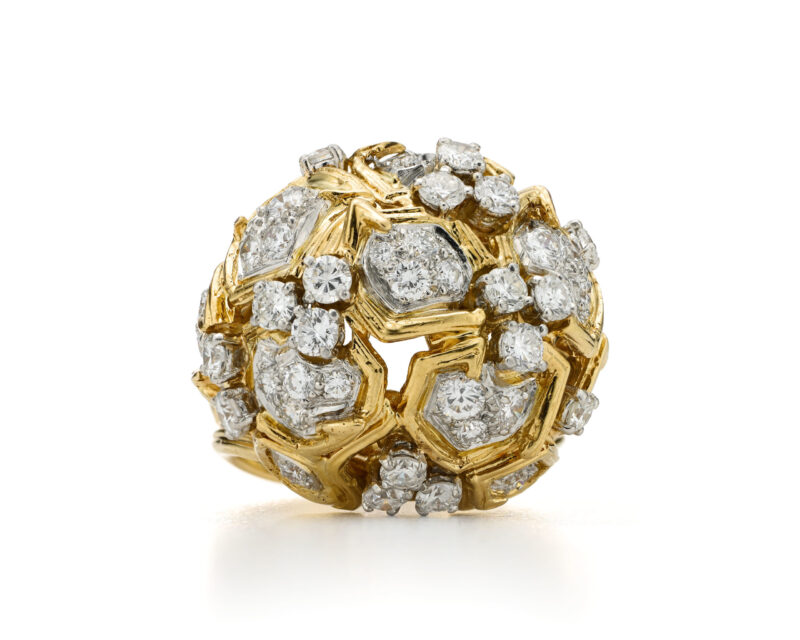
An archival object is strongest when the signature, design record and physical ring can be read together.
Insurance is where collectors most often encounter a number that looks authoritative and is then misused as resale evidence.
The National Association of Insurance Commissioners advises owners of valuable jewellery and collectibles to document and appraise items so coverage can be set appropriately. It also distinguishes replacement coverage from actual-cash-value treatment and notes that policy terms matter.
Jewelers Mutual describes retail replacement value as the amount needed to replace or recreate an item with one of similar kind and quality. It explicitly distinguishes that insurance-oriented replacement value from resale value.
That difference is structural.
If an insurer needs to replace a lost ring through a retail channel, the required amount can be higher than what a dealer would pay the owner for the original ring today. The insurance figure may also reflect taxes, sourcing difficulty, custom work or a stated replacement basis defined by the appraisal and policy.
An insurance appraisal should therefore be read with four questions:
- What is the intended use of the appraisal?
- What basis of value is stated?
- On what date was it prepared?
- What market and replacement assumptions were used?
A large insurance figure is not evidence that the owner can realise the same amount in a sale.
Seven numbers, seven jobs
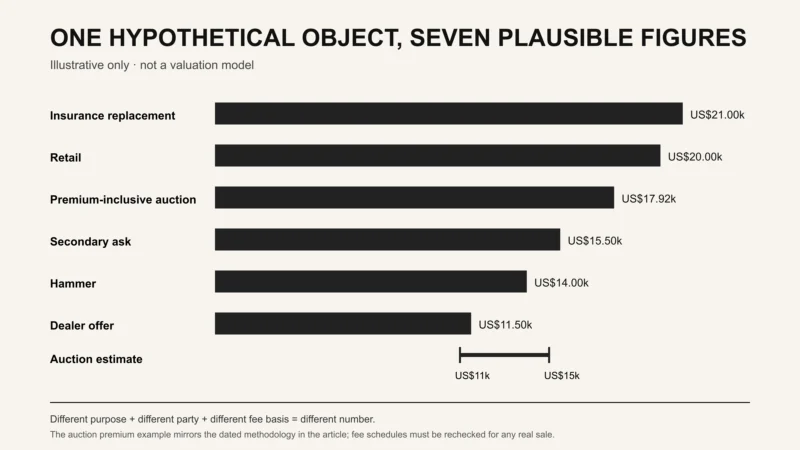
A worked example reveals how seven plausible figures can coexist without contradiction. Courtesy of TheTimeo.
Explore the comparison
| NUMBER | CREATED BY | WHAT IT ANSWERS | TRANSACTION EVIDENCE? | COMMON MISUSE |
|---|---|---|---|---|
| Retail price | maison/retailer | What is the new object offered for in this channel now? | No, unless a purchase occurs | treating it as pre-owned resale value |
| Asking price | dealer/private seller | What is the seller requesting? | No | treating the listing as a completed sale |
| Auction estimate | auction house | Where does the house expect bidding may fall? | No | treating the range as a guaranteed outcome |
| Hammer price | auction | At what accepted bid did bidding stop? | Yes, for the auction bid | treating it as buyer total or seller net |
| Premium-inclusive result | auction house | What was hammer plus stated buyer premium? | Yes, subject to definition | calling it “all-in” without checking taxes/costs |
| Dealer offer | purchasing dealer | What will this buyer pay under its terms? | Yes if accepted; quote if not | calling one buyer’s bid “the market” |
| Insurance value | appraiser/insurer context | What amount is appropriate under the stated coverage basis? | No sale transaction | treating replacement value as resale proceeds |
The table is deliberately unsatisfying to anyone looking for one master number.
There usually is not one.
One hypothetical object, seven plausible figures
Consider a fictional luxury watch. The numbers below are invented to show how the language works; they are not a valuation model.
Explore the comparison
| FIELD | HYPOTHETICAL FIGURE | WHAT IT MEANS |
|---|---|---|
| Current retail price | US$20,000 | current new-object retail reference |
| Secondary asking price | US$15,500 | public seller request |
| Auction estimate | US$11,000–15,000 | pre-sale expectation range |
| Hammer price | US$14,000 | accepted auction bid |
| Premium-inclusive result | US$17,920 | hammer + 28% example buyer premium, before tax |
| Dealer offer | US$11,500 | one dealer’s acquisition price after inspection |
| Insurance replacement value | US$21,000 | appraisal figure for stated replacement purpose |
A careless comparison could tell several contradictory stories.
The owner might say the watch is “worth US$21,000” because of the appraisal.
A buyer might say the market is “US$15,500” because that is the listing.
An auction database might show US$17,920.
The consignor might focus on US$14,000 hammer.
The dealer may only be willing to pay US$11,500.
Each number can be internally coherent because it answers a different question.
The correct response is not to average them.
It is to identify the decision being made.
If the owner wants immediate liquidity, the dealer offer is relevant.
If the collector wants to understand public auction bidding, hammer is relevant.
If the buyer wants the expected invoice, premium-inclusive result and taxes matter.
If the owner is arranging coverage, the appraisal basis matters.
If the analyst is studying secondary supply, asking prices may be useful as long as they stay labelled as asks.
Seller proceeds are a separate outcome
There is one more figure collectors regularly confuse with the seven above: net seller proceeds.
It is not included in the headline taxonomy because it is a cash-flow result after transaction terms rather than a public price category.
At auction, the consignor’s proceeds may begin with hammer and then reflect seller commission and agreed expenses. Christie’s glossary describes seller commission as a percentage based on hammer, while its fee guidance notes that other seller-side charges can apply depending on the agreement.
In a direct dealer sale, the accepted dealer offer may already be the net cash amount, subject to the contract.
In consignment, the owner may receive the eventual sale price minus commission and service costs.
Never infer seller proceeds from a public result without the seller-side terms.
How to compare numbers without fooling yourself
Before placing two prices in the same chart, align at least these fields:
Price basis — retail, ask, estimate, hammer, premium-inclusive, dealer offer or insurance.
Object identity — exact reference, material, size, stone configuration, dial, bracelet and other relevant specifications.
Condition — polishing, repairs, service parts, restoration, stone condition and current functionality where applicable.
Provenance and documents — because materially different files can make two outwardly similar objects poor comparables.
Date — markets, retail lists, fees and exchange rates change.
Currency — retain original currency and document the conversion method if one is used.
Venue and geography — taxes, buyer behaviour, dealer costs and brand pricing differ by market.
Fees — compare hammer with hammer, premium-inclusive with premium-inclusive, or convert through an explicit method.
A clean dataset should make an invalid comparison difficult to perform accidentally.
What each number can tell a collector
Retail can establish a new-object reference and replacement context.
Asking prices can show visible supply and seller expectations.
Auction estimates can show a house’s pre-sale positioning.
Hammer prices can show accepted bidding outcomes.
Premium-inclusive results can show the buyer-side auction result under the house’s published definition.
Dealer offers can show immediate acquisition appetite from a specific professional buyer.
Insurance values can show the figure used for a stated coverage purpose.
None of them should be promoted to a universal market truth.
The more sophisticated the object, the more important that restraint becomes. A rare watch with an unusual dial, a signed Art Deco jewel with restoration, or a coloured stone with a significant laboratory report may have no truly close comparable. Precision in the price label cannot compensate for weak object matching.
The simplest useful rule
When someone says, “This watch is US$25,000,” ask one follow-up question:
What kind of US$25,000?
Retail?
Ask?
Estimate?
Hammer?
Price including premium?
Dealer bid?
Insurance replacement value?
That question often resolves the apparent disagreement before any further market analysis is needed.
Price data becomes useful when its grammar is correct.
Sources & further reading
This briefing was checked on 5 September 2026 against Christie’s auction glossary and current buyer-premium guidance, Sotheby’s current buyer guidance, RICS/International Valuation Standards context on basis and purpose, the US Federal Trade Commission’s MSRP guidance, Watchfinder and Bucherer seller processes, National Association of Insurance Commissioners consumer guidance, Jewelers Mutual’s appraisal/insurance materials and current Cartier US retail listings. The existing TheTimeo article on auction estimates, hammer and buyer’s premium was reviewed to avoid duplication; this piece deliberately focuses on the cross-market taxonomy and decision use of seven different numbers.
- Christie’s — Auction Terminology: https://www.christies.com/en/help/glossary
- Christie’s — Understanding Auction Fees: https://www.christies.com/en/help/auction-help-library/understanding-auction-fees
- Christie’s — Financial Information, buyer’s premium effective 1 September 2026: https://www.christies.com/en/help/buying-guide-important-information/financial-information
- Sotheby’s — Guide for Buyers: https://help.sothebys.com/en/support/solutions/articles/44002518078-guide-for-buyers-global
- Sotheby’s — Buyer’s Premium: https://help.sothebys.com/en/support/solutions/articles/44002686902-what-is-a-buyer-s-premium-
- FTC — Manufacturer-imposed Requirements / MSRP: https://www.ftc.gov/advice-guidance/competition-guidance/guide-antitrust-laws/dealings-supply-chain/manufacturer-imposed-requirements
- SEC — Ask Price: https://www.sec.gov/answers/ask.htm
- Watchfinder — Sell Your Watch: https://www.watchfinder.com/sell-your-watch
- Bucherer — Sell or Trade: https://www.bucherer.com/at/en/sell-or-trade
- NAIC — Insure Expensive Jewelry & Gifts: https://content.naic.org/article/consumer-insight-learn-how-insure-expensive-jewelry-gifts
- Jewelers Mutual — Jewelry Appraisals: https://www.jewelersmutual.com/jewelry-insurance-explained/appraisals
- RICS — Valuation Standards / Red Book context: https://www.rics.org/profession-standards/rics-standards-and-guidance/sector-standards/valuation-standards
- IVSC — Standards Glossary: https://ivsc.org/standards-glossary/
- Cartier — LOVE bracelets, US: https://www.cartier.com/en-us/jewelry/bracelets/love/
- TheTimeo — Auction Estimates, Hammer Price and Buyer’s Premium Explained: https://thetimeo.com/insights-investment/auction-estimates-hammer-price-buyers-premium/
The Edit
Insights & Investment stories
Selected stories from the same editorial universe.
Inside a Gold Roskell: The Date in the Case
A richly worked gold dial, an engine-turned back and a signed movement: a Robert
The Emerald Brooch: A Jewel Worth Turning Over
An emerald, a fine platinum framework and the fittings on the reverse: a close
A Name on the Dial: Looking Closely at a Skeleton Watch
A gold skeleton watch, a visible mechanism and a famous name: the Met’s attribution

The TheTimeo Provenance Standard: What Should Travel With an Object
A collectible object needs more than a pile of accessories. Identity, ownership, service, condition,
How to Audit a Luxury Watch Listing: Nine Details That Matter
Before judging price, audit the listing: identity, configuration, condition, service, documents, photography, seller claims,
How to Read a Jewellery Auction Lot: Five Separate Lines of Evidence
A laboratory report, maker’s mark, condition note, repair record and provenance answer different questions.