
TheTimeo / Insights & Investment
Geneva:
Before
the hammer.
A steel chronograph, a retailer’s signature and a constellation of gold stars. Three lots at Phillips Geneva invite three different ways of looking before the sale.
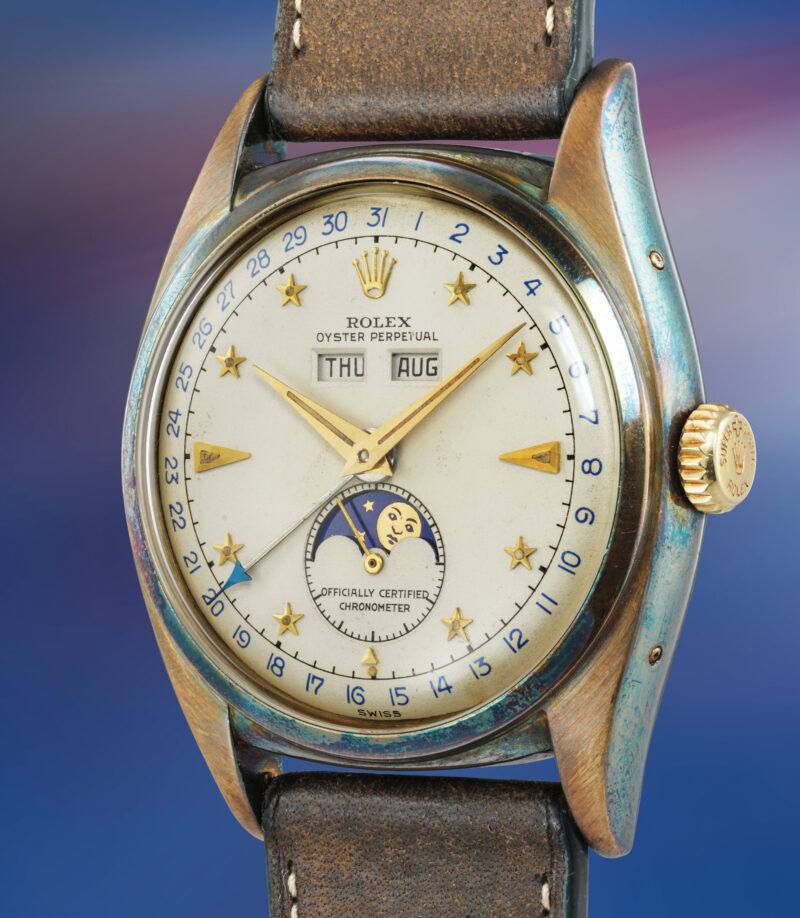
Lot 129: Rolex 6062, circa 1952, in yellow gold. Photograph courtesy of Phillips.
Explore the story
Eight small gold stars change the character of a dial. They sit around the face of a Rolex reference 6062, above a moon-phase display and beneath two narrow calendar windows. The watch is recognisably practical in its circular case and clear divisions, yet those little points of gold introduce something almost fanciful. Before a catalogue begins to explain rarity or provenance, the object has already offered a reason to look.
Four views on the wrist
01 / 04
Lot 95 on the wrist, in the auction house’s presentation. Photograph courtesy of Phillips.
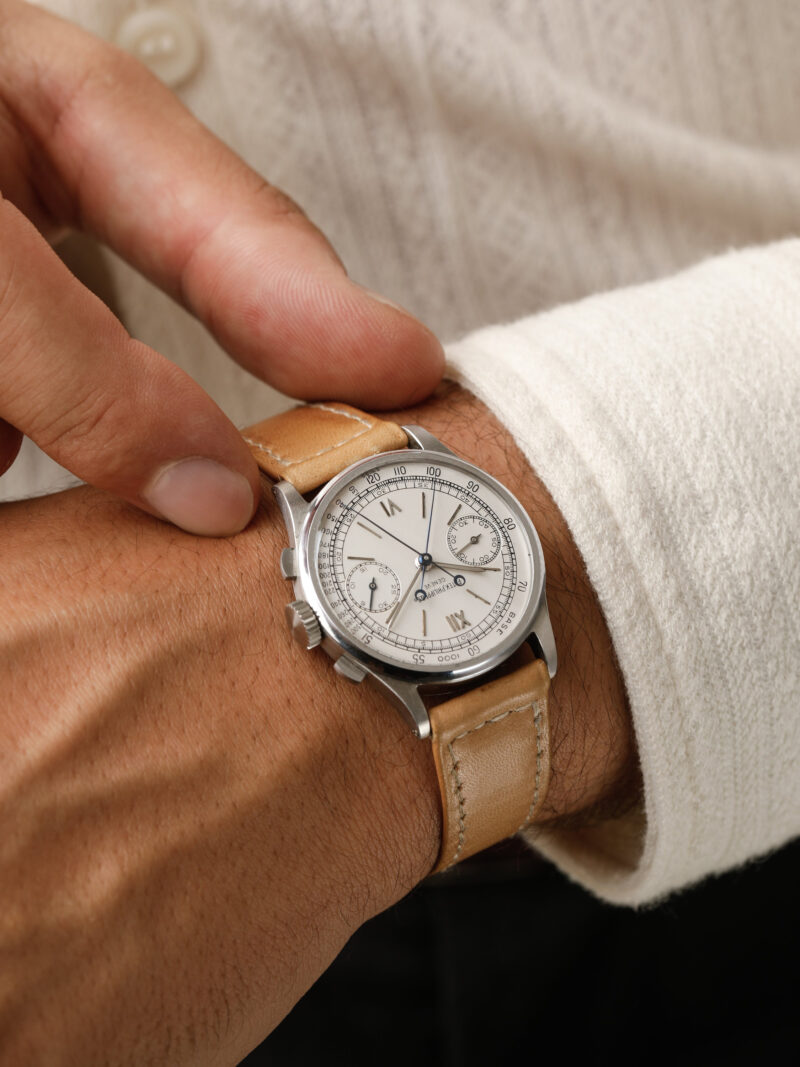
A closer wrist view of lot 95. Photograph courtesy of Phillips.
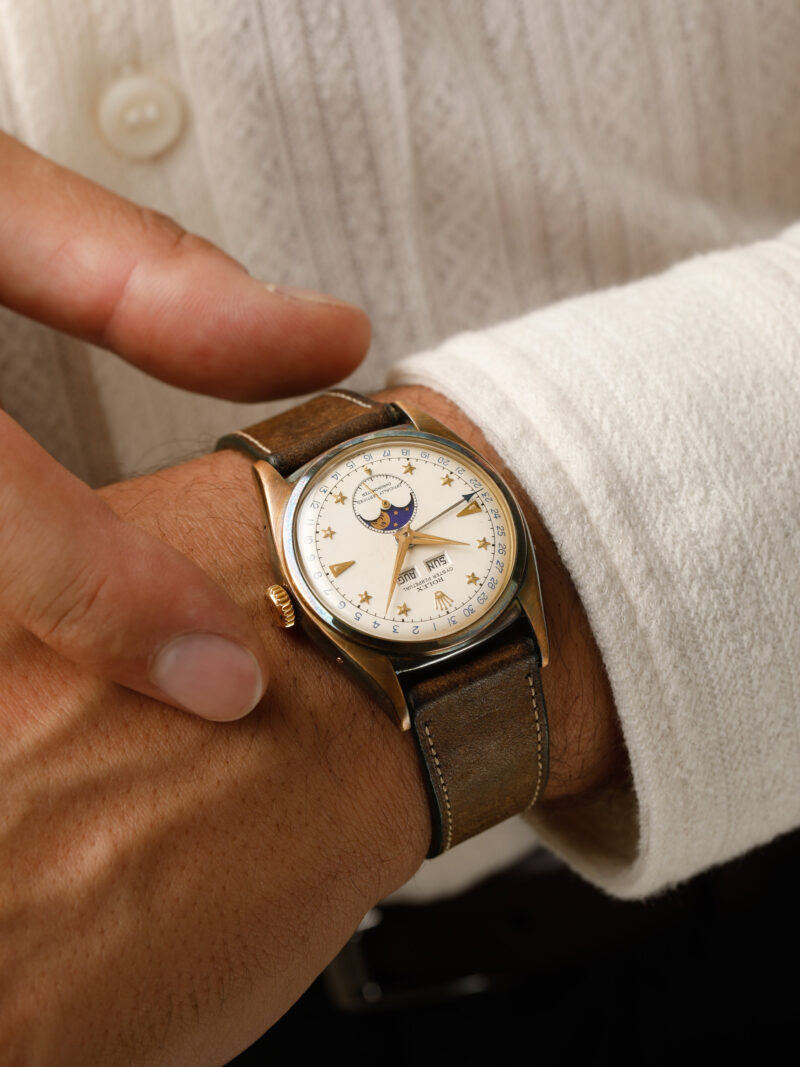
The Rolex 6062, lot 129, seen on the wrist. Photograph courtesy of Phillips.
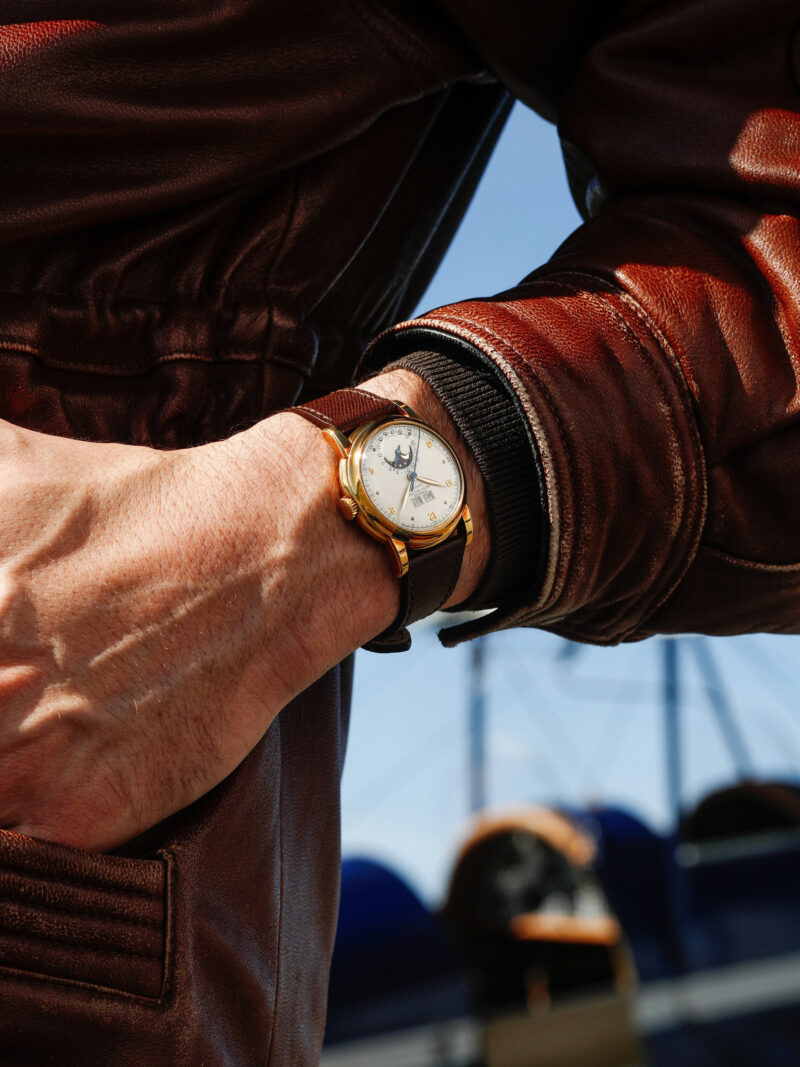
The Patek Philippe 2497, lot 16, in a different setting on the wrist. Photograph courtesy of Phillips.
A wrist photograph introduces a different scale of evidence. The steel Patek appears first against a dark sleeve, then in a closer view beside a pale cuff. The change of distance makes its compact dimensions easier to imagine. A case that fills a product portrait occupies a much smaller part of the body; the strap and the space around the lugs become part of the composition.
The Rolex follows beside another pale cuff. Gold stars that were easy to study in the opening portrait now become small points within an overall impression of warmth. The last frame places the yellow-gold 2497 near a brown leather jacket. Its case and the surrounding fabric share a warm palette, bringing a different character to the same watch shown earlier against the catalogue background.
These are the auction house’s presentation photographs, rather than a record of previous ownership or a wearing test by TheTimeo. Their value lies in restoring relationships that a frontal portrait can hide: dial to wrist, case to cuff, strap to skin. They also remind us how much a setting changes the impression of an object. The four large frames allow those differences to be seen without reducing the watches to small catalogue tiles.
Steel, gold and a different kind of rarity
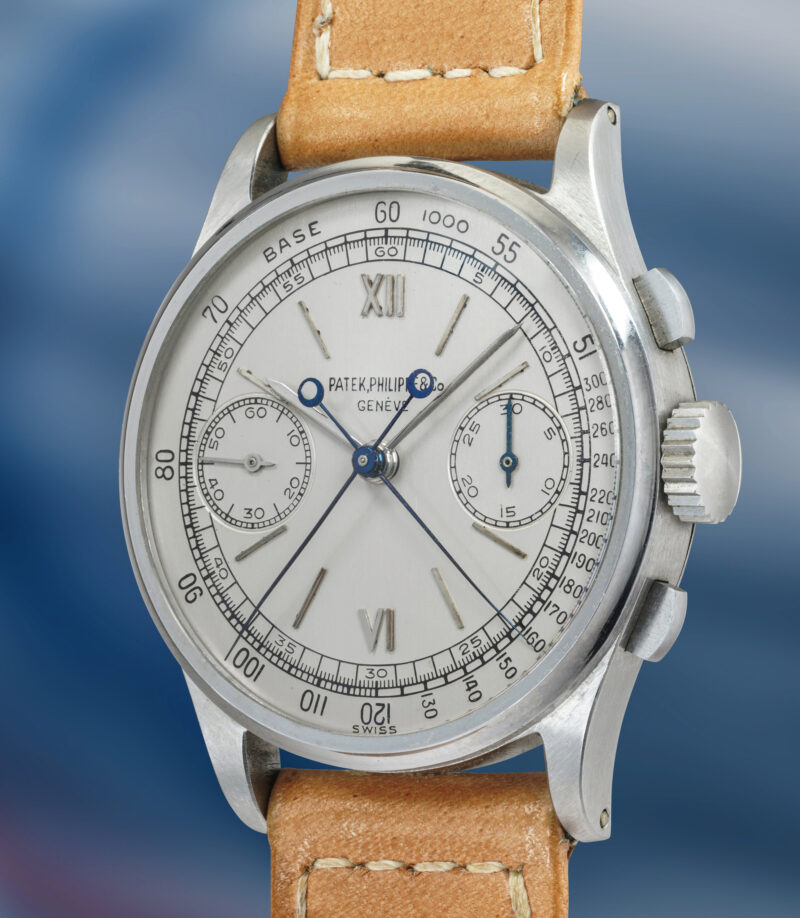
Lot 95: the stainless steel Patek Philippe 1436, dated 1945 in the catalogue. Photograph courtesy of Phillips.
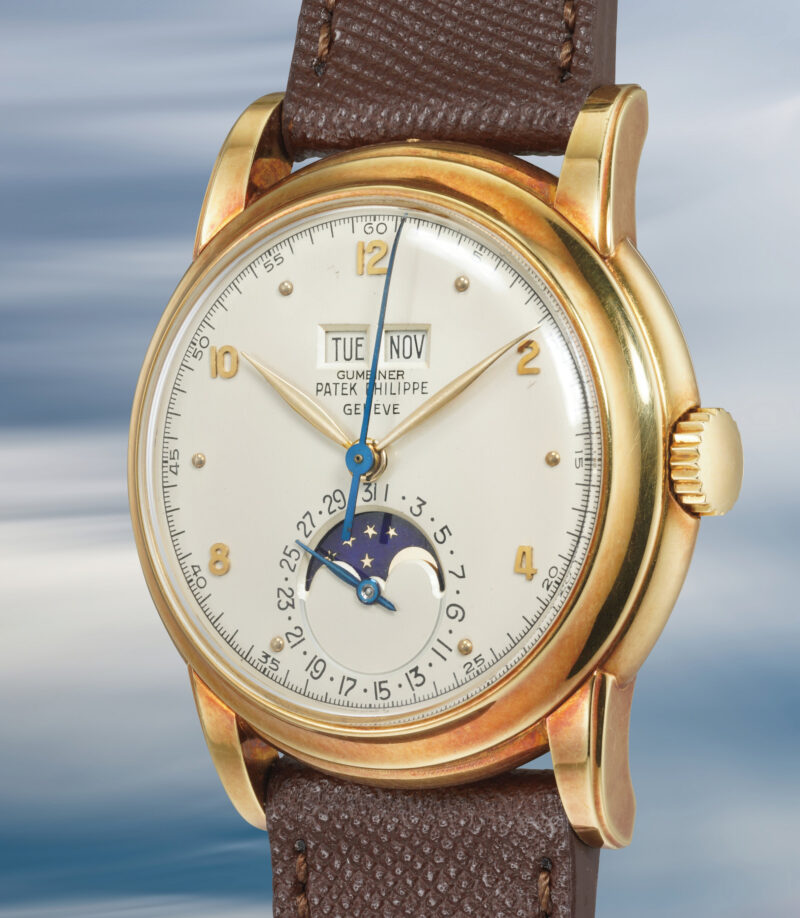
Lot 16: Patek Philippe 2497, retailed by Gumbiner. Photograph courtesy of Phillips.
This is lot 129 in Phillips’ Geneva Watch Auction XXIV, scheduled for 7 and 8 November 2026. Alongside it, a steel Patek Philippe 1436 and a yellow-gold 2497 suggest different routes into the same sale. One draws attention to material and a split-seconds chronograph; another carries an additional name on the dial. Read together, the three watches show how a photograph, a small inscription and an archival record can each change the question a collector asks.
This is a pre-sale reading, checked on 4 November 2026. The estimates cited here are catalogue figures, rather than results or predictions. The interest is in the watches and the evidence accompanying them, while the uncertainty that belongs to an auction is still intact.
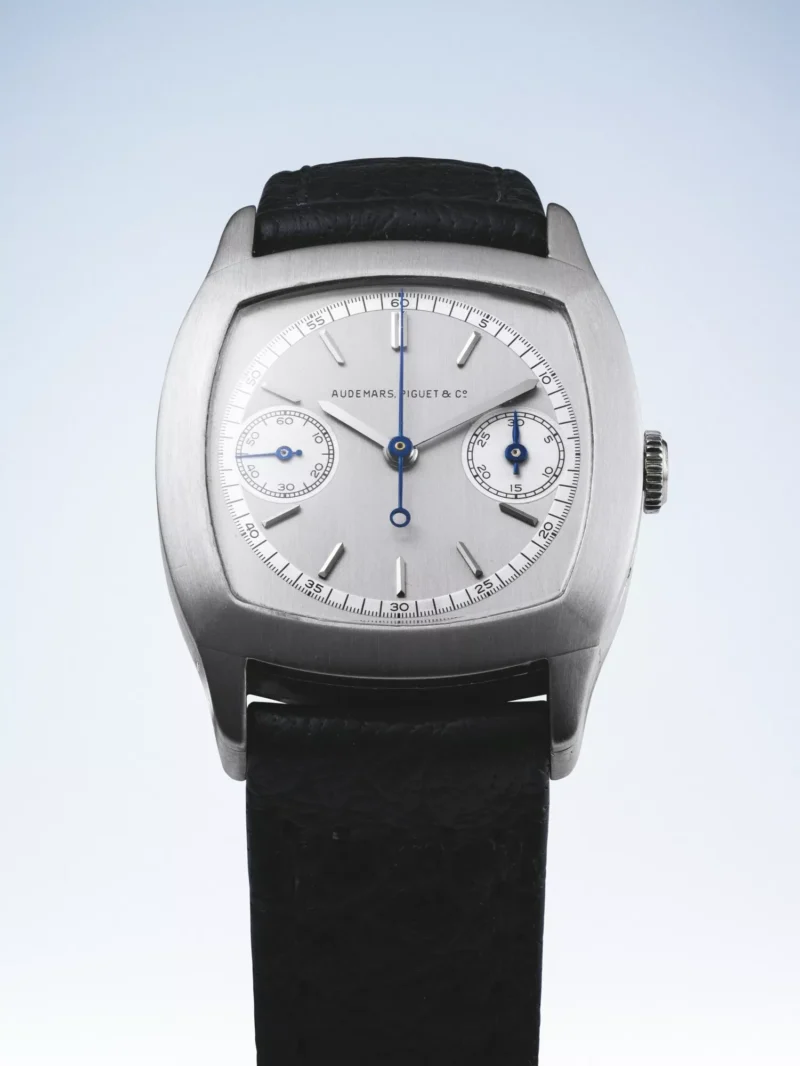
The two Patek Philippe portraits have a useful visual contrast. The steel reference 1436 concentrates its dial around two subsidiary registers and an outer scale. The yellow-gold reference 2497 has a more open centre, with day and month windows above and a moon-phase display below. Both use pale dials and slender hands, but their displays organise attention in different ways.
Lot 95, the steel 1436, is dated 1945 and measures 33mm according to Phillips. The catalogue estimate is CHF2 million to CHF4 million. Those figures place an unusually large expectation around a relatively small object. The watch’s interest begins with the particular combination Phillips documents: a split-seconds chronograph in stainless steel, retaining the configuration described in its archival evidence. The auctioneer identifies it as one of two known surviving examples born in that configuration; that rarity assessment remains attributed to Phillips.
Lot 16, the 2497, is dated 1953, with an 18-carat yellow-gold case measuring 37mm. Its estimate is CHF250,000 to CHF500,000. The dial has a different sort of intimacy. Between the calendar windows and the main maker’s signature appears the name Gumbiner. It is a small addition, easy to miss in a distant view, which opens a second history around the watch.
The Rolex brings another arrangement of information. Phillips dates lot 129 to circa 1952 and gives a 36mm diameter for its yellow-gold case. The current catalogue lists an estimate in excess of CHF600,000. Its star-shaped markers give the face an individual rhythm, while the calendar and moon-phase displays keep the centre busy without turning it into a chronograph. The pleasure of comparing these watches comes partly from seeing three distinct solutions to the problem of fitting useful information into a small circle.
The date behind the watch
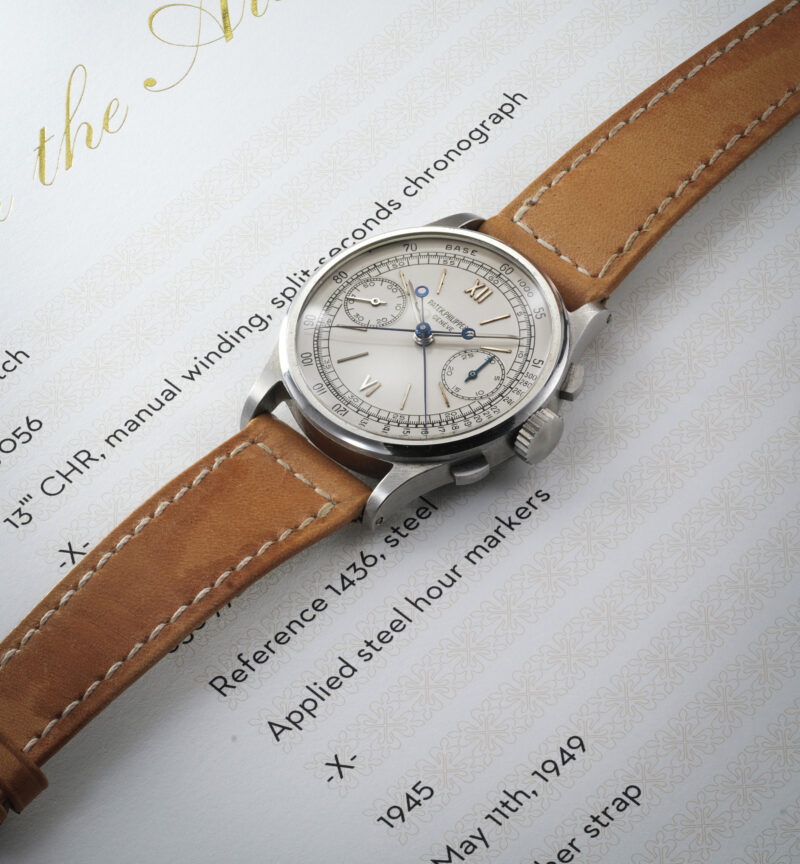
Lot 95 with the archive extract supplied in the catalogue photographs. Photograph courtesy of Phillips.
An archive extract beside the steel chronograph changes the pace of looking. The watch remains a physical object with a dial, a case and a strap; the document introduces a second timescale. Phillips states that the accompanying extract confirms production in 1945 and a subsequent sale on 11 May 1949. Those dates describe separate moments. A watch’s manufacture and its first recorded sale need not fall in the same year.
That distinction is worth holding onto when a catalogue compresses an object’s life into one line. A production year helps place the design. A sale date concerns its passage into commerce. The extract adds documentary detail, but it does not by itself describe every later owner, every intervention or the present state of every component. Each type of evidence answers a particular question.
The photographs offer their own kind of information. The steel case surrounds a closely organised dial; the leather strap brings warmth to the otherwise cool palette. At a larger scale, the viewer can compare the spacing of the registers, the length of the hands and the way the lugs lead towards the strap. These are observations about the images, distinct from a physical examination of the watch.
Phillips makes strong assessments of this example’s preservation in its catalogue essay. Such assessments should be read as the auction house’s account. Surface reflections, colour balance and camera position all influence a photograph. A condition enquiry and an inspection address questions a published image cannot settle, including operation, service history and aspects of a case that are outside the frame. The attraction of the portrait is a beginning to that enquiry.
A small name changes the question
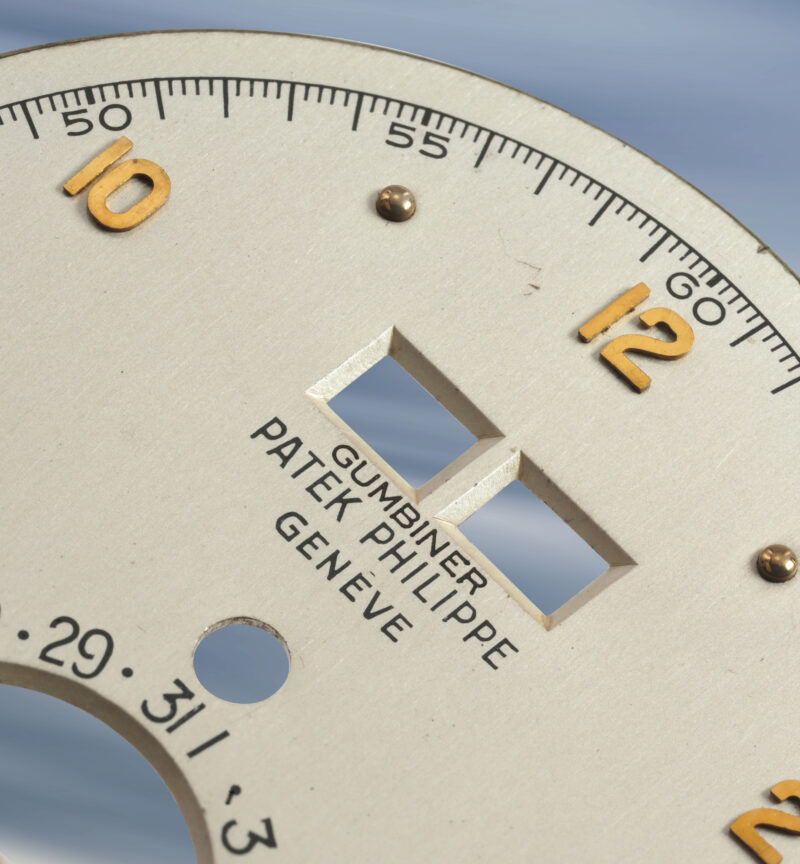
The Gumbiner signature on lot 16, photographed close up. Photograph courtesy of Phillips.
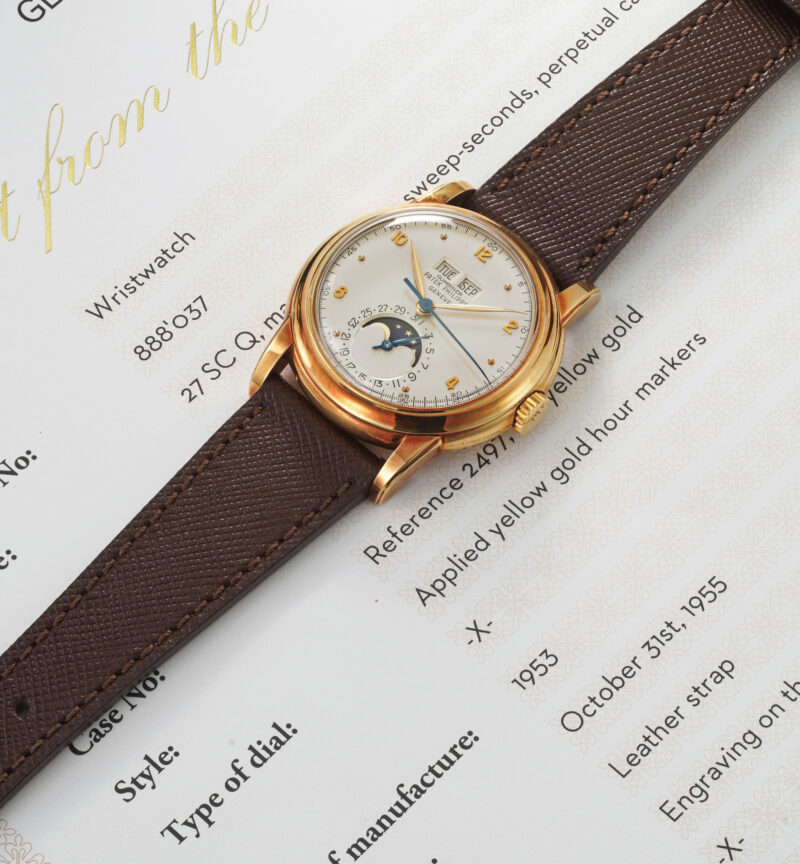
Lot 16 and its archive extract, as photographed for the sale. Photograph courtesy of Phillips.
The close view of the 2497 makes the extra signature legible. Gumbiner sits between the calendar apertures and Patek Philippe’s own name, occupying a small but conspicuous part of the dial. Phillips identifies it as the only known example of the reference bearing the New York retailer’s signature. Here again, the scope matters: it is the catalogue’s statement of what is known, rather than a claim that TheTimeo has independently surveyed every surviving watch.
The accompanying extract confirms production in 1953 and sale on 31 October 1955, according to the lot description. Beside the dial detail, it gives the comparison a useful structure. The photograph shows the additional name as it appears today. The archive record supplies dated information about the watch. The catalogue connects these details to its account of the reference and retailer. The three should be read together, while retaining their different roles.
There is also a visual reason to pause over this dial. Arabic numerals alternate with small round markers; the calendar windows sit high enough to leave a broad area below them; the moon-phase display gathers another set of indications at six. The additional signature enters an already considered composition. It adds narrative without becoming its largest graphic element.
For the Rolex, Phillips recounts acquisition by the consignor from the original Japanese owner. That is a provenance statement supplied by the auctioneer. It deserves attention alongside the visible star dial, but it cannot be deduced from that dial’s appearance. The two forms of interest strengthen a reading of the object when they remain clearly identified: one belongs to what can be seen, the other to the history presented with it.
The evening before the sale
A compelling pre-sale selection can remain specific without pretending to know the result. The steel 1436 raises questions about an uncommon material and the configuration documented with it. The 2497 brings a retailer’s name into a familiar maker’s history. The 6062 combines a distinctive dial with the provenance account offered by Phillips. Each supplies a different reason to spend time with the catalogue.
The live lot pages are the reference for the estimates stated here. Earlier publicity used a bounded range for the Rolex; the current catalogue instead states a figure in excess of CHF600,000. That change is a practical reason to return to the individual lot before the sale. An estimate is also separate from the eventual hammer price and from a buyer’s total invoice. Premiums, taxes and other applicable charges are governed by the conditions of sale.
For now, the most rewarding comparison is close and unhurried: the two registers of the chronograph, the extra name below the calendar windows, the eight small stars around the Rolex dial. Their appeal is already present before a bid is made. The sale will add another dated event to each watch’s story; it will not replace the details that made the objects worth studying in the first place.
Sources & further reading
The Edit
Insights & Investment stories
Selected stories from the same editorial universe.
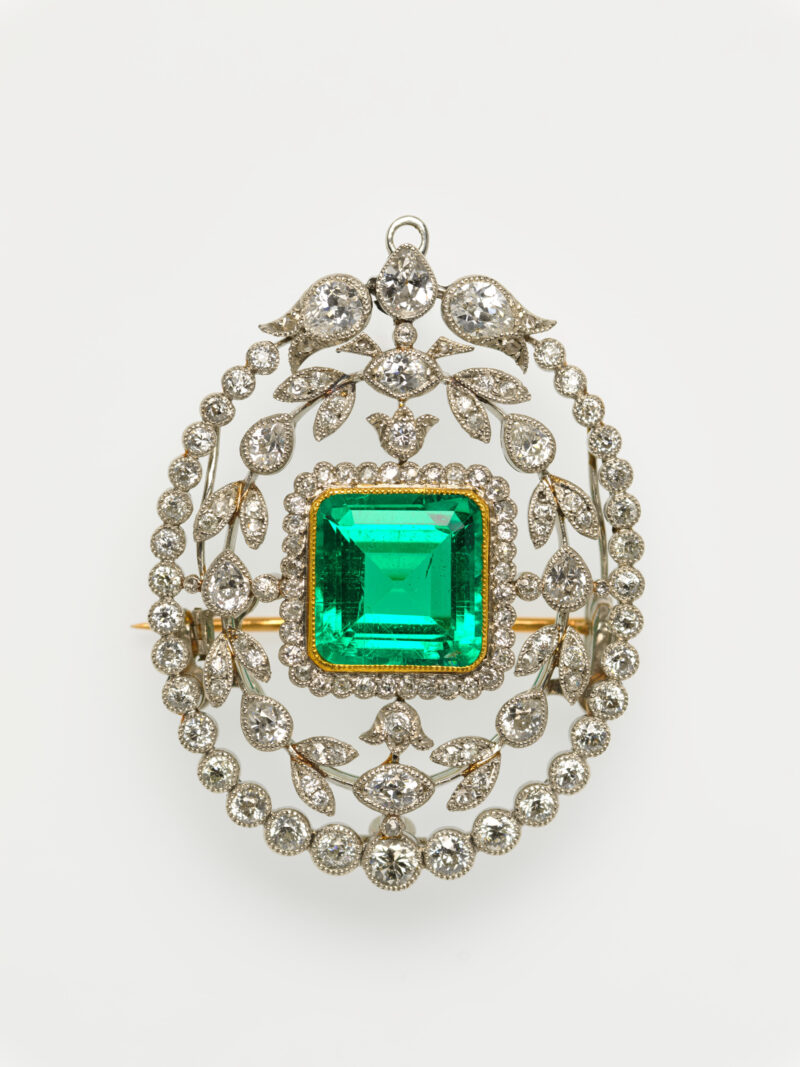
The Emerald Brooch: A Jewel Worth Turning Over
An emerald, a fine platinum framework and the fittings on the reverse: a close
Auction Estimates, Hammer Price and Buyer’s Premium Explained
The fall of the hammer is wonderfully clear; the number that appears afterwards can
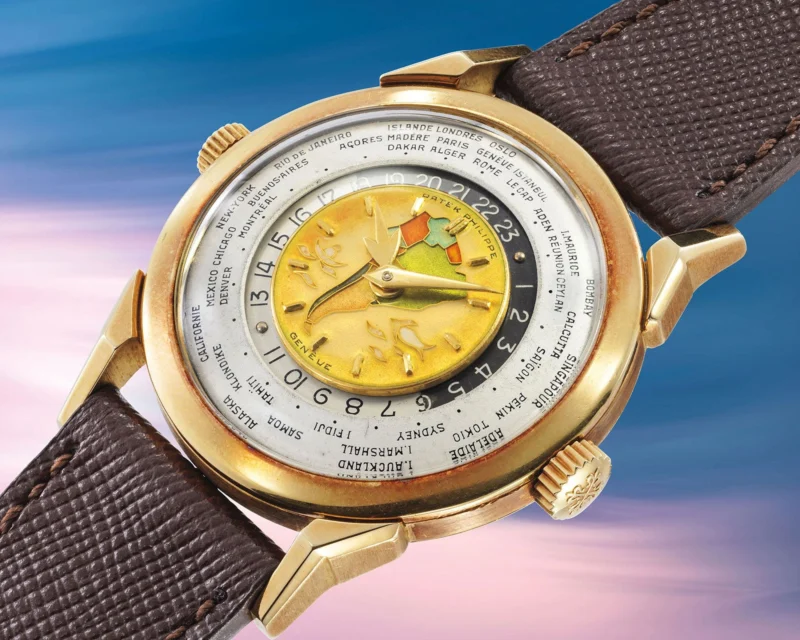
Phillips Geneva Watch Auction XXIII: What the Results Record
Across two days in Geneva, Phillips brought together early independent watchmaking, important Patek Philippe
Christie’s Geneva Watches, May 2026: Reading the Results
Three watches gave Christie’s May sale in Geneva its character: an early F.P. Journe

A Sapphire Report: The Stone and Its Words
A blue sapphire draws the eye before its laboratory reports enter the conversation. A

Queen Mary’s Hennell Necklace: The Meaning of a Second Version
Commissioned from Hennell in 1928, Queen Mary’s cultured pearl and diamond necklace revisits a