
The collector’s eye
A jewel worth
turning over.
An emerald, a fine platinum framework and the fittings on the reverse: a close reading of a brooch the Met attributes, cautiously, to Tiffany & Co.
Discover the story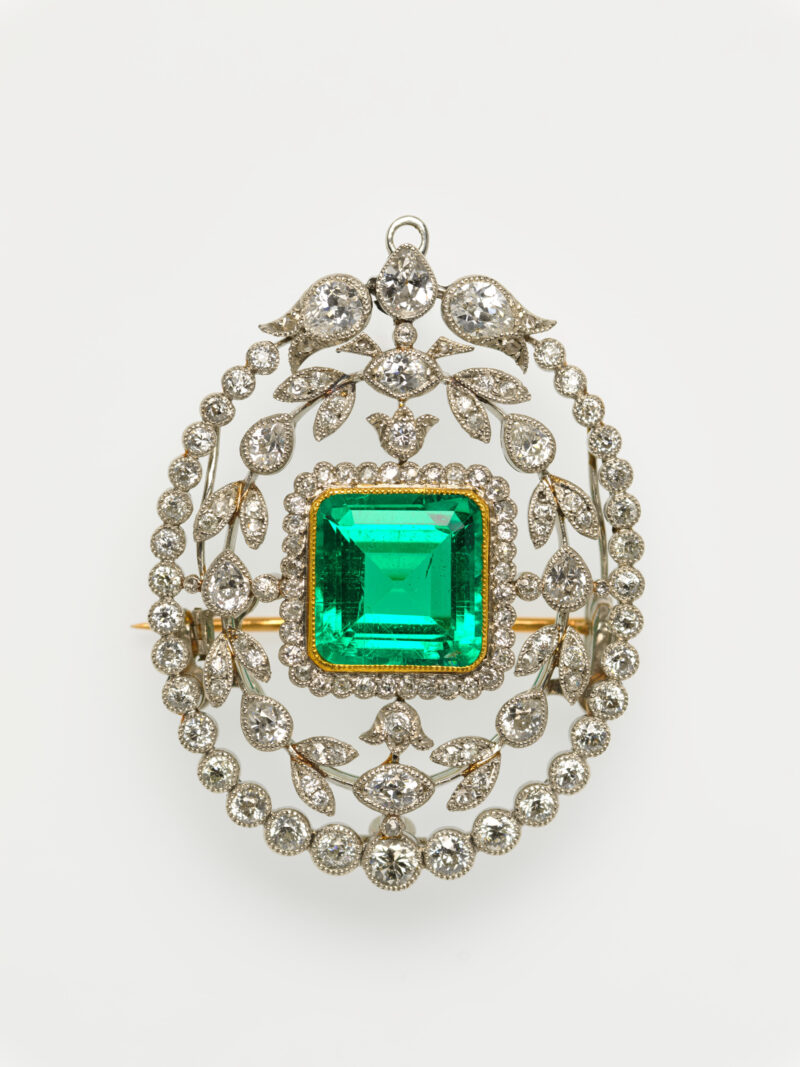
The Met dates this brooch to around 1900 and attributes it to Tiffany & Co. with the qualification “probably”. The Metropolitan Museum of Art, New York.
Inside the story
The emerald catches the eye first. It occupies the centre of a light, open arrangement of diamonds, its straight edges held within an oval of small, glittering forms. Turn the brooch over and another design appears: supports, a long pin and a fitting at the top. The front invites admiration; the reverse makes that admiration more specific.
The Metropolitan Museum of Art dates this American jewel to around 1900 and catalogues its maker as probably Tiffany & Co. That careful attribution belongs beside the emerald, diamonds and platinum whenever the piece is described. Looking closely means enjoying the object and keeping its identity equally clear.
Three ways of looking
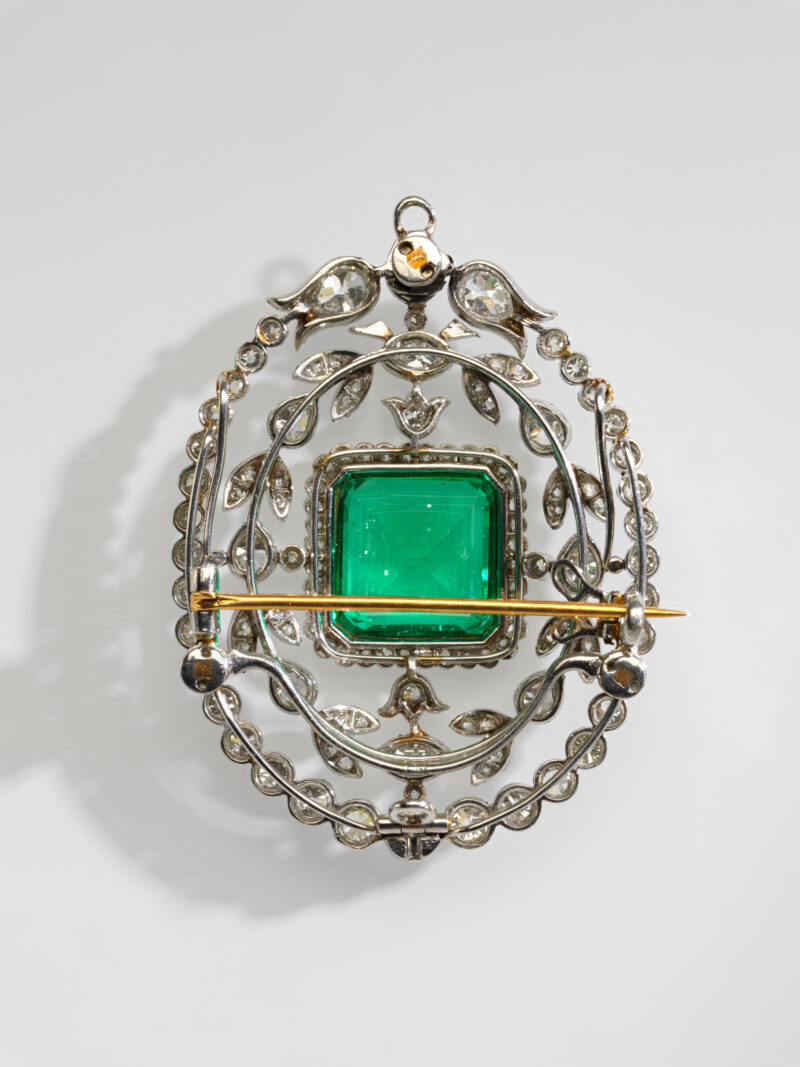
An angled view brings the pin, setting and pendant fitting into the same picture. The Metropolitan Museum of Art, New York.
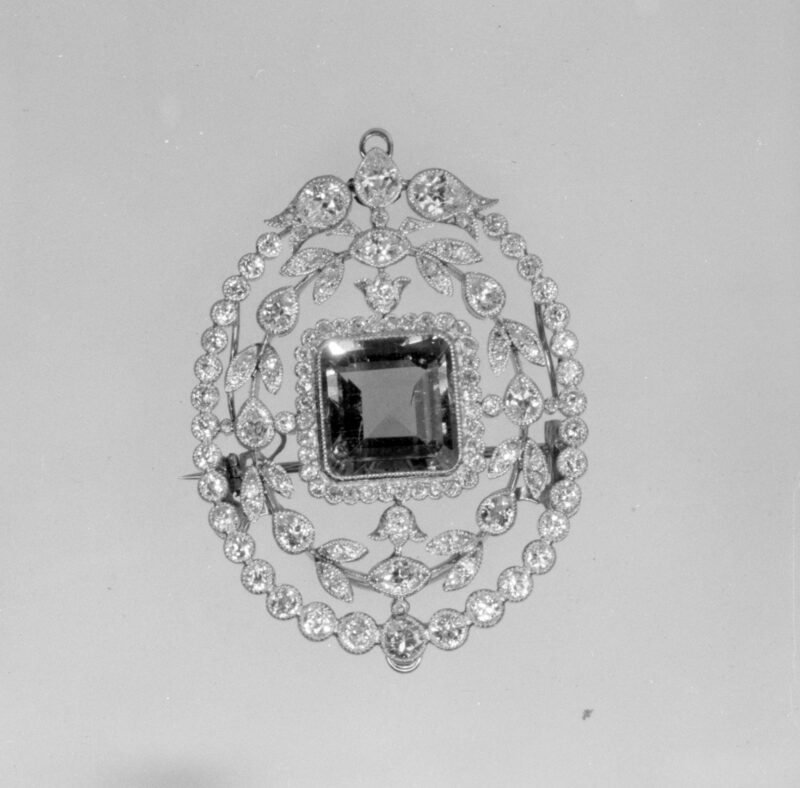
A black-and-white museum photograph emphasises the arrangement of the stones and the oval outline. The Metropolitan Museum of Art, New York.
Begin with the whole jewel, then follow the museum’s photographs towards its reverse. The pin becomes an additional horizontal line across the composition, while the setting around the emerald and the surrounding openwork can be considered together. A black-and-white view gives the front a different visual emphasis, drawing attention to the arrangement rather than the green.
These are useful changes of viewpoint. The photograph that makes a jewel desirable need not answer every question about it. A second image can show how a fastening sits; another can clarify the relationship between the central stone and the surrounding framework. Ask each view to add something, and a small group of photographs becomes a much richer introduction than one repeatedly enlarged front view.
A framework drawn around colour
The centre stone is square in outline, with softened corners and a stepped cut. Around it, the diamonds form two oval frames, interrupted by small, leaf-like shapes and connecting elements. The eye can move from the broad green centre towards finer and finer points of light. That change of scale is part of the brooch’s appeal.
The Met describes thin platinum bezels with millegrain detailing. The word refers to the fine beaded finish along an edge: a small detail that rewards a closer view. Here the lightness of the setting matters as much as the stones. There is air between the elements, allowing the individual forms to remain legible rather than merging into a solid plate.
When comparing jewels of this kind, spend time on those intervals. Look at how much metal is visible, where one element joins another and how the outline returns to the central stone. Describing a piece in those terms gives a conversation with a specialist more substance than a general impression of sparkle. It also makes personal preferences easier to recognise.
The front and the fitting
The picture it presents
The front brings colour, proportion and the rhythm of the diamond garlands together. Its balance can be appreciated before any maker’s name enters the conversation.
The life it allows
The Met records fittings that allow the jewel to be worn as a brooch or pendant. The reverse therefore explains an aspect of its use that a frontal portrait keeps almost hidden.
The importance of one word
The museum’s attribution includes the word “probably”. Its description also states that the brooch is unmarked. Together, those observations make an elegant distinction between a possible maker and a signed piece. They allow the jewel to be discussed with precision while leaving its beauty entirely intact.
For a collector, preserving that wording is a useful habit. If a catalogue says probably, attributed to or in the manner of, carry the phrase into your notes. Keep the source and the object number with it. An attribution can develop as scholarship advances; a personal record is more useful when it preserves the account that was actually available at the time.
The same care applies to other details. The Met lists emerald, diamonds and platinum, but its record is not a new laboratory report on the centre stone. A question about gemstone treatment or origin belongs with an appropriate gemmological assessment. One document may explain construction and attribution beautifully while another answers a different question about the material.
Give the jewel a place in your notes
The museum records a width of 4.4 centimetres and a height of 3.2 centimetres. Those measurements return the enlarged photographs to the scale of a small object. Imagine that span against a lapel or on a chain, rather than allowing the size of a screen to determine the impression of weight and presence.
A useful private record can be equally concise: an overall photograph, a reverse view, dimensions, a description of the materials and the exact wording of the attribution. Add the catalogue reference and any subsequent specialist correspondence. Keep copies together so that the next conversation begins with the same object, rather than a shortened version of its story.
The Met’s accession number is 53.153.1, and its credit line records the gift of Susan Dwight Bliss in 1953. The accession reference gives this particular brooch a stable identity within a much larger collection. For a private owner, a consistent personal inventory number can serve a similar organising purpose without pretending to replace a maker’s number or an expert opinion.
Keep looking after the first impression
The pleasure of this brooch begins with green held inside a bright, delicate oval. It grows when the eye finds the small beads on an edge, the spaces between the diamonds and the practical arrangement of the back. Each detail makes the jewel less interchangeable.
That is an appealing way to collect: let the first response bring you closer, then give the object enough attention to understand what you are seeing. A considered description, a useful photograph and a carefully preserved attribution become part of living with the piece. The next time you admire a brooch, ask to see its other side.
Sources & further reading
- The Metropolitan Museum of Art: object record and curatorial account.
- The Met: collection data and image record.
Last verified:18 October2026. Photographs: The Metropolitan Museum of Art, New York.
The Edit
Further discoveries
Objects, makers and the questions worth asking.
Inside a Gold Roskell: The Date in the Case
A richly worked gold dial, an engine-turned back and a signed movement: a Robert
A Name on the Dial: Looking Closely at a Skeleton Watch
A gold skeleton watch, a visible mechanism and a famous name: the Met’s attribution
Market Price Is Not One Number: Seven Values, Seven Different Jobs
Retail, asking price, estimate, hammer, premium-inclusive result, dealer offer and insurance value answer different
The TheTimeo Provenance Standard: What Should Travel With an Object
A collectible object needs more than a pile of accessories. Identity, ownership, service, condition,
How to Audit a Luxury Watch Listing: Nine Details That Matter
Before judging price, audit the listing: identity, configuration, condition, service, documents, photography, seller claims,
How to Read a Jewellery Auction Lot: Five Separate Lines of Evidence
A laboratory report, maker’s mark, condition note, repair record and provenance answer different questions.