Insights & Investment
Buying Watches at Auction: From Preview to Paddle
How to prepare for a watch auction: choose the sale format, examine the lot, confirm registration and set a limit that includes the costs beyond the bid.

THE WATCH FIRST. The paddle afterwards.
The excitement belongs in the room. The questions, the paperwork and the spending limit belong in place before you raise your hand.




The moment before the bid
There is a particular pleasure in an auction preview: a watch you have only seen in books or on a screen is suddenly within reach. The dial has depth, the case has edges, and a description becomes an object. Give that moment its proper place. It can make you want the watch more, or reveal that the idea of owning it was stronger than the attraction to this example.
The sale is a separate stage. Before bidding, you need to know what is being offered, which terms apply and what the purchase would cost beyond the amount you call out. Preparation does not remove the pleasure. It lets you enjoy the room without allowing its pace to set your budget.
“Boutique auction” is not a sufficiently precise description to organise a purchase around. Ask for the actual sale format and governing documents. A smaller audience does not, by itself, mean privileged access to new releases or an opportunity to buy before a watch reaches the public market.
Live auction
Phillips describes in-person, online, absentee and telephone participation in its live sales. Choose the method before the day and confirm approval for that sale. Watching the stream and being authorised to place a bid are different things.
Timed online sale
Read the sale-specific rules for placing bids and closing times. Confirm the time zone and how the platform handles the end of bidding. Do not assume that the process is identical to a live auction simply because both can be accessed on a screen.
Private sale
Phillips also operates Perpetual, a separate year-round shop platform. An enquiry or listed asking price there should not be confused with an auction estimate. Our private-sales guide considers that route on its own terms.
Preview or exhibition
Confirm that your chosen lot is available to inspect. Phillips’ Geneva online conditions say that online-only lots are not available for viewing unless indicated otherwise. A preview may show only a selection; obtain confirmation before booking travel around one watch.
Start with the particular example
Write down the auction house, sale, lot number and catalogue description together. A favourite reference is the start of an enquiry, not the end of it. Ask what accompanies this watch and which details remain uncertain. Keep photographs, reports and correspondence associated with the correct lot; a similar-looking example from another sale is not a substitute.
Phillips’ Hong Kong watch buyer’s guide encourages prospective buyers to inspect and explains that condition reports are not exhaustive. Treat the report as a basis for questions. If an issue matters to your decision, ask specifically about it rather than taking silence as reassurance. Where necessary, consider an appropriately qualified independent adviser before bidding.
At a preview, examine the watch only as permitted by the staff. Ask for help with handling, operating or opening anything. You are there to understand the example, not to perform an improvised service inspection. Note what you observed, what the specialist explained and what has not been established. Those are three different kinds of information.
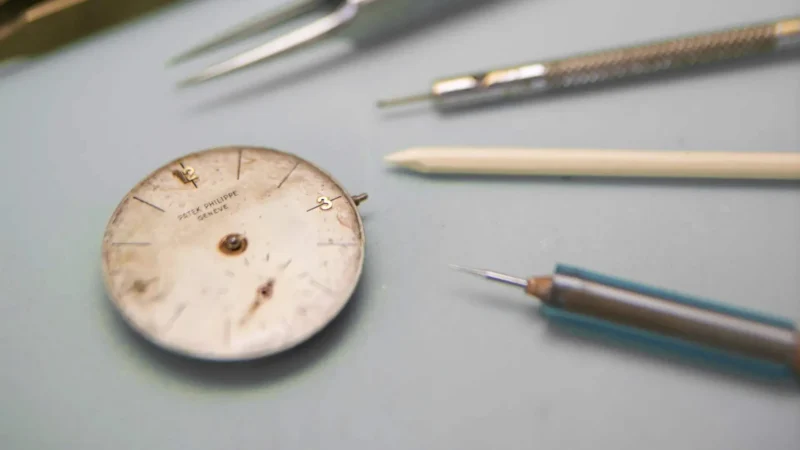
The photographs accompanying this guide are illustrative images published by Phillips, not the lots offered in a particular forthcoming sale. Their variety is the point: a shaped case, an unusual dial or a movement visible through the face calls for different questions. None of the captions implies current availability or a condition assessment.
01 — The lot
Save the precise catalogue entry and request the documents that matter to you. Confirm the stated contents: watch, bracelet or strap, box, papers and any other accessories. Ask about omissions instead of filling them with assumptions.
02 — The terms
Read the conditions attached to that sale, together with its notices and lot symbols. Jurisdiction and format matter. If a provision is unclear or material to your purchase, ask the auction house for clarification and seek appropriate professional advice.
03 — The viewing
Confirm whether the actual lot can be inspected, whether an appointment is needed and which location holds it. If you cannot attend, ask what additional images or information can be supplied. Decide whether the remaining uncertainty is acceptable before placing a bid.
04 — The registration
Complete the sale registration and any requested identity checks early enough for approval. Confirm the bidding method and contact details. A user account, an email subscription or a preview invitation should not be treated as evidence of bidding approval.
05 — The full cost
Work backwards from the amount you are prepared to spend in total. Ask about buyer’s premium, applicable taxes and any additional charges, then establish shipping, insurance or collection costs for your circumstances. Keep that calculation distinct from the hammer-price limit.
06 — The follow-through
Before the sale, confirm payment deadlines, accepted methods and the process for release and collection. Plan where the watch will go afterwards. If you are bidding remotely, have the official contact details available without relying on a message arriving during the sale.
Set a limit while the room is quiet
Phillips’ watch buyer’s guide distinguishes the hammer price from the total purchase price and says that estimates exclude premium and applicable taxes. Do not use the upper estimate as shorthand for the amount you would pay. Nor is an estimate a promise of the result. Build your own limit from the sale’s current charges and the amount you are willing to commit.
Use two figures in your notes: the total spending ceiling and the corresponding maximum bid. If there are several lots on your shortlist, decide what happens if you win the first. You may need a combined limit as well as a limit for each watch. Resolve that before a second attractive lot appears.
Leave room for the ownership you actually intend. If a service assessment, a suitable strap or secure delivery will be necessary, allow for it in the decision. This is budgeting advice, not a prediction of a watch’s future value. Buying within a considered limit does not establish that the object will appreciate.
A written limit is useful only if you are willing to stop at it. Losing a lot can be disappointing, but it is not a reason to change the purpose of your collection halfway through the sale. There will be other objects to examine; there is no obligation to leave this room with one.
Choose the bidding method you can manage
On its buying page, Phillips explains that an absentee bid sets a pre-submitted maximum; a telephone representative bids live with the client. It also provides online participation and advance registration for a paddle. Confirm what is available for your sale and which instructions the house needs. Do not assume that every lot supports every method.
For remote bidding, use the official platform and check your device and connection beforehand. Find the sale, confirm your registration status and locate the relevant lot. Familiarise yourself with the difference between following a lot and entering an offer. If you are unsure about an action on the screen, resolve it with the house before the sale is under way.
Be careful with labels that sound like preferential treatment. Phillips’ current buying page explicitly excludes watch auctions from its priority-bidding programme. An early registration or maximum bid therefore should not be presented as a route to a watch-specific priority benefit. Read the rule for the exact category, not merely the programme’s headline.
If you choose to attend in person, settle the administrative questions beforehand and give yourself time to find the room. Once bidding begins, keep the catalogue entry and your limit in view. The gesture is simple; the decision behind it should already have been made.
01Does a low estimate make a watch a bargain?
No. An estimate guides a sale; it is not the full purchase cost or a guarantee of the result. Assess the actual example and calculate the total you would pay. Decide whether that purchase suits you without relying on a future resale claim.
02Can I assume an online lot has a physical preview?
No. Check the particular sale’s viewing details and confirm your lot with the department. If inspection is unavailable, ask for the information you need and decide whether you are comfortable proceeding. You can choose not to bid.
03What should I keep after buying?
Retain the invoice, catalogue entry, condition report, relevant correspondence and delivery or collection records. Record what accompanied the watch on receipt. If a discrepancy arises, contact the auction house promptly through verified details; the applicable sale terms govern the process.
After the room has emptied
Follow the official invoice and collection instructions, and verify unexpected payment communications through a known contact. Arrange delivery and cover appropriate to your circumstances rather than assuming that winning the lot has settled the journey home.
Then return to the watch. The best reason to have prepared is not a tidy folder, although the folder matters. It is the chance to enjoy the object you chose, knowing that the pace of the auction did not choose it for you.
Sources & credits
Sources & further reading
Reviewed on 13 September 2026. Phillips’ current buying page and watch department were checked directly. The Hong Kong watch buyer’s guide is effective 12 April 2026; the Geneva online watch conditions provide a separate, format-specific example. These documents are not interchangeable terms for every auction. No fee schedule, legal warranty summary or claim of pre-market access is reproduced.
- Phillips — How to Buy
- Phillips — Hong Kong watch buyer’s guide, effective 12 April 2026
- Phillips — Geneva online watch auction conditions
- Phillips — Watches department
Photographs were downloaded directly from the official publishers; original files, source pages and verification hashes are recorded with the media. They illustrate the guide, not an offer of sale or a promise of access. The practical questions and recommendations are TheTimeo editorial method. No investment-return forecast or preferential allocation claim is made.
Admire the watch without asking the auction to make the decision for you.
TheTimeo — editorial bidding principle
Further stories from this world

Insights & Investment
The TheTimeo Provenance Standard: What Should Travel With an Object

Insights & Investment
How to Audit a Luxury Watch Listing: Nine Details That Matter

Insights & Investment
Auction Estimates, Hammer Price and Buyer’s Premium Explained

Insights & Investment