
TheTimeo / Insights & Investment
SELLING A WATCH:
trust, layer by layer
A trusted sale is a chain of five separate checks: authentication, condition, valuation, logistics and market exposure.
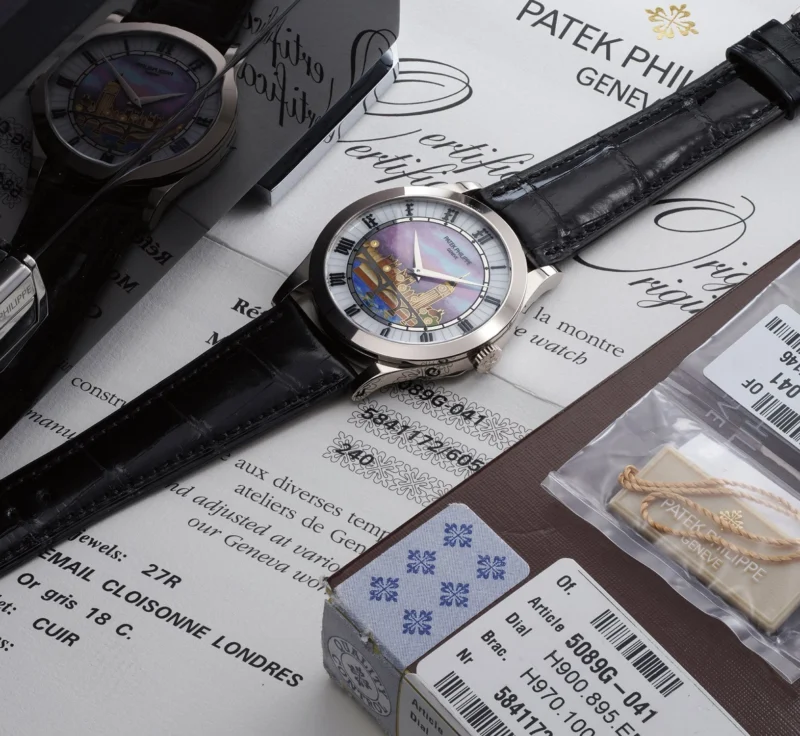
Patek Philippe wristwatch presented with its documentation. Courtesy of Phillips.
Explore the story
The word trusted appears everywhere in the resale market. Trusted seller. Trusted platform. Trusted valuation. Trusted shipping. Trusted authentication.
That language can be comforting, but it can also hide the question that matters most: trusted to do what?
A watch can be authenticated and still be badly described. It can be accurately described and still be sent under transport terms the owner has not understood. It can carry a sensible auction estimate and still reach the wrong audience. It can appear on a reputable platform while the seller remains unclear about returns, payment timing or what happens if the watch fails an inspection.
This is why TheTimeo treats resale trust as five separate jobs rather than one badge.
Authentication. Condition. Valuation. Logistics. Market exposure.
Each layer answers a different question. Each can fail independently. A strong selling process makes the scope of each one visible before the watch leaves the owner’s control.
Key takeaways
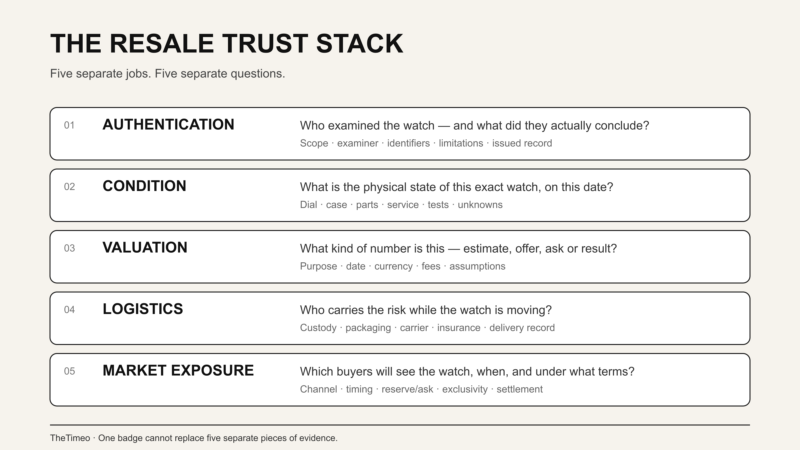
Authentication, condition, valuation, logistics and market exposure are separate jobs.
- Authentication should identify who examined the watch, what was examined and what the conclusion does not cover.
- Condition is a dated description of the object now. It should not be replaced by words such as “excellent” or “mint”.
- A valuation only makes sense when its purpose is named: auction estimate, dealer offer, asking price, insurance value and completed sale are different numbers.
- Declared carrier value is not automatically shipping insurance. The transport contract and any separate insurance policy must be read as separate documents.
- Market exposure is a selling decision. Auction, private sale, dealer purchase and marketplace listing create different kinds of buyer access, timing and price discovery.
- A lost-or-stolen database search can be useful, but it answers a status question; it should not be written as if it were a complete authentication or title guarantee.
Trust is a chain, not a logo

Historical archive books used to document Patek Philippe watches. Courtesy of Patek Philippe.
Imagine an owner preparing to sell a watch acquired fifteen years ago.
The watch has its box and warranty card. It was serviced once, although the owner has only an invoice with a short description. A dealer has given an indicative figure by email. An auction house has offered a higher estimate. A marketplace promises authentication for eligible transactions. A courier allows a declared value to be entered when the label is created.
None of those facts is useless. None of them, alone, describes the whole transaction.
The most common confusion comes from allowing one layer to stand in for another. A warranty card becomes “proof of provenance”. An authentication badge becomes a warranty of mechanical performance. A high auction estimate becomes an expected net payment. A declared shipping value becomes “insured”. A large online audience becomes assumed liquidity.
The five-layer method is designed to stop those substitutions.
For an owner, the practical question is not “Which company should I trust?” It is: what evidence do I receive at each stage, and what happens when that evidence is incomplete?
Layer 1 — Authentication: who is saying what?

A watch undergoing inspection within the Rolex Certified Pre-Owned programme. Courtesy of Rolex.
Authentication is strongest when the scope is narrow and explicit.
Rolex’s Certified Pre-Owned programme is a useful example because the manufacturer states exactly what its own process means. Rolex says watches in the programme return to its workshops, where their original configuration is checked and the watch is authenticated; qualifying watches are also serviced, tested and supplied with a two-year international guarantee and programme documentation.
That is a manufacturer-backed process for watches inside the Rolex Certified Pre-Owned programme. It should not be stretched into a general statement about every pre-owned Rolex on the market.
A third-party platform can define a different scope. eBay’s current Authenticity Guarantee for eligible watches says its authentication partner checks the watch against the listing and performs a physical authentication inspection. The same terms also state important limits: the authenticator does not verify timekeeping accuracy, does not test waterproofing and does not authenticate aftermarket provenance documentation. eBay also states that the programme is not affiliated with or endorsed by the brands sold on the platform.
Those limitations are not weaknesses. They are useful because they tell the buyer and seller what the service is actually doing.
TheTimeo would rather see a precise scope than a broad promise.
Before handing over a watch, ask:
- Who performs the authentication?
- Is the examiner the manufacturer, an authorised service network, an auction specialist, a platform-appointed third party or another specialist?
- Is the case opened?
- Are movement and case identifiers checked?
- Are replacement, service or aftermarket parts identified?
- Is the conclusion about the entire watch or only about selected components?
- Are papers and accessories checked for consistency, or independently authenticated?
- Is mechanical performance part of the examination?
- What document, report, card or digital record is issued afterwards?
- What happens if the examiner cannot reach a conclusion?
The answer should not be reduced to a green tick.
A stolen-status search is a different check
Ownership risk sits close to authentication, but it is not the same thing.
Enquirus, a Richemont initiative, allows owners and industry users to register watches and jewellery by serial number, report items lost or stolen and search the database when considering a pre-owned item. Cartier links to Enquirus from its own service pages and recommends registration for its creations.
A dated database search can therefore be useful evidence that a serial was or was not returned as reported lost or stolen in that database at that time.
It does not follow that a negative search proves authenticity, complete ownership history or clean legal title. That is a broader conclusion than the search itself supports.
Record the database used, the identifier searched, the date and the result. Keep the wording as narrow as the evidence.
Layer 2 — Condition: what, physically, is being sold?
Rolex Certified Pre-Owned watch and programme seal. Courtesy of Rolex.
Authentication answers whether a watch is what it is represented to be within a stated process. Condition answers a different question: what has happened to this particular object?
The distinction matters because genuine watches can contain later service parts, refinished cases, replaced hands, repaired bracelets, changed crystals or movement components that have been renewed during maintenance.
A useful condition record is component-specific and dated.
Christie’s describes its condition reports as specialist descriptions of an object’s physical state and notes that they may discuss damage, restoration and repair. Its watch-sale terms also warn that a condition report may not identify every mechanical replacement or defect and that lots are sold in their existing condition.
A current Christie’s watch lot makes the point clearly. The report identifies a service dial and hands, notes wear to the case and bracelet, states that the movement was running when catalogued, and separately says it had not been tested for accuracy. That is far more useful than the phrase “very good condition” on its own.
For a resale file, ask for the same kind of separation:
Dial and hands: surface, printing, lume, replacements, restoration. Case: scratches, dents, corrosion, refinishing, engraving, geometry. Bezel and crown: present configuration, replacement evidence, damage. Movement: calibre, visible condition, service evidence, current function tests and limits. Bracelet or strap: reference, clasp, links, stretch, repairs, replacements. Water resistance: only a current test can support a current performance statement.
Cartier’s own care guidance notes that water-resistance seals deteriorate with age and recommends regular checks. That is a useful reminder: a historic factory rating is not the same thing as a current pressure-test result.
If a seller says “recently serviced”, the next question is simple: by whom, when, and what was done?
The invoice matters. So do the parts and decisions behind it.
Layer 3 — Valuation: which number is this?
Owners often reach the resale market by asking, “What is my watch worth?”
The better question is, “What kind of number have I been given?”
TheTimeo’s separate price taxonomy distinguishes retail, asking price, auction estimate, hammer price, premium-inclusive result, dealer offer and insurance value. The point is not academic. A seller can receive several different figures for the same watch within the same week and each may be reasonable for its purpose.
Christie’s online estimate service, for example, describes its auction estimates as provisional opinions for considering a possible consignment. It explicitly says an estimate is not a prediction or guarantee of the eventual selling price. If a consignment proceeds, seller commission and other terms are dealt with separately.
A dealer acquisition offer answers another question: what that buyer is prepared to pay under its own commercial model, at that moment, for that watch.
An asking price answers what a seller wants to receive before negotiation or transaction costs.
None should quietly become “market value” without explaining the basis.
Before relying on a figure, record:
- issuer;
- date;
- currency;
- exact label used;
- whether the watch was examined physically or only from images;
- assumptions about condition, provenance and accessories;
- whether fees or tax are included;
- how long the figure is intended to remain relevant;
- whether the figure is an estimate, offer, asking price or completed transaction.
For an owner choosing a selling route, the useful comparison is often not “Which number is highest?” It is which route produces the clearest expected outcome after its conditions, costs, timing and uncertainty are understood.
Layer 4 — Logistics: trust while the watch is moving
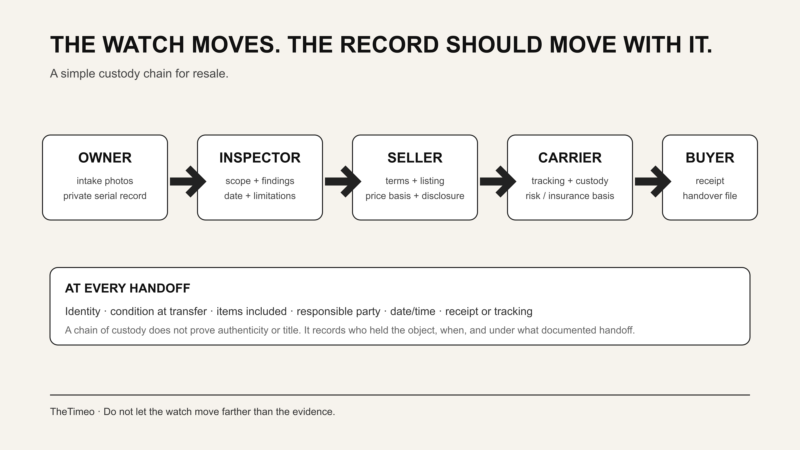
The watch moves; its record should move with it.
A sale can be carefully researched and still fail during the least glamorous part of the process: custody.
The watch may travel from owner to dealer, auction house, authenticator, photographer, bonded storage, buyer or service centre. Every handoff creates a period in which the object and the record need to stay together.
Start with an intake record before dispatch:
- date and time;
- watch identity and private serial record;
- photographs of front, back, sides, clasp and accessories;
- visible pre-existing damage;
- list of every item inside the package;
- packaging method;
- carrier and service level;
- tracking reference;
- recipient and delivery instructions;
- declared value and separate insurance basis, if any.
One distinction deserves particular attention. FedEx states plainly that declared value is not shipping insurance. It describes declared value as the maximum liability it assumes in connection with a shipment, subject to its terms, proof requirements and exclusions. FedEx separately discusses insurance obtained from an insurance agent or broker.
That is not a reason to avoid a carrier. It is a reason to read the words on the contract.
High-value watches can also fall under special carrier programmes, account qualifications, destination limits or commodity restrictions. Those rules change. A seller should not copy a shipping method from a forum post and assume the same protection applies to another account, country or value.
Ask the selling intermediary in writing:
- Who owns the risk while the watch is in transit?
- Who arranges the shipment?
- What exactly is insured, by whom and from when to when?
- Are there value, route or packaging conditions?
- Does cover continue while the watch is stored, inspected or photographed?
- Is signature delivery required?
- What happens if customs holds the package?
- Who files a claim if the package is lost or damaged?
The right answer depends on the transaction. The important part is that the answer exists before the package moves.
Layer 5 — Market exposure: who will actually see the watch?
A selling channel does more than display a price. It decides which buyers encounter the object, when they see it and under what terms.
Auction houses make this explicit in their seller material. Phillips says specialists discuss timing, location and whether auction or private sale is the more appropriate route. Sotheby’s similarly describes a process in which an accepted object is researched, catalogued, photographed and marketed before the sale. Christie’s offers both auctions and private sales for watches.
Those are different forms of exposure.
A dealer purchase may provide speed and price certainty, but the watch is bought by one professional counterparty rather than exposed to open bidding.
Consignment can provide specialist presentation and an existing client network while leaving the owner exposed to time-to-sale, exclusivity and agreed commission terms.
An auction creates a defined sale date and competitive bidding environment, but the result depends on catalogue placement, estimate, reserve, bidder interest and the specific sale.
A marketplace can create wide digital visibility and direct seller control, while making listing quality, response handling, payment, authentication and returns more central to the owner’s work.
The point is not to crown one route the winner.
Ask each route the same questions:
- How will the watch be presented?
- Where will it appear?
- Which buyers are realistically reached?
- Is there a fixed sale date or open-ended listing period?
- Is the arrangement exclusive?
- Who controls the asking price, estimate or reserve?
- Can the seller accept or reject offers?
- What marketing is included?
- What information will the seller receive about interest or bids?
- When can the watch be withdrawn, and at what cost?
- When and how is the seller paid?
A large audience number is not enough. What matters is whether the right buyers can evaluate the object with enough evidence to act.
Where the five layers fail
The five checks become most useful when something looks reassuring but is incomplete.
Explore the comparison
| Situation | What looks reassuring | What is still missing |
|---|---|---|
| Watch passes a platform authentication | authentication badge | timekeeping, water resistance, provenance-document scope and any exclusions |
| Watch has box and warranty papers | “full set” | complete ownership history, current condition and component history |
| Auction house gives a strong estimate | high estimate | reserve, seller terms, actual bidding and net proceeds |
| Courier label carries a high declared value | large number on shipment | whether separate insurance exists and which risks the carrier contract excludes |
| Lost/stolen database returns no match | negative search | authenticity, title and the possibility of records outside that database |
| Marketplace has millions of users | broad reach | whether the listing reaches qualified buyers for this reference at this price |
| Watch is described as “excellent” | positive adjective | dated component-by-component observations and photographs |
None of these situations automatically means a problem exists. They mean the next question has not yet been answered.
The evidence an owner should request
A clean resale file can be surprisingly compact.
Authentication file
Keep the examiner’s identity, date, watch identifiers, scope, conclusion, limitations and any issued report or card. If the service is platform-specific, save the programme terms that applied at the time.
Condition file
Keep dated high-resolution photographs, a component-level condition description, service documents and any current test results. Record what was not examined.
Valuation file
Keep every figure with its label, date, currency, assumptions and fee basis. Do not overwrite an earlier estimate when a later offer arrives.
Logistics file
Keep the dispatch inventory, photographs, shipping label, tracking, signed delivery record, insurance certificate or policy evidence where applicable, and any claim instructions.
Market-exposure file
Keep the consignment or sale agreement, channel, estimate or asking price, reserve where relevant, duration, exclusivity, fees, withdrawal terms, marketing commitments and settlement terms.
That file is useful even if the sale never happens. It tells the owner what was offered, what was checked and what remains unresolved.
A 15-minute pre-sale audit
Before accepting a consignment, shipping label or marketplace workflow, an owner can run a short audit without pretending to become a watch specialist.
Put the watch on a table with its documents. Write the exact reference and the full serial in a private note. Photograph the watch and everything that will travel with it. Then place the proposed seller, auction house or platform terms beside that record.
Ask five questions and write the answer in one sentence each.
Authentication: Who will physically inspect this watch, and what will their conclusion cover?
Condition: What dated description will exist after inspection, and will replacements, refinishing or functional limits be recorded?
Valuation: Is the number on the page an estimate, an offer, an asking price or something else, and what costs sit outside it?
Logistics: From the moment the parcel leaves, who bears the risk and which document proves the transport or insurance arrangement?
Exposure: Where will the watch actually be offered, for how long, and under what price, reserve, exclusivity or withdrawal terms?
If one answer depends on a phone conversation, ask for it in writing. If one answer is “we will know after inspection”, record that as the current state rather than filling the gap.
This exercise is deliberately modest. It will not authenticate a watch or predict a sale. It does something more practical: it shows which promises have already become evidence and which are still only promises.
A route should earn trust layer by layer
A reputable company can perform several of these jobs well. That still does not make the jobs interchangeable.
A manufacturer may offer the strongest possible authentication within a defined certified programme but may not be the owner’s selling route. An auction house may combine specialist examination, valuation, logistics and market exposure while still making clear that condition reports have limits. A marketplace may insert an independent authentication step yet leave service history and provenance-document analysis outside that scope. A dealer may give a fast executable offer without exposing the object to competing bidders.
Those differences are not defects. They are the shape of the market.
For an owner, trust becomes easier to judge once it stops being a feeling and becomes a set of documents:
Who checked the watch? What condition was recorded? What number was quoted? Who carries the risk while it moves? How will buyers see it?
If those five answers are clear, the selling decision becomes calmer. If one is missing, the right response is not suspicion. It is a specific follow-up question.
That is a much more useful form of trust than a badge on its own.
Sources & further reading
This article was checked on 5 September 2026 against Rolex’s official Certified Pre-Owned certification-process documentation; eBay’s current Authenticity Guarantee terms for watches; Enquirus’ official registration, lost/stolen and search documentation; Cartier’s official watch-service and Enquirus guidance; Christie’s current condition-report guidance, online auction-estimate terms and watch-sale material; Phillips’ current seller guidance; Sotheby’s July 2026 seller guide; and FedEx’s current declared-value guidance.
Programme eligibility, fees, shipping limits, insurance terms, auction terms and marketplace rules can change. The applicable contract for the specific transaction controls. This article is an editorial decision framework, not authentication, valuation, legal, insurance or shipping advice.
The Edit
Insights & Investment stories
Selected stories from the same editorial universe.
How to Audit a Luxury Watch Listing: Nine Details That Matter
Before judging price, audit the listing: identity, configuration, condition, service, documents, photography, seller claims,

Rolex GMT-Master II: a closer look
Beyond the bezel colour: understanding GMT-Master generations, original components, service history and the documents

Omega Speedmaster: originality, service and the watch you wear
A replacement dial or bracelet can change a vintage Speedmaster’s appeal. How to understand
Auction Estimates, Hammer Price and Buyer’s Premium Explained
The fall of the hammer is wonderfully clear; the number that appears afterwards can
How to Read a Jewellery Auction Lot: Five Separate Lines of Evidence
A laboratory report, maker’s mark, condition note, repair record and provenance answer different questions.

Watch Documents and Provenance: Build the File, Test the Claims
A watch can become more captivating when its past comes into focus. An archive